


Global Condensed Whey Market Size, Share, And Enhanced Productivity By Product (Plain, Sweetened, Acid), By Type (Sweet Condensed Whey, Unsweetened Condensed Whey), By Source (Cow's Milk, Goat's Milk, Sheep's Milk), By Fat Content (Full-Fat Condensed Whey, Low-Fat Condensed Whey, Non-Fat Condensed Whey), By Functionality (Emulsifier, Stabilizer, Water Binding Agent, Gelling Agent, Thickener), By Application (Food and Beverage (Dairy Products, Bakery Products and Confectionery, Sauces, Soups, and Dressings, Jams and Jellies, Meat Products), Animal Feed, Others), By Region and Companies - Industry Segment Outlook, Market Assessment, Competition Scenario, Trends, and Forecast 2026-2035
- Published date: March 2026
- Report ID: 182655
- Number of Pages: 317
- Format:
-
keyboard_arrow_up
Quick Navigation
- Report Overview
- Key Takeaways
- By Product Analysis
- By Type Analysis
- By Source Analysis
- By Fat Content Analysis
- By Functionality Analysis
- By Application Analysis
- Key Market Segments
- Driving Factors
- Restraining Factors
- Growth Opportunity
- Latest Trends
- Regional Analysis
- Key Players Analysis
- Recent Developments
- Report Scope
Report Overview
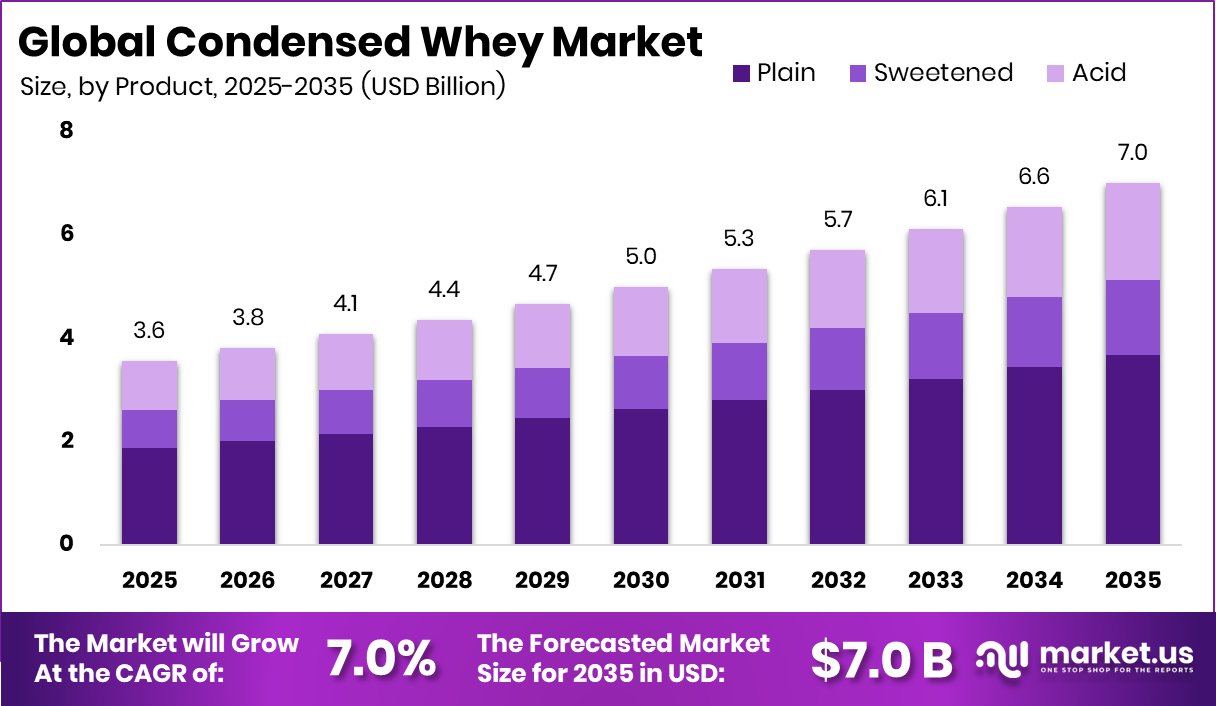
The Global Condensed Whey Market is expected to be worth around USD 7.0 billion by 2035, up from USD 3.6 billion in 2025. It is projected to grow at a CAGR of 7.0% from 2026 to 2035. With a 33.9% share, the European condensed whey market size stands at USD 1.2 Bn.
Condensed whey is a dairy-derived liquid obtained after removing part of the water from whey, which itself is a by-product of cheese production. Through evaporation, the whey becomes thicker and more concentrated while retaining lactose, minerals, and proteins. It is widely used in food processing due to its functional and nutritional properties. The condensed whey market refers to the production, processing, and use of this ingredient across multiple industries, particularly in food and beverage and animal feed applications, where it supports cost efficiency and product formulation.
The market is shaped by steady growth factors linked to dairy processing and ingredient optimization. Condensed whey allows manufacturers to utilize by-products effectively, reducing waste while improving profitability. Its role in enhancing texture, flavor, and shelf life supports its integration into various formulations. Government-backed funding initiatives, such as MDARD surpassing $250 million in grants and awarding over $3.1 million through food system programs, further strengthen infrastructure and processing capabilities, indirectly supporting dairy ingredient development.
Demand for condensed whey continues to rise due to its versatility and affordability. It is increasingly used in food production and animal nutrition, where it provides energy and functional benefits. Investments like the $68.8 million CAD funding raised by BinSentry for animal feed monitoring highlight growing attention toward feed efficiency and supply chain improvements, which align with whey utilization.
Opportunities are emerging through supply chain improvements and agricultural support programs. Initiatives such as drought relief funding for pastoralists and MDARD’s Farm to Family program enhance resource distribution and food system resilience. These efforts create a supportive environment for better dairy ingredient usage, including condensed whey, across regions and applications.
- In December 2025, Associated Milk Producers Inc., a dairy cooperative that produces cheese, butter, and whey-based ingredients, including condensed whey, announced the sale of its butter plant in New Ulm, Minnesota, to Grassland Dairy Products. This move is part of its effort to focus more on core dairy ingredient operations and improve efficiency. By adjusting its production assets, the company aims to better utilize milk supply and strengthen its ingredient portfolio, including whey products used in food manufacturing.
Key Takeaways
- The Global Condensed Whey Market is expected to be worth around USD 7.0 billion by 2035, up from USD 3.6 billion in 2025. It is projected to grow at a CAGR of 7.0% from 2026 to 2035.
- The Condensed Whey Market shows 52.5% dominance by plain products due to widespread industrial usage.
- Sweet condensed whey leads the Condensed Whey Market with 64.2% share across multiple applications globally.
- Cow’s milk remains the primary source in the Condensed Whey Market, contributing 79.3% production share worldwide.
- Full-fat condensed whey holds 48.9% share in the Condensed Whey Market due to its higher nutritional value.
- Emulsifier functionality captures 32.6% in the Condensed Whey Market, supporting stability in processed food products.
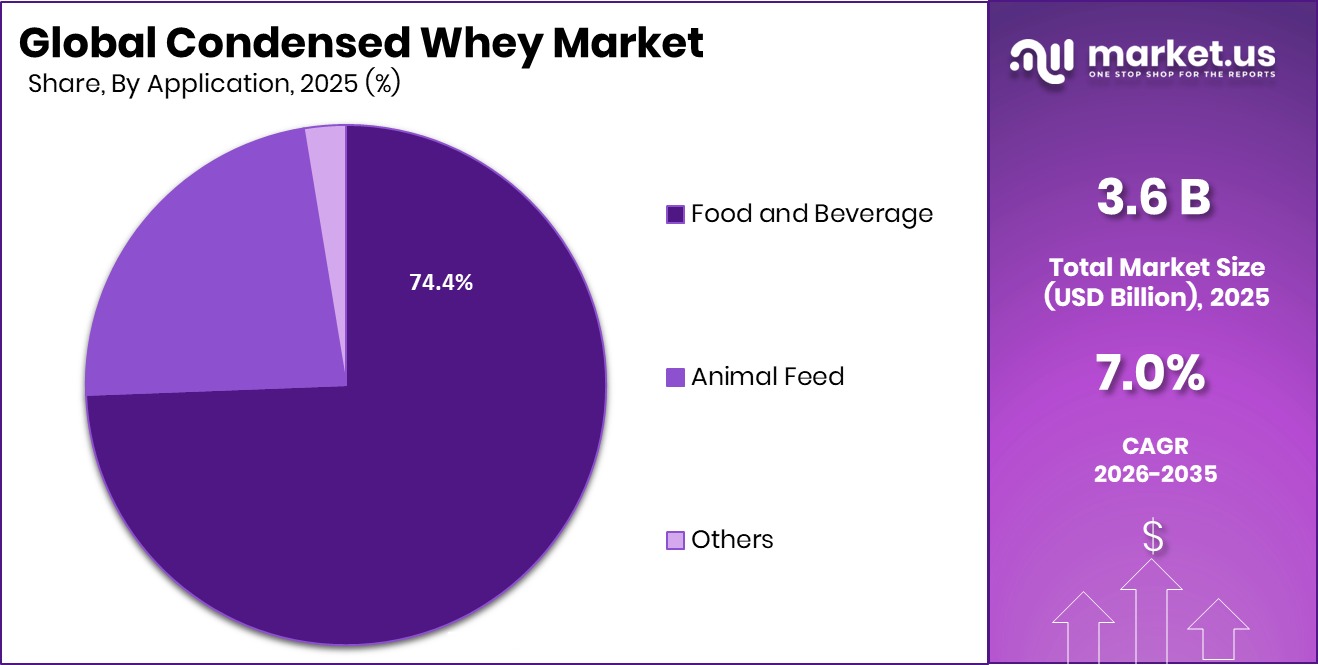
- Food and beverage applications dominate the Condensed Whey Market with 74.4% usage across diverse industries globally.
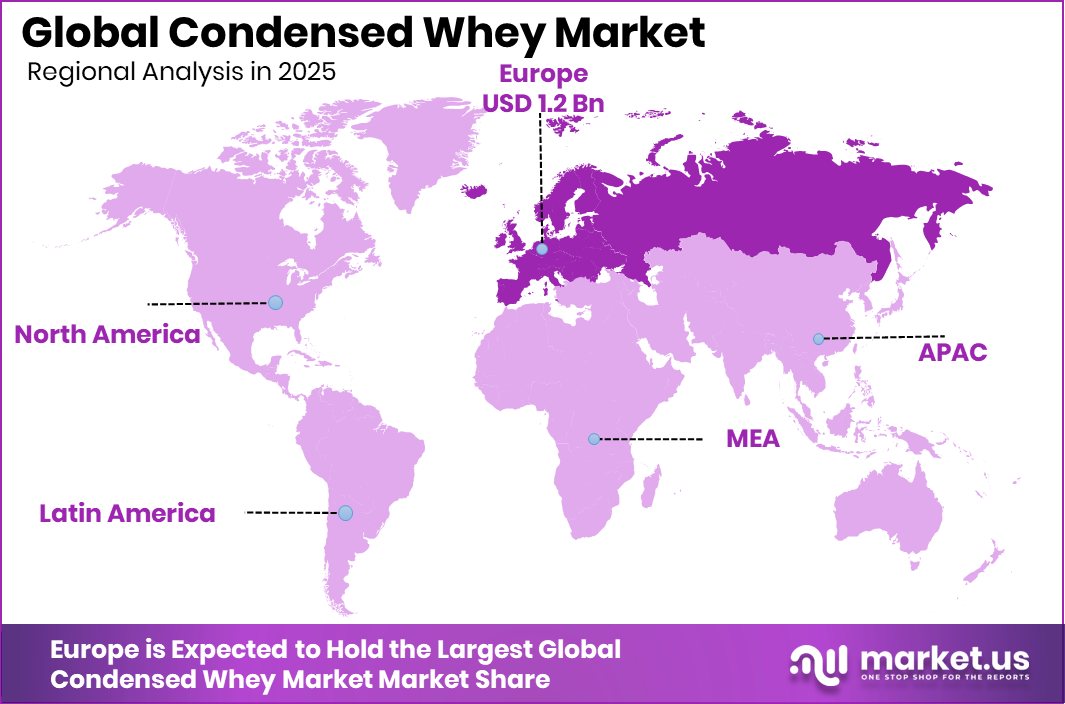
- Europe accounts for 33.9% of the condensed whey market, reaching a USD 1.2 Bn valuation.
By Product Analysis
The condensed whey market shows strong demand for plain products at 52.5%.
In 2025, the condensed whey market shows a strong preference for plain products, accounting for 52.5% of the overall share. This dominance reflects the widespread use of plain condensed whey as a versatile ingredient across multiple food formulations. Its neutral taste and adaptability make it suitable for both sweet and savory applications, including bakery, confectionery, and processed foods.
Manufacturers prefer plain condensed whey due to its consistency and ease of blending with other ingredients. Additionally, growing demand for cost-effective dairy-based components in developing markets further supports this segment. As consumer demand for simple and functional ingredients increases, the plain category is expected to maintain its leading position in the market.
By Type Analysis
Sweet condensed whey type dominates market share, reaching 64.2% globally overall.
In 2025, sweet condensed whey leads the market by type, holding a significant 64.2% share. This growth is driven by its extensive use in desserts, confectionery, and dairy-based beverages. Its natural sweetness reduces the need for additional sugar, making it an economical choice for manufacturers. The product also enhances flavor, texture, and shelf life, which are crucial factors in processed food production.
Rising consumer inclination toward indulgent and ready-to-eat food products further fuels demand. Additionally, sweet condensed whey is widely used in emerging markets where affordability and taste are key purchasing factors. This segment is expected to continue dominating due to its multifunctional benefits and strong presence in the food industry.
By Source Analysis
Cow’s milk remains the primary source, contributing 79.3% of the total market value.
In 2025, cow’s milk remains the primary source of condensed whey, accounting for 79.3% of the market share. This dominance is largely attributed to the widespread availability of cow milk and its established processing infrastructure worldwide. Cow’s milk-based whey offers consistent quality, nutritional value, and functionality, making it a preferred choice for manufacturers.
It is rich in proteins and lactose, which contribute to its application in food and beverage formulations. Furthermore, large-scale dairy farming and advancements in milk processing technologies support its continued growth. While alternative sources are gaining attention, cow’s milk remains the backbone of the condensed whey market due to its reliability and cost efficiency.
By Fat Content Analysis
The full-fat condensed whey segment holds 48.9% share in the current global market.
In 2025, full-fat condensed whey captures 48.9% of the market under the fat content segment. This segment benefits from its ability to enhance texture, richness, and mouthfeel in various food products. Full-fat variants are particularly favored in bakery, confectionery, and dairy applications where creaminess is a key quality attribute. Consumers increasingly associate full-fat dairy ingredients with better taste and satisfaction, which drives demand despite rising health consciousness.
Additionally, food manufacturers use full-fat condensed whey to improve product consistency and flavor profiles. Although low-fat alternatives are present, the sensory advantages of full-fat options ensure their continued relevance and steady growth in the global market.
By Functionality Analysis
Emulsifier functionality leads usage accounting for 32.6% across diverse industrial applications.
In 2025, emulsifier functionality accounts for 32.6% of the condensed whey market, highlighting its importance in food processing. Condensed whey acts as an effective emulsifying agent, helping to stabilize mixtures of fat and water in products such as sauces, dressings, and baked goods. Its natural composition allows manufacturers to replace synthetic additives, aligning with the clean-label trend. This functionality also improves texture, shelf stability, and overall product quality.
As the demand for natural and multifunctional ingredients grows, the emulsifier segment continues to gain traction. Food producers increasingly rely on condensed whey to achieve desired consistency while maintaining cost efficiency and product appeal.
By Application Analysis
Food and beverage applications dominate, capturing 74.4% of condensed whey consumption.
In 2025, the food and beverage sector dominates the application segment with a 74.4% market share. Condensed whey is widely used in bakery products, confectionery, dairy items, and beverages due to its nutritional value and functional properties. It enhances taste, texture, and shelf life, making it a valuable ingredient for manufacturers. The growing demand for processed and convenience foods further accelerates its usage.
Additionally, the expansion of the global food industry and increasing consumption of dairy-based products contribute to this segment’s leadership. As innovation in food processing continues, condensed whey is expected to remain a key ingredient, supporting consistent growth in the food and beverage application segment.
Key Market Segments
By Product
- Plain
- Sweetened
- Acid
By Type
- Sweet Condensed Whey
- Unsweetened Condensed Whey
By Source
- Cow’s Milk
- Goat’s Milk
- Sheep’s Milk
By Fat Content
- Full-Fat Condensed Whey
- Low-Fat Condensed Whey
- Non-Fat Condensed Whey
By Functionality
- Emulsifier
- Stabilizer
- Water Binding Agent
- Gelling Agent
- Thickener
By Application
- Food and Beverage
- Dairy Products
- Bakery Products and Confectionery
- Sauces, Soups, and Dressings
- Jams and Jellies
- Meat Products
- Animal Feed
- Others
Driving Factors
Increasing demand for cost-effective dairy ingredients
Increasing demand for cost-effective dairy ingredients continues to support the Condensed Whey Market, as manufacturers seek affordable alternatives that maintain product quality and functionality. Condensed whey offers a practical solution by enhancing texture, taste, and shelf stability while optimizing production costs. Its ability to serve multiple applications across food and feed industries strengthens its relevance in evolving production environments.
Additionally, financial activities such as Shore Capital Partners closing over $450 million for Food & Beverage Fund III, along with internal promotions, indicate growing investment interest in scalable ingredient solutions. Such developments indirectly support innovation, operational efficiency, and expansion in dairy-based ingredient segments, reinforcing condensed whey’s importance in cost-conscious manufacturing strategies.
Restraining Factors
Fluctuating raw milk supply impacts production
Fluctuating raw milk supply remains a key challenge affecting the Condensed Whey Market, as production directly depends on consistent dairy input. Variations caused by climate conditions, feed availability, and farming constraints can disrupt supply chains and impact pricing stability. These uncertainties make it difficult for manufacturers to maintain steady production volumes and long-term planning.
Financial developments like Chicago’s Shore Capital Partners securing $450 million for Food and Beverage Fund III highlight investor interest in stabilizing and improving supply chains, yet raw material dependency continues to pose risks. As milk availability fluctuates across regions, producers must adapt to changing conditions, which can limit operational efficiency and influence overall market consistency.
Growth Opportunity
Expanding applications in animal feed nutrition
Expanding applications in animal feed nutrition present strong growth opportunities for the Condensed Whey Market, as livestock producers increasingly look for nutrient-rich and cost-efficient feed ingredients. Condensed whey provides energy and digestibility benefits, making it suitable for improving feed formulations. The growing focus on livestock productivity and feed optimization supports wider adoption of such ingredients.
At the same time, funding activities like Willie Nelson’s hemp beverage brand launching a $15 million Series A round reflect broader investment trends in alternative and functional consumables. While focused on beverages, this type of funding signals increasing openness to innovative ingredient applications, creating indirect opportunities for dairy-derived components like condensed whey in both feed and hybrid nutrition segments.
Latest Trends
Shift toward natural functional food ingredients
A clear shift toward natural and functional food ingredients is shaping trends within the Condensed Whey Market, as consumers and manufacturers prioritize clean-label and minimally processed components. Condensed whey fits well into this transition due to its natural origin and multifunctional benefits in food systems. It supports emulsification, texture enhancement, and flavor improvement without relying on synthetic additives.
Investment movements such as Shore Capital targeting food and beverage deals with a $450 million fund further highlight growing interest in ingredient-focused innovation and product development. This trend encourages manufacturers to explore versatile dairy ingredients that align with evolving consumer preferences, positioning condensed whey as a relevant and adaptable solution in modern food processing.
Regional Analysis
In 2025, Europe holds 33.9% share in the condensed whey market, valued at USD 1.2 Bn.
The condensed whey market demonstrates varied regional dynamics across North America, Europe, Asia Pacific, the Middle East & Africa, and Latin America. Europe emerges as the dominating region, accounting for 33.9% of the market with a valuation of USD 1.2 Bn, supported by its well-established dairy processing industry and strong consumption of dairy-based ingredients.
North America represents a mature market, driven by consistent demand for processed and convenience foods utilizing condensed whey in multiple applications. Asia Pacific shows steady growth potential due to expanding food manufacturing activities and increasing consumption of dairy-derived products. Meanwhile, the Middle East & Africa region is gradually developing, supported by rising demand for affordable dairy ingredients in food production.
Latin America also reflects stable progress, with growing utilization of condensed whey in local food processing industries. Overall, regional performance highlights Europe’s clear leadership, while other regions continue to strengthen their presence through evolving consumption patterns and industrial applications.
Key Regions and Countries
- North America
- US
- Canada
- Europe
- Germany
- France
- The UK
- Spain
- Italy
- Rest of Europe
- Asia Pacific
- China
- Japan
- South Korea
- India
- Australia
- Rest of APAC
- Latin America
- Brazil
- Mexico
- Rest of Latin America
- Middle East & Africa
- GCC
- South Africa
- Rest of MEA
Key Players Analysis
In 2025, Agri-Mark Inc. continues to demonstrate a focused approach in the condensed whey space through its cooperative structure and strong dairy sourcing network. The company benefits from direct relationships with milk producers, enabling consistent raw material supply and quality control. Its operational strength lies in efficiently converting whey by-products into value-added condensed forms suitable for diverse food applications. By maintaining close alignment between production and member supply, Agri-Mark ensures reliability and scalability. Its emphasis on product consistency and practical functionality supports steady positioning in the condensed whey segment.
Dairy Farmers of America plays a significant role through its expansive cooperative network and integrated processing capabilities. The company leverages its large-scale milk collection system to optimize whey utilization, including condensed whey production. Its ability to manage supply chains effectively enhances operational efficiency and supports consistent product output. By focusing on ingredient solutions that align with food manufacturing needs, Dairy Farmers of America maintains a balanced approach between volume and value. Its scale and structured operations contribute to stable participation in the global condensed whey landscape.
Associated Milk Producers Inc. maintains a steady presence supported by its cooperative-driven model and emphasis on dairy ingredient production. The company utilizes its milk sourcing network to produce condensed whey with reliable quality and composition. Its operational approach focuses on efficient processing and practical application suitability across food sectors. Aligning production capabilities with member supply, it ensures continuity and consistency. Associated Milk Producers Inc. continues to sustain its role through disciplined operations and a clear focus on core dairy ingredient segments.
Top Key Players in the Market
- Agri-Mark Inc.
- Dairy Farmers of America
- Associated Milk Producers Inc.
- Leprino Foods Company
- Optimum Nutrition
Recent Developments
- In September 2024, Agri-Mark Inc. announced a strategic partnership with other regional dairy cooperatives to improve how dairy ingredients are marketed and sold. The company works in dairy processing, producing cheese, butter, and whey-based ingredients like condensed whey. This development helps Agri-Mark strengthen its position in supplying high-quality whey ingredients by improving coordination between production and customers.
- In August 2025, Dairy Farmers of America acquired W&W Dairy, located in Wisconsin. The company works as a large dairy cooperative that collects milk and produces dairy ingredients, including whey-based products used in food manufacturing. This acquisition includes a manufacturing facility and branded cheese products, helping DFA expand its processing capacity. By adding this facility, the company strengthens its ability to handle milk and produce more value-added ingredients like whey and related products.
Report Scope
Report Features Description Market Value (2025) USD 3.6 Billion Forecast Revenue (2035) USD 7.0 Billion CAGR (2026-2035) 7.0% Base Year for Estimation 2025 Historic Period 2020-2024 Forecast Period 2026-2035 Report Coverage Revenue Forecast, Market Dynamics, Competitive Landscape, Recent Developments Segments Covered By Product (Plain, Sweetened, Acid), By Type (Sweet Condensed Whey, Unsweetened Condensed Whey), By Source (Cow’s Milk, Goat’s Milk, Sheep’s Milk), By Fat Content (Full-Fat Condensed Whey, Low-Fat Condensed Whey, Non-Fat Condensed Whey), By Functionality (Emulsifier, Stabilizer, Water Binding Agent, Gelling Agent, Thickener), By Application (Food and Beverage (Dairy Products, Bakery Products and Confectionery, Sauces, Soups, and Dressings, Jams and Jellies, Meat Products), Animal Feed, Others) Regional Analysis North America – US, Canada; Europe – Germany, France, The UK, Spain, Italy, Rest of Europe; Asia Pacific – China, Japan, South Korea, India, Australia, Singapore, Rest of APAC; Latin America – Brazil, Mexico, Rest of Latin America; Middle East & Africa – GCC, South Africa, Rest of MEA Competitive Landscape Agri-Mark Inc., Dairy Farmers of America, Associated Milk Producers Inc., Leprino Foods Company, Optimum Nutrition Customization Scope Customization for segments, region/country-level will be provided. Moreover, additional customization can be done based on the requirements. Purchase Options We have three licenses to opt for: Single User License, Multi-User License (Up to 5 Users), Corporate Use License (Unlimited User and Printable PDF) 
-
-
- Agri-Mark Inc.
- Dairy Farmers of America
- Associated Milk Producers Inc.
- Leprino Foods Company
- Optimum Nutrition
Our Clients

- 182655
- March 2026






