


Global Commercial Greenhouse Market Size, Share, And Industry Analysis Report By Equipment Type (Heating Systems, Cooling and Ventilation Systems, LED Grow Lighting, Irrigation and Fertigation, Structural Components), By Crop Type (Fruits and Vegetables, Flowers and Ornamentals, Cannabis and Specialty Crops), By Greenhouse Type (Plastic-film, Glass, Rigid Polycarbonate), By Technology (Hydroponic, Non-hydroponic, Hybrid and Vertical Integration), By Automation Level (Low-tech Naturally Ventilated, Medium-tech Semi-automatic, High-tech Fully Automatic Smart Systems), By End-user (Commercial Growers, Research and Educational Institutes, Retail Garden Centers and Nurseries), By Region and Companies - Industry Segment Outlook, Market Assessment, Competition Scenario, Statistics, Trends and Forecast 2026-2035
- Published date: February 2026
- Report ID: 179243
- Number of Pages: 242
- Format:
-
keyboard_arrow_up
Quick Navigation
- Report Overview
- Key Takeaways
- Equipment Type Analysis
- Crop Type Analysis
- Greenhouse Type Analysis
- Material Analysis
- Technology Analysis
- Automation Level Analysis
- End-user Analysis
- Key Market Segments
- Emerging Trends
- Drivers
- Restraints
- Growth Factors
- Regional Analysis
- Key Regions and Countries
- Key Players Analysis
- Recent Developments
- Report Scope
Report Overview
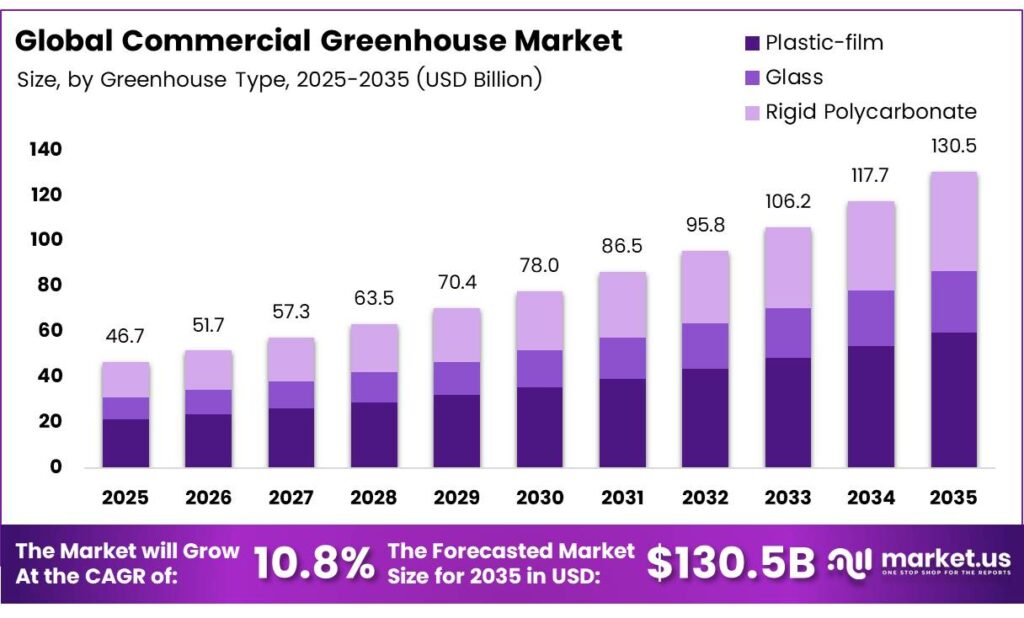
The Global Commercial Greenhouse Market size is expected to be worth around USD 130.5 billion by 2035 from USD 46.7 billion in 2025, growing at a CAGR of 10.8% during the forecast period 2026 to 2035.
The commercial greenhouse market includes facilities that produce crops, flowers, and specialty plants in controlled environments. These structures use advanced equipment such as heating systems, LED lighting, and automated irrigation to optimize plant growth. Moreover, they support year-round production regardless of outdoor climate conditions.
Greenhouses serve a wide range of end users, including large-scale commercial growers, research institutions, and retail nurseries. Consequently, demand spans multiple crop categories from fresh vegetables to premium ornamental plants. The market encompasses both low-tech plastic-film structures and high-tech fully automated smart systems.
- China’s greenhouse area ranged between 1,000,000 and 3,500,000 hectares in data compiled for 2024, confirming Asia Pacific’s position as the world’s largest protected cultivation region. This scale reflects deep government investment in food self-sufficiency and rural agricultural modernization programs across the country.
Urbanization and declining arable land push producers to adopt more efficient growing methods. Commercial greenhouse operators use hydroponics, soilless substrates, and precision climate systems to maximize yield per square meter. Therefore, the industry attracts strong investment from both public agencies and private agribusiness firms seeking sustainable food production models.
Europe’s total greenhouse area reached 188,772 hectares in 2024, including 33,637 hectares of high-tech capacity. This demonstrates Europe’s strong focus on premium, technology-intensive production methods that command higher market value and set global standards for greenhouse innovation. Turkey’s greenhouse cultivation area reached 77,600 hectares in 2024, up 45% since 2002, ranking fourth globally and second in Europe after Spain, illustrating rapid regional growth.
Key Takeaways
- The Global Commercial Greenhouse Market is valued at USD 46.7 billion in 2025 and is projected to reach USD 130.5 billion by 2035, at a CAGR of 10.8% during the forecast period 2026 to 2035.
- Heating Systems holds the leading position with a 24.6% market share.
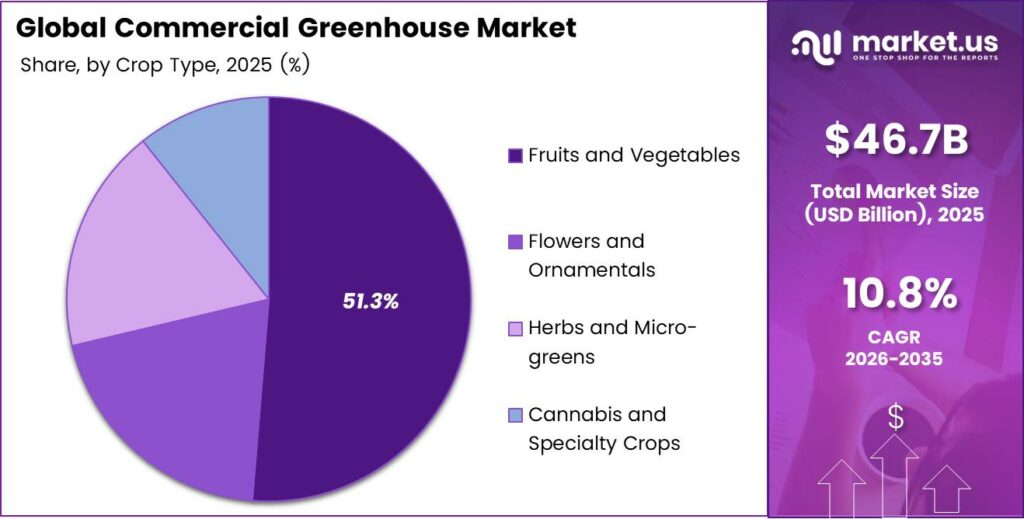
- Fruits and Vegetables lead all sub-segments with a 51.3% share.
- Plastic-film Greenhouses dominate with a 48.5% share.
- Plastic Films capture the largest share at 54.7%.
- Hydroponic systems lead with a 48.1% share.
- Low-tech, Naturally Ventilated greenhouses hold a 51.4% share.
- Commercial Growers account for 73.9% ofthe total market share.
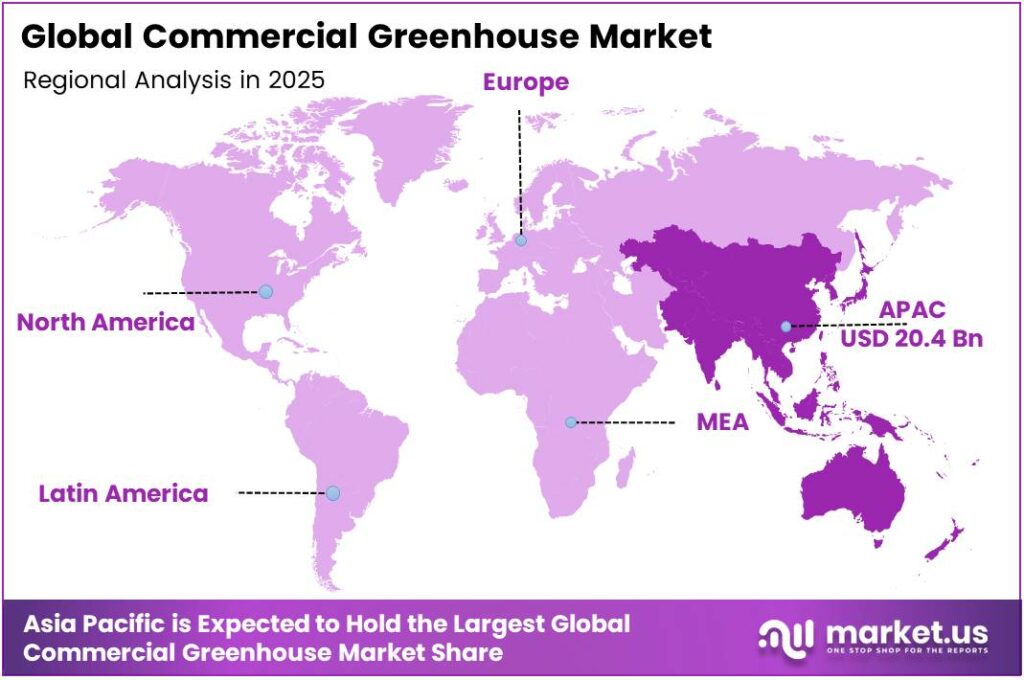
- Asia Pacific dominates the market with a 43.6% share, valued at USD 20.4 billion in 2025.
Equipment Type Analysis
Heating Systems dominate with 24.6% due to their critical role in maintaining optimal year-round growing temperatures.
In 2025, Heating Systems held a dominant market position in the By Equipment Type segment of the Commercial Greenhouse Market, with a 24.6% share. Operators rely on heating infrastructure to maintain stable growing temperatures across all climates. Moreover, advanced heat distribution systems reduce energy waste while supporting consistent crop yields throughout colder seasons.
Cooling and Ventilation Systems represent a significant segment driven by the need to prevent heat stress in warm growing regions. These systems regulate airflow, humidity, and temperature simultaneously. Consequently, they integrate closely with automation software to enable precise climate management that boosts productivity across large commercial operations.
LED Grow Lighting adoption grows rapidly as growers seek energy-efficient alternatives to traditional high-pressure sodium lamps. Spectral tuning capabilities allow operators to optimize light recipes for specific crops. Additionally, LED systems reduce energy costs significantly while improving plant development cycles in both vertical and horizontal greenhouse structures.
Irrigation and Fertigation systems deliver water and nutrients directly to plant root zones with high precision. Drip and recirculating systems minimize waste while maximizing nutrient uptake efficiency. Therefore, these solutions are essential for hydroponic and soilless cultivation setups that require consistent nutrient delivery throughout the production cycle.
Structural Components, including glazing and frame,s form the physical foundation of every greenhouse facility. High-performance materials such as tempered glass and polycarbonate panels provide durability and light transmission. Additionally, modular frame designs allow operators to expand production capacity incrementally without significant construction downtime.
Crop Type Analysis
Fruits and vegetables dominate with 51.3% due to consistent global demand for fresh, locally grown produce.
In 2025, Fruits and Vegetables held a dominant market position in the By Crop Type segment of the Commercial Greenhouse Market, with a 51.3% share. Consumer demand for fresh, pesticide-reduced produce drives strong investment in controlled environment facilities. Moreover, year-round availability of tomatoes, cucumbers, peppers, and berries supports premium pricing for greenhouse-grown products.
Flowers and Ornamentals represent a high-value segment supported by growing demand from the retail and event industries. Greenhouse cultivation ensures consistent quality and availability of roses, chrysanthemums, and tropical species. Consequently, floriculture producers invest in specialized climate control systems that maintain specific temperature and humidity ranges for premium bloom development.
Herbs and Micro-greens gain commercial traction as foodservice operators and health-conscious consumers increase purchases of fresh culinary plants. Compact greenhouse systems suit urban herb production efficiently. Additionally, short growth cycles and high turnover rates make this segment financially attractive for smaller-scale commercial growers seeking a rapid return on investment.
Cannabis and Specialty Crops emerge as a fast-growing segment driven by expanding legalization across North America and Europe. Controlled environment facilities provide the precise light, humidity, and temperature conditions that cannabis cultivation requires. Therefore, growers invest heavily in high-tech automation and security systems to maximize potency and ensure regulatory compliance.
Greenhouse Type Analysis
Plastic-film Greenhouses dominate with 48.5% due to low construction cost and wide adoption in emerging markets.
In 2025, Plastic-film Greenhouses held a dominant market position in the By Greenhouse Type segment of the Commercial Greenhouse Market, with a 48.5% share. These structures offer affordable construction and fast deployment across a wide range of geographies. Moreover, lightweight polyethylene films allow growers in developing markets to scale operations quickly without significant capital investment.
Glass Greenhouses serve premium and high-tech production facilities that prioritize light transmission and structural longevity. Glass panels provide superior optical clarity and support precise climate control systems. Consequently, major commercial growers in Europe and North America favor glass structures for their ability to sustain high-yield, year-round production over multi-decade operational lifespans.
Rigid Polycarbonate Greenhouses balance cost-efficiency with performance by offering better insulation than film and lower cost than glass. Twin-wall panels trap heat effectively while diffusing light evenly across the growing area. Additionally, polycarbonate structures resist hail and UV degradation, making them suitable for regions with variable weather conditions and extended production seasons.
Material Analysis
Plastic Films dominate with 54.7% due to affordability and ease of replacement across large-scale operations.
In 2025, Plastic Films held a dominant market position in the By Material segment of the Commercial Greenhouse Market, with a 54.7% share. Low material cost and simple installation make plastic films the preferred choice for commercial growers worldwide. Moreover, UV-stabilized and anti-drip film formulations extend operational lifespan while improving light diffusion and condensation management inside structures.
Glass Panels retain strong demand in technologically advanced markets where durability and light quality are primary priorities. Tempered and laminated glass options provide enhanced safety and insulation performance. Consequently, high-tech greenhouse operators in the Netherlands, Belgium, and Canada continue investing in glass-covered facilities to maintain competitive crop quality and yield consistency.
Rigid Plastics, including polycarbonate and acrylic sheets, offer a practical middle-ground between plastic film and glass. These materials provide better thermal retention and impact resistance than film alternatives. Additionally, growing environmental awareness encourages manufacturers to develop recyclable rigid plastic formulations that align with sustainability goals and circular economy frameworks.
Technology Analysis
Hydroponic systems dominate with 48.1% due to superior water efficiency and higher crop yields per unit area.
In 2025, Hydroponic systems held a dominant market position in the By Technology segment of the Commercial Greenhouse Market, with a 48.1% share. Nutrient film technique, deep water culture, and recirculating systems deliver measurable yield advantages over traditional soil cultivation. Moreover, hydroponics uses up to 90% less water than conventional farming, making it essential for water-scarce regions.
Non-hydroponic (Soil/Substrate) cultivation remains relevant for crop types that perform better in natural growing media. Substrate-based methods using coco coir, peat, and perlite blends support strong root development for specific vegetables and herbs. Consequently, many commercial growers maintain substrate systems alongside hydroponic setups to diversify their product offerings across different crop categories.
Hybrid and Vertical Integration approaches combine multiple growing technologies within a single facility to maximize space utilization and production diversity. Vertical growing racks with hydroponic channels optimize square footage in urban greenhouse facilities. Additionally, hybrid systems allow operators to experiment with different crop varieties while maintaining consistent quality standards across all production zones.
Automation Level Analysis
Low-tech, Naturally Ventilated greenhouses dominate with 51.4% due to widespread adoption in cost-sensitive markets globally.
In 2025, Low-tech Naturally Ventilated greenhouses held a dominant market position in the By Automation Level segment of the Commercial Greenhouse Market, with a 51.4% share. These structures rely on passive airflow management through ridge vents and side openings. Moreover, minimal electrical infrastructure requirements make them the practical choice for smallholder commercial growers in Asia, Africa, and Latin America.
Medium-tech Semi-automatic greenhouses incorporate basic sensors, automated shade systems, and programmable irrigation controllers. These facilities offer significant productivity improvements over low-tech alternatives without full smart system investment. Consequently, medium-tech adoption grows rapidly among mid-scale producers seeking operational efficiency gains that justify incremental technology investment over multiple growing seasons.
High-tech Fully Automatic Smart Systems represent the industry’s most advanced tier, integrating AI-driven climate control, robotic harvesting, and real-time analytics. These facilities achieve maximum crop density and minimal labor dependence. Additionally, smart system operators benefit from data-driven insights that continuously optimize growing parameters, reduce energy consumption, and predict maintenance needs before equipment failures occur.
End-user Analysis
Commercial Growers dominate with 73.9% due to large-scale production requirements and high facility investment capacity.
In 2025, Commercial Growers held a dominant market position in the By End-user segment of the Commercial Greenhouse Market, with a 73.9% share. Large farming enterprises invest heavily in greenhouse infrastructure to ensure a consistent supply to retail chains, food processors, and export markets. Moreover, vertical integration strategies allow commercial growers to control production quality from seed to shelf.
Research and Educational Institutes use greenhouse facilities for plant science studies, crop genetics research, and agronomy training programs. Universities and government research centers operate controlled environment facilities to test new cultivars and growing technologies. Consequently, innovations developed in research greenhouses transfer directly to commercial production, accelerating technology adoption across the broader industry.
Retail Garden Centers and Nurseries maintain greenhouse facilities to produce seasonal plants, bedding flowers, and potted specimens for consumer markets. These operations prioritize aesthetic quality and product variety over maximum yield efficiency. Additionally, consumer interest in home gardening and indoor plants drives consistent retail demand for greenhouse-grown ornamental and edible plant products.
Key Market Segments
By Equipment Type
- Heating Systems
- Cooling and Ventilation Systems
- LED Grow Lighting
- Irrigation and Fertigation
- Control and Automation Software
- Structural Components (Glazing, Frames)
By Crop Type
- Fruits and Vegetables
- Flowers and Ornamentals
- Herbs and Micro-greens
- Cannabis and Specialty Crops
By Greenhouse Type
- Plastic-film Greenhouses
- Glass Greenhouses
- Rigid Polycarbonate Greenhouses
By Material
- Plastic Films
- Glass Panels
- Rigid Plastics
By Technology
- Hydroponic
- Non-hydroponic (Soil/Substrate)
- Hybrid and Vertical Integration
By Automation Level
- Low-tech Naturally Ventilated
- Medium-tech Semi-automatic
- High-tech Fully Automatic Smart Systems
By End-user
- Commercial Growers
- Research and Educational Institutes
- Retail Garden Centers and Nurseries
Emerging Trends
Urban Greenhouse Architecture and Renewable Energy Integration Reshape Protected Cultivation
Renewable energy integration transforms greenhouse operating economics by reducing dependence on grid electricity. Solar panels, geothermal systems, and biomass boilers now power many large commercial facilities. Consequently, recirculating irrigation systems pair with renewable energy sources to create closed-loop water and energy cycles that significantly cut operational costs and carbon footprints.
- Vertical and hybrid greenhouse architectures spread rapidly across urban zones where land costs make horizontal expansion impractical. Developers stack growing layers within compact footprints to maximize production density. Order intake totaled SEK 42,303 thousand in FY2024, up from SEK 28,056 thousand in 2023, reflecting rising LED grow lighting demand that powers these energy-intensive vertical setups.
Cannabis and high-value specialty crop facilities expand rapidly as regulatory frameworks mature across key markets. Producers invest in premium controlled environment infrastructure to meet strict quality and potency standards. Additionally, the transition toward recyclable rigid plastics and glass covering materials accelerates as operators prioritize long-term sustainability and circular economy compliance in new facility builds.
Drivers
Increasing Demand for Year-Round Fresh Produce and Shrinking Arable Land Drive Greenhouse Market Growth
Consumer demand for fresh fruits and vegetables throughout all seasons pushes producers to invest in protected cultivation facilities. Retail chains and foodservice operators require consistent quality and uninterrupted supply. Moreover, population growth in urban centers amplifies pressure on food systems, making greenhouse production an essential component of modern agricultural supply chains.
- Breakthroughs in AI-driven climate control and LED spectral tuning technologies make advanced greenhouse systems more accessible and cost-effective. Smarter systems reduce energy consumption while improving crop output measurably. Gibraltar Industries Agtech segment adjusted operating income reached $17.5 million in FY2024 with an 11.5% margin, confirming that technology-forward greenhouse companies generate strong profitability from these performance improvements.
Arable land decline and rapid urbanization force producers to adopt more land-efficient growing methods. Greenhouse facilities generate significantly higher yields per hectare compared to open-field cultivation. The Agtech segment is demonstrating that commercial greenhouse infrastructure investment grows alongside this intensifying land pressure.
Restraints
High Capital Investment and Persistent Energy Costs Limit Faster Commercial Greenhouse Adoption
Advanced greenhouse structures require substantial upfront capital for foundation work, structural framing, glazing systems, and integrated equipment installation. Many prospective operators struggle to secure adequate financing for full-featured facilities. Moreover, high-tech automated systems add further cost layers that extend payback periods, making investment decisions difficult for smaller commercial producers entering the market.
Energy consumption remains one of the most significant ongoing cost challenges for greenhouse operators worldwide. Heating, cooling, lighting, and ventilation systems collectively demand large amounts of electricity and fuel. Consequently, volatile energy prices create unpredictable operating cost environments that compress profit margins and discourage expansion investments, particularly in regions without access to stable or renewable energy sources.
Operational maintenance expenses add continuous financial pressure beyond initial construction costs. Climate control equipment, irrigation infrastructure, and automation systems require regular servicing and component replacement. Therefore, operators must maintain skilled technical teams capable of managing complex integrated systems, which increases labor costs and creates workforce dependency challenges that limit operational scalability for many producers.
Growth Factors
AI Automation, Soilless Cultivation, and Premium Crop Demand Accelerate Greenhouse Market Expansion
Hydroponics, aeroponics, and soilless cultivation techniques scale explosively as producers recognize their yield, water efficiency, and land use advantages. These methods enable crop production in locations where traditional agriculture cannot operate. Consequently, greenhouse-as-a-service leasing models emerge in developing economies, allowing growers to access advanced soilless cultivation infrastructure without the full burden of capital ownership.
- Proliferation of AI platforms, IoT sensors, and full automation systems transforms greenhouse operations into data-driven precision farming enterprises. Real-time monitoring and predictive analytics optimize every growing variable continuously. Mexico’s greenhouse vegetable exports reached 3.3 million metric tons of fresh tomatoes, cucumbers, and bell peppers, illustrating how technology-enabled production scales to meet large international export demand efficiently.
Rising demand for premium floriculture and ornamental horticulture products creates high-margin growth opportunities for specialized greenhouse producers. Affluent consumer segments and expanding event industries drive consistent purchasing of premium cut flowers and specialty plants. Additionally, Mexico’s protected cultivation area reached approximately 60,000 hectares, demonstrating how emerging economy growers actively scale greenhouse capacity to meet both domestic and export market demand.
Regional Analysis
Asia Pacific Dominates the Commercial Greenhouse Market with a Market Share of 43.6%, Valued at USD 20.4 Billion
Asia Pacific leads the global commercial greenhouse market with a 43.6% share, valued at USD 20.4 billion in 2025. China drives regional dominance with the world’s largest greenhouse footprint, supported by deep government investment in food self-sufficiency programs. Moreover, Asia, excluding China’s greenhouse area, confirms broad regional expansion well beyond China’s massive domestic production base.
North America maintains a strong greenhouse sector supported by advanced technology adoption and high consumer demand for premium produce. Consequently, the region leads in automated, high-output greenhouse systems that serve major retail and foodservice distribution networks efficiently.
The Middle East and Africa region invests in greenhouse technology to overcome harsh climate conditions and address food security challenges. Water scarcity concerns accelerate the adoption of hydroponic and recirculating irrigation systems in Gulf countries. Additionally, government-backed agricultural diversification programs in Saudi Arabia, the UAE, and South Africa fund protected cultivation facility development to reduce fresh produce import dependency.
Latin America expands greenhouse production rapidly, with Mexico serving as the region’s largest and most export-oriented market. Proximity to the United States creates strong commercial incentives for Mexican producers to scale controlled environment facilities. Furthermore, Brazil and Colombia develop their own greenhouse sectors to supply domestic retail markets with fresh vegetables, flowers, and specialty crops throughout the year.
Key Regions and Countries
North America
- US
- Canada
Europe
- Germany
- France
- The UK
- Spain
- Italy
- Rest of Europe
Asia Pacific
- China
- Japan
- South Korea
- India
- Australia
- Rest of APAC
Latin America
- Brazil
- Mexico
- Rest of Latin America
Middle East & Africa
- GCC
- South Africa
- Rest of MEA
Key Players Analysis
Richel Group SAS stands as one of the world’s leading greenhouse structure manufacturers, specializing in turnkey horticultural projects across multiple continents. The company designs and builds plastic-film and glass greenhouse complexes for commercial growers, government programs, and agribusiness operators. Moreover, Richel’s engineering expertise covers climate control, irrigation, and crop production consulting services that accompany its structural installations globally.
DENSO Corporation contributes to the commercial greenhouse sector through precision agriculture technology and automation systems, drawing on its broader industrial engineering capabilities. The company develops sensor networks, climate-monitoring equipment, and environmental-control platforms for large-scale protected cultivation environments. Consequently, DENSO’s technological depth positions it as a strategic partner for high-tech greenhouse operators seeking fully integrated automation solutions.
Gibraltar Industries, Inc. operates a dedicated Agtech segment focused on commercial greenhouse structures and controlled environment agriculture. The segment generates significant revenues from greenhouse construction projects across North America and international markets. Additionally, Gibraltar’s engineering and manufacturing capabilities allow it to deliver complex, large-scale greenhouse infrastructure projects for leading commercial growers and vertical farming operators.
Netafim Ltd leads the global irrigation and fertigation technology market with precision drip and micro-irrigation systems widely adopted across commercial greenhouse operations. The company’s solutions optimize water and nutrient delivery at the root zone level, reducing waste while improving crop quality and yield consistency. Therefore, Netafim’s products integrate seamlessly with greenhouse automation platforms to support data-driven precision farming at scale.
Top Key Players in the Market
- Richel Group SAS
- DENSO Corporation
- Gibraltar Industries, Inc.
- Netafim Ltd.
- Priva Holding B.V.
- Van der Hoeven Horticultural Projects B.V.
- Palram Industries Ltd.
- Argus Control Systems Ltd.
- Logiqs B.V.
- Agra-Tech, Inc.
- AB Ludvig Svensson
Recent Developments
- In 2025, Richel Group partnered with Volta (Alpes-de-Haute-Provence) on an agrivoltaic project at Vergers de Fouillas in Loriol-sur-Drôme. The project features two photovoltaic greenhouses covering 5 hectares. The structures protect kiwi crops from climatic risks while enabling light transmission for flowering induction via bifacial PV modules.
- In 2025, DENSO completed Profarm environment-control installations for the Michinoku Shirakawa Farm and the Murakami Farm sprouting-vegetable facility. Earlier reference projects include Denden Village (high-yield first cultivation) and Date City agricultural training greenhouse.
Report Scope
Report Features Description Market Value (2025) USD 46.7 Billion Forecast Revenue (2035) USD 130.5 Billion CAGR (2026-2035) 10.8% Base Year for Estimation 2025 Historic Period 2020-2024 Forecast Period 2026-2035 Report Coverage Revenue Forecast, Market Dynamics, Competitive Landscape, Recent Developments Segments Covered By Equipment Type (Heating Systems, Cooling and Ventilation Systems, LED Grow Lighting, Irrigation and Fertigation, Control and Automation Software, Structural Components (Glazing, Frames)), By Crop Type (Fruits and Vegetables, Flowers and Ornamentals, Herbs and Micro-greens, Cannabis and Specialty Crops), By Greenhouse Type (Plastic-film Greenhouses, Glass Greenhouses, Rigid Polycarbonate Greenhouses), By Material (Plastic Films, Glass Panels, Rigid Plastics), By Technology (Hydroponic, Non-hydroponic (Soil/Substrate), Hybrid and Vertical Integration), By Automation Level (Low-tech Naturally Ventilated, Medium-tech Semi-automatic, High-tech Fully Automatic Smart Systems), By End-user (Commercial Growers, Research and Educational Institutes, Retail Garden Centers and Nurseries) Regional Analysis North America (US and Canada), Europe (Germany, France, The UK, Spain, Italy, and Rest of Europe), Asia Pacific (China, Japan, South Korea, India, Australia, and Rest of APAC), Latin America (Brazil, Mexico, and Rest of Latin America), Middle East & Africa (GCC, South Africa, and Rest of MEA) Competitive Landscape Richel Group SAS, DENSO Corporation, Gibraltar Industries, Inc., Netafim Ltd, Priva Holding B.V., Van der Hoeven Horticultural Projects B.V., Palram Industries Ltd., Argus Control Systems Ltd., Logiqs B.V., Agra-Tech, Inc., AB Ludvig Svensson Customization Scope Customization for segments, region/country-level will be provided. Moreover, additional customization can be done based on the requirements. Purchase Options We have three licenses to opt for: Single User License, Multi-User License (Up to 5 Users), Corporate Use License (Unlimited Users and Printable PDF)  Commercial Greenhouse MarketPublished date: February 2026add_shopping_cartBuy Now get_appDownload Sample
 -
-
- Richel Group SAS
- DENSO Corporation
- Gibraltar Industries, Inc.
- Netafim Ltd.
- Priva Holding B.V.
- Van der Hoeven Horticultural Projects B.V.
- Palram Industries Ltd.
- Argus Control Systems Ltd.
- Logiqs B.V.
- Agra-Tech, Inc.
- AB Ludvig Svensson
Our Clients

- 179243
- February 2026






