


Global Cold Flow Improvers Market Size, Share, And Enhanced Productivity By Product (Ethylene Vinyl Acetate, Polyalkyl Methacrylate, Polyalpha Olefin, Others), By Application (Diesel Fuel, Lubricating Oil, Aviation Fuel, Others), By End Use (Automotive, Aerospace and Defense, Others), By Region and Companies - Industry Segment Outlook, Market Assessment, Competition Scenario, Trends, and Forecast 2026-2035
- Published date: March 2026
- Report ID: 179837
- Number of Pages: 206
- Format:
-
keyboard_arrow_up
Quick Navigation
Report Overview
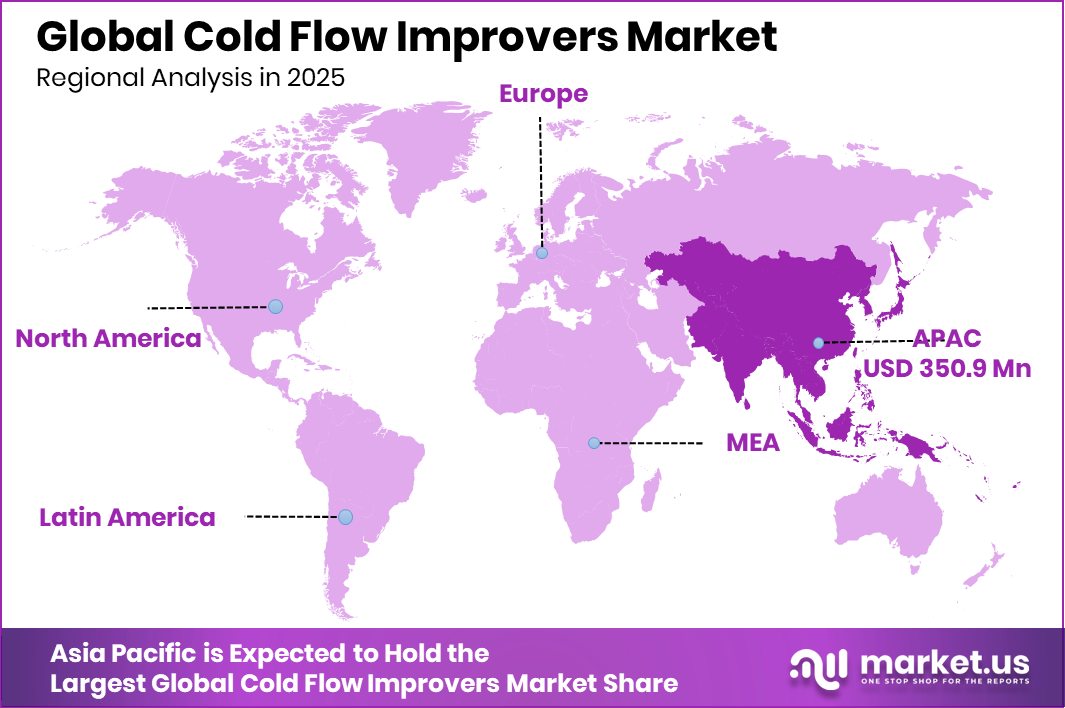
The Global Cold Flow Improvers Market is expected to be worth around USD 1,521.8 million by 2035, up from USD 902.1 million in 2025, and is projected to grow at a CAGR of 5.4% from 2026 to 2035. Cold Flow Improvers Market is expected to lead strongly in the Asia Pacific region with a 38.9% share and a USD 350.9 Mn value.
Cold flow improvers are chemical additives used to help fuels maintain proper flow when temperatures drop. They prevent wax crystals in diesel, lubricating oils, and aviation fuels from growing too large, which keeps engines running smoothly in cold conditions. In the Global Cold Flow Improvers Market, products such as ethylene vinyl acetate, polyalkyl methacrylate, polyalpha olefin, and other specialty polymers are used across diesel fuel systems, lubricating oils, and aviation applications. Demand also comes from end-use sectors like automotive, aerospace, defense, and various industrial segments where uninterrupted winter operations matter.

Growth in this market is supported by rising investment in cleaner and more reliable fuel use. Governments are placing a stronger focus on improving winter fuel performance and reducing emissions at the same time. The Government of Australia’s AU$1.1 billion plan, announced on September 17, to support domestic production of low-carbon liquid fuels, including renewable diesel and sustainable aviation fuel, creates new opportunities for cold-flow-optimized formulations. These fuels often require advanced additive packages to ensure smooth handling in cold regions.
Demand is also shaped by emission-reduction programs. The DNR’s US$385,000 funding to cut diesel engine emissions and more than US$12 million in federal support for tribal renewable energy projects encourage wider use of improved diesel blends that rely on cold flow additives. Similar momentum comes from the US$11 million federal backing for clean fuel projects and the £32.5 million UK initiative to help industries cut fossil-fuel dependence. Even northern projects, such as the US$2 million geothermal funding in Northern Canada, reinforce the need for fuels that remain stable in harsh climates.
Key Takeaways
- The Global Cold Flow Improvers Market is expected to be worth around USD 1,521.8 million by 2035, up from USD 902.1 million in 2025, and is projected to grow at a CAGR of 5.4% from 2026 to 2035.
- Ethylene vinyl acetate leads the Cold Flow Improvers Market with a strong 37.4% product share.
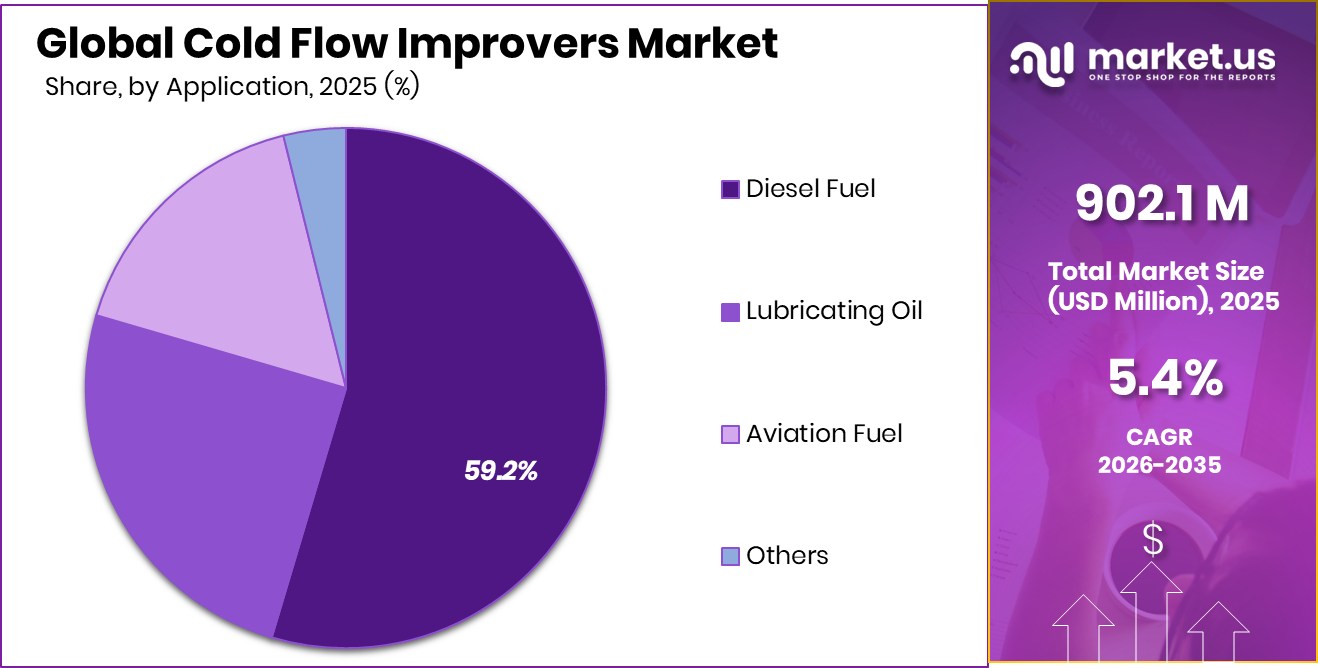
- Diesel fuel applications account for 59.2% of Cold Flow Improvers Market demand worldwide today.
- The automotive sector holds 64.5% share, making it the largest Cold Flow Improvers Market end user.
- Cold Flow Improvers Market saw Asia Pacific dominate at 38.9% and a USD 350.9 Mn scale.
By Product Analysis
In 2025, Ethylene Vinyl Acetate dominated Cold Flow Improvers Market with 37.4% share.
In 2025, the Cold Flow Improvers Market will continue to see strong traction for Ethylene Vinyl Acetate (EVA), which held a 37.4% share in the latest assessment. This product type remains widely preferred because it blends easily with diesel, biodiesel, and heating oils while lowering pour points even in harsh winters. Refiners and fuel blenders increasingly rely on EVA to maintain fuel fluidity as cold-weather disruptions become more frequent across North America, Europe, and parts of Asia.
Its cost-effectiveness and compatibility with ultra-low-sulfur diesel keep it in steady demand. As countries tighten winter fuel quality norms, EVA-based cold flow improvers remain the first choice for fuel distributors seeking reliable low-temperature performance.
By Application Analysis
In 2025, Diesel Fuel dominated the Cold Flow Improvers Market with 59.2% share.
In 2025, diesel fuel applications will continue dominating the Cold Flow Improvers Market with a solid 59.2% share, driven by rising demand from logistics fleets, public transport, and commercial vehicles that operate year-round. Cold flow improvers play a crucial role in preventing diesel gelling, waxing, and filter plugging in sub-zero temperatures, especially across colder regions such as Canada, Nordic Europe, and northern China.
Growing cross-border freight activities and increased use of temperature-sensitive engines have made low-temperature operability a critical requirement for fuel suppliers. With winter-grade diesel becoming a regulatory necessity in many markets, investment in diesel-specific cold flow additives remains high. These additives ensure smooth engine operation, reduced downtime, and better fuel handling during extended cold spells.
By End Use Analysis
In 2025, Automotive dominated the Cold Flow Improvers Market with 64.5% share.
In 2025, the automotive sector will remain the leading end-use category in the Cold Flow Improvers Market with a 64.5% share, supported by the expanding population of diesel-powered passenger cars, commercial trucks, and off-road vehicles. Automotive engines face significant cold-weather challenges, making reliable cold-flow additives essential for maintaining fuel fluidity and injection performance.
Countries with heavy snowfall and long winter seasons see the highest adoption, as vehicle owners increasingly prefer fuels treated with pour-point depressants and wax-crystal modifiers. The shift toward cleaner-burning diesel and stricter emission regulations has also pushed automakers and fuel suppliers to prioritize fuel stability in low temperatures. Consequently, cold flow improvers are integral to ensuring smoother ignition, reduced maintenance issues, and predictable winter performance.
Key Market Segments
By Product
- Ethylene Vinyl Acetate
- Polyalkyl Methacrylate
- Polyalpha Olefin
- Others
By Application
- Diesel Fuel
- Lubricating Oil
- Aviation Fuel
- Others
By End Use
- Automotive
- Aerospace and Defense
- Others
Driving Factors
Rising diesel usage boosts winter additives
The Cold Flow Improvers Market is increasingly supported by rising diesel usage, especially in colder regions where winter additives become essential for maintaining smooth engine performance. Government-backed energy transitions are also pushing demand. Greece approved a €112 million green hydrogen subsidy for an oil company, creating indirect opportunities for additives that help new fuel blends meet cold-weather standards.
Meanwhile, the £1-million fund for innovative waste-oil recycling technology encourages cleaner fuel pathways, where cold flow additives play a role in stabilizing low-temperature performance. As countries shift toward greener and more efficient fuels, winter operability remains a priority, making cold flow improvers increasingly relevant across transportation and industrial fuel systems.
Restraining Factors
High formulation costs limit product adoption
Despite strong demand, the market faces restraints linked to high formulation costs and the complexity of meeting varied fuel specifications. Premium additives often require specialized chemistries, raising production expenses and limiting adoption in cost-sensitive regions. A major shift in the lubricant sector emerged with BP entering advanced talks to sell its $8 billion Castrol unit to Stonepeak, signaling potential volatility in downstream fuel-treatment supply chains.
Additionally, the growing CO₂ capture and storage project pipeline in Greece, nearing €4 billion, reflects capital redirection toward decarbonization, which may temporarily divert investment away from additive development, creating uneven market progress.
Growth Opportunity
Renewable diesel transition drives additive innovation
Opportunities continue to rise as renewable diesel transitions accelerate worldwide, pushing fuel producers to adopt additives that ensure stability in cold climates. The sector gains momentum from hydrogen-integrated refinery upgrades, including Motor Oil securing a €111.7 million EU grant for a 50 MW hydrogen project, supporting the shift toward cleaner fuels that still require strong low-temperature performance characteristics.
Investment activity also strengthens the ecosystem, as IMM Private Equity announced plans to acquire a 40% stake in SK Lubricants for $900 million, showing steady confidence in fuel-treatment and lubricant technologies. These advancements create openings for cold flow improvers tailored to emerging fuel compositions.
Latest Trends
Shift toward bio-based cold flow technologies
A major trend shaping the market is the move toward bio-based and cleaner cold flow technologies that support next-generation diesel and aviation fuels. Regulatory momentum remains strong, highlighted by the EU’s approval of €111.7 million in Greek state aid for Motor Oil Hellas to expand renewable hydrogen production.
As hydrogen-ready and renewable liquid fuels enter the mainstream, fuel producers seek additives capable of ensuring reliable flow in cold seasons, especially for blends with altered paraffin behavior. This transition encourages research into plant-derived polymers and more flexible additive formulations. The shift reflects a broader industry push to pair low-carbon fuel strategies with dependable winter performance solutions.
Regional Analysis
Cold Flow Improvers Market in Asia Pacific reached a 38.9% share with a USD 350.9 Mn valuation.
The Cold Flow Improvers Market shows varied regional performance across North America, Europe, Asia Pacific, the Middle East & Africa, and Latin America, with each region contributing differently to demand patterns shaped by fuel usage, winter conditions, and automotive activity. Asia Pacific stands as the dominating region, holding 38.9% of the market and reaching a value of USD 350.9 Mn, supported by its extensive diesel consumption and expanding vehicle population across countries such as China, India, and Japan.
North America continues to display steady adoption due to colder climates in Canada and the northern United States, supporting consistent usage of cold flow treatment additives in diesel fuel. Europe reflects broad regulatory-driven consumption, with colder Northern and Central European zones maintaining demand across transportation and industrial sectors.
The Middle East & Africa region shows selective but growing adoption tied to diesel-dependent logistics hubs and expanding mobility fleets. Latin America maintains a moderate demand, largely influenced by diesel use in agriculture and transportation networks. With Asia Pacific firmly holding the largest share, regional dynamics highlight clear dominance in both percentage contribution and overall market value.
Key Regions and Countries
- North America
- US
- Canada
- Europe
- Germany
- France
- The UK
- Spain
- Italy
- Rest of Europe
- Asia Pacific
- China
- Japan
- South Korea
- India
- Australia
- Rest of APAC
- Latin America
- Brazil
- Mexico
- Rest of Latin America
- Middle East & Africa
- GCC
- South Africa
- Rest of MEA
Key Players Analysis
Afton Chemical maintains a strong foothold, supported by its legacy in fuel-performance chemistry and its ability to tailor cold flow solutions for varying diesel compositions across regions. Its established relationships with refineries and fuel distributors give it a competitive advantage in delivering products optimized for seasonal temperature challenges.
Baker Hughes holds a distinct position as an energy-focused technology provider, enabling it to integrate cold flow improver solutions within broader upstream and downstream fuel-treatment platforms. Its ability to align additive performance with operational needs in colder drilling and production environments keeps the company relevant in both industrial and transportation diesel segments. Baker Hughes also benefits from its global footprint, allowing rapid adaptation to region-specific fuel conditions.
BASF SE continues to influence the market with its deep chemical expertise and diversified additive portfolio. Its research-driven approach helps address shifting fuel standards and evolving diesel formulations, allowing customers to manage cold-weather operability with greater efficiency. In 2025, these three companies collectively anchor innovation and reliability in the Cold Flow Improvers Market, shaping performance expectations and driving product differentiation across key global regions.
Top Key Players in the Market
- Afton Chemical
- Baker Hughes
- BASF SE
- Bell Performance, Inc.
- Chevron Corporation
- Clariant
- Dorf Ketal
- Evonik Industries
- Infineum International Limited
- Innospec
- The Lubrizol Corporation
Recent Developments
- In August 2025, Afton Chemical launched HiTEC® 12582, an advanced additive tailored for hydrogen heavy-duty engines. This represents a step forward in fuel additive technology that could indirectly support diesel and cold flow performance solutions for future engine types.
- In January 2024, BASF SE, a major global chemical company providing fuel performance additives, including cold flow solutions, launched Keropur, a new gasoline additive, in Taiwan. The product helps keep engines clean by removing deposits and supports overall fuel performance.
Report Scope
Report Features Description Market Value (2025) USD 902.1 Million Forecast Revenue (2035) USD 1,521.8 Million CAGR (2026-2035) 5.4% Base Year for Estimation 2025 Historic Period 2020-2024 Forecast Period 2026-2035 Report Coverage Revenue Forecast, Market Dynamics, Competitive Landscape, Recent Developments Segments Covered By Product (Ethylene Vinyl Acetate, Polyalkyl Methacrylate, Polyalpha Olefin, Others), By Application (Diesel Fuel, Lubricating Oil, Aviation Fuel, Others), By End Use (Automotive, Aerospace and Defense, Others) Regional Analysis North America – US, Canada; Europe – Germany, France, The UK, Spain, Italy, Rest of Europe; Asia Pacific – China, Japan, South Korea, India, Australia, Singapore, Rest of APAC; Latin America – Brazil, Mexico, Rest of Latin America; Middle East & Africa – GCC, South Africa, Rest of MEA Competitive Landscape Afton Chemical, Baker Hughes, BASF SE, Bell Performance, Inc., Chevron Corporation, Clariant, Dorf Ketal, Evonik Industries, Infineum International Limited, Innospec, The Lubrizol Corporation Customization Scope Customization for segments, region/country-level will be provided. Moreover, additional customization can be done based on the requirements. Purchase Options We have three licenses to opt for: Single User License, Multi-User License (Up to 5 Users), Corporate Use License (Unlimited User and Printable PDF)  Cold Flow Improvers MarketPublished date: March 2026add_shopping_cartBuy Now get_appDownload Sample
 -
-
- Afton Chemical
- Baker Hughes
- BASF SE
- Bell Performance, Inc.
- Chevron Corporation
- Clariant
- Dorf Ketal
- Evonik Industries
- Infineum International Limited
- Innospec
- The Lubrizol Corporation
Our Clients

- 179837
- March 2026






