


Global Botanical Supplements Market Size, Share Analysis Report By Source (Herbs, Leaves, Spices, Flowers, Others), By Form (Powder, Liquid, Tablets, Capsules, Gummies, Others), By Application (Energy And Weight Management, General Health, Bone And Joint Health, Gastrointestinal Health, Immunity, Cardiac Health, Diabetes, Anti-cancer, Others), By Distribution Channel (Offline, Online) , By Region and Companies - Industry Segment Outlook, Market Assessment, Competition Scenario, Trends and Forecast 2026-2035
- Published date: Mar 2026
- Report ID: 182160
- Number of Pages: 395
- Format:
-
keyboard_arrow_up
Quick Navigation
Report Overview
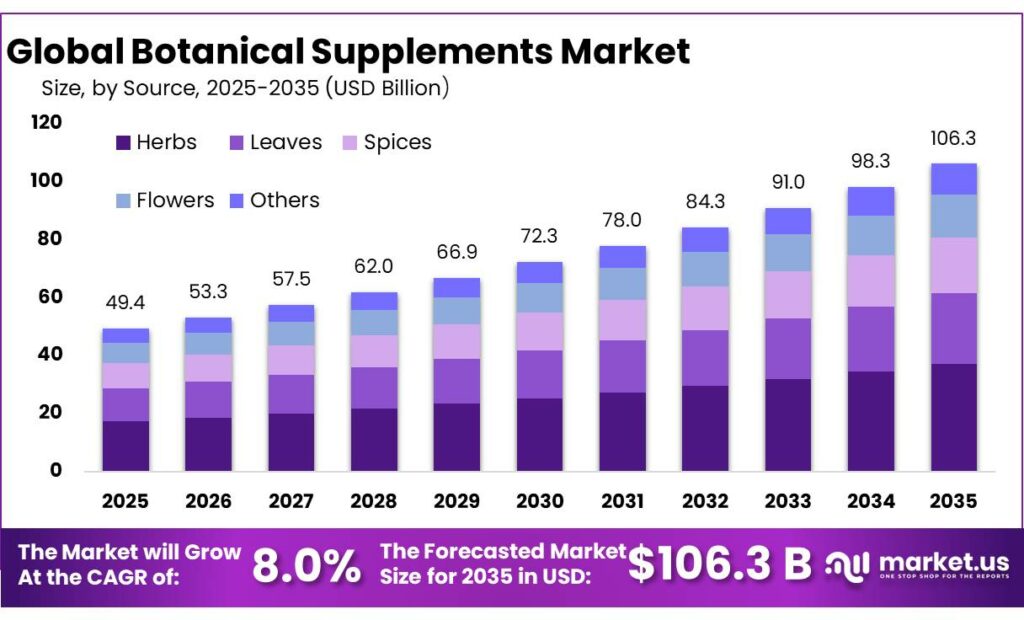
The Global Botanical Supplements Market size is expected to be worth around USD 106.3 Billion by 2035, from USD 49.4 Billion in 2025, growing at a CAGR of 8.0% during the forecast period from 2026 to 2035. In 2025, North America held a dominant market position, capturing more than a 42.4% share, holding USD 20.9 Billion revenue.
Botanical supplements represent the intersection of preventive nutrition, traditional plant knowledge, and modern consumer health positioning. In industry terms, they include herb- and plant-derived ingredients marketed in formats such as capsules, tablets, powders, gummies, and liquid tonics for wellness support rather than as prescription medicines.
The sector is supported by a large and increasingly formalized global ecosystem: WHO reports that traditional, complementary and integrative medicine is used in 170 of 194 Member States, while its 2019 global report was built from inputs from 179 Member States.
In regulatory terms, progress has also become more visible, with 124 countries reporting regulations on herbal medicines in 2018, versus 65 countries in 1999, indicating a far more structured operating environment for botanical products than in earlier decades.
A 2025 review of global medicinal and aromatic plant trade reported that world exports reached US$4.18 billion and imports US$4.25 billion in 2023, with both values up by roughly 98% versus 2010. The same review noted that India achieved around 240% growth in medicinal and aromatic plant export value over that period, underlining how supply-chain depth, cultivation capability, and processing know-how are becoming strategic advantages for companies active in botanical supplements.
On the demand side, the category benefits from sustained household adoption of supplements more broadly; the NIH Office of Dietary Supplements states that dietary supplements are used by more than one-half of U.S. adults and one-third of children, which reinforces the commercial relevance of adjacent botanical formats as consumers increasingly seek plant-positioned wellness products.
The main growth drivers are trust in natural-health positioning, preventive self-care, premiumization, and stronger institutional support for quality and cultivation. India is especially important here. In the Union Budget for 2025–26, the Ministry of AYUSH received ₹3,992.90 crore, while the National AYUSH Mission was allocated ₹1,275 crore, the Central Sector Scheme for Conservation, Development and Sustainable Management of Medicinal Plants received ₹65 crore, and AOGUSY—focused on AYUSH drug quality and production—received ₹27 crore.
In addition, the budget document notes that the National Medicinal Plants Board works through 32 State Medicinal Plants Boards across 27 states and 5 Union Territories, which is important because botanical supplements depend heavily on traceable raw material availability, post-harvest systems, and standardized testing.
Key Takeaways
- Botanical Supplements Market size is expected to be worth around USD 106.3 Billion by 2035, from USD 49.4 Billion in 2025, growing at a CAGR of 8.0%.
- Herbs held a dominant market position, capturing more than a 35.7% share.
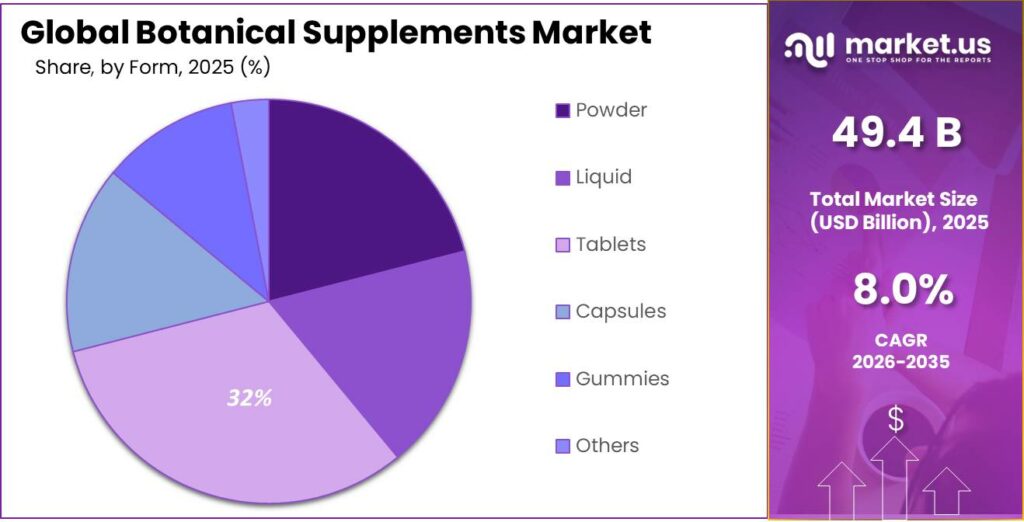
- Tablets held a dominant market position, capturing more than a 32.4% share.
- Energy & Weight Management held a dominant market position, capturing more than a 23.5% share.
- Offline held a dominant market position, capturing more than a 73.1% share.
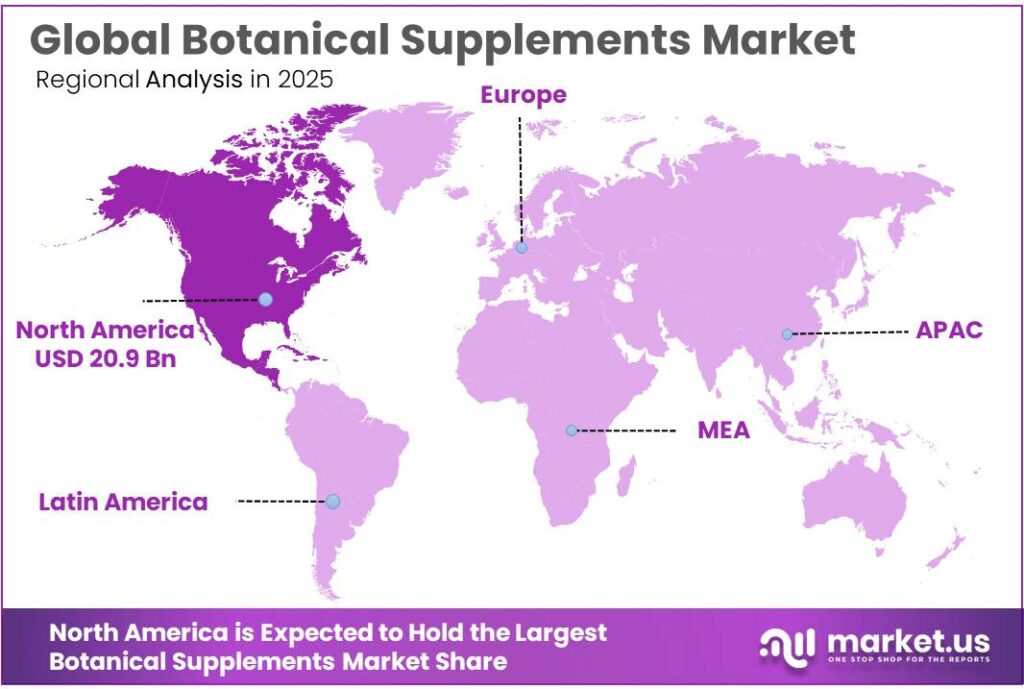
- North America remains the dominating region in the botanical supplements market, accounting for 42.4% share with a value of around USD 20.9 billion.
By Source Analysis
Herbs dominate with 35.7% share driven by strong consumer trust and traditional usage
In 2025, Herbs held a dominant market position, capturing more than a 35.7% share. This leadership mainly comes from the deep-rooted consumer familiarity with herbal ingredients such as ashwagandha, turmeric, ginseng, and tulsi, which have been used for generations in traditional health systems. Consumers continue to prefer herbs because they are perceived as natural, safer, and closer to daily dietary practices compared to more processed botanical extracts.
By Form Analysis
Tablets lead with 32.4% share due to convenience and precise dosing
In 2025, Tablets held a dominant market position, capturing more than a 32.4% share. This strong position is mainly because tablets are easy to use, store, and carry, making them a preferred choice for daily supplementation. Consumers like tablets as they offer a fixed and accurate dosage, which builds trust, especially in botanical supplements where consistency matters. Compared to powders or liquids, tablets are less messy and have a longer shelf life, which makes them suitable for both consumers and retailers.
By Application Analysis
Energy & Weight Management leads with 23.5% share driven by fitness and lifestyle trends
In 2025, Energy & Weight Management held a dominant market position, capturing more than a 23.5% share. This segment has grown strongly as more people focus on staying active, managing body weight, and improving daily energy levels. Botanical supplements such as green tea extract, garcinia cambogia, ginseng, and caffeine-based herbal blends are widely used for these purposes. Consumers are increasingly choosing plant-based options over synthetic products, as they are seen as safer and more suitable for long-term use.
By Distribution Channel Analysis
Offline channels dominate with 73.1% share due to trust and physical availability
In 2025, Offline held a dominant market position, capturing more than a 73.1% share. This strong presence is mainly because consumers still prefer buying botanical supplements from physical stores such as pharmacies, health stores, supermarkets, and traditional outlets. Many buyers trust offline channels as they can directly check the product, read labels, and sometimes get advice from pharmacists or store staff before making a purchase. This is especially important for health-related products, where confidence and product authenticity matter a lot.
Key Market Segments
By Source
- Herbs
- Leaves
- Spices
- Flowers
- Others
By Form
- Powder
- Liquid
- Tablets
- Capsules
- Gummies
- Others
By Application
- Energy & Weight Management
- General Health
- Bone & Joint Health
- Gastrointestinal Health
- Immunity
- Cardiac Health
- Diabetes
- Anti-cancer
- Others
By Distribution Channel
- Offline
- Online
Emerging Trends
Science-backed botanical supplements are becoming the clearest trend in the market
A major latest trend in the botanical supplements market is the clear move toward science-backed, quality-tested, and more regulated herbal products. This shift is happening because consumers still like natural wellness, but they now want proof, safety, and consistency before buying. The scale of demand is already strong.
The U.S. NIH Office of Dietary Supplements says about half of all U.S. adults use dietary supplements, with spending of almost US$60 billion a year, showing how large the broader supplement habit has become.
At the same time, the CDC reported that 57.6% of U.S. adults aged 20 and over used any dietary supplement in 2017–2018. On the herbal side, WHO says traditional, complementary and integrative medicine is used in 170 of 194 Member States, and 124 Member States have laws or regulations for herbal medicines. This matters because botanical supplements are no longer growing only through tradition. They are growing because brands are now presenting herbs in a more clinical, standardized, and trusted way.
Government support and medicinal plant systems are strengthening this trend further
This trend is also getting stronger because governments are putting more money and structure behind herbal ecosystems. India is one of the clearest examples. In the Union Budget for 2025–26, the Ministry of AYUSH received ₹3,992.90 crore. Within that, the National AYUSH Mission was allocated ₹1,275 crore, while the Central Sector Scheme for Conservation, Development and Sustainable Management of Medicinal Plants received ₹65 crore.
This is important because better cultivation, traceability, and quality control directly support botanical supplement makers. India’s National Medicinal Plants Board also works through 32 State Medicinal Plants Boards across the country, helping build a more organized raw material base for the sector. Globally, supply depth is also improving. FAO states that more than 1,000 medicinal plant species are in international trade, and over 30,000 plant species are known to have medicinal or aromatic uses.
Drivers
Rising Consumer Shift Toward Natural and Preventive Healthcare
One of the strongest driving factors for botanical supplements is the clear shift of consumers toward natural and preventive healthcare. Across the world, people are becoming more aware of long-term health and are trying to avoid synthetic medicines for everyday wellness needs.
According to the World Health Organization, more than 80% of the world’s population relies on traditional medicine, including herbal products, for primary healthcare needs. . This is not a small trend—it shows that plant-based health solutions are already deeply rooted in global healthcare behavior. In addition, traditional medicine practices are reported in 170 out of 194 countries, showing wide acceptance across both developed and developing regions
This growing reliance is also supported by biodiversity and availability of medicinal plants. The Food and Agriculture Organization estimates that there are over 50,000 medicinal plant species globally, which gives manufacturers a wide base for innovation and product development.
Strong Government Support and Expansion of Herbal Ecosystems
Globally, the expansion of trade in medicinal plants also reflects this institutional support. A recent scientific review highlighted that global trade of medicinal and aromatic plants has grown significantly, showing nearly 98% increase in trade value between 2010 and 2023, indicating rising international demand for plant-based products. This growth is not only driven by consumer demand but also by structured policies that promote sustainable harvesting, quality control, and export potential.
Restraints
Safety and Quality Concerns Limit Consumer Confidence
One of the major restraining factors for the botanical supplements market is the ongoing concern around safety, quality, and lack of standardization. While these products are widely perceived as natural and safe, the reality is more complex. Studies show that adverse effects linked to herbal medicines can range from as low as 0.03% to as high as 29.84%, with a pooled estimate of around 1.42%, indicating that safety risks are not negligible
Another major issue is contamination and adulteration. Reports have shown that herbal products can contain harmful substances such as heavy metals, pesticides, and microbial contaminants, which directly impact consumer safety. In fact, a U.S. government review found that 92% of tested herbal supplements contained lead and 80% had other chemical contaminants, raising serious concerns about manufacturing practices and quality control.
Lack of Standardization and Regulatory Gaps Across Markets
Another key challenge is the lack of uniform regulations and standardization across the global botanical supplements industry. Unlike pharmaceutical drugs, many herbal products are sold without strict requirements for proving safety or effectiveness before reaching the market. This creates a gap in quality assurance and makes it difficult for consumers to fully trust product claims. According to WHO guidance, safety in traditional medicine depends heavily on proper regulation, documentation, and quality control systems, which are still developing in many countries
Additionally, herbal products often contain multiple active compounds, sometimes more than 150 different chemical components in a single formulation, making it difficult to identify interactions and ensure consistent results. This complexity increases the chances of herb-drug interactions, especially when consumers use botanical supplements along with prescription medicines. In many cases, these interactions are not clearly labeled or understood, leading to potential health risks.
Opportunity
Expansion of Global Medicinal Plant Trade Creating New Growth Opportunities
One of the biggest growth opportunities for botanical supplements lies in the rapid expansion of global trade in medicinal and aromatic plants. This is not just a small niche anymore—it has become a large and steadily growing global industry. A 2025 scientific review shows that the global medicinal plants market was valued at around US$201 billion in 2023 and is expected to reach nearly US$375.6 billion by 2032, showing strong long-term demand for plant-based health products
The trade side is also expanding quickly. Global trade in medicinal plant resources is growing at an annual rate of around 10–12%, which clearly shows increasing demand across countries. In addition, more than 1,000 medicinal plant species are already in international trade, mainly used in food and wellness products. This wide variety gives companies strong opportunities to develop new products and enter new markets.
Rising Demand for Sustainable and Plant-Based Wellness Products
Another major opportunity comes from the rising demand for sustainable and plant-based wellness solutions. Consumers today are not only looking for health benefits but also for products that are natural, eco-friendly, and responsibly sourced.
According to the FAO, more than 30,000 plant species are known to have medicinal or aromatic uses, and over 10,000 species are actively used in traditional medicine systems, showing the huge natural resource base available for future product development
There is also a strong shift toward replacing synthetic ingredients with plant-based alternatives. Around 30% of pharmaceutical drugs globally are derived from plant compounds, which highlights the long-standing importance of botanicals in healthcare. This creates an opportunity for supplement companies to develop scientifically supported herbal products that can appeal to both traditional users and modern consumers.
Regional Insights
North America dominates with 42.4% share driven by high supplement usage and strong consumer awareness
North America remains the dominating region in the botanical supplements market, accounting for 42.4% share with a value of around USD 20.9 billion. This leadership is mainly supported by strong consumer awareness, high spending on health products, and a well-developed supplement ecosystem. The United States plays a central role in this dominance, where dietary supplement usage is already part of daily life for a large portion of the population.
In addition, data from the CDC shows that 57.6% of U.S. adults reported using dietary supplements, indicating consistent and widespread adoption across age groups. This high usage directly supports demand for botanical supplements, as many consumers prefer plant-based and natural ingredients for long-term wellness. Herbal products such as turmeric, echinacea, and ginseng are widely accepted in the region, supported by increasing interest in preventive healthcare and clean-label nutrition.
Key Regions and Countries Insights
- North America
- US
- Canada
- Europe
- Germany
- France
- The UK
- Spain
- Italy
- Rest of Europe
- Asia Pacific
- China
- Japan
- South Korea
- India
- Australia
- Rest of APAC
- Latin America
- Brazil
- Mexico
- Rest of Latin America
- Middle East & Africa
- GCC
- South Africa
- Rest of MEA
Key Players Analysis
NBTY Inc., now part of The Bountiful Company under Nestlé Health Science, is a major global supplement player with strong presence in vitamins and herbal products. The company generated around $3.4 billion in revenue (2020) and operates in more than 80 countries with over 22,000 products.It employs around 13,000 people, showing its large operational scale.NBTY’s portfolio includes well-known brands like Nature’s Bounty and Solgar, which offer herbal and botanical supplements targeting immunity, heart health, and overall wellness.
Ricola AG is a Switzerland-based company known for its herbal formulations, especially in cough drops and herbal wellness products. The company reported revenue of around CHF 307.2 million, supported by exports to more than 50 countries. Ricola uses a blend of 13 natural herbs, sourced from over 100 Swiss farms, ensuring strong supply chain control and quality. Its focus on natural ingredients and sustainable sourcing has helped it build a strong brand in herbal wellness, especially in Europe and North America.
PLT Health Solutions operates as a key ingredient supplier in the botanical supplements industry, focusing on scientifically supported plant-based solutions. The company generates estimated annual revenue of around $27 million and employs approximately 100 employees. Its role is more B2B-focused, supplying functional botanical ingredients to supplement and food companies. PLT is known for developing clinically researched ingredients that support areas like energy, cognition, and weight management, helping brands create differentiated and science-backed products.
Top Key Players Outlook
- Dabur India
- NBTY Inc.
- Ricola AG.
- PLT health Solution
- Mondelez International
- Procter and Gamble
- Nutraceutical International Company
- BASF SE
- The Himalaya Drug Company
- Glanbia Nutritionals
Recent Industry Developments
In 2025, Mondelez International reported global net revenue of around USD 38.5 billion and net earnings of about USD 2.5 billion, showing its strong financial scale and global reach across more than 150 countries.
PLT Health Solutions generates estimated annual revenue of about USD 27 million, with a revenue per employee of roughly USD 270,000, indicating efficient value generation through high-margin ingredient innovation.
Report Scope
Report Features Description Market Value (2025) USD 49.4 Bn Forecast Revenue (2035) USD 106.3 Bn CAGR (2026-2035) 8.0% Base Year for Estimation 2025 Historic Period 2020-2024 Forecast Period 2026-2035 Report Coverage Revenue Forecast, Market Dynamics, Competitive Landscape, Recent Developments Segments Covered By Source (Herbs, Leaves, Spices, Flowers, Others), By Form (Powder, Liquid, Tablets, Capsules, Gummies, Others), By Application (Energy And Weight Management, General Health, Bone And Joint Health, Gastrointestinal Health, Immunity, Cardiac Health, Diabetes, Anti-cancer, Others), By Distribution Channel (Offline, Online) Regional Analysis North America – US, Canada; Europe – Germany, France, The UK, Spain, Italy, Rest of Europe; Asia Pacific – China, Japan, South Korea, India, Australia, Singapore, Rest of APAC; Latin America – Brazil, Mexico, Rest of Latin America; Middle East & Africa – GCC, South Africa, Rest of MEA Competitive Landscape Dabur India, NBTY Inc., Ricola AG., PLT health Solution, Mondelez International, Procter and Gamble, Nutraceutical International Company, BASF SE, The Himalaya Drug Company, Glanbia Nutritionals Customization Scope Customization for segments, region/country-level will be provided. Moreover, additional customization can be done based on the requirements. Purchase Options We have three licenses to opt for: Single User License, Multi-User License (Up to 5 Users), Corporate Use License (Unlimited User and Printable PDF)  Botanical Supplements MarketPublished date: Mar 2026add_shopping_cartBuy Now get_appDownload Sample
 -
-
- Dabur India
- NBTY Inc.
- Ricola AG.
- PLT health Solution
- Mondelez International
- Procter and Gamble
- Nutraceutical International Company
- BASF SE
- The Himalaya Drug Company
- Glanbia Nutritionals
Our Clients

- 182160
- Mar 2026






