


Global Bambara Beans Market Size, Share, And Enhanced Productivity By Product Type (Whole Beans, Flour, Split Beans, Others), By Application (Food and Beverage, Animal Feed, Pharmaceuticals and Nutraceuticals, Cosmetics, Others), By Distribution Channel (Supermarkets and Hypermarkets, Specialty Stores, Convenience Stores, Others), By Region and Companies - Industry Segment Outlook, Market Assessment, Competition Scenario, Trends, and Forecast 2025-2034
- Published date: March 2026
- Report ID: 180769
- Number of Pages: 349
- Format:
-
keyboard_arrow_up
Quick Navigation
Report Overview
The Global Bambara Beans Market is expected to be worth around USD 282.1 million by 2034, up from USD 152.6 million in 2024, and is projected to grow at a CAGR of 6.3% from 2025 to 2034. With USD 73.7Mn value Middle East & Africa captures 48.3% Bambara Beans Market.
Bambara beans are nutrient-rich legumes traditionally grown in parts of Africa and valued for their strong adaptability to dry climates and poor soils. The crop produces small, round seeds that are rich in plant protein, fiber, and essential minerals. Bambara beans are commonly consumed in whole, roasted, or ground forms and are often used in traditional meals, porridges, snacks, and flour-based preparations. Because the plant can grow in challenging environmental conditions while maintaining nutritional value, it is often considered an important crop for food security and sustainable agriculture.
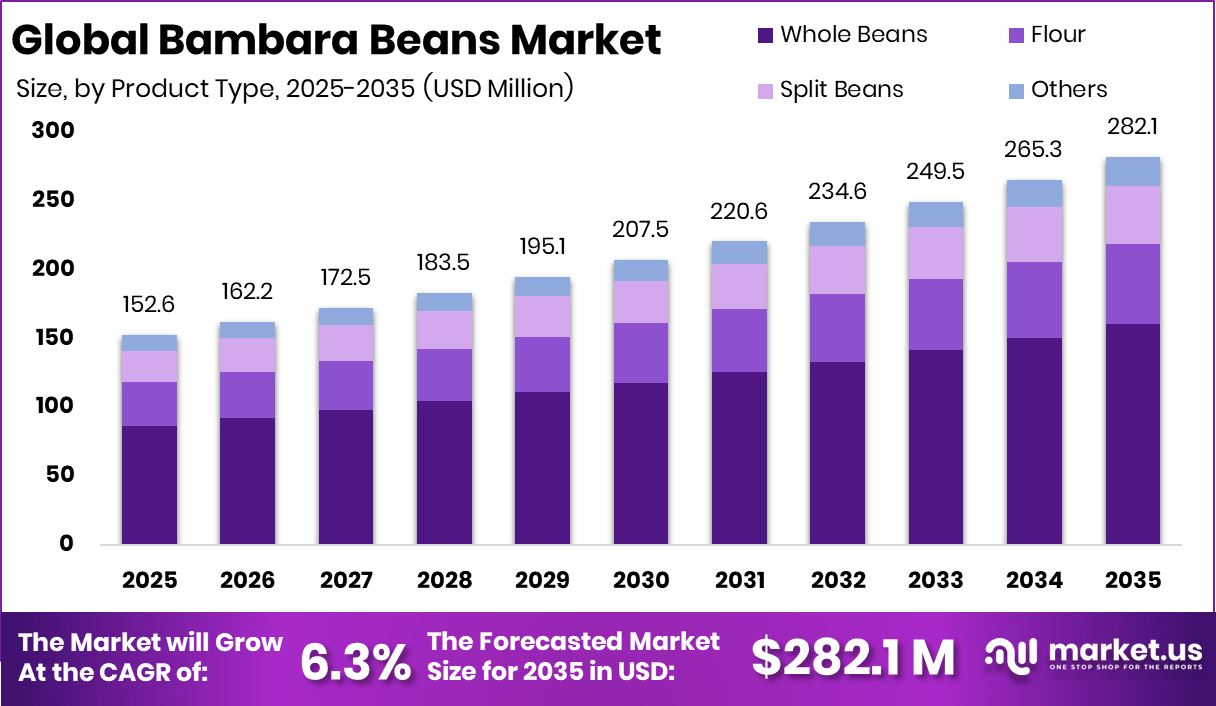
The Bambara Beans Market refers to the global trade, processing, and distribution of Bambara beans and related products across different industries. The market includes various product types such as whole beans, flour, split beans, and other processed forms that are supplied through supermarkets and hypermarkets, specialty stores, convenience stores, and other channels. Bambara beans are widely used in food and beverage products, animal feed, pharmaceuticals and nutraceuticals, cosmetics, and other applications. The market reflects the activities of growers, processors, distributors, and food manufacturers who integrate this legume into different product formats.
Several factors are contributing to the steady growth of the Bambara Beans Market. One major driver is the increasing global focus on plant-based nutrition and sustainable crop cultivation. Bambara beans naturally provide high levels of protein and essential nutrients while requiring relatively low agricultural inputs, making them appealing to farmers and food producers. Advances in food technology and agricultural research are also supporting the crop’s development. For example, Purdue researchers received $118,000 to develop freeze-drying, meat validation, and thermal imaging innovations, highlighting ongoing interest in improving food processing and preservation methods that can benefit plant-based ingredients.
Demand for Bambara beans is influenced by shifting consumer preferences toward healthier and plant-based food choices. Food producers are increasingly exploring traditional legumes as ingredients for new food formats, including snacks, flours, and functional foods. At the same time, wider investment activity across food, beauty, and ingredient industries is encouraging innovation that indirectly supports plant-based raw materials.
For instance, Oishii secured $16 million to expand its premium fruit production, while YSE Beauty closed $15 million in funding to develop modern beauty products. Similarly, RENÉE Cosmetics raised $30 million in Series C funding, reflecting the broader momentum in ingredient-driven product innovation that influences the demand for natural and plant-based materials.
Opportunities in the Bambara Beans Market are linked to product diversification, food innovation, and new industry applications. Beyond traditional food uses, Bambara beans have potential in nutraceutical formulations, functional ingredients, and cosmetic product development due to their nutritional profile. Expanding investment in plant-based and natural ingredient technologies is also opening new pathways.
For example, RAFIQ secured $11 million in Series B funding to construct a CGMP facility focused on plant-based cosmetic technology, highlighting the growing integration of plant-derived materials in advanced manufacturing. As food systems, cosmetics, and health industries continue to explore sustainable ingredients, Bambara beans present opportunities for new product formats, improved processing techniques, and expanded market accessibility across multiple sectors.
Key Takeaways
- The Global Bambara Beans Market is expected to be worth around USD 282.1 million by 2034, up from USD 152.6 million in 2024, and is projected to grow at a CAGR of 6.3% from 2025 to 2034.
- In the Bambara Beans Market, whole beans dominate product type segments, accounting for a significant 56.8% share.
- Within the Bambara Beans Market, food and beverage applications lead demand, contributing approximately 67.3% of usage.
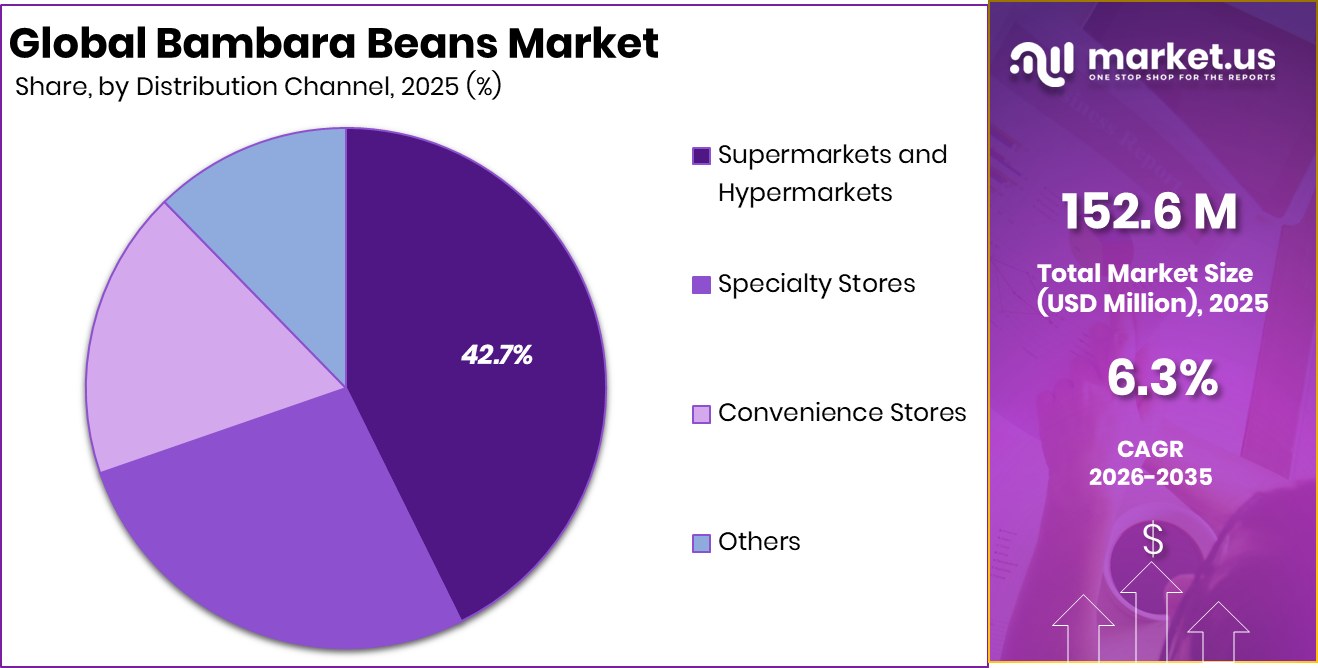
- In the Bambara Beans Market, supermarkets and hypermarkets remain the primary distribution channel with 42.7% share.
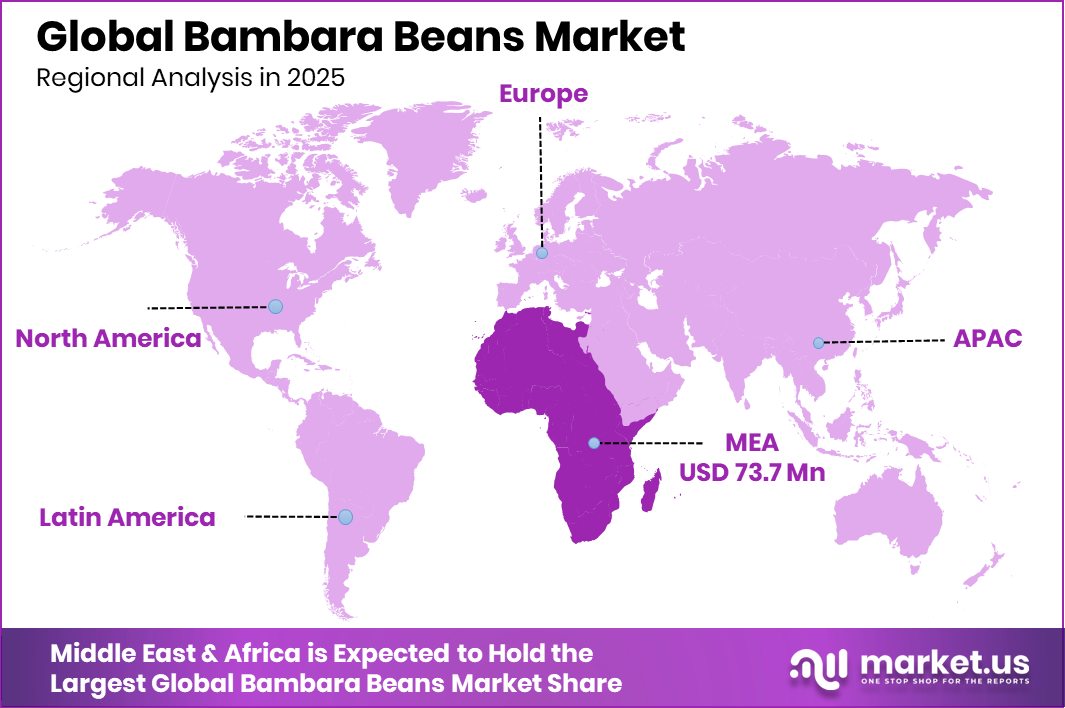
- Middle East & Africa records 48.3% Bambara Beans Market share, totaling USD 73.7Mn.
By Product Type Analysis
Whole beans dominate the Bambara Beans Market with a 56.8% product share globally.
In 2025, the Bambara Beans Market is largely dominated by whole beans, accounting for 56.8% of the overall product segment. Whole Bambara beans remain highly preferred because they retain their natural nutritional value, taste, and versatility in traditional cooking. Consumers in Africa, parts of Asia, and emerging international markets often use whole beans in stews, porridges, and roasted snacks, making them an essential ingredient in daily diets. Their long shelf life and minimal processing requirements also make them attractive for both small-scale farmers and commercial distributors.
As awareness of plant-based proteins increases globally, demand for whole Bambara beans continues to expand. Food processors and retailers are also promoting whole beans as a healthy, sustainable alternative to other legumes, strengthening their strong position in the Bambara Beans Market.
By Application Analysis
Food and beverage applications lead the Bambara Beans Market, accounting for 67.3% demand.
In 2025, the Food and Beverage segment represents the largest application area in the Bambara Beans Market, contributing 67.3% of total demand. Bambara beans are widely used in food preparation due to their high protein content, rich flavor, and adaptability across many cuisines. They are commonly processed into flour, snacks, beverages, and traditional dishes, particularly in African countries where the crop is considered nutritionally valuable.
The rising global interest in plant-based diets has also boosted the use of Bambara beans in food innovation, including dairy alternatives, protein powders, and fortified products. Food manufacturers are increasingly exploring Bambara beans as a functional ingredient because they offer both nutritional benefits and sustainability advantages. This growing integration into modern food products continues to strengthen the role of the Food and Beverage sector in the Bambara Beans Market.
By Distribution Channel Analysis
Supermarkets and hypermarkets drive the Bambara Beans Market distribution with a 42.7% share.
In 2025, supermarkets and hypermarkets account for 42.7% of the distribution share in the Bambara Beans Market, making them the leading retail channel. These large retail outlets provide consumers with easy access to packaged Bambara beans and related products in both urban and semi-urban areas. Supermarkets and hypermarkets offer advantages such as product variety, quality assurance, and convenient purchasing options, which attract a wide consumer base.
Retail chains are also expanding their shelves to include more plant-based and traditional food products, including Bambara beans, as consumer interest in nutritious legumes grows. Promotional campaigns, in-store visibility, and organized supply chains further support sales through this channel. As modern retail infrastructure expands in developing economies, supermarkets and hypermarkets are expected to remain a key distribution platform for the Bambara Beans Market.
Key Market Segments
By Product Type
- Whole Beans
- Flour
- Split Beans
- Others
By Application
- Food and Beverage
- Animal Feed
- Pharmaceuticals and Nutraceuticals
- Cosmetics
- Others
By Distribution Channel
- Supermarkets and Hypermarkets
- Specialty Stores
- Convenience Stores
- Others
Driving Factors
Rising demand for plant-based protein
The Bambara Beans Market is gaining momentum as global consumers increasingly look for plant-based protein sources that support balanced nutrition and sustainable food production. Bambara beans naturally provide high protein content and essential nutrients, making them a suitable ingredient for modern food applications. Food innovators and beverage companies are also exploring plant-based ingredients to meet changing dietary preferences.
Investment activity in alternative food and beverage innovation reflects this shift. For instance, Edible Coffee “Mokable” raised ¥150 million in seed funding through Suntory’s FRONTIER DOJO venture program, while Mumbai-based Subko Coffee Roasters secured $10 million in funding to expand specialty coffee experiences. Such investments show how companies are exploring novel food ingredients and alternative products, indirectly encouraging the development of diverse plant-based raw materials, including Bambara beans.
Restraining Factors
Limited global awareness of Bambara beans
Despite their nutritional value and agricultural resilience, Bambara beans remain relatively unfamiliar in many international markets. This limited awareness affects their adoption in mainstream food production and retail channels. Consumers outside traditional growing regions often lack knowledge about the bean’s culinary uses and health benefits. Meanwhile, innovation in alternative beverage and ingredient technologies continues to attract significant attention and funding, which can overshadow lesser-known crops.
For example, bean-free coffee innovators have raised about US$4.2 million to support global expansion, while frozen coffee startup Cometeer secured $35 million in a recent funding round to strengthen product development and distribution. These developments highlight how emerging food technologies are capturing strong investor interest, which can slow broader visibility and recognition for traditional crops such as Bambara beans.
Growth Opportunity
Expansion in functional food products
The Bambara Beans Market holds strong opportunities in functional food development as food companies continue exploring nutrient-dense plant ingredients for modern diets. Bambara beans provide protein, fiber, and essential nutrients that can support the creation of new food formats such as fortified snacks, flours, beverages, and plant-based blends. Expanding interest in alternative ingredient technologies further reflects the broader innovation environment around plant-based foods.
For instance, Compound Foods raised $4.5 million to develop coffee without traditional beans, while Singapore-based startup Prefer secured $2 million in seed funding led by Forge Ventures to advance sustainable beverage alternatives. Such developments demonstrate how investors are supporting ingredient innovation and food technology, creating a wider ecosystem where underutilized crops like Bambara beans can be explored for future functional food applications.
Latest Trends
Innovation in Bambara bean food ingredients
Innovation in plant-based food ingredients continues to influence how traditional crops are integrated into modern product development. Within the Bambara Beans Market, researchers and food developers are exploring new ways to process the beans into flours, protein ingredients, and ready-to-use food components. The broader beverage and ingredient innovation landscape reflects similar experimentation with plant-based formulations.
Chamberlain Coffee recently raised another $7 million in funding to expand its beverage product portfolio, while ansā coffee secured $9 million to strengthen market penetration and product innovation. These developments highlight how companies are investing in new ingredient formats and product concepts. Such innovation trends create opportunities for Bambara beans to be incorporated into evolving food and beverage categories that prioritize nutrition, sustainability, and diverse plant-based ingredients.
Regional Analysis
Middle East & Africa Bambara Beans Market holds 48.3% share worth USD 73.7Mn.
The Bambara Beans Market is analyzed across key regions, including North America, Europe, Asia Pacific, Middle East & Africa, and Latin America, reflecting varying levels of production, consumption patterns, and supply chain development.
North America represents an emerging market where increasing interest in plant-based protein sources and alternative legumes is gradually supporting demand for Bambara beans in specialty food products. In Europe, the market is gaining attention due to the rising focus on sustainable crops and nutrient-rich plant ingredients used in food innovation and research.
Asia Pacific is also witnessing growing awareness, particularly in health-focused food segments where traditional legumes and plant proteins are gaining traction. Latin America shows gradual market development as agricultural diversification and interest in resilient crops expand.
The Middle East & Africa region dominates the Bambara Beans Market, accounting for 48.3% of the total market share with a value of USD 73.7 Mn. The region’s dominance is strongly linked to the crop’s traditional cultivation, local consumption patterns, and established agricultural familiarity with Bambara beans, making it the primary production and consumption hub within the global market landscape.
Key Regions and Countries
- North America
- US
- Canada
- Europe
- Germany
- France
- The UK
- Spain
- Italy
- Rest of Europe
- Asia Pacific
- China
- Japan
- South Korea
- India
- Australia
- Rest of APAC
- Latin America
- Brazil
- Mexico
- Rest of Latin America
- Middle East & Africa
- GCC
- South Africa
- Rest of MEA
Key Players Analysis
In 2025, Earth Expo Company is recognized for its role in promoting Bambara beans through agricultural sourcing and international trade activities. The company focuses on connecting growers with broader food supply networks, helping increase the visibility of Bambara beans within ingredient markets. By working closely with farming communities and exporters, Earth Expo Company contributes to improving product availability and supporting supply consistency. Its involvement also reflects a growing interest in traditional legumes that hold strong nutritional value and adaptability to diverse climates. Through its sourcing and distribution efforts, the company supports the integration of Bambara beans into wider food ingredient channels, strengthening its presence within the evolving Bambara beans ecosystem.
Sacoma Global Foods Innovation CIC approaches Bambara beans from an innovation and development perspective. The organization emphasizes the use of Bambara beans in food product experimentation, ingredient development, and sustainable food initiatives. By exploring new ways to utilize Bambara beans in food formulations, Sacoma Global Foods Innovation CIC contributes to expanding their functional applications. The organization’s activities highlight the importance of underutilized crops in building resilient food systems. Through collaboration and food innovation programs, it plays a role in encouraging wider recognition of Bambara beans as a valuable ingredient.
WhatIF Foods focuses on transforming Bambara beans into consumer-oriented food products. The company integrates the crop into alternative food formats designed for modern consumers seeking nutritious plant-based options. By incorporating Bambara beans into product development strategies, WhatIF Foods demonstrates how traditional legumes can be adapted into contemporary food categories. Its approach highlights the versatility of Bambara beans while supporting broader awareness of their nutritional and culinary potential.
Top Key Players in the Market
- Earth Expo Company
- Sacoma Global Foods Innovation CIC
- WhatIF Foods
- Others
Recent Developments
- In November 2025, Earth Expo Company, a Gujarat-based exporter and supplier of natural food ingredients, spices, oils, and seeds, launched a new Bambara bean-based plant protein product line for health-focused retailers in North America and Europe, expanding its plant-based food offerings
- In October 2025, Sacoma Global Foods Innovation CIC, a UK-based food innovation and sustainable agriculture organization, expanded its food innovation and research initiatives, focusing on climate-resilient crops such as Bambara beans, supporting new food concepts, sustainable supply chains, and community-based agri-food innovation programs.
Report Scope
Report Features Description Market Value (2025) USD 282.1 Billion Forecast Revenue (2035) USD 152.6 Million CAGR (2026-2035) 6.3% Base Year for Estimation 2025 Historic Period 2020-2024 Forecast Period 2026-2035 Report Coverage Revenue Forecast, Market Dynamics, Competitive Landscape, Recent Developments Segments Covered By Product Type (Whole Beans, Flour, Split Beans, Others), By Application (Food and Beverage, Animal Feed, Pharmaceuticals and Nutraceuticals, Cosmetics, Others), By Distribution Channel (Supermarkets and Hypermarkets, Specialty Stores, Convenience Stores, Others) Regional Analysis North America – US, Canada; Europe – Germany, France, The UK, Spain, Italy, Rest of Europe; Asia Pacific – China, Japan, South Korea, India, Australia, Singapore, Rest of APAC; Latin America – Brazil, Mexico, Rest of Latin America; Middle East & Africa – GCC, South Africa, Rest of MEA Competitive Landscape Earth Expo Company, Sacoma Global Foods Innovation CIC, WhatIF Foods, Others Customization Scope Customization for segments, region/country-level will be provided. Moreover, additional customization can be done based on the requirements. Purchase Options We have three licenses to opt for: Single User License, Multi-User License (Up to 5 Users), Corporate Use License (Unlimited User and Printable PDF) 
-
-
- Earth Expo Company
- Sacoma Global Foods Innovation CIC
- WhatIF Foods
- Others
Our Clients

- 180769
- March 2026






