


Report Overview
Global Automotive Valve Market size is expected to be worth around USD 51.5 Billion by 2035 from USD 36.0 Billion in 2025, growing at a CAGR of 3.7% during the forecast period 2026 to 2035. This trajectory reflects sustained demand across combustion, hybrid, and electrified powertrain platforms globally.
The automotive valve market covers precision-engineered components that regulate gas exchange, fluid flow, pressure, and emissions across vehicle systems. Product categories span engine valves, HVAC and air-conditioning valves, control and emission valves, and fluid and pressure valves. These components serve OEM assembly lines and the independent aftermarket through two distinct sales channels.
Key Takeaways
- The global Automotive Valve Market is valued at USD 36.0 Billion in 2025 and is forecast to reach USD 51.5 Billion by 2035.
- The market grows at a CAGR of 3.7% from 2026 to 2035.
- Engine Valve dominates the By Valve Type segment with a 38.00% share.
- Mono-Metallic construction dominates the By Construction Type segment with a 59.20% share.
- Steel / Stainless Steel dominates the By Material segment with a 61.50% share.
- Engine System dominates the By Application System segment with a 34.00% share.
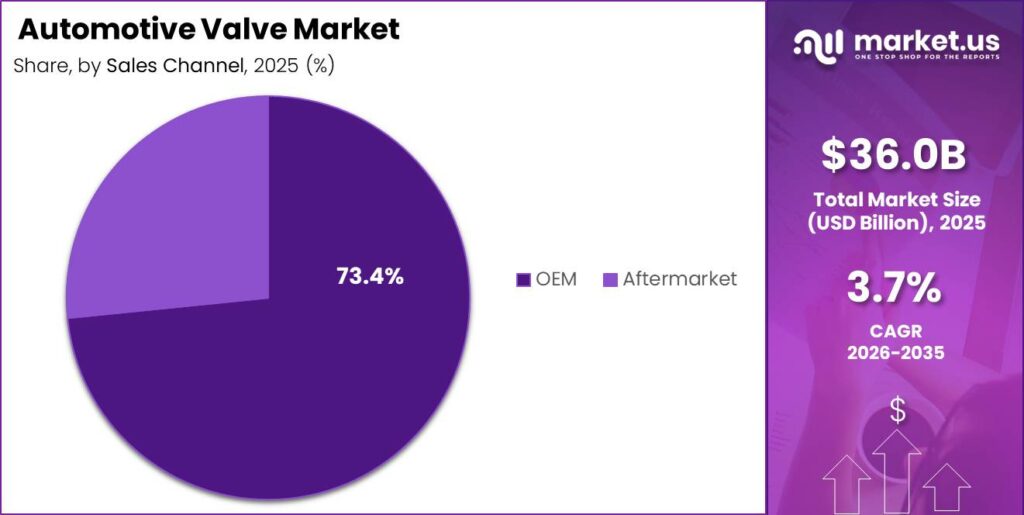
- OEM dominates the By Sales Channel segment with a 73.40% share.
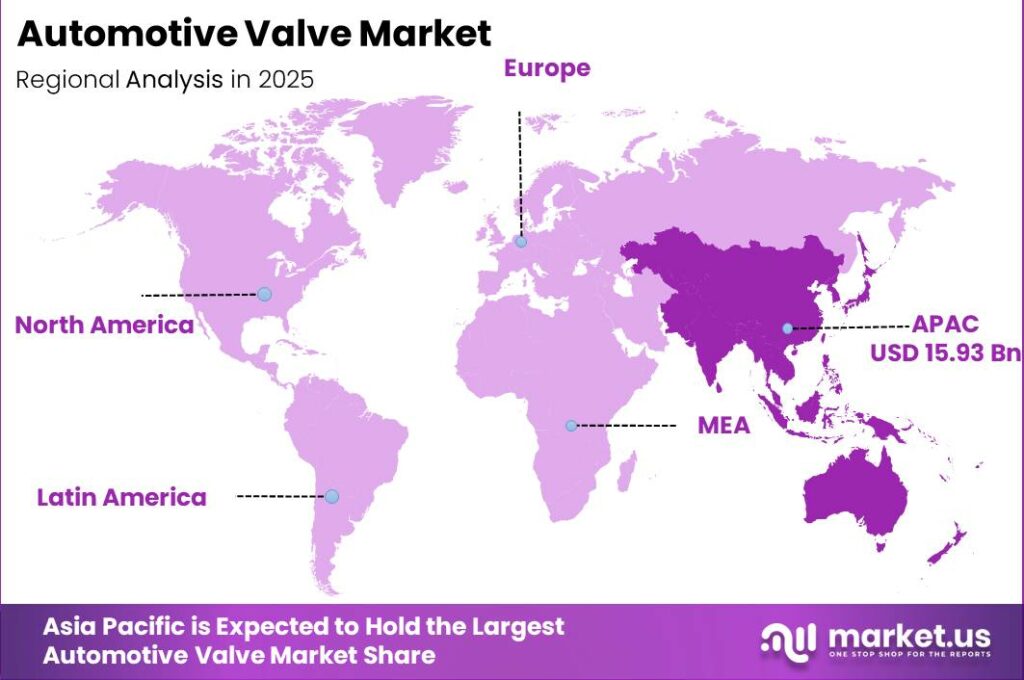
- Asia Pacific is the dominant region with a 44.30% share, valued at USD 15.93 Billion.
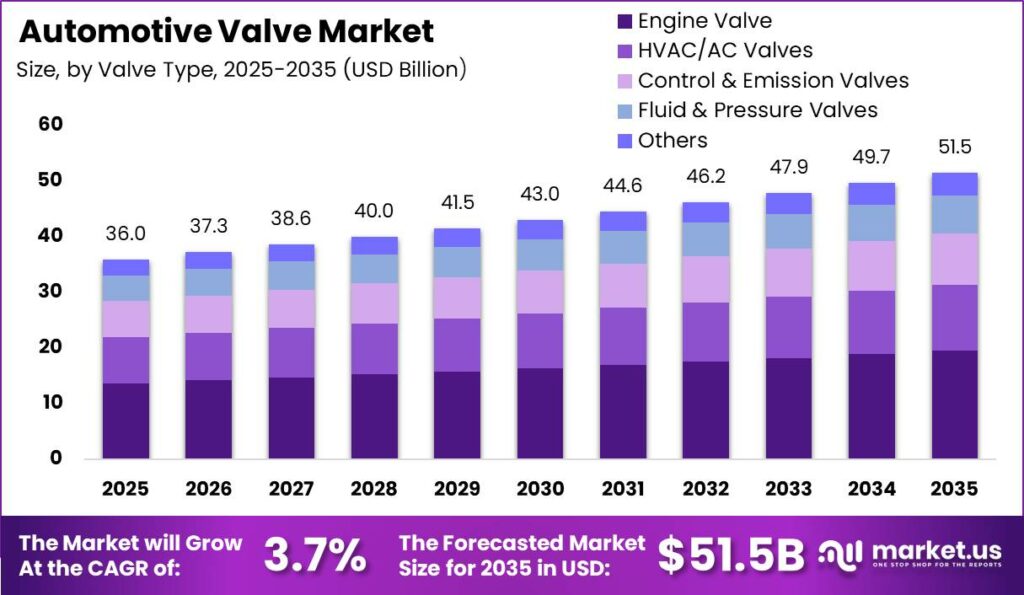
Tightening emission standards across Europe, North America, China, and India compel automakers to adopt precisely engineered valve components in both combustion and hybrid powertrains. Euro 7, adopted in 2024, adds stricter solid-particle provisions to existing exhaust limits. US multi-pollutant standards phase in from model year 2027 through 2032. This regulatory cycle directly sustains OEM valve sourcing volumes through the forecast period.
Hybrid powertrain adoption accelerates valve complexity per vehicle. Each hybrid platform requires gas-exchange, thermal-management, and emission-control valves simultaneously. This multi-system demand per unit means each vehicle produced contributes more valve content than a conventional combustion vehicle, lifting average revenue per unit for suppliers with diversified product lines.
As per our research, cold upsetting increased the seating-face hardness of a Ni30 exhaust valve by 60 HV0.2 compared with a conventional solution-aged valve. This durability gain reduces warranty returns and extends service intervals. Suppliers adopting cold-upset processing capture a measurable quality advantage over rivals using standard heat-treatment methods.
After 2 million impact cycles at 650°C, the cold-upset exhaust valve’s wear-scar area fell from 0.377 mm² to 0.246 mm², a reduction of 34.75%, while total valve and seat-insert wear decreased by as much as 26.76%. This performance data signals that cold-upset valves can command premium pricing in high-load engine programs. In April 2026, FUJI OOZX Inc. entered a revised five-year technical collaboration with SPR Auto Technologies for engine-valve manufacturing in India, signaling active technology transfer into high-growth emerging markets.
Valve Type Analysis
Engine Valve dominates with 38.00% due to high fitment across combustion and hybrid engines.
In 2025, Engine Valve held a dominant market position in the By Valve Type segment of the Automotive Valve Market, with a 38.00% share. Every combustion and hybrid vehicle requires multiple intake and exhaust valves per cylinder. This universal fitment, combined with replacement demand in the aftermarket, keeps engine valves structurally ahead of all other valve type categories throughout the forecast period.
HVAC and AC Valves address climate-control and cabin-comfort requirements across all vehicle classes. Electrified vehicles rely on heat-pump architectures that require additional electronically controlled expansion and switching valves compared with conventional systems. This structural shift increases HVAC valve content per vehicle on electrified platforms, creating incremental unit demand as EV and hybrid penetration rises.
Control and Emission Valves manage exhaust-gas recirculation, variable valve timing, turbocharger bypass, and fuel vapor recovery. Regulatory programs in Europe, the US, China, and India mandate tighter emission thresholds, requiring higher-precision, electronically actuated variants that carry higher unit values than mechanical predecessors. This per-unit revenue uplift offsets any volume pressure from engine downsizing.
Fluid and Pressure Valves govern coolant, brake fluid, and transmission fluid routing across the vehicle’s hydraulic and thermal circuits. As per our research, automotive thermal-loop valves support flow rates of 10 to 700 L/min, with pressure drops of 3.0 kPa at 200 L/min and 11 kPa at 400 L/min using a 50/50 glycol mixture at 20°C. Coolant valves with design lives of 35,000 operating hours address durability requirements for commercial and fleet operators, supporting aftermarket replacement cycles.
Construction Type Analysis
Mono-Metallic dominates with 59.20% due to cost efficiency and broad engine compatibility.
In 2025, Mono-Metallic held a dominant market position in the By Construction Type segment of the Automotive Valve Market, with a 59.20% share. Single-alloy construction offers lower production cost, proven machinability, and compatibility with established valve-seat and guide materials. OEMs default to mono-metallic valves in naturally aspirated and mildly turbocharged engines where thermal loads remain within established alloy tolerances.
Bimetallic valves join dissimilar alloys to place heat-resistant material at the head and lower-cost steel at the stem. This design targets high-load turbocharged and direct-injection engines where exhaust temperatures impose oxidation and recession risks on single-alloy heads. Bimetallic valves command a unit-price premium over mono-metallic alternatives, improving supplier margin per part in performance-focused programs. TLX Technologies’ 2025 modular valve family, which includes 3-way and 4-way switching valves with SAE coolant-port sizes up to 25.4 mm, reflects this premiumization trend in multi-material fluid-control components.
Hollow sodium-filled valves dissipate heat from the valve head through sodium movement within the hollow stem. This construction targets high-performance gasoline and racing engines where conventional solid or bimetallic designs cannot maintain acceptable head temperatures. Hollow valves carry the highest unit cost in this segment, limiting their fitment to premium and performance applications where thermal management is non-negotiable.
Material Analysis
Steel / Stainless Steel dominates with 61.50% due to balanced strength, heat resistance, and cost.
In 2025, Steel / Stainless Steel held a dominant market position in the By Material segment of the Automotive Valve Market, with a 61.50% share. Steel and stainless-steel alloys offer the combination of high-cycle fatigue strength, oxidation resistance, and machinability that mass-production engine programs require. The material’s established supply chain and machining infrastructure reinforce its dominant position across OEM sourcing decisions globally.
Titanium valves reduce reciprocating mass, lowering inertia loads on valve springs and camshaft actuation systems at high engine speeds. This weight benefit makes titanium the preferred material for performance, motorsport, and high-revving naturally aspirated engines. Titanium valves carry a significant unit-cost premium over steel, restricting volume to specialized segments where engineers prioritize power output over part cost.
Nickel alloy and aluminum valves address specific thermal and weight requirements in niche engine programs. Nickel alloys resist oxidation and corrosion at extreme exhaust temperatures above those manageable with standard stainless grades. Aluminum valves appear in limited applications where weight reduction is critical and operating temperatures remain controlled. Bronze, plastic, and remaining material types collectively hold the minor residual share, serving fluid-control and HVAC applications rather than gas-exchange service.
Application System Analysis
Engine System dominates with 34.00% due to universal valve fitment across all combustion platforms.
In 2025, Engine System held a dominant market position in the By Application System segment of the Automotive Valve Market, with a 34.00% share. Intake and exhaust valves, variable-valve-timing actuators, and EGR components all fall within the engine system category. Their mandatory presence in every combustion and hybrid powertrain makes this the highest-volume application system regardless of vehicle class or region.
Fuel System valves control injector return flow, vapor recovery, and high-pressure fuel delivery in direct-injection gasoline and diesel engines. Tighter emissions standards push OEMs toward port-and-direct injection combinations that increase fuel-system valve count per engine. This trend expands fuel-system valve addressable volume without requiring a proportional increase in vehicle production rates.
Brake System, HVAC System, Emission Control System, and Transmission System valves collectively address the remaining application share. Brake valves govern ABS and ESC modulation across all vehicle types. Emission control valves include EGR and canister purge applications mandated by global emissions programs. Transmission and HVAC system valves grow alongside automatic transmission penetration and electrified thermal-management architectures across major production markets.
Sales Channel Analysis
OEM dominates with 73.40% due to captive build volumes and long-term supply agreements.
In 2025, OEM held a dominant market position in the By Sales Channel segment of the Automotive Valve Market, with a 73.40% share. OEM contracts lock in valve specifications, volumes, and pricing over multi-year vehicle model cycles. This structure gives tier-one valve suppliers predictable revenue and scale advantages unavailable through spot-market aftermarket transactions.
The Aftermarket channel serves independent repair shops, franchised dealerships, and fleet operators replacing worn or failed valve components across the installed vehicle base. Aftermarket demand is counter-cyclical relative to new-vehicle production: slower new-vehicle sales extend the average vehicle age, increasing replacement frequency. Suppliers with strong OEM heritage benefit from brand recognition when vehicle owners and technicians source replacement parts.
Key Market Segments
By Valve Type
- Engine Valve
- HVAC/AC Valves
- Control and Emission Valves
- Fluid and Pressure Valves
- Others
By Construction Type
- Mono-Metallic
- Bimetallic
- Hollow (Sodium-Filled)
By Material
- Steel / Stainless Steel
- Titanium
- Nickel Alloy
- Aluminum
- Bronze
- Plastic
By Application System
- Engine System
- Fuel System
- Brake System
- HVAC System
- Emission Control System
- Transmission System
By Sales Channel
- OEM
- Aftermarket
Regional Analysis
Asia Pacific Dominates the Automotive Valve Market with a Market Share of 44.30%, Valued at USD 15.93 Billion
Asia Pacific controls 44.30% of the global automotive valve market, generating USD 15.93 Billion in 2025. China, Japan, South Korea, and India anchor this dominance through high-volume vehicle assembly, integrated tier-one supply chains, and government programs that mandate stricter emissions compliance across passenger and commercial vehicle segments. The region’s OEM concentration gives valve suppliers significant volume leverage and long-term contract visibility.
Europe is the fastest-growing region, driven by Euro 7 standards adopted in 2024 that require higher-precision, electronically actuated valve components across new vehicle types. In June 2025, Rheinmetall AG (Pierburg) secured an upper-double-digit-million-euro order for electronic throttle bodies and delta-pressure valves optimized for hybrid and range-extender engines, with production scheduled in China from 2026 to 2030. This cross-regional sourcing strategy reflects the integrated nature of European OEM supply chains with Asian manufacturing bases.
North America represents a mature but structurally resilient market sustained by commercial vehicle replacement cycles and multi-pollutant emission standards phasing in from model year 2027. Latin America, the Middle East, and Africa hold smaller individual shares but collectively offer growth potential as vehicle parc expansion, local content regulations, and rising fleet replacement rates create incremental valve demand outside the primary production hubs.
Key Regions and Countries
North America
- US
- Canada
Europe
- Germany
- France
- The UK
- Spain
- Italy
- Rest of Europe
Asia Pacific
- China
- Japan
- South Korea
- India
- Australia
- Rest of APAC
Latin America
- Brazil
- Mexico
- Rest of Latin America
Middle East and Africa
- GCC
- South Africa
- Rest of MEA
Drivers
Tightening exhaust-emission requirements sustain demand for precisely engineered intake, exhaust, EGR, fuel-control, turbocharger, and variable-valve-timing components in combustion and hybrid vehicles. The European Council adopted Euro 7 in 2024, maintaining existing Euro 6 exhaust limits for cars and vans while adding stricter solid-particle provisions and battery-durability requirements. US multi-pollutant standards finalized on March 20, 2024, phase in from model year 2027 through model year 2032. These milestones shift valve demand toward tighter-tolerance, heat-resistant, electronically actuated, and diagnostic-capable products, contributing an estimated +0.9% to the 3.7% baseline CAGR.
| Driver | (~) % Impact on CAGR Forecast | Geographic Relevance | Impact Timeline |
|---|---|---|---|
| Emissions-Compliant Engine Technology | +0.9% | Europe, North America, China, India | Short term (≤ 2 years) |
| Hybrid Powertrain Expansion | +0.8% | China, Japan, North America, Europe | Short term (≤ 2 years) |
| Thermal System Electrification | +0.7% | China, Europe, North America, South Korea | Medium term (2–4 years) |
| Turbocharged Engine Mix | +0.5% | Europe, China, North America, India | Short term (≤ 2 years) |
| Automatic Transmission Content | +0.4% | China, North America, Europe, ASEAN | Medium term (2–4 years) |
| Commercial Vehicle Replacement | +0.3% | North America, Europe, China, India | Short term (≤ 2 years) |
Restraints
Battery-electric vehicles eliminate cylinder-head intake and exhaust valves, camshaft actuation, variable-valve-timing assemblies, EGR valves, and several fuel-system control applications that historically generate substantial conventional valve volume. Electric-car sales exceeded 17 million globally in 2024, representing more than 20% of total car sales. The additional 3.5 million electric cars sold compared with 2023 alone exceeded total global electric-car sales recorded in 2020. This volume shift produces an estimated -1.1% deduction from the 3.7% baseline CAGR, forcing legacy suppliers to redirect capital toward thermal, brake, and fluid-control product lines.
| Restraint | (~) % Impact on CAGR Forecast | Geographic Relevance | Impact Timeline |
|---|---|---|---|
| Battery-Electric Powertrain Substitution | -1.1% | China, Europe, North America | Medium term (2–4 years) |
| Engine Downsizing Content Loss | -0.8% | Europe, China, North America | Short term (≤ 2 years) |
| Vehicle Production Volatility | -0.6% | Europe, North America, global exports | Short term (≤ 2 years) |
| Raw-Material Cost Inflation | -0.5% | Global | Short term (≤ 2 years) |
| Low-Trim Powertrain Decontenting | -0.4% | India, ASEAN, Latin America | Short term (≤ 2 years) |
| Legacy Capacity Underutilization | -0.3% | Europe, Japan, North America | Medium term (2–4 years) |
Challenges
Higher cylinder pressures, turbocharger temperatures, exhaust aftertreatment demands, and extended durability requirements increase the material-performance burden on valves, seats, guides, coatings, springs, and actuator interfaces. Exhaust-valve operating temperatures can exceed 700°C in highly loaded engines. Validation must demonstrate resistance to oxidation, thermal fatigue, seat recession, and stem wear over duty cycles extending beyond 150,000 kilometres. This creates an estimated -0.9% drag on maximum growth potential, requiring sustained investment in metallurgical capability, automated inspection, and localized validation infrastructure.
| Challenge | (~) % CAGR Friction Drag | Geographic Relevance | Mitigation Horizon |
|---|---|---|---|
| High-Temperature Material Qualification | -0.9% | Global, highest in turbocharged engines | Long term (≥ 4 years) |
| Precision Machining Yield | -0.7% | Global | Medium term (2–4 years) |
| Electromechanical Actuation Integration | -0.6% | Europe, China, North America, Japan | Medium term (2–4 years) |
| Fluid Compatibility Validation | -0.5% | Global | Long term (≥ 4 years) |
| Leakage Detection Requirements | -0.4% | Global | Medium term (2–4 years) |
| Specialist Talent Availability | -0.3% | Europe, North America, Japan, South Korea | Long term (≥ 4 years) |
Opportunities
Battery thermal switching valves represent an underexploited category for conventional automotive-valve suppliers whose product histories center on engine gas exchange and mechanical fuel control. A centralized EV thermal circuit may require 4 to 8 independently controlled valves per vehicle. A modular coolant-valve assembly can reduce hose connections, assembly operations, and potential leak paths by approximately 15% to 30% compared with discrete routing architectures. Suppliers securing design wins before thermal architectures standardize could achieve gross-margin expansion of roughly 5% to 10%, supporting a potential +1.0% uplift above the 3.7% baseline CAGR.
| Opportunity | (~) % Potential CAGR Upside | Geographic Relevance | Execution Window |
|---|---|---|---|
| Battery Thermal Switching Valves | +1.0% | China, Europe, North America, South Korea | Medium term (2–4 years) |
| Hydrogen Combustion Valves | +0.7% | Europe, Japan, North America, China | Long term (≥ 4 years) |
| Remanufactured Fleet Components | +0.6% | North America, Europe, India, China | Medium term (2–4 years) |
| Smart Diagnostic Valve Modules | +0.5% | North America, Europe, China, Japan | Medium term (2–4 years) |
| Off-Highway Fluid Controls | +0.5% | North America, Europe, China, Australia | Long term (≥ 4 years) |
| Modular Valve Platform Roll-Ups | +0.4% | Global | Medium term (2–4 years) |
Key Company Insights
Robert Bosch GmbH operates across engine management, HVAC, and emission-control valve categories simultaneously, giving it cross-platform content per vehicle that pure engine-valve specialists cannot match. This breadth means Bosch captures revenue as powertrains shift from combustion to hybrid configurations. However, exposure to BEV substitution risk is real in the engine-valve segment, requiring accelerated investment in thermal and fluid-control product lines.
DENSO Corporation leverages its integrated position within Toyota’s global supply network to secure long-cycle OEM contracts across engine, fuel-system, and thermal-management valve categories. This captive volume insulates DENSO from spot-market pricing pressure in the aftermarket channel. In April 2025, Rane Group completed the amalgamation of Rane Engine Valve Limited and Rane Brake Lining Limited into Rane (Madras) Limited, illustrating how regional valve specialists are consolidating product portfolios to match the diversification strategies of global tier-one suppliers like DENSO.
Key Players
- Robert Bosch GmbH
- DENSO Corporation
- Eaton Corporation plc
- MAHLE GmbH
- Continental AG
- Aisin Corporation
- BorgWarner Inc. (incl. Delphi)
- Tenneco Inc. (Federal-Mogul)
- Hitachi Astemo, Ltd.
- NITTAN Corporation
- FUJI OOZX Inc.
- Rheinmetall AG (Pierburg)
- Eagle Industry Co., Ltd.
- Rane Group
- MAHLE Tri-Ring Valve Train (Hubei) Co.
Recent Developments
- July 2025 – Tenneco Inc. (Federal-Mogul), through its DRiV business, launched Wagner HVAC components including automotive A/C expansion valves for the US and Canadian aftermarket, directly expanding its aftermarket valve portfolio in North America.
- September 2025 – MAHLE GmbH introduced a production-ready ethanol Power Cell Unit with adapted valve sets for engines operating on up to 100% ethanol and presented a compact EV thermal-management module integrating valves, extending its valve product scope across both alternative-fuel combustion and electrified platforms.
- January 2026 – Eaton Corporation plc announced a planned spin-off of its Vehicle and eMobility operations into an independent publicly traded Mobility company, including its global valve-actuation technology business; the separation remains proposed and is expected to close by the end of the first quarter of 2027.
Report Scope
| Report Features | Description |
|---|---|
| Market Value (2025) | USD 36.0 Billion |
| Forecast Revenue (2035) | USD 51.5 Billion |
| CAGR (2026-2035) | 3.7% |
| Base Year for Estimation | 2025 |
| Historic Period | 2020-2024 |
| Forecast Period | 2026-2035 |
| Report Coverage | Revenue Forecast, Market Dynamics, Market Opportunity Analysis, Technology and Innovation Landscape, Competitive Landscape, Recent Developments |
| Segments Covered | By Valve Type (Engine Valve, HVAC/AC Valves, Control and Emission Valves, Fluid and Pressure Valves, Others), By Construction Type (Mono-Metallic, Bimetallic, Hollow/Sodium-Filled), By Material (Steel/Stainless Steel, Titanium, Nickel Alloy, Aluminum, Bronze, Plastic), By Application System (Engine System, Fuel System, Brake System, HVAC System, Emission Control System, Transmission System), By Sales Channel (OEM, Aftermarket) |
| Regional Analysis | North America (US and Canada), Europe (Germany, France, The UK, Spain, Italy, and Rest of Europe), Asia Pacific (China, Japan, South Korea, India, Australia, and Rest of APAC), Latin America (Brazil, Mexico, and Rest of Latin America), Middle East and Africa (GCC, South Africa, and Rest of MEA) |
| Competitive Landscape | Robert Bosch GmbH, DENSO Corporation, Eaton Corporation plc, MAHLE GmbH, Continental AG, Aisin Corporation, BorgWarner Inc. (incl. Delphi), Tenneco Inc. (Federal-Mogul), Hitachi Astemo Ltd., NITTAN Corporation, FUJI OOZX Inc., Rheinmetall AG (Pierburg), Eagle Industry Co. Ltd., Rane Group, MAHLE Tri-Ring Valve Train (Hubei) Co. |
| Customization Scope | Customization for segments, region/country-level will be provided. Additional customization can be done based on requirements. |
| Purchase Options | We have three licenses to opt for: Single User License, Multi-User License (Up to 5 Users), Corporate Use License (Unlimited User and Printable PDF) |





































