


Report Overview
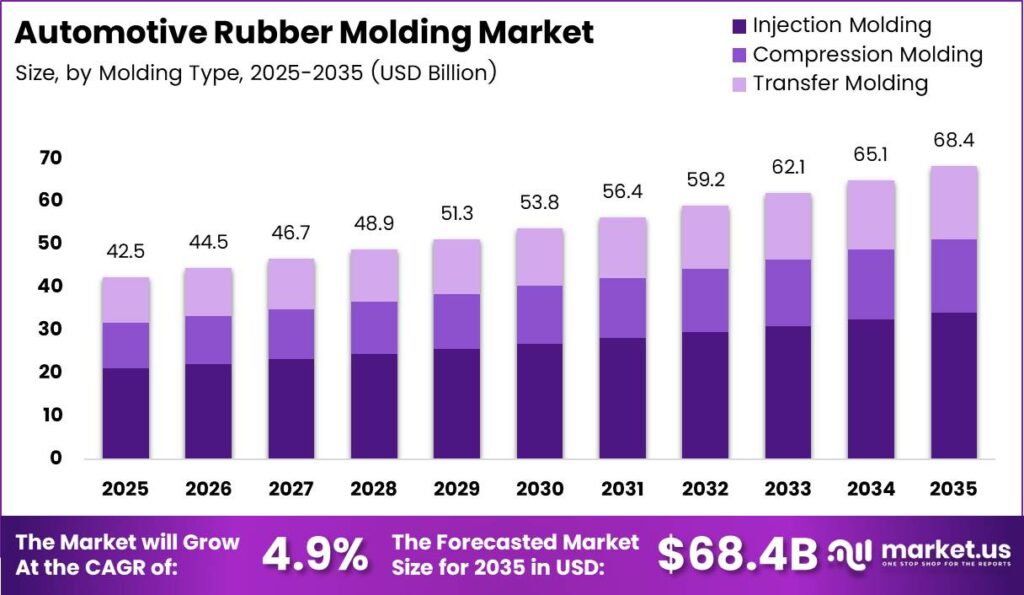
Global Automotive Rubber Molding Market size is expected to be worth around USD 68.4 Billion by 2035 from USD 42.5 Billion in 2025, growing at a CAGR of 4.9% during the forecast period 2026 to 2035.
The automotive rubber molding market covers manufactured elastomeric components that seal, dampen, protect, and connect systems across passenger and commercial vehicles. It spans three primary molding processes: injection, compression, and transfer. Key end products include grommets, gaskets, and bellows. This reflects a market built on platform-level engineering contracts, long qualification cycles, and deep OEM integration.
Key Takeaways
- The Global Automotive Rubber Molding Market was valued at USD 42.5 Billion in 2025 and is forecast to reach USD 68.4 Billion by 2035, growing at a CAGR of 4.9% during 2026 to 2035.
- By Molding Type, Injection Molding dominates the market with a 43.56% share in 2025, driven by its suitability for high-precision, high-volume automotive component production.
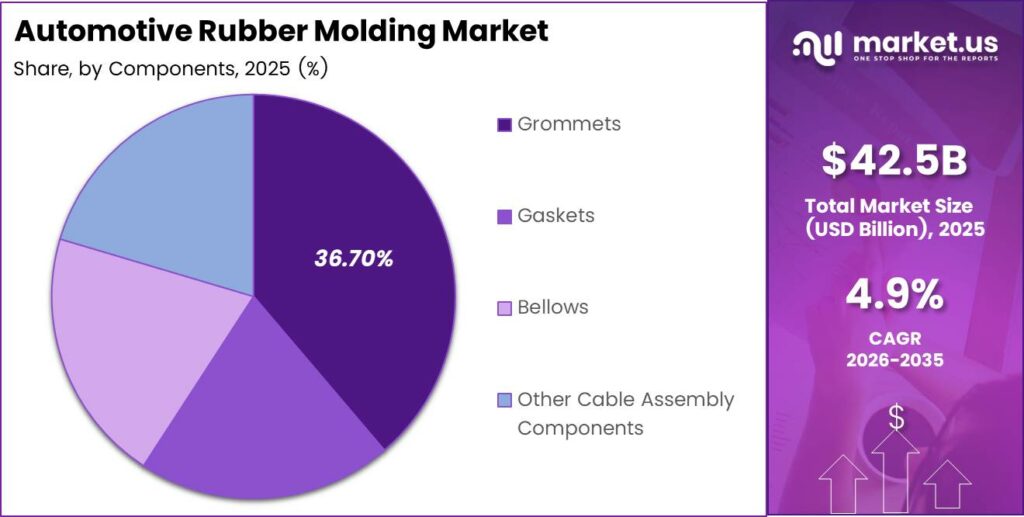
- By Components, Grommets hold the largest share at 36.45% in 2025, reflecting universal cable and wiring harness protection requirements across all vehicle platforms.
- By Vehicle, Passenger Cars account for 63.21% of the market in 2025, supported by the highest global unit volumes and rubber content per vehicle.
- Other Cable Assembly Components is the fastest-growing sub-segment within By Components, driven by expanding electrical architectures in both EV and advanced combustion platforms.
- Injection Molding is the fastest-growing molding type, while Passenger Cars is the fastest-growing vehicle segment, both benefiting from rising EV program volumes and per-vehicle content expansion.
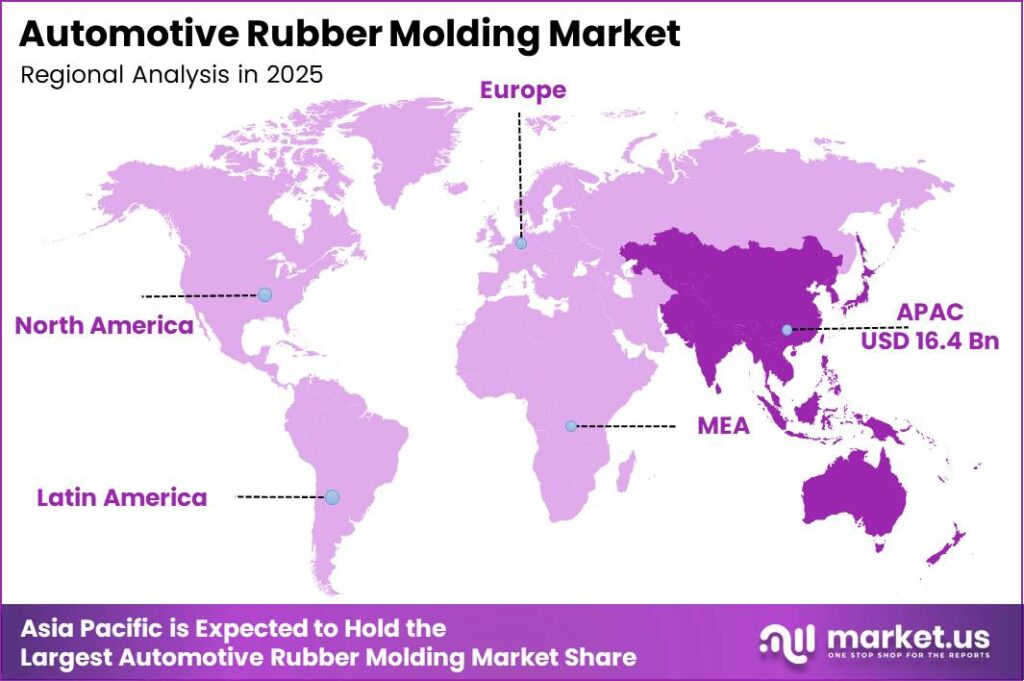
- Asia-Pacific is the dominant region with a 38.78% market share, valued at USD 16.4 Billion in 2025, and is simultaneously the fastest-growing region, led by vehicle production exceeding 61% of global output.
The United States imposed a 25% tariff on imported automobiles from April 3, 2025, and on specified automobile parts from May 3, 2025. An IMF tariff simulation estimated a 32% decrease in US goods imports and a 15% increase in US domestic sales. This trade shift forces suppliers to reassess cross-border production programs and accelerate regional manufacturing strategies.
As reported by ACEA, global car production increased 4.2% to 78.7 million units in 2025. Data from IEA shows global electric-car sales increased by more than 20% to 21 million units in 2025, representing one in four cars sold. These twin signals confirm that total vehicle output and EV penetration are both expanding, expanding the total addressable base for molded rubber components across all powertrain types.
World merchandise-trade volume growth was projected to decrease from 2.8% in 2024 to 2.4% in 2025 and 0.5% in 2026, according to WTO data. This deceleration compresses export-driven revenue for component suppliers serving global OEMs. Trelleborg’s December 2024 acquisition of Mampaey Offshore Industries, with SEK 170 million in sales and 30 employees, signals that leading players are using consolidation to offset slowing organic trade growth and secure specialized application coverage.
Molding Type Analysis
Injection Molding dominates with 43.56% due to high precision and fast cycle suitability.
In 2025, Injection Molding held a dominant market position in the By Molding Type segment of the Automotive Rubber Molding Market, with a 43.56% share. Injection molding delivers tight dimensional tolerances and supports high-volume production cycles that match OEM assembly line speeds. Trelleborg’s July 2024 acquisition of Baron Group, with SEK 1 billion in sales and 1,000 employees, signals how top suppliers are building injection-molding scale through consolidation rather than greenfield expansion.
Compression Molding serves high-load sealing applications where tooling simplicity and material efficiency outweigh cycle-time disadvantages. OEMs specify compression-molded parts for larger cross-section gaskets and vibration mounts where material flow consistency is more critical than production speed. This positions compression molding as the preferred process for heavy-duty and under-hood applications requiring sustained pressure performance.
Transfer Molding bridges the precision of injection and the simplicity of compression, targeting complex multi-cavity parts and insert-molded assemblies. This process supports tight shot control with lower tooling investment than full injection systems. As a result, transfer molding captures mid-tier programs where part complexity is high but annual volumes do not justify full injection tooling expenditure.
Components Analysis
Grommets dominates with 36.45% due to universal cable and harness protection requirements.
In 2025, Grommets held a dominant market position in the By Components segment of the Automotive Rubber Molding Market, with a 36.45% share. Grommets protect wiring harnesses and cable assemblies against abrasion, vibration, and fluid ingress at panel pass-throughs. According to Trelleborg data, IP54-rated grommets support cable diameters from 1 to 69 mm and wall thicknesses from 1 to 3 mm, covering the full harness diameter range found in modern vehicle platforms.
Gaskets form critical sealing interfaces across powertrain, battery, and body systems in both combustion and electric vehicles. ESTOH, a NOK Group company, produces plastic gaskets where approximately 90% of its products serve automotive lithium-ion battery applications. This concentration reflects how battery-system sealing is becoming a structurally distinct and high-value sub-category within the broader gasket segment.
Bellows protect articulating joints and shafts against dust, moisture, and mechanical wear across steering, driveshaft, and suspension systems. Trelleborg Type A-Green silicone bellows operate from -60°C to +180°C and at a maximum working pressure of 4 bar at 20°C, covering the full thermal and pressure envelope of passenger and commercial vehicle platforms. This thermal range makes silicone bellows the specification-of-record for extreme-environment powertrain protection.
Other Cable Assembly Components represent the fastest-growing sub-segment within the components breakdown, driven by expanding electrical architectures in both EV and advanced combustion platforms. The United States recorded 997 safety recalls involving more than 29 million vehicles in 2025, according to NHTSA data. This recall volume creates aftermarket demand for replacement cable assembly components, adding a non-OEM revenue channel that supports this sub-segment’s above-average growth rate. The automotive sector consumes nearly two-thirds of global natural rubber, while natural-rubber prices decreased 14% in April and May 2025 compared with the first quarter, after briefly exceeding USD 2 per kilogram, according to World Bank data. This price correction temporarily relieves compound cost pressure and improves margin visibility for molders serving this fast-growing sub-segment.
Vehicle Analysis
Passenger Cars dominates with 63.21% due to highest global unit volume and content per vehicle.
In 2025, Passenger Cars held a dominant market position in the By Vehicle segment of the Automotive Rubber Molding Market, with a 63.21% share. Indian passenger-vehicle sales reached 4.3 million units in FY2024-25, increasing 2% from FY2023-24, according to SIAM data. This sustained volume growth in a high-growth emerging market creates durable demand for molded rubber sealing and damping components across entry and mid-segment platforms.
Commercial Vehicles represent a segment with diverging internal dynamics that create distinct specification and volume patterns for rubber component suppliers. As reported by ACEA, EU truck registrations decreased 6.2% to 307,460 units, while bus registrations increased 7.5% to 38,238 units in 2025. This divergence signals that suppliers serving bus OEMs face different volume and specification trajectories than those serving freight truck platforms. ContiTech’s investment of more than USD 85 million in Mount Pleasant, Iowa, with approximately 50 new jobs planned, reflects continued commercial vehicle parts capacity commitment despite headline truck volume softness in Europe.
Key Market Segments
By Molding Type
- Injection Molding
- Compression Molding
- Transfer Molding
By Components
- Grommets
- Gaskets
- Bellows
- Other Cable Assembly Components
By Vehicle
- Passenger Cars
- Commercial Vehicles
Regional Analysis
Asia-Pacific Dominates the Automotive Rubber Molding Market with a Market Share of 38.78%, Valued at USD 16.4 Billion
Asia-Pacific holds the dominant regional position and is simultaneously the fastest-growing region in the automotive rubber molding market. According to OICA data, Asia-Pacific vehicle production increased 7.6% to approximately 59.2 million units in 2025, exceeding 61% of global production. This output concentration means that the majority of global molded rubber demand originates in the region, creating structural supplier proximity advantages for manufacturers based in China, Japan, South Korea, and India.
Europe represents the second-largest regional market and a key specification-setting region for premium and commercial vehicle rubber components. As reported by ACEA, EU car production reached 11.5 million vehicles in 2024, approximately 750,000 fewer than in 2023. This volume contraction signals pricing pressure across the European supply chain. Continental agreed to sell ContiTech to Lone Star Funds for €4 billion plus performance-based components of up to €250 million in July 2026, reflecting structural reorganization among major European rubber component players. Continental also inaugurated a more than €300 million Rayong expansion that added annual capacity for 3 million tires and created 600 jobs in May 2026, demonstrating continued Asia-based capacity investment despite European volume softness.
North America holds a strategically important position shaped by reshoring incentives and trade policy shifts. SIAM data confirms Indian passenger-vehicle sales reached 4.3 million units in FY2024-25, reinforcing South Asia as a structurally expanding sub-region within the broader Asia-Pacific demand base and creating additional sourcing opportunities for regional rubber component suppliers serving Indian OEM programs.
Key Regions and Countries
North America
- US
- Canada
Europe
- Germany
- France
- The UK
- Spain
- Italy
- Rest of Europe
Asia Pacific
- China
- Japan
- South Korea
- India
- Australia
- Rest of APAC
Latin America
- Brazil
- Mexico
- Rest of Latin America
Middle East and Africa
- GCC
- South Africa
- Rest of MEA
Market Dynamics
Market Opportunity Analysis - Underserved vehicle sub-segments and emerging regional markets offer high-return entry points for focused rubber component suppliers
The Other Cable Assembly Components sub-segment within the By Components group represents an underexploited high-growth pocket inside an otherwise mature product portfolio. OEM electrical architecture expansion and aftermarket recall-driven replacement demand are both pulling volume toward this sub-segment simultaneously. Suppliers that establish dedicated compound and tooling programs for cable assembly components will capture first-mover pricing before the segment attracts broader competition.
Transfer Molding remains a structurally underserved process tier between full injection tooling and basic compression programs. Mid-tier OEM programs that require multi-cavity insert molding without the volume to justify injection tooling capital represent a consistent award opportunity for transfer-molding specialists. This process gap creates a defensible niche for suppliers who invest in transfer tooling capacity and application engineering at mid-volume program scale.
Commercial Vehicles present a split opportunity structure across truck and bus sub-categories. Bus registrations increased 7.5% to 38,238 units in Europe in 2025 while truck registrations declined, confirming that bus platforms are a growing but distinct demand channel. Suppliers who segment their commercial vehicle coverage by platform type rather than treating the category as a single block will access bus-specific sealing and damping content that generalist truck suppliers do not actively pursue.
Latin America and the Middle East represent sub-regions with limited established supplier presence relative to the vehicle volume growth potential indicated by the regional market structure. By contrast, Asia-Pacific holds 38.78% market share and is attracting the most supplier investment. This concentration signals that Latin American and Middle Eastern OEM programs remain comparatively under-serviced, creating lower competitive density for entrants willing to establish regional application support and localized tooling partnerships.
Technology and Innovation Landscape - Precision molding equipment, advanced material ratings, and digital protection standards define the next competitive tier in automotive rubber components
Taiwan Kinki KT-series vertical injection-molding machines provide clamping forces from 15 to 250 tons, covering the full range of small-to-mid-volume automotive rubber component production. This clamping range supports complex multi-material and insert-molded grommet and seal configurations without requiring multiple dedicated press investments. Manufacturers who standardize on scalable vertical injection platforms reduce changeover time and tooling inventory across diverse OEM program mixes.
Wabash compression-molding presses provide tonnage up to 2,500 tons, with 400 to 1,000-ton configurations for elastomer transfer molding and large-part compression molding. This tonnage range enables production of heavy-duty gaskets, body mounts, and vibration isolators that exceed the capacity of standard injection equipment. Tung Yu’s transfer-injection molding machine provides 250 tons of clamping force, bridging the gap between compression and full injection tooling and enabling mid-volume programs to access insert-molding precision without injection capital costs.
Trelleborg cable-entry plates carry IP66/IP67 classifications and protect against dust, strong water jets, and immersion between 0.15 and 1 metre. These ingress-protection ratings set a verifiable performance benchmark that OEM procurement teams use as a minimum specification threshold for body electrical penetration components. Suppliers who engineer to IP66/IP67 certification as a baseline rather than a premium option position their products as specification-compliant from initial bid rather than requiring costly re-engineering after award.
Drivers
Electric-vehicle platform growth is reshaping the composition of rubber content per vehicle rather than simply adding volume to existing product lines. Global electric-car sales exceeded 17 million units in 2024 and were expected to surpass 20 million units in 2025, compelling molders to develop battery-pack gaskets, dielectric boots, coolant seals, and low-permeation hose families. Platform-level modeling indicates these applications raise relevant molded-rubber content by approximately 8% to 15%, supporting an estimated +0.35% contribution to the baseline CAGR.
Suppliers are shifting toward early engineering collaboration and multi-year platform awards to capture EV-driven content upside. Validation commonly precedes vehicle production by a modeled 12 to 24 months, which means strategic partners gain a structural timing advantage over transactional suppliers. This content shift supports a +0.35% CAGR contribution from EV sealing programs alone, making early co-design positioning a direct revenue-capture decision for rubber molders.
| Driver | (~) % Impact on CAGR Forecast | Geographic Relevance | Impact Timeline |
|---|---|---|---|
| Current EV Content Shift | +0.35% | China, Europe, North America | Short term (≤ 2 years) |
| Vehicle Output Resilience | +0.25% | Global | Short term (≤ 2 years) |
| Aging Fleet Replacements | +0.20% | Europe, Japan, North America | Medium term (2–4 years) |
| NVH Sealing Intensity | +0.15% | Global premium-vehicle platforms | Medium term (2–4 years) |
| Emissions-System Durability | +0.10% | Europe, North America, East Asia | Short term (≤ 2 years) |
| SUV Content Intensity | +0.05% | North America, Middle East, Asia-Pacific | Medium term (2–4 years) |
Restraints
The United States imposed an additional 25% tariff on covered imported automobile parts effective May 3, 2025, immediately raising landed-cost exposure for cross-border supply programs. Temporary manufacturer offsets equaled 3.75% of eligible aggregate vehicle MSRP through April 30, 2026, declining to 2.5% from May 1, 2026 through April 30, 2027. Scenario analysis indicates a potential 6% to 18% net landed-cost increase after exemptions, producing approximately -0.40% CAGR impact.
Suppliers exposed to tariff-affected import programs face margin compression by a modeled 2 to 5 percentage points where contractual pass-through clauses do not match duty timing or coverage. This forces a strategic choice between accepting margin erosion, renegotiating OEM contracts, or redirecting production toward regional plants. Importers who cannot localize quickly face tooling deferral and program loss risk in the short term.
| Restraint | (~) % Impact on CAGR Forecast | Geographic Relevance | Impact Timeline |
|---|---|---|---|
| Section 232 Duty Exposure | -0.40% | United States and import-dependent suppliers | Short term (≤ 2 years) |
| OEM Price-Down Mandates | -0.25% | Global | Short term (≤ 2 years) |
| Program Tooling Barriers | -0.18% | Emerging manufacturing markets | Medium term (2–4 years) |
| Thermoplastic Substitution | -0.12% | Europe, North America, East Asia | Long term (≥ 4 years) |
| Supplier-Base Consolidation | -0.10% | Global OEM programs | Medium term (2–4 years) |
| High Financing Costs | -0.05% | Capital-constrained emerging markets | Short term (≤ 2 years) |
Challenges
Natural-rubber supply faces structural exposure from concentrated production geography and tapping-labor constraints. Thailand alone produced more than 4.7 million tonnes in 2022, representing roughly one-third of global output. During the first 11 months of 2024, reported production reached 12.7 million tonnes against demand of 13.9 million tonnes, creating a supply-demand gap that drives compound cost volatility across all molding categories.
The 2025 outlook placed natural-rubber production growth at only 0.5% versus demand growth of 1.3%, widening the structural imbalance. This creates an estimated -0.30% friction drag through compound-cost volatility, rescheduling, and qualification risk. Molders must maintain a modeled 8 to 12 weeks of critical-material coverage and dual-source major grades to sustain production continuity without increasing rejection rates.
| Challenge | (~) % CAGR Friction Drag | Geographic Relevance | Mitigation Horizon |
|---|---|---|---|
| Natural-Rubber Supply Volatility | -0.30% | Global, concentrated in Southeast Asian sourcing | Long term (≥ 4 years) |
| Compound-Batch Consistency | -0.18% | Global | Medium term (2–4 years) |
| Process-Engineering Talent Gaps | -0.12% | North America, Europe, emerging Asia | Long term (≥ 4 years) |
| OEM Validation-Cycle Drag | -0.09% | Global regulated vehicle platforms | Medium term (2–4 years) |
| Tooling Changeover Complexity | -0.06% | High-mix manufacturing clusters | Medium term (2–4 years) |
| End-of-Life Material Separation | -0.05% | Europe and circularity-led markets | Long term (≥ 4 years) |
Opportunities
Next-generation battery sealing represents white space beyond conventional pack gaskets and coolant seals already in production. Immersion cooling, cell-to-pack architectures, and thermal-runaway barrier assemblies remain in development or limited platform deployment despite electric-car sales exceeding 17 million units in 2024. Successful qualification of dielectric, flame-resistant, and ultra-low-permeation molded systems could increase addressable sealing content per next-generation battery platform by a modeled 20% to 35%.
Co-designed assemblies, automated dispensing, and molded-in-place features could reduce installed cost per sealing interface by an estimated 4% to 7% and lower rework by 8% to 12%. Supplier operating margins could expand by approximately 3 to 5 percentage points relative to commoditized compression-molded parts. This positions early battery sealing specialists to capture long-term margin premiums that transactional component suppliers cannot access.
| Opportunity | (~) % Potential CAGR Upside | Geographic Relevance | Execution Window |
|---|---|---|---|
| Next-Generation Battery Seals | +0.18% | China, Europe, North America, South Korea | Medium term (2–4 years) |
| Sensorized Elastomer Components | +0.12% | Europe, Japan, North America | Long term (≥ 4 years) |
| Circular Premium Compounds | +0.10% | Europe and sustainability-led OEM markets | Medium term (2–4 years) |
| Hydrogen-Resistant Sealing | +0.07% | Europe, Japan, South Korea, China | Long term (≥ 4 years) |
| ADAS Sensor Protection | +0.05% | Global advanced-vehicle platforms | Medium term (2–4 years) |
| Regional M&A Roll-Ups | +0.03% | Fragmented supplier markets globally | Medium term (2–4 years) |
Key Company Insights
Trelleborg AB generated net sales of SEK 34,329 million in 2025 compared with SEK 34,170 million in 2024, with organic sales increasing 1%. This near-flat organic performance alongside a high-tempo acquisition strategy signals that Trelleborg is building market share through consolidation rather than volume growth. In September 2026, Trelleborg acquired M+R Dichtungstechnik, with annual sales exceeding SEK 85 million and 20 employees, adding precision sealing capacity in a specialized segment. Trelleborg also announced a 24,630 square metre technology and production facility in Wuxi in June 2025, with capacity for a potential 20% output increase and approximately 200 technology-centre employees.
NOK Corporation recorded net sales of JPY 766,859 million and operating income of JPY 37,264 million in FY2024, with operating income increasing 62.6%. This sharp profitability gain on modest revenue growth of 2.2% points to aggressive cost structure improvement rather than top-line momentum. ESTOH, within the NOK Group, directs approximately 90% of its products toward plastic gaskets for automotive lithium-ion battery applications, positioning the group with concentrated EV sealing exposure. Trelleborg’s April 2024 acquisition of MNE Group, with SEK 300 million in sales and 108 employees, illustrates the competitive consolidation pressure NOK faces from European peers expanding their sealing portfolio.
Key Players
- Taiwan Kinki Machinery Co., Ltd.
- ALP Group
- Roop Polymers Ltd
- Asean Rubber Pvt. Ltd
- Sujan Industries
- Bohra Rubber Pvt. Ltd
- NOK Corporation
- Trelleborg AB
- Jayem Auto Industries Pvt Ltd
- Bony Polymers Pvt Ltd
- Other Key Players
Recent Developments
- June 5, 2026 – Trelleborg acquired Gomet for €42.5 million; Gomet generated approximately €24 million in 2025 revenue, expanding Trelleborg’s elastomeric sealing portfolio in the European aftermarket segment.
- January 7, 2026 – Trelleborg acquired Nexus Elastomer Molds, which had approximately SEK 160 million in external sales and 50 employees, adding specialized elastomer tooling and mold-making capabilities to its production platform.
- October 23, 2025 – Freudenberg secured €100 million in EIB financing for an approximately €214 million research-and-development program, directing capital toward next-generation sealing and elastomeric material innovation.
- November 13, 2025 – TRP Sealing Systems invested more than €500,000 in an automated injection-molding press, increasing production throughput and reducing manual cycle dependencies in its sealing component manufacturing operations.
- May 6, 2025 – Trelleborg acquired Sico Gesellschaft fur Siliconverarbeitung and Sico Silicone, which had SEK 280 million in sales and 330 employees, strengthening its silicone compound molding capabilities for high-temperature automotive applications.
- April 2, 2025 – Trelleborg acquired National Gummi, which had SEK 150 million in sales and 60 employees, adding natural-rubber molding capacity to its European manufacturing network.
Report Scope
| Report Features | Description |
|---|---|
| Market Value (2025) | USD 42.5 Billion |
| Forecast Revenue (2035) | USD 68.4 Billion |
| CAGR (2026-2035) | 4.9% |
| Base Year for Estimation | 2025 |
| Historic Period | 2020-2024 |
| Forecast Period | 2026-2035 |
| Report Coverage | Revenue Forecast, Market Dynamics, Market Opportunity Analysis, Technology and Innovation Landscape, Competitive Landscape, Recent Developments |
| Segments Covered | By Molding Type (Injection Molding, Compression Molding, Transfer Molding), By Components (Grommets, Gaskets, Bellows, Other Cable Assembly Components), By Vehicle (Passenger Cars, Commercial Vehicles) |
| Regional Analysis | North America (US and Canada), Europe (Germany, France, The UK, Spain, Italy, and Rest of Europe), Asia Pacific (China, Japan, South Korea, India, Australia, and Rest of APAC), Latin America (Brazil, Mexico, and Rest of Latin America), Middle East and Africa (GCC, South Africa, and Rest of MEA) |
| Competitive Landscape | Taiwan Kinki Machinery Co., Ltd., ALP Group, Roop Polymers Ltd, Asean Rubber Pvt. Ltd, Sujan Industries, Bohra Rubber Pvt. Ltd, NOK Corporation, Trelleborg AB, Jayem Auto Industries Pvt Ltd, Bony Polymers Pvt Ltd, Other Key Players |
| Customization Scope | Customization for segments, region/country-level will be provided. Additional customization can be done based on requirements. |
| Purchase Options | We have three licenses to opt for: Single User License, Multi-User License (Up to 5 Users), Corporate Use License (Unlimited User and Printable PDF) |





































