


Report Overview
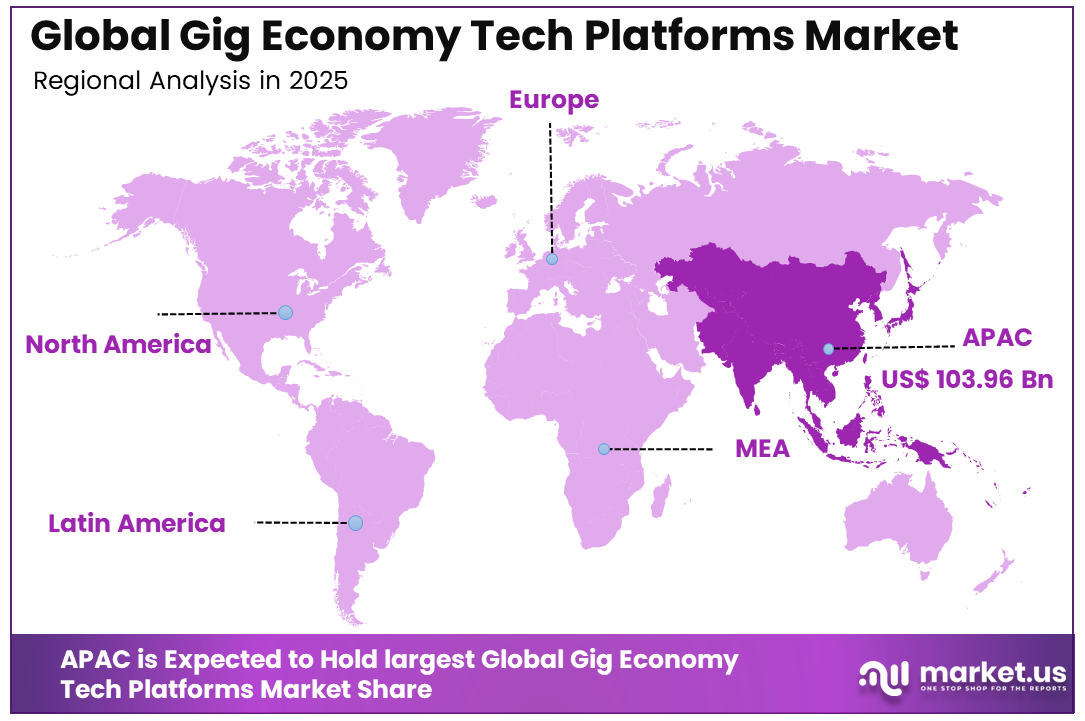
The Global Gig Economy Tech Platforms Market size is expected to be worth around USD 1,012.55 billion by 2035, from USD 230.52 billion in 2025, growing at a CAGR of 15.95% during the forecast period from 2026 to 2035. Asia Pacific held a dominant market position, capturing more than a 45.1% share, holding USD 103.96 billion in revenue.
Gig Economy Tech Platforms refer to digital systems that connect independent workers with customers or businesses for short-term, flexible, or task-based work. These platforms support services such as ride sharing, food delivery, freelancing, home services, and professional projects by managing job matching, payments, ratings, communication, and worker access through mobile or web-based tools.
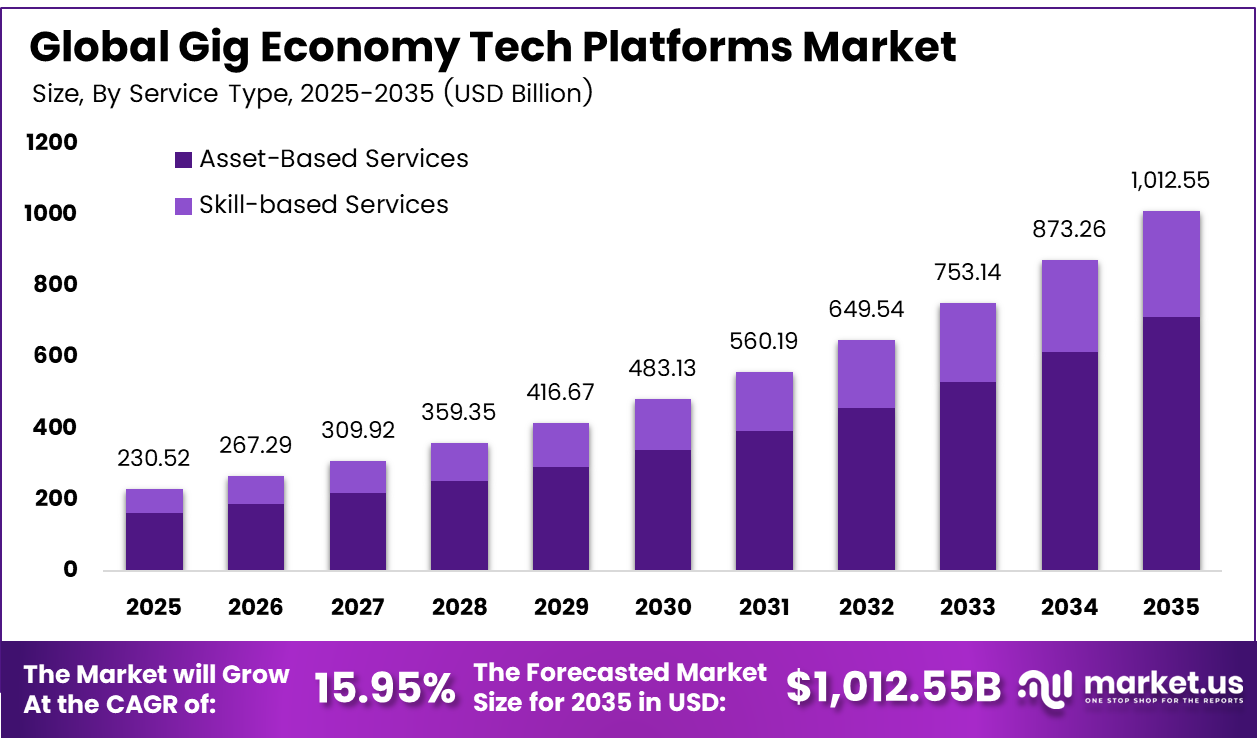
Top Driving Factors Include rising preference for flexible work, quick urban services, and strong smartphone adoption. Mobile internet access now covers well over 90% of people in many large economies, helping digital platforms reach workers and consumers more easily. This has supported faster matching, better service access, and wider use of gig-based work models.
The market for Gig Economy Tech Platforms is driven by rising demand for flexible income, faster digital services, and app-based work access. Workers prefer task-based roles that fit their schedules, while businesses use platforms to manage short-term demand and access skilled talent. Strong smartphone use, digital payments, and urban service needs further support platform adoption.
Demand Analysis is shaped by younger workers seeking side income, retirees re-entering part-time roles, and companies using gig labour during seasonal peaks. Independent contractors in some countries have grown about 3 times faster than traditional workers over recent years. This shows how flexible work is becoming a practical option for both individuals and businesses.
For instance, in November 2025, Fiverr enhanced its AI-assisted brief and project-scoping tools to help buyers define requirements and budgets more clearly. This upgrade supports higher conversion and satisfaction on complex digital services, reinforcing Fiverr’s position as a curated marketplace rather than a pure low-cost freelancing site.
Key Takeaway
- In 2025, the Asset-Based Services segment held a dominant market position, capturing a 70.4% share of the Global Gig Economy Tech Platforms Market.
- In 2025, the On-Demand Marketplaces segment held a dominant market position, capturing a 64.8% share of the Global Gig Economy Tech Platforms Market.
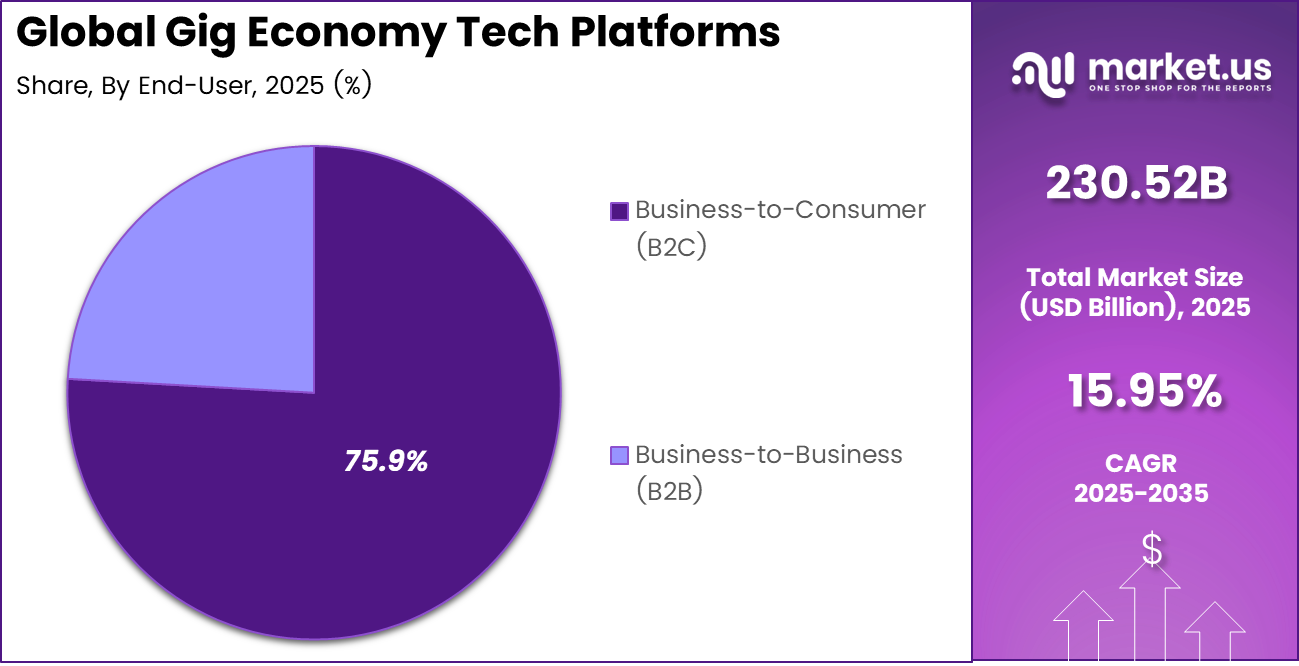
- In 2025, the Business-to-Consumer (B2C) segment held a dominant market position, capturing a 75.9% share of the Global Gig Economy Tech Platforms Market.
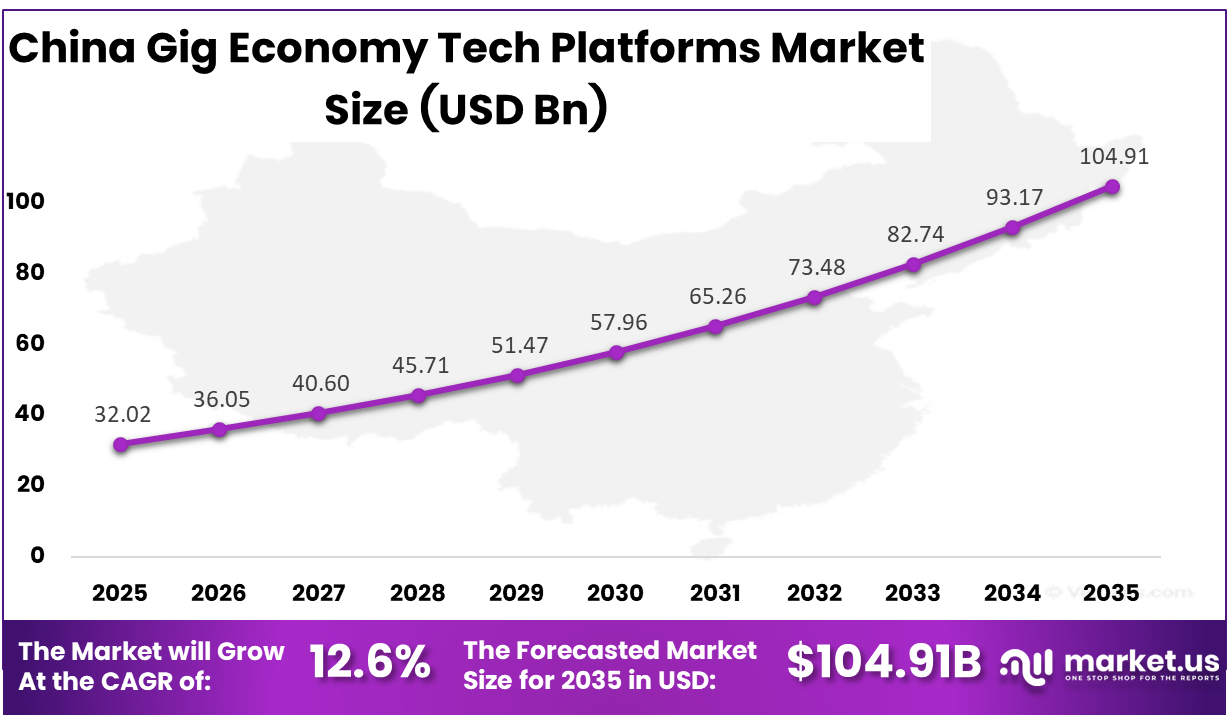
- The China Gig Economy Tech Platforms Market was valued at USD 32.02 Billion in 2025, with a robust CAGR of 12.6%.
- In 2025, the Asia Pacific held a dominant market position in the Global Gig Economy Tech Platforms Market, capturing more than a 45.1% share.
Role of Generative AI
Generative AI is helping gig economy tech platforms improve how workers and customers are matched. It can study job requirements, worker skills, location, pricing, and past performance to suggest better task assignments. This helps platforms reduce delays, improve service quality, and support smoother experiences for both workers and users.
Generative AI also supports customer service, fraud checks, content creation, and worker guidance. Chatbots can answer questions, explain policies, and help users resolve issues faster. For workers, AI tools can support profile writing, proposal creation, route planning, and skill training, making platform work more efficient and accessible.
Investment and Business Benefits
Investment Opportunities are expanding across consumer-facing apps, business-to-business freelance marketplaces, payment systems, identity checks, insurance, and worker training. Some analyses suggest tens of millions of people already depend on platform work as their primary income source. This creates room for platforms that improve trust, payments, safety, and worker support.
Business Benefits include labour costs that adjust with demand, access to specialised skills across borders, faster entry into new cities, and lower dependence on large permanent teams. These benefits can improve utilisation and shorten service times by 20 to 40% in scaled operations, making gig platforms useful for companies seeking flexible capacity.
Regional Analysis
In 2025, the Asia Pacific held a dominant market position in the Global Gig Economy Tech Platforms Market, capturing more than a 45.1% share, holding USD 103.96 billion in revenue. This dominance is due to large urban populations, high smartphone use, and strong demand for app-based services across transport, delivery, home support, and freelance work. Asia Pacific has a large base of young workers seeking flexible income, while consumers prefer quick and affordable digital services. Businesses are also using platform-based labour to manage peak demand, expand city coverage, and improve operational flexibility.
For instance, in July 2025, Freelancer Limited reported group gross merchandise volume of about 439 million dollars for the first half, with resilient marketplace activity despite macro headwinds, confirming that its diversified project mix across IT, creative and professional services keeps it a central platform for online gig work originating in and flowing through Asia-Pacific.
China Gig Economy Tech Platforms Market Size
The market for Gig Economy Tech Platforms within China is growing tremendously and is currently valued at USD 32.02 billion; the market has a projected CAGR of 12.6%. The market is growing due to strong mobile app usage, high digital payment adoption, and rising demand for flexible work in large urban areas. Consumers increasingly prefer fast delivery, ride-hailing, home services, and online freelance support. Businesses are also using platform-based workers to manage seasonal demand, reduce fixed labour pressure, and improve service reach across major cities.
For instance, in April 2026, Alibaba strengthened its gig ecosystem by deepening Ele.me’s integration with Taobao and local merchants, while Xianyu’s fast-growing service categories, from skill monetisation to emotional companionship, drew millions of young flexible workers, turning the platform into a key innovation hub for new gig-work formats in China.
Key Regions and Countries
North America
- US
- Canada
Europe
- Germany
- France
- The UK
- Spain
- Italy
- Russia
- Netherlands
- Rest of Europe
Asia Pacific
- China
- Japan
- South Korea
- India
- Australia
- Singapore
- Thailand
- Vietnam
- Rest of APAC
Latin America
- Brazil
- Mexico
- Rest of Latin America
Middle East & Africa
- South Africa
- Saudi Arabia
- UAE
- Rest of MEA
Service Type Analysis
In 2025, the Asset-Based Services segment held a dominant market position, capturing a 70.4% share of the Global Gig Economy Tech Platforms Market. This dominance is due to the strong use of physical assets in ride-hailing, delivery, home services, and rental-based platform models. Customers prefer fast access to vehicles, spaces, tools, and local services without ownership, which supports steady use of asset-based gig economy platforms.
Asset-based services also gain from location tracking, digital payments, ratings, and real-time booking systems. These features make service delivery easier for both workers and customers. The model remains practical because it connects available assets with immediate consumer needs simply and reliably.
For instance, in May 2026, Instacart expanded its Ads Manager tools for retailers, deepening ties with grocery partners that depend on its network of shoppers and stores for last-mile delivery. By helping retailers run their own campaigns, Instacart strengthens the asset-based side of its marketplace, where personal shoppers and vehicles keep orders moving.
Platform Model Analysis
In 2025, the On-demand Marketplaces segment held a dominant market position, capturing a 64.8% share of the global gig economy tech platforms market. This dominance is due to the ability of on-demand marketplaces to connect customers and workers quickly. These platforms reduce waiting time, simplify booking, and help users access services when needed. Their real-time matching model is useful across delivery, transport, repairs, freelancing, and local support work.
On-demand marketplaces are also preferred because they offer transparent pricing, worker profiles, ratings, and easy payment options. This creates trust and improves user convenience. For businesses, the model helps manage short-term demand without building large permanent teams or complex service networks.
For instance, in May 2026, DoorDash launched new AI-powered tools to help merchants onboard faster and grow across channels, making it easier for restaurants and retailers to join its marketplace. The company also expanded reservations and grocery programs, reinforcing its position as an on-demand hub where consumers can access a wide range of local services in one place.
End-User Analysis
In 2025, the Business-to-Consumer (B2C) segment held a dominant market position, capturing a 75.9% share of the Global Gig Economy Tech Platforms Market. This dominance is due to strong consumer demand for quick, app-based services in daily life. People use gig platforms for mobility, food delivery, personal tasks, home support, and short-term rentals. The segment benefits from convenience, simple access, and growing comfort with mobile-based service booking.
Business-to-Consumer platforms also gain from repeat usage and high visibility in urban markets. Consumers often return to platforms that provide speed, reliability, and easy payments. This makes the model suitable for companies seeking direct customer reach and flexible service delivery across different locations.
For instance, in May 2026, Uber’s first-quarter update showed strong trip-led growth, with more riders using its mobility and delivery services across markets. The results highlight how everyday consumers continue to rely on the app for commuting, meals, and errands, keeping B2C demand at the centre of its business.
Key Market Segments
By Service Type
- Asset-Based Services
- Transportation-based
- Rental-based
- Delivery-based
- Skill-based Services
- Professional & Technical Services
- Creative & Digital Services
- Manual & Local Services
By Platform Model
- On-Demand Marketplaces
- Project-based Marketplaces
- Managed Marketplaces
By End-User
- Business-to-Consumer (B2C)
- Business-to-Business (B2B)
Emerging Trends
A key trend in gig economy tech platforms is the shift toward specialised work categories. Platforms are moving beyond transport and delivery into healthcare support, design, software, education, home repair, and professional consulting. This change is making gig work more skill-based and useful for businesses seeking flexible talent.
Another emerging trend is a stronger focus on worker protection, digital payments, and trust systems. Platforms are adding identity checks, faster payouts, insurance options, ratings, dispute support, and training tools. These features are becoming important as users expect safer services and workers look for more reliable earning conditions.
Growth Factors
Growth in gig economy tech platforms is supported by rising demand for flexible income and convenient services. Many workers prefer part-time, remote, or task-based work that fits personal schedules. At the same time, consumers expect fast delivery, on-demand support, and easy booking through mobile apps.
Business adoption is also supporting market growth. Companies use gig platforms to access temporary workers, specialised skills, and local service capacity without expanding permanent teams. This helps them manage peak demand, reduce fixed labour pressure, and enter new locations faster while maintaining operational flexibility.
Market Dynamics
Drivers - Shift toward Flexible Work
The market is driven by the growing preference for flexible work models among workers and businesses. Many people now prefer task-based, part-time, or remote work that fits their personal schedules. Gig economy platforms make this possible by connecting workers with quick-earning opportunities through digital tools.
Businesses are also adopting gig platforms to manage changing demand without expanding permanent teams. These platforms help companies access drivers, delivery workers, freelancers, and service professionals when needed. This improves workforce flexibility and supports faster service delivery across urban and digital markets.
For instance, in May 2026, Uber highlighted new app features designed to make earning more flexible for drivers, emphasising tools that help them choose trips, track performance, and optimise working hours on their own terms. The update reflects ongoing efforts to position the platform as a primary option for people who want adaptable work alongside other commitments.
Restraint - Regulatory and Labour Concerns
Regulatory and labour concerns remain a major restraint for gig economy tech platforms. Many workers face uncertainty around benefits, job security, insurance, and fair pay. This creates pressure on platform operators as governments review worker classification, social protection, and basic employment rights.
Stricter labour rules can increase compliance costs and require changes in platform operations. Companies may need to adjust contracts, payment models, dispute systems, and worker support policies. These changes are important for fairness but can slow expansion and reduce operating flexibility in some markets.
For instance, in July 2025, Airbnb’s new policy package banned off-platform communication, required full fee transparency, and tightened rules on payments and marketing. These changes were partly shaped by regulatory scrutiny and consumer-rights concerns, but they also restrict how hosts run side businesses and manage guest relationships outside the platform’s controlled environment.
Opportunities - Digital Work Access
Digital work access creates a significant opportunity for gig-economy tech platforms. Online and app-based systems allow workers to find jobs beyond local employment limits. This is especially useful for freelancers, skilled professionals, part-time workers, students, and people looking for additional income.
Platforms that provide secure payments, identity checks, training, dispute support, and skill verification can build stronger trust. These services can help workers improve earnings visibility and help businesses find reliable talent. As digital work becomes more accepted, platform participation is expected to widen.
For instance, in September 2025, DoorDash’s announcements around DashMart and retail partnerships described how new services create additional earning opportunities for couriers and access to local commerce for small businesses. By building more digital channels for local delivery, the platform expands the range of work available to people using the app in different neighbourhoods.
Challenges - Algorithm and Trust Issues
Algorithm and trust issues are a key challenge for gig economy tech platforms. Workers often depend on automated systems for job matching, pricing, ratings, and account access. If these systems are unclear or unfair, workers may feel they have limited control over their income and platform visibility.
Trust also matters for customers and businesses using gig services. Poor ratings, weak dispute handling, payment issues, or sudden account actions can reduce confidence. Platforms need transparent rules, fair review processes, and stronger support systems to maintain worker trust and customer satisfaction.
For instance, in July 2025, Upwork’s update noted that Instant Interview aims to reduce friction and bias by replacing open-ended cover letters with structured questions, reflecting both the opportunity and challenge of using automated flows to match freelancers and clients while maintaining a sense of fairness and transparency in selection.
Key Players Analysis
One of the leading players in September 2025, Lyft expanded its membership and employer-partner offerings, packaging commute benefits and discounted rides for corporate clients in the U.S. This strategy aims to stabilise ride volumes and attract higher-value demand, partially offsetting volatility in purely consumer-driven trips across the gig transportation space.
Top Key Players in the Market
- Uber Technologies
- Lyft
- DoorDash
- Fiverr
- Upwork
- TaskRabbit
- Handy
- Airbnb
- Postmates
- Deliveroo
- Instacart
- Turo
- Glovo
- Gojek
- Bolt
- Zomato
- Swiggy
- Freelancer.com
- Thumbtack
- Gigster
- Others
Recent Developments
- In October 2025, Uber rolled out a refreshed driver rewards and savings program in North America, using real-time earnings insights to help gig workers manage fuel, maintenance, and downtime more efficiently. The move is designed to deepen engagement on the platform and defend share as regulations and competition intensify.
- In January 2025, DoorDash sharpened its focus on profitability by tightening incentives and expanding white-label delivery for retailers and grocers. By monetising logistics as a service, the company is trying to grow non-restaurant revenue streams while retaining scale advantages in last-mile delivery across major U.S. metros.
Report Scope
| Report Features | Description |
|---|---|
| Market Value (2025) | USD 230.52 Billion |
| Forecast Revenue (2035) | USD 1,012.55 Billion |
| CAGR (2026-2035) | 15.95% |
| Base Year for Estimation | 2025 |
| Historic Period | 2020-2024 |
| Forecast Period | 2026-2035 |
| Report Coverage | Revenue Forecast, Market Dynamics, Competitive Landscape, Recent Developments |
| Segments Covered | By Service Type (Asset-Based Services, Skill-based Services), By Platform Model (On-Demand Marketplaces, Project-based Marketplaces, Managed Marketplaces), By End-User (Business-to-Consumer (B2C), Business-to-Business (B2B)) |
| Regional Analysis | North America (US and Canada), Europe (Germany, France, The UK, Spain, Italy, and Rest of Europe), Asia Pacific (China, Japan, South Korea, India, Australia, and Rest of APAC), Latin America (Brazil, Mexico, and Rest of Latin America), Middle East & Africa (GCC, South Africa, and Rest of MEA) |
| Competitive Landscape | Uber Technologies, Lyft, DoorDash, Fiverr, Upwork, TaskRabbit, Handy, Airbnb, Postmates, Deliveroo, Instacart, Turo, Glovo, Gojek, Bolt, Zomato, Swiggy, Freelancer.com, Thumbtack, Gigster, Others |
| Customization Scope | Customisation at the segment and region/country levels will be provided. Moreover, customisation can be tailored to the requirements. |
| Purchase Options | We have three licenses to opt for: Single User License, Multi-User License (Up to 5 Users), Corporate Use License (Unlimited Users and Printable PDF) |





























