


Global Gaming Desks Market Size, Share, Growth Analysis By Product Type (Standard Gaming Desks, L-Shaped Gaming Desks, Height-Adjustable Gaming Desks, Corner Gaming Desks), By Material (Wood, Metal, Glass, Composite Materials), By End-User (Individual Gamers, Gaming Cafes, Educational Institutions), By Distribution Channel (Online, Offline), By Region and Companies - Industry Segment Outlook, Market Assessment, Competition Scenario, Statistics, Trends and Forecast 2026-2035
- Published date: Jan 2026
- Report ID: 174492
- Number of Pages: 376
- Format:
-
keyboard_arrow_up
Quick Navigation
Gaming Desks Market Overview
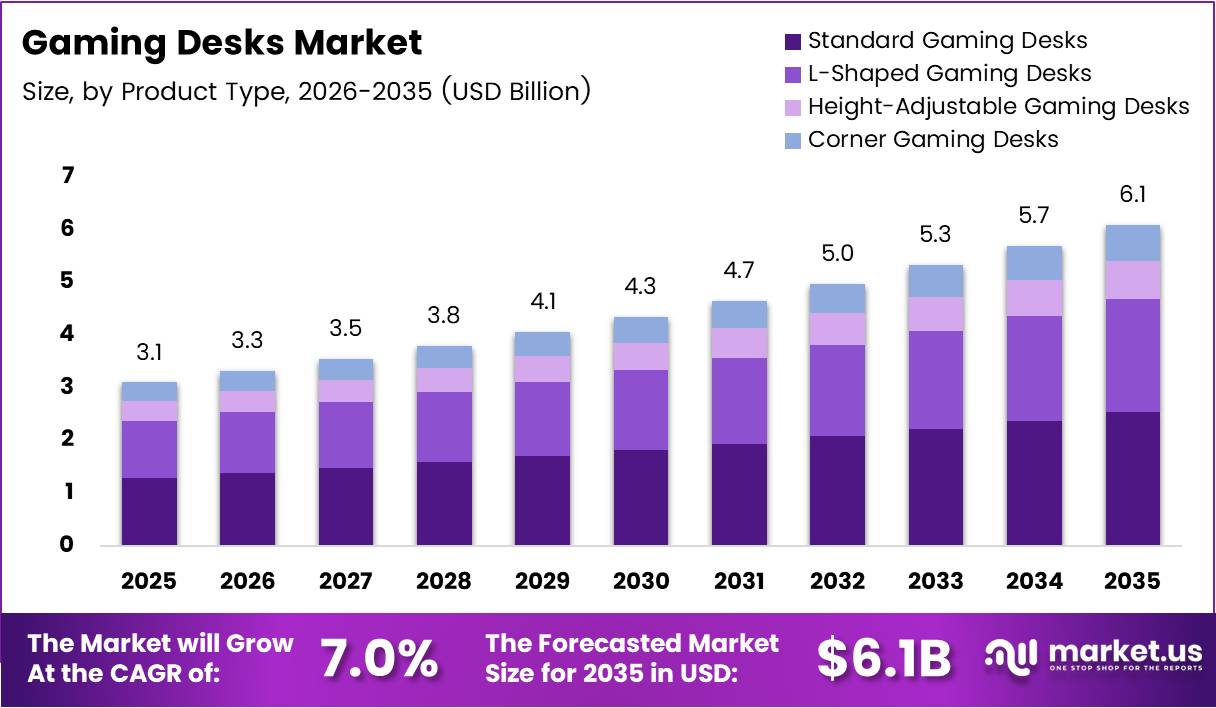
Global Gaming Desks Market size is expected to be worth around USD 6.1 Billion by 2035 from USD 3.1 Billion in 2025, growing at a CAGR of 7.0% during the forecast period 2026 to 2035.
The gaming desks market represents specialized furniture designed for gamers, streamers, and esports professionals. These desks integrate ergonomic features, cable management systems, and customizable configurations. Moreover, they accommodate multi-monitor setups and gaming peripherals effectively.
Gaming desks have evolved beyond traditional computer furniture. Consequently, manufacturers now prioritize adjustable height mechanisms, RGB lighting integration, and modular accessories. Additionally, these products support both casual gaming sessions and professional streaming environments simultaneously.
The market experiences robust growth driven by PC gaming expansion globally. Therefore, demand for ergonomic workspace solutions continues rising among gaming enthusiasts. Furthermore, hybrid work-from-home models accelerate adoption of multifunctional gaming furniture significantly.
Esports participation worldwide has transformed gaming desk requirements substantially. However, consumers now seek premium features like motorized adjustments and smart power management. Additionally, aesthetic preferences favor minimalist designs optimized for streaming setups effectively.
Individual gamers represent the largest end-user segment, demanding personalized configurations. Moreover, gaming cafes and educational institutions contribute to commercial market expansion. Consequently, distribution channels have shifted predominantly toward online platforms for convenience.
North America dominates the gaming desks market with significant revenue contribution. However, Asia Pacific shows rapid growth potential due to expanding gaming populations. Additionally, European markets demonstrate strong demand for premium ergonomic solutions consistently.
According to The ESA, 190.6 million Americans play video games weekly, highlighting massive consumer base potential. Therefore, gaming furniture manufacturers target this demographic with specialized product offerings. Furthermore, this statistic underscores the substantial market opportunity across North America.
Material innovation drives product differentiation within competitive landscapes. Consequently, manufacturers experiment with carbon-fiber frames, aluminum constructions, and sustainable composite materials. Additionally, eco-friendly options gain traction among environmentally conscious consumers steadily.
Government ergonomic workplace regulations indirectly support gaming desk adoption patterns. Moreover, increasing health awareness promotes sit-stand desk configurations among users. Therefore, height-adjustable models command premium pricing and growing market share consistently.
Key Takeaways
- Global Gaming Desks Market valued at USD 3.1 Billion in 2025, projected to reach USD 6.1 Billion by 2035 at 7.0% CAGR.
- Standard Gaming Desks dominate By Product Type segment with 44.3% market share in 2025.
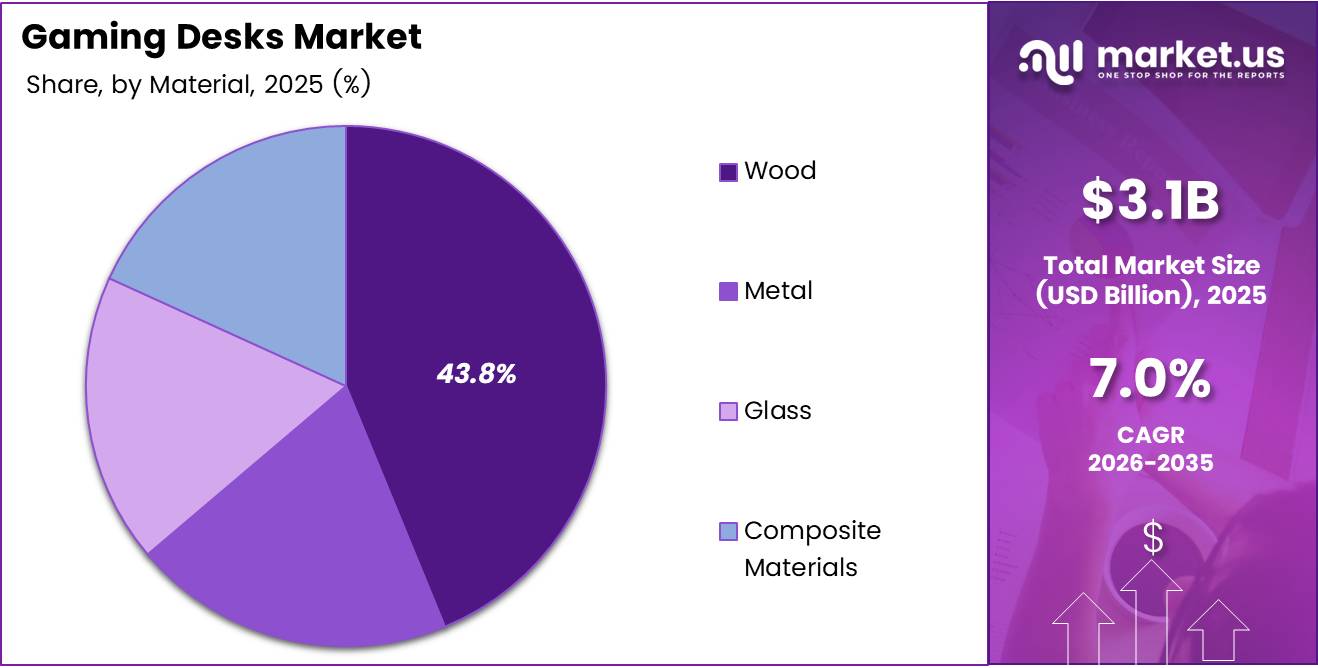
- Wood material holds 43.8% share in By Material segment during 2025.
- Individual Gamers represent 69.2% of By End-User segment in 2025.
- Online distribution channels account for 71.9% market share in 2025.
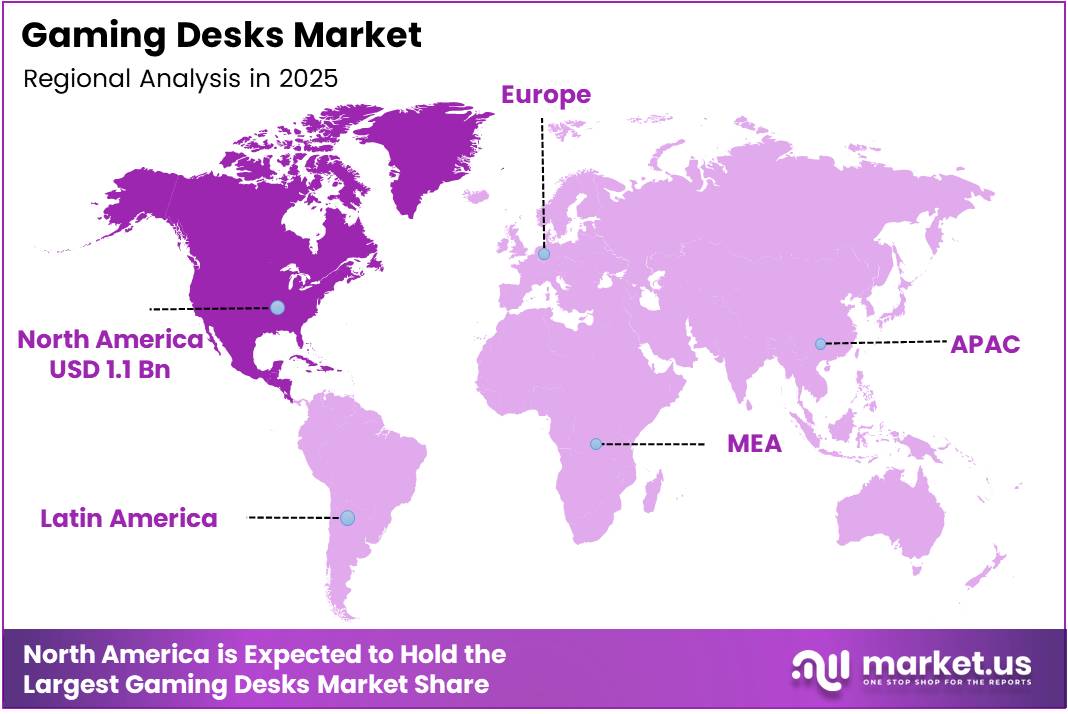
- North America leads regional market with 38.2% share, valued at USD 1.1 Billion.
Product Type Analysis
Standard Gaming Desks dominate with 44.3% due to their affordability and widespread availability.
In 2025, Standard Gaming Desks held a dominant market position in the By Product Type segment of Gaming Desks Market, with a 44.3% share. These desks offer rectangular designs with basic cable management features. Moreover, they provide cost-effective solutions for entry-level gamers. Therefore, mass-market appeal drives consistent sales volumes globally.
L-Shaped Gaming Desks provide corner optimization and expanded workspace configurations effectively. Consequently, they accommodate multi-monitor setups and additional gaming peripherals simultaneously. Additionally, these models suit gamers requiring separate zones for gaming and productivity tasks.
Height-Adjustable Gaming Desks incorporate motorized or manual adjustment mechanisms for ergonomic customization. Furthermore, sit-stand functionality appeals to health-conscious users seeking posture improvement. Therefore, premium pricing reflects advanced engineering and wellness benefits offered.
Corner Gaming Desks maximize space utilization in compact gaming environments efficiently. Moreover, they fit seamlessly into room corners, optimizing floor space. Additionally, triangular configurations support wraparound monitor arrangements for immersive gaming experiences.
Material Analysis
Wood dominates with 43.8% due to its durability and aesthetic appeal.
In 2025, Wood held a dominant market position in the By Material segment of Gaming Desks Market, with a 43.8% share. Wooden desks offer traditional aesthetics combined with structural strength. Moreover, they provide versatile finishing options matching diverse interior designs. Therefore, consumer preference remains strong across residential segments.
Metal materials deliver industrial aesthetics and superior load-bearing capacity effectively. Consequently, aluminum and steel frames support heavy gaming equipment reliably. Additionally, metal desks feature modern minimalist designs appealing to contemporary gamers.
Glass surfaces provide sleek, modern appearances with easy-clean properties. Furthermore, tempered glass ensures safety and scratch resistance during intensive use. However, weight limitations restrict compatibility with heavier multi-monitor setups.
Composite Materials combine multiple elements for enhanced performance characteristics. Moreover, engineered woods and carbon-fiber blends offer lightweight yet durable alternatives. Additionally, eco-friendly composites attract sustainability-focused consumers increasingly.
End-User Analysis
Individual Gamers dominate with 69.2% due to growing home gaming adoption.
In 2025, Individual Gamers held a dominant market position in the By End-User segment of Gaming Desks Market, with a 69.2% share. Personal gaming setups drive primary demand for customized desk solutions. Moreover, enthusiasts invest in premium features enhancing gaming experiences. Therefore, this segment sustains majority revenue generation consistently.
Gaming Cafes require durable, standardized desk configurations for commercial operations. Consequently, bulk purchasing patterns influence pricing negotiations and product specifications. Additionally, high-traffic environments demand robust construction and easy maintenance features.
Educational Institutions incorporate gaming desks into esports training programs and computer labs. Furthermore, academic adoption supports skill development and competitive team training. Therefore, institutional procurement focuses on cost-effectiveness and scalability.
Distribution Channel Analysis
Online channels dominate with 71.9% due to convenience and broader product selection.
In 2025, Online held a dominant market position in the By Distribution Channel segment of Gaming Desks Market, with a 71.9% share. E-commerce platforms provide extensive product comparisons and customer reviews effectively. Moreover, direct-to-consumer shipping eliminates retail markups, improving affordability. Therefore, digital channels continue capturing increasing market share rapidly.
Offline retail channels offer tactile product evaluation and immediate purchase fulfillment. Consequently, furniture showrooms enable physical testing before buying decisions. Additionally, brick-and-mortar stores provide personalized sales assistance and assembly services attracting certain consumers.
Key Market Segments
By Product Type
- Standard Gaming Desks
- L-Shaped Gaming Desks
- Height-Adjustable Gaming Desks
- Corner Gaming Desks
By Material
- Wood
- Metal
- Glass
- Composite Materials
By End-User
- Individual Gamers
- Gaming Cafes
- Educational Institutions
By Distribution Channel
- Online
- Offline
Drivers
Rapid Expansion of PC Gaming and Esports Participation Drives Market Growth
PC gaming continues experiencing exponential growth across global markets consistently. Moreover, competitive esports tournaments attract millions of participants and viewers worldwide. Consequently, professional and amateur gamers invest in specialized furniture enhancing performance. Therefore, gaming desk demand correlates directly with expanding player populations.
Multi-monitor configurations require desks with greater surface area and stability. Additionally, ultra-wide displays necessitate specialized support structures and cable management solutions. Furthermore, streaming setups demand integrated power outlets and accessory mounting options effectively.
Ergonomic furniture adoption increases as health awareness grows among gamers. Moreover, prolonged gaming sessions create demand for adjustable seating and standing positions. Consequently, height-adjustable desks reduce physical strain and improve long-term wellness outcomes significantly.
Work-from-home trends blur boundaries between professional workstations and gaming setups. Therefore, consumers seek multifunctional furniture serving dual purposes efficiently. Additionally, hybrid configurations support productivity tasks during daytime and gaming during evenings seamlessly.
Restraints
High Price Sensitivity Limits Premium Gaming Desk Adoption
Premium gaming desks command significantly higher prices than standard computer furniture. Moreover, budget-conscious consumers prioritize essential features over advanced customization options. Consequently, price sensitivity restricts market penetration within cost-sensitive demographic segments substantially.
Entry-level gamers often perceive specialized desks as unnecessary luxury purchases. Therefore, they opt for multipurpose furniture alternatives reducing specialized desk demand. Additionally, economic uncertainty influences discretionary spending patterns on non-essential gaming accessories.
Limited standardization across desk dimensions creates compatibility challenges with gaming accessories. Furthermore, inconsistent load-bearing specifications confuse consumers during purchase decisions. Consequently, lack of industry-wide standards hinders confident buying behavior among potential customers.
Manufacturers follow proprietary sizing conventions complicating cross-brand accessory compatibility. Moreover, varying weight capacities require consumers researching specifications carefully before purchasing. Therefore, standardization absence slows market growth and increases purchase hesitation rates.
Growth Factors
Smart Gaming Desks with Integrated Technology Drive Future Growth
Smart gaming desks incorporate built-in power management and RGB lighting synchronization. Moreover, wireless charging surfaces and USB-C docking stations enhance convenience significantly. Consequently, tech-integrated furniture attracts early adopters seeking cutting-edge gaming environments.
Modular desk systems allow customizable configurations adapting to evolving gaming needs. Furthermore, interchangeable components support incremental upgrades without complete furniture replacement. Therefore, modular designs appeal to consumers in space-constrained urban apartments.
Eco-friendly materials gain prominence as sustainability consciousness increases among consumers. Moreover, recycled composites and responsibly sourced wood reduce environmental impact effectively. Additionally, green certifications influence purchasing decisions among environmentally aware demographic segments.
Subscription-based furniture models offer flexible upgrade pathways without significant upfront investments. Furthermore, replacement programs ensure access to latest designs without ownership burdens. Consequently, subscription services attract younger consumers preferring access over ownership.
Emerging Trends
Height-Adjustable Sit-Stand Desks Gain Popularity Among Health-Conscious Gamers
Sit-stand gaming desks address health concerns associated with prolonged sitting periods. Moreover, motorized adjustment mechanisms enable effortless transitions between positions during gaming sessions. Consequently, ergonomic benefits justify premium pricing for health-conscious consumer segments.
Carbon-fiber and aluminum frames reduce overall desk weight while maintaining strength. Furthermore, lightweight materials facilitate easier relocation and assembly processes significantly. Therefore, advanced material adoption appeals to consumers prioritizing portability and aesthetics.
Integrated wireless charging pads eliminate cable clutter on desktop surfaces effectively. Moreover, USB-C docking stations provide centralized connectivity for multiple gaming peripherals simultaneously. Additionally, seamless power integration supports cleaner, more organized gaming environments.
Minimalist matte-finish designs optimize visual presentation for streaming and content creation. Furthermore, neutral color palettes complement professional broadcasting setups without distracting elements. Consequently, streamer-focused designs represent rapidly growing niche market segment.
Regional Analysis
North America Dominates the Gaming Desks Market with a Market Share of 38.2%, Valued at USD 1.1 Billion
North America leads the gaming desks market with a 38.2% share, valued at USD 1.1 Billion in 2025. The region benefits from high disposable incomes and strong gaming culture adoption. Moreover, widespread esports infrastructure and streaming platforms drive premium furniture demand. Additionally, established distribution networks facilitate rapid product accessibility across markets.
Europe Gaming Desks Market Trends
Europe demonstrates strong demand for ergonomic and sustainable gaming furniture solutions. Moreover, stringent furniture safety regulations ensure high-quality product standards consistently. Additionally, growing esports participation across UK, Germany, and France drives regional expansion. Furthermore, eco-conscious consumers favor sustainably sourced materials increasingly.
Asia Pacific Gaming Desks Market Trends
Asia Pacific exhibits fastest growth potential due to massive gaming populations. Moreover, rising middle-class incomes enable increased discretionary spending on gaming accessories. Additionally, countries like China, South Korea, and Japan lead esports infrastructure development. Furthermore, compact urban living spaces drive demand for space-efficient desk designs.
Latin America Gaming Desks Market Trends
Latin America shows emerging demand driven by growing gaming communities. Moreover, Brazil and Mexico represent primary markets with expanding middle-class populations. Additionally, increasing internet penetration supports online gaming adoption rates. However, price sensitivity limits premium product penetration currently.
Middle East & Africa Gaming Desks Market Trends
Middle East and Africa demonstrate nascent but growing gaming desk adoption. Moreover, GCC countries exhibit higher purchasing power supporting premium furniture sales. Additionally, youth demographics and increasing tech adoption drive future growth potential. Furthermore, expanding retail infrastructure improves product availability across regions.
Key Regions and Countries
North America
- US
- Canada
Europe
- Germany
- France
- The UK
- Spain
- Italy
- Rest of Europe
Asia Pacific
- China
- Japan
- South Korea
- India
- Australia
- Rest of APAC
Latin America
- Brazil
- Mexico
- Rest of Latin America
Middle East & Africa
- GCC
- South Africa
- Rest of MEA
Key Gaming Desks Company Insights
IKEA maintains significant market presence through affordable, modular gaming desk solutions globally. Moreover, the company leverages extensive retail networks and strong brand recognition effectively. Additionally, IKEA’s flat-pack designs enable cost-effective shipping and easy consumer assembly. Furthermore, their sustainability initiatives align with growing eco-conscious consumer preferences.
Flexispot specializes in height-adjustable ergonomic desks targeting health-conscious gaming segments. Moreover, their motorized sit-stand mechanisms deliver smooth transitions enhancing user comfort significantly. Additionally, Flexispot emphasizes direct-to-consumer sales models reducing retail markups. Furthermore, competitive pricing positions them strongly within mid-range market segments.
Arozzi focuses on gaming-specific furniture with integrated cable management and RGB lighting. Moreover, their products cater specifically to esports enthusiasts and professional streamers. Additionally, Arozzi’s European design aesthetics appeal to style-conscious gaming demographics. Furthermore, strategic partnerships with gaming influencers enhance brand visibility effectively.
Secretlab commands premium positioning through innovative features and superior build quality. Moreover, their MAGNUS desk line integrates advanced cable management and power systems. Additionally, Secretlab’s strong esports sponsorships build credibility among competitive gaming communities. Furthermore, direct sales models enable premium pricing while maintaining healthy margins.
Key Players
- IKEA
- Flexispot
- Arozzi
- Secretlab
- Lian Li
- VariDesk
- BDI
- Mojo
- Eureka
- Homall
Recent Developments
- In October 2025, Secretlab launched the MAGNUS Evo sit-to-stand gaming desk featuring enhanced cable management systems. Moreover, motorized height adjustments provide ergonomic customization for users. This expansion strengthens their premium gaming desk lineup significantly.
- In November 2024, LeetDesk became the official gaming desk partner of Karmine Corp, a major European esports organization. Moreover, this partnership boosts brand exposure among competitive players and fans. Additionally, the collaboration enhances LeetDesk’s credibility within professional gaming communities.
Report Scope
Report Features Description Market Value (2025) USD 3.1 Billion Forecast Revenue (2035) USD 6.1 Billion CAGR (2026-2035) 7.0% Base Year for Estimation 2025 Historic Period 2020-2024 Forecast Period 2026-2035 Report Coverage Revenue Forecast, Market Dynamics, Competitive Landscape, Recent Developments Segments Covered By Product Type (Standard Gaming Desks, L-Shaped Gaming Desks, Height-Adjustable Gaming Desks, Corner Gaming Desks), By Material (Wood, Metal, Glass, Composite Materials), By End-User (Individual Gamers, Gaming Cafes, Educational Institutions), By Distribution Channel (Online, Offline) Regional Analysis North America (US and Canada), Europe (Germany, France, The UK, Spain, Italy, and Rest of Europe), Asia Pacific (China, Japan, South Korea, India, Australia, and Rest of APAC), Latin America (Brazil, Mexico, and Rest of Latin America), Middle East & Africa (GCC, South Africa, and Rest of MEA) Competitive Landscape IKEA, Flexispot, Arozzi, Secretlab, Lian Li, VariDesk, BDI, Mojo, Eureka, Homall Customization Scope Customization for segments, region/country-level will be provided. Moreover, additional customization can be done based on the requirements. Purchase Options We have three licenses to opt for: Single User License, Multi-User License (Up to 5 Users), Corporate Use License (Unlimited User and Printable PDF) 
-
-
- IKEA
- Flexispot
- Arozzi
- Secretlab
- Lian Li
- VariDesk
- BDI
- Mojo
- Eureka
- Homall
Our Clients

- 174492
- Jan 2026






