


Global Foot and Leg Massagers Market Size, Share, Growth Analysis By Product (Combination Leg and Foot Massagers, Leg Massagers, Foot Massagers), By Technology (Electric Massagers, Manual/Handheld Massagers), By End-User (Commercial, Residential), By Distribution Channel (Offline, Online), By Region and Companies - Industry Segment Outlook, Market Assessment, Competition Scenario, Statistics, Trends and Forecast 2026-2035
- Published date: Mar 2026
- Report ID: 181619
- Number of Pages: 357
- Format:
-
keyboard_arrow_up
Quick Navigation
Report Overview
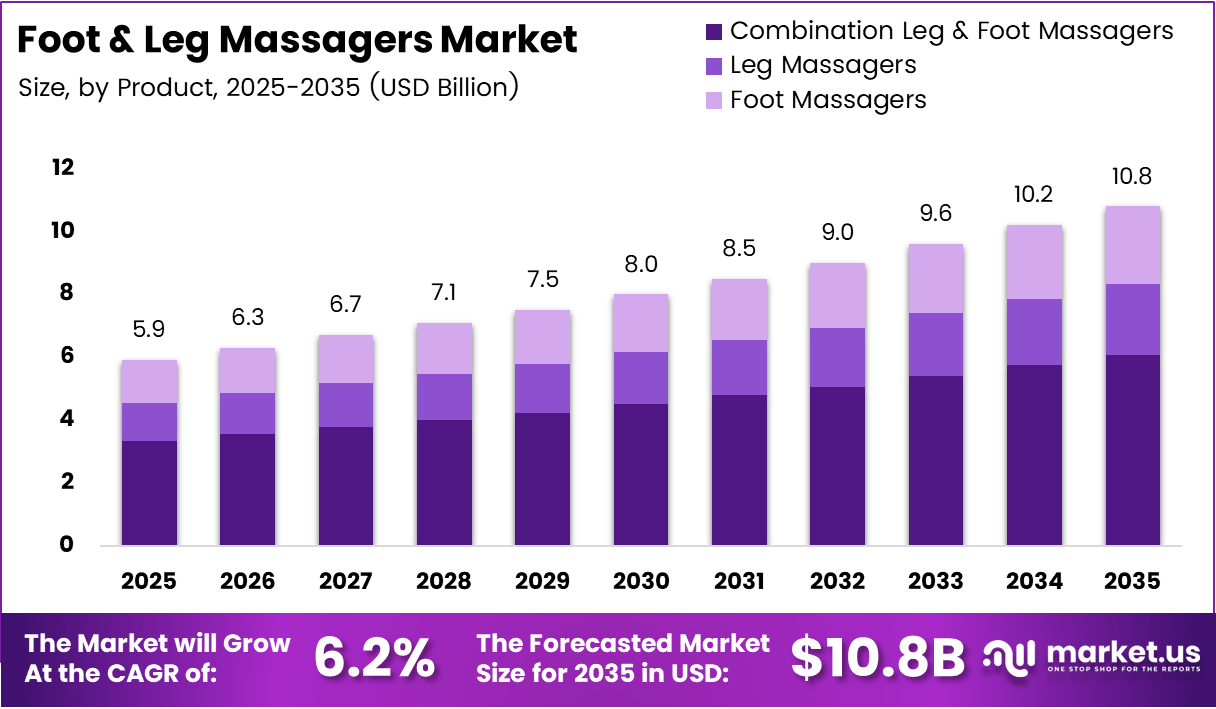
Global Foot and Leg Massagers Market size is expected to be worth around USD 10.8 Billion by 2035 from USD 5.9 Billion in 2025, growing at a CAGR of 6.2% during the forecast period 2026 to 2035.
The foot and leg massagers market covers electric, manual, and combination devices designed for therapeutic relief, circulatory support, and daily wellness use. Products range from basic foot rollers to advanced pneumatic compression leg wraps with app-based controls. These devices serve both residential users seeking at-home pain management and commercial operators in spas, clinics, and rehabilitation centers.
Chronic leg pain, varicose veins, and circulatory disorders affect millions of adults globally. This health burden has shifted consumer behavior — buyers no longer treat massage devices as luxury items but as functional healthcare tools. That shift in perception is what separates this market from discretionary wellness spending and gives it structural staying power.
Post-pandemic consumer habits reinforced investment in home-based recovery and self-care. Households that once relied on professional therapy services began purchasing personal massage equipment as a long-term substitute. This behavioral shift expanded the addressable market beyond traditional wellness buyers and created new entry points for mid-tier electric device manufacturers.
Aging demographics in North America, Europe, and Asia Pacific add further structural support. Older adults with mobility challenges and chronic lower-limb conditions represent a high-frequency, high-loyalty buyer segment. This group drives repeat purchases and premium product upgrades, making them more valuable per customer than younger, occasional-use buyers.
In January 2024, OSIM International introduced new smart wellness and massage products at CES 2024, focusing on AI-driven personalization and health tracking. This signals a product category shift — from passive comfort devices toward active, data-informed health management tools — which will redefine price points and brand positioning across the market.
Clinical evidence increasingly supports adoption of these devices. According to a study published via Organs Science Group, 93.08% of patients reported decreased swelling after three months of regular use with compression and lymphatic drainage pump devices. This outcome data gives buyers confidence and gives healthcare providers a basis to recommend specific devices — narrowing the gap between consumer wellness and clinical application.
Additionally, the same source reports that 86.60% of patients experienced reduced pain symptoms after three months of regular use. These figures validate therapeutic claims at a clinical level, which matters for premium product positioning. Brands that anchor marketing to peer-reviewed outcomes gain credibility that generic wellness messaging cannot replicate — a compounding advantage as category competition intensifies.
Key Takeaways
- The global Foot and Leg Massagers Market was valued at USD 5.9 Billion in 2025 and is forecast to reach USD 10.8 Billion by 2035.
- The market grows at a CAGR of 6.2% during the forecast period 2026 to 2035.
- By Product, Combination Leg and Foot Massagers lead with a 56.3% share in 2025.
- By Technology, Electric Massagers dominate with a 71.7% share of the market.
- By End-User, the Commercial segment holds the largest share at 61.8%.
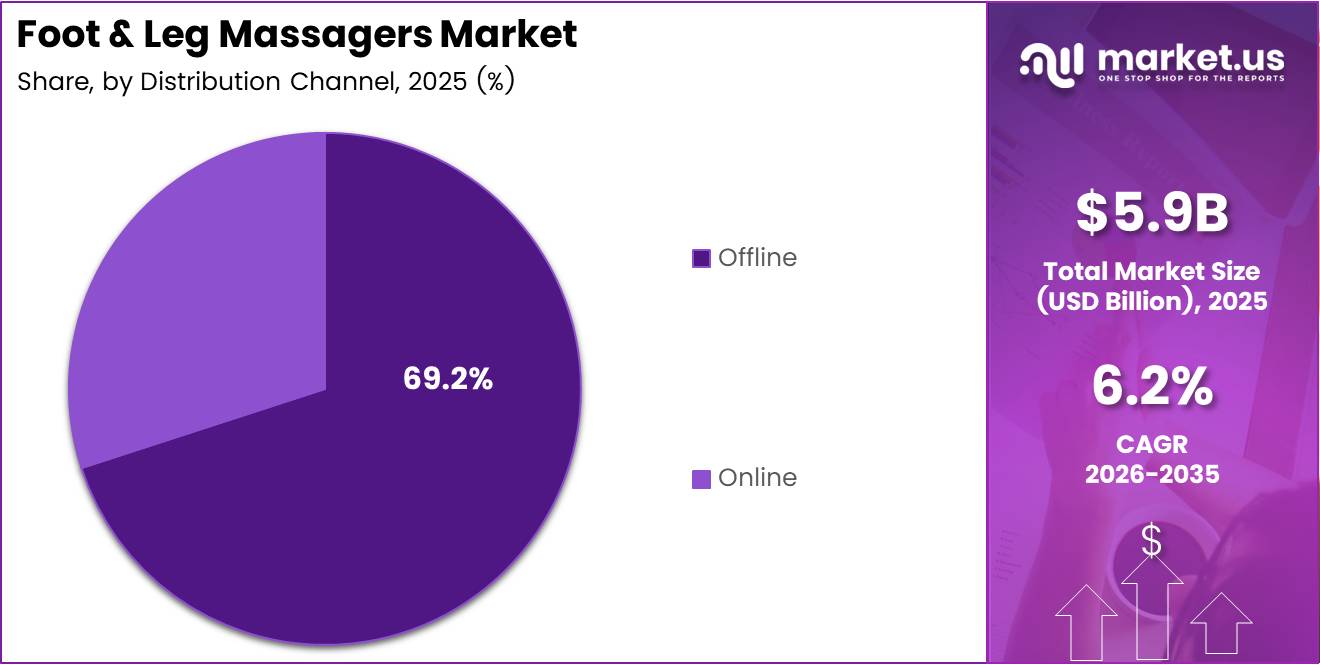
- By Distribution Channel, Offline channels lead with a 69.2% share.
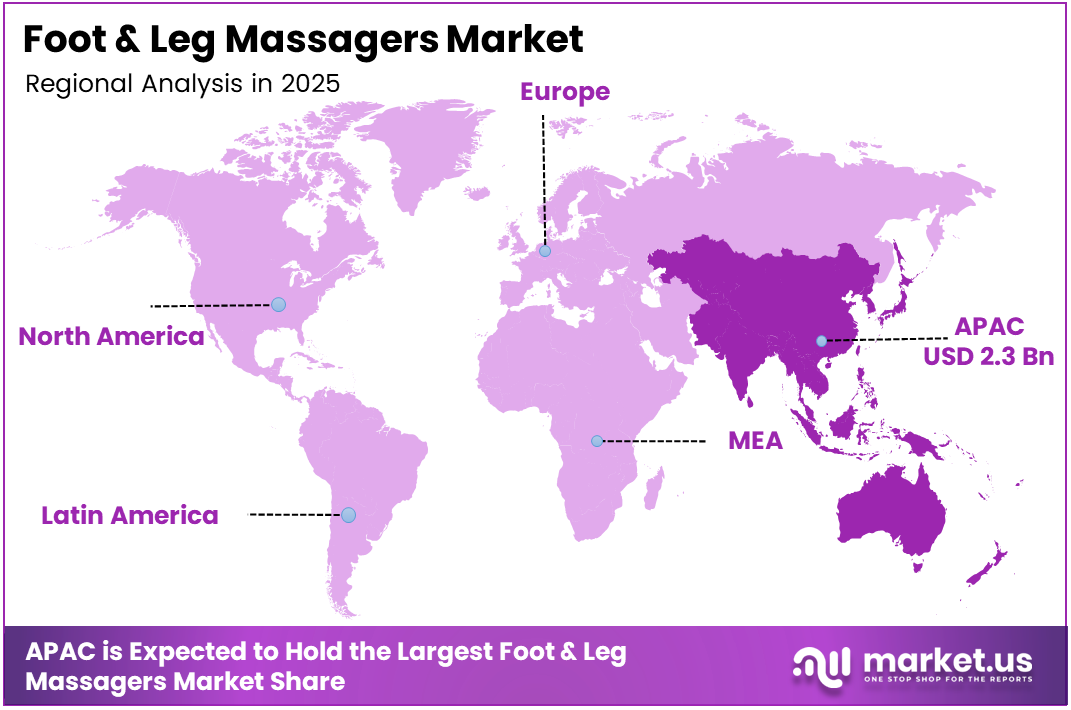
- Asia Pacific leads all regions with a 39.80% share, valued at USD 2.3 Billion.
Product Analysis
Combination Leg and Foot Massagers dominate with 56.3% due to dual therapeutic function in one device.
In 2025, Combination Leg and Foot Massagers held a dominant market position in the By Product segment of the Foot and Leg Massagers Market, with a 56.3% share. Buyers consistently choose combined units over single-function devices because they eliminate the need for separate purchases, reducing total spend while delivering broader therapeutic coverage. This value consolidation makes combination units the default choice across both residential and commercial settings.
Leg Massagers serve as the preferred solution in clinical and rehabilitation environments where targeted lower-limb therapy is prescribed. These devices address specific conditions such as deep vein thrombosis risk, post-surgical recovery, and venous insufficiency. Their specialized application commands higher unit prices, which supports margin performance even at lower volume relative to combination devices.
Foot Massagers carry the highest entry-level accessibility within the product range, attracting first-time buyers and gift purchasers. Their compact form and lower average price point make them the category gateway for new consumers. However, repeat buyers frequently upgrade to combination units — meaning foot massager sales function as a customer acquisition channel that feeds long-term value into the broader segment.
Technology Analysis
Electric Massagers dominate with 71.7% due to consistent therapeutic output and multi-feature functionality.
In 2025, Electric Massagers held a dominant market position in the By Technology segment of the Foot and Leg Massagers Market, with a 71.7% share. Electric units deliver programmable intensity, heat integration, and automated massage sequences that manual alternatives cannot replicate. For clinical and commercial buyers, consistent output is non-negotiable — making electric devices the operational standard across spas, physiotherapy clinics, and wellness centers.
Manual and Handheld Massagers differentiate through portability, zero power dependency, and low purchase cost. These attributes make them the preferred choice in markets where electricity access is inconsistent or where buyers prioritize convenience over feature depth. However, the category faces structural pressure as electric devices decline in price, compressing the cost gap that has historically anchored manual device demand.
End-User Analysis
Commercial users dominate with 61.8% due to high-frequency professional deployment and bulk procurement.
In 2025, Commercial users held a dominant market position in the By End-User segment of the Foot and Leg Massagers Market, with a 61.8% share. Hotels, spas, physiotherapy clinics, and corporate wellness programs purchase devices in volume, creating predictable recurring demand for manufacturers and distributors. Commercial accounts also replace equipment more frequently than residential users, generating a replacement cycle that sustains baseline revenue independent of new buyer growth.
Residential buyers represent the fastest-evolving demand pool in the market. Post-pandemic wellness investment pushed home users toward premium electric units with clinical-grade features previously reserved for professional settings. Though residential share lags commercial at present, this segment carries higher unit value per sale as consumers increasingly seek hospital-adjacent recovery tools for home use.
Distribution Channel Analysis
Offline channels dominate with 69.2% due to hands-on demonstration requirements and immediate purchase preference.
In 2025, Offline channels held a dominant market position in the By Distribution Channel segment of the Foot and Leg Massagers Market, with a 69.2% share. Buyers of mid-to-premium massage devices frequently require physical product trials before committing to purchase — a behavior that sustains strong foot traffic in specialty wellness retailers and electronics chains. Demonstration-driven sales also enable upselling, which raises average transaction values beyond what online listings typically achieve.
Online channels are gaining structural importance, particularly for repeat buyers and entry-level product categories. E-commerce platforms enable access in semi-urban and rural markets where physical retail infrastructure is limited. As online review ecosystems mature and return policies improve, digital purchasing confidence for higher-ticket massage devices will rise — gradually eroding offline’s structural lead over the forecast period.
Key Market Segments
By Product
- Combination Leg and Foot Massagers
- Leg Massagers
- Foot Massagers
By Technology
- Electric Massagers
- Manual/Handheld Massagers
By End-User
- Commercial
- Residential
By Distribution Channel
- Offline
- Online
Drivers
Chronic Lower-Limb Conditions and Aging Demographics Create Sustained, Medically-Anchored Demand for Foot and Leg Massage Devices
Chronic leg pain, varicose veins, and circulatory disorders affect a growing share of adults across developed and developing economies. These conditions are not episodic — they require ongoing management, which makes therapeutic massage devices a recurring purchase rather than a one-time investment. For manufacturers, this medical demand base provides volume stability that purely lifestyle-driven categories cannot match.
Aging populations in Asia Pacific, North America, and Europe compound this effect. Older adults with reduced mobility and chronic lower-limb conditions are among the most consistent buyers of electric massage equipment. According to a clinical study published at PMC, VAS pain scores decreased from 5 to 2 — a more than 50% immediate reduction — following automated pneumatic lymphatic drainage treatment. Evidence like this accelerates physician recommendations and drives structured adoption among older demographics.
Consumer preference for home wellness and self-care devices strengthened considerably after pandemic-era clinic closures. Households that lost access to physiotherapy services invested in personal recovery equipment and retained those habits afterward. This behavioral shift permanently expanded the residential buyer base and created a durable demand foundation that manufacturers can target through both direct-to-consumer and clinical referral channels.
Restraints
High Device Costs and Readily Available Low-Cost Alternatives Limit Penetration in Price-Sensitive and Developing Markets
Advanced electric foot and leg massagers carry price points that exclude large buyer segments in price-sensitive markets across Southeast Asia, Latin America, and Sub-Saharan Africa. In these regions, consumers can access manual rollers, traditional massage therapy, and low-cost handheld tools at a fraction of the cost of electric units. This cost gap is not closing quickly enough to accelerate mass adoption in the near term.
According to research published in the Journal of Vascular Surgery: Venous and Lymphatic Disorders, patient adherence reached 81% with nonpneumatic compression devices compared to just 56% with advanced pneumatic devices. This divergence reveals a core restraint: complex, higher-cost devices do not automatically deliver better adherence or outcomes. Buyers and healthcare providers increasingly factor this into purchase decisions, limiting the revenue ceiling for premium-tier products.
Manual alternatives and traditional therapies retain strong cultural acceptance in many high-population markets. In markets where massage therapy is embedded in daily wellness practice — such as India and parts of Southeast Asia — device adoption competes against established behavioral norms, not just price. Overcoming this requires sustained brand education investment, which raises customer acquisition costs and slows payback timelines for market entrants.
Growth Factors
Smart Technology Integration and Expanding Commercial Partnerships Open New Revenue Channels in the Foot and Leg Massagers Market
Integration of AI-based pressure control and app connectivity into massage devices is redefining what buyers expect from the category. Connected devices enable personalized treatment protocols, usage tracking, and remote adjustment — features that justify premium pricing and create recurring software-layer revenue opportunities. In May 2024, Therabody expanded its recovery portfolio with upgraded smart devices featuring app-based customization and Bluetooth connectivity, signaling that this product direction is becoming a competitive baseline.
According to a clinical study published via Organs Science Group, regular use of compression and lymphatic drainage devices produced a quality of life improvement of 14.2% (SD: 23.4%). This outcome data supports a growing argument for medical-grade partnerships. As physiotherapy clinics and rehabilitation centers adopt evidence-backed massage equipment, manufacturers gain access to institutional procurement channels that carry higher order values and longer contract cycles than retail sales.
Demand for portable and travel-friendly leg massagers among working professionals creates a distinct high-value segment outside traditional wellness positioning. Compact devices with extended battery life — such as the Normatec Elite with its 4-hour battery and 3.2 lb per boot weight — address a buyer who prioritizes performance without sacrificing portability. This specification-driven demand from frequent travelers and athletes represents a premium niche with limited direct competition from traditional bulkier devices.
Emerging Trends
Shiatsu, Heat Integration, and Biomimicry Technology Shift Foot and Leg Massagers from Comfort Devices to Precision Recovery Tools
Shiatsu and reflexology-based massagers with multi-mode functionality are attracting buyers who previously relied on professional therapists. These devices replicate specialized manual techniques at home, which elevates perceived clinical value and supports premium price positioning. As multi-mode functionality becomes standard in mid-tier products, manufacturers must differentiate through technique accuracy and programmable customization rather than feature count alone.
Heated massage features are becoming a default consumer expectation rather than a premium add-on. Heat application enhances muscle relaxation and blood circulation — benefits that buyers now associate with higher therapeutic effectiveness. According to a study published at PMC, lymphatic pulsing frequency increased from baseline 0.53 pulses per minute to 0.96 pulses per minute during automated lymphatic drainage treatment — nearly a 2-fold improvement. This clinical mechanism supports why heat-combined devices achieve stronger perceived outcomes and command better retention rates among regular users.
Ergonomic and compact designs respond directly to urban housing constraints and shifting consumer aesthetics. Buyers in dense urban markets will not purchase wellness equipment that disrupts living spaces. Influencer marketing and social media product reviews are accelerating purchase decisions — particularly among younger urban consumers who research wellness devices through peer content before engaging brand channels. Manufacturers that optimize for both physical compactness and social media visual appeal gain a measurable conversion advantage.
Regional Analysis
Asia Pacific Dominates the Foot and Leg Massagers Market with a Market Share of 39.80%, Valued at USD 2.3 Billion
Asia Pacific leads the global market with a 39.80% share, valued at USD 2.3 Billion. The region’s dominance reflects deep cultural integration of massage therapy into daily wellness routines across China, Japan, South Korea, and India, combined with a large and rapidly aging population base. Dense retail networks and strong domestic manufacturing capacity further reinforce the region’s structural leadership and price competitiveness.
North America Foot and Leg Massagers Market Trends
North America holds a significant share driven by high per-capita healthcare expenditure, mature e-commerce infrastructure, and a large base of aging adults managing chronic pain and circulatory conditions. The United States leads regional consumption, where physician-recommended home therapy devices gain rapid household adoption. Growing awareness of compression therapy benefits among athletes and post-surgical patients further supports premium segment performance.
Europe Foot and Leg Massagers Market Trends
Europe maintains a solid market position supported by strong regulatory frameworks for medical-grade devices, high consumer health literacy, and established physiotherapy referral networks. Germany, France, and the UK lead regional demand. European buyers place a premium on clinically validated products, which advantages manufacturers with peer-reviewed efficacy data and CE-certified device portfolios over unvalidated alternatives.
Latin America Foot and Leg Massagers Market Trends
Latin America represents a developing opportunity, with Brazil and Mexico driving the majority of regional demand. Rising disposable incomes in urban centers and a growing middle-class interest in personal wellness are expanding the addressable buyer base. However, pricing sensitivity remains a structural constraint, and most current demand concentrates in entry-level electric and manual device categories rather than premium smart-enabled units.
Middle East and Africa Foot and Leg Massagers Market Trends
The Middle East and Africa market is at an early development stage, with demand concentrated in GCC countries where high-income consumers invest in premium wellness equipment. Healthcare infrastructure investment across the GCC supports physiotherapy clinic expansion, creating commercial procurement channels for professional-grade massage devices. South Africa leads Sub-Saharan demand, though affordability barriers constrain broader regional adoption.
Key Regions and Countries
North America
- US
- Canada
Europe
- Germany
- France
- The UK
- Spain
- Italy
- Rest of Europe
Asia Pacific
- China
- Japan
- South Korea
- India
- Australia
- Rest of APAC
Latin America
- Brazil
- Mexico
- Rest of Latin America
Middle East & Africa
- GCC
- South Africa
- Rest of MEA
Key Company Insights
OGAWA Group has built its competitive position through vertically integrated product development that spans entry-level home massagers to commercial-grade wellness equipment. The company’s strength lies in its Asian market depth — particularly across China and Southeast Asia — where brand recognition and retail penetration give it a distribution advantage that international competitors struggle to replicate quickly. Its broad product architecture allows simultaneous capture of both volume and premium segments.
Panasonic Corporation leverages decades of consumer electronics credibility to anchor trust in the massage device category. Its engineering expertise in motor technology and ergonomic design translates directly into product differentiation, particularly for electric foot and leg massagers targeting home health users. Panasonic’s global distribution network and after-sales service infrastructure reduce buyer hesitation at premium price points — an advantage that pure wellness brands cannot easily replicate.
OSIM International Pte Ltd. positions itself at the intersection of luxury wellness and functional therapy, targeting high-income consumers who expect both aesthetic quality and clinical performance. OSIM’s retail experience strategy — flagship wellness showrooms with live product demonstrations — converts high-consideration buyers more effectively than online-only competitors. Its investment in AI-driven personalization, demonstrated at CES 2024, reinforces a product roadmap that competitors are still responding to.
ROTAI competes primarily on price-performance efficiency, targeting the mid-tier segment across Asian and emerging markets. The company’s manufacturing scale enables competitive pricing without sacrificing core functionality — making it a dominant choice for commercial buyers such as hotel chains and wellness centers that require reliable devices at controlled procurement costs. ROTAI’s volume-driven model creates revenue resilience but limits margin expansion unless it successfully moves upmarket.
Key Players
- OGAWA Group
- Panasonic Corporation
- OSIM International Pte Ltd.
- ROTAI
- Johnson Health Tech Retail Inc.
- Beurer GmbH
- RENPHO US
- Osaki Massage Chair
- SKG
- JSB Healthcare
Recent Developments
- May 2024 – Therabody expanded its recovery product portfolio with upgraded smart massage devices featuring app-based customization and Bluetooth connectivity, strengthening its position in the connected wellness segment and raising the feature baseline for mid-to-premium electric recovery devices.
- March 2024 – Beurer GmbH advanced its wellness device lineup through new product innovations and collaborations in massage and therapy equipment, reinforcing its European market presence and broadening its therapeutic device portfolio for both residential and clinical end-users.
Report Scope
Report Features Description Market Value (2025) USD 5.9 Billion Forecast Revenue (2035) USD 10.8 Billion CAGR (2026-2035) 6.2% Base Year for Estimation 2025 Historic Period 2020-2024 Forecast Period 2026-2035 Report Coverage Revenue Forecast, Market Dynamics, Competitive Landscape, Recent Developments Segments Covered By Product (Combination Leg & Foot Massagers, Leg Massagers, Foot Massagers), By Technology (Electric Massagers, Manual/Handheld Massagers), By End-User (Commercial, Residential), By Distribution Channel (Offline, Online) Regional Analysis North America (US and Canada), Europe (Germany, France, The UK, Spain, Italy, and Rest of Europe), Asia Pacific (China, Japan, South Korea, India, Australia, and Rest of APAC), Latin America (Brazil, Mexico, and Rest of Latin America), Middle East & Africa (GCC, South Africa, and Rest of MEA) Competitive Landscape OGAWA Group, Panasonic Corporation, OSIM International Pte Ltd., ROTAI, Johnson Health Tech Retail Inc., Beurer GmbH, RENPHO US, Osaki Massage Chair, SKG, JSB Healthcare Customization Scope Customization for segments, region/country-level will be provided. Moreover, additional customization can be done based on the requirements. Purchase Options We have three licenses to opt for: Single User License, Multi-User License (Up to 5 Users), Corporate Use License (Unlimited User and Printable PDF)  Foot and Leg Massagers MarketPublished date: Mar 2026add_shopping_cartBuy Now get_appDownload Sample
 -
-
- OGAWA Group
- Panasonic Corporation
- OSIM International Pte Ltd.
- ROTAI
- Johnson Health Tech Retail Inc.
- Beurer GmbH
- RENPHO US
- Osaki Massage Chair
- SKG
- JSB Healthcare
Our Clients

- 181619
- Mar 2026






