Report Overview
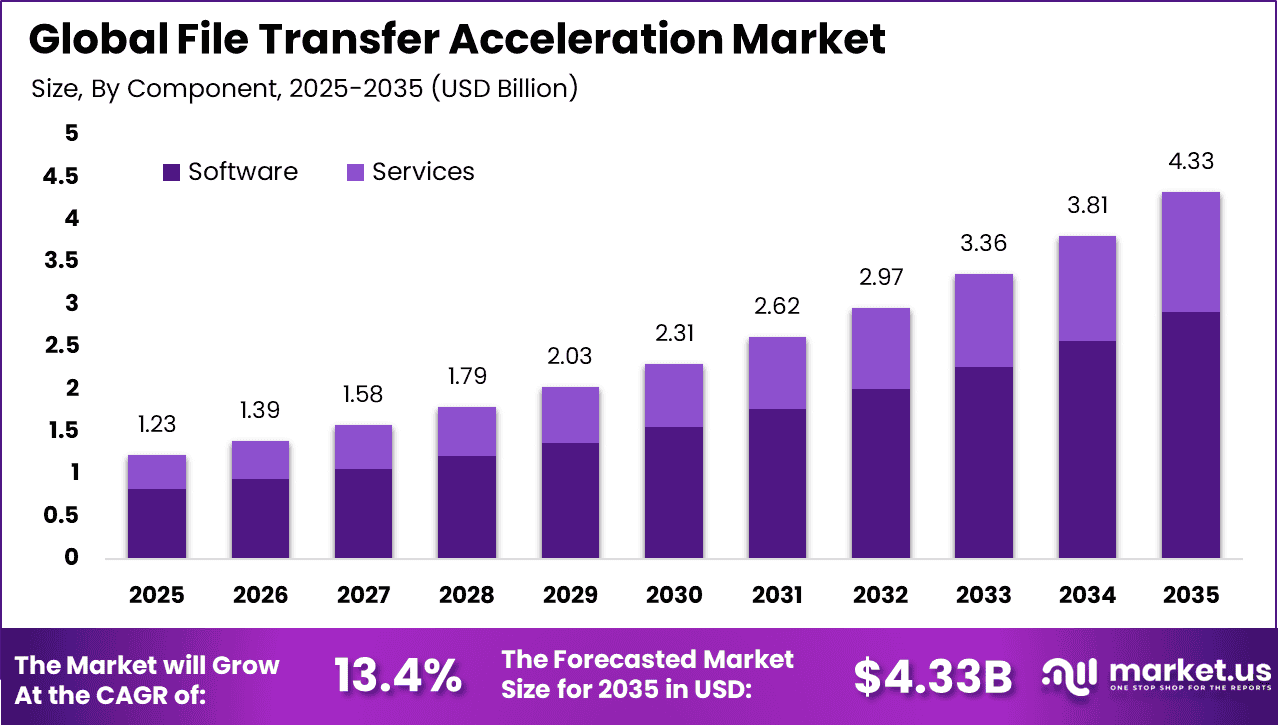
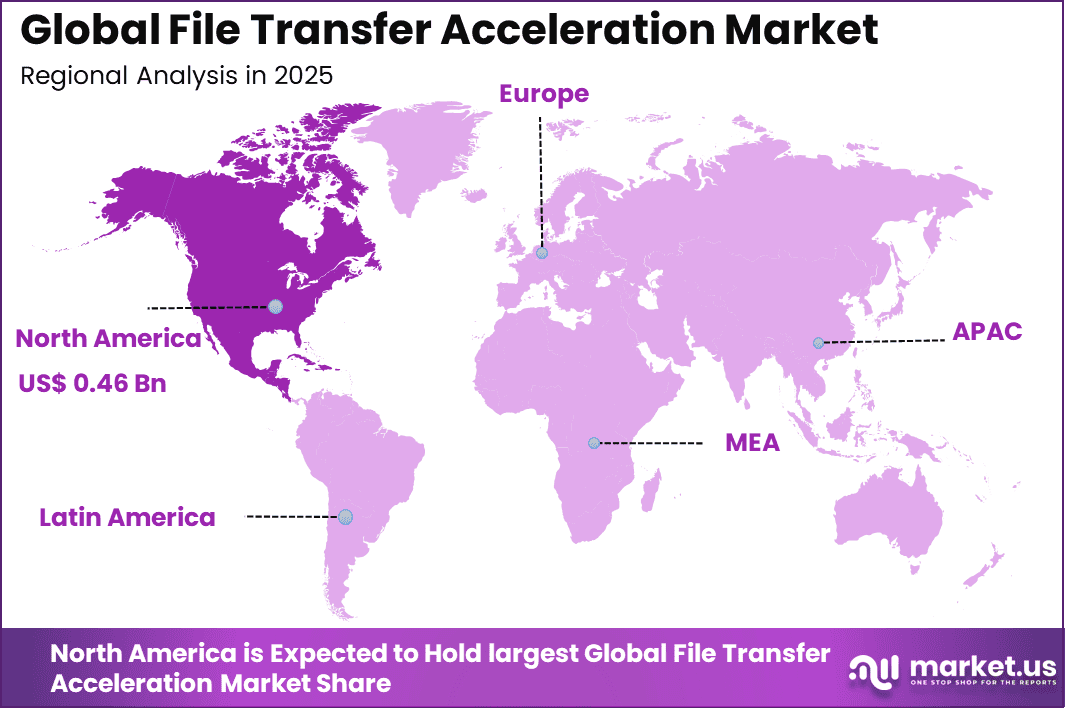
The Global File Transfer Acceleration Market size is expected to be worth around USD 4.33 billion by 2035, from USD 1.23 billion in 2025, growing at a CAGR of 13.4% during the forecast period from 2025 to 2035. North America held a dominant market position, capturing more than a 37.4% share, holding USD 0.46 billion in revenue.
The file transfer acceleration market refers to technologies and solutions designed to improve the speed, reliability, and efficiency of data transfers across networks. These platforms optimize file movement over wide area networks by using advanced protocols, compression techniques, bandwidth optimization, and parallel data transfer methods. File transfer acceleration solutions are widely used in industries that handle large data volumes such as media and entertainment, healthcare, finance, and cloud computing environments.
Traditional file transfer protocols often face limitations in speed and performance, especially when transferring large files over long distances or congested networks. File transfer acceleration tools address these limitations by reducing latency effects, maximizing bandwidth utilization, and ensuring secure and consistent data delivery. As digital transformation increases data generation and exchange, these solutions have become essential for maintaining efficient data workflows.
Businesses adopt file transfer acceleration because slow uploads waste valuable work time and delay decisions. Distributed teams need quick access to large files to keep projects moving without interruption. This technology helps reduce transfer delays from hours to minutes and often achieves around 95% bandwidth use, compared with only 10–20% from traditional methods on high-latency network connections.
Demand continues to rise as businesses manage larger files such as video content, design assets, and research datasets that conventional transfer tools struggle to handle efficiently. Media, engineering, and research teams face the greatest pressure because delays directly affect delivery schedules. Under favorable conditions, transfer speeds improve by 10 to 100 times, making these solutions highly attractive.
For instance, in September 2025, Accellion launched Kiteworks 2026 with zero-trust file acceleration supporting 100TB/day transfers. The platform’s compliance automation appeals to government agencies and healthcare providers, reinforcing Accellion’s leadership in regulated industry secure file movement.
Key Takeaway
- In 2025, the Software segment led the Global File Transfer Acceleration Market, accounting for 67.5% of total share.
- In 2025, Cloud based deployment dominated with a 62.3% market share.
- In 2025, Cloud Acceleration emerged as the leading solution type, capturing 38.2% of the market.
- In 2025, the Financial Services sector held the largest industry share at 25.8%.
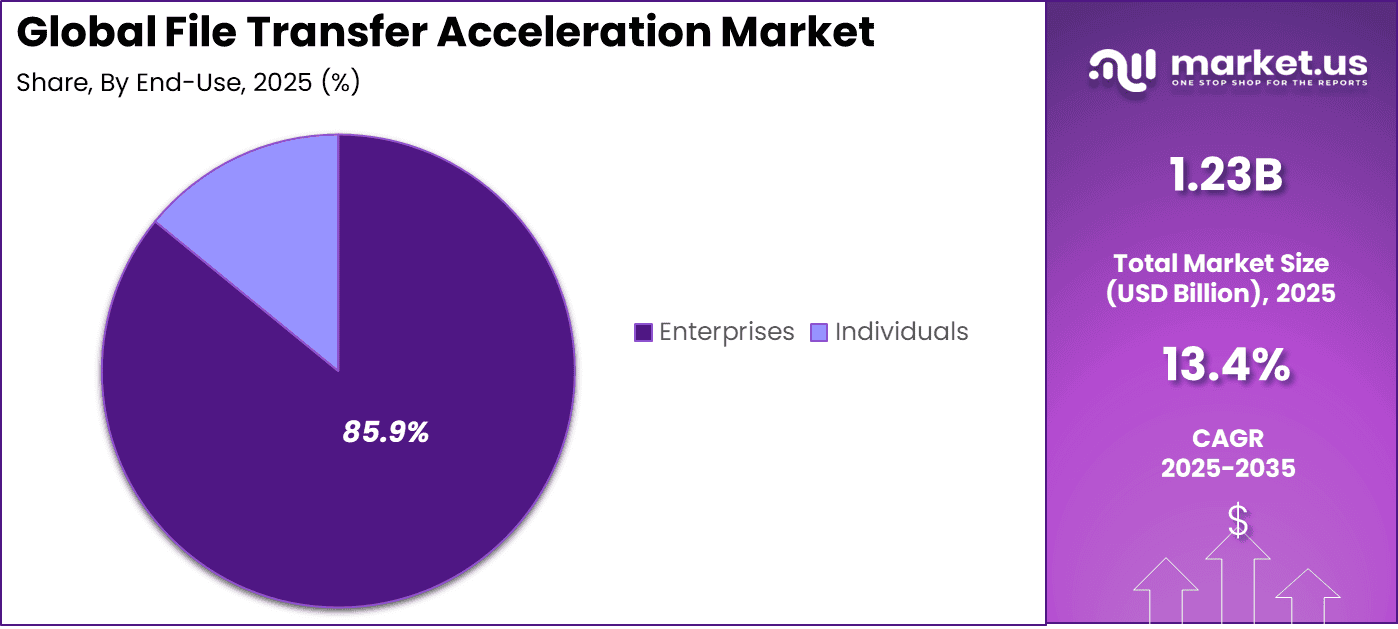
- In 2025, Enterprises represented the primary end user segment, contributing 85.9% of overall demand.
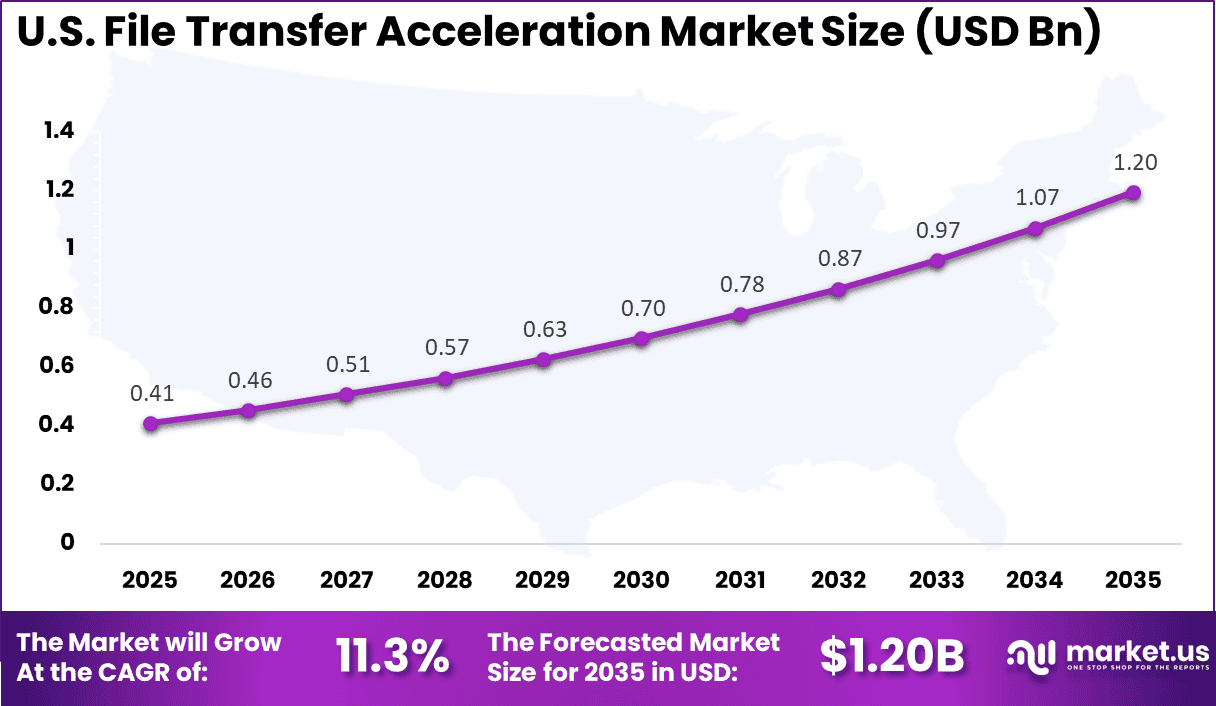
- In 2025, the U.S. File Transfer Acceleration Market reached USD 0.41 billion and recorded a growth rate of 11.3%.
- In 2025, North America maintained regional leadership, securing more than 37.4% of the Global File Transfer Acceleration Market.
Key Statistics
- Amazon S3 Transfer Acceleration improves long distance file transfer speeds by 50% to over 500%, leveraging global edge locations and optimized backbone networks.
- Compared to standard internet uploads, performance gains typically range between 100% and 200%, depending on distance and network conditions.
- Transfers from Southeast Asia or Australia to the U.S. East region have demonstrated speed improvements exceeding 500%.
- Larger file sizes benefit more significantly from acceleration, while smaller files show relatively modest performance gains.
- A 300 MB file transfer to the Asia Pacific region achieved a 50% reduction in total upload time under accelerated configurations.
- Multipart upload strategies reduce transfer times by approximately 40%, particularly for files exceeding 100 MB.
- Advanced acceleration platforms can achieve 90% or higher utilization of available bandwidth, improving overall data transfer efficiency.
By Component
Software accounts for 67.5% of the market, reflecting the growing reliance on platforms that optimize file transfer performance through advanced protocols and data compression techniques. These solutions reduce latency, improve bandwidth utilization, and ensure secure transmission of large files across networks. Organizations use file transfer acceleration software to enhance operational efficiency and reduce delays in data exchange.
The dominance of software solutions is also supported by their integration with enterprise systems such as cloud storage, data centers, and content management platforms. Automated transfer scheduling and monitoring capabilities further improve reliability. As data volumes continue to increase, software driven file transfer solutions remain central to efficient data movement.
For Instance, in February 2026, Aspera, an IBM Company, launched new software features tuned for edge computing, speeding transfers in remote spots. Users now handle patchy networks better, which is perfect for field teams sharing video or logs on the go. Growth here shows how software keeps leading by solving real-world snags.
By Deployment Mode
Cloud based deployment represents 62.3% of the market, indicating strong enterprise preference for scalable and accessible file transfer systems. Cloud platforms allow organizations to transfer data across multiple locations without relying on extensive on site infrastructure. Centralized cloud environments provide better visibility into transfer processes and performance metrics.
Cloud deployment also supports real time monitoring and seamless integration with cloud storage and enterprise applications. Organizations benefit from reduced infrastructure costs and improved flexibility. As cloud adoption continues to grow, cloud based file transfer acceleration solutions maintain strong market presence.
For instance, in December 2025, Riverbed Technology enhanced its cloud platform with better WAN optimization, boosting transfer speeds over public networks. Companies love it for linking offices without lag, driving the shift from old hardware. It’s practical growth from teams chasing easy access anywhere.
By Technology
Cloud acceleration accounts for 38.2% of the technology segment due to its ability to enhance data transfer speeds across cloud networks. These technologies optimize data routing and reduce latency by using advanced transfer protocols and network optimization techniques. Organizations rely on cloud acceleration to improve the performance of data transfers between cloud platforms and enterprise systems.
The adoption of cloud acceleration technologies is driven by the increasing use of cloud computing and distributed data environments. Faster data transfer capabilities support real time analytics, collaboration, and operational efficiency. As organizations expand cloud based operations, cloud acceleration remains a key technology driver.
For Instance, in February 2026, Signiant added multi-path routing to its cloud acceleration tech, slashing latency for international sends. Media pros use it to fly footage between continents quickly, fueling this segment’s rise. The update proves tech like this thrives on global collaboration needs.
By Application
Financial services represent 25.8% of market applications due to the need for secure and fast transmission of sensitive financial data. Banks and financial institutions handle large volumes of transactional data, reports, and regulatory documents that require reliable transfer systems. File transfer acceleration platforms help ensure data integrity and reduce transfer delays.
Financial organizations also rely on accelerated file transfer solutions to support real time processing and compliance reporting. Secure data transmission is essential to maintaining regulatory standards and protecting sensitive information. As digital financial services expand, the demand for high performance file transfer solutions continues to grow.
For Instance, in November 2025, Thru Inc. boosted its app for financial reports, accelerating bulk transfers with end-to-end checks. Auditors and traders save hours, making it a staple in the sector. This reflects how apps grow by nailing security plus pace in money moves.
By End User
Enterprises account for 85.9% of market adoption due to their extensive data transfer requirements across departments and global operations. These organizations manage large datasets that must be transferred efficiently between internal systems, partners, and cloud environments. File transfer acceleration platforms help enterprises improve operational efficiency and reduce delays in data exchange.
Large enterprises also require secure and reliable transfer systems to support business continuity and data protection. Automated monitoring and performance optimization tools enable organizations to manage data movement more effectively. As enterprise data environments continue to grow, demand for file transfer acceleration solutions remains strong.
For Instance, in February 2026, Dell Technologies integrated acceleration into its enterprise storage line, streamlining backups across sites. Big outfits cut downtime on massive shifts, cementing their top spot. It grows from scale needs that only heavy users push hard.
By Region
North America holds 37.4% of the market share due to strong adoption of advanced data management and cloud technologies. Organizations in the region invest in high performance file transfer solutions to support digital operations and global connectivity. The presence of large enterprises and advanced IT infrastructure further supports regional market growth.
For instance, in January 2026, IBM enhanced its Aspera file transfer platform with AI-driven acceleration, achieving 10x faster large-file transfers for media clients. This innovation solidified North America’s leadership in enterprise file transfer solutions, serving Hollywood studios and Fortune 500 companies with unmatched speed and security.
Within North America, the United States contributes USD 0.41 billion with a growth rate of 11.3%. The country’s increasing reliance on cloud computing and data intensive applications has strengthened demand for file transfer acceleration platforms. Continued investment in digital infrastructure is expected to sustain market development across the region.
For instance, in June 2026, Riverbed’s SteelHead, upgraded with predictive caching, delivered 500% faster cloud file transfers. The San Francisco advancement cemented U.S. superiority in WAN optimization for file acceleration, vital for hybrid workforces in tech and professional services.
Growth Factors
One of the primary growth factors driving the file transfer acceleration market is the increasing volume of large data files generated across industries. High-resolution video content, scientific data, and enterprise datasets require efficient transfer mechanisms. Acceleration technologies enable organizations to move these large files quickly and reliably, improving productivity and operational efficiency.
Another growth factor is the growing adoption of cloud computing and hybrid IT environments. Organizations frequently transfer data between on-premise systems and cloud platforms, which can introduce latency and bandwidth challenges. File transfer acceleration solutions help optimize these transfers, ensuring faster data movement across distributed environments.
Emerging Trends
One emerging trend in the file transfer acceleration market is the integration of artificial intelligence for network optimization. AI-driven systems analyze network conditions, predict congestion, and dynamically adjust transfer parameters to achieve optimal performance. This approach enhances transfer efficiency and reduces delays.
Another trend is the increasing use of secure managed file transfer solutions. Organizations are combining acceleration capabilities with advanced security features such as encryption, authentication, and compliance controls to ensure safe data transmission across networks.
Key Market Segments
By Component
- Software
- Services
By Deployment Mode
- On-Premises
- Cloud
By Technology
- WAN Optimization
- TCP Acceleration
- UDP Acceleration
- Cloud Acceleration
- Others (Peer-to-Peer, Edge Acceleration)
By Application
- Media & Entertainment
- Healthcare
- IT & Telecom
- Financial Services
- Government & Defense
- Others
By End-User
- Enterprises
- Individuals
Key Regions and Countries
North America
- US
- Canada
Europe
- Germany
- France
- The UK
- Spain
- Italy
- Russia
- Netherlands
- Rest of Europe
Asia Pacific
- China
- Japan
- South Korea
- India
- Australia
- Singapore
- Thailand
- Vietnam
- Rest of APAC
Latin America
- Brazil
- Mexico
- Rest of Latin America
Middle East & Africa
- South Africa
- Saudi Arabia
- UAE
- Rest of MEA
Drivers
Rising Demand for High-Speed Data Movement
Organizations handle growing volumes of large files such as video, analytics, and design data, which increases the need for faster transfer solutions. Traditional methods often slow down due to latency and network limits, making accelerated file transfer essential for maintaining workflow speed and reducing delays across distributed environments.
Faster data movement improves productivity and supports real-time collaboration between teams working across locations. Businesses rely on efficient transfer systems to meet deadlines and avoid workflow interruptions. As digital operations expand, the demand for high-speed file transfer continues to rise, making it a key driver for market growth.
For instance, in March 2025, Teams at IBM rolled out updates to their Aspera tools that make sending big files across global networks much quicker. This fits right into the growing need for fast data movement as companies share more design files and media daily. Workers now finish tasks without waiting hours, keeping projects on track even with remote setups.
Restraint
Complexity in Implementation
Implementing file transfer acceleration solutions requires proper configuration, integration, and technical expertise. Organizations may face difficulties aligning these systems with existing infrastructure, especially when dealing with legacy networks. This complexity can slow adoption, as companies need time and resources to ensure proper setup and performance optimization.
Maintenance and management also require skilled professionals to monitor performance and resolve issues. Smaller organizations may find it challenging to handle these requirements, leading to hesitation in adoption. This limits wider implementation, particularly among businesses looking for simpler and less resource-intensive solutions.
For instance, in March 2025, FileCatalyst pushed a major version update with a fresh look and new SSL setup for their server apps, but it meant admins had to tweak keystores and load balancers carefully. Many IT folks found the changes tricky to roll out smoothly across old networks. This shows how setup hurdles slow down adoption for teams short on time.
Opportunities
Expansion of Cloud and Hybrid Infrastructure
The growth of cloud and hybrid environments creates strong opportunities for file transfer acceleration solutions. Organizations need reliable and fast data movement between on-premise systems and cloud platforms. Accelerated transfer technologies help ensure smooth communication and efficient data exchange across these distributed infrastructures.
As businesses continue digital transformation, the need for seamless data flow becomes more important. These solutions support faster uploads, reduce delays, and improve collaboration across locations. This expanding infrastructure landscape offers significant opportunities for adoption as companies modernize their data management and connectivity systems.
For instance, in October 2025, Signiant updated its app with better cloud delivery features, like pausing auto-sends and opening completed files easily in hybrid setups. This opens doors as firms mix on-site and cloud storage more. It helps seamless data flows between environments without extra hassle.
Challenges
Balancing Speed with Reliability and Security
One major challenge is maintaining high transfer speeds while ensuring data reliability and security. Faster transfers can sometimes increase risks such as data loss or interruptions if not properly managed. Organizations need solutions that deliver both speed and stability across different network conditions.
Security also remains critical, especially when transferring sensitive data across global networks. Ensuring encryption, data integrity, and compliance adds complexity to system design. Balancing performance with secure and reliable transfers continues to be a key challenge for organizations adopting file transfer acceleration technologies.
For instance, in March 2025, FileCatalyst fixed bugs in their central dashboard where reports failed to load big datasets, stressing the need to keep speeds reliable. Fast transfers risked incomplete logs, so teams balanced quick sends with stable tracking. This tweak ensured data stayed whole during high-volume use.
Key Players Analysis
The File Transfer Acceleration Market is driven by enterprise technology providers that deliver high speed data movement solutions for large file transfers across distributed networks. IBM Corporation through IBM Aspera, along with Signiant and Progress Software Corporation, provide advanced acceleration technologies based on optimized protocols and bandwidth utilization. These platforms enable secure and rapid transfer of large media files, datasets, and enterprise content.
Infrastructure and storage technology providers also contribute to the market through integrated data transfer solutions. Seagate Technology, Dell Technologies, and Riverbed Technology offer solutions that combine storage optimization with accelerated data transfer capabilities. These systems improve network efficiency and reduce latency during large scale data migration and backup processes.
Specialized file transfer and managed service providers further expand the competitive landscape. FileCatalyst, Atempo, Masergy, Citrix Systems, and Thru Inc. focus on secure file transfer, cloud integration, and workflow automation. Additional providers such as Globalscape, Ipswitch, SoftEx, and Accellion deliver managed file transfer platforms with strong encryption and compliance features.
Top Key Players in the Market
- Accellion
- IBM Corporation
- Aspera, an IBM Company
- FileCatalyst
- Signiant
- Progress Software Corporation
- Seagate Technology
- Atempo
- Masergy
- Ipswitch (a Progress company)
- Riverbed Technology
- Dell Technologies
- SoftEx
- Globalscape
- Citrix Systems
- Thru Inc.
- Others
Recent Developments
- In January 2026, IBM Corporation launched Storage Scale 7.0 with enhanced file transfer acceleration for hybrid cloud environments, cutting data movement times by 60% for enterprise customers. The update integrates Aspera fasp technology with AI-driven optimization, solidifying IBM’s leadership in high-speed secure transfers across North America.
- In October 2025, Riverbed Technology enhanced SteelHead with All-flash acceleration, delivering 10Gbps file transfer performance for distributed enterprises. The solution targets global supply chains, reducing data transfer windows from hours to minutes across North American headquarters and international branches.
Report Scope
| Report Features | Description |
|---|---|
| Market Value (2025) | USD 1.2 Bn |
| Forecast Revenue (2035) | USD 4.3 Bn |
| CAGR (2026-2035) | 13.4% |
| Base Year for Estimation | 2025 |
| Historic Period | 2020-2024 |
| Forecast Period | 2026-2035 |
| Report Coverage | Revenue forecast, AI impact on Market trends, Share Insights, Company ranking, competitive landscape, Recent Developments, Market Dynamics and Emerging Trends |
| Segments Covered | By Component (Software, Services), By Deployment Mode (On-Premises, Cloud), By Technology (WAN Optimization, TCP Acceleration, UDP Acceleration, Cloud Acceleration, Others (Peer-to-Peer, Edge Acceleration), By Application (Media & Entertainment, Healthcare, IT & Telecom, Financial Services, Government & Defense, Others), By End-User (Enterprises, Individuals) |
| Regional Analysis | North America – US, Canada; Europe – Germany, France, The UK, Spain, Italy, Russia, Netherlands, Rest of Europe; Asia Pacific – China, Japan, South Korea, India, New Zealand, Singapore, Thailand, Vietnam, Rest of Latin America; Latin America – Brazil, Mexico, Rest of Latin America; Middle East & Africa – South Africa, Saudi Arabia, UAE, Rest of MEA |
| Competitive Landscape | Accellion, IBM Corporation, Aspera, an IBM Company, FileCatalyst, Signiant, Progress Software Corporation, Seagate Technology, Atempo, Masergy, Ipswitch (a Progress company), Riverbed Technology, Dell Technologies, SoftEx, Globalscape, Citrix Systems, Thru Inc., Others |
| Customization Scope | Customization for segments, region/country-level will be provided. Moreover, additional customization can be done based on the requirements. |
| Purchase Options | We have three license to opt for: Single User License, Multi-User License (Up to 5 Users), Corporate Use License (Unlimited User and Printable PDF) |