


Global Feather Meal Market Size, Share, And Enhanced Productivity By Type (Conventional, Organic), By Crude Protein Content (75-80%, 80-90%, More than 90%), By Application (Animal Feed, Agrochemicals, Others), By Region and Companies - Industry Segment Outlook, Market Assessment, Competition Scenario, Trends, and Forecast 2025-2034
- Published date: March 2026
- Report ID: 181345
- Number of Pages: 256
- Format:
-
keyboard_arrow_up
Quick Navigation
- Report Overview
- Key Takeaways
- By Type Analysis
- By Crude Protein Content Analysis
- By Application Analysis
- Key Market Segments
- Driving Factors
- Restraining Factors
- Limited digestibility compared with other proteins
- Growth Opportunity
- Latest Trends
- Regional Analysis
- Key Players Analysis
- Recent Developments
- Report Scope
Report Overview
The Global Feather Meal Market is expected to be worth around USD 1,165.7 million by 2034, up from USD 590.3 million in 2024, and is projected to grow at a CAGR of 7.1% from 2025 to 2034. Asia Pacific dominated the global feather meal market, holding a 37.1% share valued at USD 219.0 Mn.
Feather meal is a protein-rich material produced by processing poultry feathers through a hydrolysis process that breaks down keratin into digestible nutrients. The resulting product is widely used as a source of protein and nitrogen in agriculture. It is commonly incorporated into livestock and poultry feed because of its high crude protein content, while in crop production, it is valued as a slow-release organic fertilizer that improves soil fertility and plant growth. By converting poultry processing residues into useful agricultural inputs, feather meal contributes to more efficient use of animal by-products and supports sustainable farming practices.
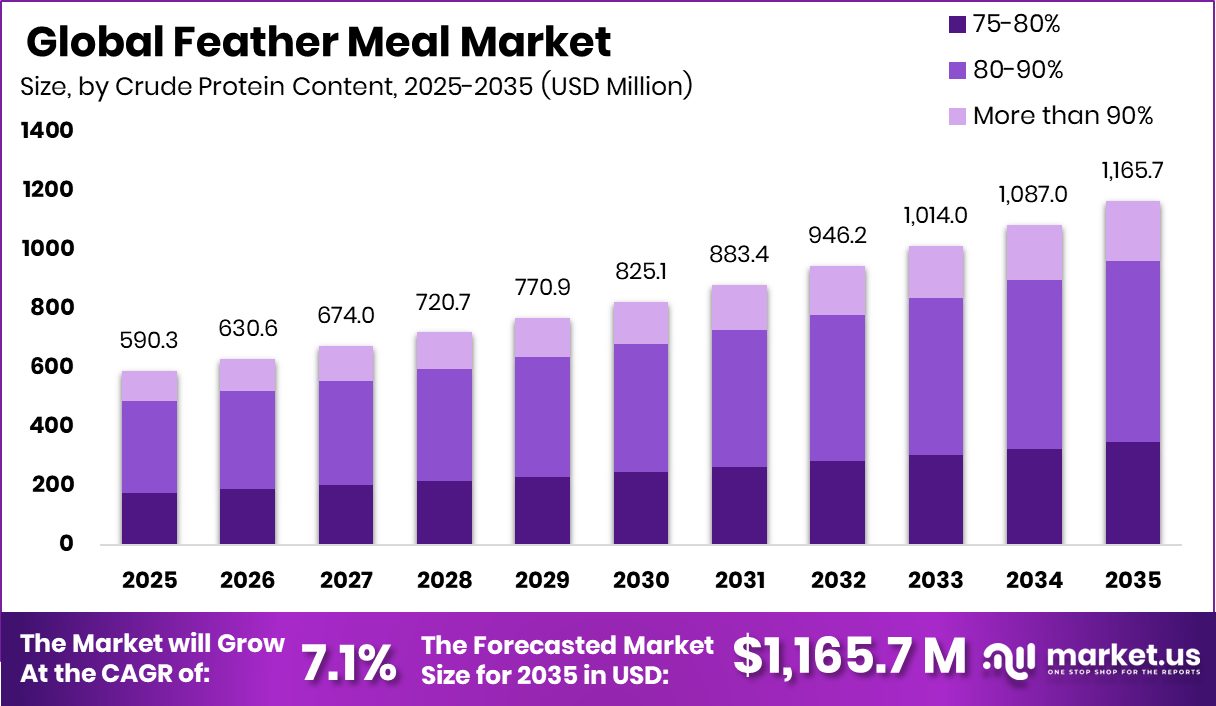
The Feather Meal Market refers to the production, processing, distribution, and use of feather-derived protein products across agricultural industries. The market is commonly segmented by type into conventional and organic products, by crude protein content, including 75–80%, 80–90%, and more than 90%, and by application, such as animal feed, agrochemicals, and other uses. It operates as part of the broader agricultural supply chain, where poultry by-products are transformed into valuable nutritional and soil-enrichment inputs.
Growth in the feather meal sector is largely supported by the expansion of livestock production and the need for efficient use of agricultural by-products. Poultry processing generates significant volumes of feathers that can be converted into usable protein ingredients instead of being discarded. Supportive investments across agricultural and biotechnology sectors also reflect broader interest in sustainable resource utilization. For example, Full Circle Biotechnology secured funding for a 7,000-ton facility, while Aviwell raised EUR 11 million to advance microbiota-based nutrition solutions, demonstrating increasing innovation within the wider animal nutrition ecosystem.
Demand for feather meal continues to be driven primarily by the livestock and feed industry, where protein-rich ingredients are required to support animal growth and productivity. The agricultural sector also increasingly seeks natural soil amendments that improve crop yields without heavy reliance on synthetic fertilizers. Government and institutional support have further strengthened agricultural development, such as MDARD surpassing $250 million in grants during the Whitmer Administration and awarding over $1.8 million for projects that support agricultural businesses and job creation.
Opportunities in the feather meal industry are linked to technological innovation and circular agriculture practices that transform waste into valuable resources. New solutions focused on sustainable feed and energy systems highlight the broader shift toward resource efficiency. For instance, MGA Thermal secured AU$3.25 million in ARENA funding for thermal energy storage studies, while Sweden’s Seaqure Labs raised €470K to convert food waste into fish and animal feed. These developments indicate growing potential for integrating by-product utilization, advanced processing technologies, and sustainable agricultural inputs within the evolving bio-economy.
- In September 2025, Darling Ingredients announced an agreement to sell approximately $125 million in production tax credits generated by its Diamond Green Diesel joint venture. The company converts food and animal by-products into sustainable fuels, feed ingredients, and fertilizers. The transaction helps strengthen financial resources that support the company’s broader operations, including rendering activities that produce protein ingredients, such as hydrolyzed feathermeal used in agriculture and animal nutrition industries.
Key Takeaways
- The Global Feather Meal Market is expected to be worth around USD 1,165.7 million by 2034, up from USD 590.3 million in 2024, and is projected to grow at a CAGR of 7.1% from 2025 to 2034.
- The conventional segment dominates the Feather Meal Market with 79.4% share due to cost efficiency.
- Feather meal containing 80–90% crude protein holds 52.6% share in the Feather Meal Market.
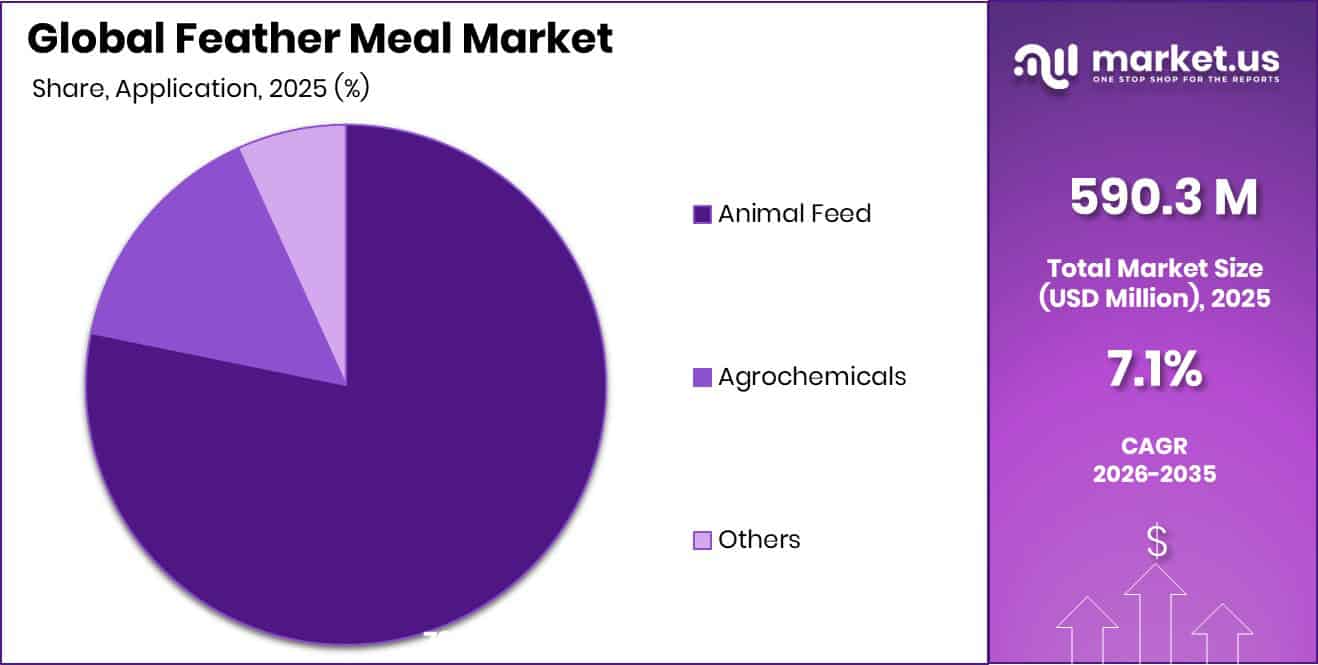
- Animal feed application accounts for 78.2% of the Feather Meal Market due to high protein demand.
- Asia Pacific led the feather meal market, capturing a 37.1% share worth USD 219.0 Mn.
By Type Analysis
Conventional type dominates the Feather Meal Market, accounting for 79.4% share globally.
In 2025, the conventional segment dominated the Feather Meal Market, accounting for approximately 79.4% of the total share. Conventional feather meal is widely produced through hydrolysis of poultry feathers under high temperature and pressure, converting keratin into a digestible protein source. This type remains the preferred choice for feed manufacturers due to its consistent quality, large-scale availability, and comparatively lower production costs.
Poultry processing plants generate significant volumes of feather by-products, making conventional processing the most practical method for converting waste into valuable animal feed ingredients. Additionally, conventional feather meal offers a sustainable solution for managing poultry waste while supporting the livestock industry with a reliable protein supplement used in poultry, swine, and aquaculture feed formulations.
By Crude Protein Content Analysis
In the Feather Meal Market, 80–90% crude protein segment holds 52.6% share.
In 2025, feather meal products containing 80–90% crude protein held the largest share of the Feather Meal Market at around 52.6%. This protein range is highly valued for its nutritional density and its ability to enhance feed formulations for various livestock species. Feather meal within this protein category provides an economical alternative to other protein-rich ingredients such as soybean meal or fish meal, helping feed producers manage costs while maintaining nutritional standards.
The hydrolyzed feather structure improves digestibility, allowing animals to utilize essential amino acids more effectively. As livestock production continues to grow globally, feed manufacturers increasingly rely on high-protein feather meal to support optimal animal growth, productivity, and feed efficiency in commercial farming operations.
By Application Analysis
Animal feed application leads the Feather Meal Market, capturing 78.2% global demand.
In 2025, animal feed remained the leading application segment in the Feather Meal Market, representing about 78.2% of the total demand. Feather meal is widely incorporated into feed formulations for poultry, cattle, swine, and aquaculture due to its high protein concentration and cost-effectiveness. Feed manufacturers utilize feather meal as a supplemental protein ingredient that supports animal growth, improves feed efficiency, and contributes to balanced nutritional profiles.
The increasing demand for meat, dairy, and aquaculture products has driven the expansion of the animal feed industry, subsequently boosting the use of feather meal in feed production. Additionally, the growing focus on sustainable feed ingredients has encouraged the utilization of poultry processing by-products such as feathers.
Key Market Segments
By Type
- Conventional
- Organic
By Crude Protein Content
- 75-80%
- 80-90%
- More than 90%
By Application
- Animal Feed
- Agrochemicals
- Others
Driving Factors
Rising demand for protein-rich animal feed
The Feather Meal Market is strongly influenced by the rising need for protein-rich ingredients used in livestock and poultry feed. Feather meal offers a concentrated protein source that helps support animal growth and feed formulation efficiency. As livestock production continues expanding, feed manufacturers increasingly incorporate alternative protein ingredients derived from poultry by-products. Innovation and investment across the agricultural input sector also highlight this momentum, such as UK Ag Chemical Discovery Company Redag raising $2 million in seed funding, supporting research and development in agricultural and feed-related technologies.
Increasing poultry processing by-product utilization
The increasing utilization of poultry processing by-products is another important driver supporting the Feather Meal Market. Large poultry production volumes generate substantial feather waste, which can be processed into protein-rich feed ingredients instead of being discarded. This conversion supports waste reduction and creates additional value within agricultural supply chains. Technological advancements and material innovation are also contributing to improved efficiency in agriculture, reflected by developments such as Infrascreen securing $1.5 million to develop efficiency-boosting greenhouse nanomaterial technologies, supporting broader agricultural productivity improvements.
Restraining Factors
Limited digestibility compared with other proteins
Despite its high protein content, feather meal may face limitations due to digestibility challenges when compared with other protein sources used in animal nutrition. Proper hydrolysis and processing are necessary to improve nutrient availability for livestock. Feed formulators must carefully balance ingredients to ensure nutritional efficiency. Broader agricultural investments also highlight the focus on crop and feed supply chains, such as Agric Fund allocating N19.5 billion to support cassava, soybeans, maize, and rice production, strengthening raw material availability for the agriculture and animal feed sectors.
Strict regulations on animal feed ingredients
Regulatory oversight in animal feed production can also influence the Feather Meal Market. Authorities often impose strict quality and safety standards on feed ingredients to ensure animal health and food chain safety. Compliance with these regulations may increase operational complexity for producers and processors. Meanwhile, biotechnology innovation continues to reshape agricultural inputs, illustrated by Crop CRISPR startup Hudson River Biotechnology raising $5.9 million in Series A funding, supporting advanced crop and agricultural biotechnology research.
Growth Opportunity
Growing demand for organic fertilizer solutions
The increasing preference for natural soil nutrients creates opportunities for feather meal as an organic fertilizer ingredient. Feather meal contains nitrogen that releases gradually in soil, supporting plant growth and improving soil structure in sustainable farming systems. As farmers adopt environmentally responsible inputs, feather-derived fertilizers gain attention in organic agriculture. Investment activity across agricultural technology sectors reflects this shift, including Vive Crop Protection securing an additional $11.2 million CAD extension to its Series C funding to enhance efficiency in agricultural chemical solutions.
Expanding livestock production in developing regions
Rapid livestock expansion in developing regions presents additional opportunities for the Feather Meal Market. Rising meat consumption and population growth increase demand for animal feed ingredients that support efficient livestock production. Feather meal can serve as a cost-effective protein supplement within feed formulations in these markets. Investment in agricultural innovation and biological inputs also indicates long-term industry potential, highlighted by Pivot Bio raising $430 million in a Series D funding round led by DCVC and Temasek, focusing on sustainable agricultural technologies.
Latest Trends
Adoption of sustainable agricultural waste recycling
A major trend in the Feather Meal Market is the growing emphasis on recycling agricultural and food processing waste. Converting poultry feathers into useful feed ingredients or soil nutrients supports circular agriculture and reduces environmental waste. This approach aligns with broader sustainability initiatives across the agricultural sector. Financial support for innovative climate and agricultural technologies further reflects this trend, including Nitricity securing $50 million in Series B funding, supporting sustainable fertilizer production technologies and efficient agricultural resource management.
Development of high-protein hydrolyzed feather meal
Technological advancements in hydrolysis and processing methods are enabling the production of higher-quality feather meal with improved protein availability. Enhanced processing techniques help increase digestibility and expand the application of feather meal in animal feed formulations. These improvements support the broader movement toward efficient biological inputs and advanced agricultural solutions. Innovation across the agri-biotech landscape continues to accelerate, as demonstrated by Micropep securing $10 million in funding from FMC and other investors to develop peptide-based agricultural inputs that improve crop productivity and sustainability.
Regional Analysis
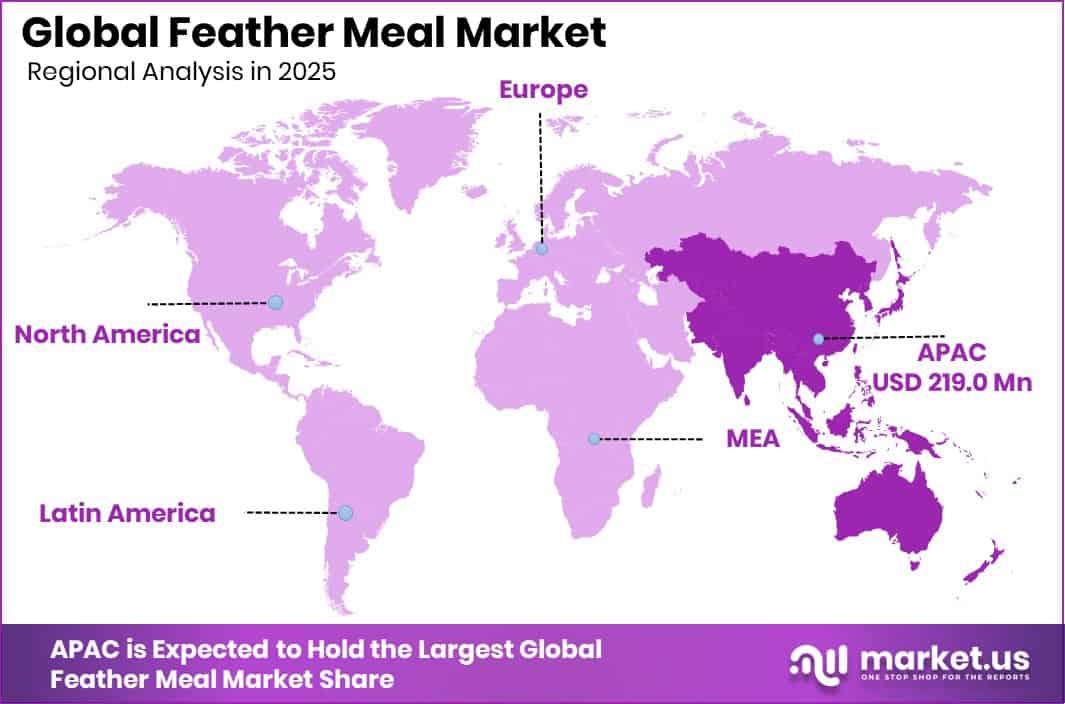
Asia Pacific Feather Meal Market held 37.1% share valued at USD 219.0 Mn.
The Feather Meal Market demonstrates varied regional dynamics across North America, Europe, Asia Pacific, the Middle East & Africa, and Latin America, reflecting differences in livestock production, feed industry expansion, and poultry processing capacity.
Asia Pacific dominates the global market, accounting for 37.1% share valued at USD 219.0 Mn, driven by the region’s extensive poultry production and increasing demand for high-protein feed ingredients in countries with rapidly expanding livestock sectors. The large availability of poultry by-products and the strong growth of the animal feed industry continue to support feather meal utilization across the region.
North America represents a significant regional market due to well-established poultry processing infrastructure and strong demand for cost-efficient protein additives in animal feed formulations. Europe also maintains a steady market presence supported by structured feed manufacturing systems and regulated by-product utilization practices.
Meanwhile, the Middle East & Africa and Latin America contribute emerging growth opportunities as livestock production and commercial feed manufacturing gradually expand in these regions, supporting the use of protein-rich by-products such as feather meal in feed applications.
Key Regions and Countries
- North America
- US
- Canada
- Europe
- Germany
- France
- The UK
- Spain
- Italy
- Rest of Europe
- Asia Pacific
- China
- Japan
- South Korea
- India
- Australia
- Rest of APAC
- Latin America
- Brazil
- Mexico
- Rest of Latin America
- Middle East & Africa
- GCC
- South Africa
- Rest of MEA
Key Players Analysis
In 2025, The Boyer Valley Company continues to maintain a specialized presence within the feather meal industry through its focus on processing poultry by-products into usable feed ingredients. The company’s operational approach centers on converting feather waste into protein-rich meal suitable for livestock nutrition applications. Its role in the industry reflects the importance of efficient by-product utilization within poultry processing ecosystems. By maintaining consistent processing standards and supplying feather meal products to feed formulators, the company contributes to the broader value chain that transforms poultry waste streams into commercially usable agricultural inputs.
Tyson Foods Inc. holds a significant industry position due to its extensive poultry processing operations, which generate substantial volumes of feather by-products. Through integrated processing capabilities, the company is able to convert these by-products into feather meal as part of its broader rendering and ingredient recovery activities. This internal supply chain structure enables efficient utilization of poultry processing outputs while supporting feed ingredient availability. Tyson’s scale and operational integration allow it to manage large volumes of raw materials while maintaining consistent production of feather-based feed ingredients.
North Country Organics represents a different segment of the industry, emphasizing natural and organic agricultural inputs. The company focuses on producing feather meal products aligned with organic farming and soil nutrition requirements. Typically, its product portfolio targets sustainable agriculture, gardening, and organic crop production systems. By offering feather-based nutrients to improve soil and help plants grow, North Country Organics promotes eco-friendly farming methods and expands the uses for feather products.
Top Key Players in the Market
- The Boyer Valley Company
- Tyson Foods Inc.
- North Country Organics
- Darling Ingredients
- Kleingarn Agrarprodukte
- Sanimax Industries
- JG Pears
- West Coast Reduction Ltd.
Recent Developments
- In September 2024, Kleingarn Agrarprodukte strengthened its trading activities for agricultural feed raw materials, including protein-based ingredients such as feather meal used in animal nutrition. The company works as a supplier and distributor of feed ingredients to the compound feed industry and livestock farms. By continuing to expand its product portfolio of proteins and other feed materials, the company improved supply options for feed producers that require reliable raw materials for livestock nutrition and agricultural operations.
- In August 2024, The Boyer Valley Company highlighted its feather meal product as a slow-release organic fertilizer designed for plant growth and soil improvement. The feather meal is produced from processed poultry feathers and provides nitrogen and nutrients that gradually become available to plants. This product is widely used in organic gardening and crop farming to enhance soil fertility and support sustainable agricultural practices. The company supplies these feather-derived products to fertilizer manufacturers and agricultural users.
Report Scope
Report Features Description Market Value (2025) USD 590.3 Million Forecast Revenue (2035) USD 1,165.7 Million CAGR (2026-2035) 7.1% Base Year for Estimation 2025 Historic Period 2020-2024 Forecast Period 2026-2035 Report Coverage Revenue Forecast, Market Dynamics, Competitive Landscape, Recent Developments Segments Covered By Type (Conventional, Organic), By Crude Protein Content (75-80%, 80-90%, More than 90%), By Application (Animal Feed, Agrochemicals, Others) Regional Analysis North America – US, Canada; Europe – Germany, France, The UK, Spain, Italy, Rest of Europe; Asia Pacific – China, Japan, South Korea, India, Australia, Singapore, Rest of APAC; Latin America – Brazil, Mexico, Rest of Latin America; Middle East & Africa – GCC, South Africa, Rest of MEA Competitive Landscape The Boyer Valley Company, Tyson Foods Inc., North Country Organics, Darling Ingredients, Kleingarn Agrarprodukte, Sanimax Industries, JG Pears, West Coast Reduction Ltd. Customization Scope Customization for segments, region/country-level will be provided. Moreover, additional customization can be done based on the requirements. Purchase Options We have three licenses to opt for: Single User License, Multi-User License (Up to 5 Users), Corporate Use License (Unlimited User and Printable PDF) 
-
-
- The Boyer Valley Company
- Tyson Foods Inc.
- North Country Organics
- Darling Ingredients
- Kleingarn Agrarprodukte
- Sanimax Industries
- JG Pears
- West Coast Reduction Ltd.
Our Clients

- 181345
- March 2026






