


Global Experiential Travels Market Size, Share, Growth Analysis By Type (Adventure Travel, Cultural Exploration, Culinary Tours, Wellness Retreats, Others), By Age Group (Millennials, Generation X, Baby Boomers, Others), By Booking Channel (Online Travel Agencies, Direct Travel Suppliers, Others), By Region and Companies - Industry Segment Outlook, Market Assessment, Competition Scenario, Statistics, Trends and Forecast 2026-2035
- Published date: Jan 2026
- Report ID: 174496
- Number of Pages: 372
- Format:
-
keyboard_arrow_up
Quick Navigation
Report Overview
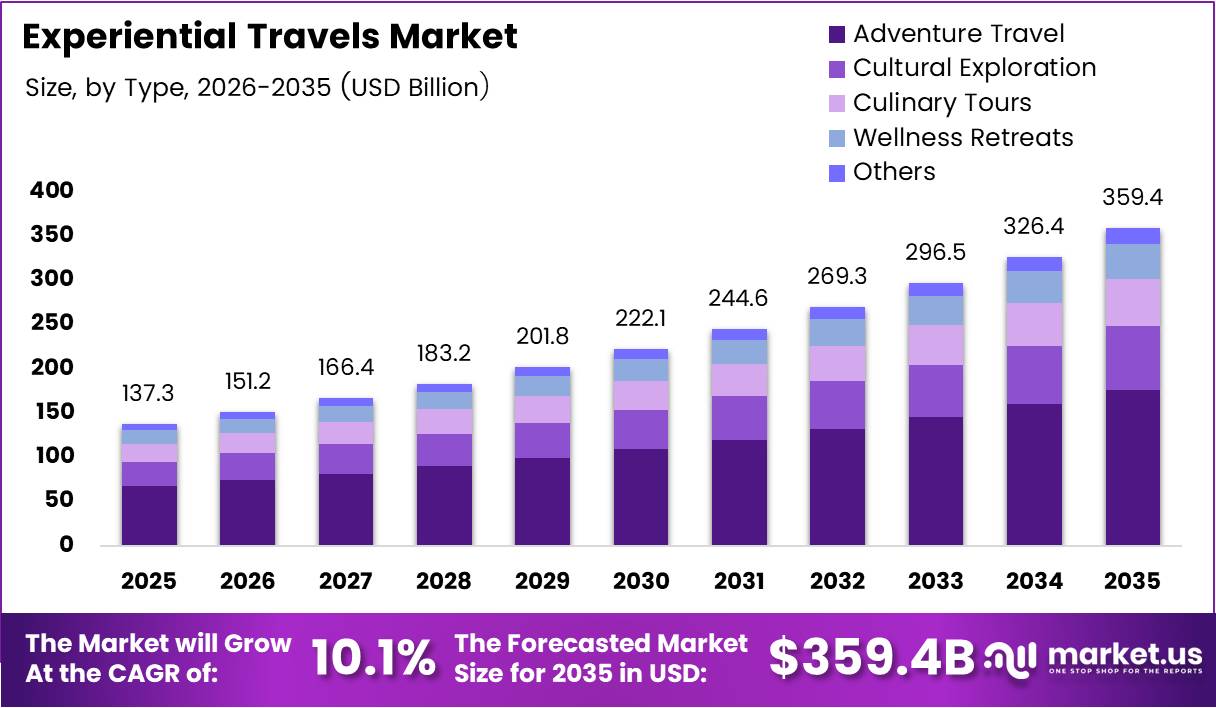
The global Experiential Travels Market is projected to reach approximately USD 359.4 Billion by 2035, up from USD 137.3 Billion in 2025. This growth reflects a robust CAGR of 10.1% during the forecast period from 2026 to 2035.
Experiential travel represents a transformative shift in tourism consumption patterns. Unlike traditional sightseeing vacations, this approach emphasizes authentic cultural immersion, meaningful local interactions, and memory-driven adventures. Moreover, travelers increasingly seek activities that connect them deeply with destinations through hands-on experiences.
The market encompasses diverse offerings including adventure tourism, culinary immersion programs, wellness retreats, and cultural exploration. Additionally, these experiences range from indigenous heritage tours to skill-based learning journeys. Consequently, travelers prioritize personal growth and authentic connections over conventional tourist attractions.
Millennials and Generation Z demographics drive significant market momentum through their preference for experiences over material possessions. Furthermore, social media platforms amplify destination discovery and activity-based tourism adoption. Therefore, younger consumers willingly allocate substantial budgets toward transformative travel experiences that create lasting memories.
Digital booking platforms have revolutionized market accessibility by offering curated experience packages. Online travel agencies now dominate distribution channels, providing convenient access to diverse experiential offerings. However, customized packages often carry premium pricing, which limits widespread mass market adoption.
Infrastructure challenges in remote experiential destinations present operational constraints. Nevertheless, the sector demonstrates remarkable resilience through innovative eco-tourism and regenerative travel programs. Additionally, corporate wellness retreats and team-building experiences expand market applications beyond leisure tourism.
According to the American Express 2024 Global Travel Trends Report, 77% of travelers prioritize the right travel experience over trip costs. Furthermore, Forbes and Mastercard 2025 research indicates 81% of high-net-worth travelers value unique immersive experiences over standardized luxury accommodations. Additionally, 73% of travelers prefer spending that directly supports local communities, demonstrating strong ethical consumption patterns.
Key Takeaways
- Global Experiential Travels Market to reach USD 359.4 Billion by 2035 from USD 137.3 Billion in 2025 at 10.1% CAGR
- Adventure Travel segment dominates By Type analysis with 39.4% market share in 2025
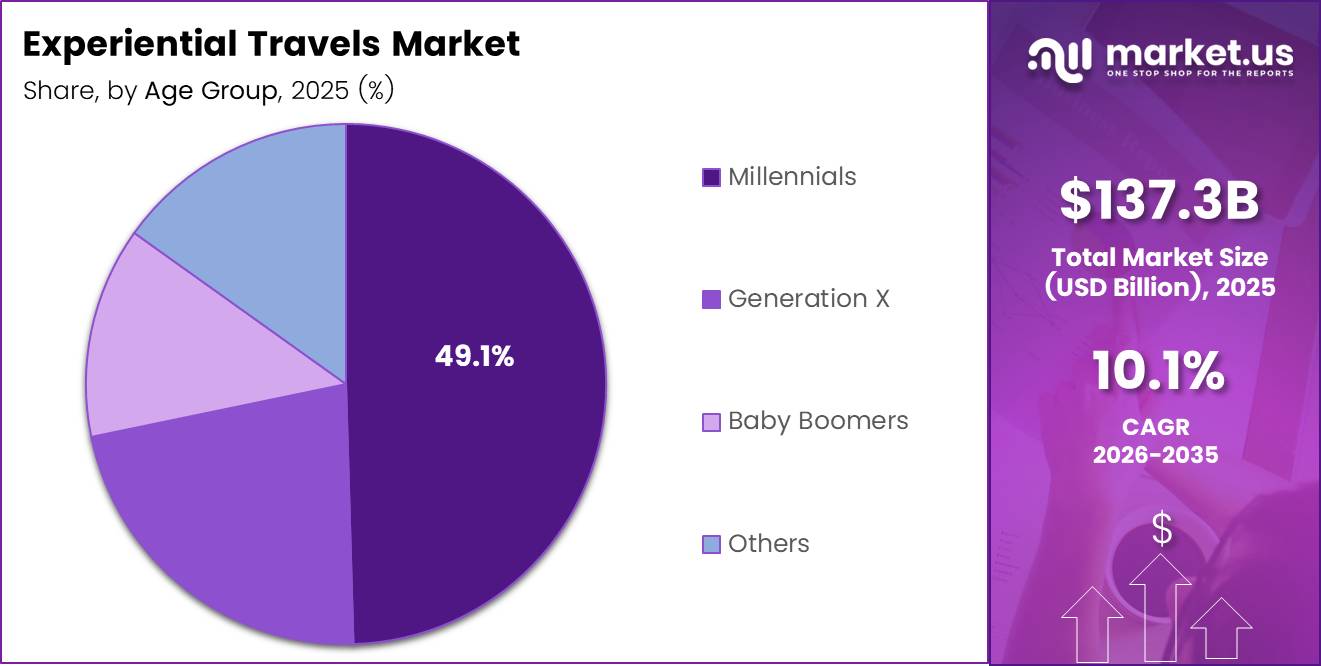
- Millennials lead By Age Group segment holding 49.1% market share in 2025
- Online Travel Agencies command 52.5% share in By Booking Channel segment during 2025
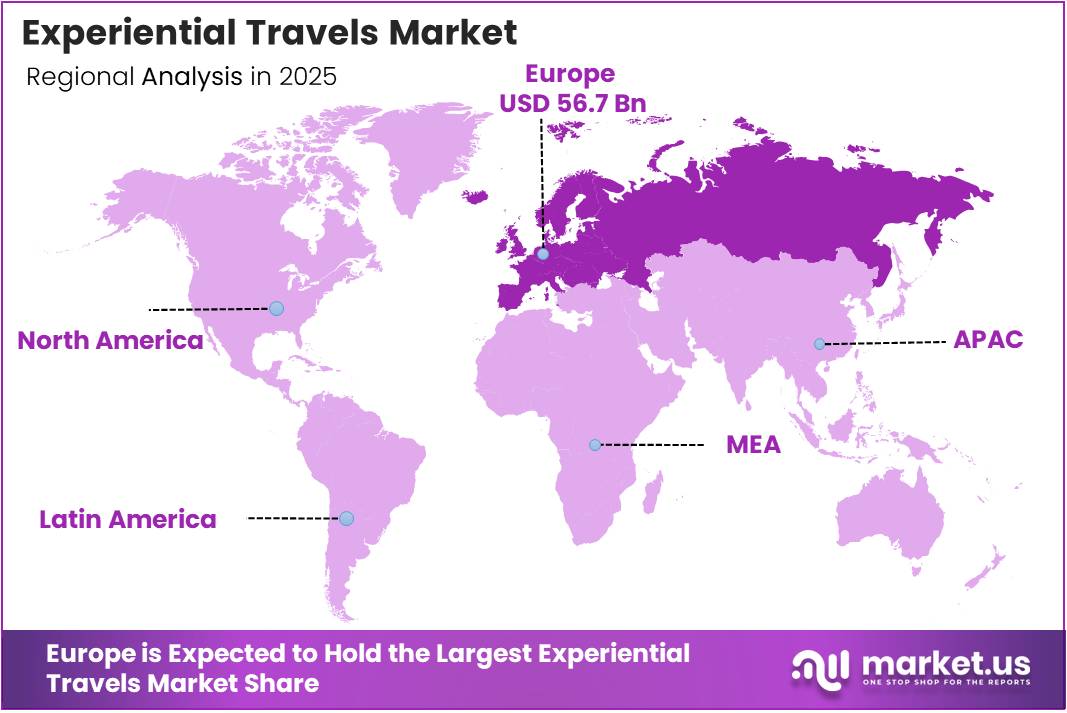
- Europe dominates regional market with 41.3% share valued at USD 56.7 Billion
Type Analysis
Adventure Travel dominates with 39.4% market share due to rising demand for adrenaline-driven authentic experiences.
In 2025, Adventure Travel held a dominant market position in the By Type Analysis segment of Experiential Travels Market, with a 39.4% share. This segment attracts thrill-seekers pursuing activities like mountaineering, wildlife safaris, and extreme sports. Moreover, younger demographics increasingly favor physically engaging experiences that challenge personal boundaries and create memorable adventures.
Cultural Exploration represents a significant segment focused on heritage discovery and local tradition immersion. Travelers engage with indigenous communities, historical sites, and artistic expressions. Consequently, this category appeals to intellectually curious consumers seeking authentic cultural understanding. Furthermore, UNESCO heritage sites and traditional festivals drive substantial bookings within this experiential category.
Culinary Tours cater to food enthusiasts exploring regional gastronomy through cooking classes and local market visits. These experiences combine sensory pleasure with cultural education. Additionally, wine tasting tours and street food explorations gain popularity among travelers prioritizing gastronomic discovery. Therefore, culinary-focused itineraries consistently attract premium-paying sophisticated travelers.
Wellness Retreats focus on holistic health through yoga programs, meditation sessions, and spa therapies in serene environments. This segment addresses growing consumer awareness about mental and physical wellbeing. Moreover, post-pandemic recovery accelerated demand for stress-reduction and rejuvenation experiences. Consequently, wellness tourism integrates traditional healing practices with modern therapeutic approaches.
Others include diverse niche experiences such as volunteer tourism, photography expeditions, and educational workshops. These specialized offerings cater to specific interest groups seeking unconventional travel pursuits. Furthermore, agritourism and farm-stay programs expand experiential travel beyond conventional categories.
Age Group Analysis
Millennials dominate with 49.1% market share driven by their strong preference for memory-driven experiences.
In 2025, Millennials held a dominant market position in the By Age Group Analysis segment of Experiential Travels Market, with a 49.1% share. This demographic actively prioritizes experiential spending over material goods accumulation. Moreover, their digital fluency enables efficient discovery and booking of curated travel experiences. Therefore, millennials represent the most commercially valuable age segment for experiential travel providers.
Generation X demonstrates substantial market participation through family-oriented experiential vacations and adventure activities. This cohort possesses significant disposable income and travel experience. Additionally, they balance professional responsibilities with desire for meaningful leisure pursuits. Consequently, Generation X seeks well-organized experiences offering both relaxation and cultural enrichment for multi-generational travel groups.
Baby Boomers increasingly embrace experiential travel during retirement years seeking cultural immersion and wellness activities. This segment prioritizes comfort alongside authentic experiences. Furthermore, longer trip durations and higher spending capacity characterize Baby Boomer travel patterns. Therefore, luxury experiential packages targeting senior travelers demonstrate consistent growth potential.
Others encompass Generation Z travelers and senior citizens beyond traditional Baby Boomer classification. These emerging segments show growing interest in sustainable and socially responsible experiential tourism. Additionally, educational gap-year programs attract younger travelers seeking transformative international experiences.
Booking Channel Analysis
Online Travel Agencies dominate with 52.5% market share through convenient digital access and diverse package offerings.
In 2025, Online Travel Agencies held a dominant market position in the By Booking Channel Analysis segment of Experiential Travels Market, with a 52.5% share. These platforms provide comprehensive experience inventories, customer reviews, and competitive pricing transparency. Moreover, user-friendly interfaces facilitate comparison shopping and instant booking confirmation. Therefore, OTAs remain the preferred distribution channel for modern experiential travelers.
Direct Travel Suppliers include tour operators, hotels, and activity providers offering bookings through proprietary channels. This segment maintains loyal customer bases through personalized service and exclusive experiences. Additionally, direct booking eliminates intermediary commissions, potentially offering better value. Consequently, specialized experiential providers leverage direct channels for premium customized itineraries.
Others encompass traditional travel agencies, corporate booking platforms, and emerging peer-to-peer experience marketplaces. These alternative channels serve specific market niches and customer preferences. Furthermore, hybrid models combining online convenience with human consultation gain traction among complex itinerary planners.
Key Market Segments
By Type
- Adventure Travel
- Cultural Exploration
- Culinary Tours
- Wellness Retreats
- Others
By Age Group
- Millennials
- Generation X
- Baby Boomers
- Others
By Booking Channel
- Online Travel Agencies
- Direct Travel Suppliers
- Others
Drivers
Rising Preference for Authentic Cultural Immersion Drives Experiential Travels Market Growth
Modern travelers increasingly reject superficial tourism in favor of deep cultural engagement and local lifestyle participation. This shift reflects changing consumer values prioritizing meaningful connections over passive sightseeing activities. Moreover, authentic experiences provide personal enrichment that standardized vacation packages cannot deliver.
Millennials and Generation Z demonstrate particularly strong spending patterns on memory-driven travel experiences rather than material possessions. These demographics view experiential investments as essential life enrichment rather than discretionary spending. Consequently, travel budgets increasingly prioritize transformative experiences that create lasting personal narratives and social media content.
Digital booking platforms have democratized access to curated experience packages previously available only through specialized travel agents. Online marketplaces showcase diverse offerings with transparent pricing and peer reviews. Therefore, consumers easily discover and book unique experiences tailored to individual interests and preferences.
Social media platforms significantly influence destination discovery and activity-based tourism adoption patterns. Visual content sharing motivates travelers to seek Instagram-worthy experiences and unique adventures. Additionally, influencer marketing and user-generated content drive awareness of experiential travel options globally.
Restraints
High Cost of Customized Packages Limits Experiential Travels Market Expansion
Premium pricing associated with personalized experiential travel packages restricts accessibility for budget-conscious consumers and middle-income segments. Customized itineraries require significant planning resources and specialized local partnerships. Consequently, many potential travelers opt for conventional tourism alternatives offering lower price points and predictable costs.
Small group sizes and specialized guides elevate per-person costs compared to mass tourism operations. Moreover, authentic experiences often occur in remote locations with limited economies of scale. Therefore, pricing structures remain prohibitive for mainstream market adoption despite growing consumer interest in experiential offerings.
Infrastructure limitations in remote experiential destinations create operational challenges for tour operators and travelers. Many culturally rich or adventure-oriented locations lack adequate transportation, accommodation, and communication facilities. Additionally, seasonal accessibility issues further complicate logistics for experience-based tourism programs.
Safety concerns and regulatory uncertainties in emerging experiential destinations deter risk-averse travelers. Furthermore, quality inconsistencies across experiential providers create hesitation among first-time participants. Therefore, market growth faces constraints from both supply-side infrastructure gaps and demand-side confidence barriers.
Growth Factors
Development of Eco-Experiential Tourism Expands Experiential Travels Market Opportunities
Eco-experiential and regenerative tourism packages in emerging destinations attract environmentally conscious travelers seeking sustainable vacation options. These programs combine authentic experiences with positive environmental and social impacts. Moreover, destinations implementing conservation-focused tourism models gain competitive advantage in attracting premium eco-tourists.
Integration of virtual pre-experience planning and AI-based personalization platforms enhances customer engagement and booking conversion rates. Advanced technologies enable travelers to preview destinations and customize itineraries efficiently. Consequently, digital innovation reduces booking friction while improving experience quality through better personalization.
Corporate team-building and wellness retreat programs expand experiential travel beyond leisure tourism into business applications. Companies increasingly invest in off-site experiences fostering employee bonding and wellbeing. Additionally, corporate budgets provide stable revenue streams less sensitive to leisure travel demand fluctuations.
Agritourism and community-based homestay programs create accessible experiential opportunities in rural and suburban locations. These grassroots initiatives support local economic development while offering authentic cultural exchanges. Furthermore, farm-stay experiences appeal to urban populations seeking agricultural connections and countryside relaxation.
Emerging Trends
Surge in Slow Travel Programs Shapes Experiential Travels Market Evolution
Slow travel and long-stay immersive destination programs gain popularity among travelers prioritizing depth over breadth in their experiences. Extended stays enable genuine community integration and cultural understanding beyond surface-level tourism. Moreover, remote work flexibility allows professionals to combine extended travel with employment responsibilities.
Rising demand for indigenous culture and heritage experience tours reflects growing appreciation for traditional knowledge and ancestral practices. Travelers seek authentic interactions with native communities preserving unique cultural identities. Consequently, ethical tourism frameworks ensure communities benefit economically while maintaining cultural integrity.
Adoption of carbon-neutral and low-impact experience travel models addresses environmental consciousness among modern consumers. Tour operators implement sustainable practices including renewable transportation and waste reduction programs. Additionally, carbon offset initiatives and eco-certification schemes build credibility with environmentally aware travelers.
Growth of skill-based travel experiences such as culinary, art, and craft immersion programs appeals to learners seeking practical knowledge acquisition. These educational tourism formats combine vacation enjoyment with personal skill development. Furthermore, workshop-style experiences create tangible takeaways beyond memories and photographs.
Regional Analysis
Europe Dominates the Experiential Travels Market with 41.3% Market Share, Valued at USD 56.7 Billion
Europe maintained its dominant position in the global Experiential Travels Market during 2025, capturing 41.3% market share valued at USD 56.7 Billion. The region benefits from exceptional cultural diversity, rich historical heritage, and well-developed tourism infrastructure supporting diverse experiential offerings. Moreover, European destinations excel in culinary tourism, cultural immersion programs, and adventure activities. Additionally, strong rail connectivity facilitates multi-country experiential itineraries appealing to international visitors. Therefore, Europe remains the premier destination for heritage-focused and culturally immersive travel experiences.
North America Experiential Travels Market Trends
North America demonstrates robust growth driven by adventure tourism in national parks and wellness retreat demand. The region offers diverse experiential opportunities from wilderness adventures to urban cultural explorations. Moreover, strong domestic travel culture and high disposable incomes support premium experiential package adoption. Additionally, technology-enabled booking platforms headquartered in North America drive global market innovation.
Asia Pacific Experiential Travels Market Trends
Asia Pacific represents the fastest-growing regional market fueled by emerging middle-class travelers and diverse cultural offerings. The region provides exceptional value propositions combining authentic experiences with competitive pricing. Moreover, destinations like Japan, Thailand, and India attract international experiential tourists seeking spiritual, culinary, and adventure experiences. Additionally, increasing outbound travel from China and India expands regional market dynamics significantly.
Latin America Experiential Travels Market Trends
Latin America gains recognition for eco-tourism, adventure activities, and indigenous cultural experiences in diverse natural environments. Countries like Costa Rica and Peru lead experiential tourism through sustainable development models. Moreover, the region’s biodiversity and archaeological heritage create unique experiential offerings. Additionally, improving infrastructure and safety perceptions encourage growing international visitation for authentic Latin American experiences.
Middle East & Africa Experiential Travels Market Trends
Middle East and Africa showcase emerging experiential tourism potential through wildlife safaris, desert adventures, and cultural heritage programs. The region offers distinctive experiences unavailable in traditional tourism markets. Moreover, luxury experiential offerings in UAE and safari experiences in Kenya attract high-spending international travelers. Additionally, improved tourism infrastructure and destination marketing expand regional market accessibility and appeal.
Key Regions and Countries
North America
- US
- Canada
Europe
- Germany
- France
- The UK
- Spain
- Italy
- Rest of Europe
Asia Pacific
- China
- Japan
- South Korea
- India
- Australia
- Rest of APAC
Latin America
- Brazil
- Mexico
- Rest of Latin America
Middle East & Africa
- GCC
- South Africa
- Rest of MEA
Key Experiential Travels Company Insights
Airbnb revolutionized experiential travel through its Experiences platform connecting travelers with local hosts offering unique activities worldwide. The company leverages its extensive accommodation network to provide integrated booking solutions. Moreover, Airbnb’s peer-to-peer model democratizes experiential tourism by enabling ordinary individuals to become experience providers. Consequently, the platform offers unmatched diversity in authentic local experiences across global destinations. Additionally, strong brand recognition and user trust position Airbnb as a dominant player in online experiential travel bookings.
Expedia Group maintains significant market presence through its multi-brand portfolio including Expedia, Vrbo, and Hotels.com offering comprehensive travel solutions. The company strategically integrates experiential offerings into its booking platforms to capture growing demand. Moreover, Expedia’s technological infrastructure enables seamless experience discovery and reservation processes. Therefore, the group effectively competes across multiple customer segments through differentiated brand positioning. Additionally, partnerships with local tour operators expand inventory depth and geographic coverage significantly.
Booking Holdings operates leading travel brands including Booking.com, Priceline, and Kayak serving diverse global markets with experiential travel options. The company invests heavily in technology innovation to enhance personalization and customer engagement. Moreover, Booking Holdings’ extensive supplier network ensures competitive pricing and diverse experience selections. Consequently, the group maintains strong market position through operational scale and brand portfolio strength. Additionally, data-driven marketing strategies optimize customer acquisition and retention across international markets effectively.
TUI Group represents Europe’s largest tourism enterprise offering integrated travel services including curated experiential packages and tours. The company combines tour operations with airline and accommodation assets creating vertically integrated value chains. Moreover, TUI’s destination expertise enables development of exclusive experiential products unavailable through online-only competitors. Therefore, the group appeals to customers seeking comprehensive travel solutions with quality assurance. Additionally, strong European market presence and brand heritage support customer loyalty and repeat bookings consistently.
Key Companies
- Airbnb
- Expedia Group
- Booking Holdings
- TUI Group
- Thomas Cook Group
- Adventures by Disney
- G Adventures
- Intrepid Travel
- Abercrombie & Kent
- Butterfield & Robinson
Recent Developments
- In March 2025, Emerald Agrees to Acquire Global Portfolio of Experiential and Luxury Travel Industry B2B Events. This strategic acquisition expands Emerald’s presence in the experiential travel sector by adding premium industry events connecting travel providers with high-value customers and partners globally.
- In July 2025, TWAI acquires Travello to enter $200 Billion tours and activities market and expand global consumer reach. This acquisition enables TWAI to diversify its portfolio into the rapidly growing experiential travel segment while leveraging Travello’s established technology platform and customer base.
- In January 2026, Flag in the Sand Acquires Neranos Yachting, Merging Two Icons of Discreet Luxury and Experiential Travel. This merger combines complementary luxury experiential travel offerings creating enhanced value propositions for high-net-worth travelers seeking exclusive yacht-based cultural immersion experiences.
Report Scope
Report Features Description Market Value (2025) USD 137.3 Billion Forecast Revenue (2035) USD 359.4 Billion CAGR (2026-2035) 10.1% Base Year for Estimation 2025 Historic Period 2020-2024 Forecast Period 2026-2035 Report Coverage Revenue Forecast, Market Dynamics, Competitive Landscape, Recent Developments Segments Covered By Type (Adventure Travel, Cultural Exploration, Culinary Tours, Wellness Retreats, Others), By Age Group (Millennials, Generation X, Baby Boomers, Others), By Booking Channel (Online Travel Agencies, Direct Travel Suppliers, Others) Regional Analysis North America (US and Canada), Europe (Germany, France, The UK, Spain, Italy, and Rest of Europe), Asia Pacific (China, Japan, South Korea, India, Australia, and Rest of APAC), Latin America (Brazil, Mexico, and Rest of Latin America), Middle East & Africa (GCC, South Africa, and Rest of MEA) Competitive Landscape Airbnb, Expedia Group, Booking Holdings, TUI Group, Thomas Cook Group, Adventures by Disney, G Adventures, Intrepid Travel, Abercrombie & Kent, Butterfield & Robinson Customization Scope Customization for segments, region/country-level will be provided. Moreover, additional customization can be done based on the requirements. Purchase Options We have three licenses to opt for: Single User License, Multi-User License (Up to 5 Users), Corporate Use License (Unlimited User and Printable PDF)  Experiential Travels MarketPublished date: Jan 2026add_shopping_cartBuy Now get_appDownload Sample
 -
-
- Airbnb
- Expedia Group
- Booking Holdings
- TUI Group
- Thomas Cook Group
- Adventures by Disney
- G Adventures
- Intrepid Travel
- Abercrombie & Kent
- Butterfield & Robinson
Our Clients

- 174496
- Jan 2026






