


Report Overview
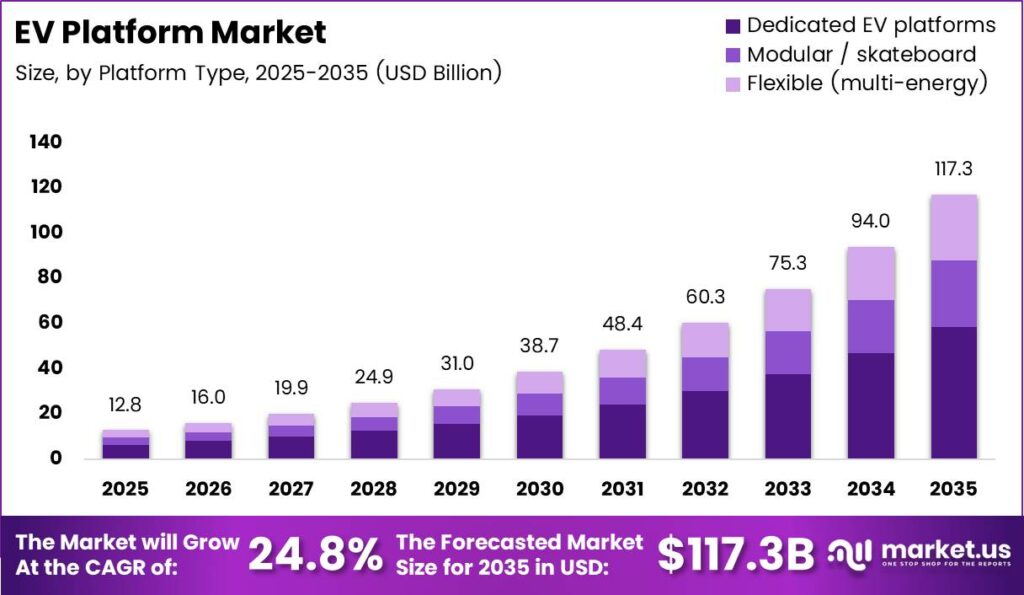
Global EV Platform Market size is expected to be worth around USD 117.30 Billion by 2035 from USD 12.80 Billion in 2025, growing at a CAGR of 24.8% during the forecast period 2026 to 2035. Platform suppliers now treat the underbody architecture as the core profit unit rather than the finished vehicle shell. Capital is moving toward shared chassis programs that can host multiple body styles under one engineering budget.
Therefore, the EV Platform Market covers dedicated, modular skateboard, and flexible multi-energy architectures that integrate batteries, motors, and control electronics. Buyers include global OEMs and regional assemblers that license or co-develop these underbodies for passenger and commercial programs. Platform choice fixes tooling cost, charging voltage, and software update paths for the vehicle life. Vendors who control battery integration and zonal electronics secure multi-year supply positions.
Key Takeaways
- The market is projected to rise from USD 12.80 Billion in 2025 to USD 117.30 Billion by 2035 at a CAGR of 24.8%.
- Dedicated EV platforms lead By Platform Type with a 47.8% share.
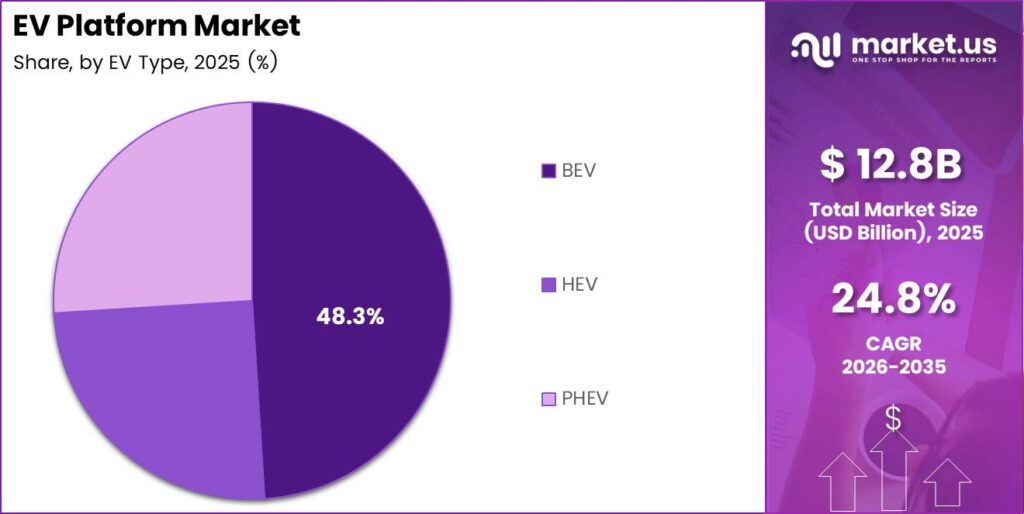
- BEV leads By EV Type with a 48.3% share.
- Batteries (incl. BMS) lead By Component Focus with a 54.4% share.
- Passenger vehicles lead By Vehicle Type with a 57.2% share.
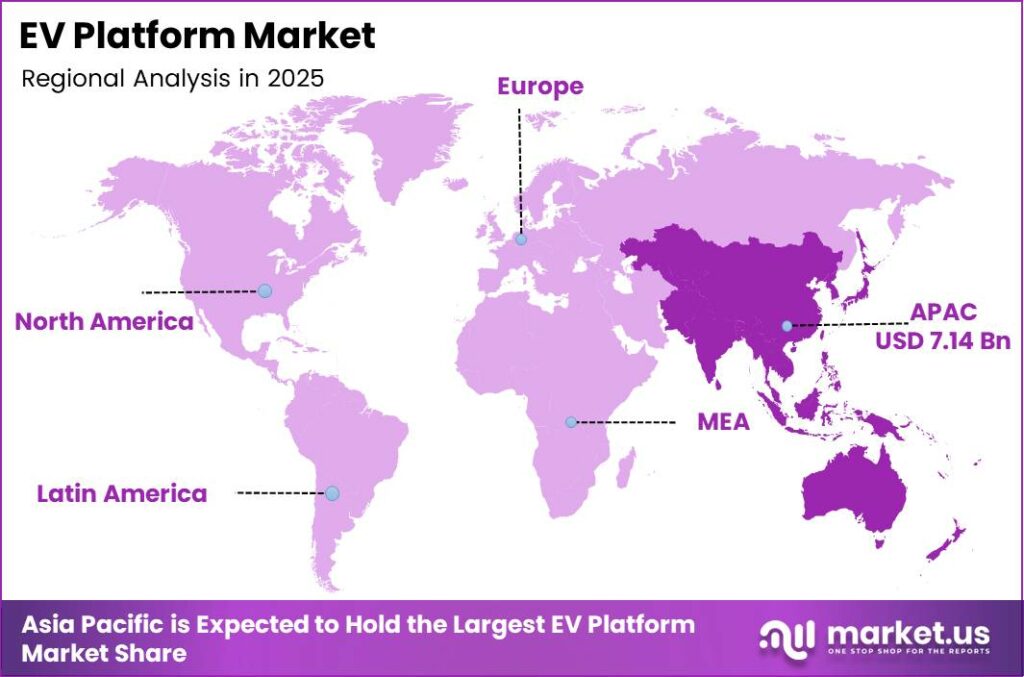
- Asia Pacific leads the regional landscape with a 55.8% share, valued at USD 7.14 Billion.
In August 2025, Ford Motor Company introduced its Universal EV Platform and Universal EV Production System and committed approximately USD 5 Billion to an affordable EV family, a midsize electric pickup, and U.S. prismatic lithium-iron-phosphate battery output. This capital wave ties passenger volume growth directly to standardized underbody tooling. As a result, suppliers that win midsize truck and car commonality capture longer production runs than single-model chassis programs.
According to Ford, the Universal EV Platform uses 20% fewer parts and 25% fewer fasteners than a typical vehicle, while requiring 40% fewer dock-to-dock factory workstations. Lower part counts cut tooling complexity and free plant floor space for automation cells. This creates a cost path that mid-market EV programs can defend after purchase incentives fade.
Ford also reported that its Universal EV Production System could assemble its midsize electric truck up to 40% faster than existing vehicles at the Louisville plant, with a net 15% speed gain after automation and insourcing. Faster takt times raise annual platform throughput without a matching rise in headcount. Investors should treat cycle-time leadership as a margin lever equal to battery cell cost.
Platform Type Analysis
Dedicated EV platforms dominates with 47.8% due to purpose-built chassis packaging efficiency.
In 2025, Dedicated EV platforms held a dominant market position in the By Platform Type segment of EV Platform Market, with a 47.8% share. Data from the IEA shows nearly 22 million electric cars were produced globally in 2025, up more than 25% from the prior year. Dedicated skateboards absorb that volume with flat floors and fixed battery zones that multi-energy shells cannot match. OEMs that standardize on native EV underbodies cut redundant crash structures and free capital for software features.
Modular and skateboard architectures give licensees a shared floorpan that can stretch across body styles without a full redesign. Figures from the IEA show battery pack prices in China were 30% lower than in North America in 2025. Lower pack costs raise the return on modular tooling because the same skateboard can host several range packs. Suppliers that certify multi-tenant skateboards win royalty streams beyond their own vehicle brands.
Flexible multi-energy platforms still serve fleets that need shared lines for hybrid and pure-electric builds during transition years. The IEA indicates electric car sales exceeded 20 million in 2025 and represented about one-quarter of global car sales. That mix keeps flexible architectures relevant where plants cannot yet dedicate full capacity to battery-only products. However, each retained combustion interface adds mass and validation cost that pure EV rivals avoid.
EV Type Analysis
BEV dominates with 48.3% due to full-electric drivetrain packaging simplicity.
In 2025, BEV held a dominant market position in the By EV Type segment of EV Platform Market, with a 48.3% share. Based on IEA data, China accounted for 70% of electric car production and over 80% of battery cell production in 2025. BEV platforms convert that cell supply into single-voltage architectures without engine bays or fuel systems. Platform owners aligned with high-volume cell makers lock cost leadership before hybrid rivals finish dual-path validation.
HEV platforms remain the fastest-growing EV type path because they reuse familiar powertrain service networks while adding electric assist. IEA tracking shows EV battery deployment reached 1.2 TWh in 2025, an increase of almost 30% versus 2024. Rising cell output lowers the incremental cost of hybrid packs on shared underbodies. This signals that hybrid-capable platforms can still monetize markets where pure BEV charging density lags.
PHEV architectures sit between pure electric and hybrid duty cycles and need larger onboard packs than mild hybrids. As reported by the IEA, average plug-in hybrid battery size rose to more than 25 kWh in China and just over 20 kWh in the European Union in 2025. Larger PHEV packs force platform teams to reserve underfloor volume that dedicated BEV designs use for range. Consequently, PHEV programs compete hardest where company-car tax rules still reward plug-in badges.
Component Focus Analysis
Batteries (incl. BMS) dominates with 54.4% due to pack cost and range control.
In 2025, Batteries (incl. BMS) held a dominant market position in the By Component Focus segment of EV Platform Market, with a 54.4% share. IEA analysis found LFP chemistries accounted for over 55% of EV batteries deployed globally in 2025, while average battery prices declined by 8% that year. Pack and BMS choices now set platform voltage, thermal layout, and charging speed. Cell and BMS partners therefore capture the largest share of platform bill-of-materials influence.
Motor and drivetrain modules convert pack energy into axle torque and define continuous power limits for each skateboard. IEA figures show electric car production in the European Union reached nearly 3.2 million units in 2025 after a 30% increase. Higher regional output pulls integrated e-axle suppliers into long-term platform contracts. Drive-unit vendors that ship inverter, motor, and reducer as one module reduce OEM assembly stations.
Chassis and suspension structures carry pack mass and set crash load paths for the full vehicle family. Brake, steering, and ECU domains complete the mechatronic stack that zonal architectures consolidate. China exported more than 2.5 million electric cars in 2025, and electric models represented more than 35% of all Chinese car exports, per the IEA. Export-ready platforms need chassis and brake-by-wire designs that clear multiple regional homologation regimes without unique tooling.
Vehicle Type Analysis
Passenger vehicles dominates with 57.2% due to high-volume consumer platform demand.
In 2025, Passenger vehicles held a dominant market position in the By Vehicle Type segment of EV Platform Market, with a 57.2% share. Light-duty vehicles represented more than 85% of global EV battery deployment in 2025, according to the IEA. Passenger skateboards therefore absorb the bulk of cell supply and software investment. Platform teams that win compact and midsize car programs scale learning curves faster than niche commercial builds.
Commercial vehicle platforms are the fastest-growing application because fleets buy on total cost of ownership and depot charging plans. Global electric truck production reached around 440,000 units in 2025, more than twice the 2024 level, and more than 90% of that output was concentrated in China. High pack mass and duty cycles force dedicated frame and cooling choices. Suppliers that certify commercial-duty skateboards early own the next wave of logistics electrification contracts.
Buses and other specialty platforms need high roof structures, multiple door cuts, and continuous stop-start thermal loads. Electric trucks already accounted for about 8% of global EV battery deployment in 2025, up from less than 5% in 2024, as reported by the IEA. That shift pulls platform engineering toward high-cycle packs and modular body interfaces. Specialty builders that adopt licensed commercial underbodies avoid full chassis R&D cost.
Key Market Segments
By Platform Type
- Dedicated EV platforms
- Modular / skateboard
- Flexible (multi-energy)
By EV Type
- BEV
- HEV
- PHEV
By Component Focus
- Batteries (incl. BMS)
- Motor / drivetrain
- Chassis & suspension
- Brake, steering, ECUs
By Vehicle Type
- Passenger vehicles
- Commercial vehicles
- Buses / others
Geopolitical Impact Analysis
UNCTAD and WTO tariff profiles show clear escalation along the EV value chain, with developing economies applying average tariffs near 17.0% on electric vehicles and 9.4% on battery packs versus about 3.9% on raw minerals. Higher finished-good duties push platform makers to localize pack assembly and final vehicle integration near demand. This means skateboard programs must carry multiple regional bill-of-materials variants. Cross-border CKD strategies rise where full built-up imports face the steepest tariff steps.
Data from the IEA shows China held 70% of electric car production and over 80% of battery cell production in 2025, while Chinese pack prices ran 30% below North America and 35% below Europe. IEA trade analysis also flags a 25% U.S. tariff on all-electric cars as a structural import cost. Concentrated cell supply plus destination tariffs force dual-sourcing of platform voltage hardware and thermal parts. Consequently, North American and European platform budgets now price geopolitical buffers into cell, pack, and logistics lines.
Regional Analysis
Asia Pacific Dominates the EV Platform Market with a Market Share of 55.8%, Valued at USD 7.14 Billion
Asia Pacific concentrates cell manufacturing, vehicle assembly, and export logistics inside one regional cost envelope. China alone produced 16 million electric cars in 2025 and captured nearly 75% of global electric car manufacturing, based on IEA tracking. That scale lets local platform programs amortize dedicated skateboards across domestic and export nameplates. Investors should treat Asia Pacific tooling capacity as the price setter for global platform licensing.
In June 2025, Nissan Motor Co. unveiled the third-generation Nissan LEAF on the CMF-EV architecture, with a flat-floor design, two liquid-cooled battery options, and a new integrated three-in-one electric powertrain. Japanese and Korean makers still anchor diversified Asia Pacific supply beyond China. This reflects how regional platform standards spread through high-volume compact car programs first. Cross-border parts sharing inside Asia Pacific keeps second-tier assemblers dependent on lead OEM architectures.
Key Regions and Countries
North America
- US
- Canada
Europe
- Germany
- France
- The UK
- Spain
- Italy
- Rest of Europe
Asia Pacific
- China
- Japan
- South Korea
- India
- Australia
- Rest of APAC
Latin America
- Brazil
- Mexico
- Rest of Latin America
Middle East and Africa
- GCC
- South Africa
- Rest of MEA
Market Dynamics
Market Opportunity Analysis - Commercial skateboards, flexible multi-energy lines, and non-affiliated licensing remain open entry points
Commercial vehicle platforms remain underexploited relative to passenger skateboards even though they are the fastest-growing vehicle type path. Fleet buyers accept longer payback when depot charging and residual values are clear. New entrants that certify medium-duty underbodies with high-cycle thermal designs can win logistics contracts without fighting compact-car brand loyalty. Early movers lock homologation data that later rivals must recreate.
Flexible multi-energy architectures still serve plants that cannot yet dedicate full lines to battery-only products. By contrast, pure dedicated platforms take share wherever cell cost and charging access already favor BEV. Regional assemblers in mixed-policy markets need flexible floorpans during the transition decade. Suppliers that keep a certified multi-energy option capture volume that dedicated-only rivals forfeit.
Third-party licensing to non-affiliated OEMs is still thinner than bilateral partner deals inside large groups. Independent builders in emerging markets lack ready EV-native electrical and safety baselines. Catalog-style platform offers with multi-tenant certification open royalty income without full vehicle branding cost. This creates a capital-light growth lane for originators already past first-generation validation.
Buses and other specialty bodies need modular door, roof, and auxiliary power interfaces that passenger skateboards omit. Specialty volume is smaller, yet switching costs are high once a transit or municipal platform is approved. Niche chassis specialists can outmaneuver mass-market OEMs on configuration flexibility. Investors should watch municipal tender pipelines as a separate demand clock from retail passenger sales.
Technology and Innovation Landscape - High-voltage charging, dense motors, advanced cells, and wireless charge reshape platform value
BYD’s 2025 Super e-Platform combines a 1,000-volt architecture, 1,000-amp charging current, and 1,000-kW peak charging power, allowing a compatible Han L to recover 400 km of range in 5 minutes. Megawatt-class charging forces thicker busbars, faster thermal loops, and connector standards into the skateboard. Platform owners who design for this voltage class own the fast-charge retail experience. Laggards locked at lower voltage lose highway-corridor buyers first.
The same Super e-Platform incorporates a mass-produced 30,000-rpm electric motor delivering 580 kW from a single module and supporting speeds exceeding 300 km/h. Higher motor speed density shrinks e-axle package size inside the skateboard. Compact drive units free underfloor volume for pack or crash structure. Performance brands can sell power without enlarging the vehicle footprint.
GM and LG Energy Solution reported in 2025 that their lithium-manganese-rich prismatic cells achieve 33% higher energy density than the best-performing lithium-iron-phosphate cells at a comparable cost. Higher density stretches range on a given skateboard footprint or shrinks pack mass for the same range. Cell chemistry choice therefore becomes a platform packaging decision, not only a supplier bid. Cost-matched density gains threaten pure LFP cost narratives in midsize trucks and cars.
Porsche’s Premium Platform Electric supports optional 11 kW inductive charging at more than 90% efficiency across a 12–18 cm air gap, with charge time matching a wired wall box. Wireless pads change how platforms route underbody shields and ground clearance targets. Premium garage and fleet depot use cases can drop cable handling from the ownership experience. Platforms pre-wired for inductive coils capture accessory and real-estate partnerships that cable-only designs miss.
Drivers
Dedicated EV-native skateboard architectures are compressing per-unit engineering cost as makers abandon adapted combustion underbodies. SAE International architecture benchmarking points to average platform-level engineering cost cuts of roughly 15% to 20% when brands share a native skateboard. IEA battery tracking shows Chinese pack prices sat 30% below North American levels by 2025. Lower pack and engineering costs expand platform-tier gross margin and shorten development cycles from about 48 months to under 36 months.
Consequently, OEM models are shifting from single-brand vertical builds toward multi-brand licensing of shared architectures. Cross-OEM licensing turns sunk research spending into recurring royalty income. Buyers gain faster model refreshes while investors gain visibility on platform-tier margin expansion of an estimated 200 to 400 basis points. Early licensors set the technical rules that followers must pay to access.
| Driver | (~) % Impact on CAGR Forecast | Geographic Relevance | Impact Timeline |
|---|---|---|---|
| Dedicated EV-Native Skateboard Architecture Scaling | +3.4% | Global | Short term (2 years or less) |
| Chinese Battery Pack Cost Deflation | +2.9% | Asia-Pacific | Short term (2 years or less) |
| EU CO2 Fleet Compliance & China NEV Mandate Enforcement | +2.6% | Europe & China | Short term (2 years or less) |
| Cross-OEM Platform Licensing Monetization | +2.3% | North America & Europe | Medium term (2 to 4 years) |
| Zonal E/E Architecture & Software-Defined Vehicle Migration | +1.8% | Global | Medium term (2 to 4 years) |
| India PM E-DRIVE & PLI-Linked Localization | +1.3% | India | Short term (2 years or less) |
Restraints
The end of the U.S. federal New Clean Vehicle Credit under Section 30D removed up to USD 7,500 of purchase support for vehicles acquired after September 30, 2025. The parallel used-EV credit of USD 4,000 under Section 25E ended on the same timeline after the July 4, 2025 law change. ICCT registration tracking linked that cliff to slower U.S. EV momentum into 2026. Compact and mid-market platform demand loses the price bridge that once covered 8 to 10 percentage points of parity versus combustion rivals.
Tariffs on Chinese-origin battery cells reached combined rates as high as 58% under U.S. Customs schedules, raising the cost base for imported pack content. Platform makers face estimated gross margin compression of 300 to 500 basis points as incentive-backed volume fades. Capacity expansions slip when dealers cannot clear compact EVs without the prior credit. Sellers must redesign cost stacks around cell localization rather than subsidy-supported list prices.
| Restraint | (~) % Impact on CAGR Forecast | Geographic Relevance | Impact Timeline |
|---|---|---|---|
| US Federal EV Purchase Tax Credit Termination | -3.6% | North America | Short term (2 years or less) |
| US Tariffs on Chinese Battery Cells & Components | -2.5% | North America | Short term (2 years or less) |
| EU Anti-Subsidy Duties on Chinese-Built BEVs | -2.0% | Europe | Short term (2 years or less) |
| High Interest Rate Capital Constraints on Gigafactory CapEx | -1.7% | Global | Short term (2 years or less) |
| Lithium & Cobalt Price Rebound | -1.4% | Global | Short term (2 years or less) |
Challenges
EV engineering talent remains scarce across battery chemistry, power electronics, and embedded software. Automotive Skills Development Council assessments indicate only 20% to 25% of the existing automotive workforce holds EV-relevant skills, while capacity plans imply demand for over 1 million additional skilled workers by 2030. Vacancy duration for power-electronics and BMS roles runs an estimated 30% to 40% longer than conventional powertrain hiring. Extended validation cycles delay platform launches and raise the cost of every late software freeze.
Software-defined vehicle programs need real-time operating system and cybersecurity specialists, yet that talent pool grows under 15% annually against project pipelines expanding over 20% per year. This creates a service market for in-house upskilling academies and university consortia that can sell certified curricula to OEMs. Training providers and tooling vendors that shorten BMS and zonal software ramp times unlock backlog conversion without safety shortcuts. Platform suppliers that own training pipelines protect launch dates better than rivals that only post open requisitions.
| Challenge | (~) % CAGR Friction Drag | Geographic Relevance | Mitigation Horizon |
|---|---|---|---|
| EV Engineering Talent Deficit | -1.6% | Global (India, US) | Medium term (2 to 4 years) |
| Charging Infrastructure Range-Anxiety Drag | -1.3% | Global | Medium term (2 to 4 years) |
| Platform Architecture Fragmentation | -1.1% | Global | Long term (4 years or more) |
| Solid-State Integration Uncertainty | -0.9% | Global | Long term (4 years or more) |
| Battery Recycling Supply Immaturity | -0.7% | Global | Medium term (2 to 4 years) |
Opportunities
Third-party platform licensing to non-affiliated OEMs remains the largest untapped profit pool beyond today’s bilateral partner deals. Independent assemblers across Southeast Asia, Latin America, and Sub-Saharan Africa still lack certified EV-native architectures. Multi-tenant certification would let originators expand platform-tier operating margins by an estimated 400 to 600 basis points. Licensee OEMs could cut per-unit non-recurring engineering cost by roughly 25% to 30% versus solo development.
This means early movers that productize electrical architecture, safety cases, and software baselines as a catalog offering own the emerging-market entry gate. Royalty models scale without matching capital intensity on every new badge. Regional contract assemblers gain speed to market while platform owners compound software and electronics attach rates. The window favors groups that can prove multi-brand homologation before local content rules harden further.
| Opportunity | (~) % Potential CAGR Upside | Geographic Relevance | Execution Window |
|---|---|---|---|
| Third-Party Platform Licensing to Non-Affiliated OEMs | +2.4% | Global (Emerging Markets) | Medium term (2 to 4 years) |
| Subscription & OTA Software Monetization Layer | +2.0% | Global | Medium term (2 to 4 years) |
| Solid-State Battery-Ready Platform Redesign | +1.9% | Global | Long term (4 years or more) |
| Two/Three-Wheeler & Light Commercial Platform Adjacency | +1.5% | Asia-Pacific | Medium term (2 to 4 years) |
| Platform & Component Supplier M&A Consolidation | +1.3% | Global | Medium term (2 to 4 years) |
| Vehicle-to-Grid Integrated Platform Monetization | +1.1% | Europe & North America | Long term (4 years or more) |
Key Company Insights
Tesla sets the reference design for high-volume dedicated EV underbodies through vertically integrated pack, drive unit, and software stacks. That control shortens change cycles between cell format and vehicle controller firmware. Rivals that buy cells and motors separately absorb interface risk Tesla internalizes. The structural advantage is speed of platform iteration rather than any single hardware module.
Volkswagen Group is converting platform research into a multi-brand and partner architecture strategy. In June 2025, Rivian received a USD 1 Billion equity investment from Volkswagen Group to develop next-generation software-defined vehicle platforms and electrical architectures for future Rivian and Volkswagen electric vehicles. Shared electrical baselines spread software cost across more nameplates. This creates licensing-style economics inside the group while still exposing execution risk if partner roadmaps diverge.
Key Players
- Tesla
- Volkswagen Group
- BYD
- Hyundai Motor Group
- General Motors
- Nissan Motor Co.
- BMW Group
- Stellantis
- SAIC Motor
- Geely Auto Group
- Ford Motor Company
- Mercedes-Benz Group AG
- Rivian Automotive
- REE Automotive
- Mahindra & Mahindra
Recent Developments
- June 2026: Rivian began public customer deliveries of the R2 electric SUV, the first production vehicle built on its all-new midsize EV platform, after saleable R2 production started at its Normal, Illinois facility.
- March 2026: BMW Group unveiled the all-electric BMW i3 as the second model based on its Neue Klasse EV architecture, featuring sixth-generation eDrive technology and the company’s new centralized electronics and vehicle-control system.
- September 2025: BMW Group unveiled the BMW iX3 as the first series-production model based on its Neue Klasse EV platform, introducing sixth-generation battery, electric-drive, electronics, and software technologies.
Report Scope
| Report Features | Description |
|---|---|
| Market Value (2025) | USD 12.80 Billion |
| Forecast Revenue (2035) | USD 117.30 Billion |
| CAGR (2026-2035) | 24.8% |
| Base Year for Estimation | 2025 |
| Historic Period | 2020-2024 |
| Forecast Period | 2026-2035 |
| Report Coverage | Revenue Forecast, Market Dynamics, Market Opportunity Analysis, Technology and Innovation Landscape, Competitive Landscape, Recent Developments |
| Segments Covered | By Platform Type (Dedicated EV platforms, Modular / skateboard, Flexible multi-energy), By EV Type (BEV, HEV, PHEV), By Component Focus (Batteries incl. BMS, Motor / drivetrain, Chassis & suspension, Brake, steering, ECUs), By Vehicle Type (Passenger vehicles, Commercial vehicles, Buses / others) |
| Regional Analysis | North America (US and Canada), Europe (Germany, France, The UK, Spain, Italy, and Rest of Europe), Asia Pacific (China, Japan, South Korea, India, Australia, and Rest of APAC), Latin America (Brazil, Mexico, and Rest of Latin America), Middle East and Africa (GCC, South Africa, and Rest of MEA) |
| Competitive Landscape | Tesla, Volkswagen Group, BYD, Hyundai Motor Group, General Motors, Nissan Motor Co., BMW Group, Stellantis, SAIC Motor, Geely Auto Group, Ford Motor Company, Mercedes-Benz Group AG, Rivian Automotive, REE Automotive, Mahindra & Mahindra |
| Customization Scope | Customization for segments, region / country-level will be provided. Additional customization can be done based on requirements. |
| Purchase Options | We have three licenses to opt for: Single User License | Multi-User License (Up to 5 Users) | Corporate Use License (Unlimited User and Printable PDF) |





































