Global Education Finance Software Market Size, Share and Analysis Report By Component (Software, Services), By Application (Budgeting and Forecasting, Financial Reporting, Student Information Systems, Fee Management, Others), By End-User (K-12 Schools, Higher Education Institutions, Private Educational Institutions, Government Organizations), By Regional Analysis, Global Trends and Opportunity, Future Outlook By 2025-2035
- Published date: Feb. 2026
- Report ID: 179626
- Number of Pages: 235
- Format:
-
keyboard_arrow_up
Quick Navigation
Report Overview
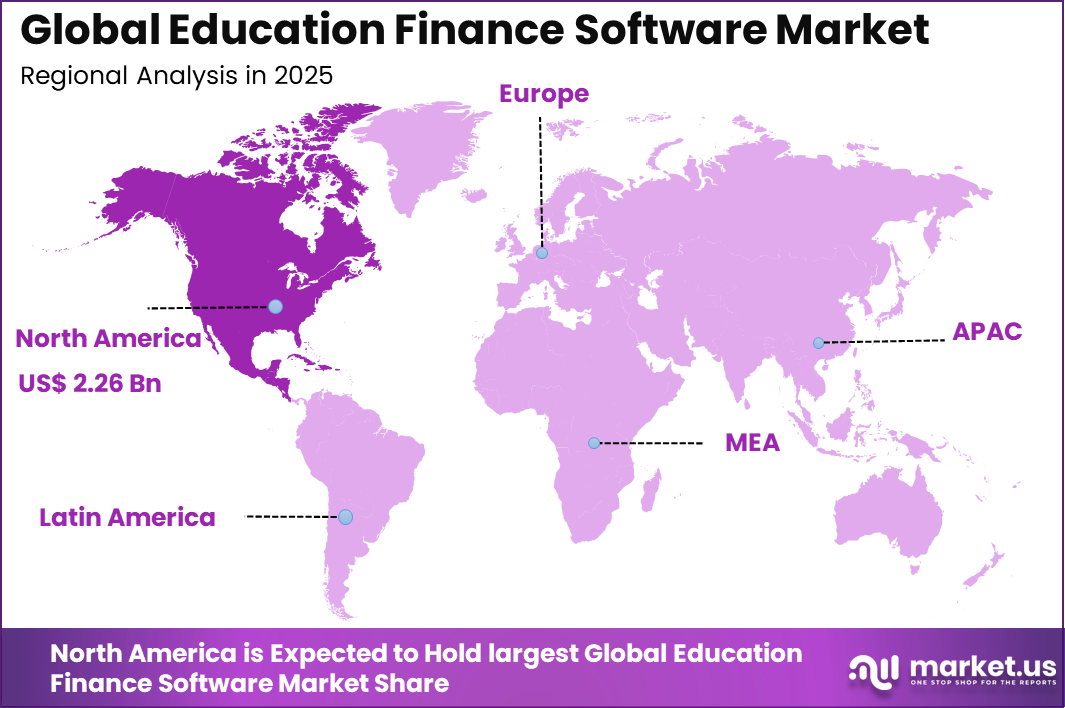
The Global Education Finance Software Market size is expected to be worth around USD 12.04 billion by 2035, from USD 5.63 billion in 2025, growing at a CAGR of 7.9% during the forecast period from 2025 to 2035. North America held a dominant market position, capturing more than a 40.3% share, holding USD 2.26 billion in revenue.
The Education Finance Software Market includes digital platforms designed to manage budgeting, accounting, tuition billing, grant management, payroll, compliance reporting, and financial planning across educational institutions. The market has expanded due to rising enrolment levels, increasing regulatory scrutiny, and the need for transparent fund management. Institutions are facing pressure to optimise spending while maintaining academic quality, which has increased reliance on integrated financial systems.
Digital transformation across campuses has accelerated investment in structured finance platforms that reduce manual processes and improve audit readiness. Financial governance in education has become more complex as funding sources diversify across tuition, government grants, research funding, donations, and endowments. Institutions are required to provide accurate and timely financial disclosures to regulators and stakeholders.
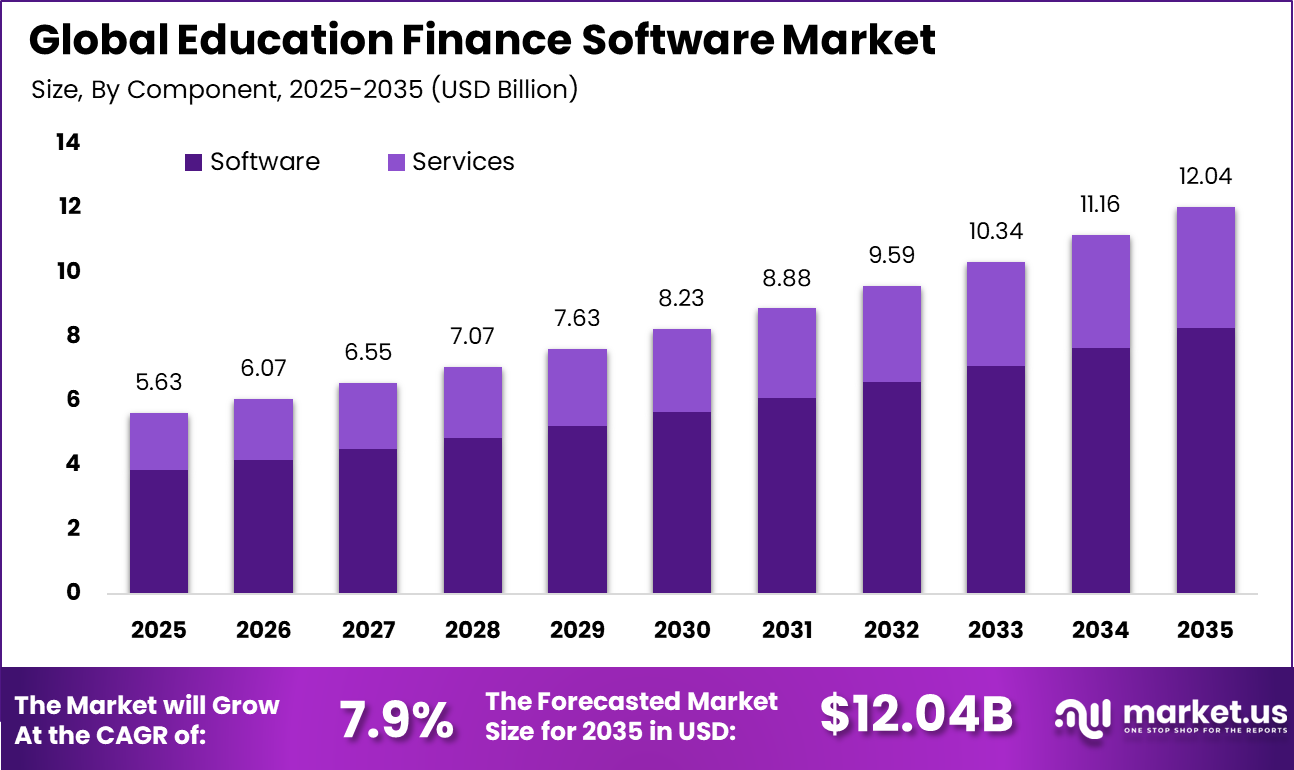
Demand grows as schools face complex finances from fees to grants, fitting both small classes and large universities. Scattered data slows decisions for 60% of finance teams, hurting operations. Parents want fast online payments, so smooth systems boost satisfaction and hold enrollment steady. Tools that unify info help leaders act quickly without endless paperwork. Overall, the need for reliable handling drives steady uptake in education settings everywhere.
One of the main driving factors is the growing need for compliance and accountability in public and private education systems. Governments in North America and Europe have strengthened reporting requirements related to public funding and student aid distribution. Institutions are expected to maintain transparent records of expenditure and allocation of resources. This regulatory environment has encouraged adoption of structured finance software that reduces reporting errors and strengthens internal controls.
For instance, in July 2025, UNIT4 partnered with leading universities to deploy its Education ERP with embedded AI for budgeting. The collaboration emphasizes predictive analytics for tuition revenue, helping North American schools navigate enrollment volatility effectively.
Key Takeaway
- By component, software accounted for 68.7%, reflecting stronger demand for core financial management platforms over standalone services.
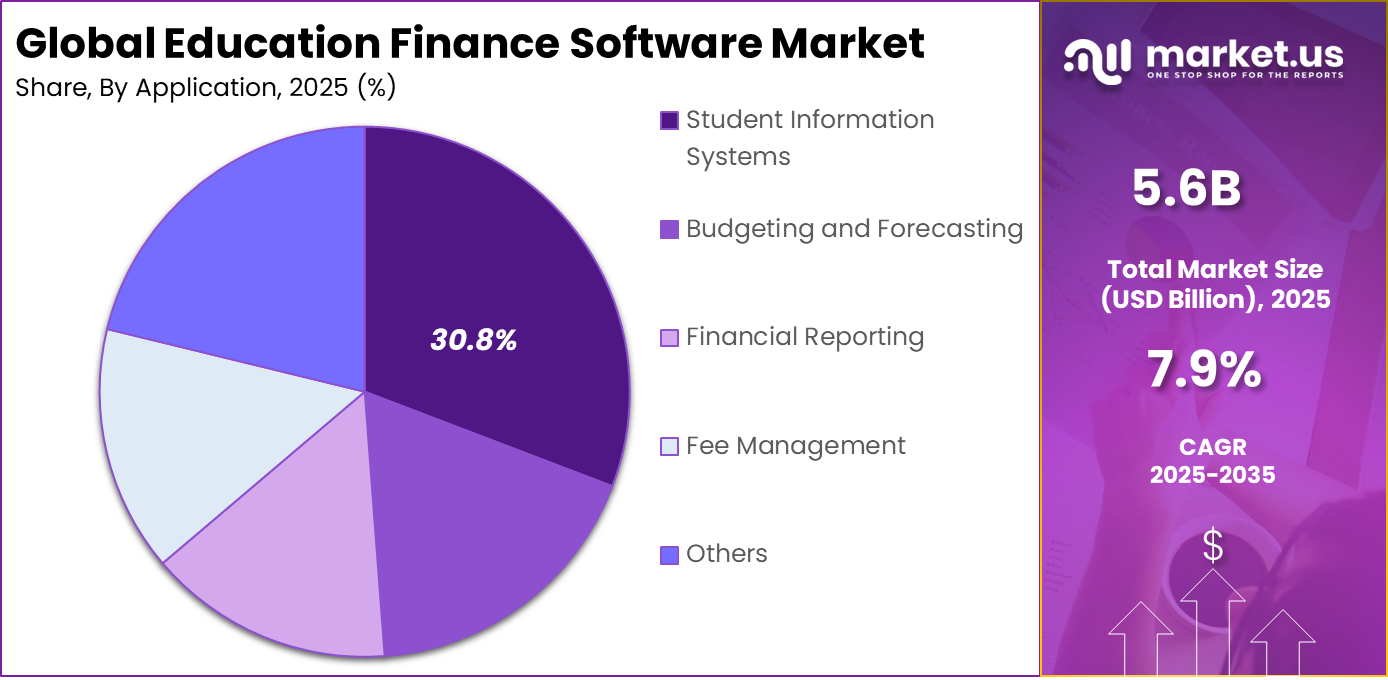
- By application, student information systems accounted for 30.8%, indicating the importance of integrating academic and financial records.
- By end user, higher education institutions accounted for 61.3%, driven by complex funding and compliance requirements.
- North America accounted for 40.3%, supported by mature digital infrastructure and regulatory standards.
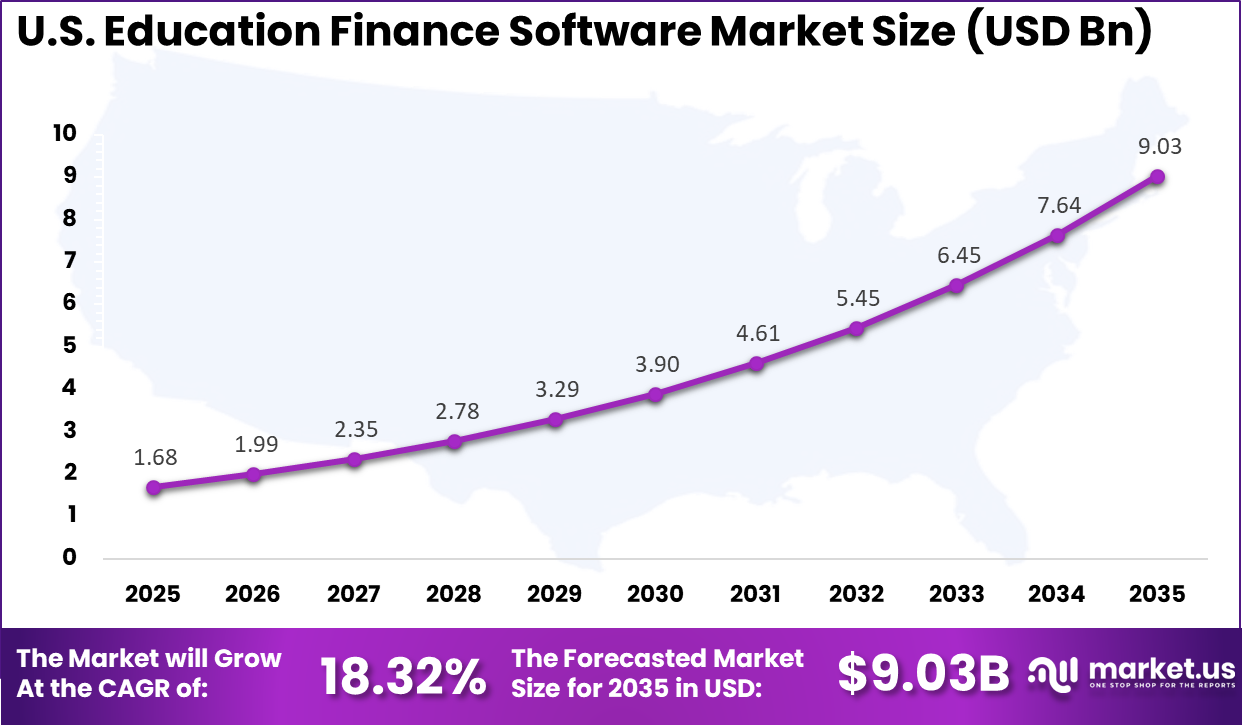
- The US market was valued at USD 1.68 Billion with a CAGR of 18.32%, reflecting sustained institutional investment in digital finance modernization.
By Component
Software dominance at 68.7% indicates that institutions prioritise comprehensive finance platforms that manage budgeting, accounting, and compliance within a unified system. These platforms reduce dependence on manual spreadsheets and fragmented tools. Automation features such as invoice tracking and grant allocation management have become essential for financial accuracy.
Institutions prefer configurable software that can align with existing enterprise systems and learning management platforms. Integration with payroll, procurement, and student information systems enhances operational efficiency. As educational institutions grow in scale and complexity, reliance on scalable finance software continues to expand.
For Instance, in February 2026, Ellucian hit a record with 32 institutions going live on its SaaS software platforms like Banner and Colleague in 2025. These SaaS-native tools unify student info, finance, and HR for higher ed, streamlining operations with AI insights. This push boosts the software segment by modernizing core systems for reliable, scalable use.
By Application
Student information systems leading at 30.8% demonstrate the strong connection between academic data and financial operations. Tuition billing, scholarship allocation, and fee management are directly linked to student records. Integration ensures that financial updates automatically reflect changes in enrolment status or course registration.
This application area supports improved transparency for students and administrators. Real time dashboards provide visibility into outstanding payments and funding distribution. Institutions benefit from reduced reconciliation time and improved compliance reporting accuracy.
For instance, in October 2025, Workday announced that over 650 higher ed institutions chose its Student, HCM, and Financial Management solutions, with 85 live supporting 3 million records. New AI agents handle transcripts and requirements, simplifying SIS tasks. This accelerates SIS growth by personalizing student financial guidance via mobile access.
By End User
Higher education institutions accounted for 61.3%, reflecting their complex financial ecosystems. Universities manage multiple revenue streams including tuition, grants, research funds, and alumni donations. Financial planning across departments requires structured systems capable of consolidating diverse funding sources.
These institutions also face rigorous auditing standards and accreditation requirements. Automated reporting tools reduce administrative burden and enhance financial governance. As universities expand global partnerships and online programs, finance software adoption continues to rise steadily.
For Instance, in December 2025, Oracle enhanced Cloud Student Financial Planning, automating 90% of aid processes. This unifies admissions, financials, and advising for universities, reducing admin burdens. Higher ed benefits from real-time insights that match their complex funding models perfectly.
Regional Analysis
North America’s 40.3% share reflects early adoption of digital administration systems across universities and colleges. Institutions in the region operate within structured regulatory frameworks that require consistent financial reporting. High levels of technology investment and IT infrastructure maturity have supported large scale deployment.
For instance, in February 2026, Oracle expanded its education finance dominance with Cloud ERP enhancements tailored for U.S. universities, streamlining tuition billing and grant management. The Austin-based leader’s AI-driven analytics platform secured major contracts with Ivy League institutions, reinforcing North America’s control over higher education financial systems.
The US market value of USD 1.68 Billion and CAGR of 18.32% indicate strong institutional focus on digital transformation in finance departments. Budget optimization, federal reporting requirements, and advanced analytics integration continue to shape regional demand.
For instance, in January 2026, Microsoft Dynamics 365 Finance gained traction among North American K-12 districts with seamless Azure integration for budgeting and payroll. Redmond’s solution processed $2B+ in school district transactions, solidifying U.S. leadership in scalable education finance software deployment.
Operational Impact
Institutions that have implemented advanced financial management platforms have reported notable efficiency improvements. On average, a 49% reduction in time allocated to manual data entry has been observed, alongside savings of nearly one hour per week in routine budgeting activities. These gains are primarily attributed to automation, centralized dashboards, and real-time financial tracking capabilities.
The integration of artificial intelligence within finance and academic support systems is advancing steadily, with adoption expanding at a compound annual growth rate exceeding 21%. AI-enabled tutoring tools and administrative optimization systems are facilitating predictive budgeting, automated reporting, and improved resource allocation. As a result, decision-making processes are becoming more data-driven and responsive.
At the same time, the average cost per user for integrated financial solutions has declined by approximately 25% over the past two years. This reduction has significantly lowered entry barriers for mid-sized institutions seeking digital transformation. Broader accessibility to scalable platforms is supporting higher adoption rates across educational and training organizations.
Investment and Business Benefits
Investment opportunities in education finance software focus on specialized solutions for different school types and regions, such as vocational institutions needing precise grant tracking. Digital payment integrations are growing rapidly, with online transactions rising about 65% annually. Advanced analytics and audit-focused features create new revenue avenues, making these gaps attractive for investors seeking long-term value in education technology.
Business benefits include reduced errors and smoother year-end audits, with many schools reporting up to 90% faster closings. Interactive dashboards support better decision-making, improving resource utilization by around 30%. Automation reduces staffing needs, freeing funds for classrooms, while teams manage workload peaks efficiently. Over time, these systems enhance operational efficiency, ultimately supporting improved teaching quality and student outcomes.
Emerging Trends Analysis
A key emerging trend is the integration of advanced analytics into finance platforms. Institutions are increasingly using predictive tools to forecast enrolment revenue and detect spending irregularities. Data driven budgeting is replacing static annual planning methods. This trend enhances transparency and supports evidence based financial decisions.
Another trend is the shift toward unified campus management ecosystems. Finance software is being integrated with human resources, procurement, and academic management systems. This holistic approach improves data consistency and reduces operational silos. Institutions are moving toward consolidated digital environments for improved governance.
Growth Factors Analysis
Growth is supported by expanding global enrolment and rising operational costs in education. Institutions require efficient financial oversight to maintain profitability and sustainability. Digital finance tools help manage growing administrative complexity. This need has strengthened long term investment in structured platforms.
Government funding reforms and accountability requirements also contribute to growth. Institutions must provide detailed expenditure tracking and grant utilisation reports. Automated compliance features reduce risk and administrative effort. As regulatory oversight increases, software adoption is expected to remain strong.
Key Market Segments
By Component
- Software
- Cloud-based
- On-premises
- Services
- Consulting
- Implementation
- Maintenance Services
By Application
- Student Information Systems
- Budgeting and Forecasting
- Financial Reporting
- Fee Management
- Others
By End-User
- K-12 Schools
- Higher Education Institutions
- Private Educational Institutions
- Government Organizations
Key Regions and Countries
North America
- US
- Canada
Europe
- Germany
- France
- The UK
- Spain
- Italy
- Russia
- Netherlands
- Rest of Europe
Asia Pacific
- China
- Japan
- South Korea
- India
- Australia
- Singapore
- Thailand
- Vietnam
- Rest of APAC
Latin America
- Brazil
- Mexico
- Rest of Latin America
Middle East & Africa
- South Africa
- Saudi Arabia
- UAE
- Rest of MEA
Drivers
Need for Efficient Financial Management
Educational institutions face growing pressure to manage multiple funding sources, grants, and complex budgets accurately. The demand for transparency and accountability makes digital finance tools increasingly essential. Administrators rely on software to streamline processes, reduce manual work, and maintain clear records for reporting and auditing purposes.
The shift from paper-based methods to automated systems allows finance teams to access real-time data and reduce errors. Many institutions report faster account closures and smoother audit preparation. The combination of efficiency, accuracy, and improved decision-making continues to drive adoption across schools and universities.
For instance, in February 2026, Ellucian hit a record with 32 institutions live on its SaaS ERP and finance systems in 2025. Powered by Banner and Colleague, these setups streamline admin work and boost financial oversight. Leaders now handle budgets and payments more smoothly, cutting errors and saving time on routine checks.
Restraint
Budget and Resource Limitations
Smaller schools and underfunded institutions often struggle to invest in advanced finance software due to limited budgets. Many prioritize core teaching resources over back-office technology, which slows down adoption. This financial constraint is especially visible in rural districts or institutions with constrained funding.
Even when funding exists, additional costs for staff training and system integration create hesitation. Without internal technical support, schools fear that implementing new software may be time-consuming and expensive, leading some to continue relying on manual accounting methods despite the long-term benefits of digital systems.
For instance, in March 2025, UNIT4 pushed cloud ERP for higher education finance to fight rising costs and funding shortfalls. Their systems aim to cut waste through real-time insights, yet many schools hesitate due to setup expenses. Resource strains make full shifts tough, as staff juggles priorities over tech training.
Opportunities
Cloud Adoption and Analytics
Cloud-based finance platforms present a major opportunity for schools and colleges to modernize their financial operations without heavy infrastructure costs. These systems allow administrators to access data remotely and securely, which supports multi-campus management and flexible operations.
Advanced analytics and automation further enhance opportunities by helping institutions monitor spending trends, plan budgets, and make informed decisions. Schools adopting these technologies gain insights that improve resource allocation and overall financial strategy, making cloud-based and analytics-driven solutions highly attractive for future growth.
For instance, in May 2025, Infor showcased cloud ERP updates for K-12 at an event, with AI analytics for budgeting and workforce planning. Districts get contract controls and predictive tools in the cloud, easing shifts to data-driven finance. This builds chances for scalable growth as more go online.
Challenges
System Integration and Security Concerns
Integrating new finance software with existing student and payroll systems can be complicated, particularly for schools using older technology. Ensuring seamless data flow between multiple platforms requires time, careful planning, and technical expertise, which can slow down implementation.
Data security remains a critical challenge, as finance software handles sensitive information. Schools must protect financial and personal data from cyber threats and comply with strict privacy regulations. Implementing strong security measures adds complexity to adoption and maintenance, making careful planning essential for safe and effective software use.
For instance, in December 2025, Tyler Technologies bought Edulink, a firm in educator evaluations and compliance workflows. The move aims to blend talent tools with Tyler’s K-12 suite, but merging data across old systems poses integration hurdles. Security risks rise with more connected compliance data, demanding strong safeguards amid regulatory eyes.
Key Players Analysis
The competitive landscape is shaped by large enterprise software providers such as Oracle Corporation, Microsoft Corporation, SAP SE, and Workday Inc., which offer integrated financial management suites. These companies leverage strong ERP ecosystems to serve large universities and multi campus institutions. Their platforms focus on scalability, compliance features, and advanced analytics integration.
Specialised education focused vendors including Ellucian, Jenzabar, PowerSchool, Classe365, TUIO, Teachmint, and OpenEduCat concentrate on tailored solutions for academic environments. Their offerings often integrate finance with student lifecycle management. Flexibility and education specific features provide competitive differentiation in this segment.
Service oriented firms such as TCS, Capgemini, Accenture, UNIT4, Infor, Blackbaud, and Tyler Technologies support implementation and system integration. Competitive advantage is increasingly determined by customisation capability, regulatory alignment, and long term service support. As institutions prioritise digital transformation, vendors that combine financial accuracy with operational efficiency are expected to maintain strong positioning.
Top Key Players in the Market
- Oracle Corporation
- Microsoft Corporation
- SAP SE
- Ellucian
- UNIT4
- Workday Inc.
- Infor
- Blackbaud
- Tyler Technologies
- TCS
- Jenzabar
- PowerSchool
- Classe365
- TUIO
- Teachmint
- OpenEduCat
- Others
Recent Developments
- In January 2026, Ellucian completed its acquisition of Anthology’s SIS and ERP business, marking a major consolidation in higher ed tech. This move bolsters Ellucian’s SaaS offerings with advanced financial and student management tools, helping institutions streamline operations amid digital transformation pressures.
- In December 2025, Tyler acquired Edu.Link, a leader in K-12 educator evaluation and compliance tracking. The deal enhances Tyler’s HR capabilities for schools, adding workflow automation and professional development tools to its municipal and education suite for better data-driven decisions.
Report Scope
Report Features Description Market Value (2025) USD 5.6 Bn Forecast Revenue (2035) USD 12.0 Bn CAGR (2026-2035) 7.9% Base Year for Estimation 2025 Historic Period 2020-2024 Forecast Period 2026-2035 Report Coverage Revenue forecast, AI impact on Market trends, Share Insights, Company ranking, competitive landscape, Recent Developments, Market Dynamics and Emerging Trends Segments Covered By Component (Software, Services), By Application (Budgeting and Forecasting, Financial Reporting, Student Information Systems, Fee Management, Others), By End-User (K-12 Schools, Higher Education Institutions, Private Educational Institutions, Government Organizations) Regional Analysis North America – US, Canada; Europe – Germany, France, The UK, Spain, Italy, Russia, Netherlands, Rest of Europe; Asia Pacific – China, Japan, South Korea, India, New Zealand, Singapore, Thailand, Vietnam, Rest of Latin America; Latin America – Brazil, Mexico, Rest of Latin America; Middle East & Africa – South Africa, Saudi Arabia, UAE, Rest of MEA Competitive Landscape Oracle Corporation, Microsoft Corporation, SAP SE, Ellucian, UNIT4, Workday Inc., Infor, Blackbaud, Tyler Technologies, TCS, Jenzabar, PowerSchool, Classe365, TUIO, Teachmint, OpenEduCat, Others Customization Scope Customization for segments, region/country-level will be provided. Moreover, additional customization can be done based on the requirements. Purchase Options We have three license to opt for: Single User License, Multi-User License (Up to 5 Users), Corporate Use License (Unlimited User and Printable PDF)  Education Finance Software MarketPublished date: Feb. 2026add_shopping_cartBuy Now get_appDownload Sample
 -
-
- Oracle Corporation
- Microsoft Corporation
- SAP SE
- Ellucian
- UNIT4
- Workday Inc.
- Infor
- Blackbaud
- Tyler Technologies
- TCS
- Jenzabar
- PowerSchool
- Classe365
- TUIO
- Teachmint
- OpenEduCat
- Others
Our Clients

- 179626
- Feb. 2026