


Report Overview
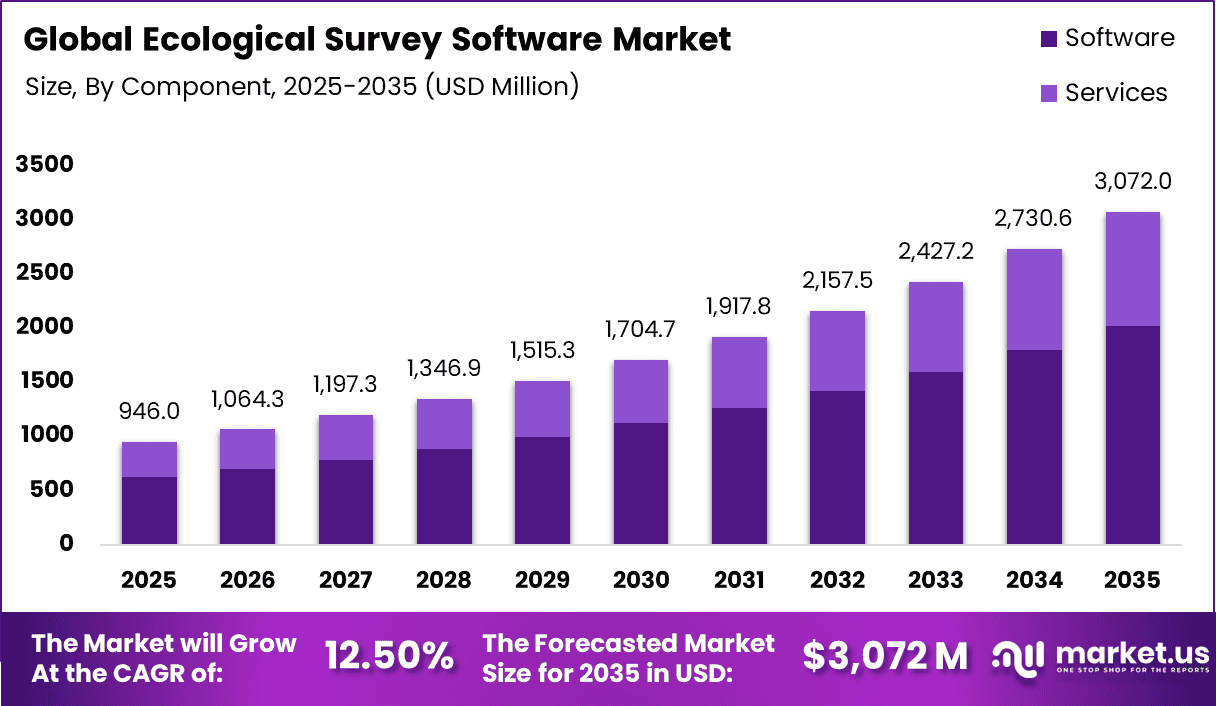
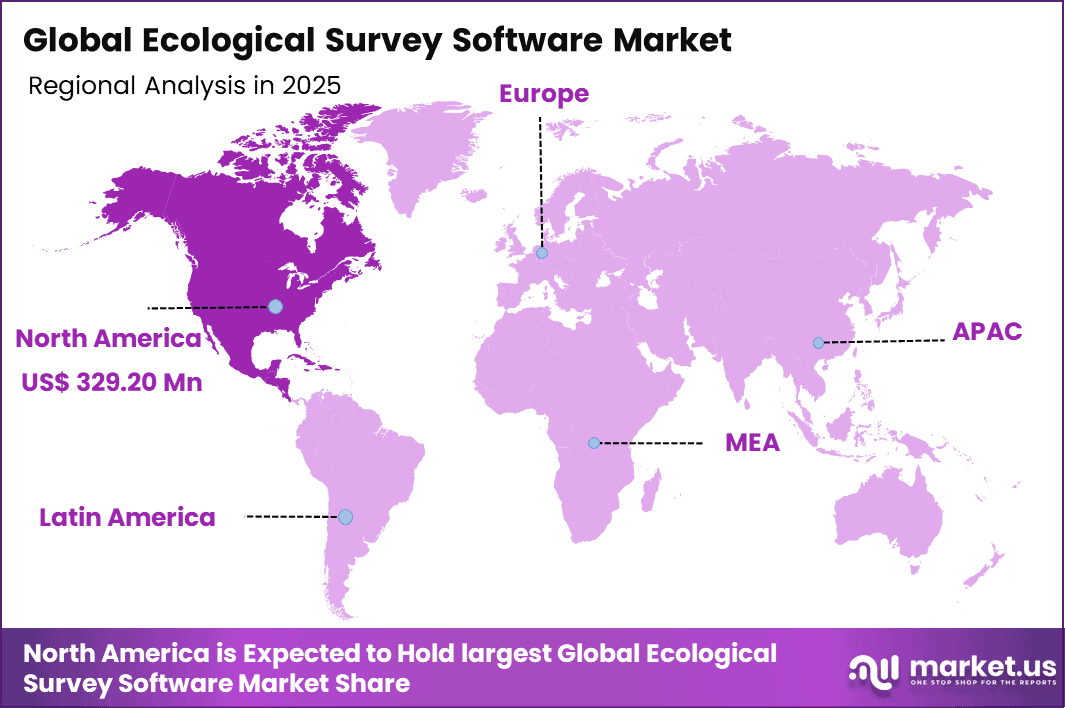
The Global Ecological Survey Software Market generated USD 946 billion in 2025 and is predicted to register growth from USD 1,064.3 billion in 2026 to about USD 3,072 billion by 2035, recording a CAGR of 12.50% throughout the forecast span. In 2025, North America held a dominant market position, capturing more than a 34.8% share, holding USD 329.20 Billion revenue.
Top Market Takeaways
- Software commands 65.7% market share, delivering GIS-integrated field data capture, species identification AI, and automated reporting for multi-site ecological inventories.
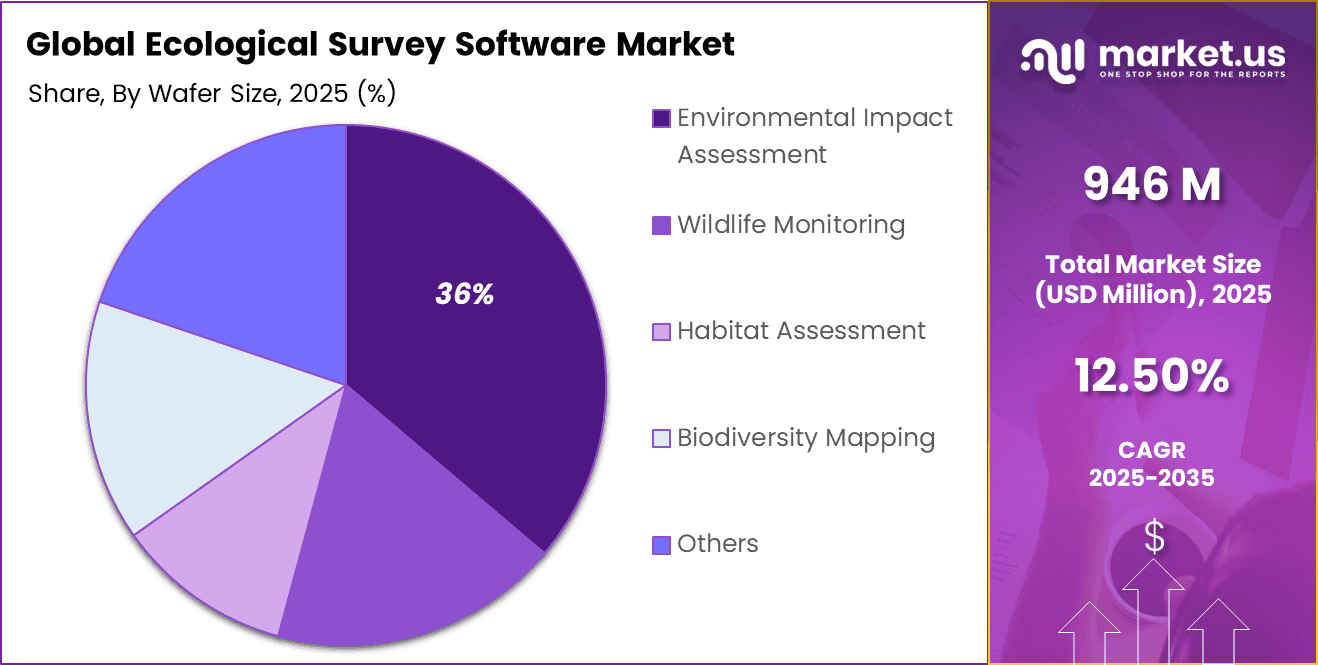
- Environmental impact assessment applications capture 36.2%, enabling predictive habitat modeling, mitigation measure simulation, and regulatory submission packages.
- Government & regulatory bodies hold 34.6%, leveraging platforms for national biodiversity baselines, protected area management, and infrastructure project clearances.
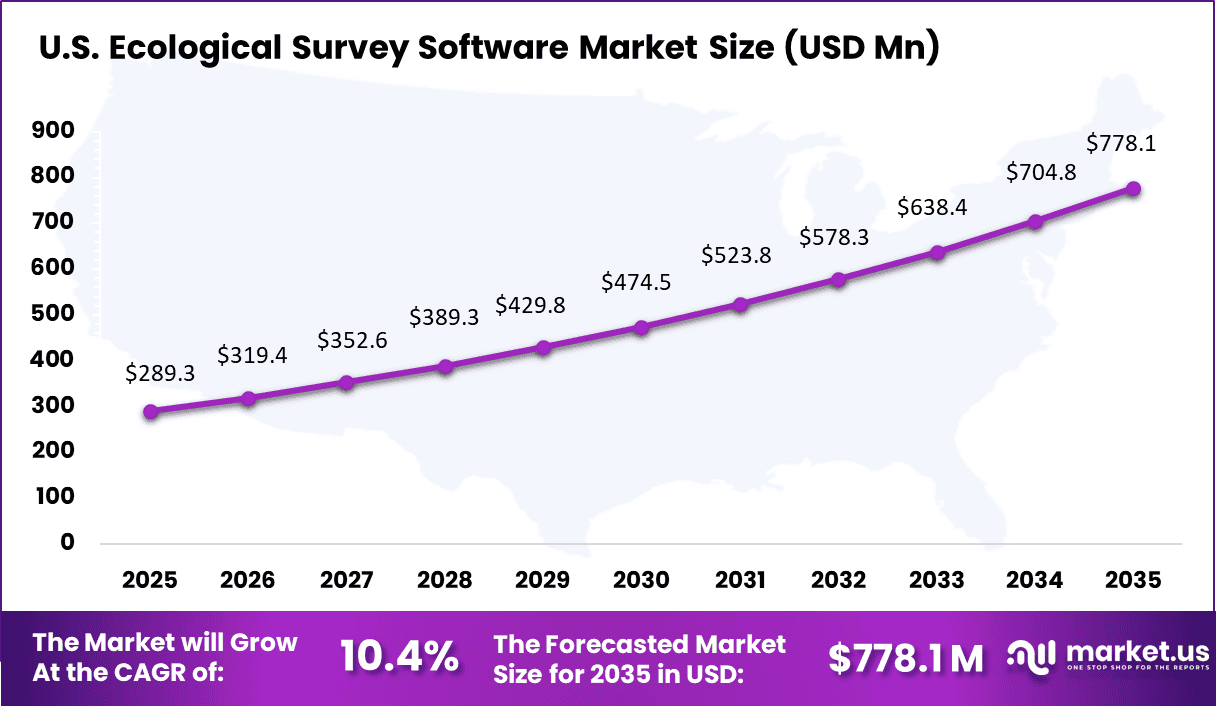
- North America drives 34.8% global value, with U.S. market at USD 289.3 million and 10.4% CAGR, fueled by NEPA requirements and endangered species compliance mandates.
Ecological survey software is used to collect, manage, and analyze environmental data related to biodiversity, habitats, and natural resources. It helps researchers, environmental consultants, and government bodies record field observations, map ecosystems, and monitor changes over time.
Traditional methods of data collection are being replaced by digital tools that improve accuracy, reduce manual effort, and allow faster analysis. As environmental monitoring becomes more important for planning and conservation, these software solutions are playing a key role in supporting informed decision making.
One of the main driving factors is the increasing focus on environmental protection and regulatory compliance. Governments and organizations are required to conduct ecological assessments before starting infrastructure or development projects, which is creating a need for efficient data management tools.
In addition, climate change and biodiversity loss are pushing stakeholders to monitor ecosystems more closely and over longer periods. The use of digital mapping, remote sensing, and mobile data collection is also supporting the adoption of ecological survey software. These tools help improve data quality and enable better collaboration among teams working in different locations.
Demand for ecological survey software is rising as organizations seek reliable and scalable solutions for environmental monitoring. There is a strong preference for platforms that can handle large datasets, support real time data entry, and provide clear visualization of results. Users are also looking for software that can integrate with geographic information systems and other analytical tools.
The demand is particularly strong among environmental agencies, research institutions, and consulting firms that require accurate and timely insights. As environmental concerns continue to grow, the need for efficient and user friendly ecological data management solutions is expected to increase steadily.
Drivers Impact Analysis
| Key Driver | Impact on CAGR Forecast (~%) | Geographic Relevance | Impact Timeline | Additional Insight |
|---|---|---|---|---|
| Increasing environmental regulations and compliance needs | +3.4% | North America, Europe, Asia Pacific | Medium to long term | Regulations drive demand for survey tools |
| Rising focus on biodiversity conservation and monitoring | +3.1% | Global | Medium to long term | Conservation efforts boost software use |
| Growth in infrastructure and environmental impact assessments | +2.8% | Emerging and developed markets | Medium term | Projects require ecological analysis |
| Adoption of digital tools in environmental research | +2.6% | Global | Medium term | Digitalization improves survey efficiency |
| Increasing government and NGO funding for ecological projects | +2.3% | Global | Medium to long term | Funding supports wider adoption |
Restraints Impact Analysis
| Key Restraint | Impact on CAGR Forecast (~%) | Geographic Relevance | Impact Timeline | Additional Insight |
|---|---|---|---|---|
| High cost of advanced ecological software solutions | -2.6% | Developing regions | Short to medium term | Cost limits access for smaller organizations |
| Lack of technical expertise among users | -2.2% | Emerging markets | Medium term | Skill gaps affect effective usage |
| Data collection and integration challenges | -1.9% | Global | Medium term | Complex datasets slow implementation |
| Limited awareness in smaller institutions | -1.6% | Developing regions | Medium term | Adoption remains low in smaller entities |
| Dependence on field data accuracy and availability | -1.4% | Global | Long term | Poor data quality impacts outcomes |
By Component Analysis
The software segment accounted for 65.7% of the market share, reflecting its central role in managing and analyzing ecological data efficiently. This dominance is supported by the growing need for digital tools that can handle large datasets, automate survey processes, and provide accurate reporting. Software solutions enable researchers and organizations to streamline data collection, mapping, and analysis, improving the overall quality of ecological assessments.
Another factor driving this segment is the increasing adoption of advanced technologies such as GIS integration and remote sensing capabilities within software platforms. These features enhance data accuracy and provide better visualization, which supports informed decision-making. The ability to customize and scale software solutions further strengthens their importance in ecological survey operations.
By Application Analysis
The environmental impact assessment segment held 36% share, driven by the rising need to evaluate the environmental effects of development projects. Governments and organizations require detailed assessments to ensure compliance with environmental regulations and minimize ecological damage. Software tools help in collecting, analyzing, and presenting data in a structured manner, making the assessment process more efficient and reliable.
In addition, the growing focus on sustainable development has increased the demand for accurate and timely impact assessments. Ecological survey software supports better planning by providing insights into potential environmental risks. This enables stakeholders to take preventive measures and ensure that projects align with environmental standards.
By End-User Analysis
The government and regulatory bodies segment captured 34.6% of the market, driven by their responsibility to monitor and enforce environmental policies. These organizations rely on ecological survey software to collect data, track environmental changes, and ensure compliance with regulations. The need for transparency and accuracy in reporting has strengthened the adoption of digital tools in this segment.
Furthermore, increasing environmental concerns and stricter regulatory frameworks have encouraged governments to invest in advanced monitoring systems. Software solutions help improve efficiency in data management and support better policy implementation. This has made ecological survey software an essential tool for government and regulatory bodies in managing environmental resources effectively.
Investor Type Impact Analysis
| Investor Type | Growth Sensitivity | Risk Exposure | Geographic Focus | Investment Outlook |
|---|---|---|---|---|
| Venture capital firms | Moderate to high | High | US, Europe | Investing in environmental tech and analytics startups |
| Private equity firms | Moderate | Moderate | North America and Europe | Scaling established environmental software providers |
| Corporate investors | High | Moderate | Global | Strategic investments in sustainability solutions |
| Institutional investors | Moderate | Low to moderate | Developed markets | Prefer stable ESG-focused technology firms |
| Government and public funding bodies | High | Low | Global | Supporting environmental monitoring and conservation initiatives |
Technology Enablement Analysis
| Technology | Impact on CAGR Forecast (~%) | Geographic Relevance | Impact Timeline | Additional Insight |
|---|---|---|---|---|
| GIS and geospatial analytics integration | +3.6% | Global | Medium to long term | Enhances mapping and analysis capabilities |
| Cloud-based ecological data platforms | +3.1% | North America and Europe | Short to medium term | Enables centralized data access |
| AI and machine learning for environmental modeling | +2.9% | Developed markets | Medium to long term | Improves predictive insights |
| Remote sensing and satellite data integration | +2.7% | Global | Medium term | Expands data collection coverage |
| Mobile and field data collection applications | +2.4% | Global | Short to medium term | Supports real-time data entry and tracking |
Key Challenges
- High cost of software and tools makes adoption difficult for small organizations.
- Lack of skilled professionals to use and manage the software.
- Data accuracy issues due to manual entry or field conditions.
- Integration challenges with existing environmental and GIS systems.
- Limited internet connectivity in remote survey locations.
- Complex software interfaces that are not easy for new users.
- Data security and privacy concerns for sensitive ecological data.
- Difficulty in handling large volumes of survey data.
- Frequent updates and maintenance requirements.
- Resistance to shift from traditional manual survey methods.
Emerging Trends
The ecological survey software market is moving toward more integrated and data rich platforms that support accurate environmental monitoring and field analysis. One key emerging trend is the use of geospatial technologies combined with real time data collection tools, allowing researchers to capture, map, and analyze ecological data directly from the field. Mobile based survey applications are gaining popularity, enabling field teams to record observations, upload images, and sync data instantly with central systems.
Another important trend is the growing use of remote sensing and drone based data inputs, which improve coverage and reduce the need for manual surveys in hard to reach areas. There is also increasing focus on automated data processing, where software tools help classify species, detect environmental changes, and generate reports with minimal manual effort. Integration with cloud platforms is further enhancing collaboration, allowing multiple stakeholders to access and analyze ecological data in a unified environment.
Growth Factors
The growth of this market is driven by the rising need for accurate environmental monitoring and compliance with regulatory requirements. Governments and environmental agencies are placing more emphasis on biodiversity conservation, land use planning, and impact assessment, which is encouraging the adoption of digital survey tools. The increasing number of infrastructure and development projects is also creating demand for ecological assessments to ensure minimal environmental impact.
Another major factor is the need to improve efficiency and reduce time spent on manual data collection and reporting. Organizations are looking for software solutions that can streamline workflows and provide reliable insights for decision making. In addition, growing awareness about climate change and ecosystem protection is pushing research institutions and conservation groups to adopt advanced tools that offer better data accuracy and long term monitoring capabilities.
Key Market Segments
By Component
- Software
- Cloud-Based
- On-Premises
- Services
By Application
- Wildlife Monitoring
- Habitat Assessment
- Environmental Impact Assessment
- Biodiversity Mapping
- Others
By End-User
- Government & Regulatory Bodies
- Environmental Consulting Firms
- Research Institutes
- Non-Profit Organizations
- Others
Regional Analysis
North America accounted for 34.8% of the Ecological Survey Software market, supported by strong focus on environmental monitoring and regulatory compliance across industries. The region has a well-established ecosystem for conservation, research, and land management, where digital tools are increasingly used to collect, analyze, and manage ecological data.
Organizations are adopting survey software to improve field data accuracy, streamline reporting, and support decision making in biodiversity assessment and environmental impact studies. Growing awareness around climate change and sustainability practices is further strengthening the demand for advanced ecological data management solutions.
The U.S. market reached USD 289.3 Million and is projected to grow at a CAGR of 10.4%, driven by rising investments in environmental research and increasing use of digital tools in field surveys. Government agencies, research institutions, and consulting firms are adopting software platforms to enhance data collection efficiency and ensure compliance with environmental regulations.
The integration of technologies such as mobile data capture, GIS mapping, and cloud-based analytics is improving the overall effectiveness of ecological surveys. This trend is expected to support steady growth in the US market as environmental monitoring continues to gain importance across sectors.
Key Regions and Countries
- North America
- US
- Canada
- Europe
- Germany
- France
- The UK
- Spain
- Italy
- Russia
- Netherlands
- Rest of Europe
- Asia Pacific
- China
- Japan
- South Korea
- India
- Australia
- Singapore
- Thailand
- Vietnam
- Rest of APAC
- Latin America
- Brazil
- Mexico
- Rest of Latin America
- Middle East & Africa
- South Africa
- Saudi Arabia
- UAE
- Rest of MEA
Competitive Analysis
The competitive landscape of the Ecological Survey Software Market includes a mix of geospatial technology providers, engineering firms, and specialized environmental software companies. Companies such as ArcGIS, Trimble Inc., Hexagon AB, Bentley Systems, Autodesk Inc., and SuperMap Software Co., Ltd. focus on advanced mapping, data visualization, and geospatial analytics platforms.
These players provide tools that help organizations collect, manage, and analyze ecological and environmental data with high accuracy. Their strong technology capabilities and wide adoption across industries such as construction, environmental monitoring, and land management support their leading position in the market.
At the same time, companies such as WSP Global Inc., Fugro N.V., Quantum Spatial (NV5 Geospatial), Geosyntec Consultants, and NatureServe combine software with consulting and field services, offering end-to-end ecological survey solutions. Specialized providers like DScience Ltd (Keen AI), GoldSim Technology Group, Avenza Systems Inc., Maptek Pty Ltd., Blue Marble Geographics, TerraGo Technologies, Ecological Software Solutions LLC, BioBase (Navico), and EarthSoft, Inc. focus on niche applications such as environmental modeling, biodiversity tracking, and mobile data collection. Competition in this market is driven by the need for accurate data analysis, integration with GIS systems, and user-friendly tools that support field and office-based workflows.
Top Key Players in the Market
- DScience Ltd (Keen AI)
- GoldSim Technology Group
- ArcGIS
- Trimble Inc.
- Hexagon AB
- Bentley Systems
- Autodesk Inc.
- SuperMap Software Co., Ltd.
- WSP Global Inc.
- Avenza Systems Inc.
- Maptek Pty Ltd.
- Blue Marble Geographics
- Fugro N.V.
- Quantum Spatial (NV5 Geospatial)
- TerraGo Technologies
- Ecological Software Solutions LLC
- Geosyntec Consultants
- NatureServe
- BioBase (Navico)
- EarthSoft, Inc.
- Others
Future Outlook
The future outlook for the Ecological Survey Software Market looks positive as governments, researchers, and organizations continue to focus on environmental monitoring and sustainability. The market is expected to grow with increasing use of digital tools for collecting, analyzing, and managing ecological data in fields like wildlife tracking, habitat assessment, and climate studies. Cloud-based platforms and mobile data collection are anticipated to make surveys faster and more accurate. In the coming years, the use of AI, remote sensing, and GIS technologies is expected to improve data insights and decision making, supporting better conservation planning and environmental management.
Recent Developments
- March, 2026 – Keen AI TreeDetect identifies 5,000+ tree species from drone imagery with 98% accuracy. Processes 1TB aerial data daily while iNaturalist integration crowdsources ground-truth. Forestry carbon credit verification leader.
- February, 2026 – GoldSim 15 adds climate risk modeling for EIA reports. Monte Carlo simulations predict wetland loss while stakeholder visualization dashboards speed approvals. Environmental consulting standard.
Report Scope
| Report Features | Description |
|---|---|
| Market Value (2025) | USD 946 Million |
| Forecast Revenue (2035) | USD 3,072 Million |
| CAGR(2025-2035) | 12% |
| Base Year for Estimation | 2024 |
| Historic Period | 2020-2024 |
| Forecast Period | 2026-2035 |
| Report Coverage | Revenue forecast, AI impact on Market trends, Share Insights, Company ranking, competitive landscape, Recent Developments, Market Dynamics and Emerging Trends |
| Segments Covered | By Component (Software (Cloud-Based, On-Premises), Services), By Application (Wildlife Monitoring, Habitat Assessment, Environmental Impact Assessment, Biodiversity Mapping, Others), By End-User (Government & Regulatory Bodies, Environmental Consulting Firms, Research Institutes, Non-Profit Organizations, Others) |
| Regional Analysis | North America – US, Canada; Europe – Germany, France, The UK, Spain, Italy, Russia, Netherlands, Rest of Europe; Asia Pacific – China, Japan, South Korea, India, New Zealand, Singapore, Thailand, Vietnam, Rest of Latin America; Latin America – Brazil, Mexico, Rest of Latin America; Middle East & Africa – South Africa, Saudi Arabia, UAE, Rest of MEA |
| Competitive Landscape | DScience Ltd (Keen AI), GoldSim Technology Group, ArcGIS, Trimble Inc., Hexagon AB, Bentley Systems, Autodesk Inc., SuperMap Software Co., Ltd., WSP Global Inc., Avenza Systems Inc., Maptek Pty Ltd., Blue Marble Geographics, Fugro N.V., Quantum Spatial (NV5 Geospatial), TerraGo Technologies, Ecological Software Solutions LLC, Geosyntec Consultants, NatureServe, BioBase (Navico), EarthSoft, Inc., Others |
| Customization Scope | Customization for segments, region/country-level will be provided. Moreover, additional customization can be done based on the requirements. |
| Purchase Options | We have three license to opt for: Single User License, Multi-User License (Up to 5 Users), Corporate Use License (Unlimited User and Printable PDF) |





























