


Report Overview
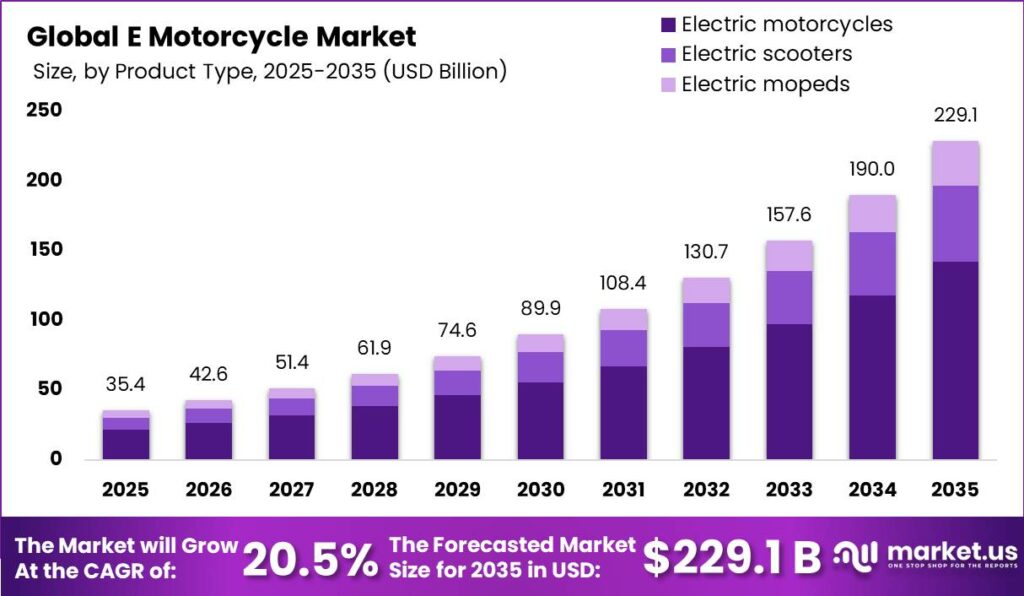
Global E Motorcycle Market size is expected to be worth around USD 229.10 Billion by 2035 from USD 35.40 Billion in 2025, growing at a CAGR of 20.5% during the forecast period 2026 to 2035. This trajectory reflects a structural shift away from petrol two-wheelers toward electric drivetrains. Investors gain a decade-long runway in a market that is scaling faster than most mobility categories worldwide.
The Electric Scooter and Motorcycle market covers battery-powered two-wheelers built for personal, commercial, and fleet use. Manufacturers structure the market around product type, battery capacity, voltage, range, application, and sales channel. This layered structure lets brands target commuters, delivery operators, and performance riders separately. Consequently, product strategy and pricing diverge sharply across each buyer group, shaping where new capital flows first.
Key Takeaways
- Global market size reaches USD 229.10 Billion by 2035, up from USD 35.40 Billion in 2025.
- Market grows at a CAGR of 20.5% across the forecast period 2026 to 2035.
- Electric motorcycles lead By Product Type with a 62.00% share.
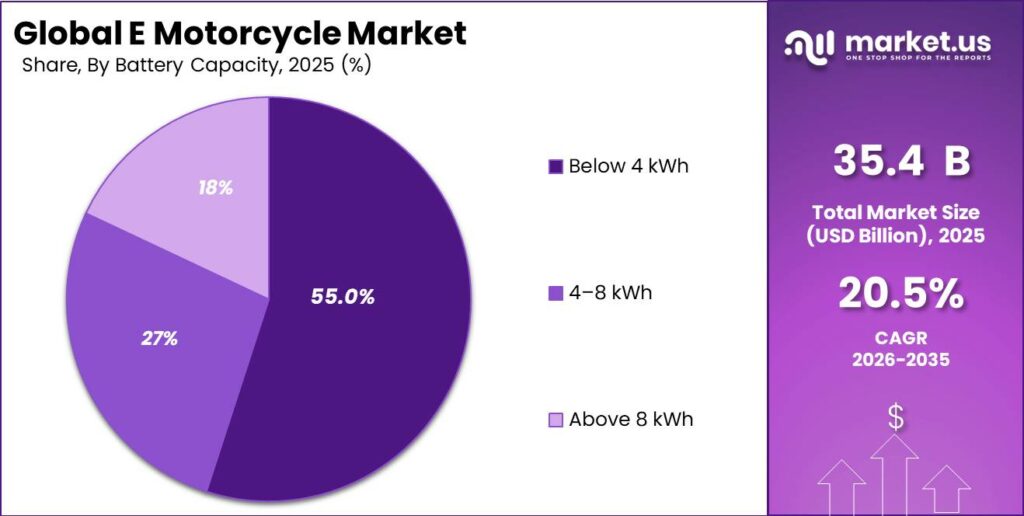
- Below 4 kWh batteries dominate By Battery Capacity with a 55.00% share.
- The 48 to 72 V band leads By Voltage with a 58.00% share.
- Up to 75 miles leads By Vehicle Range with a 35.00% share.
- Personal mobility dominates By Application with a 68.90% share.
- Offline channels lead By Sales Channel with a 52.00% share.
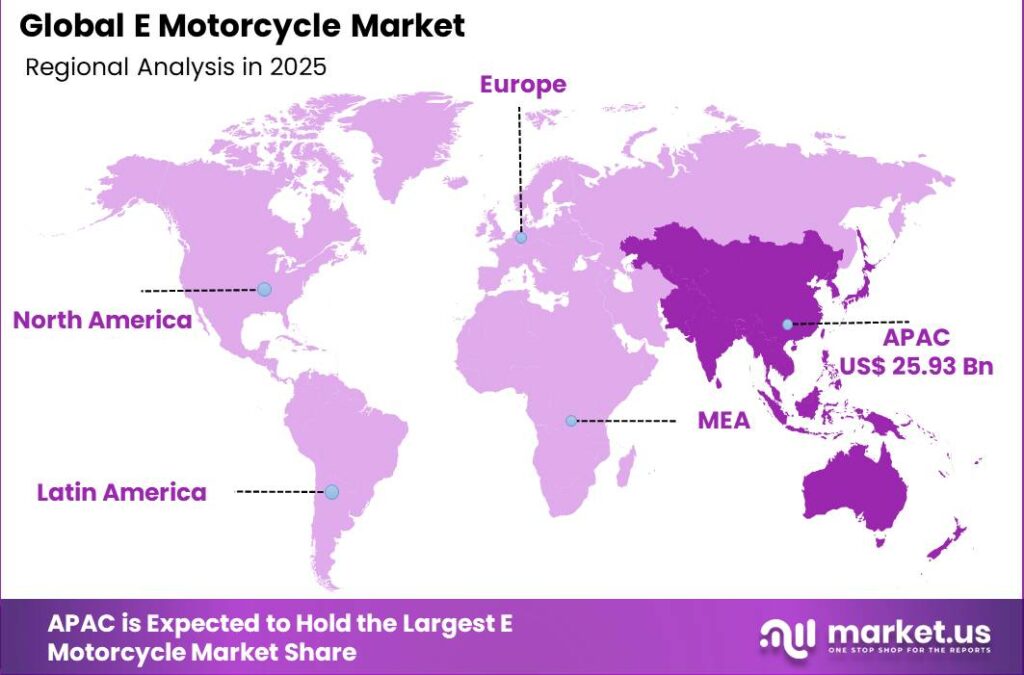
- Asia-Pacific dominates regionally with a 73.33% share, valued at USD 25.93 Billion.
Government action anchors demand across the largest markets. India’s Ministry of Heavy Industries backs privately, corporately, and commercially owned electric two-wheelers under PM E-DRIVE through March 31, 2026. This eligibility widens the buyer base beyond individual riders. As a result, fleet operators and delivery firms now enter procurement cycles that were previously consumer-only, expanding addressable volume for manufacturers.
Charging economics shape daily usability and purchase confidence. Can-Am electric motorcycles need about 3 hours 10 minutes for a 20% to 80% Level 1 charge, against 50 minutes on Level 2. This gap pushes buyers toward faster charging access. Therefore, brands that bundle Level 2 support gain an adoption edge among time-sensitive urban commuters.
Running costs reinforce the switch from petrol. Ultraviolette reports electric-motorcycle energy expenditure near ₹20 to ₹25 per 100 km under its 2025 buyer assumptions. This low per-kilometer cost rewards high-mileage riders fastest. Consequently, delivery and taxi operators reach payback sooner, which makes them the earliest committed volume buyers. Honda’s September 2025 WN7 launch in Europe signals mainstream OEM entry into fixed-battery models.
Product Type Analysis
Electric motorcycles dominate with 62.00% due to superior speed and highway capability.
In 2025, Electric motorcycles held a dominant market position in the By Product Type segment of E Motorcycle Market, with a 62.00% share. The LiveWire S2 Del Mar reaches 103 mph and produces 194 lb-ft of torque. This performance rivals petrol motorcycles directly. Consequently, brands offering high-output electric models capture riders unwilling to trade away speed for zero emissions.
Electric scooters serve short-distance urban commuters seeking low-cost daily transport. India recorded 1.28 million new electric two-wheeler registrations in 2025 across scooter-heavy demand. This volume base rewards manufacturers with dense retail footprints. Therefore, scooter-focused brands scale fastest in congested cities where trip distances stay short and charging happens at home.
Electric mopeds anchor the lowest-speed, lowest-cost entry tier for first-time buyers. Their compact batteries and modest range suit tight urban delivery loops. UN Comtrade trade data shows sustained cross-border flows of low-power two-wheeler units into emerging Asian markets. As a result, mopeds open affordable ownership pathways that pull petrol riders into their first electric purchase.
Battery Capacity Analysis
Below 4 kWh dominates with 55.00% due to affordable commuter-focused compact battery packs.
In 2025, Below 4 kWh held a dominant market position in the By Battery Capacity segment of E Motorcycle Market, with a 55.00% share. Ola Electric’s Roadster X offers packs from 2.5 kWh to 4.5 kWh. This range targets cost-sensitive commuters directly. Consequently, small-pack models drive volume where daily trips rarely exceed short urban distances.
The 4 to 8 kWh band serves riders needing extended daily range without premium pricing. The Ultraviolette F77 SuperStreet uses a 10.3 kWh pack, sitting just above this tier and showing the upgrade path buyers follow. This means mid-capacity models bridge budget commuters and performance seekers. Therefore, brands filling this gap capture upgrading customers before they exit to premium brands.
Above 8 kWh packs power high-range and performance motorcycles for demanding riders. World Bank industrial indicators link larger cell demand to rising domestic battery assembly across Asia. This concentration favors localized supply chains. As a result, brands securing large-pack cell supply protect margins as premium demand climbs.
Voltage Analysis
48 to 72 V dominates with 58.00% due to balanced power and cost efficiency.
In 2025, 48 to 72 V held a dominant market position in the By Voltage segment of E Motorcycle Market, with a 58.00% share. Ola’s Roadster X accelerates from 0 to 40 km/h in 3.1 seconds within this common voltage class. This band balances torque and component cost. Consequently, most mass-market motorcycles standardize here to control price while meeting commuter needs.
Below 48 V systems power the cheapest, lowest-speed two-wheelers for entry buyers. National statistical offices across South Asia record heavy registration volumes in low-voltage categories. This regulatory tier often avoids stricter licensing rules. Therefore, low-voltage models attract first-time riders and teenagers seeking legal, affordable mobility.
Above 72 V systems drive premium performance motorcycles built for high speed. Higher voltage cuts current draw and heat under load. Patent filings for high-voltage two-wheeler powertrains have expanded across leading manufacturers. As a result, brands investing in high-voltage architecture position early for the premium performance tier.
Vehicle Range Analysis
Up to 75 miles dominates with 35.00% due to short urban commuting travel patterns.
In 2025, Up to 75 miles held a dominant market position in the By Vehicle Range segment of E Motorcycle Market, with a 35.00% share. The 2025 Can-Am Origin delivers up to 90 miles in city use and 71 miles under WMTC conditions. This range matches typical daily commutes. Consequently, short-range models satisfy most urban riders without costly large batteries.
The 76 to 150 miles tier serves intercity commuters and light delivery routes. The Ultraviolette F77 Recon provides up to 323 km of IDC range and about 266 km in mixed use. This buffer eases range anxiety for longer trips. Therefore, mid-range models unlock buyers who reject short-range city bikes.
Above 150 miles targets touring and high-utilization fleet riders. IEA transport tracking links long-range demand to falling battery costs per kWh. This trend steadily lowers the premium for extended range. As a result, long-range motorcycles move from niche to viable as pack prices decline through the forecast period.
Application Analysis
Personal mobility dominates with 68.90% due to daily individual commuting demand growth.
In 2025, Personal mobility held a dominant market position in the By Application segment of E Motorcycle Market, with a 68.90% share. FAO and World Bank mobility data link two-wheeler ownership to rising urban incomes across Asia. This income growth expands the private buyer base. Consequently, personal-use models capture the largest share of new registrations.
Commercial delivery relies on low running costs and high daily mileage. Energy expenditure near ₹20 to ₹25 per 100 km rewards operators covering long routes. This economics shortens payback for fleets. Therefore, delivery firms adopt electric two-wheelers faster than individual buyers on pure cost logic.
Fleet operations scale through centralized charging and standardized maintenance. UNIDO industrial output data shows rising commercial two-wheeler assembly across emerging economies. This supports fleet-grade supply at volume. As a result, operators procuring large fleets gain pricing leverage over single-unit buyers.
Racing and recreation, law enforcement, and other uses hold the remaining share collectively. These niches drive brand visibility and specialized product testing without large volume.
Sales Channel Analysis
Offline dominates with 52.00% due to test rides and service trust.
In 2025, Offline held a dominant market position in the By Sales Channel segment of E Motorcycle Market, with a 52.00% share. Buyers value test rides before high-value motorcycle purchases. ITC Trade Map data confirms dealer-routed distribution dominates two-wheeler flows across major markets. Consequently, brands with dense dealer networks convert cautious first-time electric buyers fastest.
OEM channels sell directly through manufacturer-controlled outlets and brand stores. This control protects pricing and customer data. Corporate filings from leading two-wheeler makers show expanding company-owned retail footprints. Therefore, OEM-direct models let brands capture full margin and own the service relationship.
Aftermarket and online channels hold the remaining share collectively. Aftermarket supports parts and battery servicing, while online sales grow among younger, tech-comfortable buyers seeking transparent pricing.
Key Market Segments
By Product Type
- Electric motorcycles
- Electric scooters
- Electric mopeds
By Battery Capacity
- Below 4 kWh
- 4 to 8 kWh
- Above 8 kWh
By Voltage
- Below 48 V
- 48 to 72 V
- Above 72 V
By Vehicle Range
- Up to 75 miles
- 76 to 150 miles
- Above 150 miles
By Application
- Personal mobility
- Commercial delivery
- Fleet operations
- Racing and recreation
- Law enforcement
- Others
By Sales Channel
- OEM
- Aftermarket
- Online
- Offline
Regional Analysis
Asia-Pacific Dominates the E Motorcycle Market with a Market Share of 73.33%, Valued at USD 25.93 Billion
Asia-Pacific leads global demand on scale and policy support. India recorded 1.28 million new electric two-wheeler registrations in 2025, an increase of 130,000 units, or 11.4%, over the prior year. This growth reflects dense urban commuting and strong subsidies. Consequently, manufacturers prioritize regional assembly to serve the world’s largest two-wheeler base. Yamaha’s November 2025 launch of the AEROX E and EC-06 scooters in India shows OEMs deepening local commitment.
Europe stands as the fastest-scaling premium region for electric motorcycles. Stricter emission rules and rising fuel costs push riders toward electric models. This regulatory pressure accelerates fleet conversion in dense cities. Therefore, premium and performance brands target Europe first when launching high-value motorcycles ahead of broader rollouts.
North America, Latin America, and the Middle East and Africa fill the remaining regional demand. North America favors premium performance models, while Latin America and Africa show strong potential in delivery and taxi electrification. This split means brands must tailor product tiers sharply by region to win share.
Key Regions and Countries
North America
- US
- Canada
Europe
- Germany
- France
- The UK
- Spain
- Italy
- Rest of Europe
Asia Pacific
- China
- Japan
- South Korea
- India
- Australia
- Rest of APAC
Latin America
- Brazil
- Mexico
- Rest of Latin America
Middle East and Africa
- GCC
- South Africa
- Rest of MEA
Market Dynamics
Market Opportunity Analysis - Underserved mid-market motorcycles and commercial fleets open the clearest entry points for new players
Electric motorcycles at 62.00% dominate By Product Type, yet affordable mid-tier models between commuter scooters and premium superbikes stay thin. This gap leaves buyers choosing between cheap scooters and costly performance bikes. Therefore, new entrants launching mid-priced motorcycles can capture riders that incumbents overlook, especially in fast-growing Asian cities.
Commercial delivery sits below personal mobility’s 68.90% share, yet its cost economics favor early conversion. Fleet operators covering long daily distances reach payback fastest on low running costs. This means purpose-built delivery motorcycles with modular cargo systems open enterprise procurement channels. Consequently, brands targeting logistics fleets secure large, repeatable orders ahead of consumer demand.
The Above 150 miles range tier remains underexploited against the 35.00% held by short-range models. Touring and high-utilization riders still lack affordable long-range options. This creates space for brands pairing large packs with competitive pricing. As a result, early movers in long-range motorcycles can lock in premium and fleet customers before the tier matures.
African and Southeast Asian markets show strong fleet potential outside Asia-Pacific’s 73.33% concentration. Motorcycle-taxi electrification programs create high-utilization deployment channels in these regions. This means operators building swap networks and financing early gain first-mover reach. Therefore, investors entering these underserved geographies position ahead of slower global incumbents.
Technology and Innovation Landscape - Battery swapping, connected telematics, and material advances redefine competitive edges
Battery-as-a-Service subscriptions separate energy-storage costs from vehicle acquisition and redistribute ownership economics. This model lowers the upfront barrier that blocks price-sensitive buyers. Consequently, manufacturers pairing motorcycles with swap subscriptions convert hesitant riders faster than rivals selling fixed-battery models outright.
Cross-brand swappable battery alliances advance interoperability across motorcycle manufacturers and energy-network operators. Shared standards reduce duplicated station capital and stranded battery inventory. This means operators joining open networks reach profitable utilization sooner. Therefore, brands backing interoperable packs gain scale advantages over closed, proprietary systems.
Connected telematics platforms enable predictive maintenance, theft tracking, over-the-air updates, and usage-based insurance. These features build recurring revenue beyond the initial sale. This creates monetization streams that pure hardware sellers miss. As a result, connected-fleet operators unlock margins that reward software investment over time.
Lithium-ion battery performance improvements extend practical riding range across daily commuter applications. Larger, denser packs like Ultraviolette’s 10.3 kWh unit push range past prior limits. This steadily erases range anxiety for mainstream riders. Consequently, manufacturers advancing cell technology capture buyers who once rejected electric two-wheelers on range alone.
Drivers
Direct purchase support converts electric motorcycles from discretionary buys into financeable mass-market mobility. India’s Ministry of Heavy Industries launched PM E-DRIVE on September 29, 2024, made it effective from October 1, 2024, and targeted about 2.479 million supported electric two-wheelers through March 31, 2026. The incentive moved from ₹5,000 per kWh in fiscal 2024 to 2025 to ₹2,500 per kWh in fiscal 2025 to 2026, capped at 15% of ex-factory price.
Official registration data had already recorded 734,760 electric two-wheelers in fiscal 2023 to 2024 by February 6, 2024. IEA policy tracking also records adoption targets extending toward 2030. Collectively, these interventions cut financed acquisition cost and lift dealer throughput, supporting an estimated +2.6% incremental CAGR contribution. However, declining subsidies force manufacturers to replace incentive discounts with localization and battery-cost savings.
| Driver | (~) % Impact on CAGR Forecast | Geographic Relevance | Impact Timeline |
|---|---|---|---|
| Government Purchase Incentives | +2.6% | India, Southeast Asia, Europe | Short term (2 years or less) |
| Battery Cost Deflation | +2.2% | Global | Short term (2 years or less) |
| Urban Delivery Electrification | +1.8% | Asia-Pacific, Europe, Latin America | Medium term (2 to 4 years) |
| Fuel-Cost Ownership Advantage | +1.5% | India, ASEAN, Africa, Latin America | Short term (2 years or less) |
| Broader OEM Model Availability | +1.2% | Global | Medium term (2 to 4 years) |
Restraints
The purchase-price premium remains a structural hard stop because batteries, power electronics, and low-volume homologation costs are paid upfront while savings accrue gradually. India’s Ministry of Heavy Industries reduced the maximum FAME-II support ceiling for electric two-wheelers from 40% to 15% of ex-factory price in 2023. The ICCT assessed that price parity would emerge only across the 2024 to 2026 period rather than uniformly at its start.
World Bank financial-sector analysis shows how affordability tightens when commercial lending rates rise from roughly 12% in 2022 to 16% in early 2025. Combined with the halving of per-kWh support in fiscal 2025 to 2026, this raises monthly payments and suppresses approval rates. Therefore, the estimated -2.4% CAGR deduction forces dealers to absorb discounts, compressing gross margins and delaying assembly-capacity commitments.
| Restraint | (~) % Impact on CAGR Forecast | Geographic Relevance | Impact Timeline |
|---|---|---|---|
| High Upfront Purchase Price | -2.4% | Emerging Asia, Africa, Latin America | Short term (2 years or less) |
| Expensive Consumer Credit | -1.9% | Africa, South Asia, Latin America | Short term (2 years or less) |
| Abrupt Subsidy Withdrawal | -1.6% | India, Europe, selected ASEAN markets | Short term (2 years or less) |
| Weak Used-Vehicle Residuals | -1.2% | Global, excluding mature Asian ecosystems | Medium term (2 to 4 years) |
| Import Duties and Localization Rules | -0.9% | South Asia, ASEAN, Latin America | Medium term (2 to 4 years) |
Challenges
Electric-motorcycle deployment remains operationally fragmented because fixed-battery charging, removable packs, and proprietary swapping create incompatible voltage, connector, and ownership systems. IEA transport tracking identifies removable batteries and swapping as useful for high-utilization two- and three-wheelers. NITI Aayog notes subscription-based swapping can cut charging downtime and separate battery ownership from vehicle ownership.
Sector infrastructure analysis identifies a need for dedicated standards for electric two-wheelers operating above 48 volts. Emerging-market assessments found most African swapping networks still had only a small number of stations as of 2024. This interoperability gap imposes an estimated -2.0% friction drag through duplicated station capital and underutilized battery inventories. Therefore, operators need multi-year investment in open protocols before reaching network-scale economics.
| Challenge | (~) % CAGR Friction Drag | Geographic Relevance | Mitigation Horizon |
|---|---|---|---|
| Fragmented Charging Standards | -2.0% | India, ASEAN, Africa, Latin America | Medium term (2 to 4 years) |
| Battery Safety Validation | -1.7% | Global | Medium term (2 to 4 years) |
| Sparse Service Capability | -1.4% | Africa, South Asia, Latin America | Medium term (2 to 4 years) |
| Cell Supply Concentration | -1.1% | Global, excluding China | Long term (4 years or more) |
| Battery End-Life Complexity | -0.8% | Europe, Asia-Pacific, North America | Long term (4 years or more) |
Opportunities
Battery-as-a-Service is future white space rather than a current broad driver because scalable execution needs interoperable packs, dense swap networks, and contracted fleet utilization. NITI Aayog’s framework establishes that battery subscriptions can separate the battery from the motorcycle purchase and minimize charging downtime. IEA analysis identifies removable packs as especially valuable for commercially operated two-wheelers with high daily use.
India’s Ministry of Heavy Industries made privately, corporately, and commercially owned electric two-wheelers eligible under PM E-DRIVE through March 31, 2026. At scale, separating the pack could cut the rider’s upfront payment by about 25 to 35%, lift battery utilization by 20 to 30%, and expand operator gross margins by roughly 4 to 7 percentage points. This supports up to +2.3% CAGR upside without assuming universal execution.
| Opportunity | (~) % Potential CAGR Upside | Geographic Relevance | Execution Window |
|---|---|---|---|
| Battery-as-a-Service Fleets | +2.3% | India, ASEAN, East Africa, Latin America | Medium term (2 to 4 years) |
| African Urban Commuter Conversion | +1.8% | East and West Africa | Long term (4 years or more) |
| Connected Fleet Monetization | +1.4% | Global urban logistics markets | Medium term (2 to 4 years) |
| Second-Life Battery Services | +1.0% | Asia-Pacific, Europe, Africa | Long term (4 years or more) |
| Performance Motorcycle Electrification | +0.8% | Europe, North America, developed Asia | Long term (4 years or more) |
Key Company Insights
Yadea Group Holdings Ltd. holds a structural advantage through massive production scale and a broad low-cost model lineup across Asia. This scale lets Yadea price aggressively in high-volume commuter segments where Premium Electric Motorcycle demand stays thin. However, the brand leans heavily on entry-tier scooters and mopeds. This creates a gap in high-output performance motorcycles, leaving premium share exposed to specialist challengers moving upmarket.
LiveWire Group, Inc. positions itself firmly in the premium performance tier with credible specifications. Its S2 Mulholland delivers 120 miles of city range, and the brand covers the S2 Alpinista battery for 5 years with unlimited mileage, subject to a 30% degradation threshold. This warranty builds buyer trust on residual value. However, its premium pricing limits volume, keeping LiveWire a margin-led niche player rather than a mass-market force.
Key Players
- Yadea Group Holdings Ltd.
- NIU Technologies
- Honda Motor Co., Ltd.
- Hero MotoCorp Ltd.
- Ola Electric Mobility Ltd.
- Zero Motorcycles, Inc.
- LiveWire Group, Inc.
- BMW Motorrad
- Vmoto Limited
- Gogoro Inc.
- Revolt Motors
- Ultraviolette Automotive Pvt. Ltd.
- KTM AG
- Yamaha Motor Co., Ltd.
- Kawasaki Motors, Ltd.
Recent Developments
- November 2025: Honda publicly debuted the production-specification WN7 at EICMA 2025, featuring a range exceeding 130 km, approximately 50 kW of motor output, and CCS2 fast-charging compatibility.
- November 2025: Yamaha Motor unveiled the YE-01 electric motocross concept jointly developed with Electric Motion for planned participation in the MXEP electric motocross series in 2026.
- November 2025: LiveWire launched the S2 Alpinista electric sport-standard motorcycle in North America and Europe at a starting MSRP of $15,999, with inventory available immediately through dealers.
Geopolitical Impact Analysis
Global battery supply chains expose electric-motorcycle makers to trade and mineral risk. According to the IEA, China refines over 60% of the world’s lithium and roughly 75% of cobalt, concentrating cell inputs in one region. This dependence raises pricing risk for two-wheeler assemblers outside China. Therefore, manufacturers diversifying cell sourcing protect margins against sudden export controls or tariff shifts on critical minerals.
Shipping disruptions add cost and delay to imported components and finished motorcycles. As reported by UNCTAD, Red Sea rerouting around Africa added roughly 10 to 14 days to affected voyages, while container freight rates rose over 100% during peak disruption in 2024. This inflates landed costs for import-dependent markets. Consequently, brands with regional assembly and localized parts sourcing gain a clear pricing and delivery edge over import-reliant rivals.
Report Scope
| Report Features | Description |
|---|---|
| Market Value (2025) | USD 35.40 Billion |
| Forecast Revenue (2035) | USD 229.10 Billion |
| CAGR (2026-2035) | 20.5% |
| Base Year for Estimation | 2025 |
| Historic Period | 2020-2024 |
| Forecast Period | 2026-2035 |
| Report Coverage | Revenue Forecast, Market Dynamics, Market Opportunity Analysis, Technology and Innovation Landscape, Competitive Landscape, Recent Developments |
| Segments Covered | By Product Type (Electric motorcycles, Electric scooters, Electric mopeds), By Battery Capacity (Below 4 kWh, 4 to 8 kWh, Above 8 kWh), By Voltage (Below 48 V, 48 to 72 V, Above 72 V), By Vehicle Range (Up to 75 miles, 76 to 150 miles, Above 150 miles), By Application (Personal mobility, Commercial delivery, Fleet operations, Racing and recreation, Law enforcement, Others), By Sales Channel (OEM, Aftermarket, Online, Offline) |
| Regional Analysis | North America (US and Canada), Europe (Germany, France, The UK, Spain, Italy, and Rest of Europe), Asia Pacific (China, Japan, South Korea, India, Australia, and Rest of APAC), Latin America (Brazil, Mexico, and Rest of Latin America), Middle East and Africa (GCC, South Africa, and Rest of MEA) |
| Competitive Landscape | Yadea Group Holdings Ltd., NIU Technologies, Honda Motor Co., Ltd., Hero MotoCorp Ltd., Ola Electric Mobility Ltd., Zero Motorcycles, Inc., LiveWire Group, Inc., BMW Motorrad, Vmoto Limited, Gogoro Inc., Revolt Motors, Ultraviolette Automotive Pvt. Ltd., KTM AG, Yamaha Motor Co., Ltd., Kawasaki Motors, Ltd. |
| Customization Scope | Customization for segments, region / country-level will be provided. Additional customization can be done based on requirements. |
| Purchase Options | We have three licenses to opt for: Single User License | Multi-User License (Up to 5 Users) | Corporate Use License (Unlimited User and Printable PDF) |





































