


Global Drowning Detection AI Market Size, Share, Industry Analysis Report By Component (Software, Hardware, Services), By Deployment (On-premise, Cloud-based), By Application (Swimming Pools, Water Parks, Beaches & Coastal Surveillance, Ships & Vessels, Others), By End-User (Residential, Commercial, Government & Municipal, Military & Defense), By Regional Analysis, Global Trends and Opportunity, Future Outlook By 2025-2034
- Published date: Nov. 2025
- Report ID: 168288
- Number of Pages: 375
- Format:
-
keyboard_arrow_up
Quick Navigation
- Report Overview
- Key Takeaway
- Key Performance Statistics
- Role of Generative AI
- Investment and Business Benefits
- U.S. Market Size
- Component Analysis
- Deployment Mode Analysis
- Application Analysis
- End-User Analysis
- Emerging Trends
- Growth Factors
- Key Market Segments
- Drivers
- Restraint
- Opportunities
- Challenges
- Key Players Analysis
- Recent Developments
- Report Scope
Report Overview
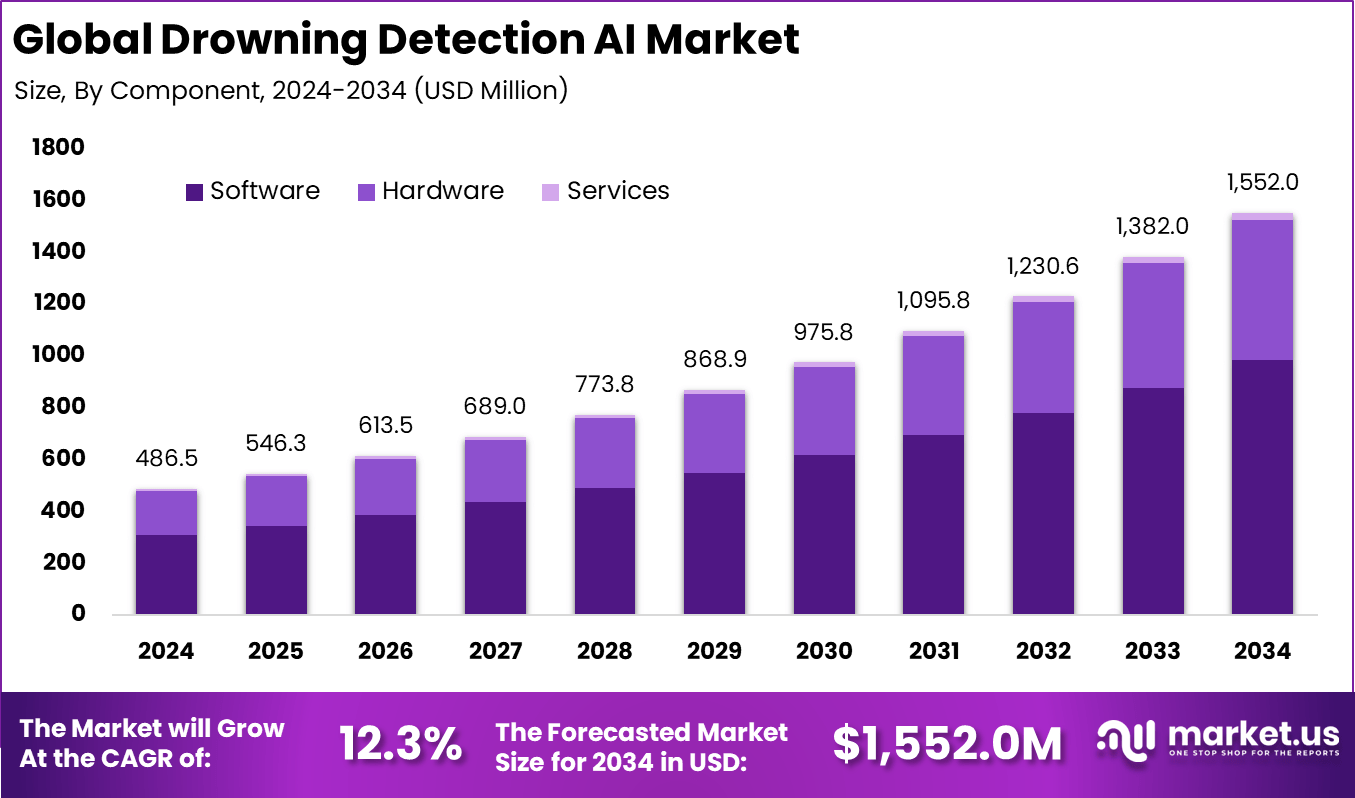
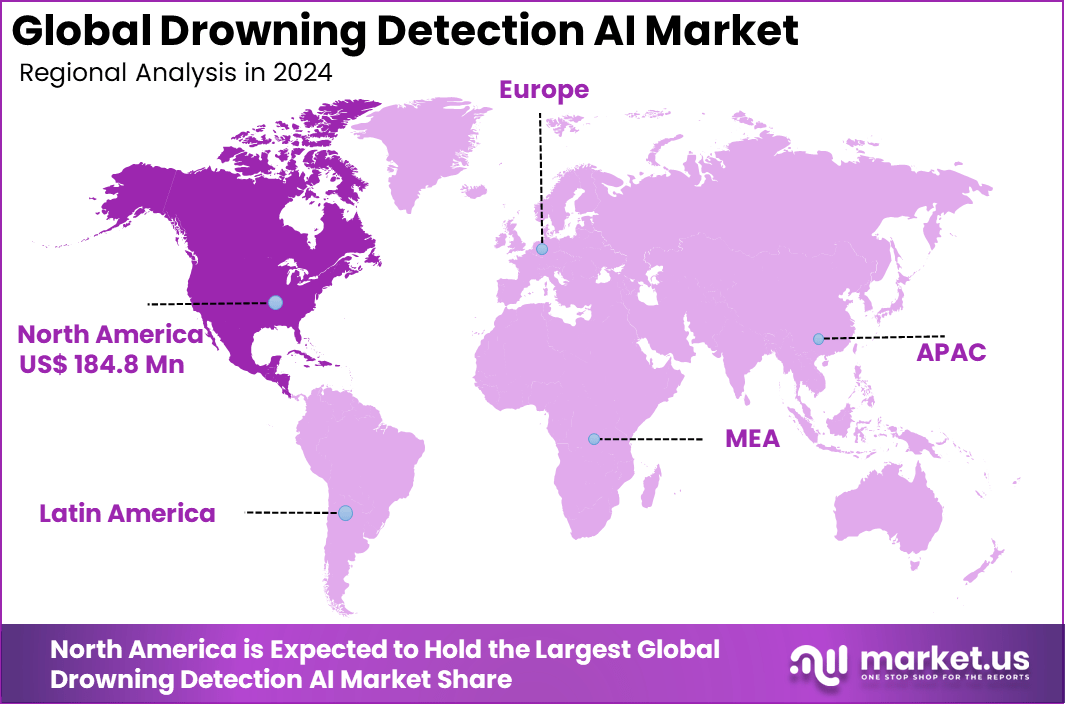
The Global Drowning Detection AI Market size is expected to be worth around USD 1,552.0 million by 2034, from USD 486.5 million in 2024, growing at a CAGR of 12.3% during the forecast period from 2025 to 2034. In 2024, North America held a dominant market position, capturing more than a 38% share, holding USD 184.8 million in revenue.
The drowning detection AI market has expanded as public pools, resorts, water parks and waterfront authorities adopt intelligent monitoring systems to enhance safety. Growth reflects rising awareness of aquatic accidents and the need for continuous, real time surveillance in environments where manual observation is often limited. AI enabled systems now support both indoor and outdoor water facilities by identifying risky behaviour, prolonged submersion and unusual motion patterns.
According to World Health Organization, around 2,36000 drowning deaths occur worldwide each year. In the United States, an estimated 3500 to 4000 people drown annually. Drowning also remains the leading cause of death for children aged 1 to 4, reflecting a significant global public health concern.
Top driving factors behind Drowning Detection AI include increasing global drowning statistics that stress the need for enhanced water safety. Research indicates that lifeguards often face challenges like fatigue and high supervision ratios, making it difficult to monitor all swimmers effectively at all times. Advances in AI and video processing have made automated detection systems more reliable and affordable, supporting broader adoption in public and private aquatic facilities.
The market for Drowning Detection AI is driven by increasing awareness of water safety and the need to prevent fatal drowning incidents. Growing concerns from parents, pool operators, and regulatory bodies push the adoption of AI systems that offer real-time monitoring and quick alerts. These technologies can reduce response times in emergencies, making aquatic environments safer.
For instance, in April 2025, Fluidra invested in Lynxight’s AI-powered pool safety technology. Lynxight transforms standard pool cameras with AI to enhance real-time swimmer detection and drowning prevention, improving lifeguard response times and overall aquatic safety.
Key Takeaway
- In 2024, the Software segment dominated with a 63.4% share, reflecting strong reliance on AI-driven video analytics and real-time detection algorithms to enhance safety.
- The On-premise segment held a leading 61.6% share, showing preference for locally hosted systems that ensure faster processing and greater data security in high-risk environments.
- The Swimming Pools segment accounted for 48.2%, driven by the widespread adoption of AI monitoring systems across public pools, hotels, and recreational facilities.
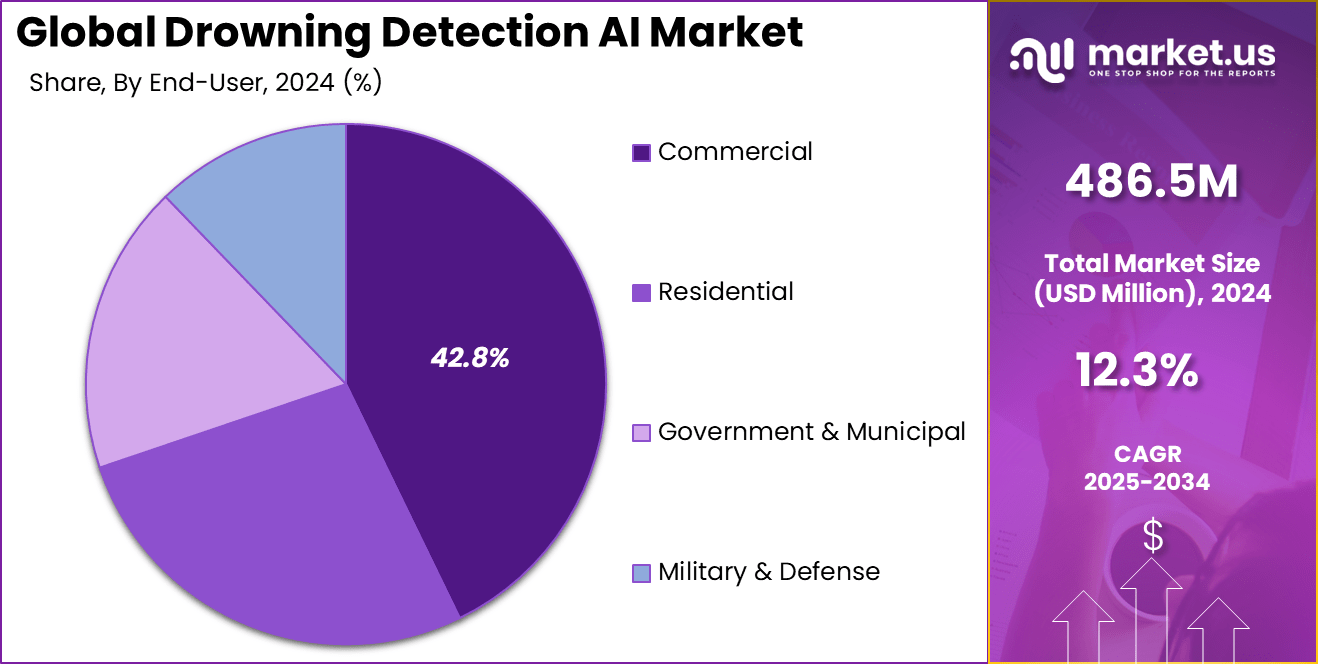
- The Commercial segment led with 42.8%, as businesses prioritize advanced surveillance solutions to improve safety compliance and liability protection.
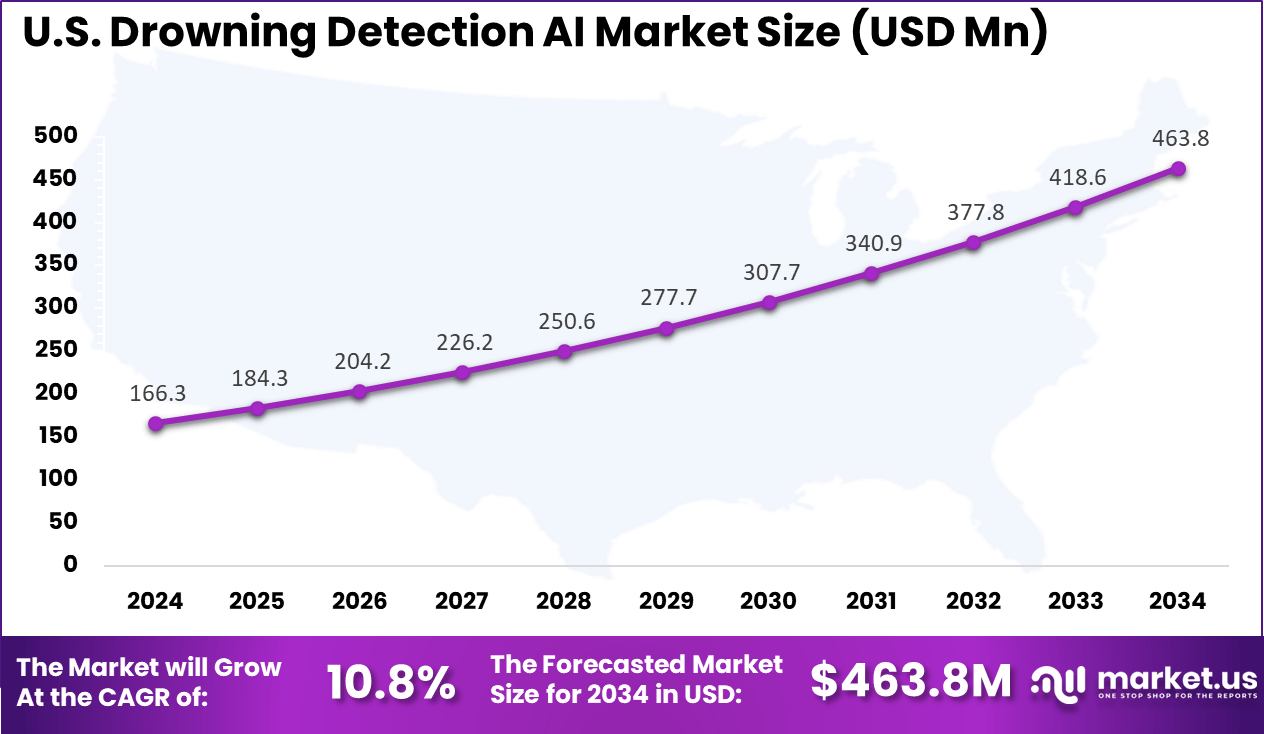
- The US market reached USD 166.3 million in 2024 and is growing at a solid CAGR of 10.8%, supported by rising safety regulations and adoption of smart surveillance technologies.
- North America maintained dominance with over 38% share, backed by strong AI innovation, infrastructure maturity, and increasing investment in safety-focused AI solutions.
Key Performance Statistics
- Accuracy: Academic studies indicate that advanced deep learning models such as YOLO variants and EfficientNet achieve detection accuracies in the range of 90% to 98% under controlled testing conditions. These results demonstrate strong capability in identifying drowning-risk movements.
- Precision and Recall: Both precision and recall are vital for safety applications. Several models report mid-to-high 90% precision and recall, which helps reduce false alerts and missed detections in benchmark datasets.
- Real-Time Responsiveness: Modern systems are designed to operate in real time. Research models can process video frames within 0.02 to 0.04 seconds per frame, allowing rapid identification of critical events and immediate alerts.
- Environmental Impact on Performance: Real-world factors such as water glare, lighting variation, turbidity, occlusion, and high crowd density can lower detection quality. Researchers continue to improve model robustness through enhanced training data, multi-camera setups, and refined filtering methods.
Role of Generative AI
Generative AI plays a transformative role in drowning detection by creating diverse, realistic drowning scenarios through artificial data generation. This capability allows systems to train more effectively, even for rare or difficult-to-capture drowning behaviors, enhancing the preparedness of detection models.
It has been shown that AI-generated data sets can closely replicate actual drowning processes, improving system adaptability across various real-world emergencies. The accuracy and responsiveness of drowning detection systems benefit greatly from generative AI’s ability to simulate multiple drowning conditions and swimmer responses.
This technology not only supports the continuous improvement of detection algorithms but also helps to reduce false alarms, making interventions more timely and precise. Studies show that AI models in drowning detection achieve recall rates as high as 98%, meaning they accurately identify nearly all true drowning incidents while minimizing false positives.
Investment and Business Benefits
Investment opportunities in this sector are buoyed by expanding safety mandates and technology advancements. Investors are drawn to the AI software platforms that transform conventional camera feeds into intelligent monitoring systems capable of analyzing complex behavioral patterns.
Funding is directed toward developing more accurate algorithms, modular sensor systems deployable in rural or low-resource settings, and hybrid AI models combining video analytics with sensor fusion. The push for reducing drowning incidents motivates public and private funding, while emerging markets present untapped potential for these lifesaving technologies.
Business benefits from deploying Drowning Detection AI include increased swimmer safety, reduction in potentially fatal incidents, and enhancement of facility reputation. These systems decrease the pressure on lifeguards by automating constant surveillance and pinpointing high-risk situations quickly. Facilities also benefit from operational savings through fewer emergency incidents and better resource management enabled by AI insights.
Furthermore, businesses can reduce insurance costs by demonstrating the use of advanced safety measures, attracting more visitors due to heightened trust. The data collected by AI systems also helps refine safety protocols and training programs. Overall, integrating these AI tools into aquatic environments delivers a safer experience that aligns with legal and ethical obligations toward public safety.
U.S. Market Size
The market for Drowning Detection AI within the U.S. is growing tremendously and is currently valued at USD 166.3 million, the market has a projected CAGR of 10.8%. The market is growing rapidly due to increasing awareness of drowning risks and the strong push for safety in aquatic environments. Rising incidents, especially among children, have heightened demand for advanced technology like AI-powered surveillance and wearable devices that provide real-time monitoring and faster response.
Regulatory measures and public safety campaigns also drive adoption in schools, resorts, and commercial pools. Technological advances in AI, machine learning, and IoT enable better accuracy and predictive capabilities, reducing false alarms while improving safety. The integration of smart sensors, cameras, and mobile alerts allows centralized monitoring of multiple facilities, making drowning detection systems more effective and accessible.
For instance, in October 2025, IBM unveiled new AI and intelligent infrastructure capabilities that can be applied to operationalize life-saving technologies, including drowning detection systems that rely on continuous monitoring and real-time alerts to emergency responders. IBM’s innovations focus on accelerating the detection and intervention processes by using advanced AI models.
In 2024, North America held a dominant market position in the Global Drowning Detection AI Market, capturing more than a 38% share, holding USD 184.8 million in revenue. This dominance is due to the high awareness of water safety and stringent regulations on pool safety measures. The region’s strong focus on deploying AI-enabled sensors, cameras, and portable monitoring devices in public pools, water parks, resorts, and schools significantly boosts safety and drowning prevention efforts.
The robust infrastructure, government support, and substantial investment in recreational aquatic facilities further strengthen the market dominance. Additionally, the U.S. leads this growth with strict safety policies and widespread adoption of IoT-based surveillance systems, which enable faster emergency response and effective drowning detection solutions.
For instance, in July 2025, Microsoft, through its advances in responsible AI, has supported the development of drowning detection models powered by computer vision that alert lifeguards when a person remains underwater beyond a safe threshold, enhancing pool and water safety. This leverages AI to provide an additional layer of vigilance, especially in environments where lifeguards must monitor large areas.
Component Analysis
In 2024, The Software segment held a dominant market position, capturing a 63.4% share of the Global Drowning Detection AI Market. This growth is driven by the rapid integration of AI-powered analytics, cloud platforms, and mobile applications that enable real-time monitoring and efficient event management.
Software solutions enhance the overall system intelligence, allowing for quick identification of distress signals and predictive analysis to prevent incidents. The rise in software adoption mirrors the increased demand for smarter, more responsive drowning detection technology that goes beyond traditional hardware setups.
By focusing on advanced algorithms and scalable platforms, software offers flexibility and continuous improvements that hardware alone cannot achieve. This segment’s expansion is supported by ongoing innovation in AI and machine learning, which sharpens detection accuracy and supports remote surveillance capabilities in various aquatic environments.
For Instance, in September 2025, SwimEye announced the upcoming release of Version 5 of their underwater monitoring system, which enhances swimmer safety and lifeguard efficiency through advanced AI software upgrades. This software improvement includes the integration of surface cameras and smart device alerts designed to boost real-time drowning detection capabilities, highlighting the importance of AI software in proactive aquatic safety.
Deployment Mode Analysis
In 2024, the On-premise segment held a dominant market position, capturing a 61.6% share of the Global Drowning Detection AI Market. Facilities that prioritize immediate access to monitoring tools without reliance on external internet connectivity tend to choose on-premise systems. This approach is especially suited to commercial pools, schools, and resorts where privacy and fast response times are paramount.
On-premise solutions provide operators with complete ownership of data and system performance, minimizing latency in alert delivery. While cloud-based alternatives are growing for multi-site management, the trust in on-premise installations remains high due to their reliability and independence from network disruptions.
For instance, in August 2023, Lynxight offers cloud-based aquatic risk management but focuses heavily on security and real-time risk assessments, supporting commercial and public venues that prioritize on-premise data control for privacy reasons. This dual capability of on-premise deployment with cloud integration flexibility ensures resilient and immediate drowning detection and response.
Application Analysis
In 2024, The Swimming Pools segment held a dominant market position, capturing a 48.2% share of the Global Drowning Detection AI Market. This prevalence is because pools, particularly public and commercial ones, have a high concentration of users and a significant need for safety monitoring. These environments require continuous supervision to quickly detect distress and initiate rescue efforts.
The ongoing push from safety regulations and increasing awareness about drowning risks drives the installation in pools. AI systems equipped with cameras and sensors help reduce accidents by providing lifeguards and operators with timely alerts, improving overall swimmer safety.
For Instance, in February 2025, the Selwyn Aquatic Centre in Canterbury implemented an AI-powered drowning prevention system using 27 cameras to monitor swimmer movements closely. The AI software analyzes behavior and alerts lifeguards through waterproof smartwatches and dashboards, specifying the pool and exact location of potential incidents.
End-User Analysis
In 2024, The Commercial segment held a dominant market position, capturing a 42.8% share of the Global Drowning Detection AI Market. These users prioritize safety to protect patrons and limit liability risks, which drives them to adopt advanced detection systems. Commercial entities often require comprehensive, reliable systems capable of handling high traffic levels and diverse swimmer behaviors.
The commercial sector benefits from AI’s ability to provide detailed analytics, real-time alerts, and integration with broader safety protocols. This enables operators to maintain high safety standards, comply with regulations, and build trust with customers. Their investments make this segment a key driver for drowning detection technology advancements and adoption.
For Instance, in March 2025, SwamCam launched its Deluxe Dual Camera System, an advanced AI-powered swimming pool monitoring system designed to prevent drownings. The system features two 1080P cameras with a 160° field of view, delivering 24/7 surveillance with AI detection that alerts pool owners via smartphone as soon as a human enters the pool area, not just the water.
Emerging Trends
One major trend in drowning detection technology is the integration of AI with IoT and wearable devices for real-time monitoring and swift response. Wearables track vital signs like heart rate and oxygen levels, feeding data into AI algorithms that assess drowning risks instantly. These systems report accuracy rates above 99% in identifying persons at risk in aquatic settings.
Another trend is the use of video analytics powered by deep learning to detect unusual motion or distress patterns automatically in public pools. The deployment of smart drowning detection technologies is also growing in public infrastructure, including community pools and beaches.
AI-driven systems use multiple sensor inputs combined with image processing to predict and alert lifeguards before drowning occurs. This proactive approach is supported by advances in 5G connectivity, allowing live monitoring over large areas and rapid emergency notification, boosting safety in crowded water environments.
Growth Factors
Key growth factors include rising awareness of water safety and increasing adoption of AI-powered surveillance in recreational, commercial, and residential aquatic environments. Governments and private operators see value in deploying intelligent systems that enhance lifeguard efficiency and reduce drowning incidents.
Enhanced detection accuracy through AI and machine learning also spurs adoption, as systems better differentiate genuine emergencies from false alarms, reducing unnecessary disruptions. Another growth factor is technological advancement, facilitating integration of drowning detection with broader safety and health monitoring ecosystems via IoT platforms.
This capability allows facility managers to centralize alerts and manage multiple locations efficiently. Increased use of affordable wearable devices, sensors, and AI analytics also contributes to broader market penetration across diverse aquatic settings such as schools and resorts.
Key Market Segments
By Component
- Software
- Hardware
- Services
By Deployment
- On-premise
- Cloud-based
By Application
- Swimming Pools
- Water Parks
- Beaches & Coastal Surveillance
- Ships & Vessels
- Others
By End-User
- Residential
- Commercial
- Government & Municipal
- Military & Defense
Regional Analysis and Coverage
- North America
- US
- Canada
- Europe
- Germany
- France
- The UK
- Spain
- Italy
- Russia
- Netherlands
- Rest of Europe
- Asia Pacific
- China
- Japan
- South Korea
- India
- Australia
- Singapore
- Thailand
- Vietnam
- Rest of Latin America
- Latin America
- Brazil
- Mexico
- Rest of Latin America
- Middle East & Africa
- South Africa
- Saudi Arabia
- UAE
- Rest of MEA
Drivers
Rising Awareness of Water Safety
The growing awareness among parents, pool operators, schools, resorts, and governments about the risks of drowning is a major driver for the Drowning Detection AI market. Increasing incidents of accidental drownings, especially among children, have urged stakeholders to adopt intelligent detection systems that provide real-time alerts to lifeguards or guardians.
These systems help reduce response times, making water environments safer by leveraging AI, wearable devices, and IoT-enabled monitoring platforms. This heightened consciousness is bolstered by regulatory mandates and safety campaigns in developed regions, encouraging the installation of advanced drowning detection solutions in commercial and residential facilities.
For instance, in October 2025, Microsoft highlighted its advances in responsible AI tools that include applications in safety-critical environments, such as drowning detection systems. Their efforts in AI transparency and ethical AI deployment drive trust and wider adoption of AI-based safety solutions, including drowning prevention technologies.
Restraint
High Installation and Maintenance Costs
One of the significant restraints on the growth of the drowning detection AI market is the high initial cost of installing sophisticated hardware such as cameras, underwater sensors, and AI-driven analytic platforms. Along with installation, ongoing maintenance, including calibration, software updates, and AI algorithm tuning, adds to the operational expenses. These costs can be prohibitive for small-scale pool owners and certain community facilities.
This economic barrier limits the widespread adoption of drowning detection technologies, particularly in cost-sensitive or developing regions where infrastructural investments are lower. Hence, despite rising awareness, the high cost factor acts as a major challenge restricting the market’s full potential.
For instance, in October 2025, IBM unveiled at Think 2025 new AI governance tools to manage complex enterprise AI workloads and compliance. While their innovations advance AI capabilities, the stringent controls and extensive monitoring required to meet industry standards show how complicated and costly AI system maintenance can be. This reflects a market restraint where high installation and upkeep costs pose challenges.
Opportunities
Technological Advancements in AI and IoT
Technological innovation presents a vast opportunity for the drowning detection AI market. Advances in AI, machine learning, and IoT connectivity allow for more accurate detection systems that can distinguish true drowning incidents from false alarms by analyzing swimmer behavior and environmental data in real-time. This enhancement raises trust and reliability in the systems.
Moreover, IoT integration enables centralized remote monitoring across multiple aquatic facilities, with mobile alerts improving responsiveness. The development of affordable wearable devices for swimmers is expanding market reach from commercial pools to residential settings and open water. These evolving technologies unlock new growth avenues for market players.
For instance, In March 2025, SwimEye announced an upgraded drowning detection system planned for release at the end of 2025. The new version combines surface cameras with advanced AI algorithms to offer multi-angle monitoring and smartwatch alerts for lifeguards. This advancement shows how AI and IoT innovations are creating stronger opportunities to improve reliability and user experience in drowning prevention.
Challenges
Integration and Privacy Concerns
A notable challenge is the difficulty in integrating drowning detection AI systems seamlessly with existing aquatic infrastructure and surveillance systems. Compatibility issues and varying technical standards can hinder smooth deployment and scaling. Additionally, concerns over privacy due to continuous video monitoring and data collection pose obstacles, especially in public and recreational environments.
Users and operators may be wary of constant surveillance, which affects acceptance and necessitates careful handling of data security and privacy regulations. This challenge requires balancing effective drowning detection with respect for individual privacy to ensure broader market adoption.
For instance, In December 2024, Coral Detection Systems highlighted the importance of seamless integration and privacy in its Coral Manta 3000 drowning detection system. Designed as a plug-and-play solution for continuous residential pool monitoring, the product addresses concerns around round-the-clock video surveillance while aiming for smooth connectivity with home networks and clear user alerts to reduce privacy-related hesitation.
Key Players Analysis
Microsoft, Google, IBM, NVIDIA, Intel, and Amazon lead the drowning detection AI market with advanced computer vision, edge analytics, and cloud processing capabilities. Their technologies support real-time surveillance, automated alerting, and high-accuracy motion detection in pools and aquatic facilities. These companies focus on improving detection precision, reducing false alarms, and enabling scalable deployment.
SwimEye, Coral Detection Systems, Poseidon Technologies, SEAL SwimSafe, and Aqualife strengthen the competitive landscape with specialized drowning detection platforms designed for aquatic safety. Their systems use underwater cameras, depth sensors, and AI-based behavior monitoring to identify at-risk swimmers. These providers offer rapid alerts to lifeguards and facility managers, enhancing prevention efforts.
Lynxight, Poolview AI, Sightcorp, Invision AI, and other participants broaden the market with innovative, flexible detection tools suited for various pool sizes and budgets. Their solutions prioritize fast setup, mobile integration, and real-time video analytics. These companies support smaller facilities and residential pools seeking automated safety enhancements.
Top Key Players in the Market
- Microsoft
- IBM
- NVIDIA
- Intel
- Amazon
- SwimEye
- Coral Detection Systems
- Poseidon Technologies
- SEAL SwimSafe
- Aqualife
- Lynxight
- Poolview AI
- Sightcorp
- Invision AI
- Others
Recent Developments
- In December 2024, Coral Detection Systems launched the Coral Manta 3000, an AI-based drowning detection system designed for private pools. This solar-powered, plug-and-play system notifies users via smartphone alerts and alarms if it detects a drowning risk or an unmoving body underwater for 15 seconds, enhancing infant and toddler safety.
- In November 2024, National Cheng Kung University unveiled a new AI-powered drowning detection system capable of monitoring pools, lakes, and other water bodies using video analytics to alert lifeguards in real-time on signs of distress. This system employs advanced image recognition for highly accurate drowning detection.
Report Scope
Report Features Description Market Value (2024) USD 486.5 Mn Forecast Revenue (2034) USD 1,552.0 Mn CAGR(2025-2034) 12.3% Base Year for Estimation 2024 Historic Period 2020-2023 Forecast Period 2025-2034 Report Coverage Revenue forecast, AI impact on Market trends, Share Insights, Company ranking, competitive landscape, Recent Developments, Market Dynamics and Emerging Trends Segments Covered By Component (Software, Hardware, Services), By Deployment (On-premise, Cloud-based), By Application (Swimming Pools, Water Parks, Beaches & Coastal Surveillance, Ships & Vessels, Others), By End-User (Residential, Commercial, Government & Municipal, Military & Defense) Regional Analysis North America – US, Canada; Europe – Germany, France, The UK, Spain, Italy, Russia, Netherlands, Rest of Europe; Asia Pacific – China, Japan, South Korea, India, New Zealand, Singapore, Thailand, Vietnam, Rest of Latin America; Latin America – Brazil, Mexico, Rest of Latin America; Middle East & Africa – South Africa, Saudi Arabia, UAE, Rest of MEA Competitive Landscape Microsoft, Google, IBM, NVIDIA, Intel, Amazon, SwimEye, Coral Detection Systems, Poseidon Technologies, SEAL SwimSafe, Aqualife, Lynxight, Poolview AI, Sightcorp, Invision AI, Others Customization Scope Customization for segments, region/country-level will be provided. Moreover, additional customization can be done based on the requirements. Purchase Options We have three license to opt for: Single User License, Multi-User License (Up to 5 Users), Corporate Use License (Unlimited User and Printable PDF)  Drowning Detection AI MarketPublished date: Nov. 2025add_shopping_cartBuy Now get_appDownload Sample
 -
-
- Microsoft
- IBM
- NVIDIA
- Intel
- Amazon
- SwimEye
- Coral Detection Systems
- Poseidon Technologies
- SEAL SwimSafe
- Aqualife
- Lynxight
- Poolview AI
- Sightcorp
- Invision AI
- Others
Our Clients

- 168288
- Nov. 2025









