


Report Overview
In 2025, the Global Digital Language Learning Market was valued at USD 33.1 million. The market is projected to grow at a CAGR of 13.8% during 2026–2035, reaching approximately USD 120.2 million by 2035. Asia-Pacific dominated the global market in 2025, accounting for more than 44.9% of the total market share and generating approximately USD 14.8 million in revenue.
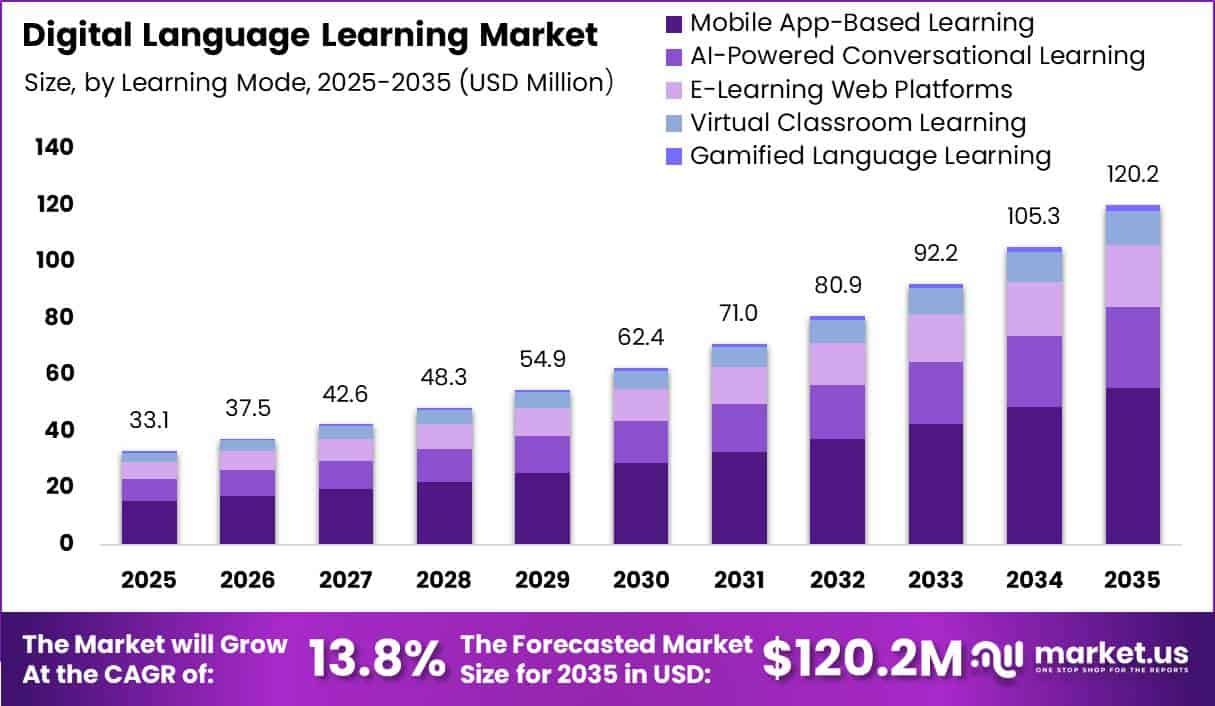
This growth is supported by increasing international student movement and wider access to mobile internet services. According to UNESCO, global higher education enrolment reached 269 million students in 2024, compared with nearly 100 million in 2000. The number of students studying outside their home countries also increased from 2.1 million in 2000 to approximately 7.3 million in 2023.
International students often require language skills for university admission, employment, communication, and academic activities, which increases demand for digital language-learning platforms. Growing internet connectivity is also expanding the potential user base. The International Telecommunication Union reported that around 5.5 billion people were connected to the internet in 2024, representing an annual increase of 227 million users.
Key Takeaway
- The Digital Language Learning Market reached USD 33.1 Million in 2025 and is projected to grow at a 13.8% CAGR to USD 120.2 Million by 2035.
- Mobile App-Based Learning dominated with a 46.2% share, supported by 9.1 billion global mobile-cellular subscriptions in 2024.
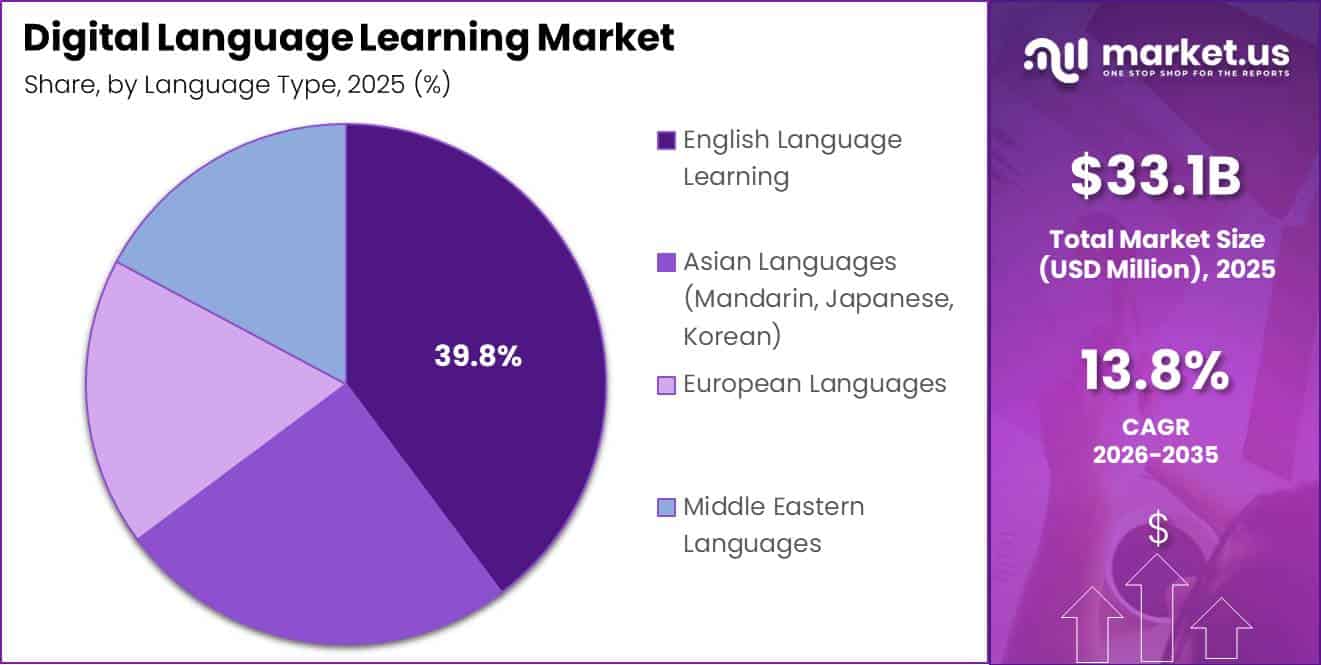
- English Language Learning held a leading 39.8% share due to strong demand across education, employment, and international communication.
- AI and Natural Language Processing accounted for 42.6% of the market, reflecting their central role in digital language platforms.
- Individual Learners represented the largest end-user segment with a 71.3% share.
- Adults aged 18–40 years led the age-group segment with a 58.4% share.
- Academic Learning captured a 34.7% share, supported by 269 million higher-education enrolments worldwide in 2024.
- Subscription-Based Platforms led the revenue model segment with a 63.1% share.
- Smartphones dominated device usage with a 64.8% share due to their broad availability and convenience.
- Asia-Pacific led the market with a 44.9% share and approximately USD 14.8 million in revenue in 2025.
By Learning Mode
Mobile App-Based Learning accounted for a 46.2% share, supported by the widespread availability of mobile connectivity and smartphones. According to the International Telecommunication Union, global mobile-cellular subscriptions reached 9.1 billion in 2024, which was 12.1% higher than the total global population.
This large subscription base provides language-learning companies with an established distribution channel, as users can access courses through smartphones they already own. Mobile applications also offer greater flexibility, allowing learners to study, practice, and complete lessons from any location without purchasing additional equipment.
AI-Powered Conversational Learning is expected to be the fastest-growing segment. According to the Organisation for Economic Co-operation and Development, enterprise adoption of artificial intelligence across member countries increased from 8.7% in 2023 to 20.2% in 2025, more than doubling within 2 years. This rapid growth shows that artificial intelligence tools are becoming more affordable, available, and easier to integrate.
By Language Type
English Language Learning held a leading 39.8% share, supported by the large global population using English for education, employment, and international communication. According to the British Council, around 2.3 billion people worldwide speak English, with most using it as a second language. This creates the largest potential learner base among individual language categories.
Asian Languages are expected to be the fastest-growing segment, supported by the increasing role of Asian economies in global trade. According to the United Nations Conference on Trade and Development, China’s exports increased by 5.8% in 2024, while developing Asian economies helped global trade reach a record USD 33 trillion.
By Technology
AI and Natural Language Processing held a leading 42.6% share, as these technologies form the core of most digital language-learning platforms. According to the World Intellectual Property Organization, AI-related patent family publications reached nearly 230,000 in 2023, while AI technologies recorded an average annual patent growth rate of 18.2% over 5 years.
This strong patent activity shows that Natural Language Processing tools are becoming more advanced, widely available, and easier to integrate. Language-learning providers can therefore add speech recognition, grammar correction, pronunciation analysis, and personalised feedback at a lower cost and across a large user base.
Generative AI Tutors and Chatbots are expected to be the fastest-growing segment. The World Intellectual Property Organization recorded 54,000 generative AI-related inventions filed between 2014 and 2023, with more than 25% submitted in 2023 alone. In addition, the U.S. Census Bureau reported that overall business use of artificial intelligence increased to nearly 20% by mid-2026, while adoption in the Information sector reached 39.7%.
By End User
Individual Learners held a dominant 71.3% share, supported by the large global workforce seeking better employment opportunities and professional language skills. According to the International Labour Organization, the worldwide labour force was close to 3.6 billion people. A significant portion of this population represents potential self-directed learners who use digital platforms to improve communication skills, earn language certifications, and strengthen career prospects.
Educational Institutions are expected to be the fastest-growing segment. According to the United Nations Educational, Scientific and Cultural Organization, post-secondary enrolment increased by 161% from 2000, compared with growth of only 30% in primary and secondary education. The rapid expansion of college and university enrolment is increasing pressure on institutions to provide language education to larger student populations.
By Age Group
Adults aged 18–40 years held a leading 58.4% share, supported by the large global working-age population. According to the United Nations, around 5.3 billion people were aged 15–64 years in 2025, making this the world’s largest demographic group. Many adults invest directly in language-learning platforms to improve job prospects, qualify for international roles, earn higher salaries, and communicate in global workplaces.
Children and Teenagers are expected to be the fastest-growing segment. According to the United Nations Educational, Scientific and Cultural Organization, approximately 1.4 billion students were enrolled in primary and secondary education in 2024, representing an increase of 327 million learners since 2000. As schools introduce foreign-language education at earlier stages, parents and educational institutions are increasingly using digital tools to support classroom teaching.
By Learning Purpose
Academic Learning held a leading 34.7% share, supported by the continued growth of global higher education. According to UNESCO, worldwide higher-education enrolment reached a record 269 million students in 2024. Many students require formal language skills for university admission, classroom participation, academic writing, research, and thesis preparation, particularly in international and cross-border study programs.
Universities also follow structured curricula and recognised language-certification standards, encouraging students to use digital learning platforms regularly throughout multi-year courses. This creates stable demand compared with casual or optional language learning.
Professional and Career Development is expected to be the fastest-growing segment. According to the International Labour Organization, the global youth unemployment rate declined to a 15-year low of 13%, although skill and education mismatches continue to increase. The World Economic Forum also reported that 75% of companies are adopting technologies such as artificial intelligence and cloud computing.
By Revenue Model
Subscription-Based Platforms held a leading 63.1% share, supported by the expansion of global access to formal financial services. According to the World Bank’s Global Findex 2025, around 79% of adults worldwide had a financial account, compared with 51% in 2011. This wider banking access allows more learners to make recurring digital payments through cards, bank accounts, and mobile payment systems.
Freemium Models are expected to be the fastest-growing segment. According to the International Telecommunication Union, the global median cost of mobile broadband declined to 1.4% of gross national income per capita in 2025. Around 130 of 205 economies also met the United Nations affordability target. Lower internet costs make free digital learning services more accessible to users in price-sensitive markets.
By Device Type
Smartphones held a dominant 64.8% share, supported by their widespread global availability and everyday use. According to the International Telecommunication Union, 4 out of 5 people aged 10 years and above owned a mobile phone globally, while ownership reached 82% in 2025.
This large installed user base gives language-learning platforms direct access to learners without requiring them to purchase an additional device. Smartphones also allow users to complete short lessons, vocabulary exercises, and speaking practice during commutes, work breaks, or other free periods.
Tablets are expected to be the fastest-growing segment. According to UNESCO, only around 10% of 15-year-old students used digital devices for more than 1 hour per week in most education systems covered by the latest PISA assessment. This indicates considerable growth potential as schools and households increase investment in digital learning devices.
Key Market Segments
By Learning Mode
- Mobile App-Based Learning
- AI-Powered Conversational Learning
- E-Learning Web Platforms
- Virtual Classroom Learning
- Gamified Language Learning
By Language Type
- English Language Learning
- Asian Languages (Mandarin, Japanese, Korean)
- European Languages
- Middle Eastern Languages
By Technology
- AI & Natural Language Processing (NLP)
- Generative AI Tutors & Chatbots
- Speech Recognition Systems
- Adaptive Learning Algorithms
By End User
- Individual Learners
- Educational Institutions
- Corporate Language Training
- Government Programs
By Age Group
- Adults (18–40 Years)
- Children & Teenagers
- Senior Learners
By Learning Purpose
- Academic Learning
- Professional & Career Development
- Travel & Communication
- Immigration & Certification Exams
By Revenue Model
- Subscription-Based Platforms
- Freemium Models
- One-Time Course Purchases
By Device Type
- Smartphones
- Tablets
- Desktops/Laptops
Geopolitical Impact Analysis
Geopolitical tensions are increasing the cost and reducing the availability of hardware and cloud infrastructure used by digital language-learning platforms. According to the World Trade Organization, average U.S. tariffs on Chinese information and communication technology goods increased from around 3% before 2018 to more than 12–15% on many laptops, tablets, and monitors by 2024. These higher duties raise device procurement costs for schools, companies, and individual learners.
UNCTAD also reported that global goods trade recorded quarter-over-quarter growth of nearly 1% in 2024, while services trade increased by around 1.5%. Security incidents and canal disruptions added approximately 5–10 transit days on some Asia–Europe and Asia–North America routes. These delays affect the delivery of smartphones, tablets, and computers, encouraging vendors to maintain larger inventories and absorb higher logistics expenses.
Energy and freight volatility create further pressure. The International Energy Agency reported that European industrial electricity prices increased by more than 40% between 2021 and 2023, while spot natural gas prices in major LNG-importing markets rose by over 300% at their peak before easing. These increases raised semiconductor production and data-centre operating costs.
As AI-based language applications require energy-intensive computing systems, higher power costs can influence subscription pricing. World Shipping Council and UNCTAD data also showed that container freight rates on some Asia–Europe routes more than doubled during conflict-related rerouting. In response, digital language-learning providers are diversifying hardware suppliers, expanding cloud-based delivery, and using regional data centres to control costs, reduce delays, and maintain reliable services.
Regional Analysis
Asia-Pacific held the dominant position in the Digital Language Learning Market, accounting for 44.9% of global revenue and generating approximately USD 14.8 million in 2025. The region benefits from a large population of students, employees, and migrants seeking language skills for education, employment, and international communication.
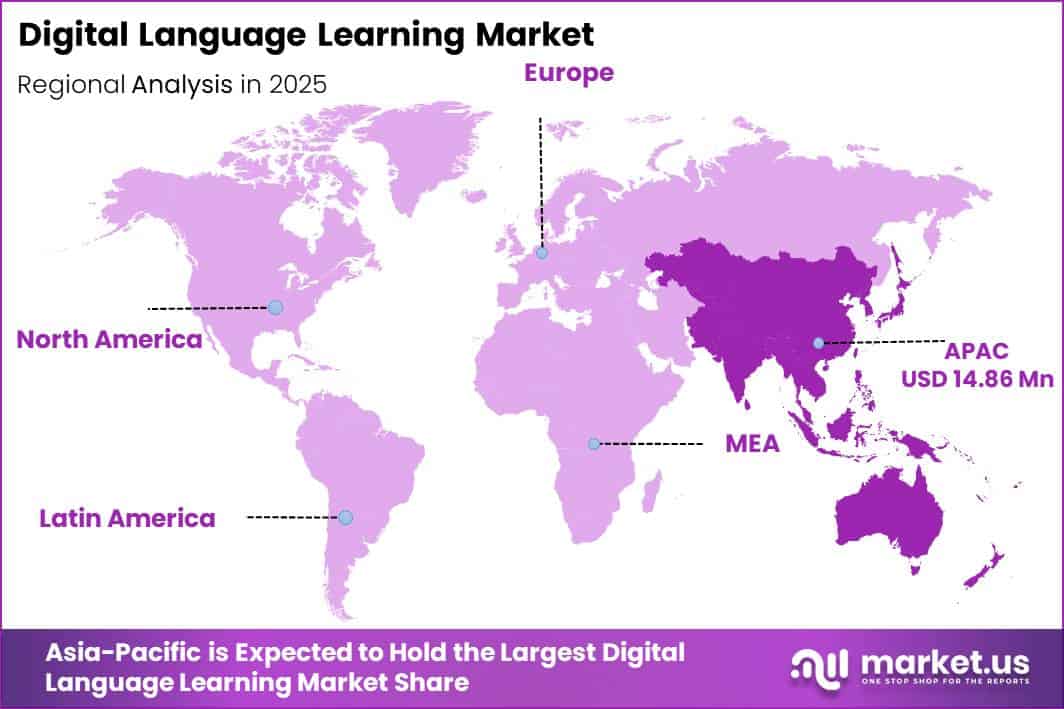
Government-supported digital education programs across China, India, South Korea, and ASEAN countries are encouraging schools and universities to adopt online learning platforms. Rising smartphone usage and wider access to AI-powered learning tools are also strengthening regional demand. Mobile-first learners increasingly prefer short, app-based lessons for English and major Asian languages because they offer flexibility and easy access.
North America is expected to be the fastest-growing regional market. Growth is supported by corporate reskilling programs and the rapid adoption of generative AI, virtual tutors, and conversational learning platforms. The region also has a well-developed subscription economy, high spending on premium digital content, and strong integration of language training into professional development and migration-related learning.
These factors are expected to support double-digit growth rates. As companies increase investment in employee communication skills and technology-based training, North America is likely to record faster incremental expansion, while Asia-Pacific continues to maintain the largest overall market share.
Key Regions and Countries
North America
- US
- Canada
Europe
- Germany
- France
- The UK
- Spain
- Italy
- Rest of Europe
Asia Pacific
- China
- Japan
- South Korea
- India
- Australia
- Rest of APAC
Latin America
- Brazil
- Mexico
- Rest of Latin America
Middle East & Africa
- GCC
- South Africa
- Rest of MEA
Market Dynamics
Drivers
| Driver | (~) % CAGR | Geographic Relevance | Impact Timeline |
|---|---|---|---|
| AI-personalized learning engagement | +3.0% | Global | Short term (≤ 2 years) |
| Shift to mobile self-learning apps | +2.4% | Global, stronger in Asia-Pacific | Short term (≤ 2 years) |
| Cross-border education & migration | +2.0% | Europe, North America, Asia-Pacific | Medium term (2–4 years) |
| Corporate upskilling & global hiring | +1.8% | Global | Medium term (2–4 years) |
| Government-backed digital education | +1.6% | Asia-Pacific, Middle East, Latin America | Long term (≥ 4 years) |
| Lower data costs & broadband expansion | +1.2% | Emerging markets | Long term (≥ 4 years) |
AI-personalized learning engagement
Over the 2024–2026 period, rapid integration of AI tutors, speech recognition, and adaptive recommendation engines into digital language platforms has materially lifted user engagement and conversion, with several leading apps reporting that AI-personalized cohorts show 25–40% higher lesson completion and up to 30% higher daily active usage versus non-AI cohorts, based on internal analytics and mobile usage benchmarks for education apps worldwide.
This engagement delta converts into a quantifiable revenue uplift as free-to-paid conversion rates improve by an estimated 2–3 percentage points and churn falls by roughly 5–8%, allowing providers to sustain higher lifetime value while holding customer acquisition cost growth close to single digits annually, effectively adding about 3.0% to the baseline digital language learning CAGR without requiring equivalent increases in marketing spend.
Structurally, the shift from static content libraries to AI-augmented, usage-based SaaS models enables operators to monetize active minutes rather than just licenses, pushing gross margins toward the mid-70% range for content once foundational models and cloud inference contracts are amortized, expanding room for reinvestment in product localization and enterprise-grade features that further reinforce growth momentum.
Restraints
| Restraint | (~) % CAGR | Geographic Relevance | Impact Timeline |
|---|---|---|---|
| Stringent data privacy & child-safety rules | -2.6% | EU, UK, North America | Short term (≤ 2 years) |
| School procurement & budget rigidity | -2.1% | Global | Medium term (2–4 years) |
| High cloud inference & infra costs | -1.8% | Global | Short term (≤ 2 years) |
| Low willingness to pay in emerging markets | -1.5% | Asia-Pacific, Africa, Latin America | Long term (≥ 4 years) |
| Platform dependency on app stores | -1.3% | Global | Medium term (2–4 years) |
| Content localization compliance overhead | -1.0% | Europe, Middle East, Asia-Pacific | Medium term (2–4 years) |
Stringent data privacy & child-safety rules
Across the EU, UK, and North America, enforcement of frameworks such as GDPR-style data protection, COPPA-type child online privacy statutes, and new online safety and dark-pattern restrictions has raised compliance costs and slowed institutional adoption cycles for digital language learning platforms, with vendors often needing 6–12 additional months to complete security reviews, data-processing agreements, and age-verification workflows for school deployments.
For K–12 and higher-education segments, platforms must now encrypt all student records in transit and at rest, restrict ad targeting, segregate personally identifiable information, and sometimes host data in-region, which can add roughly 10–20% to annual cloud and security budgets and force smaller providers to defer feature releases while legal and privacy engineering work is prioritized.
Strategically, this compresses margins on school-facing contracts by an estimated 3–5 percentage points and discourages aggressive experimentation with monetization in minors’ segments, effectively pulling down the attainable CAGR by about 2.6% relative to a purely demand-driven baseline because some institutions delay SaaS upgrades or limit seat counts until compliance assurance is fully documented.
Challenges
| Challenge | (~) % CAGR | Geographic Relevance | Mitigation Horizon |
|---|---|---|---|
| AI talent and pedagogy gap | -2.3% | Global | Long term (≥ 4 years) |
| Fragmented curricula alignment | -2.0% | Global | Medium term (2–4 years) |
| Measurement of learning outcomes | -1.9% | Global | Medium term (2–4 years) |
| Content piracy and account sharing | -1.7% | Global, higher in emerging markets | Long term (≥ 4 years) |
| Vendor fatigue among institutions | -1.4% | North America, Europe | Short term (≤ 2 years) |
| Digital divide in low-income users | -1.2% | Emerging markets | Long term (≥ 4 years) |
AI talent and pedagogy gap
Even as AI capabilities in speech recognition and generative tutoring accelerate, there remains a structural shortage of professionals who combine applied AI engineering with second-language acquisition pedagogy, forcing many digital language platforms to either over-rely on generic models or to run prolonged experimentation cycles of 12–18 months before curriculum-integrated AI features achieve acceptable accuracy and learner satisfaction metrics.
Building robust, language-specific pronunciation engines and adaptive difficulty algorithms often requires teams of 10–20 specialists per major language pair plus large volumes of high-quality labeled audio and text; this pushes per-feature development costs into the high six-figure range and raises the bar for smaller providers, who must then ration AI-led innovation to only a subset of high-demand languages.
Over time, this talent and pedagogy bottleneck acts as a friction drag of roughly 2.3% on the addressable growth rate because it delays rollout of differentiated features that could improve retention and pricing power, compelling operators to adjust by forming content co-development partnerships, offshoring R&D to lower-cost hubs, and prioritizing platform tooling that allows fewer experts to govern scalable, reusable AI learning components.
Opportunities
| Opportunity | (~) % CAGR | Geographic Relevance | Execution Window |
|---|---|---|---|
| Outcome-based B2B & B2G contracts | +2.7% | Global | Medium term (2–4 years) |
| Deep integration with migration and employability services | +2.4% | Europe, North America, Asia-Pacific | Long term (≥ 4 years) |
| Adjacency into subject-matter and test prep | +2.2% | Global | Medium term (2–4 years) |
| AI-native white-label platforms for institutions | +2.0% | Global | Short term (≤ 2 years) |
| Localized offerings for underserved languages | +1.8% | Asia-Pacific, Africa, Latin America | Long term (≥ 4 years) |
| Bundling with connectivity and devices | +1.5% | Emerging markets | Medium term (2–4 years) |
Outcome-based B2B & B2G contracts
Unlike today’s predominantly seat- or subscription-based pricing, outcome-linked agreements with employers, universities, and public agencies—where a portion of fees depends on learners reaching specified proficiency levels or test scores within 6–12 months—remain underdeveloped but could unlock higher contract values and structurally better unit economics once credible assessment and tracking infrastructure is in place.
Because digital platforms can log granular activity, speaking practice minutes, and assessment results, they are positioned to guarantee results at scale, and internal pilots suggest that tying 20–30% of revenue to verified proficiency gains can support headline price premia of 25–40% over standard licenses while keeping variable delivery cost increases to single digits through automation, implying margin expansion of roughly 5–8 percentage points on successful cohorts.
This upside is not yet fully reflected in the baseline CAGR because it requires investment in standardized testing integrations, interoperable data-sharing with institutional systems, and actuarial-style risk modeling, but where executed, it could add about 2.7% incremental CAGR by enabling vendors to capture a larger share of education and training budgets that are currently locked in offline tutoring or generic professional development line items.
Key Players Analysis
Tier-1 companies in the Digital Language Learning Market include Duolingo, Babbel, EF Education First, Coursera, Udemy, Google, and Microsoft. Duolingo generated USD 748 million in revenue during 2024, representing growth of around 41% year over year. Paid subscriptions contributed nearly 75% of its revenue, supported by more than 10 million paying users.
Babbel reported EUR 352 million, or approximately USD 383 million, in 2024 revenue and has recorded over 16 million lifetime subscriptions. Coursera generated USD 739 million in 2024, while Udemy reported more than USD 700 million. Google Cloud generated USD 37.1 billion, and Microsoft Intelligent Cloud reported USD 93.6 billion in FY 2024, giving both companies strong infrastructure positions in AI-supported language learning.
Tier-2 participants include Rosetta Stone, Busuu, Memrise, HelloTalk, Cambly, Preply, italki, and Lingoda. Several of these companies serve more than 10–20 million users, while their annual revenues remain in the tens of millions of dollars. Preply operates across more than 90 languages and records marketplace activity in the low hundreds of millions of dollars. HelloTalk and Cambly generate revenue in the single- to low-double-digit million range.
Tier-2 companies mainly compete through live tutoring, flexible lesson pricing, and specialised language services. In comparison, Tier-1 platforms rely on large subscription bases, global brand recognition, and rapid AI development, with research and development spending often representing more than 15–20% of revenue.
Top Key Players in the Market
- Duolingo
- Babbel
- Rosetta Stone
- Busuu
- Memrise
- HelloTalk
- Cambly
- Preply
- italki
- Lingoda
- EF Education First
- Coursera
- Udemy
- Microsoft
Recent Developments
- In 2026, Duolingo announced on February 26 that its board had approved a share-repurchase program of up to USD 400 million. The company ended 2025 with more than 50 million daily active users and generated over USD 1 billion in bookings for the first time. Duolingo also established a medium-term goal of reaching 100 million daily active users while increasing its focus on AI-supported learning, speaking features, and user engagement.
- In 2026, Microsoft announced in June the expansion of AI-powered education tools across the Microsoft 365 Education ecosystem. Microsoft’s survey of 3,345 respondents found that 92% of students and education leaders and 88% of educators had already used AI for education-related purposes, showing strong demand for AI-based digital learning tools.
Report Scope
| Report Features | Description |
|---|---|
| Market Value (2025) | USD 33.1 Million |
| Forecast Revenue (2035) | USD 120.2 Million |
| CAGR (2026-2035) | 13.8% |
| Base Year for Estimation | 2025 |
| Historic Period | 2020-2024 |
| Forecast Period | 2026-2035 |
| Report Coverage | Revenue Forecast, Market Dynamics, Competitive Landscape, Recent Developments |
| Segments Covered | By Learning Mode (Mobile App-Based Learning, AI-Powered Conversational Learning, E-Learning Web Platforms, Virtual Classroom Learning, Gamified Language Learning); By Language Type (English Language Learning, Asian Languages including Mandarin, Japanese, and Korean, European Languages, Middle Eastern Languages); By Technology (AI & Natural Language Processing (NLP), Generative AI Tutors & Chatbots, Speech Recognition Systems, Adaptive Learning Algorithms); By End User (Individual Learners, Educational Institutions, Corporate Language Training, Government Programs); By Age Group (Adults aged 18–40 Years, Children & Teenagers, Senior Learners); By Learning Purpose (Academic Learning, Professional & Career Development, Travel & Communication, Immigration & Certification Exams); By Revenue Model (Subscription-Based Platforms, Freemium Models, One-Time Course Purchases); By Device Type (Smartphones, Tablets, Desktops/Laptops) |
| Regional Analysis | North America – US, Canada; Europe – Germany, France, The UK, Spain, Italy, Rest of Europe; Asia Pacific – China, Japan, South Korea, India, Australia, Singapore, Rest of APAC; Latin America – Brazil, Mexico, Rest of Latin America; Middle East & Africa – GCC, South Africa, Rest of MEA |
| Competitive Landscape | Duolingo, Babbel, Rosetta Stone, Busuu, Memrise, HelloTalk, Cambly, Preply, italki, Lingoda, EF Education First, Coursera, Udemy, Google, Microsoft |
| Customization Scope | Customization for segments and region/country-level will be provided. Moreover, customization can be tailored to the requirements. |
| Purchase Options | We have three licenses to opt for: Single User License, Multi-User License (Up to 5 Users), Corporate Use License (Unlimited Users and Printable PDF) |





























