


Report Overview
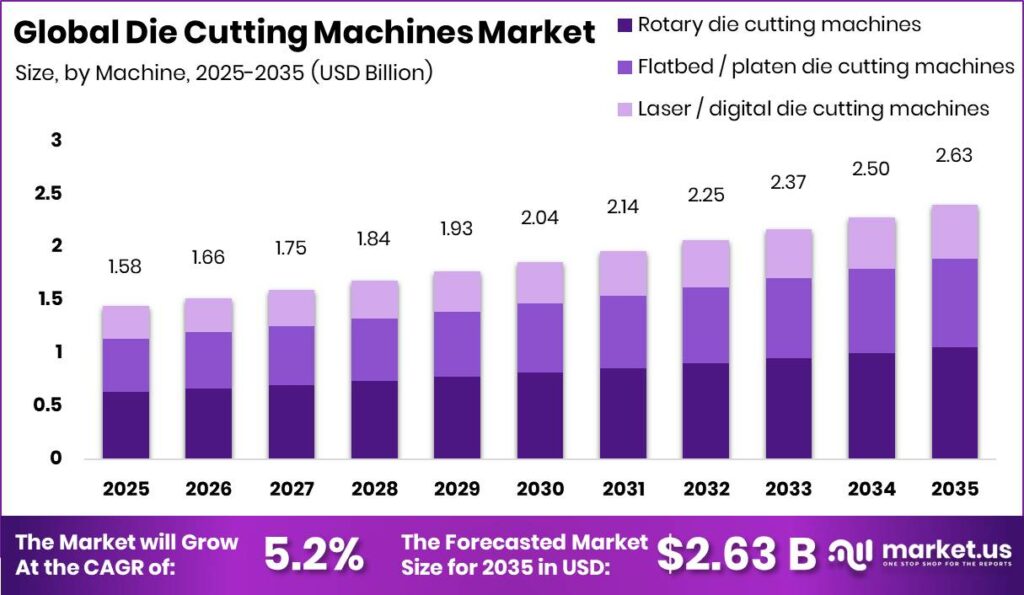
Global Die Cutting Machines Market size is expected to be worth around USD 2.63 Billion by 2035 from USD 1.58 Billion in 2025, growing at a CAGR of 5.2% during the forecast period 2026 to 2035. This steady climb signals durable capital demand from converters. Equipment suppliers can plan multi-year production capacity against a predictable order pipeline rather than short cyclical spikes.
The die cutting machines market covers powered systems that cut, crease, and shape paper, board, film, foil, and specialty substrates. Manufacturers structure the market around machine type, cutting technology, and end-use industry. This layered structure lets buyers match machine speed and precision to specific job runs. Therefore vendors compete on both throughput economics and application-specific accuracy rather than price alone.
Key Takeaways
- Global Die Cutting Machines Market size will reach USD 2.63 Billion by 2035 from USD 1.58 Billion in 2025 at a CAGR of 5.2%.
- Rotary die cutting machines led the By Machine segment with a 40.2% share in 2025.
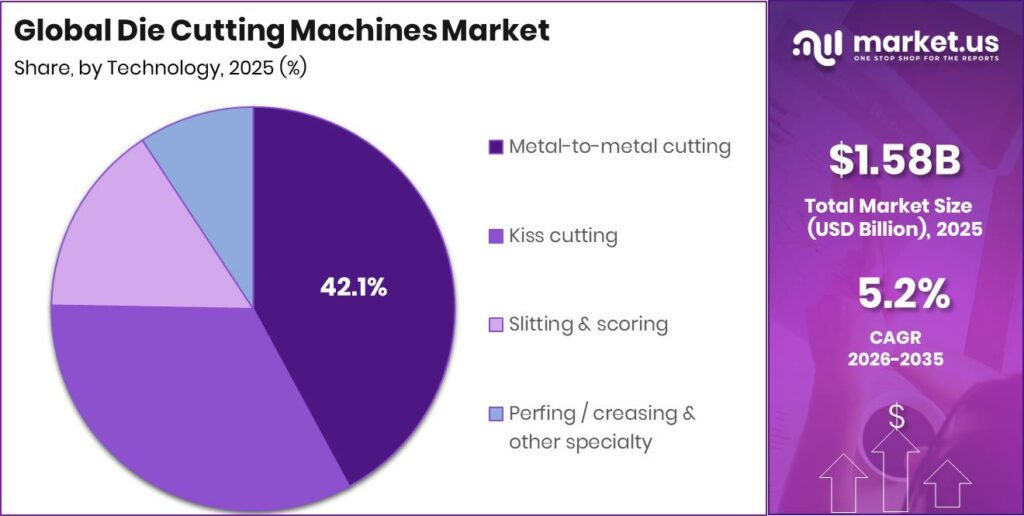
- Metal-to-metal cutting held a 42.1% share of the By Technology segment.
- Packaging led the By End-use Industry segment with a 24.0% share.
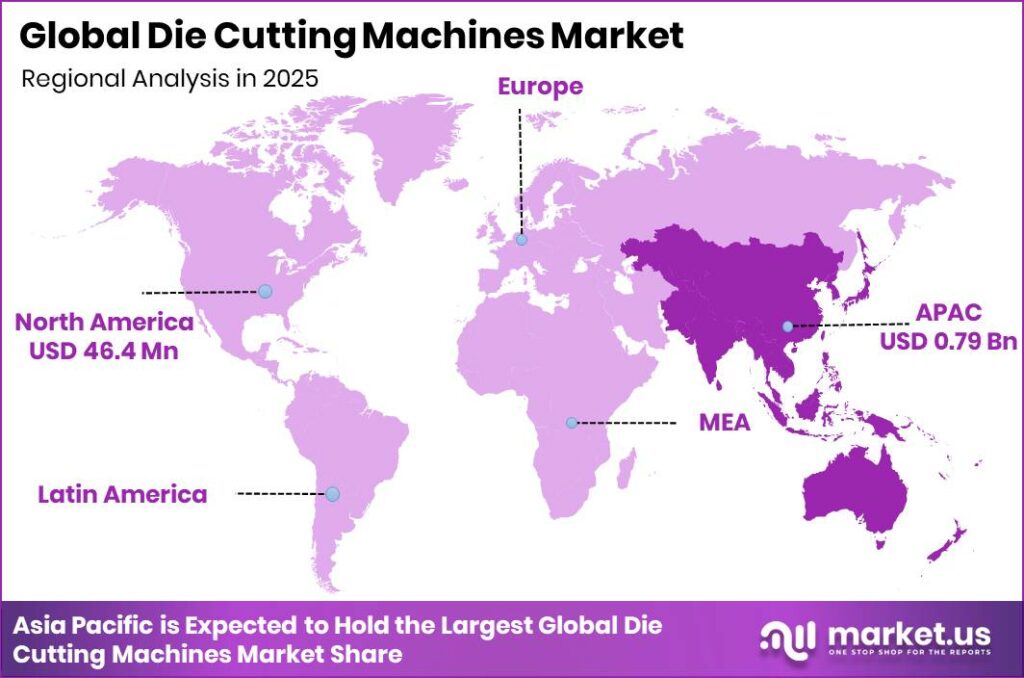
- Asia Pacific dominated with a 50.1% share, valued at USD 0.79 Billion.
Government-backed manufacturing statistics anchor investment confidence in this market. According to ISTMA, the 2025 Statistical Yearbook now covers 35 countries active in the global tools, dies, and moulds industry. This wide coverage gives buyers verified benchmarking data across borders. As a result equipment planners can size capacity decisions against real national output rather than guesswork.
Packaging output directly pulls die cutting machine demand across Europe. Data from FEFCO shows Europe produces 49 billion square meters of corrugated board every year as of 2024. This scale of board conversion requires dense die cutting capacity near production hubs. Therefore converters expanding corrugated lines create a recurring replacement and upgrade market for equipment suppliers through the forecast period.
Machine Analysis
Rotary die cutting machines dominate with 40.2% due to high-speed continuous web throughput.
In 2025, Rotary die cutting machines held a dominant market position in the By Machine segment of Die Cutting Machines Market, with a 40.2% share. UN Comtrade classifies this machinery under HS code 844110, a category tracking automatic and semi-automatic units across major trading nations. High-speed rotary lines suit long corrugated and label runs. This means converters serving e-commerce packaging favor rotary platforms to protect margin on volume orders.
Flatbed and platen die cutting machines serve short-run and heavy-board jobs where flat sheet accuracy matters most. FEFCO data shows Europe alone converts 49 billion square meters of corrugated board yearly, much of it on flatbed lines for premium cartons. In 2025, Excel Machineries raised the feeder and delivery height of its Exb 35 flatbed machine by 1 foot. This upgrade improves sheet handling, so converters gain productivity without buying entirely new lines.
Laser and digital die cutting machines rank as the fastest-growing sub-segment because they need no physical steel rule tooling. Battery makers now adopt these systems for contactless electrode cutting and faster cycle times. This tooling-free flexibility suits short runs and frequent job changes. Therefore converters handling custom and prototype work shift spending toward digital platforms to cut setup cost and time.
Other and manual specialty systems hold the remaining share collectively, serving craft, hobbyist, and niche industrial buyers. These low-cost units fit small workshops that cannot justify industrial capital spend. This creates an entry tier where suppliers build brand loyalty before customers scale up to automated rotary or flatbed platforms.
Technology Analysis
Metal-to-metal cutting dominates with 42.1% due to durable high-volume clean-cut performance.
In 2025, Metal-to-metal cutting held a dominant market position in the By Technology segment of Die Cutting Machines Market, with a 42.1% share. Trade data under HS code 8441 tracks the paper and board making-up machinery that carries this hardened cutting method. Metal-to-metal tooling delivers clean edges on high runs. This means packaging plants adopt it to hold quality across millions of units per shift.
Kiss cutting ranks as the fastest-growing technology because it cuts the top layer while leaving the liner intact for labels and adhesives. Narrow-web label lines accept substrate roll widths from 100 mm up to 330 mm, matching typical pressure-sensitive label work. This precise depth control suits self-adhesive products. Therefore label converters investing in kiss cutting capture growing demand from branded consumer goods.
Slitting and scoring technology prepares board and paper for folding and clean separation in downstream assembly. Converters rely on it to feed carton lines with accurate crease lines. This role makes slitting and scoring a steady requirement across packaging plants, so suppliers embed it as standard capability rather than a premium option.
Perfing, creasing, and other specialty methods hold the remaining share collectively, serving tear-strip, coupon, and complex fold applications. These functions add finishing value to printed products. This creates upsell room where vendors bundle specialty modules onto core platforms to raise per-machine revenue.
End-use Industry Analysis
Packaging dominates with 24.0% due to high corrugated and carton conversion volume.
In 2025, Packaging held a dominant market position in the By End-use Industry segment of Die Cutting Machines Market, with a 24.0% share. FEFCO reports more than 75% of European goods travel in corrugated packaging, anchoring vast die cutting demand. This structural reliance makes packaging the base load for equipment orders. As a result suppliers prioritize packaging converters as their largest recurring customer base.
Automotive buyers use die cutting for gaskets, interiors, insulation, and EV parts that require tight tolerance cuts. FEFCO data shows more than 40% of European corrugated packaging goes to food, but automotive relies on precision foam and adhesive cutting instead. This distinct material need pushes automotive plants toward specialized tooling. Therefore vendors serving this tier compete on accuracy rather than raw sheet speed.
Electronics and consumer device makers form the fastest-growing end-use industry because thin films and adhesives demand precise contactless cuts. Battery and wearable assembly increasingly adopt die and laser cutting for electrode and circuit substrates. This precision requirement raises machine value. Consequently suppliers with electronics-grade platforms command higher prices than commodity packaging equipment vendors.
Medical, pharmaceutical, textile, other industrial uses, and LED applications hold the remaining share collectively, each demanding tailored cutting profiles. Medical converters need compliant, contaminant-free cuts, while textile and LED buyers seek flexible substrate handling. This spread of niche needs lets suppliers diversify revenue beyond high-volume packaging into higher-margin specialty segments.
Key Market Segments
By Machine
- Rotary Die Cutting Machines
- Flatbed / Platen Die Cutting Machines
- Laser / Digital Die Cutting Machines
- Other / Manual & Specialty Systems
By Technology
- Metal-to-Metal Cutting
- Kiss Cutting
- Slitting & Scoring
- Perfing / Creasing & Other Specialty
By End-use Industry
- Packaging (cartons, corrugated, labels, flexible packs)
- Automotive (gaskets, interiors, insulation, EV parts)
- Electronics & Mobile / Consumer Devices
- Medical & Pharmaceutical
- Textile & Other Industrial Uses
- LED
Regional Analysis
Asia Pacific Dominates the Die Cutting Machines Market with a Market Share of 50.1%, Valued at USD 0.79 Billion
Asia Pacific led the die cutting machines market in 2025 with a 50.1% share, valued at USD 0.79 Billion. China, India, and Southeast Asia host dense packaging and electronics manufacturing that consumes cutting capacity. This concentration of converters keeps regional equipment demand high. As a result suppliers place production, service, and spare-parts networks close to Asian buyers to defend share.
North America and Europe follow as mature markets built on packaging replacement demand and precision applications. FEFCO figures confirm Europe converts vast corrugated volume yearly, sustaining steady flatbed and rotary upgrades. These regions favor automation and compliance-grade accuracy. Therefore vendors win here by selling productivity and precision rather than low entry price.
Key Regions and Countries
North America
- US
- Canada
Europe
- Germany
- France
- The UK
- Spain
- Italy
- Rest of Europe
Asia Pacific
- China
- Japan
- South Korea
- India
- Australia
- Rest of APAC
Latin America
- Brazil
- Mexico
- Rest of Latin America
Middle East and Africa
- GCC
- South Africa
- Rest of MEA
Market Dynamics
Market Opportunity Analysis - Underserved electronics, emerging Asian converters, and inline integration open entry points for new players
Electronics and consumer device converting stands out as underexploited despite ranking as the fastest-growing end-use segment. Most installed capacity still targets paper and board rather than thin-film and electrode cutting. This gap leaves precision electronics demand thinly served. Therefore new entrants with anti-static handling and micron-level accuracy can claim share before conventional packaging suppliers retool for the segment.
India and Southeast Asia represent open regional white space within the dominant Asia Pacific base. While the region holds a 50.1% share, converter capacity in these specific markets remains under-built relative to demand. This means mid-range platform suppliers face limited entrenched competition. Consequently vendors offering financing and local service can capture greenfield converter buildouts ahead of premium global brands.
Laser and digital die cutting, the fastest-growing machine sub-segment, remains underpenetrated in short-run and custom packaging workflows. Converters still rely on tooling-heavy flatbed lines for many small jobs. This creates room for tooling-free platforms. As a result early movers integrating digital cutting into inline print-to-pack lines can lock in customized packaging demand before rivals respond.
Technology and Innovation Landscape - Servo speed, durable tooling, and narrow-web flexibility redefine competitive edges
High-speed full rotary die cutters now reach processing speeds up to 120 meters per minute using integrated modern servo drives. This throughput lets converters clear high-volume corrugated and label runs faster per shift. As a result manufacturers who match this servo-driven speed win volume-focused packaging buyers seeking maximum output per line.
Rotary die cutting assemblies have passed customer acceptance testing at an operating speed of 900 pieces per minute. This validated performance gives buyers confidence in real production reliability, not lab claims. Therefore suppliers who demonstrate proven acceptance-test speeds shorten sales cycles with converters wary of unverified vendor promises.
Specialized flatbed tooling now uses wear-resistant metal matrix cutting components rated for a service life of up to 80 million strokes. This durability cuts tool replacement frequency and downtime for high-volume converters. Consequently manufacturers marketing long tool life reduce customer lifetime cost, strengthening their case against cheaper but shorter-lived competing systems.
Standard high-speed label lines now accept narrow-web substrate roll widths from 100 mm up to 330 mm, with flatbed alignment held to 2 mm increments. This range and precision let converters handle varied label jobs on one platform. Therefore flexible narrow-web capability becomes a decisive selling point for label converters chasing job diversity without extra machines.
Drivers
E-commerce expansion is the primary force pushing die cutting machine demand, adding an estimated +1.65% to the CAGR forecast. Online retail needs far more protective corrugated shippers, mailers, and custom inserts per unit sold than store retail. This raises die cut component volume sharply. Therefore corrugated converters run rotary and flatbed lines at high utilization and justify new equipment purchases to clear fulfillment bottlenecks.
Sustainable packaging mandates add another +1.10% to forecast growth by pushing converters toward paper-based substrates that require precise die cutting. Regulators across the EU, UK, and North America drive this shift away from plastic. This creates fresh investment in paperboard cutting capacity. As a result suppliers who lead on recyclable-substrate handling capture first-mover advantage with compliance-focused buyers.
| Driver | (~) % Impact on CAGR Forecast | Geographic Relevance | Impact Timeline |
|---|---|---|---|
| E-Commerce Packaging Volume Growth Driving Corrugated & Folding Carton Die Cutting Demand | +1.65% | Global — led by United States, China, Europe, India, Southeast Asia | Short term (≤ 2 years) |
| Sustainable & Recyclable Packaging Mandates Accelerating Paper-Based Substrate Die Cutting Investment | +1.10% | European Union, United Kingdom, United States, Canada, Australia | Short term (≤ 2 years) |
| Pharmaceutical & Medical Device Packaging Compliance Complexity Requiring Precision Die Cut Components | +0.80% | United States, European Union, Japan, South Korea, India | Medium term (2–4 years) |
| Digital Printing & Short-Run Customised Packaging Demand Expanding Desktop & Mid-Range Die Cutter Segment | +0.72% | North America, Europe, China, India, Brazil | Short term (≤ 2 years) |
| Automotive & Electronics Gasket, Foam & Adhesive Die Cutting Volume Growth | +0.55% | Germany, Japan, United States, China, South Korea | Medium term (2–4 years) |
| Craft & Hobbyist Market Expansion Driving Consumer Desktop Die Cutting Machine Adoption | +0.42% | United States, United Kingdom, Australia, Canada, Germany | Short term (≤ 2 years) |
Restraints
Laser cutting substitution is the leading restraint, trimming an estimated -1.15% from the CAGR forecast. Laser systems remove the need for physical steel rule dies and cut tooling changeover to under 2 minutes on short runs. This erases setup cost on prototype and low-volume jobs. As a result conventional die cutter makers lose short-run enquiries and face structural leakage in their sales funnel.
High capital cost of industrial flatbed and rotary platforms adds another -0.80% drag by blocking smaller converters from entering the market. Buyers in India, Southeast Asia, and Latin America struggle to fund premium lines. This slows adoption in fast-growing regions. Therefore suppliers must offer financing or mid-range models to convert price-sensitive demand into actual orders.
| Restraint | (~) % Impact on CAGR Forecast | Geographic Relevance | Impact Timeline |
|---|---|---|---|
| Laser Cutting Technology Substitution Displacing Conventional Die Cutting in Precision & Short-Run Segments | -1.15% | Global — most acute in North America, Europe, Japan for short-run & prototyping use cases | Short term (≤ 2 years) |
| High Capital Cost of Industrial Flatbed & Rotary Die Cutting Platforms Limiting SME Market Entry | -0.80% | India, Southeast Asia, Latin America, Eastern Europe | Short term (≤ 2 years) |
| Steel Rule Die & Tooling Cost Inflation Adding Per-Job Variable Cost Burden on Short-Run Converters | -0.55% | Global — most acute in markets without domestic die tooling manufacturing | Short term (≤ 2 years) |
| Corrugated & Paperboard Raw Material Price Volatility Suppressing Converter CapEx Confidence | -0.38% | North America, Europe, China — integrated corrugated converter markets | Short term (≤ 2 years) |
Challenges
Die register accuracy is the sharpest challenge, dragging an estimated -0.75% on forecast growth. Substrate caliper and moisture shifts cause cut position deviation, and a ±0.3 to 0.5mm error can reject pharmaceutical or premium cartons. This yield loss hits high-volume shifts hardest. Therefore converters demand closed-loop register control, opening a clear upgrade opportunity for suppliers who can deliver vision-guided precision.
Skilled makeready and tooling setup operator shortage adds a further -0.60% friction across North America, Europe, Japan, and Australia. Experienced setup staff retire faster than new operators train. This slows changeover and raises labor cost. As a result vendors selling automated setup and self-calibrating platforms open a new revenue stream tied to labor savings rather than raw speed.
| Challenge | (~) % CAGR Friction Drag | Geographic Relevance | Mitigation Horizon |
|---|---|---|---|
| Die Register Accuracy & Substrate Variation Yield Loss | -0.75% | Global — most acute for pharmaceutical & premium brand packaging converters | Long term (≥ 4 years) |
| Skilled Makeready & Tooling Setup Operator Shortage | -0.60% | North America, Europe, Japan, Australia | Long term (≥ 4 years) |
| Multi-Material Substrate Compatibility & Tooling Wear Escalation | -0.48% | Global — most acute in automotive, electronics, and medical die cutting segments | Long term (≥ 4 years) |
| Emerging Market After-Sales Service & Spare Parts Infrastructure Gap | -0.35% | India, Southeast Asia, Latin America, Sub-Saharan Africa | Medium term (2–4 years) |
| Digitalisation & MES Integration Complexity for Legacy Converter Fleets | -0.28% | Europe, North America — mid-size converter fleet operators | Medium term (2–4 years) |
Opportunities
Flexible and thin-film electronics die cutting is the largest opportunity, offering an estimated +1.20% CAGR upside. EV battery cells need precise cutting of electrode foils at 8 to 20 microns to tight tolerances on advanced rotary lines. This demands purpose-built platforms that command far higher margins. Therefore suppliers who validate electrode cutting capability early can capture gigafactory equipment demand before rivals qualify.
Automated inline die cutting inside digital print-to-pack lines adds another +0.90% upside across North America, Europe, and Asia. Converters want print, cut, and crease integrated in one continuous workflow. This removes handoffs and raises throughput. As a result early movers who bundle inline cutting with digital presses win share among short-run and customized packaging buyers.
| Opportunity | (~) % Potential CAGR Upside | Geographic Relevance | Execution Window |
|---|---|---|---|
| Flexible & Thin-Film Electronics Die Cutting for EV Battery & Wearable Device Manufacturing | +1.20% | United States, Germany, Japan, South Korea, China | Medium term (2–4 years) |
| Automated & Inline Die Cutting Integration within Digital Print-to-Pack Production Lines | +0.90% | North America, Europe, China, India, Brazil | Medium term (2–4 years) |
| India & Southeast Asia Packaging Converter Capacity Buildout Demand | +0.72% | India, Indonesia, Vietnam, Thailand, Philippines | Short term (≤ 2 years) |
| Predictive Maintenance & Remote Diagnostics SaaS Platform for Installed Fleet Monetisation | +0.55% | Europe, North America, Japan, Australia | Long term (≥ 4 years) |
| Biodegradable & Compostable Substrate Die Cutting Process Optimisation as Premium Service Offering | +0.35% | European Union, United Kingdom, United States, Canada, Australia | Long term (≥ 4 years) |
Key Company Insights
BOBST Group anchors its position through Cutting Equipment depth across corrugated, folding carton, and label converting. Its broad platform range lets one supplier serve many job types, which locks in large converters seeking a single vendor. However, this premium positioning exposes BOBST to price pressure from lower-cost Asian rivals in emerging markets, where capital budgets favor mid-range machines over full automation lines.
Heidelberger Druckmaschinen AG strengthened its packaging position in October 2025 by expanding its strategic partnership with a converting specialist to deliver automated end-to-end production. This integration of die cutting and robotics helps Heidelberg sell complete workflows rather than single machines. Structured preventive maintenance can cut total maintenance cost by 20%, so its automated fleet offer appeals to converters chasing lower lifetime operating expense.
Key Players
- BOBST Group (Switzerland)
- Heidelberger Druckmaschinen AG
- MK Masterwork
- Komori Corporation
- Koenig & Bauer AG
- SANWA Co., Ltd.
- Young Shin Industries Co., Ltd
- ASAHI MACHINERY Limited
- IIJIMA MFG Co., Ltd.
- Yawa Printing Machinery Co., Ltd.
- Delta ModTech
- Sysco Machinery Co., Ltd.
- Berhalter AG
- Hunkeler AG
- Winkler + Dünnebier GmbH (W+D)
- Others
Recent Developments
- April 2026: Koenig & Bauer Celmacch entered a strategic partnership with Guangdong Keshenglong Hi-Tech Group and launched the new Prima series, including the PrimaCUT rotary die cutting machine, to expand into the mid-tech corrugated packaging market.
Geopolitical Impact Analysis
According to the WTO, world merchandise trade volume growth stayed near 2.7% in recent measurement, while shipping disruption reshapes machinery delivery routes. The World Shipping Council reports Red Sea rerouting around the Cape of Good Hope adds roughly 10 to 14 days transit for Asia to Europe freight. This delays die cutting machine and spare-part shipments. As a result European converters build larger safety stocks of cutting components to protect uptime.
Data from the IMF shows global growth held near 3.2%, yet tariff actions raise landed cost for imported machinery and steel tooling. Steel rule dies and hardened cutting components track steel price swings, and US tariff measures push some rates above 25% on affected imports. This lifts converter capital cost. Therefore suppliers with regional manufacturing gain a pricing edge over import-dependent competitors during trade tension.
Report Scope
| Report Features | Description |
|---|---|
| Market Value (2025) | USD 1.58 Billion |
| Forecast Revenue (2035) | USD 2.63 Billion |
| CAGR (2026-2035) | 5.2% |
| Base Year for Estimation | 2025 |
| Historic Period | 2020-2024 |
| Forecast Period | 2026-2035 |
| Report Coverage | Revenue Forecast, Market Dynamics, Market Opportunity Analysis, Technology and Innovation Landscape, Competitive Landscape, Recent Developments |
| Segments Covered | By Machine (Rotary Die Cutting Machines, Flatbed / Platen Die Cutting Machines, Laser / Digital Die Cutting Machines, Other / Manual & Specialty Systems), By Technology (Metal-to-Metal Cutting, Kiss Cutting, Slitting & Scoring, Perfing / Creasing & Other Specialty), By End-use Industry (Packaging, Automotive, Electronics & Mobile / Consumer Devices, Medical & Pharmaceutical, Textile & Other Industrial Uses, LED) |
| Regional Analysis | North America (US and Canada), Europe (Germany, France, The UK, Spain, Italy, and Rest of Europe), Asia Pacific (China, Japan, South Korea, India, Australia, and Rest of APAC), Latin America (Brazil, Mexico, and Rest of Latin America), Middle East and Africa (GCC, South Africa, and Rest of MEA) |
| Competitive Landscape | BOBST Group, Heidelberger Druckmaschinen AG, MK Masterwork, Komori Corporation, Koenig & Bauer AG, SANWA Co., Ltd., Young Shin Industries Co., Ltd, ASAHI MACHINERY Limited, IIJIMA MFG Co., Ltd., Yawa Printing Machinery Co., Ltd., Delta ModTech, Sysco Machinery Co., Ltd., Berhalter AG, Hunkeler AG, Winkler + Dünnebier GmbH (W+D), Others |
| Customization Scope | Customization for segments, region / country-level will be provided. Additional customization can be done based on requirements. |
| Purchase Options | We have three licenses to opt for: Single User License | Multi-User License (Up to 5 Users) | Corporate Use License (Unlimited User and Printable PDF) |





































