Deposit Analytics Platform Market By Component (Software, Services), By Deployment Mode (On-Premises, Cloud-Based), By Application (Risk Management, Customer Insights, Product Optimization, Regulatory Compliance, Others), By Enterprise Size (Small and Medium Enterprises, Large Enterprises), By End-User (Banks, Credit Unions, Financial Institutions, Others), By Regional Analysis, Global Trends and Opportunity, Future Outlook By 2026-2035
The Global Deposit Analytics Platform Market generated USD 2.2 billion in 2025 and is predicted to register growth from USD 2.7 billion in 2026 to about USD 16.7 billion by 2035, recording a CAGR of 22.5% throughout the forecast span. In 2025, North America held a dominant market position, capturing more than a 39.1% share, holding USD 0.86 Billion revenue.
Top Market Takeaways
Component Software accounts for 70.5% of the Deposit Analytics Platform market, as banks primarily invest in advanced analytics platforms rather than standalone services.
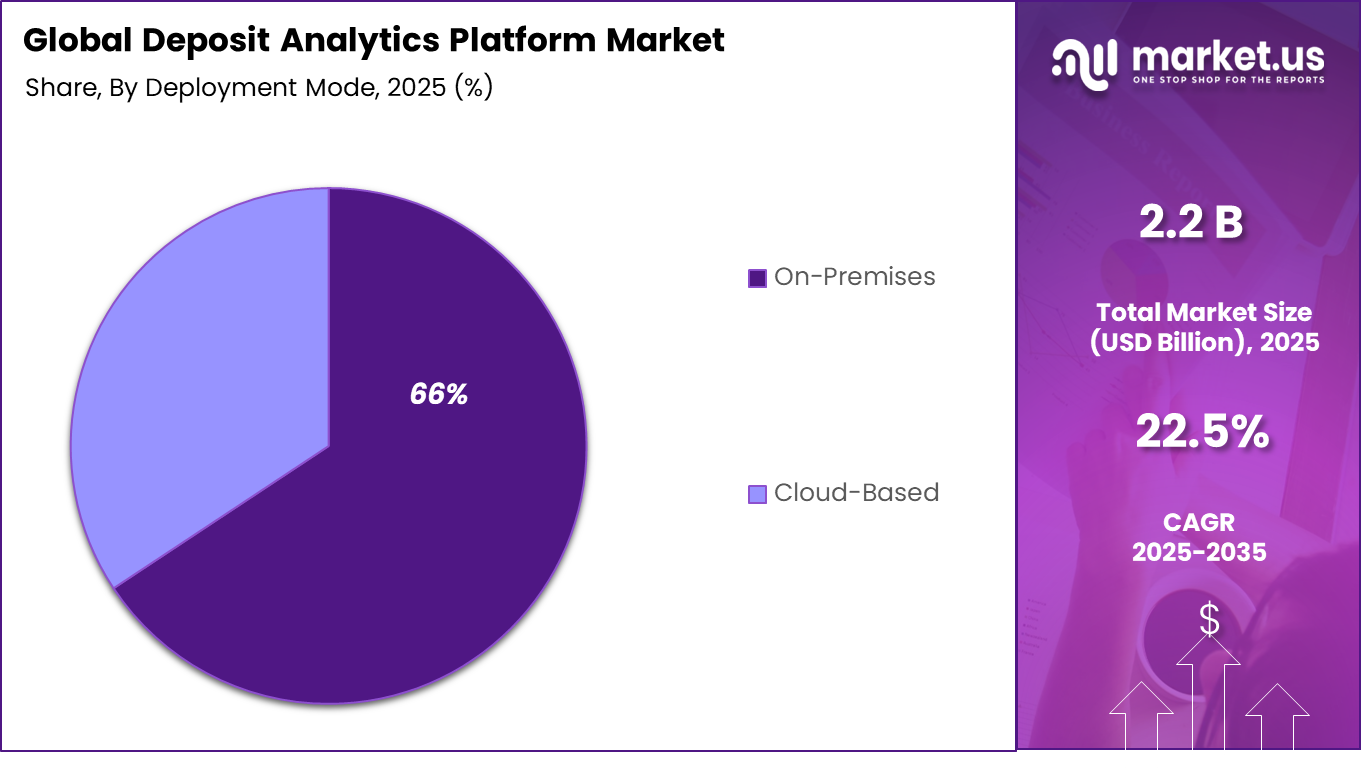
Deployment Mode On-premises holds 65.7% of the market, because many financial institutions prefer to keep sensitive deposit and customer data within their own data centers for security and compliance.
Application Risk management represents 40.6% of demand, reflecting strong use of deposit analytics to monitor liquidity, interest rate risk, and customer behavior.
Enterprise Size Large enterprises account for 75.2% of the market, since big banks and large financial groups have the most complex deposit bases and the greatest need for sophisticated analytics.
End-User Banks make up 46.7% of demand, as they are the primary users of deposit analytics platforms to optimize pricing, product strategy, and balance sheet management.
Region North America represents 39.1% of the global market, supported by advanced banking systems and strong adoption of data-driven decision-making.
Country The US market is valued at USD 0.73 billion and is expected to grow at a CAGR of 19.2%, driven by increasing focus on deposit profitability, regulatory expectations, and real-time analytics.
Deposit analytics platforms are digital solutions used by financial institutions to analyze deposit behavior, customer trends, account performance, and liquidity patterns across banking operations. These platforms help banks understand how deposits move across products, channels, and customer segments, allowing better planning and financial decision making.
Traditional reporting methods often provide delayed or fragmented insights, while analytics platforms offer more detailed and real time visibility into deposit activity. As banks face changing customer behavior and tighter financial management requirements, deposit analytics is becoming an important part of strategic banking operations.
One of the main driving factors is the growing need for stronger liquidity and balance sheet management in the banking sector. Financial institutions are under pressure to monitor funding stability, customer retention, and interest rate sensitivity more closely.
In addition, customer expectations for personalized banking services are encouraging banks to use analytics for deeper understanding of account behavior and engagement patterns. Regulatory reporting requirements are also becoming more detailed, increasing the demand for systems that can generate accurate and timely insights. The expansion of digital banking channels is further supporting adoption by generating larger volumes of customer and transaction data.
Demand for deposit analytics platforms is rising as banks seek data driven tools that improve forecasting, profitability analysis, and customer strategy development. There is a strong preference for platforms that provide real time dashboards, predictive analytics, scenario modeling, and integration with core banking systems.
Financial institutions are also looking for solutions that can support risk management and improve decision making across treasury and retail banking functions. The demand is particularly strong among mid sized and large banks managing diverse deposit portfolios and high transaction activity. As banking operations become more analytics focused, the need for scalable and intelligent deposit analysis platforms is expected to grow steadily.
Drivers Impact Analysis
Key Driver
Impact on CAGR Forecast (~%)
Geographic Relevance
Impact Timeline
Additional Insight
Rising need for real-time liquidity and deposit monitoring
+4.8%
North America, Europe, Asia Pacific
Medium term
Banks require stronger liquidity visibility
Increasing adoption of AI and data analytics in banking
+4.4%
Global
Medium to long term
Analytics improves deposit forecasting
Growing regulatory focus on risk management and compliance
+4.0%
North America, Europe
Medium term
Compliance drives analytics adoption
Expansion of digital banking and customer transaction volumes
+3.6%
Global
Medium to long term
Digital banking increases data generation
Rising competition among banks for deposit retention
+3.2%
Global
Medium term
Platforms help improve customer insights
Restraints Impact Analysis
Key Restraint
Impact on CAGR Forecast (~%)
Geographic Relevance
Impact Timeline
Additional Insight
High implementation and integration costs
-3.4%
Emerging markets
Short to medium term
Costs slow adoption for smaller banks
Complexity in integrating with legacy banking systems
-3.0%
Global
Medium term
Older systems delay deployment
Data privacy and cybersecurity concerns
-2.6%
North America, Europe
Medium to long term
Security risks affect confidence
Shortage of skilled analytics professionals
-2.2%
Global
Medium term
Talent gaps impact operations
Dependence on accurate and standardized banking data
-1.9%
Global
Long term
Poor data quality affects insights
By Component Analysis
The software segment accounted for 70.5% of the market share, reflecting its central role in analyzing deposit trends, customer behavior, and liquidity performance within financial institutions. This dominance is supported by the growing demand for advanced analytics tools that can process large volumes of banking data and generate actionable insights. Banks are increasingly relying on software platforms to improve decision-making and strengthen financial planning.
Another factor driving this segment is the increasing complexity of deposit management and regulatory reporting requirements. Software solutions help institutions automate data analysis, improve forecasting accuracy, and monitor financial performance in real time. These capabilities continue to strengthen adoption across the banking sector.
By Deployment Mode Analysis
The on-premises segment held 66% share, driven by the need for stronger data security, regulatory compliance, and internal system control. Financial institutions prefer on-premises deployment to maintain direct oversight of sensitive customer and transaction data. This approach supports stricter governance and reduces concerns related to external infrastructure dependency.
In addition, many banks operate complex legacy environments that require close integration with internal analytics systems. On-premises solutions provide greater flexibility for customization and allow institutions to manage updates and configurations according to internal operational requirements. These benefits continue to support strong adoption.
By Application Analysis
The risk management segment captured 40.6% of the market, reflecting the growing importance of monitoring liquidity, deposit stability, and financial exposure within banking operations. Deposit analytics platforms help institutions identify patterns, assess potential risks, and improve financial resilience. These insights are essential for maintaining operational stability and regulatory compliance.
Furthermore, changing economic conditions and fluctuations in customer deposit behavior have increased the need for advanced risk analysis tools. Banks are investing in analytics platforms to strengthen forecasting capabilities and improve strategic planning, reinforcing demand within the risk management segment.
By Enterprise Size Analysis
The large enterprises segment accounted for 75.2% of the market share, driven by the extensive data management needs of major financial institutions. Large enterprises handle significant transaction volumes and customer portfolios, creating strong demand for advanced analytics solutions that support efficient monitoring and reporting. Deposit analytics platforms help improve operational accuracy and decision-making.
Moreover, large organizations have the financial and technical resources to implement enterprise-scale analytics infrastructure. Their focus on compliance, profitability, and customer retention continues to drive investment in sophisticated deposit analytics systems.
By End-User Analysis
The banks segment held 46.7% share, reflecting their direct role in managing customer deposits, liquidity planning, and financial risk. Banks rely on deposit analytics platforms to gain better visibility into account activity, customer trends, and funding stability. These tools support more informed strategic and operational decisions.
In addition, increasing competition in the financial sector has encouraged banks to improve customer insights and optimize deposit-related services. Analytics platforms help institutions enhance financial performance, manage risk more effectively, and support long-term operational efficiency, reinforcing their importance in the banking industry.
Investor Type Impact Analysis
Investor Type
Growth Sensitivity
Risk Exposure
Geographic Focus
Investment Outlook
Venture capital firms
Very high
High
US, Europe
Investing in banking analytics startups
Private equity firms
High
Moderate
North America and Europe
Scaling financial analytics providers
Corporate investors
Very high
Moderate
Global
Strategic investments in digital banking platforms
Institutional investors
Moderate to high
Moderate
Developed markets
Prefer scalable fintech and SaaS firms
Government and public funding bodies
Moderate
Low
Global
Supporting financial sector modernization
Technology Enablement Analysis
Technology
Impact on CAGR Forecast (~%)
Geographic Relevance
Impact Timeline
Additional Insight
AI-driven deposit forecasting and analytics
+5.0%
North America, Europe, Asia Pacific
Medium to long term
Improves predictive accuracy
Cloud-based banking analytics platforms
+4.5%
Global
Medium term
Enables scalable data processing
Real-time transaction monitoring systems
+4.1%
Global
Medium term
Enhances liquidity visibility
Machine learning for customer behavior analysis
+3.7%
Developed markets
Medium to long term
Supports deposit retention strategies
API integration with digital banking systems
+3.3%
Global
Medium term
Improves data connectivity
Key Challenges
Complex integration with existing banking and financial systems.
High implementation and maintenance costs for advanced analytics platforms.
Data security and privacy concerns related to customer financial information.
Difficulty in managing and analyzing large volumes of deposit data.
Strict regulatory and compliance requirements in the banking sector.
Lack of skilled professionals for data analytics and platform management.
Poor data quality can affect analytics accuracy and decision-making.
Resistance to adopting advanced digital analytics tools in traditional banks.
Dependence on real-time data processing and stable network infrastructure.
Frequent software updates and changing banking regulations increase complexity.
Emerging Trends
The deposit analytics platform market is evolving toward more predictive and customer focused financial intelligence systems that help banks improve deposit management and decision making. One of the key emerging trends is the growing use of AI and machine learning to analyze customer transaction behavior, predict deposit movement patterns, and identify retention opportunities in real time. This is helping financial institutions respond faster to changing liquidity conditions.
Another important trend is the integration of analytics platforms with digital banking channels, allowing institutions to generate personalized product recommendations and improve customer engagement. There is also increasing focus on real time dashboards and scenario modeling tools that support treasury teams in monitoring funding stability and interest sensitivity more effectively. In addition, cloud based analytics environments are becoming more common, enabling faster data processing and easier scalability across banking operations. Automation in regulatory reporting and risk monitoring is also gaining traction as banks seek greater operational efficiency.
Growth Factors
The growth of this market is driven by the increasing need for stronger liquidity management and data driven banking strategies. Financial institutions are facing more pressure to understand customer deposit behavior and maintain stable funding sources in changing economic conditions. The expansion of digital banking services is also generating large volumes of transactional data, creating demand for advanced analytics tools that can turn this information into actionable insights.
Another major factor is the rising focus on customer retention and personalized banking experiences, where analytics platforms help identify trends and improve engagement strategies. Banks are also aiming to reduce operational complexity and improve forecasting accuracy, which supports investment in automated analytics solutions. Furthermore, evolving regulatory expectations around risk management and financial transparency are encouraging institutions to adopt platforms that provide deeper visibility into deposit performance and funding dynamics.
Key Market Segments
By Component
Software
Services
By Deployment Mode
On-Premises
Cloud-Based
By Application
Risk Management
Customer Insights
Product Optimization
Regulatory Compliance
Others
By Enterprise Size
Small and Medium Enterprises
Large Enterprises
By End-User
Banks
Credit Unions
Financial Institutions
Others
Regional Analysis
North America accounted for 39.1% of the Deposit Analytics Platform market, supported by strong adoption of data-driven banking solutions and advanced financial analytics tools. Banks and financial institutions across the region are increasingly using deposit analytics platforms to monitor customer behavior, manage liquidity, and improve deposit portfolio performance.
The growing focus on risk management and profitability optimization is encouraging institutions to adopt platforms that provide real-time insights and predictive analysis. In addition, increasing competition among banks to strengthen customer retention and improve financial decision making is supporting market growth across the region.
The U.S. market reached USD 0.73 Billion and is projected to grow at a CAGR of 19.2%, driven by rising demand for intelligent banking analytics and digital financial management solutions. Financial institutions are adopting deposit analytics platforms to improve forecasting accuracy, optimize pricing strategies, and better understand changing customer deposit patterns.
The shift toward digital banking and increasing use of cloud-based financial systems are also contributing to market expansion. In addition, growing emphasis on operational efficiency and regulatory compliance is expected to support strong growth of the market in the US over the coming years.
Key Regions and Countries
North America
US
Canada
Europe
Germany
France
The UK
Spain
Italy
Russia
Netherlands
Rest of Europe
Asia Pacific
China
Japan
South Korea
India
Australia
Singapore
Thailand
Vietnam
Rest of APAC
Latin America
Brazil
Mexico
Rest of Latin America
Middle East & Africa
South Africa
Saudi Arabia
UAE
Rest of MEA
Competitive Analysis
The competitive landscape of the Deposit Analytics Platform Market is driven by a mix of core banking technology providers and digital banking platform companies. Companies such as FIS, Finastra, Temenos, Oracle Financial Services, Fiserv, SAP, Infosys Finacle, and TCS BaNCS focus on advanced analytics platforms that help banks manage deposits, customer behavior, liquidity, and profitability.
These players provide integrated solutions with real-time reporting, predictive analytics, and regulatory compliance features. Their strong banking expertise and long-term relationships with financial institutions help them maintain a leading position in the market.
At the same time, companies such as nCino, Q2 Holdings, Jack Henry & Associates, Alkami Technology, Backbase, Thought Machine, Mambu, Avaloq, Appway, CREALOGIX, EdgeVerve Systems, and Intellect Design Arena compete by offering cloud-based and customer-centric analytics solutions.
These players focus on digital transformation, personalized banking insights, and easy integration with existing banking systems. Competition in this market is driven by real-time data analysis, cloud adoption, automation capabilities, and the ability to improve customer engagement and deposit growth strategies.
The future outlook for the Deposit Analytics Platform Market looks strong as banks and financial institutions continue to focus on improving customer insights, liquidity management, and risk analysis. The market is expected to grow with increasing demand for data-driven decision making and real-time monitoring of deposit activities. Financial organizations are anticipated to adopt advanced analytics platforms to better understand customer behavior, optimize deposit products, and improve profitability. In the coming years, integration with AI, cloud computing, and predictive analytics is expected to enhance forecasting accuracy and operational efficiency, making deposit analytics platforms an important part of modern banking operations.
Recent Developments
April 2026, FIS – FIS extends its multi‑year core banking deal with Barclays US Consumer Bank, using its cloud‑ready Profile core to manage deposits, accounts, and balances in real time for better pricing and product decisions.
February 2025, FIS – FIS teams up with Curinos to give IBS and HORIZON core clients advanced deposit analytics so regional and community banks can optimize deposit growth, interest rates, and product mix using data‑driven insights.
Report Scope
Report Features
Description
Market Value (2025)
USD 2.2 Billion
Forecast Revenue (2035)
USD 16.7 Billion
CAGR(2025-2035)
22.7%
Base Year for Estimation
2024
Historic Period
2020-2024
Forecast Period
2026-2035
Report Coverage
Revenue forecast, AI impact on Market trends, Share Insights, Company ranking, competitive landscape, Recent Developments, Market Dynamics and Emerging Trends
Segments Covered
By Component (Software, Services), By Deployment Mode (On-Premises, Cloud-Based), By Application (Risk Management, Customer Insights, Product Optimization, Regulatory Compliance, Others), By Enterprise Size (Small and Medium Enterprises, Large Enterprises), By End-User (Banks, Credit Unions, Financial Institutions, Others)
Regional Analysis
North America – US, Canada; Europe – Germany, France, The UK, Spain, Italy, Russia, Netherlands, Rest of Europe; Asia Pacific – China, Japan, South Korea, India, New Zealand, Singapore, Thailand, Vietnam, Rest of Latin America; Latin America – Brazil, Mexico, Rest of Latin America; Middle East & Africa – South Africa, Saudi Arabia, UAE, Rest of MEA