


Report Overview
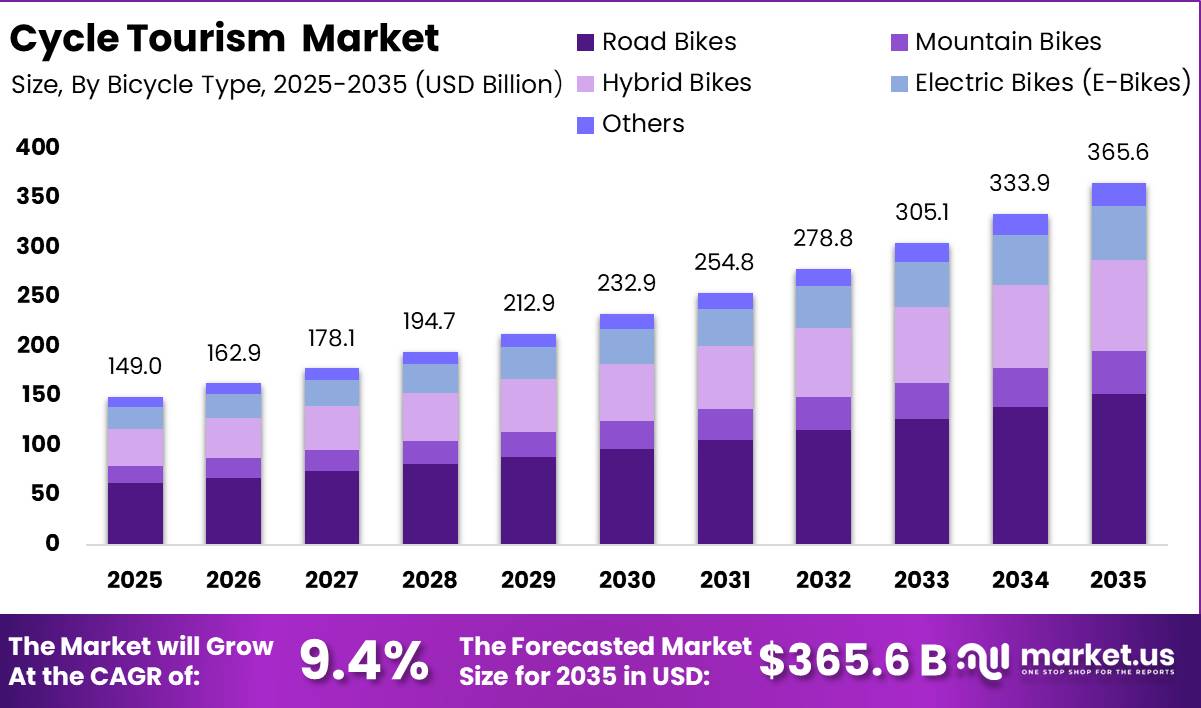
Global Cycle Tourism Market size is expected to be worth around USD 365.6 Billion by 2035 from USD 149.0 Billion in 2025, growing at a CAGR of 9.4% during the forecast period 2026 to 2035.
The cycle tourism market encompasses organized and independent travel experiences where cycling serves as the primary activity. This includes guided and self-guided tours, bicycle rental services, route-based leisure travel, adventure cycling expeditions, and sport or event-centered trips. Operators, destination managers, digital booking platforms, and transport infrastructure providers all form part of this ecosystem. This reflects a broad market structure that connects infrastructure investment directly to traveler spending and destination revenue.
Key Takeaways
- The Global Cycle Tourism Market was valued at USD 149.0 Billion in 2025 and is forecast to reach USD 365.6 Billion by 2035.
- The market is growing at a CAGR of 9.4% during the forecast period 2026 to 2035.
- By Tour Type, Independent/Self-Guided Tours dominate with a 57.80% share in 2025.
- By Bicycle Type, Road Bikes hold the leading position with a 41.60% share in 2025.
- By Booking Mode, Online Booking leads with a 63.40% share in 2025.
- By Tourist Type, Domestic Tourists hold a dominant 68.90% share in 2025.
- By Age Group, the 25–44 Years segment leads with a 46.20% share in 2025.
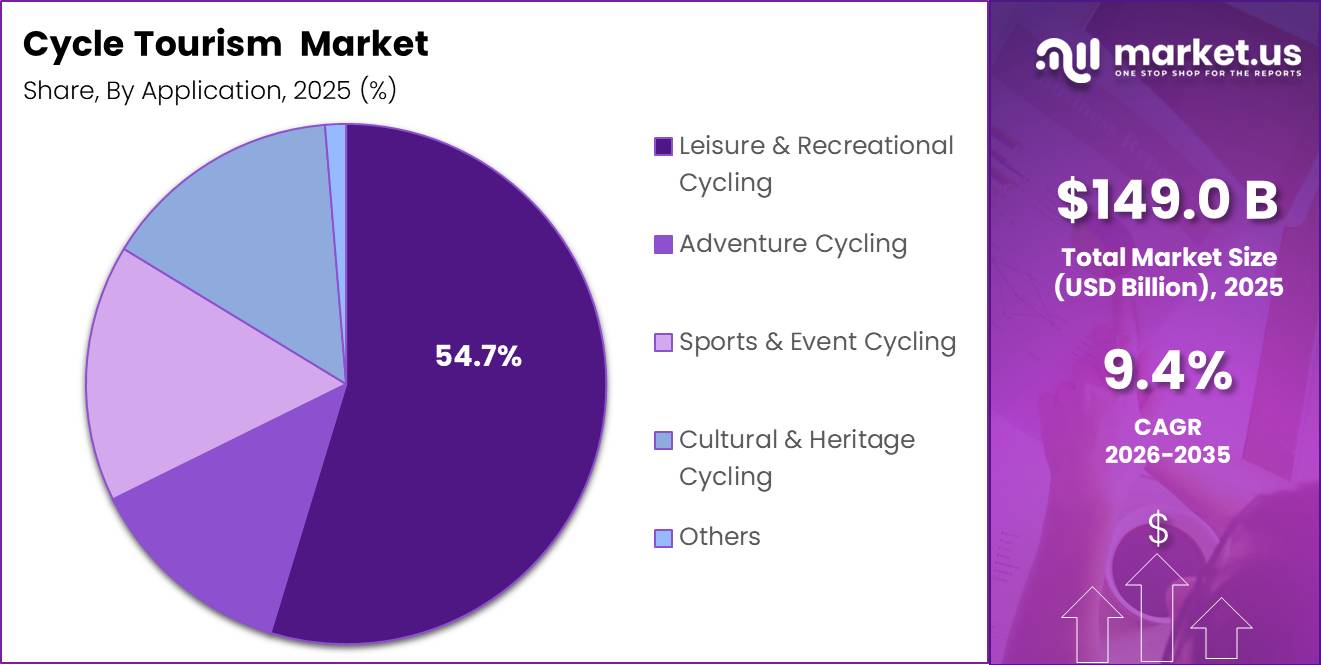
- By Application, Leisure and Recreational Cycling dominates with a 54.70% share in 2025.
- Europe is the dominant region, holding a 49.30% market share valued at USD 73.01 Billion in 2025.
According to the European Cyclists’ Federation (ECF) EuroVelo Usage Barometer 2025, cycling traffic on the EuroVelo network increased by 4.0% in 2025 compared with 2024, tracked across 496 automatic bicycle counters in 20 European countries. This consistent infrastructure-backed measurement signals that cycle tourism demand is not speculative but structurally supported. Investors and destination managers can treat these verified traffic gains as a reliable indicator of forward spending potential.
As reported by the European Cyclists’ Federation (ECF) EuroVelo Usage Barometer 2025, spring cycling volumes on EuroVelo routes rose by 6.7% year-over-year in 2025, representing the strongest seasonal growth period. This seasonal shift reduces dependence on a single peak summer window.
Tour operators who develop spring-season products and regional packages now have a concrete demand signal to justify earlier-season investment. In January 2026, EuroVelo announced its “5 Cycling Tourism Trends in 2026” initiative, identifying multimodal cycling-rail travel and e-bike service adoption as the two most commercially significant trends shaping the European cycle tourism market.
Tour Type Analysis
Independent/Self-Guided Tours dominate with 57.80% due to traveler demand for flexible, self-paced itineraries.
In 2025, Independent/Self-Guided Tours held a dominant market position in the By Tour Type segment of the Cycle Tourism Market, with a 57.80% share. Travelers increasingly choose self-guided formats because they offer full control over pace, route, and accommodation. Summer remained the peak cycle-tourism season in 2025, averaging nearly 395,000 bicycle counts per day across monitored EuroVelo routes, according to the European Cyclists’ Federation (ECF). This volume confirms that self-guided demand is not niche but structurally embedded in the market’s busiest season.
Guided Tours hold the remaining share in the By Tour Type segment. Guided formats appeal to first-time cycle tourists, older travelers seeking support, and group bookings that require logistical coordination. This segment captures higher per-trip revenue than self-guided options, giving operators a clear incentive to invest in premium guided experiences rather than competing on price alone.
Bicycle Type Analysis
Road Bikes dominate with 41.60% due to their established use on paved long-distance touring routes.
In 2025, Road Bikes held a dominant market position in the By Bicycle Type segment of the Cycle Tourism Market, with a 41.60% share. Road bikes suit the established European touring corridor infrastructure where paved, long-distance routes dominate. This positioning locks in road bike demand wherever EuroVelo-style route networks expand. Tour operators and rental providers on these corridors should maintain road bike inventory as their primary revenue asset.
Mountain Bikes capture a material portion of the remaining segment. Demand concentrates in alpine, trail, and off-road destinations where terrain limits road bike use. Adventure-oriented travelers and younger demographics drive this sub-segment, creating a distinct product and pricing tier for destination operators to develop separately from mainstream touring.
Hybrid Bikes serve travelers who require versatility across mixed terrain and urban connections. Their appeal spans age groups and fitness levels, making them a practical fleet choice for rental operators in destinations where routes transition between sealed roads and gravel paths. In 2026, EuroVelo highlighted the growing commercialization of e-bike tourism offerings, with destinations and tour operators launching e-bike rental, charging, and guided-tour services to attract broader traveler demographics.
Electric Bikes (E-Bikes) represent the fastest-shifting sub-segment within the By Bicycle Type category, with Others holding the residual share. E-bike adoption directly expands the accessible traveler base by removing physical barriers related to terrain, distance, and rider fitness. Operators who integrate e-bike fleets now position themselves to capture senior, low-fitness, and casual traveler segments before competitors scale.
Booking Mode Analysis
Online Booking dominates with 63.40% due to traveler preference for direct, self-managed reservations.
In 2025, Online Booking held a dominant market position in the By Booking Mode segment of the Cycle Tourism Market, with a 63.40% share. Digital channels now control the majority of cycle tourism revenue. Operators without optimized direct booking platforms surrender margin to intermediaries. This concentration of online demand rewards early investment in booking technology and direct customer acquisition strategies.
Offline Booking retains the remaining share of the By Booking Mode segment. This channel serves travelers who require personalized consultation, complex multi-leg itinerary planning, or group booking support that digital platforms cannot yet fully replicate. Offline channels generate disproportionately higher-value transactions, making them a margin-protection tool for operators who can staff them efficiently.
Tourist Type Analysis
Domestic Tourists dominate with 68.90% due to proximity, lower cost, and accessible local infrastructure.
In 2025, Domestic Tourists held a dominant market position in the By Tourist Type segment of the Cycle Tourism Market, with a 68.90% share. Local travelers form the structural foundation of cycle tourism demand in nearly every major market. Data from the Adventure Travel Trade Association (reported by Condé Nast Traveler) found that more than half of adventure travel bookings were made by female travelers in 2025. This signals that domestic cycle tourism operators who design products with female traveler preferences in mind will access the majority of the booking base in this segment.
International Tourists hold the remaining share of the By Tourist Type segment. Cross-border cycle tourists typically generate higher per-trip spending on accommodation, guided services, and equipment rental. This spending premium justifies destination-specific marketing investment targeting source markets where outbound cycling travel is culturally embedded, particularly in Northern Europe and North America.
Age Group Analysis
25–44 Years dominate with 46.20% due to high discretionary spending and strong preference for active travel.
In 2025, the 25–44 Years age group held a dominant market position in the By Age Group segment of the Cycle Tourism Market, with a 46.20% share. This cohort drives the highest per-trip spending and highest rebooking rates in active tourism. European Cyclists’ Federation (ECF) analysis in 2026 identified families, city-break travelers, day-trippers, young adventurers, and e-bike users as major expanding consumer segments. Operators who develop product lines targeting these sub-groups within the 25–44 cohort will access the widest available growth pool in this segment.
Below 25 Years, 45–64 Years, and 65 Years and Above collectively hold the remaining share across the By Age Group segment. The 45–64 bracket is particularly significant for premium and guided tour products given higher disposable incomes. The 65 and above segment is the fastest-shifting cohort, driven directly by e-bike adoption that removes physical barriers to long-distance cycling travel.
Application Analysis
Leisure and Recreational Cycling dominates with 54.70% due to its broad appeal across all demographics and fitness levels.
In 2025, Leisure and Recreational Cycling held a dominant market position in the By Application segment of the Cycle Tourism Market, with a 54.70% share. This application category captures the widest possible traveler base. Figures from the European Cyclists’ Federation (ECF) and Eco-Counter show that during the first eight months of 2025, rural EuroVelo counters recorded a 7.2% increase in traffic, compared with 5.8% in urban areas and 3.6% in suburban areas. Rural leisure cycling is outpacing all other location types, signaling a clear geographic shift in where leisure demand concentrates.
Adventure Cycling holds a structurally distinct position within the By Application segment. This sub-category targets physically active travelers seeking challenging terrain, multi-day backcountry routes, and destination experiences not accessible by conventional tourism. Based on European Cyclists’ Federation (ECF) data, rural EuroVelo locations recorded the strongest traffic growth in 2025, outperforming both urban and suburban route segments. This rural growth pattern directly benefits adventure cycling operators whose routes pass through non-urban corridors.
Sports and Event Cycling addresses a high-value niche within the By Application segment. Event-linked travel generates concentrated, predictable demand spikes around races, sportives, and organized charity rides. Destinations that co-locate cycling events with broader tourism infrastructure can extract higher per-visitor revenue during event windows than any other application category.
Key Market Segments
By Tour Type
- Independent/Self-Guided Tours
- Guided Tours
By Bicycle Type
- Road Bikes
- Mountain Bikes
- Hybrid Bikes
- Electric Bikes (E-Bikes)
- Others
By Booking Mode
- Online Booking
- Offline Booking
By Tourist Type
- Domestic Tourists
- International Tourists
By Age Group
- 25–44 Years
- Below 25 Years
- 45–64 Years
- 65 Years and Above
By Application
- Leisure and Recreational Cycling
- Adventure Cycling
- Sports and Event Cycling
- Cultural and Heritage Cycling
Regional Analysis
Europe Dominates the Cycle Tourism Market with a Market Share of 49.30%, Valued at USD 73.01 Billion
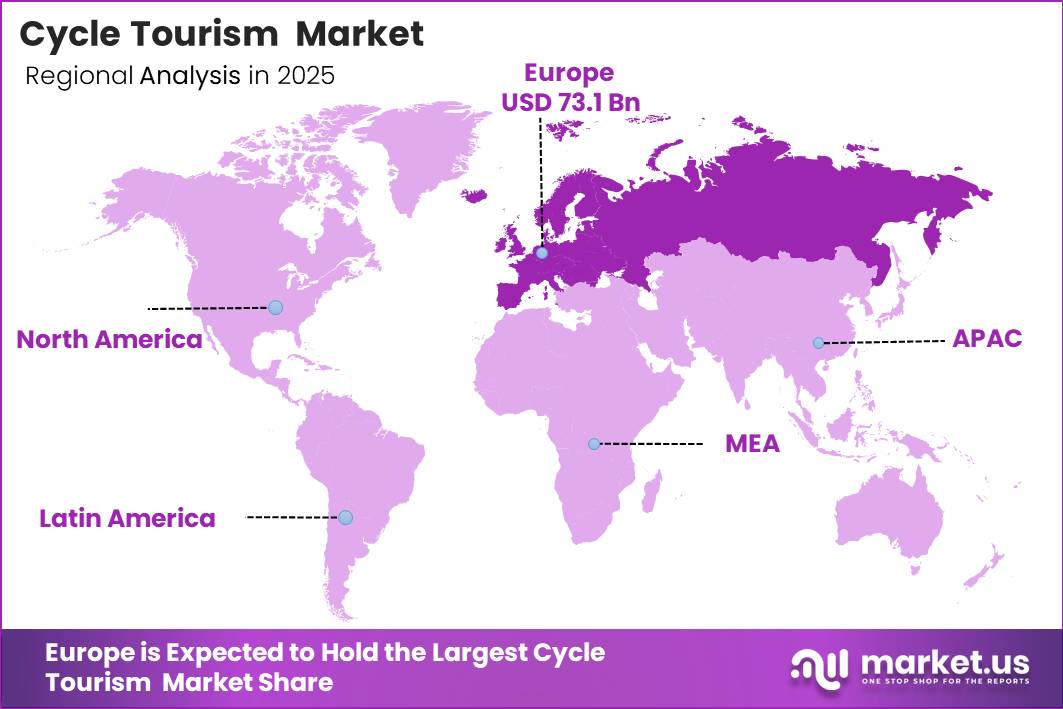
Europe holds the largest share of the global Cycle Tourism Market at 49.30%, valued at USD 73.01 Billion in 2025. The German Cyclists’ Association (ADFC) Bicycle Travel Analysis 2025 recorded 3.3 million cycling holidays of three nights or longer in Germany alone during 2025. This single-country figure illustrates the depth of domestic cycling tourism demand embedded within Europe’s overall regional dominance. In 2025, Sustrans advanced National Cycle Network improvement projects across the United Kingdom, including route upgrades, accessibility enhancements, and safer cycling infrastructure, further reinforcing European supply-side investment.
North America holds the second-largest regional position in the Cycle Tourism Market. Strong outdoor recreation spending, growing bikepacking culture, and established long-distance trail networks such as the TransAmerica Trail underpin regional demand. Higher per-trip spending by North American cycle tourists gives regional operators a structurally higher revenue-per-customer ratio than most other regions.
Asia-Pacific is the highest-growth regional market in cycle tourism. According to European Cyclists’ Federation (ECF) data, more than 166 million Europeans live within 5 kilometers of a EuroVelo route, providing a reference point for the scale of accessible population that dedicated cycling infrastructure can unlock. Asia-Pacific governments investing in comparable route density will replicate this demand activation at a regional scale larger than Europe’s.
Latin America holds an early-stage position in the global Cycle Tourism Market. Brazil and Mexico anchor regional demand through adventure cycling and ecotourism products. Underdeveloped route certification and limited specialized accommodation constrain organized tour growth, but the region’s geography creates a natural product differentiation opportunity for operators willing to invest in infrastructure ahead of mass market entry.
Key Regions and Countries
North America
- US
- Canada
Europe
- Germany
- France
- The UK
- Spain
- Italy
- Rest of Europe
Asia Pacific
- China
- Japan
- South Korea
- India
- Australia
- Rest of APAC
Latin America
- Brazil
- Mexico
- Rest of Latin America
Middle East and Africa
- GCC
- South Africa
- Rest of MEA
Drivers
Ireland allocated 360 million euros in 2026 for active travel and greenway infrastructure, supporting nearly 1,000 projects including 200 km of new walking and cycling routes, with 62 million euros specifically dedicated to long-distance greenways. The European Union’s 2021–2027 Cohesion Policy earmarked 4.5 billion euros for cycling infrastructure across member states. These investments expand connected cycling networks and improve route safety, directly increasing the supply capacity that cycle tourism operators need to scale.
The European Declaration on Cycling, adopted in 2023, commits all 27 EU member states to integrating cycling into national transport and mobility planning. This policy commitment accelerates infrastructure funding cycles and reduces regulatory uncertainty for destination developers. Operators and investors working within the EU can treat this declaration as a durable structural signal, not a short-term policy measure.
| Driver | (~) % Impact on Baseline Growth | Geographic Relevance | Impact Timeline |
|---|---|---|---|
| Public Infrastructure & Greenway Expansion | +2.3% | EU core, Ireland, Benelux, APAC | Short term (≤ 2 years) |
| Health & Preventive Wellness Mainstreaming | +2.0% | North America, Western EU, APAC urban centers | Short term (≤ 2 years) |
| E-Bike Hardware Democratization | +2.6% | EU, China, Southeast Asia, India | Medium term (2–4 years) |
| Silver Economy & Active Ageing Tourism | +1.7% | Southern & Northern EU, Japan, North America | Medium term (2–4 years) |
| Sustainability Mandates & Green Mobility Policy | +1.5% | EU (compliance-driven), UK, Canada, Australia | Medium term (2–4 years) |
| Digital Booking Penetration & Experiential Travel Shift | +1.9% | Global — North America & APAC leading | Long term (≥ 4 years) |
Restraints
Guided cycle tourism packages remain unaffordable across most emerging economies. A 7-day guided tour costs USD 1,200 to USD 1,800 in emerging destinations and USD 3,500 to USD 6,000 in established European and North American markets. Indonesia’s 2025 per capita GDP stands at approximately USD 4,600 and Vietnam’s at approximately USD 4,200, exposing a direct affordability barrier for international-style cycling holidays. Self-guided 5-day trips priced at USD 200 to USD 400 remain the most accessible option in developing markets.
This pricing structure channels demand away from organized guided tours toward lower-cost self-supported formats in price-sensitive markets. Operators targeting emerging market growth cannot apply Western pricing models without destroying addressable market size. Product architects who design tiered entry-level cycling packages at regional price points will unlock participation that premium-priced products cannot reach.
| Restraint | (~) % Negative Impact | Geographic Relevance | Impact Timeline |
|---|---|---|---|
| E-Bike & Component Tariff Escalation | -2.4% | North America core, India, South America | Short term (≤ 2 years) |
| Inadequate Road Safety Infrastructure | -2.0% | South & Southeast Asia, Sub-Saharan Africa, Latin America | Short term (≤ 2 years) |
| Multimodal Rail–Bike Integration Deficit | -1.6% | EU non-core, Eastern Europe, APAC corridors | Medium term (2–4 years) |
| Prohibitive Trip Pricing in Emerging Economies | -1.9% | India, Southeast Asia, Sub-Saharan Africa, Latin America | Medium term (2–4 years) |
| Absence of Cross-Border Quality Certification | -1.3% | APAC, Middle East, Africa, Latin America | Medium term (2–4 years) |
| Destination Awareness & Promotional Investment Gap | -1.5% | Australia, South America, South Asia, East Africa | Long term (≥ 4 years) |
Challenges
Seasonality compresses approximately 60 to 70% of annual cycle tourism demand into a 14 to 18 week peak window. A 2026 European Cyclists’ Federation industry survey found that 46% of European cycle tourism operators identified seasonality as a key operational challenge. High fixed costs persist year-round despite this demand concentration, eroding profitability during off-peak months. Climate change shortens riding seasons in alpine and high-altitude destinations, amplifying pressure on the already compressed peak capacity window.
Ireland’s 2026 allocation of 360 million euros to active travel infrastructure targets year-round route usability improvement across nearly 1,000 projects, including 200 km of new walking and cycling infrastructure. Investments that extend shoulder-season usability create structural relief for operators facing seasonal revenue compression. Destinations that diversify their cycling calendar across spring, autumn, and winter offerings will reduce peak-season dependence faster than those relying on infrastructure investment alone.
| Challenge | (~) % Friction Drag | Geographic Relevance | Mitigation Horizon |
|---|---|---|---|
| Skilled Workforce Deficit & Guide Attrition | -1.8% | EU, North America, India, APAC | Short term (≤ 2 years) |
| Acute Accommodation Gap Along Route Corridors | -2.1% | Southern EU, APAC, Sub-Saharan Africa, India | Medium term (2–4 years) |
| Extreme Weather & Climate Disruption Risk | -1.6% | Alpine EU, Himalayan APAC, Mediterranean | Medium term (2–4 years) |
| Tech Stack Fragmentation & Booking Interoperability | -1.4% | Global — North America & EU worst affected | Medium term (2–4 years) |
| Seasonal Revenue Compression & Demand Concentration | -1.9% | Northern & Central EU, North America, Himalayan corridors | Long term (≥ 4 years) |
| Route Carrying Capacity & Overtourism Degradation | -1.3% | Western EU hotspots, coastal & heritage routes | Long term (≥ 4 years) |
Opportunities
E-bike prices falling into the USD 800 to USD 1,500 range are making cycle tourism accessible across emerging markets. Countries including India, Vietnam, Indonesia, and Brazil are becoming viable cycle tourism destinations as e-bike affordability reduces terrain, climate, and fitness barriers. India’s cycle tourism sector is expanding at approximately 13.0% annually, with the 18–30-year-old segment growing at around 13.3% per year. Supporting infrastructure including certified routes, battery-swapping networks, and specialized insurance remains underdeveloped, creating a first-mover structural gap.
Southeast Asia is strengthening its cycling ecosystem through dedicated national cycling route investments. Adventure destinations such as Rwanda’s Virunga Massif and Ethiopia’s Simien Mountains remain untapped for commercial cycle tourism. An asset-light franchise or licensing model that provides local operators with standardized routes, booking platforms, and safety protocols offers a scalable expansion path that avoids the capital constraints of traditional tourism development.
| Opportunity | (~) % Potential Incremental Upside (Annual) | Geographic Relevance | Execution Window |
|---|---|---|---|
| Corporate Wellness B2B Cycle Retreat Integration | +1.8% | North America core, EU (DACH, Nordics), India | Short term (≤ 2 years) |
| Premium & Luxury Cycle Tourism Tier Monetization | +2.2% | Western Europe, North America, APAC (Japan, Australia) | Short term (≤ 2 years) |
| Voluntary Carbon Credit & ESG Monetization | +1.4% | EU (compliance-sensitive markets), UK, North America | Medium term (2–4 years) |
| E-Bike Tourism Expansion into Emerging Markets | +2.8% | South & Southeast Asia, Latin America, Sub-Saharan Africa | Medium term (2–4 years) |
| AI-Powered Data Monetization & SaaS Route Platform | +1.6% | Global (North America & EU first movers) | Medium term (2–4 years) |
| M&A Roll-Up of Fragmented Niche Operators | +2.4% | EU, North America, India | Long term (≥ 4 years) |
Key Company Insights
Butterfield and Robinson operates in the premium and luxury cycle tourism tier, delivering high-margin guided tours across Europe and beyond. Their positioning targets high-net-worth travelers who prioritize curated experience over price. This premium focus insulates them from low-cost competition but creates vulnerability if luxury travel spending contracts. Their product depth in Europe aligns directly with the continent’s dominant 49.30% market share position.
Backroads competes in the active travel segment with a broad tour portfolio spanning cycling, walking, and multi-sport experiences across global destinations. Their multi-activity model diversifies seasonal and geographic revenue risk. In 2025, Exodus Adventure Travels expanded its cycling holiday offerings and e-bike-supported departures across multiple European destinations, signaling that the premium active travel space is intensifying. Backroads must accelerate e-bike product integration to defend its position against operators who are already scaling e-bike capacity.
Key Players
- Butterfield and Robinson
- Backroads
- Trek Travel
- Exodus Travels
- Intrepid Travel
- G Adventures
- Cycling Holidays
- Eurobike
- ExperiencePlus! Bicycle Tours
- VBT Bicycling Vacations
- BikeTours.com
- Saddle Skedaddle
- Austin Adventures
- KE Adventure Travel
- UTracks
Recent Developments
- 2025 – European rail operators expanded bicycle carriage services and bike-friendly travel programs in cooperation with cycling tourism stakeholders, strengthening the rail-and-bike tourism model identified by EuroVelo as a key market trend.
- April 2026 – The European Cyclists’ Federation (ECF) reported that cycling on the EuroVelo network grew by 4.0% in 2025, supported by continued expansion of route infrastructure and monitoring systems across Europe, strengthening the cycle tourism ecosystem.
- November 2025 – EuroVelo confirmed that its network had expanded by approximately 11,600 km since 2021, representing one of the largest recent infrastructure developments supporting long-distance cycle tourism in Europe.
Report Scope
| Report Features | Description |
|---|---|
| Market Value (2025) | USD 149.0 Billion |
| Forecast Revenue (2035) | USD 365.6 Billion |
| CAGR (2026-2035) | 9.4% |
| Base Year for Estimation | 2025 |
| Historic Period | 2020-2024 |
| Forecast Period | 2026-2035 |
| Report Coverage | Revenue Forecast, Market Dynamics, Market Opportunity Analysis, Technology and Innovation Landscape, Competitive Landscape, Recent Developments |
| Segments Covered | By Tour Type (Independent/Self-Guided Tours, Guided Tours), By Bicycle Type (Road Bikes, Mountain Bikes, Hybrid Bikes, Electric Bikes/E-Bikes, Others), By Booking Mode (Online Booking, Offline Booking), By Tourist Type (Domestic Tourists, International Tourists), By Age Group (25–44 Years, Below 25 Years, 45–64 Years, 65 Years and Above), By Application (Leisure and Recreational Cycling, Adventure Cycling, Sports and Event Cycling, Cultural and Heritage Cycling) |
| Regional Analysis | North America (US and Canada), Europe (Germany, France, The UK, Spain, Italy, and Rest of Europe), Asia Pacific (China, Japan, South Korea, India, Australia, and Rest of APAC), Latin America (Brazil, Mexico, and Rest of Latin America), Middle East and Africa (GCC, South Africa, and Rest of MEA) |
| Competitive Landscape | Butterfield and Robinson, Backroads, Trek Travel, Exodus Travels, Intrepid Travel, G Adventures, Cycling Holidays, Eurobike, ExperiencePlus! Bicycle Tours, VBT Bicycling Vacations, BikeTours.com, Saddle Skedaddle, Austin Adventures, KE Adventure Travel, UTracks |
| Customization Scope | Customization for segments, region/country-level will be provided. Additional customization can be done based on requirements. |
| Purchase Options | We have three licenses to opt for: Single User License, Multi-User License (Up to 5 Users), Corporate Use License (Unlimited User and Printable PDF) |





































