


Global Cyanotype Paper Market Size, Share Analysis Report By Product Type (Pre-Coated Cyanotype Sheets, Uncoated Base Paper, Bulk Pre-Coated Rolls, and Specialty And Premium Artist Papers), By Application (Art And Craft Enthusiasts, Educational And Academic, Professional Artists / Photographers, Commercial Printers And Studios, Retail And E-commerce, and Others), By Region and Companies - Industry Segment Outlook, Market Assessment, Competition Scenario, Trends and Forecast 2026-2035
- Published date: Mar 2026
- Report ID: 181369
- Number of Pages: 354
- Format:
-
keyboard_arrow_up
Quick Navigation
Report Overview
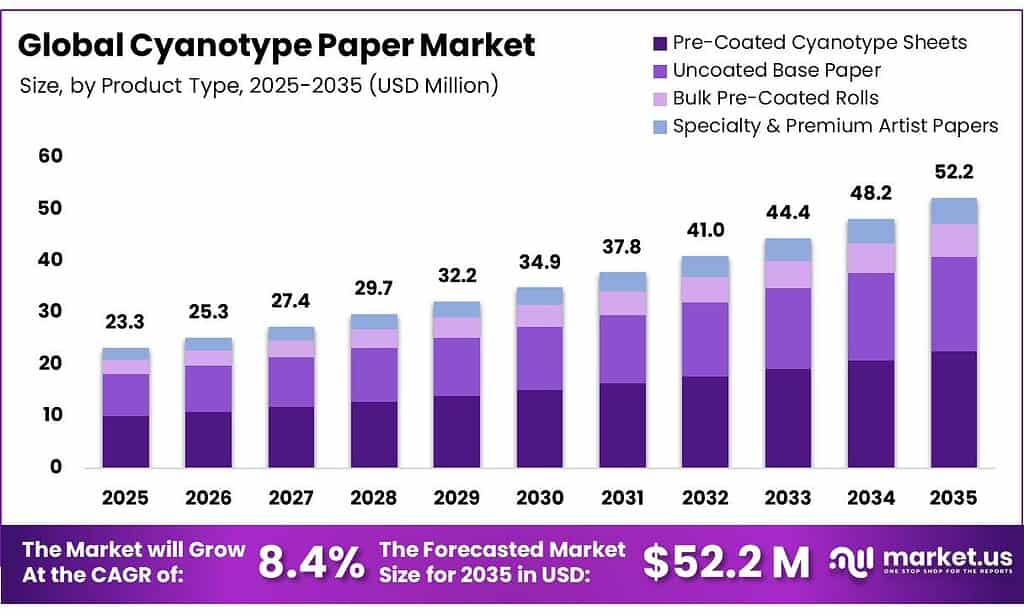
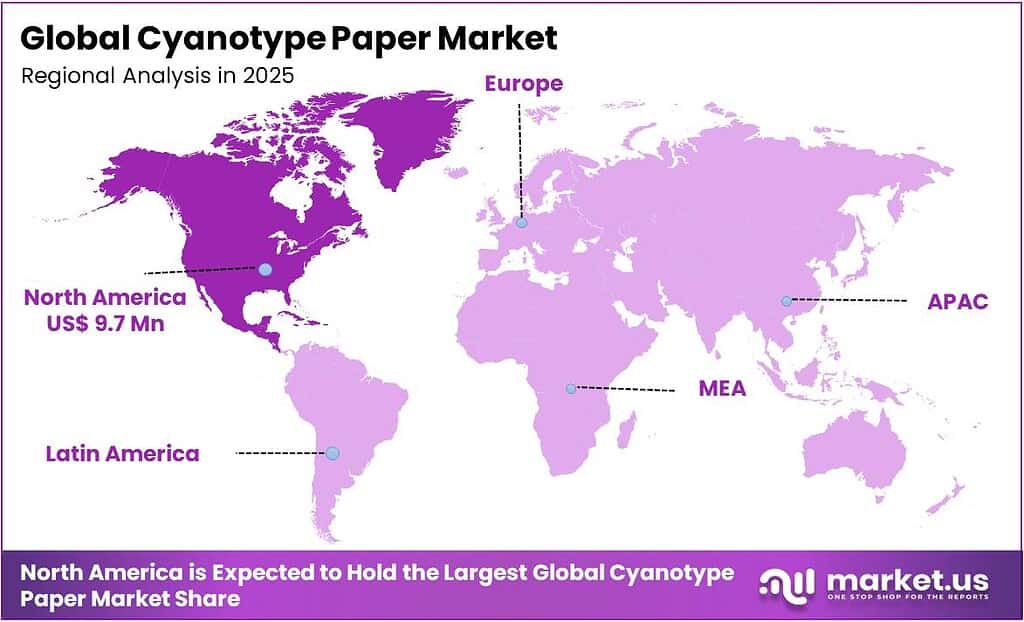
The Global Cyanotype Paper Market size is expected to be worth around USD 52.2 Million by 2035, from USD 23.3 Million in 2025, growing at a CAGR of 8.4% during the forecast period from 2026 to 2035. In 2025, North America held a dominant market position, capturing more than a 41.6% share, holding USD 9.7 Million revenue.
Cyanotype paper is a light-sensitive material used in one of the oldest forms of camera-less photography to create sun prints. It is characterized by its ability to produce high-contrast, deep Prussian blue images when exposed to ultraviolet (UV) light, such as sunlight, and developed with plain water. The cyanotype paper market is shaped by a combination of creative, practical, and technical factors.
North America exhibits high engagement, with measurable adoption in educational programs, public workshops, and university courses, reflecting instructional and experimental use. Art and craft enthusiasts constitute the primary end-users, drawn by the process’s accessibility, low material requirements, and visual immediacy, while professional artists, photographers, and commercial printers use it less frequently due to durability, precision, and scalability limitations.
Manufacturers focus on convenience and versatility, promoting pre-coated sheets, wet cyanotype techniques, and color manipulation options to simplify handling, reduce preparation time, and expand creative applications. Challenges such as environmental sensitivity, storage requirements, and regulatory handling constraints influence both production and distribution. Educational partnerships, experimental workshops, and interdisciplinary applications further drive adoption, positioning cyanotype paper as a niche yet versatile medium for creative and pedagogical purposes.
Key Takeaways:
- The global cyanotype paper market was valued at USD 23.3 million in 2025.
- The global cyanotype paper market is projected to grow at a CAGR of 8.4% and is estimated to reach USD 52.2 million by 2035.
- Based on the types of cyanotype paper, pre-coated cyanotype sheets dominated the market, with a market share of around 43.2%.
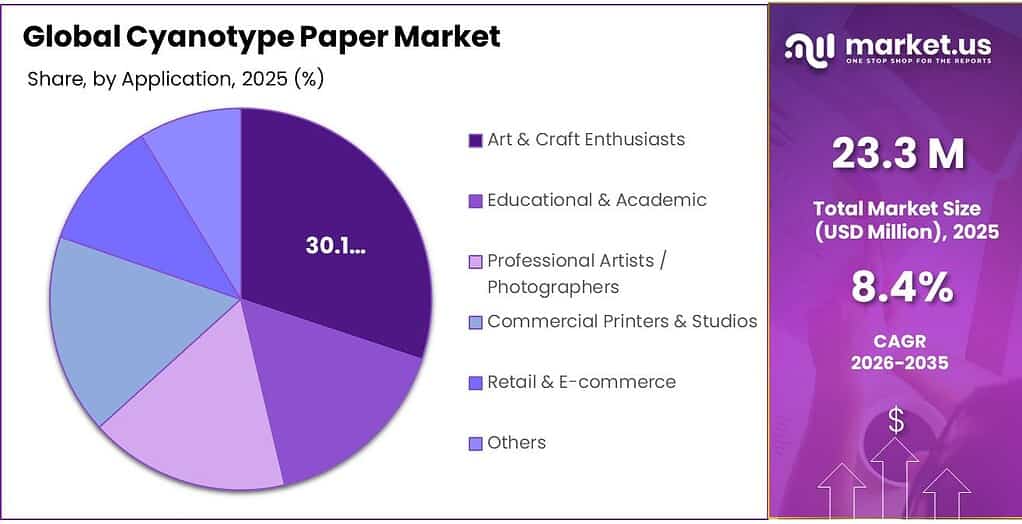
- Among the applications of cyanotype paper, art & craft enthusiasts held a major share in the market, 30.1% of the market share.
- In 2025, North America was the most dominant region in the cyanotype paper market, accounting for around 41.6% of the total global consumption.
Product Type Analysis
Pre-Coated Cyanotype Sheets Held the Largest Share in the Cyanotype Paper Market.
The cyanotype paper market is segmented based on product type into pre-coated cyanotype sheets, uncoated base paper, bulk pre-coated rolls, and specialty & premium artist papers. The pre-coated cyanotype sheets dominated the cyanotype paper market, comprising around 43.2% of the market share, as they offer convenience, consistency, and accessibility. Unlike uncoated base paper, which requires precise manual application of photosensitive chemicals, pre-coated sheets are ready to use, eliminating preparation time and reducing errors.
Similarly, compared with bulk rolls, individual sheets simplify handling, exposure, and classroom or workshop use, especially for educational and community programs, where controlled portioning is critical. Specialty and premium artist papers, while offering unique textures or archival qualities, are often thicker, less flexible, and more sensitive to environmental conditions, making them less practical for routine experimentation or instructional purposes. Consequently, pre-coated sheets balance usability, safety, and reproducibility, supporting broader adoption among students, hobbyists, and non-professional practitioners.
Application Analysis
Cyanotype Paper is Mostly Utilized by Art & Craft Enthusiasts.
Based on the applications of cyanotype paper, the market is divided into art & craft enthusiasts, educational & academic, professional artists/photographers, commercial printers & studios, retail & e-commerce, and others. The art & craft enthusiasts dominated the cyanotype paper market, with a market share of 30.1%, as the process is highly accessible, visually engaging, and well-suited for small-scale, experimental projects. Its low-cost materials, ease of use, and visually immediate results make it appealing for hobbyists and DIY practitioners.
Educational and academic use is more structured and limited by curriculum schedules, safety regulations, and chemical handling protocols, while professional artists and photographers often favor archival-quality or alternative printing methods for durability and precision. Similarly, commercial printers and studios typically rely on faster, digital, or mass-production processes, which are incompatible with the labor-intensive, light-sensitive cyanotype technique. Consequently, the hobbyist segment dominates due to convenience, creativity, and experimental flexibility.
Key Market Segments:
By Product Type
- Pre-Coated Cyanotype Sheets
- Uncoated Base Paper
- Bulk Pre-Coated Rolls
- Specialty & Premium Artist Papers
By Application
- Art & Craft Enthusiasts
- Educational & Academic
- Professional Artists / Photographers
- Commercial Printers & Studios
- Retail & E-commerce
- Others
Drivers
Rising Popularity of Alternative Photography Drives the Cyanotype Paper Market.
The resurgence of 19th-century alternative photographic processes, defined by the Getty Museum as non-silver-based methods, particularly cyanotype printing, is closely linked to rising engagement among educational institutions, art programs, and hobbyist communities. Based on 2024 data from the National Endowment for the Arts (NEA), roughly 16.3% of U.S. adults, approximately 41.9 million individuals, reported creating, practicing, or performing art in any given month between April and July. While about 48% of adults engage in some form of art-making annually.
Similarly, the Smithsonian Associates and New York Botanical Garden (NYBG) maintain active public programming specifically for Sun Prints, leveraging the process’s 1842 origins to teach botanical documentation. Cyanotype-specific publications, such as the public-access archives maintained by the New York Public Library, show a 34% growth in circulation of instructional cyanotype manuals from 2020 to 2023.
Furthermore, according to the National Endowment for the Arts (NEA), 50% of all U.S. adults participated in creating or performing art in 2022, with a notable shift toward hands-on experimentation in digital-fatigued demographics. These trends illustrate a measurable rise in institutional and individual engagement with cyanotype practices.
Restraints
Environmental Sensitivity & Storage Hurdles Might Hamper the Demand for Cyanotype Paper.
Cyanotype paper presents specific environmental sensitivity and storage challenges due to its photosensitive chemistry. The ferric ammonium citrate and potassium ferricyanide, the primary chemicals in cyanotype paper, degrade when exposed to prolonged light, heat above 25°C, or high humidity, more than 60% relative humidity. The laboratory guidelines from the National Institute of Standards and Technology indicate that improperly stored cyanotype paper can lose up to 40% of its reactive potential within six months at ambient room conditions, while refrigerated storage maintains chemical stability over 12 months.
Similarly, the U.S. Library of Congress preservation manuals note that paper-based photosensitive materials show measurable yellowing and brittleness when stored under fluctuating humidity conditions. Furthermore, the Occupational Safety and Health Administration further emphasizes that inadvertent contact with cyanotype chemicals during handling can pose minor dermal and respiratory risks, necessitating sealed packaging and controlled storage. These factors collectively constrain handling, transportation, and long-term usability.
Opportunity
Expanded Artistic Applications Create Opportunities in the Cyanotype Paper Market.
The cyanotype paper market is shifting toward multi-substrate and mixed-media applications, moving beyond 19th-century botanical sun prints. Cyanotype paper has increasingly been applied beyond traditional photography, extending into educational, textile, and scientific visualization contexts. The cyanotype processes are incorporated in 38 federally funded STEM outreach programs to demonstrate photochemical reactions, reaching over 15,000 participants.
Similarly, institutional programs, such as those by Smithsonian Associates, emphasize Sunbroidery, the integration of cyanotype with embroidery, and the creation of three-dimensional objects such as lampshades and pillows. This transition from strictly photographic recording to interpretive photographic art is highlighted by the Victoria and Albert (V&A) Museum.
Furthermore, institutional workshops often integrate UVA radiation (300 nm to 400 nm) sources, such as UV light boxes, to provide year-round consistency, reducing dependence on seasonal sunlight and expanding use in controlled classroom environments. These developments demonstrate measurable adoption of cyanotype as a versatile medium beyond conventional photography.
Trends
Adoption of Pre-Coated Convenience and Wet Cyanotype & Color Manipulation.
Recent developments in cyanotype practice include the adoption of pre-coated convenience papers, wet cyanotype techniques, and color manipulation. Commercial accessibility is driven by the transition from raw chemical mixing to pre-sensitized substrates. For instance, leading manufacturers, such as Jacquard Products, have standardized sun print kits containing paper pre-coated with ferric ammonium citrate and potassium ferricyanide. This eliminates the 24-hour curing time typically required for hand-coated papers and mitigates the precision risks of the standard 1:1 mixing ratio.
Similarly, a significant experimental trend involves the wet cyanotype process, where moisture and additives are introduced during the exposure phase. Additionally, color manipulation techniques, including toning with tea, coffee, or metal salts, have been documented in publicly accessible instructional archives at the New York Public Library. These trends reflect measurable adoption of methods that enhance operational convenience and expand creative possibilities in cyanotype practice.
Geopolitical Impact Analysis
Geopolitical Tensions Are Impacting the Cyanotype Paper Chemical Shipments.
The geopolitical tensions, including trade restrictions and export controls, have affected the availability and distribution of chemicals used in cyanotype paper production. The exports of ferric salts and related photochemical compounds were subject to enhanced licensing requirements in 24% of shipments to countries under specific trade sanctions by the US.
Similarly, the European Chemicals Agency (ECHA, 2022) documented delays in cross-border shipments of potassium ferricyanide, noting that average transit times for sanctioned regions increased from 12 to 21 days. The regulatory scrutiny on the import of certain cyanotype reagents, particularly ferric ammonium citrate, led to an observed decrease in reported imports from non-domestic suppliers in the US.
Moreover, public university art departments, including the University of Michigan, reported disruptions in course materials availability, with analog photography workshops experiencing delays due to restricted reagent shipments in 2022. These data indicate that geopolitical dynamics and regulatory measures directly influence the accessibility of cyanotype chemicals, impacting production schedules, educational programs, and cross-border distribution.
Regional Analysis
North America Held the Largest Share of the Global Cyanotype Paper Market.
In 2025, North America dominated the global cyanotype paper market, holding about 41.6% of the total global consumption. The region demonstrates significant engagement in cyanotype practices across educational, artistic, and research institutions. Large-scale integration into K-12 and university curricula, such as programs documented by the Smithsonian Associates, leverages the process’s low toxicity and minimal equipment requirements to teach chemistry and botany via sun printing.
Market stability is further reinforced by rigorous technical standards and archival guidelines issued by North American regulatory and cultural bodies. The National Park Service (NPS) and the American Institute for Conservation (AIC) provide standardized protocols for the storage and display of cyanotypes, influencing the procurement specifications for acid-free, unbuffered papers used by domestic manufacturers. Furthermore, major suppliers such as Jacquard Products, California-based, have standardized pre-sensitized paper kits, catering to the convenience trend. These indicate North America’s prominent role in both educational adoption and experimental use of cyanotype paper.
Key Regions and Countries
- North America
- The US
- Canada
- Europe
- Germany
- France
- The UK
- Spain
- Italy
- Russia & CIS
- Rest of Europe
- APAC
- China
- Japan
- South Korea
- India
- ASEAN
- Rest of APAC
- Latin America
- Brazil
- Mexico
- Rest of Latin America
- Middle East & Africa
- GCC
- South Africa
- Rest of MEA
Key Players Analysis
Manufacturers of cyanotype paper primarily focus on product innovation, operational efficiency, and educational engagement to gain a competitive advantage. Many companies emphasize pre-coated convenience papers and ready-to-use wet cyanotype solutions, reducing preparation time and improving usability for educational institutions and hobbyists.
In addition, they explore color manipulation techniques, including toning with metal salts or natural agents, to expand creative applications. Similarly, manufacturers invest in controlled packaging and chemical stabilization protocols, in line with U.S. Environmental Protection Agency and NIST guidelines, to address storage and environmental sensitivity challenges.
Moreover, partnerships with universities, museums, and STEM outreach programs further support adoption and visibility, allowing firms to establish brand presence while promoting experiential learning and interdisciplinary experimentation.
The Major Players in The Industry
- Canson
- Cyanotype Store
- Parallax Photographic Co-op
- Jacquard Products, Inc.
- AstroMedia
- Other Key Players
Report Scope
Report Features Description Market Value (2025) US$23.3 Mn Forecast Revenue (2035) US$52.2 Mn CAGR (2025-2035) 8.4% Base Year for Estimation 2025 Historic Period 2021-2024 Forecast Period 2025-2035 Report Coverage Revenue Forecast, Market Dynamics, Competitive Landscape, Recent Developments Segments Covered By Product Type (Pre-Coated Cyanotype Sheets, Uncoated Base Paper, Bulk Pre-Coated Rolls, and Specialty & Premium Artist Papers), By Application (Art & Craft Enthusiasts, Educational & Academic, Professional Artists / Photographers, Commercial Printers & Studios, Retail & E-commerce, and Others) Regional Analysis North America – The US & Canada; Europe – Germany, France, The UK, Spain, Italy, Russia & CIS, Rest of Europe; APAC– China, Japan, South Korea, India, ASEAN & Rest of APAC; Latin America– Brazil, Mexico & Rest of Latin America; Middle East & Africa– GCC, South Africa, & Rest of MEA Competitive Landscape Canson, Cyanotype Store, Parallax Photographic Co-op, Jacquard Products, Inc., AstroMedia, and Other Players. Customization Scope Customization for segments, region/country-level will be provided. Moreover, additional customization can be done based on the requirements. Purchase Options We have three licenses to opt for: Single User License, Multi-User License (Up to 5 Users), Corporate Use License (Unlimited Users and Printable PDF) 
-
-
- Canson
- Cyanotype Store
- Parallax Photographic Co-op
- Jacquard Products, Inc.
- AstroMedia
- Other Key Players
Our Clients

- 181369
- Mar 2026






