


Report Overview
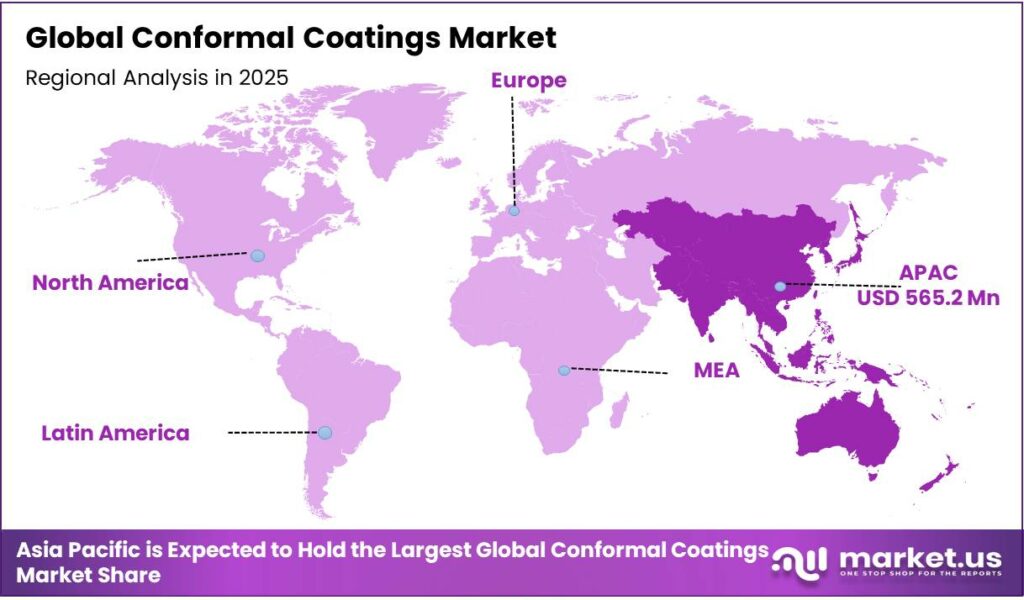
The Global Conformal Coatings Market size is expected to be worth around USD 2.4 Billion by 2035, from USD 1.3 Billion in 2025, growing at a CAGR of 6.3% during the forecast period from 2026 to 2035. In 2025, Asia-Pacific held a dominant market position, capturing more than a 44.7% share, holding USD 565.2 Million revenue.
Conformal coatings are thin, protective polymeric films applied to printed circuit boards (PCBs) and electronic assemblies to shield them from environmental stress. They conform to the irregular landscape of the board and its components, typically maintaining a thickness between 25 and 250 μm. The market is driven by the increasing demand for protective solutions in electronic devices, particularly within the consumer electronics sector.
- According to the Semiconductor Industry Association (SIA), the global semiconductor sales reached US$627.6 billion in 2024, an increase of 19.1% compared to 2023. The proliferation of electronic devices is a critical factor driving the growth of the conformal coatings market.
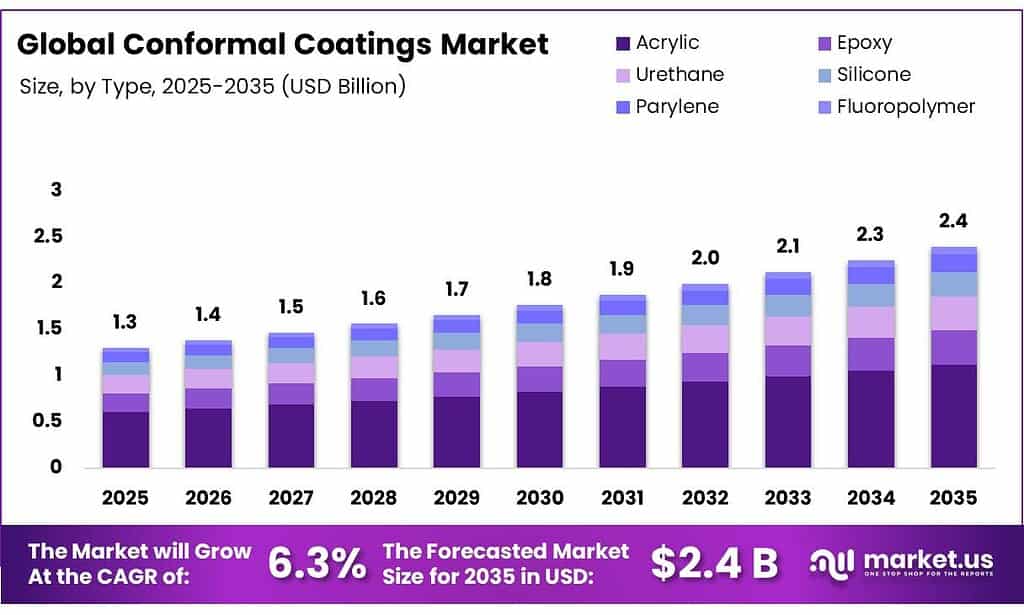
The largest market for conformal coatings is the Asia Pacific, which is a global hub for electronics manufacturing, especially in countries such as China, Japan, and South Korea. Acrylic coatings dominate due to their ease of application, cost-effectiveness, and reliability. Solvent-based coatings are preferred for their superior durability and faster drying times, though water-based and UV-cured alternatives are gaining traction due to environmental concerns.
- In January 2025, the U.S. Environmental Protection Agency established an aerosol category for electrical, electronic and conformal coatings with a reactivity limit of 2.00 grams of ozone per gram of VOC. EPA guidance also recognises waterborne, high-solids and UV-cured coatings as lower-emission alternatives.
While the consumer electronics sector remains the primary end-user, opportunities are emerging in automotive and defense applications, where higher-performance coatings are needed. Moreover, the geopolitical tensions and regulatory pressures around environmental impact are creating both challenges and opportunities for manufacturers in the industry.
Key Takeaways
- The global conformal coatings market was valued at USD 1.3 billion in 2025.
- The global market is projected to grow at a CAGR of 6.3% and is estimated to reach USD 2.4 billion by 2035.
- On the basis of types, acrylic conformal coatings dominated the market, constituting 46.8% of the total market share.
- Based on the technology, solvent-based conformal coatings dominated the market, with a market share of around 57.5%.
- Based on the application method, spraying of conformal coatings led the market, comprising 54.2% of the total market.
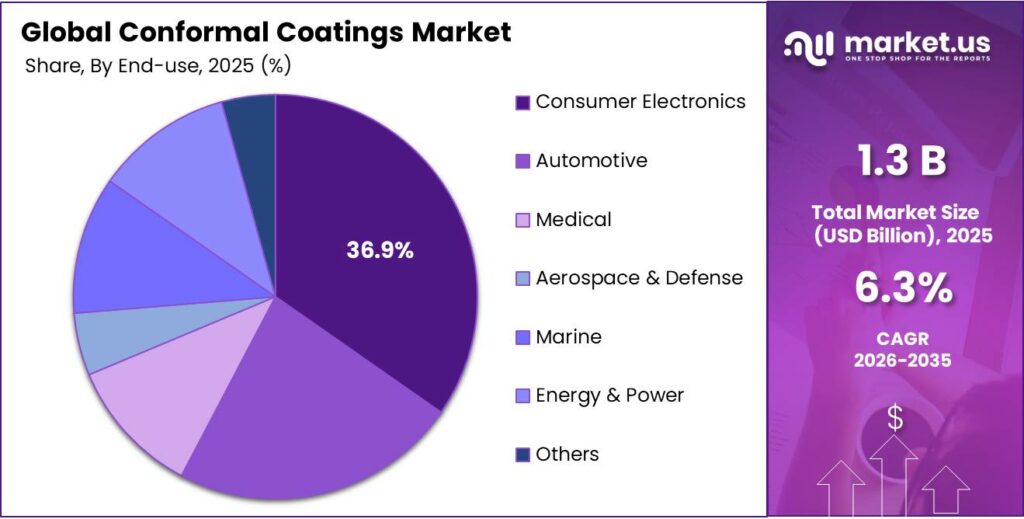
- Among the end-uses, the consumer electronics sector held a major share in the conformal coatings market, 36.9% of the market share.
- In 2025, the Asia-Pacific was the most dominant region in the conformal coatings market, accounting for 44.7% of the total global consumption.
Type Analysis
Acrylic Conformal Coatings are a Prominent Segment in the Market.
The conformal coatings market is segmented based on pump type into acrylic, epoxy, urethane, silicone, parylene, and fluoropolymer. The acrylic conformal coatings led the market, comprising 46.8% of the market share, due to their balance of performance, ease of application, and cost-effectiveness. Acrylics offer excellent protection against moisture, dust, and chemicals while maintaining good flexibility and electrical properties. They are easily applied via spray, dip, or brush techniques, reducing processing time and costs.
Additionally, acrylic coatings are fast-drying and reworkable, allowing for repairs without damaging the underlying circuitry. While other coatings, such as urethane and silicone, offer superior environmental resistance or flexibility, acrylics often provide a better combination of properties for general electronic applications, especially in consumer electronics. Furthermore, their low viscosity makes them easier to handle, and their transparent nature allows for visual inspection of the coated components.
Technology Analysis
Solvent-based Conformal Coatings Dominated the Market.
On the basis of the technology, the conformal coatings market is segmented into solvent-based, water-based, and UV-cured. The solvent-based conformal coatings dominated the market, comprising 57.5% of the market share, primarily due to their superior performance characteristics and ease of application. These coatings offer excellent moisture, chemical, and temperature resistance, making them ideal for a wide range of electronic applications, particularly in harsh environments. The fast-drying properties of solvent-based coatings make them more efficient in high-volume production settings.
Additionally, solvent-based coatings tend to have better penetration and coverage, ensuring consistent protection over complex geometries. While water-based coatings are more environmentally friendly, and UV-cured coatings offer faster curing times, solvent-based formulations remain preferred due to their reliability, established application processes, and extensive track record across various industries.
Application Method Analysis
Spraying of Conformal Coatings Accounted for Most Shares in the Market.
Based on the application method, the conformal coatings market is divided into brush, spray, dipping, and selective coating. Spraying of conformal coatings dominated the market, with a notable market share of 54.2%, due to its efficiency, uniform coverage, and versatility. This technique allows for rapid application over large surface areas, ensuring even coating across complex or densely populated circuit boards without the need for excessive manual labor. Spraying offers better control over coating thickness, reducing the risk of excess material that could affect performance or functionality.
Compared to brushing, spraying avoids brush marks and the inconsistent application that may occur with manual methods. While dipping and selective coating can be effective in certain cases, spraying remains the preferred choice for its speed, precise application, and ability to minimize material waste. It is especially useful in high-volume manufacturing, where time efficiency and consistent quality are critical.
End-Use Analysis
Consumer Electronics Industry Held a Major Share of the Conformal Coatings Market.
Among the end-uses, 36.9% of the total global consumption of conformal coatings is for the consumer electronics industry, as these products often require cost-effective, reliable, and easy-to-apply solutions for protecting delicate electronic components. Consumer electronics, such as smartphones, laptops, and wearables, typically face less extreme environmental conditions compared to sectors such as aerospace, automotive, or medical.
Consequently, the coatings needed for these devices prioritize basic moisture and dust protection rather than advanced durability features. Additionally, the high-volume production and shorter product lifecycles in consumer electronics make conformal coatings a practical solution for cost-effective manufacturing. Other industries, such as automotive and aerospace, require specialized coatings with enhanced chemical resistance, flexibility, and performance under extreme conditions, limiting the broader use of standard conformal coatings.
Key Market Segments
By Type
- Acrylic
- Epoxy
- Urethane
- Silicone
- Parylene
- Fluoropolymer
By Technology
- Solvent-based
- Water-based
- UV Cured
By Application Method
- Brush
- Spray
- Dipping
- Selective Coating
By End-Use
- Consumer Electronics
- Automotive
- Medical
- Aerospace & Defense
- Marine
- Energy & Power
- Others
Drivers
Expansion of conformal coating services and automation
In parallel, the spread of IPC‑CC‑830-qualified materials and detailed process guidelines from IPC and UL enable automation vendors to standardize recipes, making it easier to replicate performance across sites and customers.
Strategically, this shifts the business model from strictly material sales to a mix of materials and services, with recurring revenue streams from coating contracts and potential for subscription-like arrangements around process monitoring and quality assurance; as more EMS providers and OEMs plug into these service networks, latent demand especially from mid-tier and regional manufacturers is unlocked, adding roughly 0.9 percentage points of CAGR above baseline material-only growth as process capacity and quality improvements reduce perceived risk and total cost of ownership of conformal coating adoption.
Drivers Impact Analysis
| Driver | (~) % Impact on CAGR | Geographic Relevance | Impact Timeline |
|---|---|---|---|
| Automotive electronics and EV reliability needs drive coating intensity | +2.0% | North America core, EU, China, APAC corridors | Long term (≥ 4 years) |
| IPC-CC-830 and IPC-A-610 standardization embeds coatings in PCB design | +1.6% | Global electronics hubs; EU, U.S., East Asia | Medium term (2-4 years) |
| Miniaturization and high-density PCBs increase protection requirements | +1.4% | Consumer electronics, telecom, data centers | Long term (≥ 4 years) |
| Harsh-environment aerospace, defense, and industrial controls adoption | +1.2% | North America, EU, select APAC, Middle East | Medium term (2-4 years) |
| Transition to low-VOC, UL-compliant chemistries | +1.0% | EU regulatory hubs, U.S., developed APAC | Medium term (2-4 years) |
| Expansion of conformal coating services and automation | +0.9% | Global EMS/ODM bases; Mexico, ASEAN, CEE | Short term (≤ 2 years) |
Restraints
Raw material and solvent cost inflation
Technical guidance from UL and IPC notes that acrylics and silicones dominate many applications, with typical dry-film thicknesses in the 30–130 µm range for acrylics and 50–210 µm for silicones, meaning each PCB consumes measurable volumes of resin and solvent; as crude oil and feedstock prices swing, so do monomer and solvent costs, and EU-focused chemical procurement analysis in 2026 emphasizes that regulatory, sustainability, and logistics costs add structural upward pressure on chemical prices, particularly in Europe where energy and transport remain expensive.
At the same time, inflation in packaging, transport, and labour as documented in broader manufacturing outlooks raises the fully loaded cost of coating operations, while OEMs and EMS customers, especially in consumer electronics, insist on tight BOM cost control and resist frequent price increases, forcing suppliers to absorb some of the cost shocks.
Strategically, this cost squeeze reduces the willingness of EMS firms to expand coating to additional SKUs or to upgrade to higher-performance chemistries when those carry price premia, and it slows material-switch decisions toward safer but initially more expensive low‑VOC or silicone systems; the result is an effective reduction in the market’s growth trajectory as margin constraints discourage aggressive adoption despite clear reliability benefits.
Restraint Impact Analysis
| Restraint | (~) % Impact on CAGR | Geographic Relevance | Impact Timeline |
|---|---|---|---|
| Raw material and solvent cost inflation | -1.2% | EU, North America, APAC electronics hubs | Medium term (2-4 years) |
| VOC, REACH and UL compliance complexity | -1.0% | EU regulatory hubs, U.S., developed APAC | Long term (≥ 4 years) |
| Application process cost and rework risk | -0.9% | Global EMS/ODM bases; Mexico, ASEAN, CEE | Medium term (2-4 years) |
| Skilled labour and automation capex constraints | -0.8% | North America core, EU, high-cost APAC | Long term (≥ 4 years) |
| Design trade-offs and OEM cost pressure | -0.7% | Consumer, telecom, low-cost electronics regions | Medium term (2-4 years) |
| Fragmented standards and certification overhead | -0.6% | Global multi-region OEMs and suppliers | Long term (≥ 4 years) |
Opportunity
Water‑based low‑VOC coating leadership
Building a leadership position in water‑based, low‑VOC conformal coatings is a future opportunity rather than a current driver because much of the installed base in 2026 still uses traditional solvent-based acrylics with VOC levels in the 600–800 g/L range, while regulatory and customer pressure is only now making low‑VOC formulations a strategic priority.
Technical commentary from ALLPCB notes that water-based PCB coatings can cut VOC content to below 50 g/L by using water as the primary solvent, a reduction of more than 90 percent versus legacy systems, while still delivering typical conformal coating thicknesses of 25–75 µm and comparable dielectric protection against moisture, dust, and thermal stress.
However, these coatings require different process conditions—spray pressures around 30–40 psi, cure regimes of roughly 80–100 °C for 30–60 minutes, and careful control of drying to avoid defects—and many EMS and OEM lines have not yet retrofitted equipment or updated work instructions to handle the longer cure times and different rheology.
Strategically, suppliers who invest now in IPC‑CC‑830C‑qualified, UL746E-compliant water-based portfolios and the application know‑how to integrate them into existing lines can capture share as regulators tighten VOC caps and OEMs elevate ESG targets; if low‑VOC products expand from a niche to, say, 20–30 percent of conformal coating volume over the next decade in EU, North America, and advanced APAC markets, the associated premium pricing and new applications could add close to 1 percentage point of CAGR upside versus a baseline where solvent-based systems remain dominant.
Opportunity Impact Analysis
| Opportunity | (~) % Potential CAGR | Geographic Relevance | Execution Window |
|---|---|---|---|
| Water-based low-VOC coating leadership | +0.9% | EU, North America, developed APAC | Medium term (2-4 years) |
| High-reliability automotive EV specialization | +0.8% | North America core, EU, China, APAC | Long term (≥ 4 years) |
| Smart-factory coating cells and data services | +0.7% | Global EMS hubs; Mexico, ASEAN, CEE | Medium term (2-4 years) |
| Eco-friendly chemistry portfolios and ESG branding | +0.6% | EU regulatory hubs, U.S., Japan | Long term (≥ 4 years) |
| Turnkey coating-as-a-service models | +0.6% | Global mid-tier OEMs & EMS | Short term (≤ 2 years) |
| Design-for-coating consulting and DfX | +0.5% | High-volume consumer & telecom | Medium term (2-4 years) |
Challenges
Skilled labour and operator shortages
Skilled labour and operator shortages are a systemic challenge because conformal coating processes sit at the intersection of electronics assembly, chemistry, and quality assurance, and the available workforce in 2026 is structurally lagging demand, especially in high-cost regions. Manufacturing labour analysis shows that U.S. manufacturing had roughly 474,000 unfilled roles in early 2026, with about 4.1 percent of positions open in Q1, and Deloitte’s 2026 manufacturing outlook notes that competition for skilled labour remains intense as manufacturers invest in advanced digital tools and smart manufacturing.
Electronics-specific commentary highlights that demand for technicians and engineers is growing faster than supply: BLS projections cited in sector reports point to about 7 percent growth in electronics-related roles from 2024 to 2034 with roughly 17,500 openings per year, much of it for replacement as older workers retire, while India’s electronics manufacturing push faces critical manpower shortages across blue-collar roles, engineers, and line supervisors for AI‑driven plants.
For conformal coatings, this shortage manifests in under-staffed coating lines, difficulty maintaining process discipline, and slower adoption of advanced chemistries and equipment; lines often rely on a few experienced operators to set spray parameters, manage masking, and interpret IPC‑CC‑830 and IPC‑A‑610 requirements, making operations vulnerable to turnover.
Challenges Impact Analysis
| Challenge | (~) % CAGR Friction | Geographic Relevance | Mitigation Horizon |
|---|---|---|---|
| Skilled labour and operator shortages | -0.9% | North America core, EU, APAC electronics hubs | Long term (≥ 4 years) |
| Thickness control and metrology complexity | -0.8% | Global EMS/ODM bases | Medium term (2-4 years) |
| Smart-factory adoption gaps in coating lines | -0.7% | Global; especially mid-tier manufacturers | Long term (≥ 4 years) |
| Supply chain and energy cost volatility | -0.6% | EU regulatory hubs, U.S., APAC logistics corridors | Medium term (2-4 years) |
| Design-process misalignment with coating | -0.6% | High-volume consumer and telecom electronics | Medium term (2-4 years) |
| Regulatory evolution and documentation load | -0.5% | EU, U.S., multi-region OEMs | Long term (≥ 4 years) |
Geopolitical Impact Analysis
Geopolitical Uncertainties Have Affected Global Conformal Coatings Supply Chains.
The geopolitical tensions have a significant impact on the conformal coatings market, particularly in the context of supply chain disruptions, raw material shortages, and shifts in manufacturing strategies. The ongoing trade tensions between major economies, such as the U.S. and China, have led to increased tariffs on raw materials used in conformal coatings, such as solvents and resins. For instance, the U.S. tariff list included several chemicals critical to coating formulations, raising costs for manufacturers and creating supply chain bottlenecks.
Additionally, sanctions and export controls, particularly in high-tech sectors, have affected the availability of specialized materials required for certain advanced coatings. The European Union’s technology sector, heavily reliant on supply chains from politically sensitive regions, faces potential risks related to these geopolitical tensions.
Moreover, in regions such as Eastern Europe, geopolitical instability and heightened security concerns may lead to increased demand for conformal coatings in defense and aerospace applications. The US has emphasized the need for rugged, high-performance coatings to ensure the reliability of military electronics. These factors contribute to a more volatile and fragmented market for conformal coatings, complicating sourcing and pricing strategies.
Regional Analysis
Asia Pacific Held the Largest Share of the Global Conformal Coatings Market.
In 2025, the Asia Pacific dominated the global conformal coatings market, holding about 44.7% of the total global consumption, driven by the rapid expansion of electronics manufacturing, automotive, and defense industries in the region. According to the United Nations Economic and Social Commission for Asia and the Pacific (ESCAP), Asia remains a global hub for electronic production, with countries such as China, Japan, South Korea, and India being major manufacturers of consumer electronics, automotive components, and industrial machinery.
The region’s electronics sector, particularly in China, accounts for a substantial share of global electronic device production, necessitating protective coatings to ensure reliability and longevity under harsh environmental conditions. Moreover, the rise of electric vehicles (EVs) and smart automotive systems in countries such as Japan and South Korea is increasing demand for conformal coatings to protect complex electronics.
Key Regions and Countries
- North America
- The US
- Canada
- Europe
- Germany
- France
- The UK
- Spain
- Italy
- Russia & CIS
- Rest of Europe
- APAC
- China
- Japan
- South Korea
- India
- ASEAN
- Rest of APAC
- Latin America
- Brazil
- Mexico
- Rest of Latin America
- Middle East & Africa
- GCC
- South Africa
- Rest of MEA
Key Players Analysis
Manufacturers of conformal coatings focus on several strategic activities, including innovation in product formulations, with an emphasis on eco-friendly and high-performance coatings that meet increasingly stringent environmental regulations. Additionally, companies invest in research and development to create coatings with enhanced properties such as faster curing times, better moisture resistance, and improved adhesion to a variety of substrates.
Another important strategy is geographical expansion, targeting emerging markets where demand for electronics, automotive, and defense applications is growing. Similarly, manufacturers strengthen supply chain resilience, securing raw materials and diversifying production locations to mitigate risks from geopolitical instability. Moreover, players emphasize strategic partnerships and collaborations with industries such as automotive and defense to integrate coatings into advanced applications.
The Major Players in The Industry
- Henkel AG & Co. KGaA
- Dow Inc.
- Chase Corp.
- Shin-Etsu Chemical Co., Ltd
- Chemtronics
- B. Fuller Company
- Electrolube
- Dymax Corporation
- Nordson Corporation
- CHT Group
- Specialty Coating Systems
- ALTANA
- KISCO LTD
- MG Chemicals
- Other Key Players
Key Development
- In February 2026, Henkel introduced the Loctite Stycast UV 7998, an addition to its range of conformal coatings. This formulation is solvent-free, cost-effective, and meets the UL 94 V-0 rating. The launch marks the expansion of Henkel’s portfolio, further enhancing its offerings in the market.
- In November 2025, HumiSeal, a leading global manufacturer of conformal coatings and encapsulation materials and part of Chase Corporation, expanded its authorized distributor network in Europe. The confirmed partnerships are with Conro Electronics, Biesterfeld, Caplinq, and Ellsworth Adhesives.
Report Scope
| Report Features | Description |
|---|---|
| Market Value (2025) | USD 1.3 Bn |
| Forecast Revenue (2035) | USD 2.4 Bn |
| CAGR (2026-2035) | 6.3% |
| Base Year for Estimation | 2025 |
| Historic Period | 2020-2024 |
| Forecast Period | 2026-2035 |
| Report Coverage | Revenue Forecast, Market Dynamics, Competitive Landscape, Recent Developments |
| Segments Covered | By Type (Acrylic, Epoxy, Urethane, Silicone, Parylene, and Fluoropolymer), By Technology (Solvent-based, Water-based, and UV Cured), By Application Method (Brush, Spray, Dipping, and Selective Coating), By End-Use (Consumer Electronics, Automotive, Medical, Aerospace & Defense, Marine, Energy & Power, and Others) |
| Regional Analysis | North America – The US & Canada; Europe – Germany, France, The UK, Spain, Italy, Russia & CIS, Rest of Europe; APAC– China, Japan, South Korea, India, ASEAN & Rest of APAC; Latin America– Brazil, Mexico & Rest of Latin America; Middle East & Africa– GCC, South Africa, & Rest of MEA |
| Competitive Landscape | Henkel AG & Co. KGaA, Dow Inc., Chase Corp., Shin-Etsu Chemical Co., Ltd., Chemtronics, H.B. Fuller Company, Electrolube, Dymax Corporation, Nordson Corporation, CHT Group, Specialty Coating Systems, ALTANA, KISCO LTD., MG Chemicals, and Other Players. |
| Customization Scope | Customization for segments, region/country-level will be provided. Moreover, additional customization can be done based on the requirements. |
| Purchase Options | We have three licenses to opt for: Single User License, Multi-User License (Up to 5 Users), Corporate Use License (Unlimited Users and Printable PDF) |





































