Report Overview
The Global Customer Success Management Market size is expected to be worth around USD 22.04 billion by 2035, from USD 2.67 billion in 2025, growing at a CAGR of 23.5% during the forecast period from 2025 to 2035. North America held a dominant market position, capturing more than a 38.5% share, holding USD 1.02 billion in revenue.
Customer Success Management is a business approach focused on helping customers achieve their desired outcomes while using a product or service. It involves guiding users through onboarding, improving product adoption, and maintaining strong relationships. This approach supports customer satisfaction, long-term retention, and consistent value delivery for both the customer and the company.
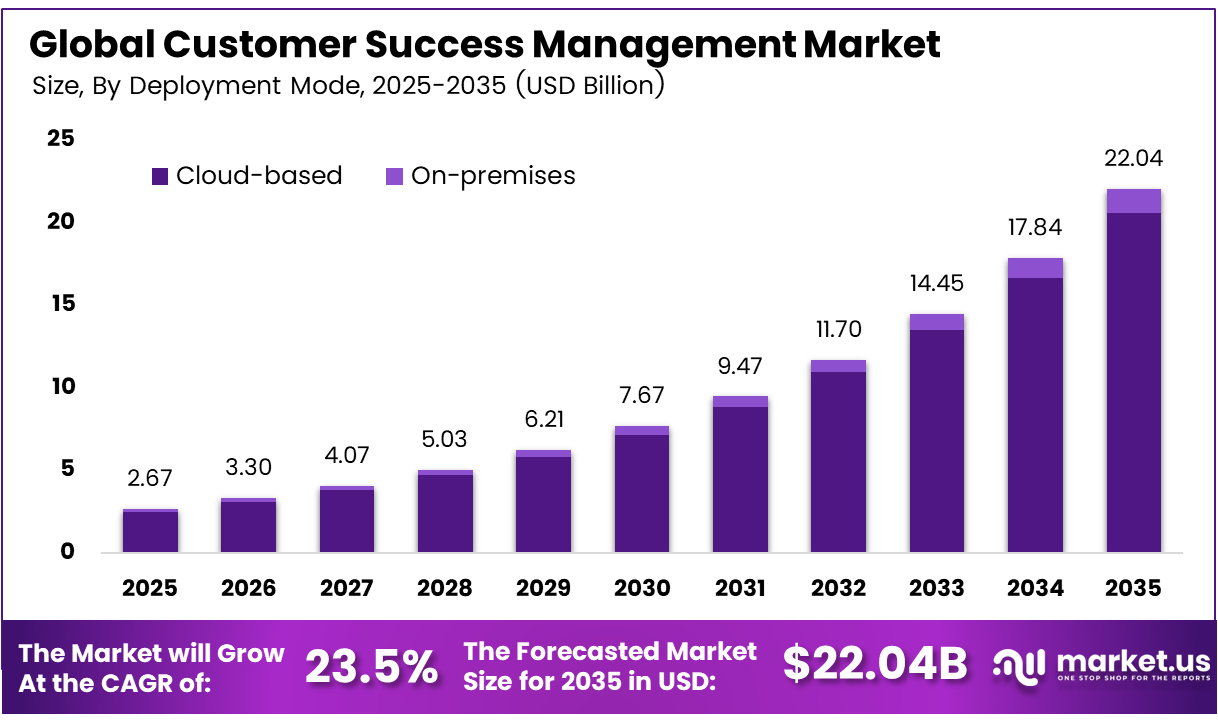
Rising expectations for seamless 24 by 7 digital experiences are reshaping customer engagement strategies. At the same time, increasing acquisition costs are forcing companies to focus on retention and long-term value. Organizations are now formalizing customer success functions, as B2B buyers expect vendors to share risk and align outcomes with measurable business results.
The market for Customer Success Management is driven by the rising focus on customer retention, recurring revenue models, and long-term value creation. Companies are prioritizing strong customer relationships to reduce churn and improve satisfaction. Increasing adoption of digital services and subscription platforms is also encouraging businesses to invest in structured success programs and proactive customer engagement strategies.
Demand for customer success management is strongest in software, digital services, and subscription-driven industries. In many cases, renewals and expansions contribute over 60% of incremental growth. Leadership teams are prioritizing structured success programs, as boards increasingly require clear visibility into adoption rates, delivered value, and customer advocacy performance.
For instance, in March 2026, Catalyst focused on product-led customer success, enhancing its platform with deeper product usage segmentation and experiments around AI coaching for CSMs. These capabilities help high-growth SaaS firms translate behavioral data into prioritized renewal and expansion motions, particularly in lean CS teams.
Key Takeaways
- In 2025, the Cloud-based segment held a dominant market position, capturing a 93.4% share of the Global Customer Success Management Market.
- In 2025, the Large Enterprises segment held a dominant market position, capturing a 68.7% share of the Global Customer Success Management Market.
- In 2025, the Risk & Churn Reduction segment held a dominant market position, capturing a 37.2% share of the Global Customer Success Management Market.
- In 2025, the IT & Telecommunications segment held a dominant market position, capturing a 52.9% share of the Global Customer Success Management Market.
- The U.S. Customer Success Management Market was valued at USD 0.93 Billion in 2025, with a robust CAGR of 21.77%.
- In 2025, North America held a dominant market position in the Global Customer Success Management Market, capturing more than a 38.5% share.
Role of Generative AI
Generative AI enables customer success teams to combine insights from usage data, support interactions, and feedback records into a unified view. It identifies behavior patterns that are often difficult to detect manually. This supports more accurate planning and allows teams to deliver personalized engagement that improves long-term customer relationships.
Teams are increasingly using AI to generate quick summaries, automate communication, and design tailored playbooks. Around 78% of customer experience leaders report improved business outcomes through these tools. More than 70% of service professionals also confirm faster issue resolution, reflecting strong efficiency gains in daily operations.
Investment and Business Benefits
Investment opportunities are expanding across software tools, analytics platforms, training services, and advisory solutions. Many firms are still in early or mid stages of maturity, creating space for specialized offerings. There is a rising demand for vertical-specific tools, outcome tracking frameworks, and benchmarking systems that provide deeper insights into retention and expansion performance.
Strong customer success management improves retention, supports cross-sell opportunities, and enhances product feedback cycles. Active engagement from success teams often leads to higher customer satisfaction and loyalty. Satisfied users contribute testimonials and referrals, which help reduce acquisition costs and strengthen brand credibility through organic advocacy and community-driven engagement.
Regional Analysis
In 2025, North America held a dominant market position in the Global Customer Success Management Market, capturing more than a 38.5% share, holding USD 1.02 billion in revenue. This dominance is due to the strong presence of subscription-based software providers, mature digital service companies, and large enterprise customers across North America. Businesses in the region place high importance on retention, renewals, and customer lifetime value. Wider adoption of cloud platforms, data analytics, and AI-enabled customer engagement tools also supports market growth. Strong spending capacity and structured customer success teams further strengthen North America’s leading position.
For instance, in July 2024, Salesforce strengthened North American dominance with its Customer Success Cloud, embedding predictive analytics and tighter links between Service Cloud and CS workflows. U.S. enterprises increasingly use Salesforce as a unified CRM-plus-success stack, consolidating vendors and standardizing retention metrics across business lines.
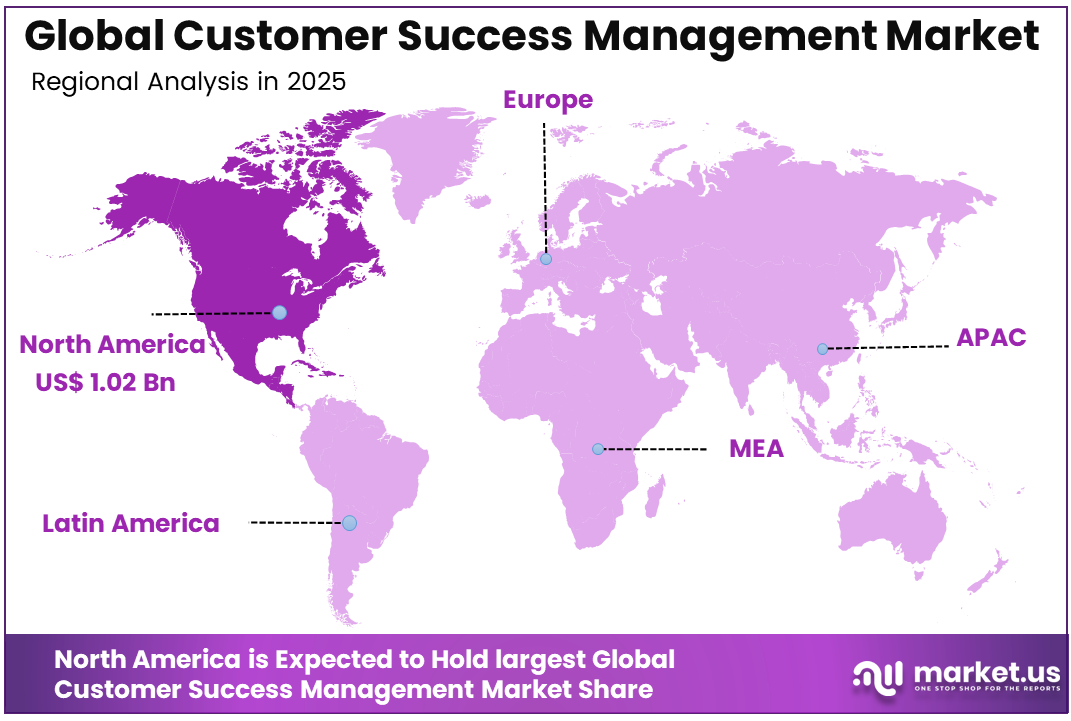
U.S. Customer Success Management Market Size
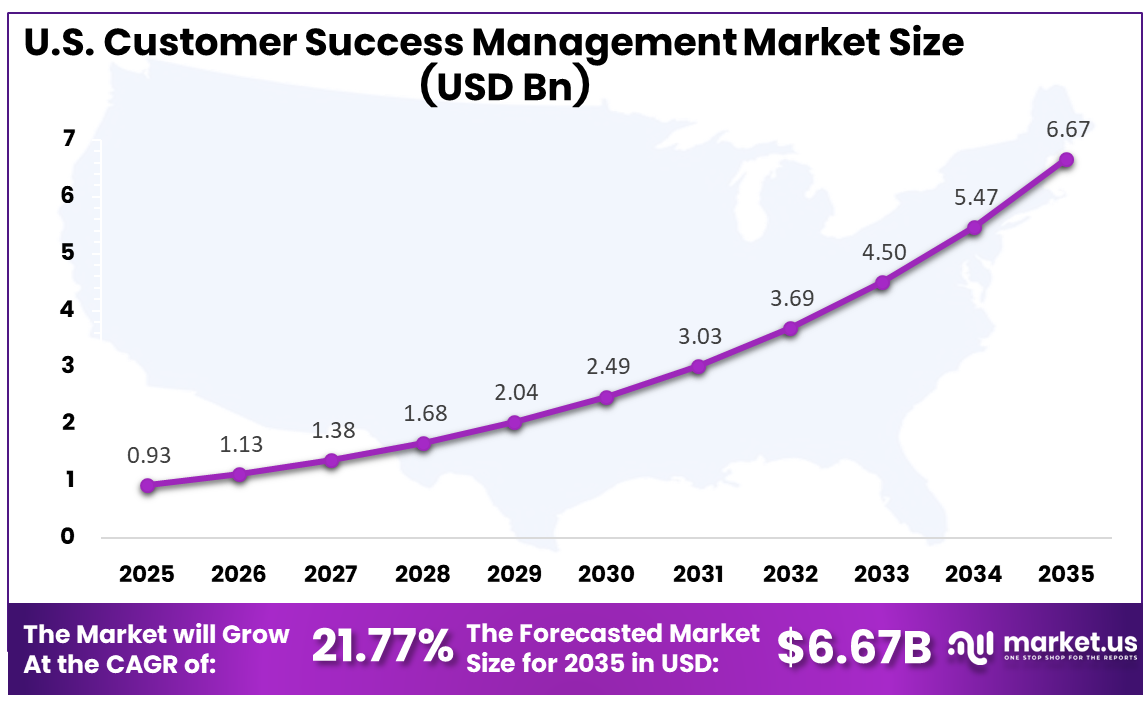
The market for Customer Success Management within the U.S. is growing tremendously and is currently valued at USD 0.93 billion; the market has a projected CAGR of 21.77%. The market is growing due to strong adoption of subscription-based software, digital services, and recurring revenue models across U.S. enterprises. Companies are placing greater focus on customer retention, renewal management, and account expansion as acquisition costs continue to rise. The presence of mature SaaS firms, advanced analytics adoption, and demand for personalized customer engagement are further supporting the need for structured Customer Success Management solutions.
For instance, in April 2025, Gainsight deepened its U.S. leadership in customer success by expanding AI-driven health scoring and playbooks tightly integrated with Salesforce, helping large North American SaaS enterprises lift net revenue retention and reduce churn. These enhancements reinforced its position as the benchmark enterprise-grade CS platform in the region.
Key Regions and Countries
North America
- US
- Canada
Europe
- Germany
- France
- The UK
- Spain
- Italy
- Russia
- Netherlands
- Rest of Europe
Asia Pacific
- China
- Japan
- South Korea
- India
- Australia
- Singapore
- Thailand
- Vietnam
- Rest of APAC
Latin America
- Brazil
- Mexico
- Rest of Latin America
Middle East & Africa
- South Africa
- Saudi Arabia
- UAE
- Rest of MEA
Deployment Mode Analysis
In 2025, the Cloud-based segment held a dominant market position, capturing a 93.4% share of the Global Customer Success Management Market. This dominance is due to the growing need for flexible customer success systems that can be accessed by teams across locations. Cloud-based platforms help companies connect customer data, support records, product usage, and renewal activities in one place, making account management more organized and timely.
These platforms are also preferred because they are easier to update and scale than on-premise tools. Customer success teams can monitor account health, identify churn signals, and coordinate customer actions faster, which is important for businesses working with recurring revenue and long-term client relationships.
For instance, in January 2025, Gainsight highlighted new acquisitions to bring education, community, and in-product experiences onto a single cloud-based customer platform. By tightening everything into one environment, it helps teams manage the full journey online, which supports faster adoption of cloud deployments in customer success programs.
Organization Size Analysis
In 2025, the Large Enterprises segment held a dominant market position, capturing a 68.7% share of the Global Customer Success Management Market. This dominance is due to the complex customer base managed by large enterprises. These companies handle many accounts, regions, contracts, and service teams, which creates a strong need for structured customer success systems that can track adoption, satisfaction, renewal risks, and expansion opportunities across different customer groups.
Large enterprises also have greater resources to invest in dedicated success teams and advanced platforms. Their focus is shifting from basic account support to measurable customer outcomes, where long-term retention, product usage, and account growth are reviewed closely by leadership and operational teams.
For instance, in November 2024, ClientSuccess continued expanding its platform through acquisitions that strengthen onboarding and implementation capabilities for bigger customer bases. By offering an integrated environment suited to multi-team, multi-region deployments, it positions itself as an attractive option for large enterprises that need consistent processes across many accounts.
Application Analysis
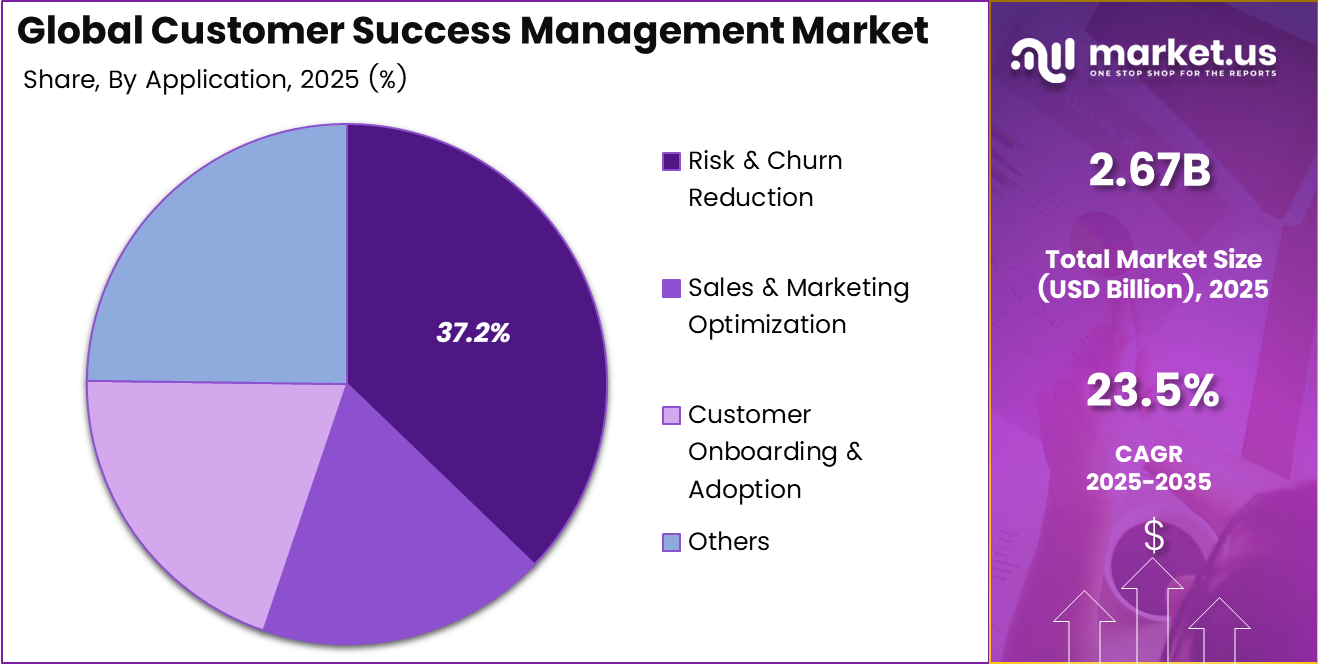
In 2025, the Risk & Churn Reduction segment held a dominant market position, capturing a 37.2% share of the Global Customer Success Management Market. This dominance is due to the rising pressure on companies to retain existing customers and reduce revenue leakage. Customer success tools help teams identify early signs of churn by tracking weak engagement, low product usage, unresolved issues, and delayed onboarding progress before the customer relationship becomes difficult to recover.
Risk and churn reduction have become a core use case because existing customers are often more cost-efficient to retain than new customers are to acquire. By acting early, companies can improve customer satisfaction, protect renewals, and create better chances for account expansion over time.
For instance, in January 2025, ChurnZero presented itself as an AI-powered partner focused on helping customer teams grow recurring revenue and manage churn more effectively. New automation features and success planning tools are designed to spot troubled accounts earlier, showing how vendors are sharpening their platforms around risk detection and churn prevention.
End-User Industry Analysis
In 2025, the IT & Telecommunications segment held a dominant market position, capturing a 52.9% share of the Global Customer Success Management Market. This dominance is due to the strong use of subscription models, managed services, and long-term service contracts in IT and telecommunications. These industries depend heavily on continuous customer engagement, technical support, onboarding, service quality, and renewal management to maintain stable relationships with business clients.
Customer success platforms are useful in these industries because they connect service performance, product adoption, support history, and account activity. This gives teams a clearer view of customer needs and helps them respond before service issues, usage gaps, or dissatisfaction affect renewals.
For instance, in October 2025, at Dreamforce 2025, Salesforce put customer success and AI-driven engagement at the centre of its agenda, showing new ways for digital and subscription businesses to deepen relationships with their users. This focus resonates strongly with IT and telecom firms, which depend on ongoing service usage and renewals.
Key Market Segments
By Deployment Mode
- Cloud-based
- On-premises
By Organization Size
- Large Enterprises
- Small and Medium-sized Enterprises (SMEs)
By Application
- Sales & Marketing Optimization
- Risk & Churn Reduction
- Customer Onboarding & Adoption
- Others
By End-User Industry
- IT & Telecommunications
- Banking, Financial Services, and Insurance (BFSI)
- Retail & E-commerce
- Healthcare
- Others
Emerging Trends
AI-driven tools are becoming part of daily workflows, with nearly 80% of organizations planning full-scale adoption to monitor customer health and predict churn risks. Customer success teams are shifting focus from basic interactions to measurable value delivery, linking product usage directly to revenue outcomes and long-term customer impact.
Product adoption remains a key priority, particularly among smaller firms, where 52% still face challenges in maximizing tool usage. Companies are investing in guided onboarding and in-app engagement features. Over 50% of customer success teams are already using AI to improve adoption rates and reduce early-stage customer drop-offs.
Growth Factors
Customer success programs are closely linked to revenue expansion, with 58% of leading teams achieving over 20% annual growth through renewals and upselling strategies. A deeper understanding of customer needs improves retention outcomes, with some organizations reporting 54% higher retention compared to industry averages.
Higher engagement in structured success initiatives increases lifetime value by 68%, supporting long-term profitability. Around 69% of companies state that customer success efforts directly contribute to revenue growth through account expansion. Improved retention also reduces acquisition costs and supports more stable and predictable business performance.
Market Dynamics
Drivers - Retention-Led Growth
Customer success management is gaining importance as companies place more focus on keeping existing customers. In subscription-based models, renewals and account expansion are critical for stable revenue. This has made customer success teams central to improving satisfaction, product adoption, and long-term business value.
Businesses are also trying to reduce dependence on costly customer acquisition. A strong customer success function helps identify account needs early, resolve concerns, and guide customers toward better outcomes. This supports stronger loyalty and creates more opportunities for repeat business and cross-sell growth.
For instance, in March 2026, Totango promotes its modular workspaces and automated flows as tools that help mid-market firms scale retention programs without large admin teams. By giving teams templates for onboarding and expansion paths, the platform aims to turn recurring customers into the main source of organic growth for software providers.
Restraint - Data Integration Complexity
Data integration complexity remains a key restraint because customer information is often spread across sales, support, billing, product, and service systems. When these systems do not connect well, customer success teams may find it difficult to build a complete and accurate view of each account.
This creates delays in identifying risks, planning actions, and measuring customer outcomes. Poor data flow can also lead to duplicate work and inconsistent reporting, which reduces the efficiency of successful teams and limits the value companies expect from customer success platforms.
For instance, in March 2026, ChurnZero is often recommended for real-time analytics, which rely on continuous data flows from CRM, subscription, and product tracking systems. Guidance to buyers stresses the need for reliable integrations to unlock this value, underlining how data quality and connection work can become a practical restraint on adoption.
Opportunities - AI-Assisted Success Operations
AI-assisted customer success operations are creating strong opportunities for faster and more personalized engagement. These tools can summarize account activity, highlight risk signals, suggest next actions, and support tailored communication. This allows success managers to spend more time on customer relationships and strategic account planning.
AI can also improve consistency across large customer portfolios. By helping teams prioritize accounts and detect early warning signs, it supports better renewal preparation and proactive service. This opportunity is especially valuable for companies that need to scale customer success without adding a heavy manual workload.
For instance, in March 2026, Salesforce promotes AI features in its customer success-related offerings, using analytics to highlight at-risk accounts and recommend next steps inside standard workflows. These capabilities show how AI-assisted operations are moving into everyday tools that successful managers already rely on, rather than being separate experimental pilots.
Challenges - Churn Risk Management
Churn risk management remains a key challenge because customer dissatisfaction is not always visible early. Low usage, delayed onboarding, unresolved issues, and weak engagement can build over time. If teams miss these signals, customers may decide not to renew before corrective action can be taken.
Managing churn also requires strong coordination across product, support, sales, and success teams. Customer issues often come from several touchpoints, not one department alone. Without shared ownership and clear processes, successful teams may find it difficult to protect renewals and maintain long-term customer trust.
For instance, in March 2026, evaluations of Gainsight show that many enterprises rely on it to track customer health and prevent churn, but also mention steep learning curves and configuration complexity in some cases. This reflects the broader challenge of translating rich data into clear, trusted churn risk signals that busy success teams can act on consistently.
Key Players Analysis
One of the leading players in February 2026, Totango expanded its modular customer success platform with more prescriptive SuccessPlays and an upgraded AI assistant, Zoe, that delivers customer summaries directly in collaboration tools like Slack. The focus is on helping mid-market and growth companies operationalize outcome-based journeys without building heavy internal CS Ops infrastructure.
Top Key Players in the Market
- Gainsight, Inc.
- Salesforce, Inc.
- Totango, Ltd.
- ChurnZero, Inc.
- Planhat, Inc.
- Strikedeck, Inc.
- Catalyst Software
- SmartKarrot, Inc.
- ClientSuccess, Inc.
- Custify
- Natero, Inc.
- Amity
- UserIQ, Inc.
- Bolstra
- AppsForOps
- Others
Recent Developments
- In January 2026, Salesforce deepened its push into customer success by enhancing Service Cloud and Success Cloud with Einstein-driven insights that surface at-risk accounts and upsell opportunities in real time. The tighter integration of customer success metrics into core CRM makes Salesforce a natural hub for organizations standardizing NRR and lifecycle management.
- In January 2026, ChurnZero launched new churn forecasting and journey automation features tailored for subscription SaaS businesses. By embedding predictive signals and playbooks into day-to-day workflows, ChurnZero is enabling CS teams to cut logo and revenue churn by double-digit percentages while proving their direct impact on pipeline and renewals.
Report Scope
| Report Features | Description |
|---|---|
| Market Value (2025) | USD 2.67 Billion |
| Forecast Revenue (2035) | USD 22.04 Billion |
| CAGR (2026-2035) | 23.5% |
| Base Year for Estimation | 2025 |
| Historic Period | 2020-2024 |
| Forecast Period | 2026-2035 |
| Report Coverage | Revenue Forecast, Market Dynamics, Competitive Landscape, Recent Developments |
| Segments Covered | By Deployment Mode (Cloud-based, On-premises), By Organization Size (Large Enterprises, Small and Medium-sized Enterprises (SMEs)), By Application (Sales & Marketing Optimization, Risk & Churn Reduction, Customer Onboarding & Adoption, Others), By End-User Industry (IT & Telecommunications, Banking, Financial Services, and Insurance (BFSI), Retail & E-commerce, Healthcare, Others) |
| Regional Analysis | North America (US and Canada), Europe (Germany, France, The UK, Spain, Italy, and Rest of Europe), Asia Pacific (China, Japan, South Korea, India, Australia, and Rest of APAC), Latin America (Brazil, Mexico, and Rest of Latin America), Middle East & Africa (GCC, South Africa, and Rest of MEA) |
| Competitive Landscape | Gainsight, Inc., Salesforce, Inc., Totango, Ltd., ChurnZero, Inc., Planhat, Inc., Strikedeck, Inc., Catalyst Software, SmartKarrot, Inc., ClientSuccess, Inc., Custify, Natero, Inc., Amity, UserIQ, Inc., Bolstra, AppsForOps, Others |
| Customization Scope | Customization for segments, region/country-level will be provided. Moreover, additional customization can be done based on the requirements. |
| Purchase Options | We have three licenses to opt for: Single User License, Multi-User License (Up to 5 Users), Corporate Use License (Unlimited Users and Printable PDF) |