


Market Overview
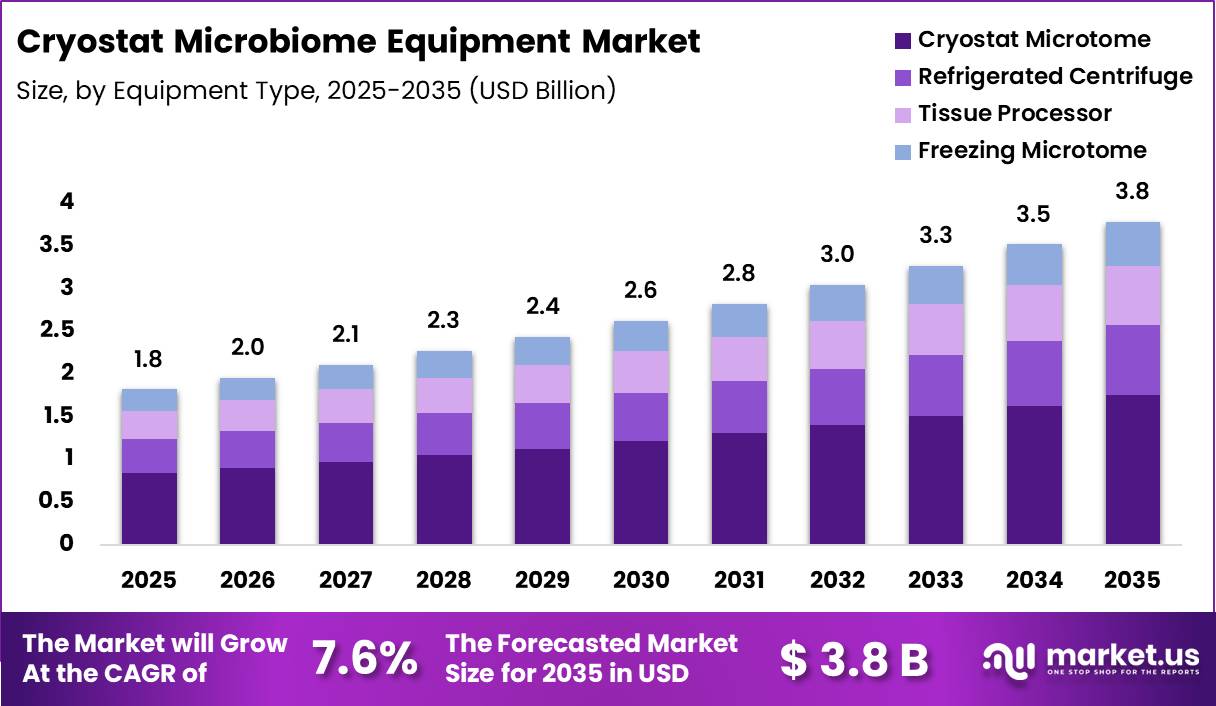
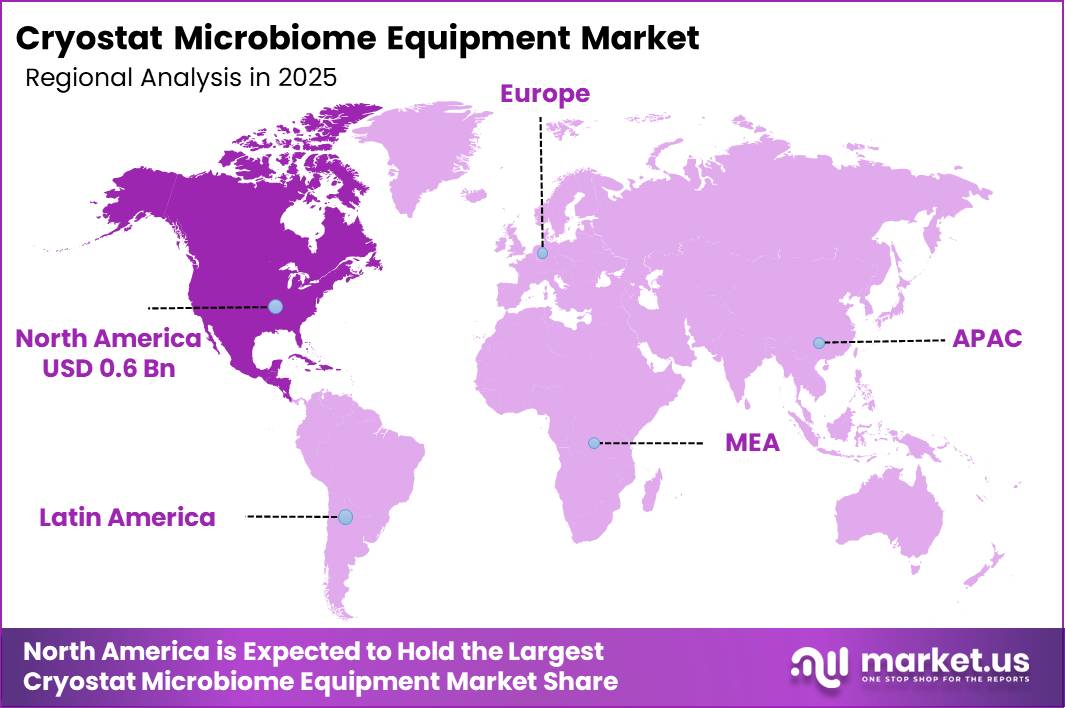
Global Cryostat Microbiome Equipment Market size is expected to be worth around US$ 3.8 Billion by 2035 from US$ 1.8 Billion in 2025, growing at a CAGR of 7.6% during the forecast period from 2026 to 2035. In 2025, North America led the market, achieving over 35.2% share with a revenue of US$ 0.6 Billion.
The Cryostat Microbiome Equipment Market refers to specialized cryogenic instrumentation used for ultra-thin frozen sectioning of biological and microbial tissue samples to support advanced microbiome research, spatial biology, and clinical diagnostics. These systems preserve microbial structure and molecular integrity at extremely low temperatures, making them essential for studying host–microbiome interactions.
According to India’s Department of Biotechnology-led human microbiome research initiatives and government-backed programs such as the Indian Human Microbiome Initiative, large-scale microbiome studies are expanding rapidly, with over 3,400–4,000 human samples already analyzed across diverse populations and hundreds of metagenomic datasets generated for microbial profiling.
This rising research volume is increasing demand for high-precision sample preparation tools such as cryostats in research institutes and clinical laboratories.
Government-supported platforms like the Department of Health Research (MoHFW) emphasize microbiome applications in gut health, infectious disease research, and precision medicine, reflecting a strong national push toward microbiome-enabled healthcare innovation. These programs require advanced tissue preservation technologies, where cryostat systems play a critical role in preparing high-quality frozen sections for sequencing and imaging workflows.
India’s expanding life sciences infrastructure, along with initiatives such as I-STEM, which provides access to over 30,000 publicly funded scientific instruments, is improving accessibility to advanced cryogenic and analytical equipment across research institutions .
Overall, the market is being driven by growing microbiome research, precision medicine adoption, and increasing translational studies in pharmaceuticals and biotechnology. Rising integration of automated cryostat systems with digital pathology and spatial omics platforms is further accelerating demand across academic, clinical, and industrial research settings.
Key Takeaways
- Market Size: Global Cryostat Microbiome Equipment Market size is expected to be worth around US$ 3.8 Billion by 2035 from US$ 1.8 Billion in 2025.
- Market Share: The market is growing at a CAGR of 7.6% during the forecast period from 2026 to 2035.
- Equipment Type Analysis: The Cryostat Microbiome Equipment market by Equipment Type is led by Cryostat Microtome, which accounted for 46.2% of the global market share in 2025.
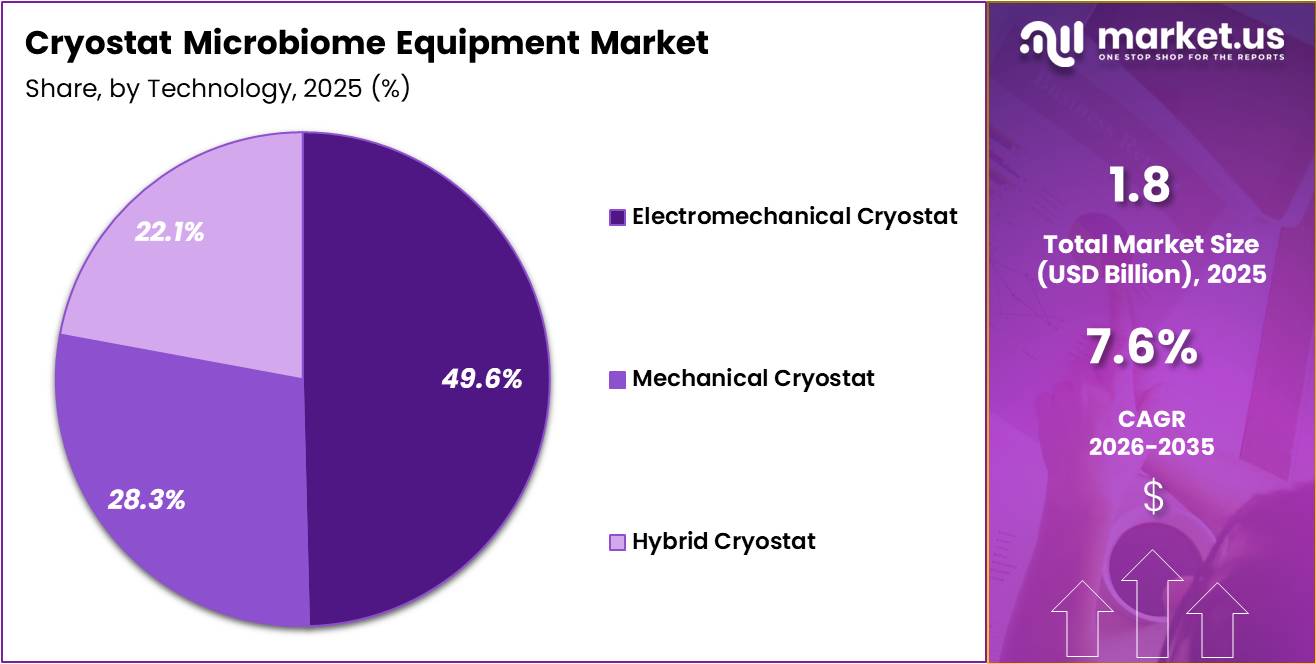
- Technology Analysis: Electromechanical Cryostat held the largest share of the Cryostat Microbiome Equipment market, accounting for 49.6% of total revenue in 2025.
- Sample Type Analysis: Animal Tissue dominates the Sample Type segment with a 62.3% market share in 2025.
- Application: The Medical Research dominates the Application segment with a 26.4% market share in 2025.
- End Use Analysis: Research Laboratories dominate the End Use segment with a 37.8% market share in 2025.
- Regional Analysis: In 2025, North America led the market, achieving over 35.2% share with a revenue of US$ 0.6 Billion.
Equipment Type Analysis
Cryostat Microtome Dominates Equipment Type Segment in Cryostat Microbiome Equipment Market.
Cryostat Microtome segment dominates the Equipment Type landscape, accounting for 46.2% market share in 2025, driven by its critical role in ultra-thin tissue sectioning for microbiome and histopathological studies.
Its dominance is supported by high demand in clinical diagnostics and advanced research workflows where precision slicing at sub-zero temperatures is essential. Continuous improvements in blade stability, temperature control accuracy, and automated sectioning features are further strengthening its adoption across laboratories.
Refrigerated Centrifuge holds a significant 21.7% share, primarily due to its ability to maintain sample integrity during high-speed separation processes, especially for temperature-sensitive biological materials.
Tissue Processor accounts for 18.5% share, benefiting from increasing automation in sample preparation workflows, enabling faster and more standardized processing in diagnostic labs. Freezing Microtome represents 13.6% share and is steadily gaining traction in niche applications requiring rapid freezing and sectioning of delicate tissue samples.
Overall, the segment is characterized by rising automation integration, workflow efficiency improvements, and increasing adoption of hybrid systems that combine precision, speed, and sample preservation, reinforcing steady market expansion across research and clinical environments.
Technology Analysis
Electromechanical Cryostat Dominates Technology Segment in Cryostat Microbiome Equipment Market.
Electromechanical Cryostat segment dominates the Technology landscape with a 49.6% market share in 2025, largely due to its superior precision control, automation capability, and consistent performance in high-throughput laboratory environments.
These systems are widely preferred in microbiome research and clinical diagnostics because they reduce manual intervention, improve reproducibility, and enhance operational efficiency in sample preparation workflows.
Mechanical Cryostat accounts for 28.3% share, maintaining steady adoption in cost-sensitive laboratories and academic institutions where basic cryosectioning functionality is required without advanced automation features. Despite slower innovation cycles, mechanical systems remain relevant due to their affordability and durability.
Hybrid Cryostat holds a 22.1% share and is emerging as a flexible solution combining features of both electromechanical and mechanical systems. These systems are increasingly used in advanced research settings where adaptability and multi-functional capability are important, particularly in evolving microbiome and molecular studies.
Overall, the technology segment is witnessing a clear shift toward automation-driven electromechanical systems, while hybrid models are gaining momentum due to their versatility. Continuous improvements in temperature precision, digital controls, and integrated imaging compatibility are expected to further shape competitive dynamics across the technology landscape.
Sample Type Analysis
Animal Tissue Dominates Sample Type Segment in Cryostat Microbiome Equipment Market.
Animal Tissue segment dominates the Sample Type landscape with a 62.3% market share in 2025, primarily driven by extensive use in biomedical research, disease modeling, toxicology studies, and microbiome-host interaction analysis.
Animal tissues are widely preferred due to their physiological similarity to human systems, making them essential for translational research and preclinical experimentation. Growing investments in life sciences research and drug discovery further reinforce this dominance.
Plant Tissue represents the remaining segment and is steadily gaining relevance in microbiome studies focused on agriculture, environmental biology, and plant-pathogen interactions. Increasing interest in soil microbiome research and sustainable agricultural practices is supporting gradual adoption of cryostat-based analysis in plant sciences.
Overall, the sample type segmentation reflects a strong bias toward animal-based research due to its direct applicability in medical and pharmaceutical fields. However, expanding interdisciplinary research linking environmental microbiomes with human health is gradually encouraging broader utilization of plant tissue analysis.
Advancements in cryosectioning accuracy and preservation techniques are also improving the feasibility of handling diverse biological samples across both research domains.
Application Analysis
Medical Research Dominates Application Segment in Cryostat Microbiome Equipment Market.
Medical Research segment dominates the Application landscape with a 26.4% market share in 2025, driven by its central role in understanding disease mechanisms, tissue pathology, and microbiome interactions at a cellular level. Cryostat equipment is extensively used in medical research for rapid freezing and precise sectioning of biological samples, enabling high-resolution analysis critical for modern biomedical studies.
Pharmaceutical Development is a key growth area, supported by increasing demand for drug discovery, preclinical testing, and biomarker identification. Biotechnology applications are also expanding rapidly, fueled by advancements in genomic and microbiome engineering research.
Diagnostic Testing continues to rely on cryostat systems for histological examination and disease confirmation, particularly in pathology laboratories. Academic Research contributes steadily to demand, driven by university-led life science studies and government-funded research programs.
Overall, the application segment reflects a diversified demand base, with medical research maintaining leadership while pharmaceutical and biotechnology segments show strong growth momentum. Increasing integration of automation, digital imaging, and AI-assisted tissue analysis is further enhancing the role of cryostat systems across multiple scientific and clinical applications.
End Use Analysis
Research Laboratories Dominate End Use Segment in Cryostat Microbiome Equipment Market.
Research Laboratories segment dominates the End Use landscape with a 37.8% market share in 2025, driven by their extensive utilization in microbiome studies, tissue pathology, and experimental life science research. These laboratories require high-precision cryosectioning tools to support advanced analytical workflows, making cryostat systems indispensable for consistent and reproducible results.
Hospitals represent a significant end-use segment, primarily driven by diagnostic pathology requirements and surgical tissue analysis. Pharmaceutical Companies are increasingly adopting cryostat equipment to support drug development pipelines, toxicology testing, and biomarker validation studies.
Academic Institutions contribute steadily to market demand, fueled by growing life sciences programs and research funding initiatives focused on microbiology and biomedical sciences. The Others category includes contract research organizations and specialized diagnostic centers that support outsourced laboratory services.
Overall, the end-use segmentation highlights a strong research-driven market structure, with research laboratories leading adoption due to their continuous need for high-accuracy tissue processing. However, expanding clinical diagnostics and pharmaceutical R&D activities are gradually broadening the market base.
Technological advancements such as automation, digital workflow integration, and improved sample preservation are further strengthening adoption across all end-use categories.
Key Market Segments
By Equipment Type
- Cryostat Microtome
- Refrigerated Centrifuge
- Tissue Processor
- Freezing Microtome
By Technology
- Electromechanical Cryostat
- Mechanical Cryostat
- Hybrid Cryostat
By Sample Type
- Animal Tissue
- Plant Tissue
By Application
- Medical Research
- Pharmaceutical Development
- Diagnostic Testing
- Biotechnology
- Academic Research
By End Use
- Hospitals
- Research Laboratories
- Pharmaceutical Companies
- Academic Institutions
- Others
Drivers
Oncology frozen section volume expansion.
The most immediate demand engine is the continued rise in cancer case volume and the associated need for rapid intraoperative pathology, where cryostats remain the core platform for preparing frozen sections within operative decision windows.
WHO IARC reported about 20 million new cancer cases and 9.7 million deaths worldwide in 2022, with 53.5 million people living within five years of diagnosis, and projected cases rising to more than 35 million by 2050; that scale directly expands specimen throughput requirements in surgical oncology, transplant assessment, and margin evaluation workflows.
In practical equipment terms, each incremental rise in frozen section demand increases utilization intensity on installed cryostats, which typically accelerates purchases of backup units, higher throughput models, anti roll accessories, blades, specimen chucks, and maintenance contracts rather than only first time capital placements.
The business model effect is important: buyers increasingly evaluate cryostats not as standalone hardware but as uptime critical nodes in anatomic pathology, pushing vendors toward bundled service agreements, preventive maintenance, application support, and consumables pull through economics that improve recurring revenue per installed base.
| Driver | (~) % Impact on CAGR Forecast | Geographic Relevance | Impact Timeline |
|---|---|---|---|
| Oncology frozen-section volume expansion | +1.6% | North America core, EU, Japan, South Korea, urban China | Short term (≤ 2 years) |
| Spatial microbiome and fresh-frozen multi-omics adoption | +1.9% | US academic centers, Western Europe, China tier-1 institutes, Singapore | Medium term (2-4 years) |
| Energy-efficient cryostat replacement cycle | +1.2% | EU, North America, Japan, Australia | Short term (≤ 2 years) |
| IVDR and evidence-intensive diagnostic workflows | +1.0% | EU core, UK spill-over, export-oriented APAC suppliers | Medium term (2-4 years) |
| Precision oncology companion-diagnostic scaling | +1.4% | US, EU5, China, South Korea | Medium term (2-4 years) |
| Decentralized translational research capacity in APAC | +0.9% | China, India, South Korea, Singapore, Middle East hubs | Long term (≥ 4 years) |
Challenge
Skilled lab technologist shortfall.
A structural talent shortfall in skilled medical and research laboratory technologists capable of operating advanced cryostat microbiome systems is emerging as a long term friction that depresses utilization rates and slows adoption in high growth regions, even though it does not fully block current sales.
In North America alone, professional associations and workforce studies indicate that healthcare and biomedical labs need roughly 10,000 new medical laboratory professionals annually, while accredited programs produce only about 5,000 graduates per year, implying a persistent 50% training shortfall and vacancy rates ranging from 7 to 11% in urban centers to over 20 to 25% in rural facilities.
When this shortage is applied to cryostat microbiome workflows, the result is that 10 to 15% of installed systems in some regions operate below 60% of their theoretical throughput because labs cannot staff enough trained personnel to run multi shift operations, validate protocols, and manage complex sample preparation and quality control cycles.
The talent constraint adds a hidden 3 to 5% to per sample operating cost when overtime, cross training inefficiencies, and higher turnover are factored in, and it pushes the payback period for high end cryostat microbiome systems from, for example, 3.5 to 4 years to 4.5 to 5 years in many hospital and contract research settings, effectively dragging potential market CAGR by around 1.4% points as some sites postpone additional unit purchases or consolidate testing into fewer specialized centers.
Long term mitigation will rest on multi year investments in training pipelines, vendor provided digital simulation modules, and increasingly automation heavy system designs that can cut hands on time per run by 25 to 40%, but these steps demand redesign of interfaces, standardized workflows, and collaboration with academic and vocational institutions, making this a structural friction persisting well beyond 2030.
| Challenge | (~) % CAGR Friction Drag | Geographic Relevance | Mitigation Horizon |
|---|---|---|---|
| Precision cryogenic calibration bottlenecks | -1.2% | North America, EU research hubs, Japan | Medium term (2–4 years) |
| Volatile cold-chain component lead times | -1.0% | North America core, EU logistics nodes, APAC corridors | Medium term (2–4 years) |
| Skilled lab technologist shortfall | -1.4% | North America, Western Europe, GCC, East Asia | Long term (≥ 4 years) |
| Capital-intensive validation and uptime | -0.9% | Tier-1 hospitals, CROs, pharma hubs globally | Medium term (2–4 years) |
| Integration with advanced microbiome workflows | -1.1% | North America, EU biotech clusters, China, South Korea | Long term (≥ 4 years) |
| Regulatory and biosafety compliance drift | -0.8% | EU regulatory hubs, US, China, India | Medium term (2–4 years) |
Restraints
Helium and cryogen cost stress.
Cryostat microbiome equipment faces a meaningful operating cost restraint because cryogenic research infrastructure remains exposed to global helium scarcity, elevated energy pass through, and tighter laboratory operating budgets, even where the cryostat itself is not the primary helium consuming instrument.
Public reporting in 2025 and 2026 points to continuing helium tightness driven by geopolitical disruptions, aging extraction assets, and delayed new supply projects, which has forced research institutions to increase reserve stock, renegotiate supply contracts more frequently, and absorb higher delivered gas pricing and logistics fees.
For an integrated life science lab running cryogenic preservation, microscopy, sequencing support infrastructure, and multiple temperature controlled assets, this can lift annual cryogen and cooling related operating expenditure by 15 to 30%, and once total lab opex rises by even 5 to 7%, procurement teams typically re-rank new capital requests against utilization thresholds rather than scientific preference.
OEMs are also affected through higher costs for vacuum insulated assemblies, temperature control electronics, specialty metals, and cold chain commissioning logistics, with component cost inflation plausibly adding 6 to 10 percent to build cost over a two year cycle while end market pricing power is often capped below that in academic and public sector tenders.
Because microbiome labs usually prioritize sequencing throughput, wet lab automation, and bioinformatics over replacement of functioning cryostats when budgets tighten, even modest cryogen related opex escalation can push equipment purchases out by 2 to 3 budget quarters, suppressing premium system mix and increasing refurbishment behavior.
The net commercial effect is a reduction in realized demand growth, pressure on gross margin through selective discounting and service bundling, and a credible -1.7% point CAGR impact in the 2026 baseline period.
| Restraint | (~) % Impact on CAGR Forecast | Geographic Relevance | Impact Timeline |
|---|---|---|---|
| Grant-funded capex volatility | -2.0% | North America core, EU, East Asia labs | Short term |
| Helium and cryogen cost stress | -1.7% | North America, EU, Japan, China | Short term |
| Long lead-time component bottlenecks | -1.5% | EU, U.S., APAC corridors | Short–Medium term |
| Workflow validation and compliance drag | -1.4% | U.S., EU, China, GCC tertiary centers | Medium term |
| Skilled operator and field-service gap | -1.3% | U.S., EU, India, East Asia hubs | Medium term |
| Multi-omics integration friction | -1.1% | Global tier-1 research clusters | Long term |
Opportunity
Decentralized stool bank systems.
This is an untapped opportunity rather than a current driver because the baseline market already reflects routine microbiome research and standard lab cryostorage demand, while the white space comes from rebuilding supply architecture after the shutdown of OpenBiome’s shipped frozen FMT operations at the end of 2024, which had previously served more than 1,300 facilities and shipped 72,507 treatments.
That disruption creates a clear opening for equipment vendors to package compact cryostats, closed aliquoting modules, traceability software, and validation services into regional “micro stool bank” deployments for hospital networks and specialty GI centers rather than selling standalone instruments.
The revenue upside comes from converting a fragmented clinical workflow into a higher value system sale: a decentralized node can raise average revenue per installed site by roughly 2.0 to 2.8 times versus a single freezer only sale, with service attach rates potentially moving from about 8 to 10% to 20 to 25%, while validated chain of custody and donor screening integration can reduce sample loss and compliance friction enough to accelerate replacement cycles by 12 to 18 months in regulated settings.
North America and Europe are the lead geographies because they already have the clinical microbiota framework, approved microbiota therapeutics precedent, and institutional need to rebuild resilient local access after the national bank model weakened, making this a near term adjacency capable of adding about 2.4% points to market CAGR if vendors commercialize turnkey node architecture quickly.
| Opportunity | (~) % Potential CAGR Upside | Geographic Relevance | Execution Window |
|---|---|---|---|
| Decentralized stool-bank systems | +2.4% | North America core, EU | Short term (≤ 2 years) |
| Autologous microbiome banking | +1.9% | North America, Japan, South Korea, GCC | Medium term (2-4 years) |
| GMP-grade cryo workflow platforms | +2.1% | U.S., EU, Singapore | Short term (≤ 2 years) |
| Biobank-to-omics service bundling | +1.6% | U.S., Western Europe, China | Medium term (2-4 years) |
| LN2-free automation retrofits | +1.3% | EU, North America, developed APAC | Short term (≤ 2 years) |
| Emerging-market hospital FMT nodes | +1.8% | India, Brazil, SE Asia, MENA | Long term (≥ 4 years) |
Regional Analysis
North America Dominates Cryostat Microbiome Equipment Market in 2025.
In 2025, North America led the Cryostat Microbiome Equipment Market, accounting for over 35.2% share and generating revenue of US$ 0.6 Billion. This dominance is driven by strong biomedical research infrastructure, advanced healthcare systems, and high adoption of cryogenic preservation technologies across microbiome and clinical research applications.
The presence of well-established hospitals, academic research institutes, and biotechnology companies further strengthens regional demand for cryostat-based microbiome sample storage and analysis. Europe remains a significant market, supported by expanding microbiome research initiatives and increasing investment in precision medicine and cold-chain laboratory infrastructure.
Asia-Pacific is emerging as the fastest-growing region due to rising healthcare expenditure, growing biotechnology ecosystems, and increasing academic collaborations in life sciences. Latin America and the Middle East & Africa are gradually adopting cryostat microbiome technologies, driven by improving diagnostic capabilities and expanding research funding in healthcare sectors.
Overall, global market growth is expected to be supported by advancements in cryopreservation systems and rising focus on microbiome-based disease research worldwide. Continuous technological innovation and cross-border collaborations among research institutions further accelerate adoption across all regions.
Growing awareness of microbiome applications in disease diagnostics and personalized medicine is also contributing to sustained global demand expansion especially in advanced research hospitals worldwide.
Key Regions and Countries
North America
- The US
- Canada
Europe
- Germany
- France
- The U.K.
- Italy
- Spain
- Russia & CIS
- Rest of Europe
Asia Pacific
- China
- India
- Japan
- South Korea
- ASEAN
- Australia & New Zealand
- Rest of Asia Pacific
Middle East & Africa
- GCC
- South Africa
- Rest of Middle East & Africa
Latin America
- Brazil
- Mexico
- Rest of Latin America
Key Player Analysis
Key player landscape in the Cryostat Microbiome Equipment Market is moderately consolidated, with competition shaped by precision engineering capability, temperature control accuracy, and integration with advanced histology and microbiome research workflows.
While the market includes a wide range of manufacturers such as Tanner Scientific Inc., Medimeas Instruments, Cardinal Health, Epredia, Hacker Instruments & Industries Inc., Histo-Line Laboratories S.R.L., Kalstein France, Labtron Equipment Ltd., Leica Microsystems Nussloch GmbH, Bright Instruments Ltd., Sakura Finetek Usa Inc., Slee Medical Gmbh, Spensers World, Amos Scientific Pty. Ltd., and Zhejiang Jinhua Kedi Instrumental Equipment Co., Ltd., competitive leadership is primarily concentrated among a few advanced solution providers.
Top-tier influence is especially seen in companies such as Leica Microsystems Nussloch GmbH, Epredia, Sakura Finetek Usa Inc., Cardinal Health, and Bright Instruments Ltd., which lead through continuous R&D investment, high-precision cryostat systems, and strong global distribution networks.
Competitive strategy in the market is centered on enhancing cutting accuracy, automation in tissue sectioning, and contamination-free sample handling. Players are increasingly focusing on workflow integration, enabling seamless connectivity between cryostats, imaging systems, and laboratory information systems.
Partnerships with hospitals, diagnostic laboratories, and research institutes are strengthening product adoption in microbiome and histopathology applications. Ecosystem-based competition is also intensifying, where companies expand beyond standalone instruments toward fully integrated laboratory solutions.
Innovation in ergonomic design, temperature stability, and digital monitoring systems continues to define market differentiation and long-term competitive positioning.
Top Key Players
- Tanner Scientific Inc.
- Medimeas Instruments
- Cardinal Health
- Epredia
- Hacker Instruments & Industries Inc.
- Histo-Line Laboratories S.R.L.
- Kalstein France
- Labtron Equipment Ltd.
- Leica Microsystems Nussloch GmbH
- Bright Instruments Ltd.
- Sakura Finetek Usa Inc.
- Slee Medical Gmbh
- Spensers World
- Amos Scientific Pty. Ltd.
- Zhejiang Jinhua Kedi Instrumental Equipment Co., Ltd.
Recent Developments
- In December 2025, Sakura Finetek USA launched four additional ready-to-use antibodies for the Tissue-Tek Genie Advanced Staining System, increasing its antibody portfolio to 160 products for pathology laboratories.
- In February 2026, Leica Biosystems (Leica Microsystems Nussloch GmbH) launched the Leica CM1950 Cryostat with DualEcoTec Cooling System, introducing a next-generation refrigerant with near-zero global warming potential and up to 50% lower energy consumption compared with previous models.
- In March 2026, Thermo Fisher Scientific expanded its cryostat portfolio optimized for microbiome tissue analysis, introducing key innovations to enhance structural temperature precision during low-temperature sample evaluation.
- In May 2026, Epredia launched the SlideMate Thermal Slide Printer, expanding its pathology laboratory portfolio with on-demand slide printing and enhanced specimen traceability capabilities.
Report Scope
| Report Features | Description |
|---|---|
| Market Value (2025) | US$ 1.8 Billion |
| Forecast Revenue (2035) | US$ 3.8 Billion |
| CAGR (2026-2035) | 7.6% |
| Base Year for Estimation | 2025 |
| Historic Period | 2020-2024 |
| Forecast Period | 2026-2035 |
| Report Coverage | Revenue Forecast, Market Dynamics, Competitive Landscape, Recent Developments |
| Segments Covered | By Equipment Type (Cryostat Microtome, Refrigerated Centrifuge, Tissue Processor, Freezing Microtome), By Technology (Mechanical Cryostat, Electromechanical Cryostat, Hybrid Cryostat), By Sample Type (Plant Tissue, Animal Tissue), By Application (Medical Research, Pharmaceutical Development, Diagnostic Testing, Biotechnology, Academic Research), By End Use (Hospitals, Research Laboratories, Pharmaceutical Companies, Academic Institutions, Others) |
| Regional Analysis | North America – The US, Canada; Europe – Germany, France, U.K., Italy, Spain, Russia & CIS, Rest of Europe; Asia Pacific – China, India, Japan, South Korea, ASEAN, Australia & New Zealand, Rest of Asia Pacific; Middle East & Africa – GCC, South Africa, Rest of Middle East & Africa; Latin America – Brazil, Mexico, Rest of Latin America |
| Competitive Landscape | Tanner Scientific Inc., Medimeas Instruments, Cardinal Health, Epredia, Hacker Instruments & Industries Inc., Histo-Line Laboratories S.R.L., Kalstein France, Labtron Equipment Ltd., Leica Microsystems Nussloch GmbH, Bright Instruments Ltd., Sakura Finetek Usa Inc., Slee Medical Gmbh, Spensers World, Amos Scientific Pty. Ltd., Zhejiang Jinhua Kedi Instrumental Equipment Co., Ltd. |
| Customization Scope | Customization for segments, region/country-level will be provided. Moreover, additional customization can be done based on the requirements. |
| Purchase Options | We have three licenses to opt for: Single User License, Multi-User License (Up to 5 Users), Corporate Use License (Unlimited User and Printable PDF) |





































