


Global Cruelty-free Cosmetics Market Size, Share, Growth Analysis By Product (Skincare, Haircare, Makeup, Fragrance), By End Use (Women, Men, Unisex, Children), By Distribution Channel (Online, Specialty Stores, Hypermarkets & Supermarkets, Pharmacies & Drugstores, Others), By Region and Companies - Industry Segment Outlook, Market Assessment, Competition Scenario, Statistics, Trends and Forecast 2026-2035
- Published date: March 2026
- Report ID: 181586
- Number of Pages: 325
- Format:
-
keyboard_arrow_up
Quick Navigation
Report Overview
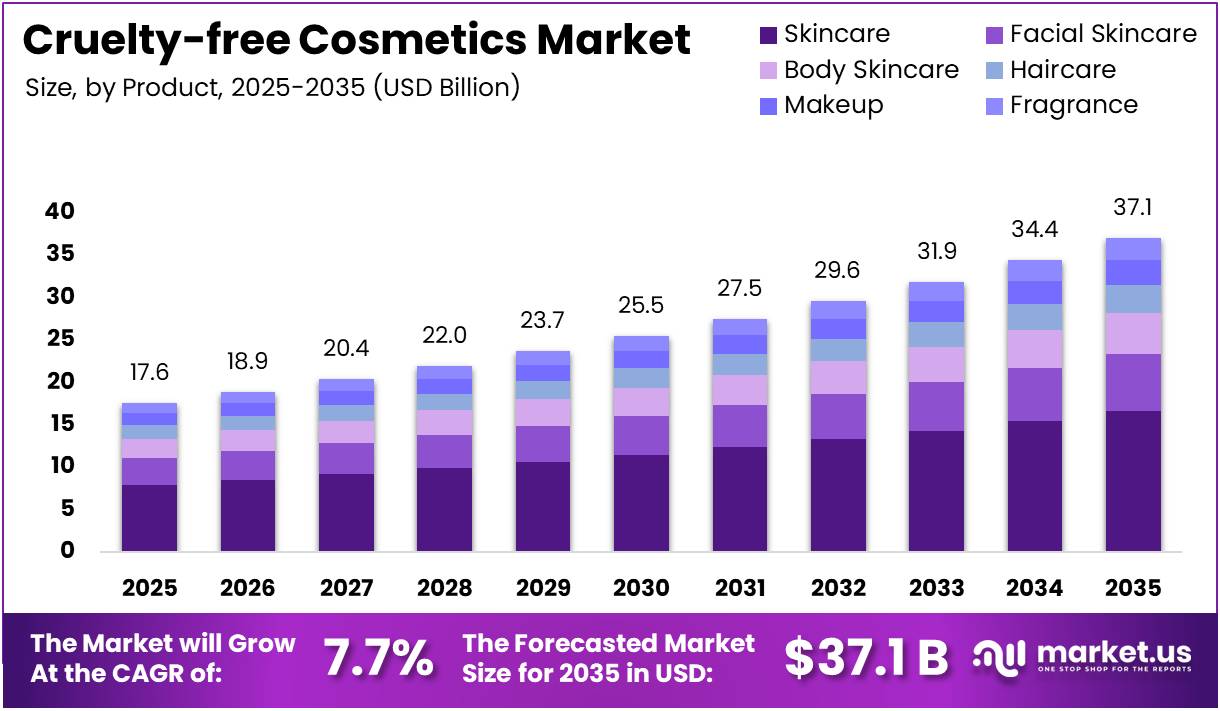
The Global Cruelty-free Cosmetics Market size is expected to be worth around USD 37.1 Billion by 2035 from USD 17.5 Billion in 2025, growing at a CAGR of 7.7% during the forecast period 2026 to 2035.
The cruelty-free cosmetics market encompasses beauty and personal care products developed and manufactured without any form of animal testing. These products span skincare, haircare, makeup, and fragrances categories. Brands operating in this space are committed to ethical sourcing, transparent ingredient use, and certified animal-free testing practices.
Consumer awareness about animal welfare and environmental responsibility has accelerated demand for cruelty-free alternatives. Governments across the European Union, the United Kingdom, and several Asian markets have enacted or proposed strict bans on animal-tested cosmetics. This regulatory momentum continues to reshape product development and brand positioning strategies globally.
Emerging economies across Asia Pacific, Latin America, and the Middle East represent significant growth opportunities for this market. Rising disposable incomes, urban youth populations, and growing ethical awareness are driving adoption in these regions. Moreover, brands are actively expanding reach through both digital platforms and physical retail networks.
Regulatory support is further reinforcing market growth. Governments and international bodies are increasingly mandating transparency in testing methods and ingredient sourcing. Additionally, sustainability-linked policies are encouraging brands to adopt certified animal-free processes, which strengthens consumer confidence and market credibility across key global regions.
Social media advocacy and conscious consumerism are amplifying demand for cruelty-free cosmetics at a rapid pace. Younger consumers actively seek certified animal-free products before making purchasing decisions. Consequently, brands that align their messaging with ethical beauty values are gaining stronger consumer loyalty and long-term brand trust.
The market’s upward trajectory is backed by compelling consumer data. According to Mytopicals, 85% of consumers claim to use vegan and cruelty-free cosmetics on a regular basis. This statistic highlights the deep integration of ethical values into mainstream beauty purchasing behavior and reinforces the long-term growth potential of this market.
Key Takeaways
- The global Cruelty-free Cosmetics Market is valued at USD 17.5 Billion in 2025 and is projected to reach USD 37.1 Billion by 2035.
- The market is expected to expand at a CAGR of 7.7% during the forecast period 2026 to 2035.
- By Product, Skincare dominates the market with a 45.3% share in 2025.
- By End Use, Women leads with a 76.1% market share, representing the largest consumer group.
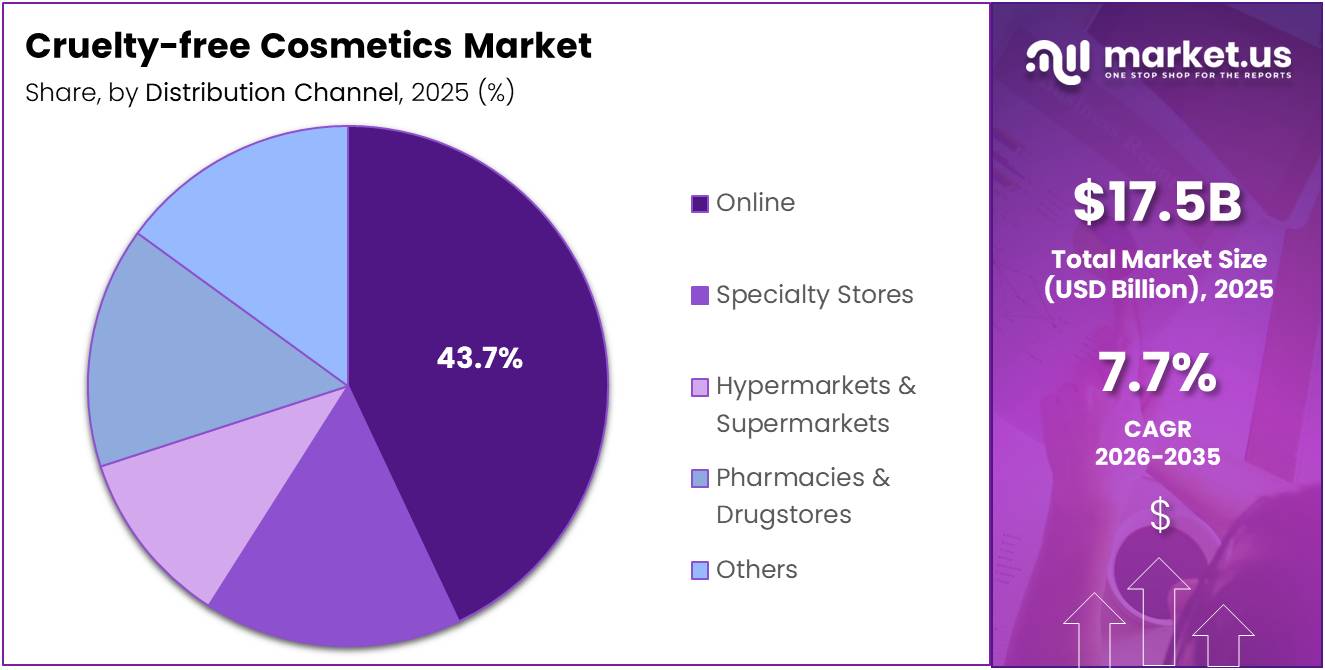
- By Distribution Channel, Online holds the largest share at 43.7%, driven by growing e-commerce adoption.
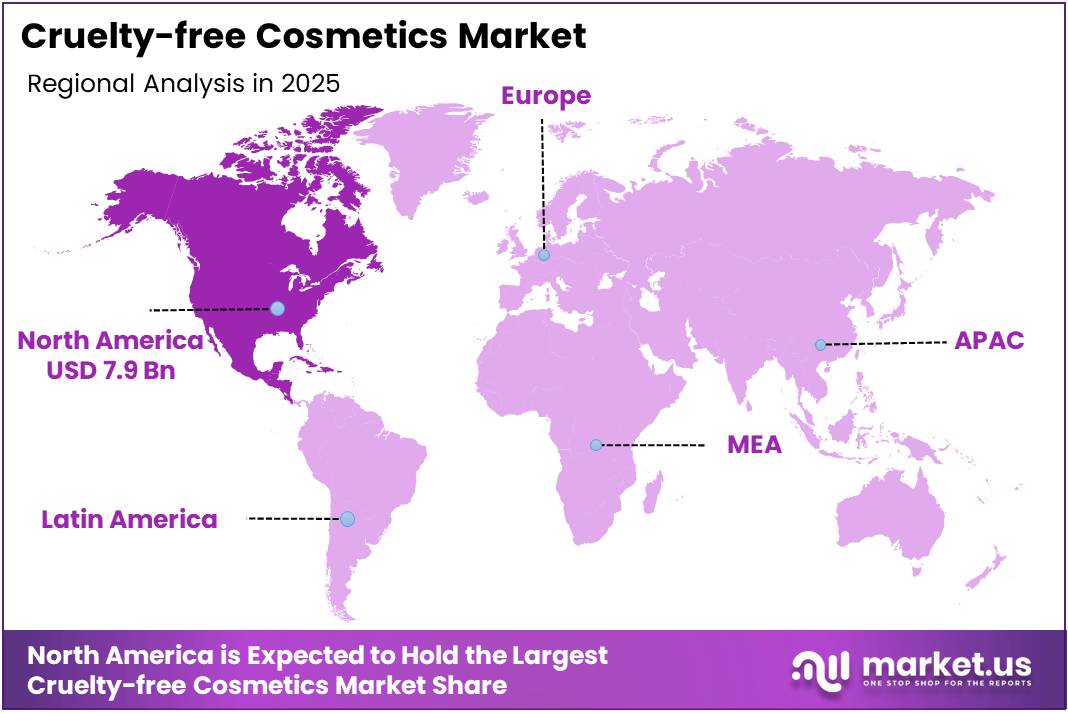
- North America is the leading region with a 45.70% market share, valued at USD 7.9 Billion.
By Product Analysis
Skincare dominates with 45.3% due to high consumer demand for ethical facial and body care products.
In 2025, Skincare held a dominant market position in the By Product segment of the Cruelty-free Cosmetics Market, with a 45.3% share. This segment is broadly driven by growing consumer focus on certified, animal-free daily care routines and increasing demand for transparent ingredient sourcing across personal care categories.
Facial Skincare is the leading sub-segment within skincare, driven by strong consumer demand for cruelty-free moisturizers, serums, facial cleansers, and toners. Consumers are increasingly prioritizing certified animal-free formulations for daily facial care. Moreover, rising awareness of skin health and ingredient transparency is accelerating adoption of ethical facial skincare products globally.
Body Skincare is a steadily growing sub-segment as consumers extend their ethical beauty choices beyond facial care to full-body routines. Products such as cruelty-free body lotions, scrubs, and washes are gaining traction. Additionally, increasing preference for plant-based and certified animal-free body care formulations is supporting consistent demand growth.
Haircare is expanding as consumers seek cruelty-free shampoos, conditioners, and treatment products free from animal-derived ingredients. Rising awareness around ethical formulation and ingredient safety is positioning haircare among the fastest growing categories within the global cruelty-free cosmetics market.
Makeup, including foundations, lip colors, and eye products, is gaining significant traction as ethical beauty standards rise globally. Consumers are actively choosing certified animal-free cosmetic alternatives. Consequently, brands are broadening their cruelty-free makeup portfolios to meet demand across diverse consumer demographics.
Fragrance is an emerging sub-segment within the cruelty-free cosmetics market. Growing preference for plant-based and synthetic fragrance alternatives is opening new product opportunities. Brands are actively introducing certified cruelty-free perfumes and body sprays to serve the expanding base of ethically conscious consumers worldwide.
By End Use Analysis
Women dominates with 76.1% due to strong engagement with ethical skincare, makeup, and personal care products.
In 2025, Women held a dominant market position in the By End Use segment of the Cruelty-free Cosmetics Market, with a 76.1% share. Women represent the largest consumer group, driven by high engagement with certified cruelty-free skincare, makeup, and haircare products aligned with ethical and sustainable values.
Men represent a steadily growing sub-segment as male grooming habits evolve toward ethical and sustainable beauty standards. Brands are developing dedicated cruelty-free grooming ranges including haircare and skincare products. Additionally, rising awareness is fueling demand within a commercially promising and increasingly conscious male consumer base.
Unisex products are gaining traction among younger, inclusivity-focused consumers who prefer gender-neutral beauty options. Growing preference for ethical and transparent formulations is driving this sub-segment forward. Brands are launching cruelty-free unisex product lines to reach a broader and more diverse global consumer audience.
Children represent a niche but growing sub-segment within the cruelty-free cosmetics market. Parents are increasingly prioritizing safe, non-toxic, and animal-free formulations for young skin. Therefore, brands are introducing certified cruelty-free products designed specifically for children, supported by parent-focused education and ethical marketing strategies.
By Distribution Channel Analysis
Online dominates with 43.7% due to growing e-commerce adoption and convenience-driven purchasing behavior.
In 2025, Online held a dominant market position in the By Distribution Channel segment of the Cruelty-free Cosmetics Market, with a 43.7% share. The rapid rise of e-commerce and direct-to-consumer platforms has made online the preferred purchasing channel for cruelty-free beauty consumers worldwide.
Specialty Stores are a key distribution channel for cruelty-free cosmetics, offering curated product ranges and personalized shopping experiences. These stores attract ethically conscious shoppers seeking in-depth product knowledge. Moreover, they help brands build strong consumer relationships across major urban retail markets globally.
Hypermarkets and Supermarkets offer broad consumer access to cruelty-free products through high-footfall retail environments. Strong shelf visibility and in-store promotions help brands reach a wider mainstream audience. Consequently, this channel plays an important role in driving mass-market adoption of cruelty-free beauty products.
Pharmacies and Drugstores serve consumers seeking trusted, dermatologist-endorsed, and certified cruelty-free products. This channel benefits from a health-focused positioning that aligns well with ethical beauty values. Additionally, pharmacies provide an important retail touchpoint for consumers prioritizing safety and certification in their beauty purchases.
Others, including department stores and independent boutiques, cater to niche and premium cruelty-free beauty buyers. These formats support brand discovery and exclusivity-driven purchasing behavior. Moreover, they complement broader distribution strategies by reaching segments not fully served through mass-market or digital retail channels.
Key Market Segments
By Product
- Skincare
- Facial Skincare
- Body Skincare
- Haircare
- Makeup
- Fragrance
By End Use
- Women
- Men
- Unisex
- Children
By Distribution Channel
- Online
- Specialty Stores
- Hypermarkets and Supermarkets
- Pharmacies and Drugstores
- Others
Drivers
Rising Ethical Awareness and Regulatory Support Drive Cruelty-Free Cosmetics Market Growth
Consumer demand for ethical and animal-free beauty products has increased significantly in recent years. Shoppers are becoming more aware of the impact of animal testing and are choosing certified cruelty-free options. This behavioral shift is one of the most powerful forces driving sustained growth in the cruelty-free cosmetics market.
Regulatory bans on animal testing are accelerating the transition toward cruelty-free formulations across global markets. Countries in Europe, Asia, and the Americas are strengthening legal frameworks to prohibit animal-tested cosmetic products. Consequently, brands are proactively reformulating and seeking certifications to remain compliant and competitive in these tightening regulatory environments.
Social media advocacy and conscious consumerism are amplifying demand for cruelty-free cosmetics at a rapid pace. Influencers and ethical lifestyle communities actively promote animal-free brands to millions of consumers. Moreover, this digital awareness is compelling both established and emerging brands to align product development with clear cruelty-free standards.
Restraints
Certification Ambiguity and Testing Gaps Restrain Full Market Potential
A significant restraint in the cruelty-free cosmetics market is the lack of global standardization in cruelty-free certifications. Different certification bodies apply varying definitions and criteria, creating confusion among consumers and manufacturers alike. This inconsistency makes it difficult for brands to build uniform trust across multiple international markets.
The absence of a universally recognized certification standard leads to consumer skepticism about product claims. Many shoppers are unable to verify whether a cruelty-free label meets credible standards. Therefore, this ambiguity reduces purchasing confidence and slows decision-making, particularly among consumers new to the ethical beauty category.
Limited availability of universally accepted alternative testing methods further constrains market expansion. While in-vitro and computational models are advancing, they are not yet fully recognized by all regulatory authorities as complete replacements. Consequently, some markets still require animal-tested safety data, creating ongoing compliance challenges for cruelty-free brands.
Growth Factors
Emerging Market Expansion and Alternative Testing Innovation Accelerate Market Growth
Expanding into emerging markets with rising ethical awareness presents a major growth opportunity for cruelty-free cosmetics brands. Regions including Asia Pacific, Latin America, and the Middle East are witnessing growing consumer interest in sustainable and animal-free beauty products. Moreover, expanding middle-class populations in these areas are generating new and sustained demand.
Innovation in alternative testing technologies, particularly in-vitro and AI-based models, is enabling brands to develop safe, certified products without animal testing. These technologies are becoming more cost-effective and scientifically validated over time. Consequently, their broader adoption is expected to remove key technical and regulatory barriers to cruelty-free product development.
Strategic collaborations between cosmetic brands and recognized ethical certification bodies are strengthening market credibility and raising product standards. These partnerships ensure products meet rigorous cruelty-free benchmarks, building strong consumer trust. Additionally, co-branded certifications are becoming powerful marketing tools that support premium positioning and drive broader market growth.
Emerging Trends
Vegan Formulations, Ingredient Transparency, and Indie Brands Reshape the Cruelty-Free Cosmetics Landscape
A prominent trend in the cruelty-free cosmetics market is the rapid surge in vegan-certified and plant-based product formulations. Brands are reformulating using natural, animal-free ingredients to meet evolving consumer demand. Moreover, the growing overlap between vegan and cruelty-free standards is accelerating the development of dual-certified product portfolios globally.
Increased transparency through ingredient traceability and clear product labeling is becoming a key brand differentiator. Consumers are demanding full visibility into ingredient sourcing, processing methods, and testing practices. Consequently, brands that offer honest and detailed product communication are earning stronger consumer loyalty and a more competitive market position.
The growth of indie and direct-to-consumer cruelty-free brands is reshaping competitive dynamics across this market. Smaller brands are leveraging digital platforms to connect directly with ethical beauty consumers. Additionally, their agility in adopting new certifications and formulations quickly gives them a meaningful competitive edge over larger, more established players.
Regional Analysis
North America Dominates the Cruelty-free Cosmetics Market with a Market Share of 45.70%, Valued at USD 7.9 Billion
North America leads the global cruelty-free cosmetics market, holding a 45.70% share and valued at USD 7.9 Billion in 2025. Strong regulatory frameworks, high consumer awareness, and a well-established network of certified cruelty-free brands underpin this region’s leadership. Additionally, the United States remains the dominant national contributor within this region.
Europe Cruelty-free Cosmetics Market Trends
Europe holds a significant position in the cruelty-free cosmetics market, supported by early adoption of animal testing bans and strict regulatory standards. Countries including Germany, France, and the UK are key contributors to regional demand. Moreover, growing consumer preference for ethically certified beauty products continues to support steady market expansion across Europe.
Asia Pacific Cruelty-free Cosmetics Market Trends
Asia Pacific represents the fastest growing regional market, driven by rising ethical awareness among younger urban consumers in China, India, Japan, and South Korea. Expanding e-commerce infrastructure and growing disposable incomes are broadening access to cruelty-free beauty products. Additionally, the region offers significant long-term growth potential for global ethical beauty brands.
Middle East and Africa Cruelty-free Cosmetics Market Trends
The Middle East and Africa market is at an early but progressing stage of cruelty-free cosmetics adoption. Rising urbanization, growing awareness of ethical beauty, and a young expanding population are creating fresh demand. Consequently, international brands are beginning to establish a stronger presence in key GCC markets and South Africa.
Latin America Cruelty-free Cosmetics Market Trends
Latin America is emerging as a relevant market for cruelty-free cosmetics, led by Brazil and Mexico. Growing awareness of animal welfare and increasing access to certified products through online retail are supporting regional expansion. Moreover, local brands are beginning to adopt cruelty-free certifications to align with rising consumer expectations in the region.
Key Regions and Countries
North America
- US
- Canada
Europe
- Germany
- France
- The UK
- Spain
- Italy
- Rest of Europe
Asia Pacific
- China
- Japan
- South Korea
- India
- Australia
- Rest of APAC
Latin America
- Brazil
- Mexico
- Rest of Latin America
Middle East & Africa
- GCC
- South Africa
- Rest of MEA
Key Company Insights
e.l.f. Cosmetics, Inc. is a prominent cruelty-free cosmetics brand recognized globally for its fully vegan and certified animal-free product portfolio. The company has strategically positioned itself as an accessible yet ethically responsible beauty label. Its strong digital presence, influencer marketing partnerships, and competitive pricing strategy have fueled rapid growth among younger, ethically conscious consumers across North America and key international markets.
The Body Shop International Limited has been a pioneer and influential advocate in the global cruelty-free beauty movement for several decades. The brand actively campaigns against animal testing and holds certifications from leading ethical organizations worldwide. Moreover, its commitment to community trade sourcing, sustainable ingredient practices, and transparent communication reinforces its position as a globally recognized and purpose-driven ethical beauty brand.
Urban Decay has established a strong and distinctive identity as a certified vegan and cruelty-free brand within the color cosmetics segment. Its consistent product innovation, particularly across makeup and eye care categories, resonates powerfully with a younger, ethically aware consumer base. Additionally, strategic retail distribution and wide accessibility have contributed to expanding the brand’s global presence and cruelty-free portfolio reach.
Too Faced Cosmetics, LLC offers a comprehensive cruelty-free range spanning makeup, skincare, and beauty accessories. The brand has cultivated a highly engaged consumer community through its inclusive and vibrant brand identity. Consequently, it has successfully merged ethical beauty values with strong commercial performance, sustaining consistent visibility across both physical retail and online channels in North America and international markets.
Key Players
- e.l.f. Cosmetics, Inc.
- The Body Shop International Limited
- Urban Decay
- Too Faced Cosmetics, LLC
- Markwins Beauty Products, Inc. (wet n wild)
- Burt’s Bees
- bareMinerals
- Charlotte Tilbury Beauty Inc.
- Milani Cosmetics
- Garnier LLC
Recent Developments
- March 2026 – The Estée Lauder Companies agreed to acquire Ayurvedic beauty line Forest Essentials, marking a strategic move to expand its portfolio into the fast-growing natural and ethically positioned beauty segment, further strengthening its global cruelty-free and wellness-aligned brand presence.
- October 2025 – L’Oréal acquired Kering Beauté from Kering in a deal valued at €4 billion, significantly strengthening its beauty portfolio and expanding its exposure to ethically positioned and premium beauty brands across key global markets.
- September 2025 – Myntra partnered with SUGAR Cosmetics to launch Molten Beauty, a Gen Z-focused brand built on vegan and cruelty-free formulations, targeting a rapidly growing base of young, ethically conscious beauty consumers across digital retail platforms.
Report Scope
Report Features Description Market Value (2025) USD 17.5 Billion Forecast Revenue (2035) USD 37.1 Billion CAGR (2026-2035) 7.7% Base Year for Estimation 2025 Historic Period 2020-2024 Forecast Period 2026-2035 Report Coverage Revenue Forecast, Market Dynamics, Competitive Landscape, Recent Developments Segments Covered By Product (Skincare, Haircare, Makeup, Fragrance), By End Use (Women, Men, Unisex, Children), By Distribution Channel (Online, Specialty Stores, Hypermarkets & Supermarkets, Pharmacies & Drugstores, Others) Regional Analysis North America (US and Canada), Europe (Germany, France, The UK, Spain, Italy, and Rest of Europe), Asia Pacific (China, Japan, South Korea, India, Australia, and Rest of APAC), Latin America (Brazil, Mexico, and Rest of Latin America), Middle East & Africa (GCC, South Africa, and Rest of MEA) Competitive Landscape e.l.f. Cosmetics, Inc., The Body Shop International Limited, Urban Decay, Too Faced Cosmetics, LLC, Markwins Beauty Products, Inc. (wet n wild), Burt’s Bees, bareMinerals, Charlotte Tilbury Beauty Inc., Milani Cosmetics, Garnier LLC Customization Scope Customization for segments, region/country-level will be provided. Moreover, additional customization can be done based on the requirements. Purchase Options We have three licenses to opt for: Single User License, Multi-User License (Up to 5 Users), Corporate Use License (Unlimited User and Printable PDF)  Cruelty-free Cosmetics MarketPublished date: March 2026add_shopping_cartBuy Now get_appDownload Sample
 -
-
- e.l.f. Cosmetics, Inc.
- The Body Shop International Limited
- Urban Decay
- Too Faced Cosmetics, LLC
- Markwins Beauty Products, Inc. (wet n wild)
- Burt's Bees
- bareMinerals
- Charlotte Tilbury Beauty Inc.
- Milani Cosmetics
- Garnier LLC
Our Clients

- 181586
- March 2026






