


Global Conveyor Oven Market Size, Share, Growth Analysis By Type (Belt Conveyor Oven, Vertical Conveyor Oven, Overhead Conveyor Oven, Chain-on-Edge Conveyor Oven, Tunnel Conveyor Oven, Others), By Power Source (Electric Conveyor Oven, Gas Conveyor Oven), By Heating Technology (Convection, Radiation), By End-User (QSRs, Full-Service Restaurants, Food Processing & Manufacturing Facilities, Others), By Region and Companies - Industry Segment Outlook, Market Assessment, Competition Scenario, Statistics, Trends and Forecast 2026-2035
- Published date: Feb 2026
- Report ID: 180140
- Number of Pages: 286
- Format:
-
keyboard_arrow_up
Quick Navigation
Report Overview
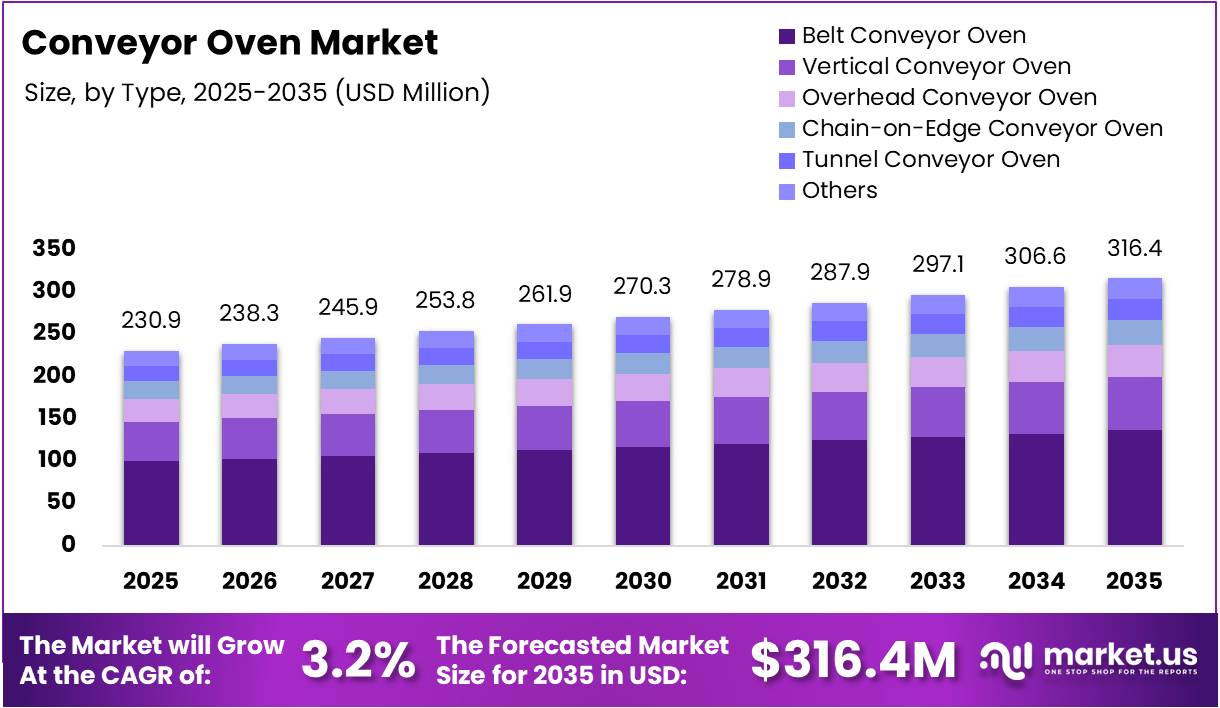
The Global Conveyor Oven Market size is expected to be worth around USD 316.4 Million by 2035 from USD 230.9 Million in 2025, growing at a CAGR of 3.2% during the forecast period 2026 to 2035.
Conveyor ovens are continuous cooking systems that move food products through a heated chamber via a moving belt or chain mechanism. They are widely used in commercial kitchens, quick-service restaurants, and industrial food production facilities. Moreover, these ovens deliver consistent and repeatable cooking results, making them a preferred choice where high volumes and uniform output are essential.
The market is expanding steadily due to the rapid growth of quick-service restaurant chains worldwide. Operators are adopting conveyor ovens to reduce labor dependency and achieve cooking consistency across multiple locations. Additionally, food processing facilities are increasingly integrating conveyor-based cooking systems to streamline production and meet growing consumer demand.
Government food safety standards and energy efficiency regulations are shaping the direction of product development in this market. Regulatory bodies in several regions are encouraging the adoption of energy-efficient commercial kitchen equipment. Consequently, manufacturers are investing in advanced conveyor oven designs that meet compliance requirements while lowering operational energy costs.
Energy efficiency is a key performance driver in this market. According to metos.com, conveyor ovens with stand-by mode reduce deck temperature by 25%, enabling up to 20–30% energy savings during idle periods. Furthermore, according to culinarydepotinc.com, modern conveyor ovens with smart technology can reduce cooking times by up to 20%.
Technical benchmarks for efficiency continue to evolve across product categories. According to icc.illinois.gov, high-efficiency natural-gas conveyor ovens have a baking energy efficiency greater than 42%. Additionally, conveyor ovens eligible for energy efficiency measures must have a conveyor width greater than 25 inches, setting clear product standards for manufacturers and buyers.
The rise of cloud kitchens and centralized food production models is further supporting market growth. These operations rely on high-output cooking equipment that can handle diverse menu items with minimal manual intervention. Therefore, demand for versatile conveyor oven systems with multi-menu capability is expected to increase throughout the forecast period.
Key Takeaways
- The Global Conveyor Oven Market is valued at USD 230.9 Million in 2025 and is projected to reach USD 316.4 Million by 2035.
- The market is expected to grow at a CAGR of 3.2% during the forecast period 2026 to 2035.
- By Type, Belt Conveyor Oven dominates with a market share of 43.28% in 2025.
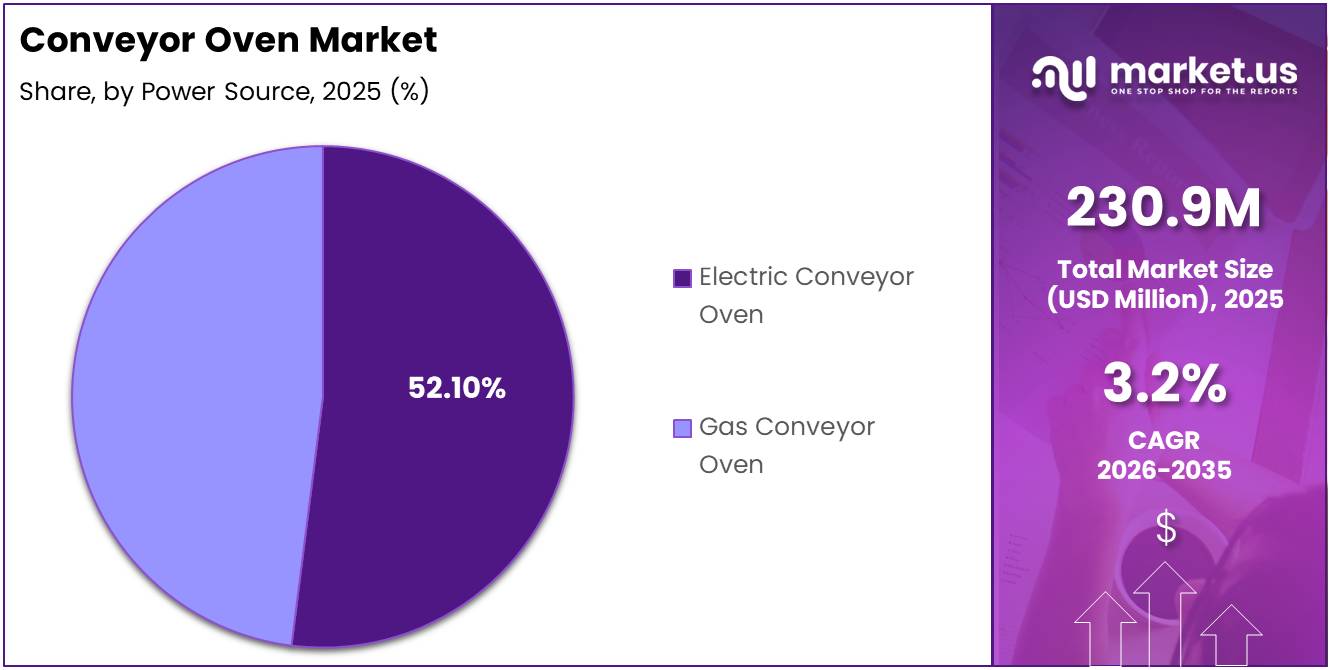
- By Power Source, Electric Conveyor Oven holds the leading share of 52.10% in the market.
- By Heating Technology, Convection leads with a dominant share of 64.82%.
- By End-User, QSRs account for the highest share at 49.27% of the total market.
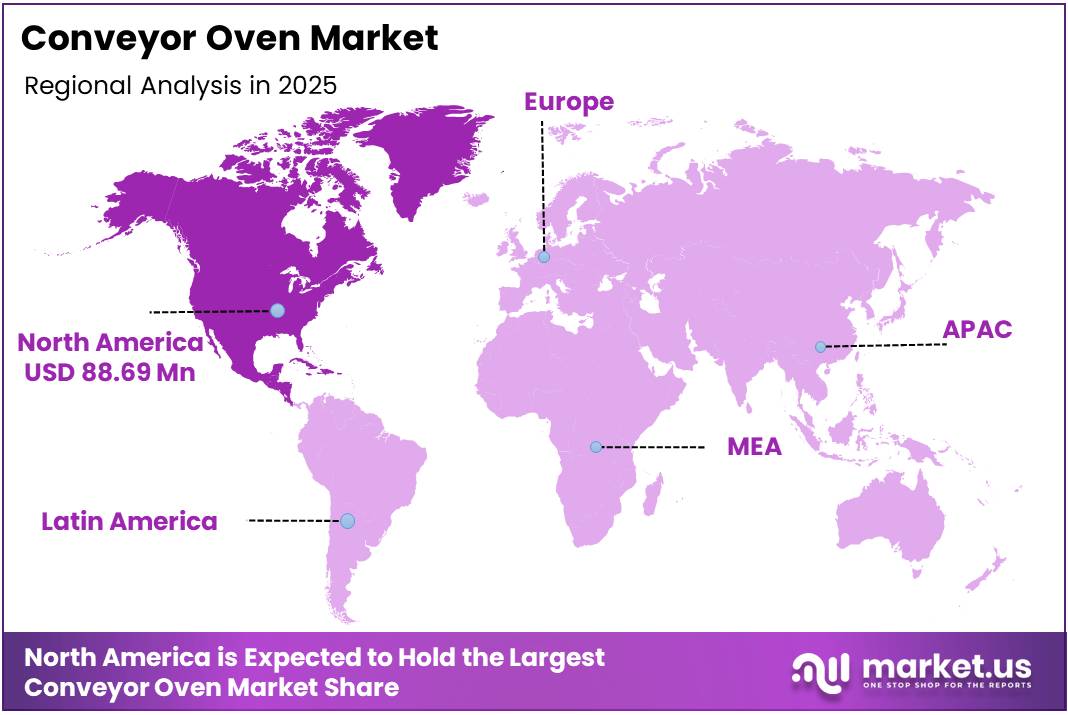
- North America dominates the regional market with a share of 38.41%, valued at USD 88.69 Million.
By Type Analysis
Belt Conveyor Oven dominates with 43.28% due to its wide use in high-volume commercial kitchen operations.
In 2025, Belt Conveyor Oven held a dominant market position in the By Type segment of the Conveyor Oven Market, with a 43.28% share. These ovens are widely preferred for their ability to deliver consistent, high-volume cooking with minimal operator intervention, making them essential in fast-food chains and commercial kitchen environments.
Vertical Conveyor Oven is gaining recognition for its space-efficient design. These ovens stack the conveyor path vertically, allowing operators to maintain high throughput in smaller kitchen footprints. However, they are typically deployed in specialty or compact kitchen setups where horizontal space is limited but output demand remains significant.
Overhead Conveyor Oven systems are used primarily in large-scale food manufacturing environments. These ovens suspend products on overhead carriers, enabling continuous processing of large batches. Additionally, their design supports complex production lines where floor space optimization and integration with other equipment are key operational requirements.
Chain-on-Edge Conveyor Oven is suited for industrial applications requiring precise product orientation during cooking. These systems hold products on edge using specialized chain carriers, ensuring even heat exposure for specific product types. Consequently, they are widely adopted in food processing plants handling structured or shaped food products.
Tunnel Conveyor Oven is widely used in large-scale baking and food processing operations. These fully enclosed ovens provide a controlled thermal environment, supporting uniform baking at high throughput. Consequently, they are a preferred choice for industrial bakeries and food manufacturers requiring consistent, continuous-flow cooking at scale.
Others in this segment include specialty and custom-designed conveyor ovens serving niche industrial and foodservice applications. These solutions are tailored to meet unique operational requirements that standard oven configurations cannot address. Therefore, they remain a relevant category for operators with highly specific cooking process or production line demands.
By Power Source Analysis
Electric Conveyor Oven dominates with 52.10% due to its energy efficiency and ease of installation.
In 2025, Electric Conveyor Oven held a dominant market position in the By Power Source segment of the Conveyor Oven Market, with a 52.10% share. Electric models are preferred for their precise temperature control, cleaner operation, and compatibility with modern energy management systems, particularly in urban commercial kitchen environments.
Gas Conveyor Oven remains a strong alternative for operators seeking high-heat cooking at lower fuel costs. These ovens are widely used in regions with established gas infrastructure and in operations requiring faster heat recovery times. However, tightening energy regulations in some markets may gradually shift demand toward electric alternatives over time.
By Heating Technology Analysis
Convection dominates with 64.82% due to its efficient and uniform heat distribution across food products.
In 2025, Convection held a dominant market position in the By Heating Technology segment of the Conveyor Oven Market, with a 64.82% share. Convection technology uses forced air circulation to deliver uniform heat across food products, reducing cooking time and improving consistency, making it the preferred choice across most commercial foodservice applications.
Radiation-based conveyor ovens use direct infrared heat transfer to cook food products. These ovens are suited for applications requiring surface browning, crisping, or rapid heating. Moreover, radiation heating offers precise energy targeting, making it effective for specialty menu items that require controlled surface treatment without prolonged exposure to ambient heat.
By End-User Analysis
QSRs dominate with 49.27% due to their high-volume, speed-focused cooking operations.
In 2025, QSRs held a dominant market position in the By End-User segment of the Conveyor Oven Market, with a 49.27% share. Quick-service restaurants rely heavily on conveyor ovens to deliver consistent cooking results at high speeds, supporting their core operational model of fast and standardized food preparation across locations.
Full-Service Restaurants represent a growing user segment for conveyor ovens. These establishments use conveyor systems to manage high-volume cooking during peak service periods while maintaining food quality standards. Additionally, the adoption of conveyor ovens in full-service settings allows kitchen staff to focus on presentation and service rather than monitoring cooking equipment.
Food Processing and Manufacturing Facilities are a major end-user segment for industrial-grade conveyor ovens. These facilities require continuous, high-throughput cooking systems that integrate into automated production lines. Consequently, conveyor ovens designed for manufacturing use feature heavy-duty construction, larger belt widths, and advanced thermal management for extended production cycles.
Others in this segment include catering businesses, institutional kitchens, and convenience food retailers. These operators use conveyor ovens to meet variable cooking demands efficiently. Therefore, flexible and compact conveyor oven models with adjustable settings are increasingly in demand across these diverse end-user categories.
Key Market Segments
By Type
- Belt Conveyor Oven
- Vertical Conveyor Oven
- Overhead Conveyor Oven
- Chain-on-Edge Conveyor Oven
- Tunnel Conveyor Oven
- Others
By Power Source
- Electric Conveyor Oven
- Gas Conveyor Oven
By Heating Technology
- Convection
- Radiation
By End-User
- QSRs
- Full-Service Restaurants
- Food Processing and Manufacturing Facilities
- Others
Drivers
Rapid Expansion of Quick-Service Restaurants Drives Consistent Demand for Conveyor Ovens
The rapid global expansion of quick-service restaurant chains is a primary driver of the conveyor oven market. As QSR operators open new locations at scale, they require standardized cooking equipment that delivers consistent results across all outlets. Consequently, conveyor ovens have become integral to QSR kitchen operations worldwide.
Increasing demand for high-throughput cooking solutions is further accelerating market growth. Foodservice operators are under pressure to serve more customers in less time without compromising food quality. Therefore, conveyor ovens that maintain speed and consistency simultaneously are highly valued across both chain and independent restaurant formats.
The growing adoption of automated and continuous cooking equipment is reshaping kitchen operations industry-wide. Operators are moving away from manual cooking methods to reduce labor costs and minimize human error. Moreover, automated conveyor systems support standardized recipes, which is critical for large-scale foodservice brands maintaining quality across multiple locations.
Restraints
Large Equipment Footprint and Complex Maintenance Requirements Restrain Market Adoption
The large physical size of conveyor ovens is a significant barrier to adoption in space-constrained commercial kitchens. Many urban and small-footprint restaurants lack the floor area required to install full-scale conveyor systems. Therefore, operators in these settings often opt for smaller cooking equipment despite the throughput advantages conveyor ovens offer.
Space limitations are particularly challenging in dense urban markets where restaurant square footage is limited and costly. Installing conveyor ovens in these environments may require structural modifications or kitchen redesigns. Consequently, the additional investment beyond equipment purchase can discourage adoption among smaller or budget-constrained foodservice operators.
Complex maintenance and technical servicing requirements also restrain market growth. Conveyor ovens consist of multiple mechanical and electronic components that require specialized technicians for routine servicing and repairs. Moreover, unplanned downtime due to equipment failure can significantly disrupt kitchen operations, making total cost of ownership a key concern for operators evaluating adoption.
Growth Factors
Smart Technology Integration and Emerging Market Demand Unlock New Growth Opportunities
The integration of smart controls and IoT-enabled monitoring systems is creating significant growth opportunities in the conveyor oven market. These technologies allow operators to remotely monitor cooking parameters, receive maintenance alerts, and optimize energy consumption. Therefore, smart-enabled conveyor ovens are increasingly attractive to large-scale foodservice operators managing multiple kitchen locations.
The expansion of centralized and cloud kitchen models is also fueling market growth. Cloud kitchens operate high-volume cooking from centralized facilities, requiring reliable and efficient conveyor-based cooking equipment. Moreover, as the cloud kitchen segment continues to grow globally, demand for industrial-grade conveyor ovens is expected to rise accordingly.
Rising demand from the organized foodservice sector in emerging markets presents a strong growth opportunity. Rapid urbanization and changing consumer dining habits are driving chain restaurant and food court expansion in Asia Pacific, Latin America, and the Middle East. Consequently, these regions are becoming increasingly important markets for conveyor oven manufacturers.
Emerging Trends
Ventless Technologies and Multi-Cooking Capabilities Reshape the Conveyor Oven Market
The increasing shift toward ventless and eco-friendly oven technologies is a prominent trend shaping the conveyor oven market. Ventless models eliminate the need for traditional hood ventilation systems, enabling easier installation in diverse kitchen environments. Moreover, this technology aligns with sustainability commitments among foodservice operators seeking to reduce energy use and emissions.
The adoption of modular and customizable conveyor oven designs is gaining momentum across the industry. Operators now seek equipment that can be adapted to specific menu requirements, kitchen layouts, and production volumes. Additionally, modular designs allow for easier upgrades and maintenance, reducing total lifecycle costs and supporting operational flexibility for growing foodservice businesses.
Growing popularity of multi-cooking and multi-menu capability systems is another significant trend emerging in the market. Modern conveyor ovens are being developed to handle multiple cooking modes within a single unit, supporting diverse menu items simultaneously. Therefore, these systems offer strong operational advantages for full-service restaurants and cloud kitchens managing broad and frequently changing menus.
Regional Analysis
North America Dominates the Conveyor Oven Market with a Market Share of 38.41%, Valued at USD 88.69 Million
North America holds the leading position in the global conveyor oven market, accounting for a 38.41% share and valued at USD 88.69 Million in 2025. The region’s dominance is driven by its large and well-established quick-service restaurant sector, high equipment replacement rates, and strong adoption of commercial kitchen automation technology.
Europe Conveyor Oven Market Trends
Europe represents a mature market for conveyor ovens, supported by a strong commercial foodservice industry across Germany, France, the UK, and Italy. Demand is driven by food safety regulations and energy efficiency standards that favor modern cooking equipment. Moreover, the growing popularity of fast-casual dining is supporting ongoing equipment upgrades across the region.
Asia Pacific Conveyor Oven Market Trends
Asia Pacific is the fastest-growing regional market, driven by rapid urbanization, rising disposable incomes, and the expansion of organized foodservice chains. Countries such as China, India, and Japan are seeing strong growth in QSR and food processing sectors. Consequently, demand for high-throughput conveyor oven systems is increasing significantly across this region.
Middle East and Africa Conveyor Oven Market Trends
The Middle East and Africa market is developing steadily, supported by the expansion of international food chains and growing hospitality infrastructure. Key markets such as the GCC are investing in modern commercial kitchen equipment. Additionally, increasing demand for processed and ready-to-eat food products is creating new opportunities for conveyor oven adoption.
Latin America Conveyor Oven Market Trends
Latin America presents emerging growth potential for the conveyor oven market, led by Brazil and Mexico. The expanding organized foodservice sector and rising consumer preference for quick-service meals are key growth drivers. However, economic volatility and limited access to after-sales service remain challenges for broader market penetration in this region.
Key Regions and Countries
North America
- US
- Canada
Europe
- Germany
- France
- The UK
- Spain
- Italy
- Rest of Europe
Asia Pacific
- China
- Japan
- South Korea
- India
- Australia
- Rest of APAC
Latin America
- Brazil
- Mexico
- Rest of Latin America
Middle East & Africa
- GCC
- South Africa
- Rest of MEA
Key Company Insights
Davron Technologies Inc. is a recognized manufacturer of industrial conveyor and tunnel ovens, serving industries ranging from food processing to electronics manufacturing. The company specializes in custom thermal processing solutions designed to meet specific production requirements. Its engineering-focused approach enables precise temperature control and reliable performance across diverse industrial and commercial applications.
Dvorson’s Food Service Equipment Inc. focuses on the distribution and supply of commercial foodservice equipment, including conveyor ovens from leading manufacturers. The company offers comprehensive product selection and technical support services to restaurants and institutional kitchens. Moreover, its deep market knowledge enables it to match clients with the most suitable conveyor oven solutions for their operational needs.
Infratrol LLC is a specialized manufacturer of infrared and conveyor cooking systems for the commercial foodservice sector. The company’s products are known for energy efficiency and compact design, making them suitable for operators with limited kitchen space. Additionally, Infratrol’s systems are engineered to deliver fast, consistent cooking results with lower energy consumption compared to conventional alternatives.
International Thermal Systems provides industrial thermal processing equipment, including conveyor ovens used in food production and processing environments. The company designs customized systems for high-volume manufacturing operations requiring consistent, repeatable heat application. Consequently, its solutions are widely adopted in sectors where reliable continuous-flow cooking and precise throughput controls are critical operational priorities.
Key Players
- Davron Technologies Inc.
- Dvorson’s Food Service Equipment Inc.
- Infratrol LLC
- International Thermal Systems
- Lewco Inc.
- Mahan Oven And Engineering Co. Inc.
- Moretti Forni Spa
- Oem Ali Group S.r.l
- The Middleby Corporation
- Wisconsin Oven Corporation
- XLT Ovens
- Lincoln Electric Holdings, Inc. (Lincoln Ovens division)
- Italforni S.r.l.
- Blodgett Oven Company
- Zanolli S.r.l.
- Ovention, Inc.
- C.H. Ellis, Inc.
- Belleco, Inc.
- Others
Recent Developments
- December 2025 – 26North agreed to acquire a 51% stake in Middleby’s commercial division, marking a significant strategic transaction in the commercial foodservice equipment sector. This acquisition reflects ongoing consolidation trends among key players in the conveyor oven and broader commercial cooking equipment market.
- September 2025 – Middleby introduced LongWave™ Infrared Conveyor Oven technology, a new advanced conveyor oven solution designed to expand high-volume commercial cooking capabilities. This innovation signals growing investment in infrared-based conveyor cooking systems capable of delivering faster and more energy-efficient cooking results.
- October 2024 – Paragon acquired a majority stake in TP Food Group, strengthening its position in the food processing and commercial kitchen equipment sector. This move highlights the increasing strategic interest from investment firms in the global foodservice equipment industry.
Report Scope
Report Features Description Market Value (2025) USD 230.9 Million Forecast Revenue (2035) USD 316.4 Million CAGR (2026-2035) 3.2% Base Year for Estimation 2025 Historic Period 2020-2024 Forecast Period 2026-2035 Report Coverage Revenue Forecast, Market Dynamics, Competitive Landscape, Recent Developments Segments Covered By Type (Belt Conveyor Oven, Vertical Conveyor Oven, Overhead Conveyor Oven, Chain-on-Edge Conveyor Oven, Tunnel Conveyor Oven, Others), By Power Source (Electric Conveyor Oven, Gas Conveyor Oven), By Heating Technology (Convection, Radiation), By End-User (QSRs, Full-Service Restaurants, Food Processing & Manufacturing Facilities, Others) Regional Analysis North America (US and Canada), Europe (Germany, France, The UK, Spain, Italy, and Rest of Europe), Asia Pacific (China, Japan, South Korea, India, Australia, and Rest of APAC), Latin America (Brazil, Mexico, and Rest of Latin America), Middle East & Africa (GCC, South Africa, and Rest of MEA) Competitive Landscape Davron Technologies Inc., Dvorson’s Food Service Equipment Inc., Infratrol LLC, International Thermal Systems, Lewco Inc., Mahan Oven And Engineering Co. Inc., Moretti Forni Spa, Oem Ali Group S.r.l, The Middleby Corporation, Wisconsin Oven Corporation, XLT Ovens, Lincoln Electric Holdings, Inc. (Lincoln Ovens division), Italforni S.r.l., Blodgett Oven Company, Zanolli S.r.l., Ovention, Inc., C.H. Ellis, Inc., Belleco, Inc., Others Customization Scope Customization for segments, region/country-level will be provided. Moreover, additional customization can be done based on the requirements. Purchase Options We have three licenses to opt for: Single User License, Multi-User License (Up to 5 Users), Corporate Use License (Unlimited User and Printable PDF) 
-
-
- Davron Technologies Inc.
- Dvorson's Food Service Equipment Inc.
- Infratrol LLC
- International Thermal Systems
- Lewco Inc.
- Mahan Oven And Engineering Co. Inc.
- Moretti Forni Spa
- Oem Ali Group S.r.l
- The Middleby Corporation
- Wisconsin Oven Corporation
- XLT Ovens
- Lincoln Electric Holdings, Inc. (Lincoln Ovens division)
- Italforni S.r.l.
- Blodgett Oven Company
- Zanolli S.r.l.
- Ovention, Inc.
- C.H. Ellis, Inc.
- Belleco, Inc.
- Others
Our Clients

- 180140
- Feb 2026






