Report Overview
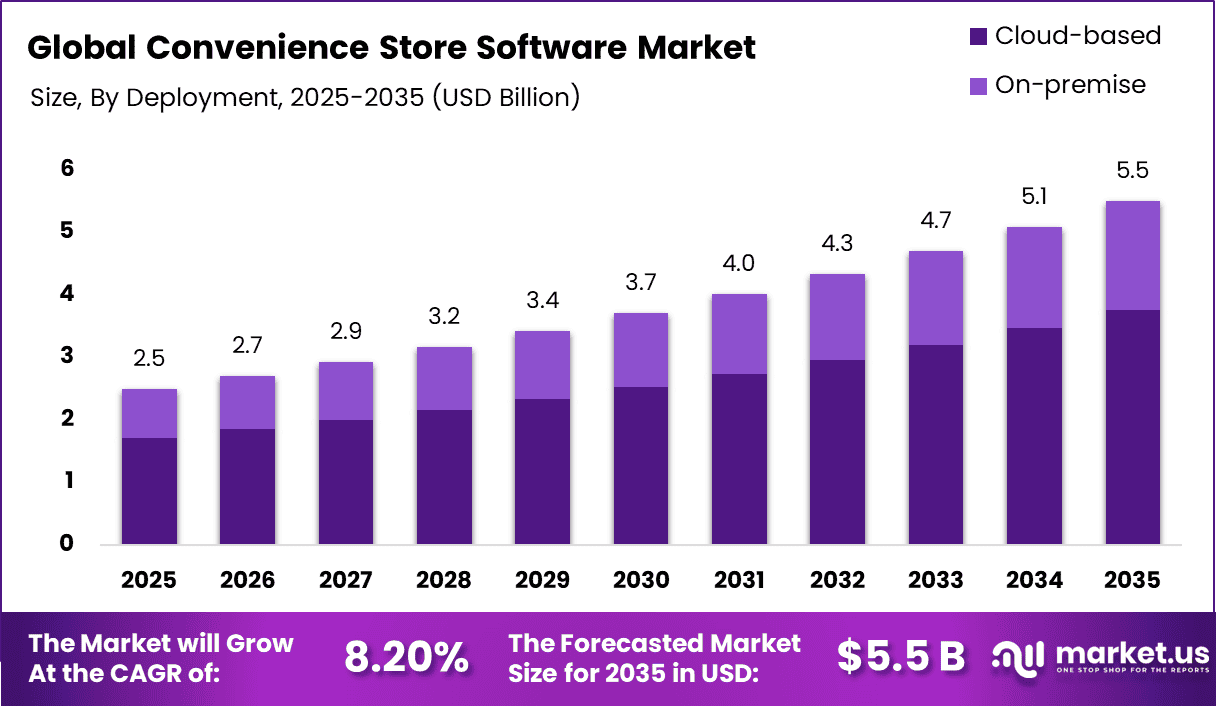
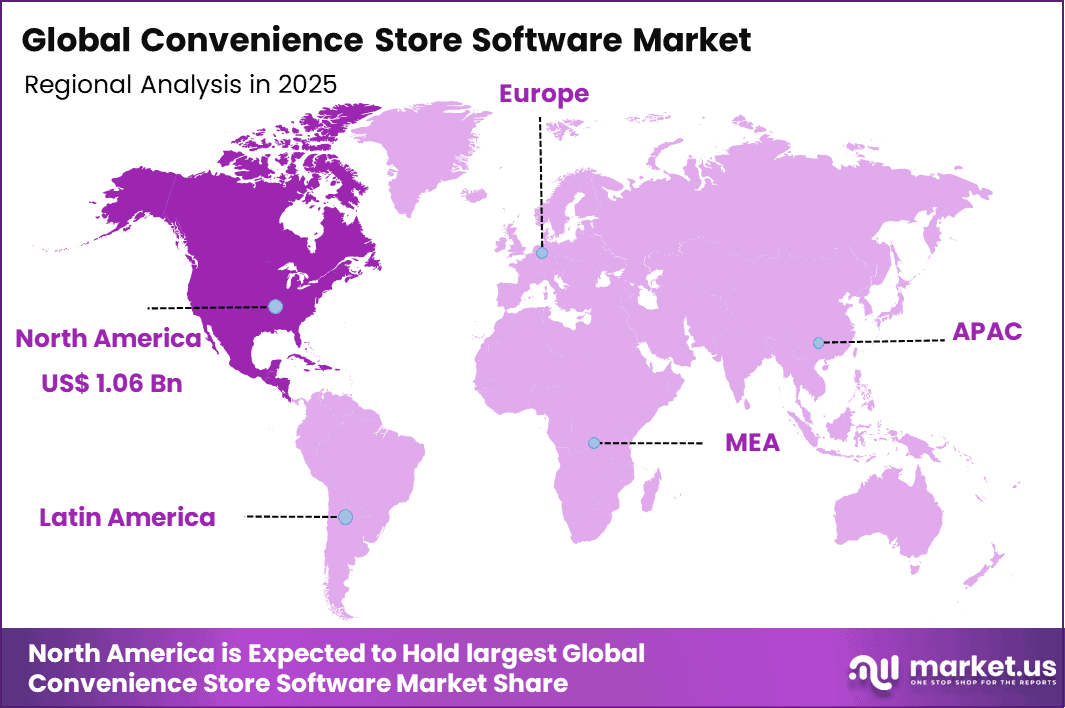
The Global Convenience Store Software Market generated USD 2.5 billion in 2025 and is predicted to register growth from USD 2.7 billion in 2026 to about USD 5.5 billion by 2035, recording a CAGR of 8.20% throughout the forecast span. In 2025, North America held a dominant market position, capturing more than a 42.7% share, holding USD 1.06 Billion revenue.
Top Market Takeaways
- Point-of-sale systems command 54.6%, streamlining transactions, inventory tracking, and customer loyalty programs with real-time sales analytics.
- Cloud-based deployment dominates at 68.2%, enabling centralized management, remote access, and automatic updates across multiple locations.
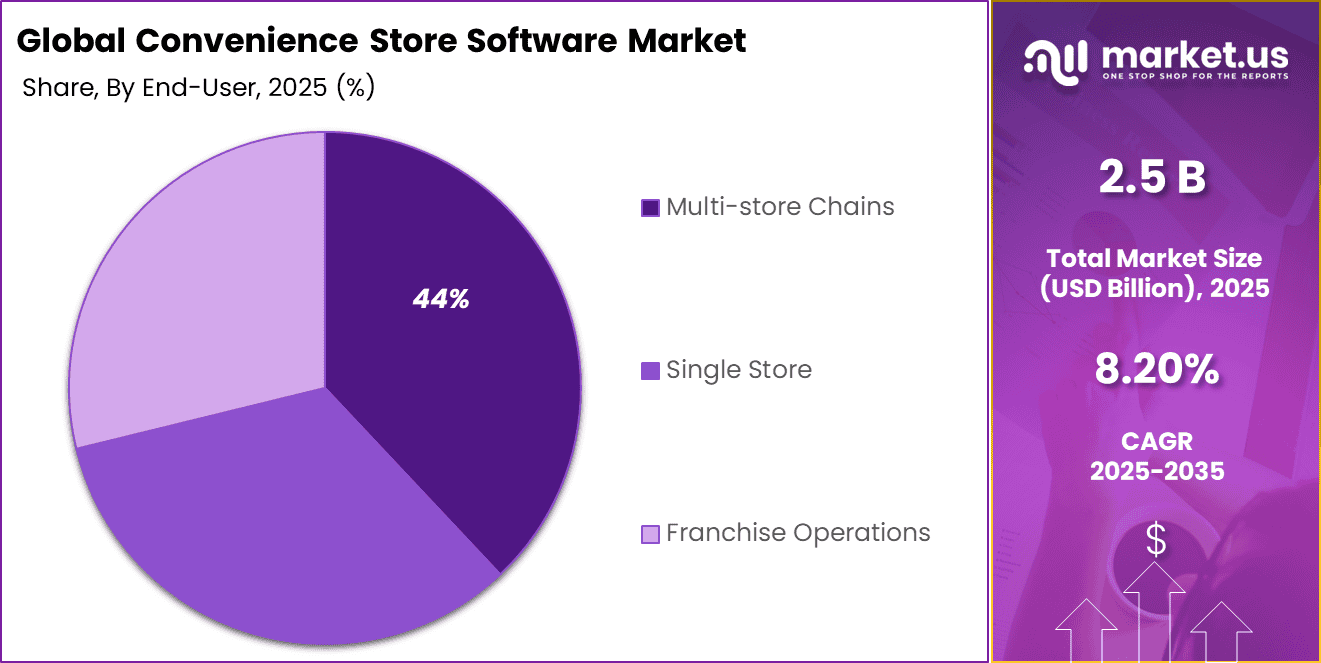
- Multi-store chains hold 43.5% end-user share, leveraging unified dashboards for cross-store inventory visibility and performance benchmarking.
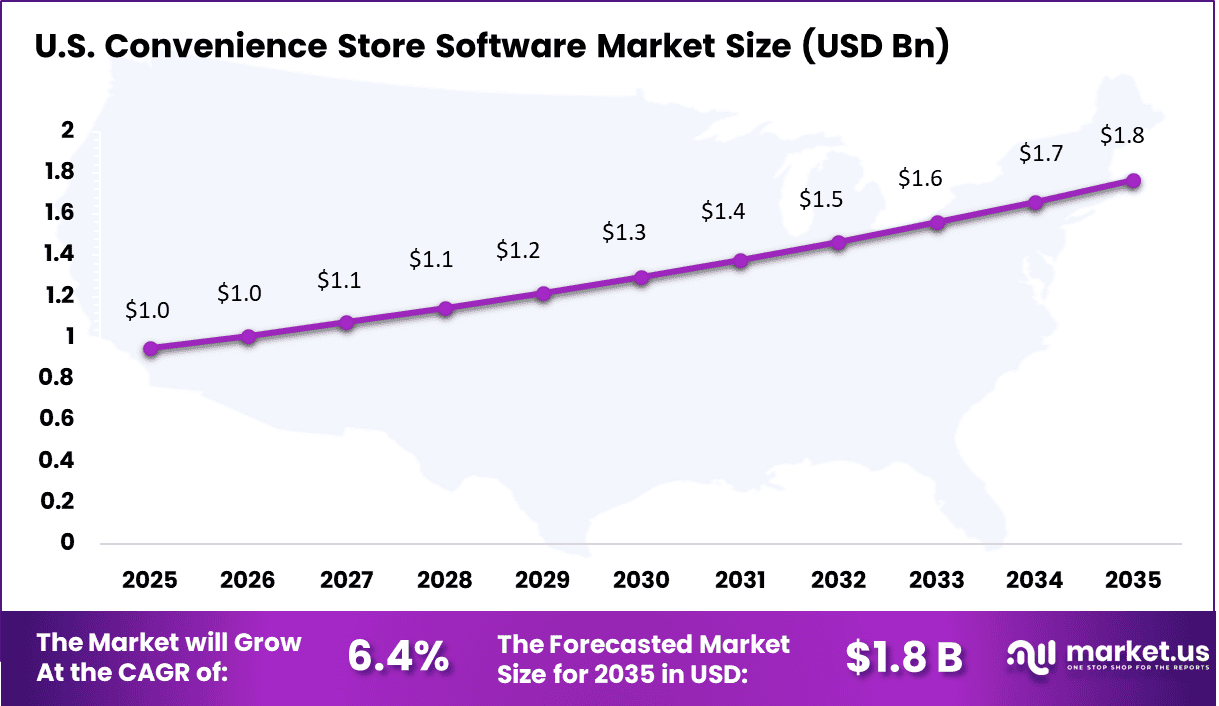
- North America drives 42.7% global value, with U.S. market at USD 0.95 billion and 6.4% CAGR, fueled by chain expansion and mobile payment integration.
Convenience store software is used to manage daily operations such as billing, inventory tracking, pricing, and customer transactions in small retail formats. It helps store owners handle multiple tasks from a single system, improving accuracy and reducing manual work.
As convenience stores handle high volumes of quick transactions, the need for efficient and reliable software is becoming more important. These systems also support features like real time stock updates and sales tracking, helping store owners make better decisions and maintain smooth operations.
One of the main driving factors is the increasing need for automation in retail operations. Store owners are looking for ways to reduce manual errors, speed up billing, and manage inventory more effectively. In addition, the shift toward digital payments is encouraging the use of software that can support multiple payment methods and ensure secure transactions.
The growing competition in the retail sector is also pushing stores to improve customer experience through faster service and better product availability. Integration with supply chain systems and analytics tools is further supporting the adoption of advanced software solutions.
Demand for convenience store software is rising as retailers seek simple and efficient tools to manage their business. There is a strong preference for solutions that are easy to use and can be quickly deployed without complex setup. Store owners are also looking for systems that can provide clear insights into sales patterns and inventory levels.
The demand is particularly strong among small and medium sized stores that want to improve efficiency without increasing operational complexity. As retail continues to adopt digital solutions, the need for reliable and user friendly store management software is expected to grow steadily.
Drivers Impact Analysis
| Key Driver | Impact on CAGR Forecast (~%) | Geographic Relevance | Impact Timeline | Additional Insight |
|---|---|---|---|---|
| Increasing adoption of digital POS and billing systems | +2.9% | North America, Europe, Asia Pacific | Short to medium term | Retailers upgrade checkout systems |
| Growing demand for inventory and supply chain management | +2.6% | Global | Medium term | Software improves stock control |
| Expansion of convenience store chains globally | +2.4% | Asia Pacific, North America | Medium to long term | Store growth drives software demand |
| Rising focus on customer experience and loyalty programs | +2.2% | Developed markets | Medium term | Software enables personalized services |
| Integration of payment and digital transaction solutions | +2.0% | Global | Medium to long term | Supports seamless payment processing |
Restraints Impact Analysis
| Key Restraint | Impact on CAGR Forecast (~%) | Geographic Relevance | Impact Timeline | Additional Insight |
|---|---|---|---|---|
| High initial setup and implementation costs | -2.3% | Emerging markets | Short to medium term | Cost limits small store adoption |
| Resistance to digital transformation among small retailers | -2.0% | Developing regions | Medium term | Traditional methods still preferred |
| Data security and privacy concerns | -1.8% | North America, Europe | Medium to long term | Security risks affect adoption |
| Integration challenges with legacy systems | -1.6% | Global | Medium term | Compatibility issues arise |
| Dependence on stable internet and IT infrastructure | -1.4% | Developing regions | Medium term | Connectivity affects performance |
By Software Type Analysis
The point-of-sale systems segment accounted for 54.6% of the market share, reflecting its central role in managing daily retail operations within convenience stores. This dominance is supported by the need for efficient billing, inventory tracking, and transaction management at the checkout level. POS systems help store operators streamline operations, reduce errors, and improve customer service by enabling faster and more accurate transactions.
Another factor driving this segment is the integration of POS systems with inventory and customer management tools. These systems provide real-time data insights that support better decision-making and stock control. Their ability to handle multiple payment methods and support loyalty programs further strengthens their importance in modern retail environments.
By Deployment Analysis
The cloud-based segment held 68.2% share, driven by the increasing demand for flexible and scalable software solutions. Cloud deployment allows store operators to access systems remotely, manage multiple locations, and update data in real time. This approach reduces the need for heavy infrastructure and simplifies system maintenance, making it attractive for both small and large businesses.
In addition, cloud-based solutions support faster updates and easier integration with third-party applications. Retailers benefit from improved data visibility and operational efficiency, especially when managing distributed store networks. This flexibility has encouraged wider adoption of cloud platforms in the convenience store software market.
By End-User Analysis
The multi-store chains segment captured 44% of the market, driven by the need to manage operations across multiple locations efficiently. These businesses require centralized systems that can handle inventory, sales, and customer data across all stores. Software solutions enable better coordination and consistency, which is essential for maintaining brand standards and operational efficiency.
Furthermore, multi-store chains are increasingly adopting advanced technologies to improve performance and competitiveness. Centralized data management and analytics help them optimize pricing, inventory levels, and customer engagement strategies. This has strengthened the demand for convenience store software among large retail networks.
Investor Type Impact Analysis
| Investor Type | Growth Sensitivity | Risk Exposure | Geographic Focus | Investment Outlook |
|---|---|---|---|---|
| Venture capital firms | Moderate to high | High | US, Europe | Investing in retail tech startups |
| Private equity firms | Moderate | Moderate | North America and Europe | Scaling retail software providers |
| Corporate investors | High | Moderate | Global | Strategic investments in retail digitization |
| Institutional investors | Moderate | Low to moderate | Developed markets | Prefer stable retail technology firms |
| Government and public funding bodies | Low to moderate | Low | Global | Supporting digital retail infrastructure |
Technology Enablement Analysis
| Technology | Impact on CAGR Forecast (~%) | Geographic Relevance | Impact Timeline | Additional Insight |
|---|---|---|---|---|
| Cloud-based retail management platforms | +3.0% | Global | Short to medium term | Enables scalable store operations |
| AI-driven inventory and demand forecasting | +2.7% | Developed markets | Medium to long term | Improves stock optimization |
| Integration with mobile payment and digital wallets | +2.5% | Global | Medium term | Supports seamless transactions |
| Data analytics for customer behavior insights | +2.3% | North America, Europe | Medium to long term | Enhances decision-making |
| IoT-enabled smart retail solutions | +2.0% | Global | Long term | Automates store operations |
Key Challenges
- High setup cost for software and hardware systems.
- Integration challenges with existing POS and inventory systems.
- Limited technical knowledge among store staff.
- Data security risks related to payment and customer information.
- Dependence on stable internet for cloud-based solutions.
- Frequent software updates can interrupt store operations.
- Difficulty in managing real-time inventory across multiple locations.
- Resistance to shift from manual or traditional systems.
- Compatibility issues with different devices and platforms.
- Ongoing maintenance and support costs increase overall expenses.
Emerging Trends
The convenience store software market is evolving toward more integrated and real time retail management systems that support faster operations and better customer experience. One of the key emerging trends is the adoption of unified platforms that combine billing, inventory, loyalty programs, and analytics into a single system, allowing store owners to manage daily activities more efficiently.
Another important trend is the growing use of AI driven demand forecasting, which helps retailers maintain optimal stock levels and reduce waste. There is also increasing focus on mobile enabled point of sale systems that allow transactions to be completed quickly and flexibly within the store. In addition, self checkout and contactless payment integration is becoming more common, improving speed and convenience for customers. Cloud based deployment is also gaining traction, enabling remote monitoring of multiple store locations and easier system updates without operational disruption.
Growth Factors
The growth of this market is driven by the rising need for operational efficiency and better inventory control in convenience retail. As consumer expectations shift toward faster service and seamless shopping experiences, store operators are investing in software solutions that can streamline transactions and reduce waiting time. The expansion of multi location retail chains is also supporting demand, as centralized management tools become essential for maintaining consistency across stores.
Another major factor is the increasing use of digital payment methods, which requires compatible and secure software systems. Retailers are also focusing on improving customer engagement through loyalty programs and personalized promotions, which is encouraging adoption of advanced software platforms. Furthermore, the need to reduce manual errors and improve data visibility is pushing businesses to move toward automated and data driven retail management solutions, supporting steady growth in this market.
Key Market Segments
By Software Type
- Point-of-sale Systems
- Inventory Management
- Employee Management
- Reporting & Analytics
- Loyalty Programs
- Others
By Deployment
- On-premise
- Cloud-based
By End-User
- Single Store
- Multi-store Chains
- Franchise Operations
Regional Analysis
North America accounted for 42.7% of the Convenience Store Software market, supported by the large network of organized retail stores and strong adoption of digital retail management solutions. The region has a highly developed convenience store ecosystem where operators rely on software for inventory tracking, billing, customer management, and sales analytics.
Increasing focus on operational efficiency and real-time data insights is encouraging retailers to adopt integrated software platforms. In addition, the growing use of digital payment systems and loyalty programs is further strengthening the demand for advanced store management solutions across the region.
The U.S. market reached USD 0.95 Billion and is projected to grow at a CAGR of 6.4%, driven by continuous modernization of retail operations and rising competition among store operators. Businesses are adopting software solutions to improve workflow efficiency, reduce manual errors, and enhance customer experience.
The expansion of multi-store operations and franchise models is also increasing the need for centralized management systems. In addition, growing demand for data-driven decision making and seamless checkout experiences is expected to support steady growth of the convenience store software market in the US over the coming years.
Key Regions and Countries
- North America
- US
- Canada
- Europe
- Germany
- France
- The UK
- Spain
- Italy
- Russia
- Netherlands
- Rest of Europe
- Asia Pacific
- China
- Japan
- South Korea
- India
- Australia
- Singapore
- Thailand
- Vietnam
- Rest of APAC
- Latin America
- Brazil
- Mexico
- Rest of Latin America
- Middle East & Africa
- South Africa
- Saudi Arabia
- UAE
- Rest of MEA
Competitive Analysis
The competitive landscape of the Convenience Store Software Market includes a mix of large enterprise software providers and specialized point-of-sale solution companies. Companies such as Oracle Corporation, SAP SE, IBM Corporation, Microsoft Corporation, and Salesforce.com, Inc. focus on providing comprehensive retail management platforms with advanced analytics, inventory tracking, and customer relationship management features. These players serve large retail chains and franchises, offering scalable and integrated solutions that support multiple store operations. Their strong technology capabilities and global presence help them maintain a leading position in the market.
At the same time, companies such as Shopify Inc., Square, Inc., Lightspeed POS Inc., Toast, Inc., Revel Systems, Vend Limited, ShopKeep by Lightspeed, AccuPOS Point of Sale, POS Nation, and IT Retail, Inc. focus on user-friendly and cost-effective solutions for small and medium-sized convenience stores. These players emphasize easy setup, cloud-based deployment, and mobile compatibility to simplify daily operations. Competition in this market is driven by ease of use, real-time data access, and the ability to integrate payment systems, inventory management, and customer engagement tools into a single platform.
Top Key Players in the Market
- Oracle Corporation
- SAP SE
- IBM Corporation
- Microsoft Corporation
- Salesforce.com, Inc.
- Shopify Inc.
- Square, Inc.
- Lightspeed POS Inc.
- Toast, Inc.
- Revel Systems
- Vend Limited
- ShopKeep by Lightspeed
- AccuPOS Point of Sale
- POS Nation
- IT Retail, Inc.
- Others
Future Outlook
The future outlook for the Convenience Store Software Market looks positive as retailers continue to focus on improving store operations and customer experience. The market is expected to grow with increasing adoption of digital solutions for billing, inventory management, and sales tracking. Store owners are anticipated to use software to reduce manual work and improve efficiency. In the coming years, integration with cloud systems, mobile payments, and data analytics is expected to help stores manage operations better and respond quickly to customer demand, supporting steady market growth.
Recent Developments
- March, 2026 – Oracle MICROS Simphony Cloud adds AI shelf-life tracking for perishables. Contactless payments via Apple Wallet while fuel pump integration syncs loyalty points. Enterprise c-store leader.
- January, 2026 – IBM Food Trust blockchain traces fresh food from farm to cooler ensuring compliance. Watson AI analyzes sales patterns while hybrid cloud scales peak traffic. Supply chain specialist.
Report Scope
| Report Features | Description |
|---|---|
| Market Value (2025) | USD 2.5 Billion |
| Forecast Revenue (2035) | USD 5.5 Billion |
| CAGR(2025-2035) | 8.20% |
| Base Year for Estimation | 2024 |
| Historic Period | 2020-2024 |
| Forecast Period | 2025-2035 |
| Report Coverage | Revenue forecast, AI impact on Market trends, Share Insights, Company ranking, competitive landscape, Recent Developments, Market Dynamics and Emerging Trends |
| Segments Covered | By Software Type (Point-of-sale Systems, Inventory Management, Employee Management, Reporting & Analytics, Loyalty Programs, Others), By Deployment (On-premise, Cloud-based), By End-User (Single Store, Multi-store Chains, Franchise Operations) |
| Regional Analysis | North America – US, Canada; Europe – Germany, France, The UK, Spain, Italy, Russia, Netherlands, Rest of Europe; Asia Pacific – China, Japan, South Korea, India, New Zealand, Singapore, Thailand, Vietnam, Rest of Latin America; Latin America – Brazil, Mexico, Rest of Latin America; Middle East & Africa – South Africa, Saudi Arabia, UAE, Rest of MEA |
| Competitive Landscape | Oracle Corporation, SAP SE, IBM Corporation, Microsoft Corporation, Salesforce.com, Inc., Shopify Inc., Square, Inc., Lightspeed POS Inc., Toast, Inc., Revel Systems, Vend Limited, ShopKeep by Lightspeed, AccuPOS Point of Sale, POS Nation, IT Retail, Inc., Others |
| Customization Scope | Customization for segments, region/country-level will be provided. Moreover, additional customization can be done based on the requirements. |
| Purchase Options | We have three license to opt for: Single User License, Multi-User License (Up to 5 Users), Corporate Use License (Unlimited User and Printable PDF) |