


Global Continuous Risk Assessment Market Size, Share and Analysis By Component (Software, Services), By Type (Quantitative Risk Assessment, Qualitative Risk Assessment, Asset-Based Risk Assessment, Vulnerability-Based Risk Assessment, Threat-Based Risk Assessment), By Organization Size (Large Enterprises, Small and Medium Enterprises (SMEs), By Application (IT & Telecom, BFSI, Healthcare, Government, Retail, Manufacturing, Others), By Regional Analysis, Global Trends and Opportunity, Future Outlook By 2025-2035
- Published date: March 2026
- Report ID: 180839
- Number of Pages: 344
- Format:
-
keyboard_arrow_up
Quick Navigation
Report Overview
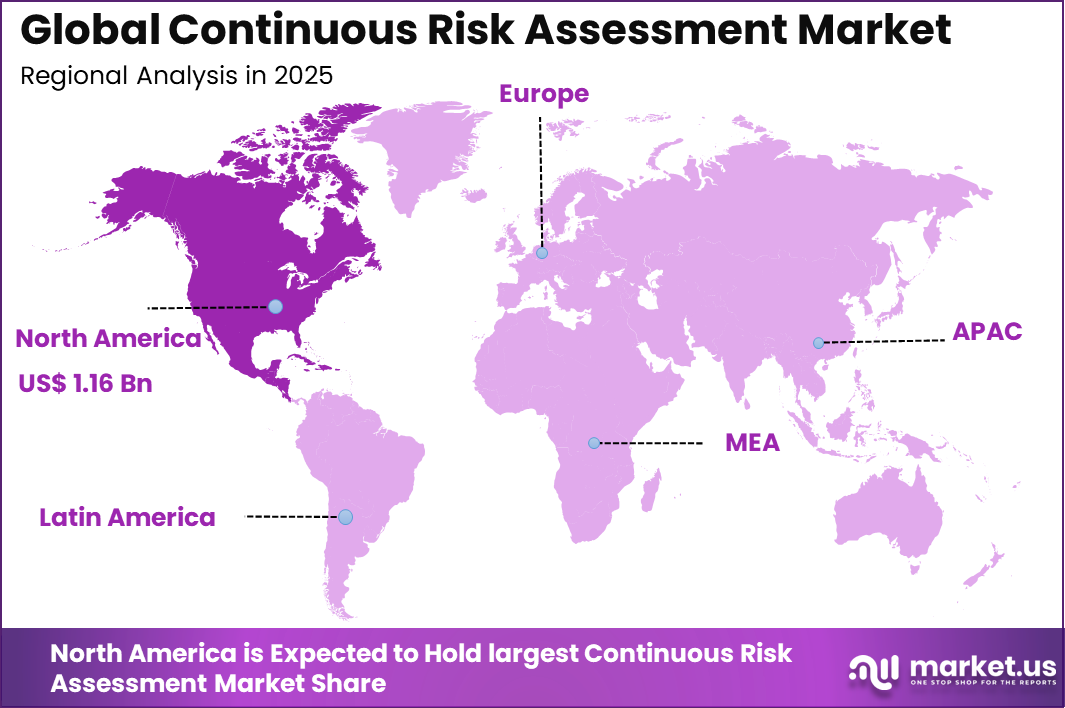
The Global Continuous Risk Assessment Market size is expected to be worth around USD 12.08 billion by 2035, from USD 2.86 billion in 2025, growing at a CAGR of 15.5% during the forecast period from 2025 to 2035. North America held a dominant market position, capturing more than a 40.7% share, holding USD 1.16 billion in revenue.
Continuous risk assessment refers to the process of evaluating organizational risks in real time rather than relying on periodic or annual reviews. It involves the use of digital tools and automated monitoring systems that continuously analyze operational data, financial transactions, cybersecurity events, and compliance indicators to identify emerging risks. By shifting from static risk evaluation methods to dynamic monitoring, organizations can respond quickly to potential threats and maintain stronger control over operational stability.
The market for continuous risk assessment solutions is expanding as organizations adopt digital risk management frameworks to address complex business environments. Traditional risk management approaches often depend on manual reviews and spreadsheets that may fail to detect rapidly evolving threats. Continuous risk assessment platforms integrate analytics, automation, and data monitoring technologies to provide ongoing insights into risk exposure and enable faster decision making.
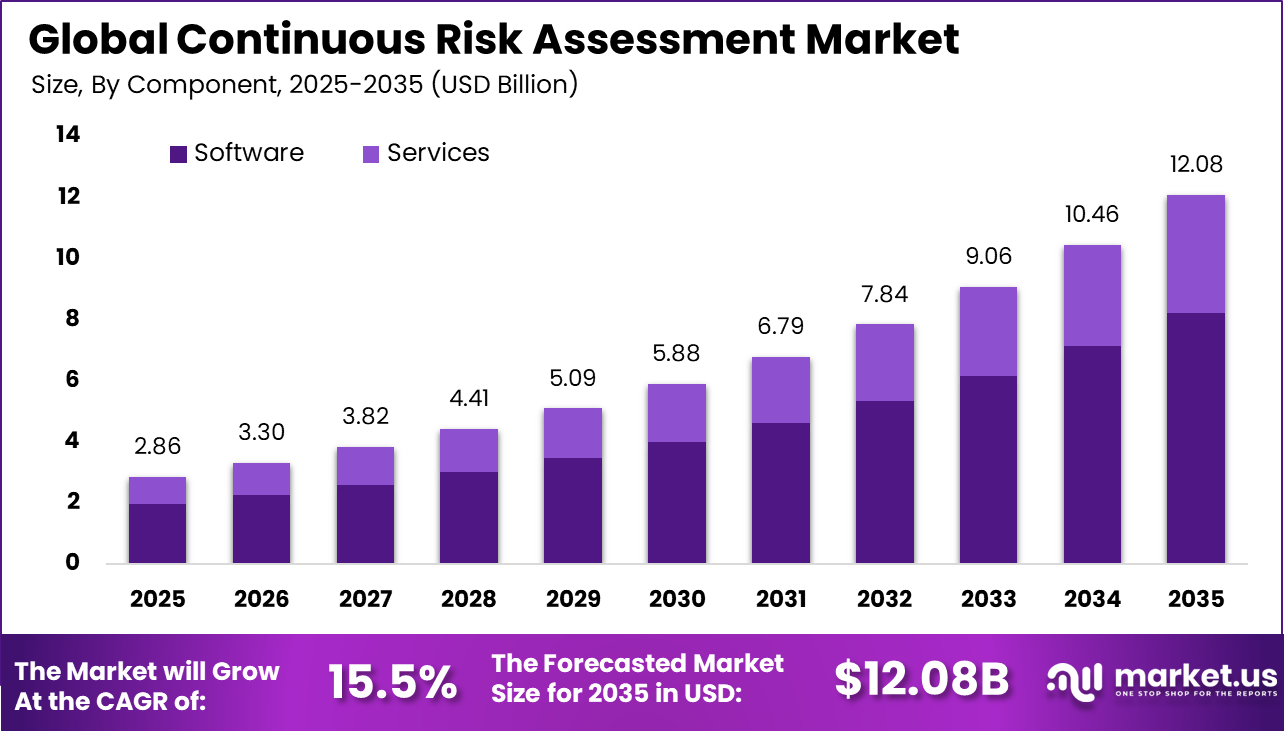
According to research, continuous risk assessment refers to the real-time and ongoing evaluation of organizational risks rather than relying on periodic reviews. This approach enables businesses to monitor risk indicators continuously, allowing faster identification of operational, financial, and cybersecurity threats as they emerge. By maintaining a dynamic view of risk exposure, organizations are better positioned to respond promptly to changes in their operating environment.
Current adoption levels indicate that approximately 19% of internal audit teams have implemented continuous risk assessment practices, while nearly 64% of organizations still rely on traditional annual risk reviews. The shift toward continuous monitoring has been supported by automated data collection tools that replace manual spreadsheet-based assessments. These technologies improve data accuracy, reduce reporting delays, and strengthen the early detection of emerging risks across complex enterprise systems.
For instance, in January 2026, Fortinet Inc. integrated continuous risk assessment into FortiGuard AI services across its 50 million endpoints. Enterprises gained real-time compliance scoring for SOC 2 audits. Fortinet’s fabric approach makes complex risk monitoring accessible to smaller North American businesses.
Key Takeaway
- In 2025, the Software segment led the Continuous Risk Assessment Market, accounting for 68.1% of total share.
- In 2025, Quantitative Risk Assessment emerged as the dominant type, capturing 40.3% of the market.
- In 2025, Large Enterprises represented the primary customer segment with a 63.7% share.
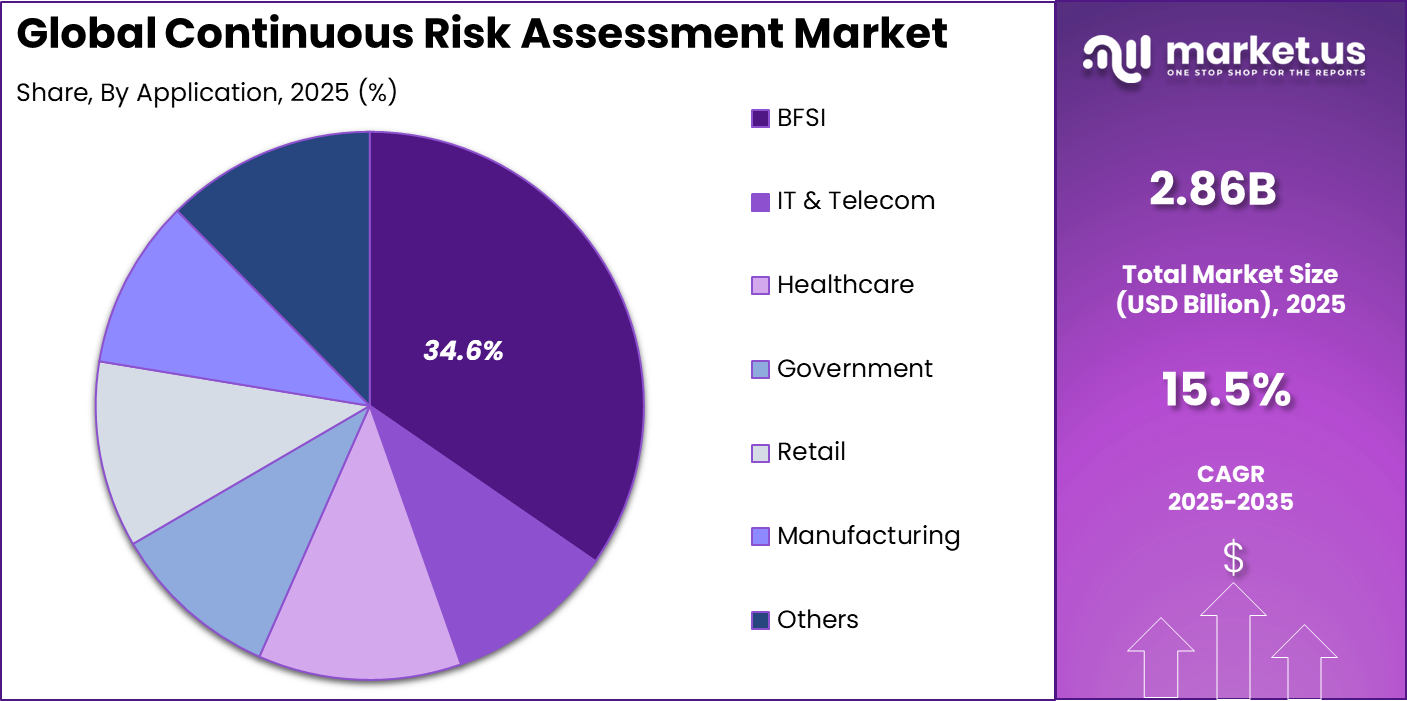
- In 2025, the BFSI sector held the largest application share at 34.6%.
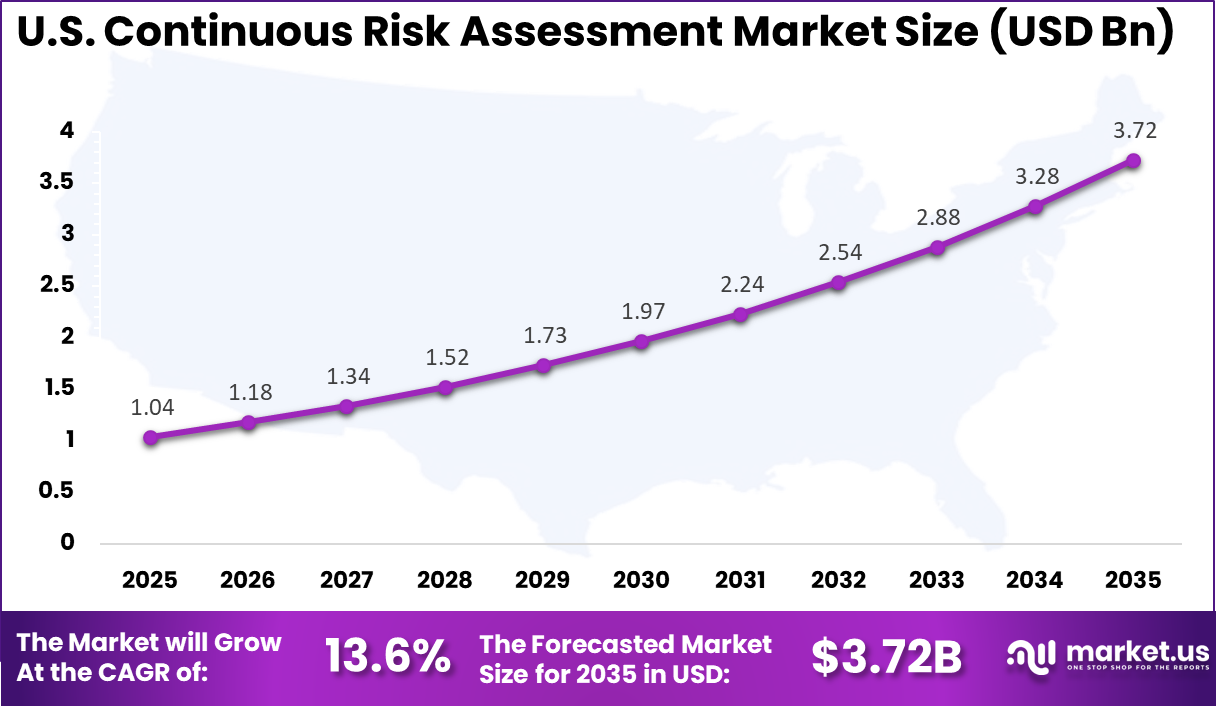
- In 2025, North America secured a 40.7% regional share, while the U.S. market reached USD 1.04 billion and recorded a growth rate of 13.6%.
Key Adoption Statistics
- Cloud security incidents increased by 154% in 2024, reflecting rapid growth in digital risk exposure.
- About 85% of business leaders report that compliance requirements have become more complex over the past three years.
- Around 61% of organizations planning to adopt continuous risk assessment within the next 24 months still rely on Excel as their primary risk management tool.
- Approximately 14.79% of organizations use APIs to integrate real time historical data into risk scoring systems.
- Nearly 64% of organizations have implemented centralized or federated governance models for third party risk management to improve visibility.
- About 66% of legal and compliance leaders state that third parties operate outside their core business model, increasing the need for continuous monitoring.
- In standardized risk measurement frameworks, likelihood levels are commonly defined as 90% for near certainty, 70% for highly likely, 50% for likely, 30% for low likelihood, and 10% for not likely.
- The average cost of a data breach reached USD 4.88 million in 2025, reinforcing the financial importance of continuous risk evaluation.
By Component
Software accounts for 68.1% of the market, reflecting the growing reliance on digital platforms that automate risk monitoring and analysis processes. These platforms collect and evaluate data from enterprise systems, financial transactions, and operational records to identify potential vulnerabilities. Automated dashboards allow risk managers to track performance indicators and detect deviations that may indicate emerging risks.
The adoption of software based solutions is also supported by their ability to integrate with governance, risk, and compliance frameworks. Real time analytics improves decision making by providing continuous insight into operational and financial exposure. As organizations prioritize proactive risk management strategies, software platforms remain central to continuous risk assessment initiatives.
For Instance, in February 2026, IBM Corporation rolled out new AI agents in its Concert platform to boost software-driven risk tools. These updates focus on real-time monitoring and automated alerts, helping teams handle threats faster across cloud and mainframe setups. It’s a smart move as software stays central to ongoing assessments.
By Type
Quantitative risk assessment represents 40.3% of the market due to its ability to evaluate risk exposure using numerical models and statistical analysis. This approach enables organizations to measure the probability and financial impact of potential risks. Quantitative methods are widely used to support strategic planning and investment decisions.
Risk modeling tools analyze large datasets to estimate potential losses, operational disruptions, or compliance violations. By applying statistical methods, organizations can prioritize risk mitigation efforts based on measurable impact. As businesses increasingly rely on data driven decision frameworks, quantitative risk assessment continues to gain adoption.
For instance, in January 2026, Oracle launched updates to its analytics suite, sharpening quantitative methods for precise risk calculations. It uses data models to weigh impacts and probabilities, aiding better decision-making. Companies appreciate this for turning raw numbers into actionable plans amid rising threats.
By Organization Size
Large enterprises account for 63.7% of market adoption due to the complexity of their operational environments and regulatory obligations. These organizations manage extensive financial transactions, supply chains, and digital systems that require continuous risk monitoring. Structured risk assessment platforms help maintain oversight across multiple departments and operational units.
Large organizations also maintain dedicated risk management teams responsible for monitoring compliance and operational stability. Continuous monitoring tools enable these teams to identify vulnerabilities early and implement mitigation strategies. As enterprise digital infrastructure grows, large organizations remain the primary adopters of continuous risk assessment technologies.
For Instance, in February 2026, ServiceNow released workflow integrations that streamline risk processes for enterprise users. It addresses the complexity of coordinating security in huge setups. This kind of innovation keeps large enterprises ahead, connecting risk data to daily operations seamlessly.
By Application
The BFSI sector represents 34.6% of market adoption due to strict regulatory requirements and the need to monitor financial risk continuously. Financial institutions rely on risk assessment systems to evaluate credit exposure, transaction anomalies, and operational risks. Continuous monitoring platforms help ensure compliance with financial regulations and internal governance policies.
Financial organizations also require accurate risk modeling to support investment decisions and capital management strategies. Automated risk analysis tools provide detailed insights that help institutions maintain financial stability. As financial services continue to digitize operations, the BFSI sector remains a major adopter of continuous risk assessment platforms.
For Instance, in March 2026, Symantec boosted its BFSI offerings with endpoint protection tied to compliance monitoring. It helps banks maintain steady oversight of customer data flows. Such steps reflect the sector’s drive to embed risk checks into core financial apps without disrupting services.
By Region
North America holds 40.7% of the market share due to strong adoption of advanced risk management technologies across financial, healthcare, and technology sectors. Organizations in the region have implemented digital governance frameworks that emphasize continuous monitoring and proactive risk mitigation. The presence of advanced analytics infrastructure further supports regional adoption.
For instance, in February 2026, IBM launched enhanced continuous risk assessment capabilities within its WatsonX.governance platform, leveraging AI to provide real-time compliance monitoring for enterprises. This innovation strengthens North America’s leadership by enabling organizations to dynamically assess regulatory and operational risks across hybrid cloud environments.
Within North America, the United States contributes USD 1.04 billion with a growth rate of 13.6%. The country’s mature financial sector and strict regulatory environment have strengthened demand for continuous risk assessment platforms. Continued investment in governance and compliance technologies is expected to sustain market growth across the region.
For instance, in March 2026, RSA Security rolled out Archer Continuous Risk Suite with advanced behavioral analytics for third-party risk monitoring. This platform enables real-time vendor risk scoring, reinforcing North America’s position in sophisticated, automated risk assessment ecosystems.
Growth Factors
One major growth factor driving the continuous risk assessment market is the increasing complexity of regulatory and compliance requirements across industries. Organizations must monitor financial transactions, operational activities, and cybersecurity threats continuously to ensure compliance with regulatory standards. Continuous risk assessment platforms help businesses track risk indicators and detect potential compliance issues before they escalate into regulatory violations.
Another growth factor is the increasing digitalization of business operations. As organizations adopt cloud platforms, digital transactions, and interconnected IT systems, the number of potential risk points expands significantly. Continuous risk assessment tools enable companies to monitor these environments in real time and identify vulnerabilities that could affect operational performance or data security.
Emerging Trends
One emerging trend in the continuous risk assessment market is the integration of artificial intelligence and predictive analytics. AI-driven platforms analyze historical data, operational patterns, and external risk indicators to forecast potential risks before they occur. These predictive capabilities allow organizations to implement preventive measures rather than responding only after incidents happen.
Another trend is the adoption of automated risk dashboards that provide real-time visibility into risk exposure across business units. These dashboards allow executives and risk management teams to monitor key risk indicators, track changes in risk levels, and quickly implement mitigation strategies when necessary.
Key Market Segments
By Component
- Software
- On-Premises
- Cloud-based
- Services
- Managed Services
- Professional Services
By Type
- Quantitative Risk Assessment
- Qualitative Risk Assessment
- Asset-Based Risk Assessment
- Vulnerability-Based Risk Assessment
- Threat-Based Risk Assessment
By Organization Size
- Large Enterprises
- Small and Medium Enterprises (SMEs)
By Application
- BFSI
- IT & Telecom
- Healthcare
- Government
- Retail
- Manufacturing
- Others
Key Regions and Countries
North America
- US
- Canada
Europe
- Germany
- France
- The UK
- Spain
- Italy
- Russia
- Netherlands
- Rest of Europe
Asia Pacific
- China
- Japan
- South Korea
- India
- Australia
- Singapore
- Thailand
- Vietnam
- Rest of APAC
Latin America
- Brazil
- Mexico
- Rest of Latin America
Middle East & Africa
- South Africa
- Saudi Arabia
- UAE
- Rest of MEA
Drivers
Rising Cybersecurity Threats
Organizations increasingly face persistent cyber threats targeting networks, cloud platforms, and connected devices. Continuous risk assessment helps security teams observe system behavior and detect irregular activity before it disrupts operations. Businesses adopt this approach to maintain stronger protection, strengthen digital resilience, and respond faster to emerging vulnerabilities across complex digital environments.
Cyber incidents often evolve quickly, making traditional periodic risk reviews insufficient. Continuous monitoring allows organizations to study patterns across systems, user behavior, and network traffic. This steady observation supports earlier detection of weaknesses and helps security teams strengthen defense strategies while maintaining trust in digital services and operational stability.
For instance, in March 2026, IBM rolled out updates to its X-Force platform, focusing on real-time threat detection amid growing attack sophistication. Teams now use AI-driven tools to track live risks across networks, helping firms stay one step ahead of breaches that hit harder and faster these days. This move underscores how constant vigilance turns raw threat data into actionable shields for businesses.
Restraint
Implementation Complexity
Adopting continuous risk assessment systems often requires significant operational adjustments within organizations. Companies must connect monitoring tools with different internal platforms, security frameworks, and business processes. This integration process can demand technical expertise and careful planning to ensure that risk data remains accurate and useful.
Organizations also face internal challenges when shifting from traditional risk reviews to continuous monitoring. Teams must adapt to new workflows, learn updated tools, and coordinate across departments. These adjustments may slow implementation and require additional training to ensure effective risk management practices.
For instance, in February 2026, Oracle announced updates to its cloud security platform, but experts noted the steep learning curve in integrating it with legacy systems during a recent webinar. Many users face hurdles in configuring continuous assessment features across hybrid environments, which delays full rollout and adds to operational strain. This reflects broader challenges where technical setup demands significant upfront effort from IT staff.
Opportunities
Expansion of Real Time Risk Intelligence
The development of real time risk intelligence creates strong opportunities for continuous risk assessment solutions. Organizations increasingly rely on live data insights to understand potential threats and operational disruptions. Continuous analysis of system activities helps businesses identify patterns early and strengthen decision making across security and operational management teams.
Real time intelligence platforms allow risk managers to connect information from multiple sources, such as operational systems, digital networks, and compliance tools. This integrated visibility improves situational awareness and enables organizations to respond to emerging risks with greater accuracy while supporting more proactive governance practices.
For instance, in January 2026, SAP introduced enhanced real-time analytics in its risk management suite, enabling instant threat visibility for enterprise users. This move taps into the growing demand for live intelligence that supports quick decision-making in dynamic business settings. It positions SAP to capture more market share as companies seek tools that deliver actionable insights without delay.
Challenges
Managing Large Volumes of Security Data
Continuous risk assessment generates large amounts of data from networks, applications, and security systems. Managing this information can become challenging for organizations that lack advanced analytics tools or skilled personnel. Teams must carefully review incoming data to identify meaningful signals among routine system activities.
Security analysts often struggle with the growing number of alerts and monitoring outputs. Sorting through large data streams requires time and careful analysis to avoid missing critical threats. Organizations must develop better data management practices to ensure monitoring systems remain effective and support accurate risk evaluation.
For instance, in December 2025, Qualys rolled out a new data processing module for its vulnerability platform, addressing the overwhelm from constant security feeds. Yet, feedback shows teams still grapple with filtering noise from vast data streams to focus on true risks. This update highlights the ongoing struggle to make sense of high-volume inputs while avoiding alert fatigue in daily operations.
Key Players Analysis
The Continuous Risk Assessment Market is led by global enterprise technology providers that integrate risk monitoring and compliance capabilities into broader governance and security platforms. IBM Corporation, Oracle Corporation, and SAP SE deliver enterprise grade risk management frameworks combined with analytics and regulatory compliance tools. These platforms allow organizations to continuously monitor operational, financial, and cybersecurity risks.
Cybersecurity vendors contribute advanced vulnerability monitoring and threat intelligence capabilities to continuous risk assessment solutions. Qualys Inc., Rapid7 Inc., Fortinet Inc., Check Point Software Technologies Ltd., and Tenable Inc. offer platforms that detect vulnerabilities, evaluate system risk levels, and automate remediation workflows. Their solutions rely on continuous network scanning, behavioral analytics, and threat intelligence feeds.
Risk analytics and governance platform providers further strengthen the competitive ecosystem. RSA Security LLC, BitSight Technologies, RiskLens Inc., LogicManager Inc., MetricStream Inc., and ServiceNow Inc. provide governance, risk, and compliance platforms supported by automated assessment tools. Additional cybersecurity providers including McAfee LLC, Broadcom Inc. through Symantec security solutions, FireEye Inc., and F5 Networks Inc. contribute threat intelligence and risk monitoring technologies.
Top Key Players in the Market
- IBM Corporation
- Oracle Corporation
- SAP SE
- RSA Security LLC
- Qualys Inc.
- Rapid7 Inc.
- FireEye Inc.
- Fortinet Inc.
- Check Point Software Technologies Ltd.
- McAfee LLC
- Symantec Corporation (Broadcom Inc.)
- F5 Networks Inc.
- Tenable Inc.
- BitSight Technologies
- RiskLens Inc.
- LogicManager Inc.
- MetricStream Inc.
- ServiceNow Inc.
- Others
Recent Developments
- In January 2026, IBM Corporation launched an enhanced version of its QRadar platform with real-time continuous risk scoring for cloud workloads. The update helps enterprises spot vulnerabilities 35% faster across hybrid environments. This move keeps IBM at the forefront of automated risk monitoring, especially for North American financial firms handling massive data flows.
- In February 2026, Qualys Inc. introduced TotalCloud with continuous vulnerability prioritization scoring. Organizations using it reduced critical patch windows from days to hours. Qualys continues dominating U.S. federal agency contracts with this always-on risk visibility across 500,000+ endpoints.
Report Scope
Report Features Description Market Value (2025) USD 2.8 Bn Forecast Revenue (2035) USD 12.08 Bn CAGR (2025-2035) 15.5% Base Year for Estimation 2025 Historic Period 2020-2024 Forecast Period 2025-2035 Report Coverage Revenue forecast, AI impact on Market trends, Share Insights, Company ranking, competitive landscape, Recent Developments, Market Dynamics and Emerging Trends Segments Covered By Component (Software, Services), By Type (Quantitative Risk Assessment, Qualitative Risk Assessment, Asset-Based Risk Assessment, Vulnerability-Based Risk Assessment, Threat-Based Risk Assessment), By Organization Size (Large Enterprises, Small and Medium Enterprises (SMEs), By Application (IT & Telecom, BFSI, Healthcare, Government, Retail, Manufacturing, Others) Regional Analysis North America – US, Canada; Europe – Germany, France, The UK, Spain, Italy, Russia, Netherlands, Rest of Europe; Asia Pacific – China, Japan, South Korea, India, New Zealand, Singapore, Thailand, Vietnam, Rest of Latin America; Latin America – Brazil, Mexico, Rest of Latin America; Middle East & Africa – South Africa, Saudi Arabia, UAE, Rest of MEA Competitive Landscape IBM Corporation, Oracle Corporation, SAP SE, RSA Security LLC, Qualys Inc., Rapid7 Inc., FireEye Inc., Fortinet Inc., Check Point Software Technologies Ltd., McAfee LLC, Symantec Corporation (Broadcom Inc.), F5 Networks Inc., Tenable Inc., BitSight Technologies, RiskLens Inc., LogicManager Inc., MetricStream Inc., ServiceNow Inc., Others Customization Scope Customization for segments, region/country-level will be provided. Moreover, additional customization can be done based on the requirements. Purchase Options We have three license to opt for: Single User License, Multi-User License (Up to 5 Users), Corporate Use License (Unlimited User and Printable PDF)  Continuous Risk Assessment MarketPublished date: March 2026add_shopping_cartBuy Now get_appDownload Sample
 -
-
- IBM Corporation
- Oracle Corporation
- SAP SE
- RSA Security LLC
- Qualys Inc.
- Rapid7 Inc.
- FireEye Inc.
- Fortinet Inc.
- Check Point Software Technologies Ltd.
- McAfee LLC
- Symantec Corporation (Broadcom Inc.)
- F5 Networks Inc.
- Tenable Inc.
- BitSight Technologies
- RiskLens Inc.
- LogicManager Inc.
- MetricStream Inc.
- ServiceNow Inc.
- Others
Our Clients

- 180839
- March 2026









