Global Computational Creativity Market Size, Share Report Analysis By Component (Solution, Service), By Technology (Generative Adversarial Networks (GANs), Transformer-based Large Language Models, Evolutionary and Genetic Algorithms and Others), By Application (Art and Design Creation, Music Composition and Sound Design, Gaming and Virtual World Building, Marketing and Advertising Content and Others), By End-User Industry (Media and Entertainment Companies, Gaming Studios and Publishers, Advertising and Creative Agencies, Automotive and Industrial Designers, Education and EdTech, Research Institutes and Academia), By Regional Analysis, Global Trends and Opportunity, Future Outlook By 2025-2034
- Published date: Dec. 2025
- Report ID: 167453
- Number of Pages: 262
- Format:
-
keyboard_arrow_up
Quick Navigation
- Report Overview
- Key Takeaways
- Adoption and Usage Statistics
- U.S Market Size
- By Component
- Technology
- Application
- By End-User Industry
- Investment and Business Benefits
- Key Market Segments
- Emerging Trends
- Growth Factors
- Driver Analysis
- Restraint Analysis
- Opportunity Analysis
- Challenge Analysis
- Key Players Analysis
- Recent Developments
- Future Outlook and Opportunities
- Report Scope
Report Overview
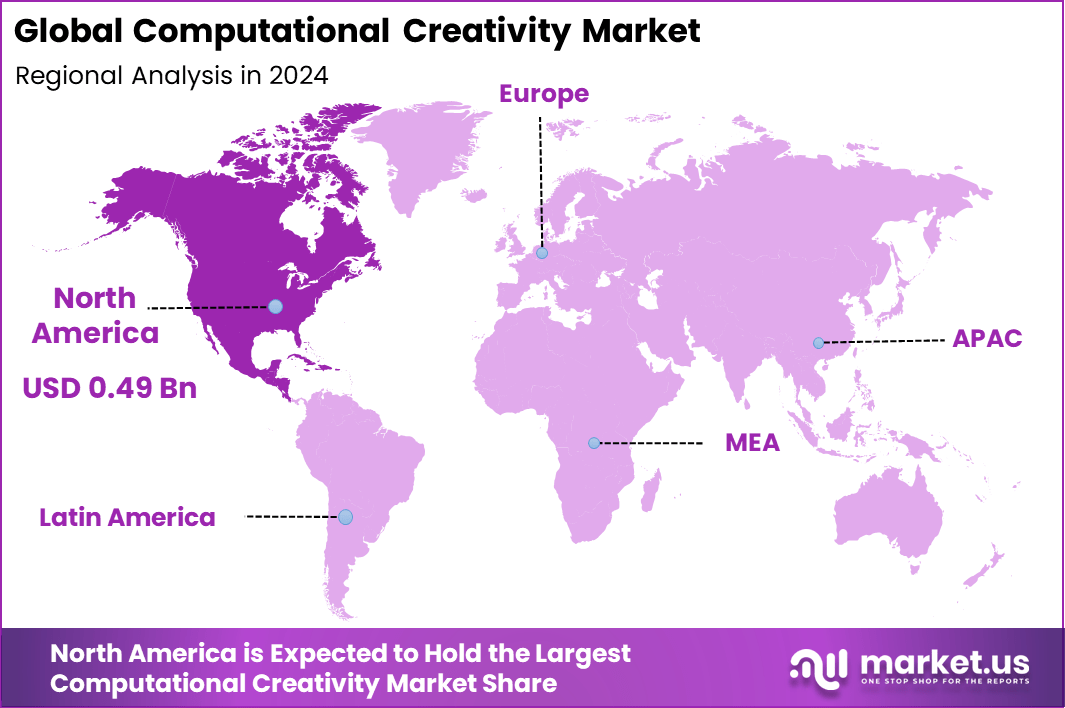
The Global Computational Creativity Market generated USD 1.1 Billion in 2024 and is predicted to register growth to about USD 9.4 Billion by 2034, recording a CAGR of 24.3% throughout the forecast span. In 2024, North America held a dominant market position, capturing more than a 46.3% share, holding USD 0.45 Billion revenue.
The Computational Creativity market is witnessing rapid growth driven by advancements in AI and machine learning that enable machines to generate creative content such as music, art, writing, and design. This technology automates creative tasks, improving efficiency for creative professionals across industries. Key drivers include automation of the creative process and the rising need to enhance productivity in creative workflows.
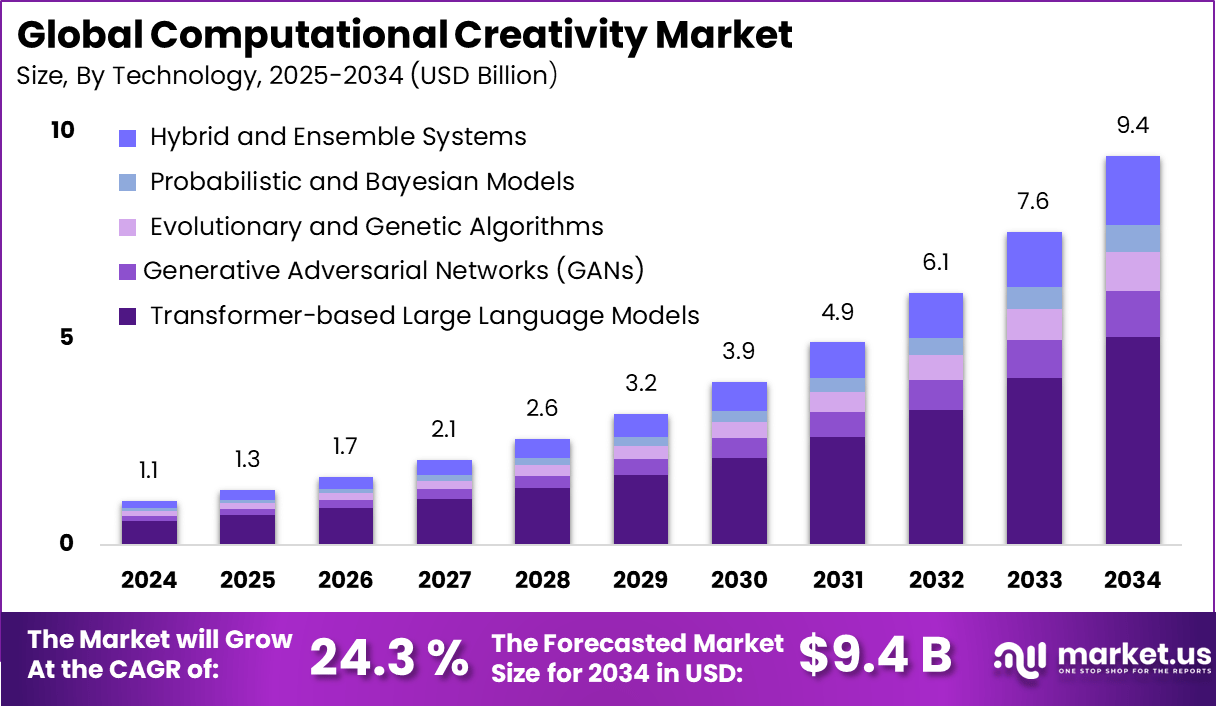
This market plays a crucial role in transforming how creative work is produced and consumed. By integrating AI driven creative tools into workflows, organizations can accelerate content generation, personalize experiences at scale, and explore new artistic expressions. Computational creativity supports tasks that would traditionally require extensive manual effort, such as generating variations of digital art, composing music, automating storytelling, or designing product concepts.
Growth in this market is driven by the increasing adoption of AI tools across creative industries and the rising need to automate content production. Advances in machine learning, deep learning, and transformer-based models have improved the quality and relevance of AI generated creative outputs. Organizations in advertising, gaming, digital media, and e-commerce are deploying these tools to reduce production time while maintaining creative diversity.
Key Takeaways
- The Solution component dominates the computational creativity market with a share of about 71.2%.
- Among technologies, Transformer-Based Large Language Models (LLMs) hold a significant portion of around 53.4% in the computational creativity market.
- About 34.5% of the computational creativity market is led by the Marketing and Advertising content application segment.
- Media and Entertainment companies account for roughly 30.8% of the computational creativity market share.
- North America holds the largest share at approximately 46.3% of the global computational creativity market.
- Within North America, the US accounts for about 22.6%, driven by its advanced digital ecosystem and significant investments in AI technologies.
Adoption and Usage Statistics
- 83% of creative professionals now use AI tools in daily design, editing, and content workflows.
- 52% of U.S. creative workers have formally adopted generative AI for ideation and content creation.
- Nearly 70% of small businesses rely on AI for marketing content and campaign execution.
- Gen Z leads adoption, with 70-74% using AI for creative enhancement and visual content.
- Marketing and advertising lead adoption at 37%, mainly for content optimization, idea generation, and task automation.
- Media and entertainment captured 34.2% market share in 2024, using AI for trailers, thumbnails, and localization.
- Product design is the fastest-growing use case, with 18.03% CAGR, cutting design cycles by up to 60%.
- Video production adoption is rising, with 34% of marketers using text-to-video tools by 2025.
- AI now handles around 60% of routine social media video editing tasks.
- Companies earn about USD 3.70 for every USD 1 invested in generative AI.
- Early adopters report 22.6% productivity gains and 15.2% cost reductions.
- AI content tools save marketers up to 5 hours per week, equal to more than one month of work annually.
- The generative AI market in creative industries is projected to reach USD 4.06 billion in 2025.
- 79% of companies report adopting AI agents to automate creative workflows with minimal oversight.
- 67% of creative professionals say AI helps overcome creative blocks.
- Trust remains limited, as 70% of consumers are cautious about AI-generated content.
- Only 5% of advanced users currently view AI as a true creative partner rather than a tool.
U.S Market Size
The United States reached USD 0.45 Billion with a CAGR of 22.6%, reflecting fast growth in computational creativity adoption. Demand is driven by expansion of digital media, marketing automation, and AI-assisted creative workflows. Continued innovation supports long-term market growth.
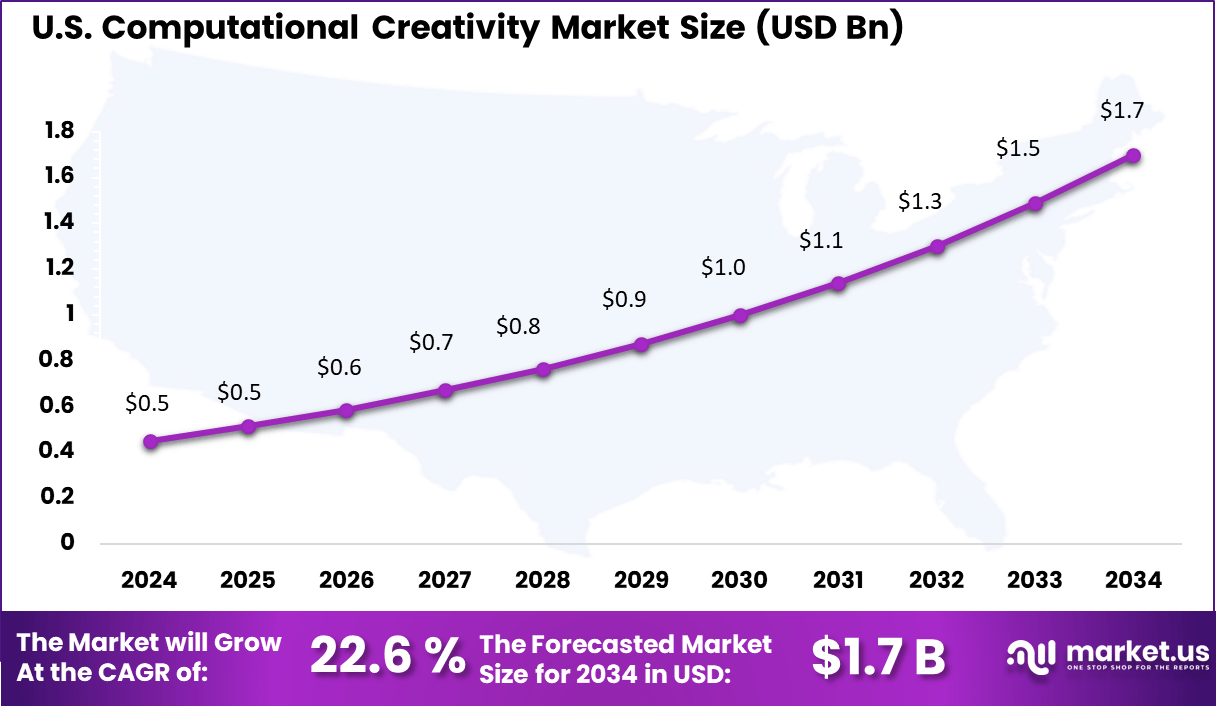
The U.S. benefits from early adoption of large language models and AI-based creative tools, especially in marketing and content generation. Companies focus on automating creative workflows to accelerate production timelines and engage consumers with personalized content. This momentum is expected to sustain the U.S.’s lead role, making it a pivotal market in the global computational creativity landscape.
North America leads the computational creativity market with a commanding 46.3% share, reflecting the region’s advanced technological infrastructure and significant investment in AI research and development. The strong presence of technology innovators and research institutions supports the rapid adoption of computational creativity solutions across various industries such as media, marketing, and entertainment.
The region’s growth is also spurred by the integration of AI-powered creative tools into business workflows, making processes more efficient and creative output more personalized and scalable. Continued government support for AI initiatives, alongside private sector investments, solidifies North America’s dominant role in shaping the computational creativity market’s evolution.
By Component
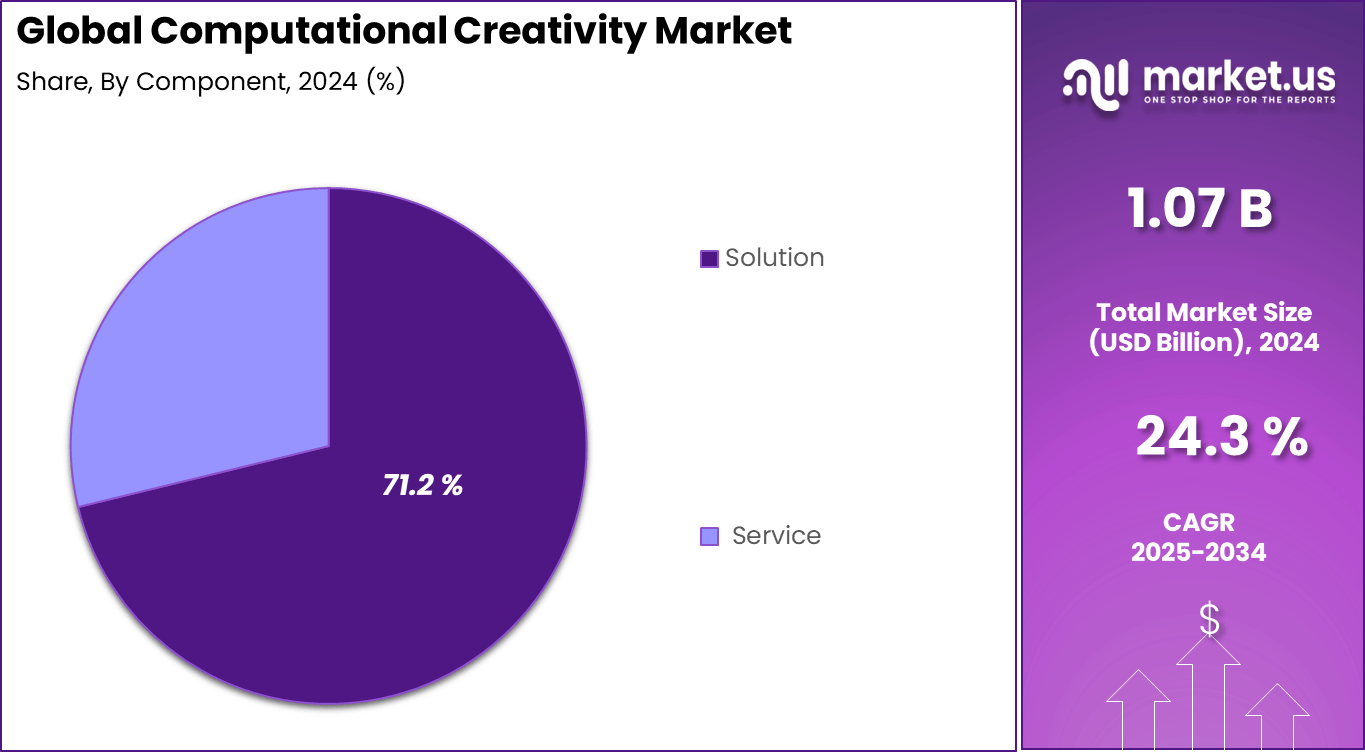
Solutions account for 71.2%, showing that most adoption is driven by dedicated computational creativity platforms. These solutions support content generation, creative workflow automation, and idea development across text, image, audio, and design outputs. Organizations rely on solution-based systems for consistent creative output at scale.
The strong position of this segment is supported by demand for ready-to-use platforms rather than custom-built tools. Solution offerings reduce implementation time and simplify integration with existing creative and business systems. This makes them suitable for both enterprise and professional creative use cases.
Technology
Transformer-based large language models hold 53.4%, reflecting their central role in modern computational creativity systems. These models enable advanced text generation, idea expansion, and contextual understanding across creative tasks. Their architecture supports high-quality language output with strong coherence.
Adoption of this technology is driven by improvements in model accuracy and adaptability. Organizations use transformer-based models to support content ideation, storytelling, and creative assistance. Their ability to learn from large datasets continues to expand creative applications.
Application
Marketing and advertising content accounts for 34.5%, making it the leading application segment. Companies use computational creativity tools to generate ad copy, social media content, campaign ideas, and brand messaging. These tools help speed up content production cycles.
Growth in this segment is supported by increasing demand for personalized and frequent content delivery. Creative automation helps marketing teams maintain consistency while responding quickly to changing campaign needs. This improves efficiency without reducing creative quality.
By End-User Industry
Media and entertainment companies represent 30.8%, highlighting strong adoption within content-driven industries. These organizations use computational creativity to assist with scriptwriting, music composition, visual design, and concept development. Creative tools support faster experimentation and idea testing.
The segment grows as digital content demand continues to rise across platforms. Media companies rely on creative technologies to manage high output requirements and reduce production timelines. This supports sustained use of computational creativity solutions.
Investment and Business Benefits
Investment opportunities exist in solutions that support fully integrated creative workflows, AI model training and optimization, and domain specific creativity engines tailored to music, game design, advertising, or product development. Early stage startups focusing on niche creative domains or plug-in platforms for existing creative tools are attracting interest.
Services that combine human curatorial expertise with AI generation also present opportunities to bridge quality expectations with automated output. Computational creativity tools deliver clear business benefits by shortening time to market for creative assets, lowering production costs, and enhancing the diversity of outputs available for campaigns and products.
By automating routine creative tasks, human teams can focus on high value strategic work and refinement. Many organizations report improvements in creative pipeline efficiency and audience engagement metrics when generative tools are integrated into standard workflows.
Key Market Segments
- By Component
- Solution
- Service
- Professional Services
- Managed Services
- By Technology
- Generative Adversarial Networks (GANs)
- Transformer-based Large Language Models
- Evolutionary and Genetic Algorithms
- Probabilistic and Bayesian Models
- Hybrid and Ensemble Systems
- By Application
- Art and Design Creation
- Music Composition and Sound Design
- Gaming and Virtual World Building
- Marketing and Advertising Content
- Product and Industrial Design
- Storytelling and Scriptwriting
- Others
- By End-User Industry
- Media and Entertainment Companies
- Gaming Studios and Publishers
- Advertising and Creative Agencies
- Automotive and Industrial Designers
- Education and EdTech
- Research Institutes and Academia
Emerging Trends
Shift Toward Multimodal and Collaborative Creativity Systems
A key trend in this market is the movement toward multimodal systems that produce a combination of text, image, audio, and video content. Instead of focusing on a single format, many platforms now offer multi-output generation. This allows creators to work within one software environment when developing campaigns, stories, or designs, improving overall workflow efficiency.
Another trend is the rise of interactive platforms that support collaboration between human creators and computational systems. These tools allow users to guide the creative process by adjusting style, structure, or theme, while the system provides variations and suggestions. This shared control helps creators produce large volumes of work while maintaining originality and quality.
Growth Factors
Increase in Digital Content Demand Across Industries
A major growth factor is the rising demand for digital content across all sectors. Companies need graphics, marketing materials, product visuals, user interaction elements, and social media assets. Computational creativity software helps meet this demand by reducing the time required to create new content. As organizations scale their digital presence, the use of creative automation becomes more important.
Another growth factor is the expansion of digital learning and entertainment platforms. Educational institutions, game developers, and media companies use computational creativity tools to design characters, develop storylines, or produce interactive elements. These tools reduce production cycles and make it easier for smaller teams to produce high-quality creative outputs.
Driver Analysis
Need for Faster Creative Workflows and Personalization
A major driver of this market is the need to accelerate creative workflows. Creative teams often manage tight deadlines and frequent content updates. Computational creativity software helps reduce repetitive tasks such as drafting visuals, creating variations, or generating layout ideas. Faster idea generation supports higher productivity and enables businesses to meet demand more consistently.
Another driver is the growing preference for personalized content. Consumers expect tailored messages, customized product visuals, and unique digital experiences. Computational creativity systems can quickly produce many variations of the same idea, allowing brands to offer more personalized content without expanding creative teams.
Restraint Analysis
Concerns About Originality and Creative Quality
A major restraint for this market is concern about the originality of generated content. Some creators worry that computational tools may produce outputs that resemble existing works or lack the depth associated with human creativity. These concerns can slow adoption, especially in industries where creative authenticity is central to brand identity.
Another restraint is the need for high-quality input data. Creative models rely on examples and training material to generate meaningful results. Poor-quality data or limited creative datasets can reduce the effectiveness of these tools. This requires organizations to manage data carefully and invest in model updates to maintain consistent output quality.
Opportunity Analysis
Expansion Into Design, Advertising, and Product Development
There is strong opportunity in industries where creative volume is high, such as advertising, fashion, digital media, and product design. Companies in these areas often need rapid concept generation and frequent visual updates. Computational creativity tools can help these sectors cut development time and produce diverse creative options for testing and selection.
Another opportunity lies in using computational creativity to support early-stage idea development. Designers and developers can use these tools for concept sketches, material exploration, or initial drafts of user experience elements. This shortens early design cycles and helps teams progress to refined stages more quickly.
Challenge Analysis
Skill Gaps and Integration With Traditional Creative Processes
A major challenge is the skill gap between computational tool capability and user adoption. Many creative professionals are comfortable with traditional tools but may need training to work effectively with computational systems. Without proper understanding, teams may underuse the technology or struggle to integrate it into their workflow.
Another challenge is harmonizing generated content with human creative direction. Computational creativity tools can support idea generation, but human judgment remains essential for style control and brand alignment. Ensuring that outputs remain consistent with brand values and creative intent requires oversight, which increases the need for structured creative workflows.
Key Players Analysis
Adobe, OpenAI, Google, Microsoft, IBM, and Autodesk lead the computational creativity market by embedding generative AI into design, content creation, and creative automation workflows. Their platforms support image generation, text creation, video editing, and design assistance at enterprise scale. These companies focus on model accuracy, workflow integration, and responsible AI use. Growing demand for faster and more cost-efficient content production continues to strengthen their leadership.
Stability AI, Canva, Runway AI, Meta Platforms, Amazon Web Services, Lightricks, and Aiva strengthen the market with creator focused tools for visual design, video generation, music composition, and social content. Their solutions enable non-technical users to produce high quality creative output. These providers emphasize ease of use, cloud delivery, and rapid iteration. Rising adoption by marketers, creators, and small businesses supports wider market penetration.
Amper Music, Soundful, Boomy, Replit, Wombo Studios, D-ID, Artbreeder, and other players expand the landscape with niche creativity tools across music, avatars, coding, and generative art. Their offerings focus on personalization, experimentation, and real time generation. These companies serve emerging creative use cases and independent creators. Increasing acceptance of AI assisted creativity continues to drive steady growth in the computational creativity market.
Top Key Players in the Market
- Adobe Inc.
- OpenAI, Inc.
- Google LLC (Alphabet, Inc.)
- Microsoft Corporation
- IBM Corporation
- Autodesk, Inc.
- Aiva Technologies SARL
- Stability AI Ltd.
- Canva Pty Ltd (Magic Design)
- Amper Music, Inc.
- Runway AI, Inc.
- Meta Platforms, Inc.
- Amazon Web Services, Inc.
- Lightricks Ltd.
- Soundful, Inc.
- Boomy Corporation
- Replit, Inc.
- Wombo Studios, Inc.
- D-ID Ltd.
- Artbreeder, Inc.
- Others
Recent Developments
- December, 2025 – Adobe partnered with OpenAI to integrate Photoshop, Express, and Acrobat into ChatGPT, tapping into its 800 million weekly users for seamless image editing and PDF handling right in the chatbot.
- December, 2025 – Adobe projected up to $26.1 billion in 2026 revenue, fueled by AI tools where over one-third of ARR now ties to generative features across Creative Cloud.
Future Outlook and Opportunities
The future outlook for the computational creativity market remains favourable as AI models become more capable and creative applications expand across industries. Opportunities lie in deeper integration with real-time interactive media, virtual and augmented reality environments, and collaborative platforms where human and machine creativity are blended.
As generative AI evolves, expectations for explainability, ethical generation, and content authenticity will shape platform development. The ongoing trend toward personalized content suggests sustained demand for computational creativity solutions that can scale with enterprise needs.
Report Scope
Report Features Description Market Value (2024) USD 1.07 Bn Forecast Revenue (2034) USD 9.4 Bn CAGR(2025-2034) 24.30% Base Year for Estimation 2024 Historic Period 2020-2023 Forecast Period 2025-2034 Report Coverage Revenue forecast, AI impact on Market trends, Share Insights, Company ranking, competitive landscape, Recent Developments, Market Dynamics and Emerging Trends Segments Covered By Component (Systems, Services (Managed Services, Professional Services)), By Application (Quantum Communication, Quantum Computing, Quantum Sensing & Metrology (Atomic Clocks, Quantum Dot Photodetector, Quantum LiDar, PAR (Photosynthetically Active Radiation) Quantum Sensors)), By End-use Industry (Space Research, Government & Defense, Telecommunication, Healthcare & Pharmaceutical, Transportation & Logistics, Environment, Others) Regional Analysis North America – US, Canada; Europe – Germany, France, The UK, Spain, Italy, Russia, Netherlands, Rest of Europe; Asia Pacific – China, Japan, South Korea, India, New Zealand, Singapore, Thailand, Vietnam, Rest of Latin America; Latin America – Brazil, Mexico, Rest of Latin America; Middle East & Africa – South Africa, Saudi Arabia, UAE, Rest of MEA Competitive Landscape Adobe Inc., OpenAI, Inc., Google LLC (Alphabet, Inc.), Microsoft Corporation, IBM Corporation, Autodesk, Inc., Aiva Technologies SARL, Stability AI Ltd., Canva Pty Ltd (Magic Design), Amper Music, Inc., Runway AI, Inc., Meta Platforms, Inc., Amazon Web Services, Inc., Lightricks Ltd., Soundful, Inc., Boomy Corporation, Replit, Inc., Wombo Studios, Inc., D-ID Ltd., Artbreeder, Inc., Others Customization Scope Customization for segments, region/country-level will be provided. Moreover, additional customization can be done based on the requirements. Purchase Options We have three license to opt for: Single User License, Multi-User License (Up to 5 Users), Corporate Use License (Unlimited User and Printable PDF)  Computational Creativity MarketPublished date: Dec. 2025add_shopping_cartBuy Now get_appDownload Sample
 -
-
- Adobe Inc.
- OpenAI, Inc.
- Google LLC (Alphabet, Inc.)
- Microsoft Corporation
- IBM Corporation
- Autodesk, Inc.
- Aiva Technologies SARL
- Stability AI Ltd.
- Canva Pty Ltd (Magic Design)
- Amper Music, Inc.
- Runway AI, Inc.
- Meta Platforms, Inc.
- Amazon Web Services, Inc.
- Lightricks Ltd.
- Soundful, Inc.
- Boomy Corporation
- Replit, Inc.
- Wombo Studios, Inc.
- D-ID Ltd.
- Artbreeder, Inc.
- Others
Our Clients

- 167453
- Dec. 2025