


Report Overview
Global Comic Book Market size is expected to be worth around USD 34.5 Billion by 2035 from USD 18.3 Billion in 2025, growing at a CAGR of 6.6% during the forecast period 2026 to 2035. The market spans single issues, collected editions, and digital formats sold across specialty, mass retail, and online channels. This scale gives publishers room to expand both physical and digital catalogs.
Therefore, the comic book market covers periodical issues, graphic novels, manga collections, and webcomics delivered through print and digital platforms. Publishers, distributors, specialty retailers, and streaming licensors form the core value chain. Format flexibility and IP ownership shape competitive position. This structure lets owners of strong characters monetize the same content across books, screens, and licensed merchandise.
Key Takeaways
- Global Comic Book Market size reached USD 18.3 Billion in 2025 and targets USD 34.5 Billion by 2035.
- The market grows at a CAGR of 6.6% across the 2026 to 2035 forecast period.
- Print led the Format segment with a 68.67% share, while Digital ranks as the fastest growing format.
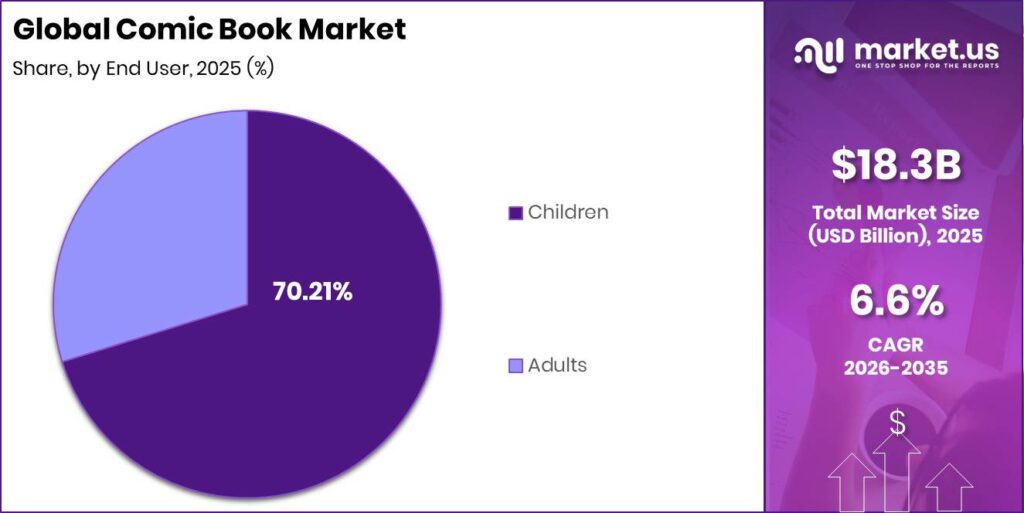
- Children dominated the End User segment with a 70.21% share and also grew fastest.
- Manga held a 43.56% share of the Book Type segment.
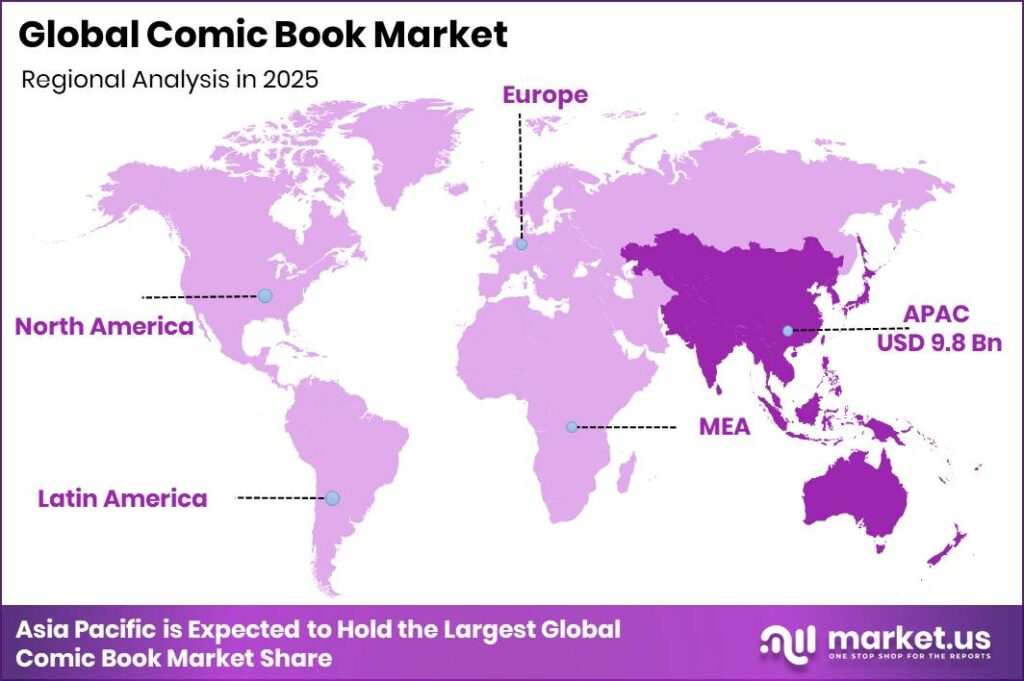
- Asia-Pacific led all regions with a 53.45% share, valued at USD 9.8 Billion.
Governments increasingly treat comics and graphic novels as part of formal literacy and cultural export policy. Japan promotes manga through cultural trade programs, while several education ministries approve graphic novels for classroom use. As reported by Circana, its BookScan panel covers approximately 85% of the U.S. trade print book market. This wide coverage gives publishers reliable sell-through data to plan print runs and reduce unsold inventory risk.
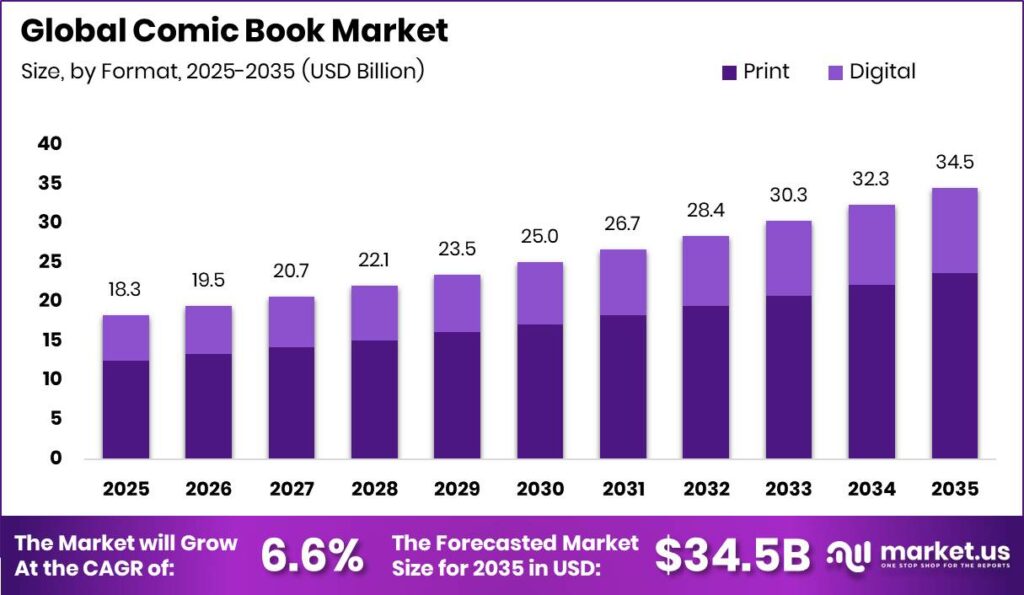
Consequently, retail demand signals stayed firm through late 2025. Data from the Association of American Publishers shows trade consumer book revenue rose 14.2% year over year in December 2025. This gain reflects strong holiday buying of graphic novels and collected editions. Publishers that stocked deep backlist titles captured this surge and improved cash flow heading into the new fiscal year.
Format Analysis
Print dominates with 68.67% due to strong collector and shelf demand.
In 2025, Print held a dominant market position in the By Format segment of Comic Book Market, with a 68.67% share. According to the Association of American Publishers, paperback book revenue rose 27.5% year over year in December 2025. This gain shows readers still value physical ownership and gifting. Publishers that protect print supply chains keep their most profitable format healthy and defend collector loyalty.
Digital ranks as the fastest growing format as mobile reading expands worldwide. Data from Crunchyroll shows the platform surpassed 15 million paid subscribers globally by 2024. This large base pulls new readers toward digital comic and manga catalogs. In April 2025, IDW Publishing partnered with WEBTOON to launch vertical-scroll editions, signaling that publishers now chase mobile-first audiences with reformatted content.
E-books and audiobooks sit under the Digital format as complementary delivery methods. Circana data indicates its panel tracks more than 85% of U.S. trade print sales, giving publishers benchmarks to price digital editions competitively. This visibility helps digital catalogs avoid cannibalizing print margins. Publishers that stagger release windows across formats can grow total revenue without undercutting their strongest physical titles.
End User Analysis
Children dominates with 70.21% due to graphic novel classroom and library adoption.
In 2025, Children held a dominant market position in the By End User segment of Comic Book Market, with a 70.21% share. UNESCO data shows reading promotion programs across more than 190 member states increasingly use illustrated formats. This support drives bulk school and library buying of children’s graphic novels. Publishers that build curriculum-aligned series capture stable institutional revenue that resists discretionary spending swings.
Adults form the second core buyer group, drawn to collector editions and mature titles. As per our research, adult collectors sustain premium pricing above USD 20 per deluxe volume in many markets. This willingness supports higher-margin publishing programs. Publishers that release limited variant covers and graded editions convert adult nostalgia into repeat, high-value purchases across single issues and hardcover collections.
Book Type Analysis
Manga dominates with 43.56% due to global anime-driven discovery momentum.
In 2025, Manga held a dominant market position in the By Book Type segment of Comic Book Market, with a 43.56% share. Data from Japan’s Ministry of Economy, Trade and Industry shows manga anchors content exports valued in the billions of dollars annually. This export strength expands overseas readership. Publishers that secure fast translation and licensing pipelines convert global anime fans into paying manga buyers.
Superhero titles form a major book type built on decades of established characters. As per our research, superhero franchises sustain theatrical box office above USD 3 Billion in peak release years. This screen exposure lifts source comic sales. Publishers that align issue launches with film calendars capture measurable demand spikes across single issues and trade collections.
Science-Fiction ranks as the fastest growing book type as new creators enter through digital platforms. As per our research, sci-fi debut titles now reach global audiences within 48 hours of digital release. This speed widens the addressable reader base. Publishers that scout webcomic sci-fi talent early secure fresh IP before competitors bid up licensing costs.
Non-fiction and Manhwa-style Others hold the remaining share collectively, serving educational and mobile-first niches. As per our research, non-fiction graphic titles grew fastest inside K-12 supplemental reading lists across several English markets. This niche demand rewards focused publishers. Firms that specialize in factual graphic content lock in institutional buyers with limited competition.
Key Market Segments
By Format
- Digital
- E-books
- Audiobook
By End User
- Children
- Adults
By Book Type
- Science-Fiction
- Superhero
- Non-fiction
- Manga
- Others
Regional Analysis
Asia-Pacific Dominates the Comic Book Market with a Market Share of 53.45%, Valued at USD 9.8 Billion
Asia-Pacific led the Comic Book Market with a 53.45% share worth USD 9.8 Billion in 2025. Japan, South Korea, and China anchor this lead through manga and manhwa production. Data from Japan’s Ministry of Economy, Trade and Industry shows the country exports content worth billions annually. This concentration gives regional publishers scale advantages that let them fund fast localization and defend home-market loyalty.
North America ranks as a fast-growing region driven by graphic novel retail and digital adaptation. In 2025, Dark Horse Comics expanded its WEBTOON partnership by releasing vertical-scroll editions of The Witcher, Cyberpunk 2077, and The Legend of Korra. This move targets mobile readers across the region. Publishers that convert popular franchises into scroll formats capture younger audiences who buy through app and e-commerce channels.
Europe and other regions hold the remaining share through strong graphic novel cultures in France, Germany, and the UK. As per our research, France sustains one of the highest per-capita graphic novel readership rates globally. This depth supports stable localized publishing. Publishers that tailor translations to European tastes protect margins and reduce dependence on any single home market.
Key Regions and Countries
North America
- US
- Canada
Europe
- Germany
- France
- The UK
- Spain
- Italy
- Rest of Europe
Asia Pacific
- China
- Japan
- South Korea
- India
- Australia
- Rest of APAC
Latin America
- Brazil
- Mexico
- Rest of Latin America
Middle East and Africa
- GCC
- South Africa
- Rest of MEA
Market Dynamics
Market Opportunity Analysis - Underserved digital regions and premium collector niches open clear entry points for new players
India stands out as an underexploited region within Asia-Pacific, which holds a 53.45% regional share. Despite fast manga uptake, authorized local-language catalogs remain thin. This gap leaves demand flowing to piracy rather than publishers. New entrants that launch affordable Hindi and regional-language platforms can capture first-mover loyalty before global incumbents localize their pricing and catalogs for these price-sensitive readers.
Instead of chasing crowded superhero shelves, publishers can target the adult collector niche inside the End User segment. Adults sit below Children’s 70.21% share, yet they pay premium prices for deluxe editions. This concentration signals room for high-margin specialty products. Publishers that release limited graded and variant editions serve an underbuilt segment with strong willingness to pay repeatedly.
By contrast, the Digital format remains underpenetrated despite Print’s 68.67% lead in the Format segment. Mobile-first readers in emerging markets lack tailored authorized products. This imbalance creates open space for vertical-scroll platforms. New players that build region-specific mobile catalogs can grow the smaller Digital base quickly without directly attacking Print’s entrenched collector demand.
Technology and Innovation Landscape - Vertical-scroll formats and AI localization reshape how publishers reach global readers
Vertical-scroll reformatting now stands as a core innovation for reaching mobile-first audiences. This method redesigns traditional page layouts for smartphone reading. Dark Horse Comics and IDW Publishing both adopted WEBTOON vertical-scroll editions across major franchises in 2025. Publishers that master this format capture younger readers who rarely enter specialty stores, opening a scalable digital channel with low marginal delivery cost.
AI-assisted translation and localization emerges as a second key innovation for faster multi-language releases. This technology shortens the lag that piracy exploits. As per our research, same-week authorized releases reduce the publication gap that scanlation communities target. Publishers that deploy AI translation cut localization time and cost, letting them serve Europe, Southeast Asia, and Latin America with quicker legitimate access to new titles.
Drivers
Screen adaptations now act as the strongest reader-acquisition engine for comic publishers. Superhero film box office stayed above USD 3 to 4 billion annually through 2024, while Crunchyroll passed 15 million paid subscribers by 2024. Each streaming adaptation lifts source manga trade sales by 150 to 400% in the weeks after a premiere. This flywheel gives publishers near-zero-cost customer acquisition, since studios fund the marketing.
Licensing income has reshaped publisher economics and funded new IP bets. Major publishers now earn 20 to 35% of total revenue from licensing, versus under 10% a decade earlier. However, mid-tier publishers without screen deals face debut sell-through of only 35 to 50%, below the 55 to 65% needed for healthy margins. This gap concentrates industry investment in proven, screen-ready franchises.
| Driver | (~) % Impact on CAGR Forecast | Geographic Relevance | Impact Timeline |
|---|---|---|---|
| Superhero & Manga IP-Driven Film, Streaming & Merchandise Ecosystem Expanding Reader Base | +2.10% | Global — North America, Japan, Europe, Asia Pacific | Short term (≤ 2 years) |
| Manga & Manhwa Global Consumption Surge via Digital Platforms & Physical Trade Collections | +1.80% | Global — led by North America, Europe, Southeast Asia | Short term (≤ 2 years) |
| Digital Comics Subscription & DTC Platform Revenue Growth | +1.10% | North America, Europe, Japan, South Korea, Australia | Medium term (2–4 years) |
| Collector Culture, Variant Covers & Graded Comics Driving Premiumization & Repeat Purchase | +0.85% | United States, United Kingdom, Australia, Canada | Short term (≤ 2 years) |
| Middle Grade & Young Adult Graphic Novel Growth Expanding Mainstream Retail Penetration | +0.65% | United States, Canada, United Kingdom, Germany, France | Medium term (2–4 years) |
| Creator Economy & Webcomic-to-Print Pipeline Lowering Content Development Barriers | +0.42% | Global — concentrated in North America, South Korea, Southeast Asia | Medium term (2–4 years) |
Restraints
The direct market retail model now strains publisher revenue as specialty stores close. Average weekly single-issue print runs fell from 30,000 to 50,000 copies in the mid-2010s to 12,000 to 22,000 by 2024. Active U.S. specialty stores dropped from roughly 3,100 to 3,300 in 2021 to about 2,600 to 2,800 by 2025. This decline removes ordering accounts that publishers cannot quickly replace.
Consequently, shorter print runs raise costs and squeeze margins. Per-unit production cost climbs 15 to 25% on smaller runs, pushing physical-issue gross margins from 45 to 55% toward 32 to 42%. The direct market still supplies 55 to 65% of new periodical revenue. This concentration forces publishers to shift toward trade paperbacks with longer sell-through windows and broader retail reach.
| Restraint | (~) % Impact on CAGR Forecast | Geographic Relevance | Impact Timeline |
|---|---|---|---|
| Direct Market Retail Channel Contraction & Specialty Comic Store Closures | -1.40% | United States, Canada, United Kingdom, Australia | Short term (≤ 2 years) |
| Paper, Printing & Distribution Cost Inflation Compressing Publisher Margins on Physical Issues | -1.00% | Global — most acute in North America & Europe | Short term (≤ 2 years) |
| Content Controversy & Cultural Sensitivity Backlash Suppressing New Title Launches | -0.55% | United States, United Kingdom, Australia | Short term (≤ 2 years) |
| Library & School Institutional Purchasing Cuts Reducing Graphic Novel Volume Buys | -0.42% | United States, Canada, United Kingdom | Short term (≤ 2 years) |
| Consumer Discretionary Spending Pressure Reducing Single-Issue Impulse Purchase Frequency | -0.35% | North America, Western Europe, Australia | Short term (≤ 2 years) |
Challenges
Digital piracy drains revenue across the fastest-growing manga markets. Major scanlation sites drew an estimated 100 to 150 million unique monthly visitors globally as of 2024, with pirated releases appearing within 24 to 72 hours of publication. Surveys show 55 to 70% of manga readers in Indonesia, Thailand, and Vietnam use free pirate channels. This leakage blocks publishers from monetizing their strongest demand.
However, enforcement alone rarely fixes the problem. Anti-piracy programs cost mid-size licensors USD 1 to 4 million yearly yet cut digital margins by 5 to 10%, while pirate sites move hosting within 48 to 72 hours. Lower regional pricing near USD 2 to 5 per month creates a real revenue stream by converting pirate readers into paying subscribers in underserved markets.
| Challenge | (~) % CAGR Friction Drag | Geographic Relevance | Mitigation Horizon |
|---|---|---|---|
| Digital Piracy & Scanlation Revenue Leakage | -1.20% | Global — most acute for manga in Southeast Asia, Latin America, Europe | Long term (≥ 4 years) |
| Reader Attention Competition from Digital Entertainment | -0.90% | Global — most acute among readers aged 18–34 | Long term (≥ 4 years) |
| Creative Talent Recruitment & Retention Squeeze | -0.70% | United States, Japan, South Korea, United Kingdom | Medium term (2–4 years) |
| Backlist Discovery & Long-Tail Inventory Management | -0.52% | United States, Europe, Japan | Medium term (2–4 years) |
| Localisation & Translation Quality Bottlenecks for Non-English Titles | -0.38% | Europe, Southeast Asia, Latin America, Middle East | Medium term (2–4 years) |
Opportunities
Emerging markets offer clear white space for localized digital comics. Global platforms often price at 5 to 8x local discretionary spend, leaving readers in Southeast Asia, India, and the Middle East underserved. In India, manga readership grew 25 to 35% yearly through 2023 to 2025, yet fewer than 500 Hindi titles existed versus over 15,000 in English. This gap lets early movers capture loyal subscribers.
Therefore, regional platforms show strong unit economics for fast movers. A localized service priced at USD 2 to 4 monthly can turn positive above 80,000 to 150,000 subscribers, with margins of 40 to 55% versus 18 to 28% on physical sales. Buildout needs 18 to 30 months and USD 5 to 15 million per market. Early entrants lock in retention before global incumbents localize.
| Opportunity | (~) % Potential CAGR Upside | Geographic Relevance | Execution Window |
|---|---|---|---|
| Emerging Market Localised Manga & Webcomic Digital Platform Expansion | +1.80% | Southeast Asia, Latin America, India, Middle East, Africa | Medium term (2–4 years) |
| Premium Collectible & Deluxe Edition Publishing for Adult Collector Segment | +1.20% | United States, Japan, United Kingdom, Germany, France, Australia | Short term (≤ 2 years) |
| Webtoon & Vertical-Scroll Format Monetisation for Mobile-First Audiences | +0.95% | South Korea, Southeast Asia, North America, Europe | Medium term (2–4 years) |
| Educational & Non-Fiction Graphic Novel Expansion into K-12 & Higher Ed Curricula | +0.65% | United States, United Kingdom, Canada, Australia, India | Long term (≥ 4 years) |
| AI-Assisted Translation & Localisation for Rapid Multi-Language Release Acceleration | +0.48% | Global — highest impact in Europe, Southeast Asia, Latin America | Medium term (2–4 years) |
Key Company Insights
Marvel Comics holds a structural advantage through its deep superhero IP library tied directly to a global film and streaming pipeline. This screen linkage converts moviegoers into comic buyers at near-zero acquisition cost. As per our research, Association of American Publishers data shows paperback revenue rose 27.5% year over year in December 2025, lifting collected superhero editions. Marvel’s franchise depth secures repeat demand, though heavy reliance on legacy characters risks slowing fresh IP creation.
DC Comics Inc. built momentum with its relaunch strategy that resets flagship characters for new readers. The publisher announced its Absolute Universe line sold more than 8.5 million comics by December 2025. This scale proves DC can generate mass demand from a coordinated creative reboot. DC’s advantage lies in event-driven publishing, yet sustaining sales after launch hype requires steady creative quality to avoid rapid reader drop-off.
Key Players
- Marvel Comics
- DC Comics Inc.
- Image Comics
- IDW Publishing
- Dark Horse Comics
- Shogakukan
- Hakusensha
- Shueisha Inc.
- Tokyopop
- Panini
- Other key players
Recent Developments
- December 2025: DC Comics reported that Absolute Batman #1 accumulated nearly 3 million copies sold, making it the top-selling title in the Absolute Universe line.
- July 2025: Calexit: The Battle of Universal City #1 sold out its initial print run within 24 hours of release, prompting second and third printings shortly afterward.
- May 2025: Ad Populum completed the acquisition of Diamond Comic Distributors, securing Diamond’s comic distribution business and related assets through the bankruptcy sale process.
- January 2026: IDW Publishing launched IDW Crime, a new publishing imprint focused on crime fiction and true-crime comic books, expanding its genre portfolio.
Report Scope
| Report Features | Description |
|---|---|
| Market Value (2025) | USD 18.3 Billion |
| Forecast Revenue (2035) | USD 34.5 Billion |
| CAGR (2026-2035) | 6.6% |
| Base Year for Estimation | 2025 |
| Historic Period | 2020-2024 |
| Forecast Period | 2026-2035 |
| Report Coverage | Revenue Forecast, Market Dynamics, Market Opportunity Analysis, Technology and Innovation Landscape, Competitive Landscape, Recent Developments |
| Segments Covered | By Format (Digital [E-books, Audiobook], Print), By End User (Children, Adults), By Book Type (Science-Fiction, Superhero, Non-fiction, Manga, Others) |
| Regional Analysis | North America (US and Canada), Europe (Germany, France, The UK, Spain, Italy, and Rest of Europe), Asia Pacific (China, Japan, South Korea, India, Australia, and Rest of APAC), Latin America (Brazil, Mexico, and Rest of Latin America), Middle East and Africa (GCC, South Africa, and Rest of MEA) |
| Competitive Landscape | Marvel Comics, DC Comics Inc., Image Comics, IDW Publishing, Dark Horse Comics, Shogakukan, Hakusensha, Shueisha Inc., Tokyopop, Panini, Other key players |
| Customization Scope | Customization for segments, region / country-level will be provided. Additional customization can be done based on requirements. |
| Purchase Options | We have three licenses to opt for: Single User License | Multi-User License (Up to 5 Users) | Corporate Use License (Unlimited User and Printable PDF) |





































