


Global Clean Beauty Market Size, Share, Growth Analysis By Product (Skincare, Face Care, Body Care, Haircare, Color Cosmetics), By End User (Women, Men), By Distribution Channel (Hypermarkets and Supermarkets, Specialty Stores, Online, Others), By Region and Companies - Industry Segment Outlook, Market Assessment, Competition Scenario, Statistics, Trends and Forecast 2026-2035
- Published date: March 2026
- Report ID: 181544
- Number of Pages: 271
- Format:
-
keyboard_arrow_up
Quick Navigation
Report Overview
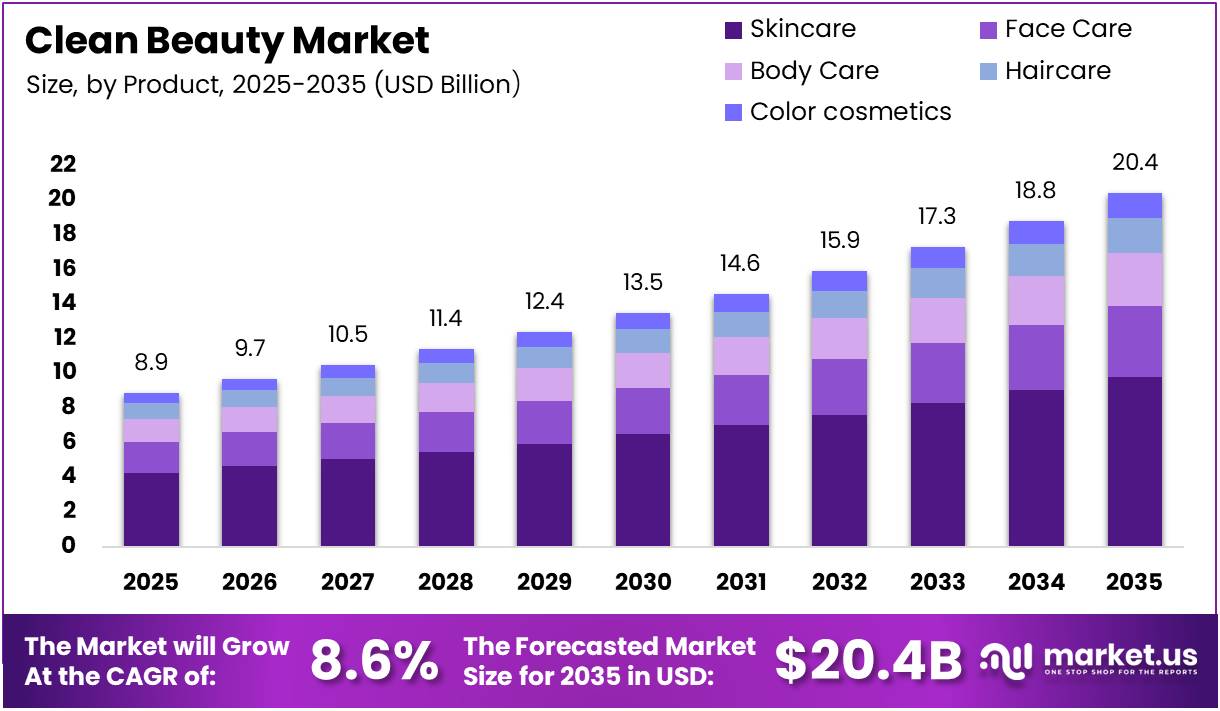
The Global Clean Beauty Market size is expected to be worth around USD 20.4 Billion by 2035 from USD 8.9 Billion in 2025, growing at a CAGR of 8.6% during the forecast period 2026 to 2035.
The clean beauty market refers to personal care and cosmetic products formulated without harmful or toxic chemicals. These products prioritize safe, natural, and sustainably sourced ingredients. Moreover, clean beauty emphasizes full ingredient transparency, ethical sourcing, and reduced environmental impact across skincare, haircare, and color cosmetics categories.
This market spans a wide range of product types, including facial care, body care, and personal hygiene solutions. Consumers are increasingly choosing products free from parabens, sulfates, synthetic dyes, and other potentially harmful substances. Additionally, the market continues to benefit from the broader wellness and self-care trend shaping consumer lifestyles globally.
The clean beauty market has gained strong momentum in recent years, driven by rising health consciousness among global consumers. Growing demand for ingredient transparency and cruelty-free beauty solutions are primary growth catalysts. Consequently, major beauty brands are reformulating existing products and launching new clean beauty lines to meet evolving consumer expectations.
Regulatory bodies in North America and Europe are strengthening oversight of cosmetic ingredients, pushing brands toward cleaner formulations. Governments are encouraging full ingredient disclosure and phasing out harmful chemical compounds. Therefore, regulatory changes are creating both compliance requirements and growth opportunities for brands committed to clean beauty standards.
Emerging economies across Asia Pacific and Latin America are witnessing growing consumer interest in premium and safe beauty products. Government initiatives supporting sustainable manufacturing and green chemistry are further accelerating market growth. Additionally, increased investment in biotechnology-based ingredients is unlocking new product development opportunities across the clean beauty landscape.
Consumer data strongly supports this growth trajectory. According to Cosmetics Business, 68% of consumers now actively seek out skin care products made with clean ingredients. Furthermore, according to NSF, 74% of consumers consider organic ingredients important in personal care products, while 65% want a clear ingredient list to identify potentially harmful ingredients.
Industry safety data also reflects this momentum. According to the BPC Leaders’ 2025 Report published on ChemForward, 76% of beauty product ingredients are now characterized for safety, and 71% are verified as safer or low concern. These findings confirm that the clean beauty market is built on a solid foundation of safety science and consumer trust.
Key Takeaways
- The Global Clean Beauty Market was valued at USD 8.9 Billion in 2025 and is projected to reach USD 20.4 Billion by 2035.
- The market is growing at a CAGR of 8.6% during the forecast period 2026 to 2035.
- By Product, Skincare holds the dominant position with a 47.9% market share in 2025.
- By End User, Women lead the market with a 72.4% share in 2025.
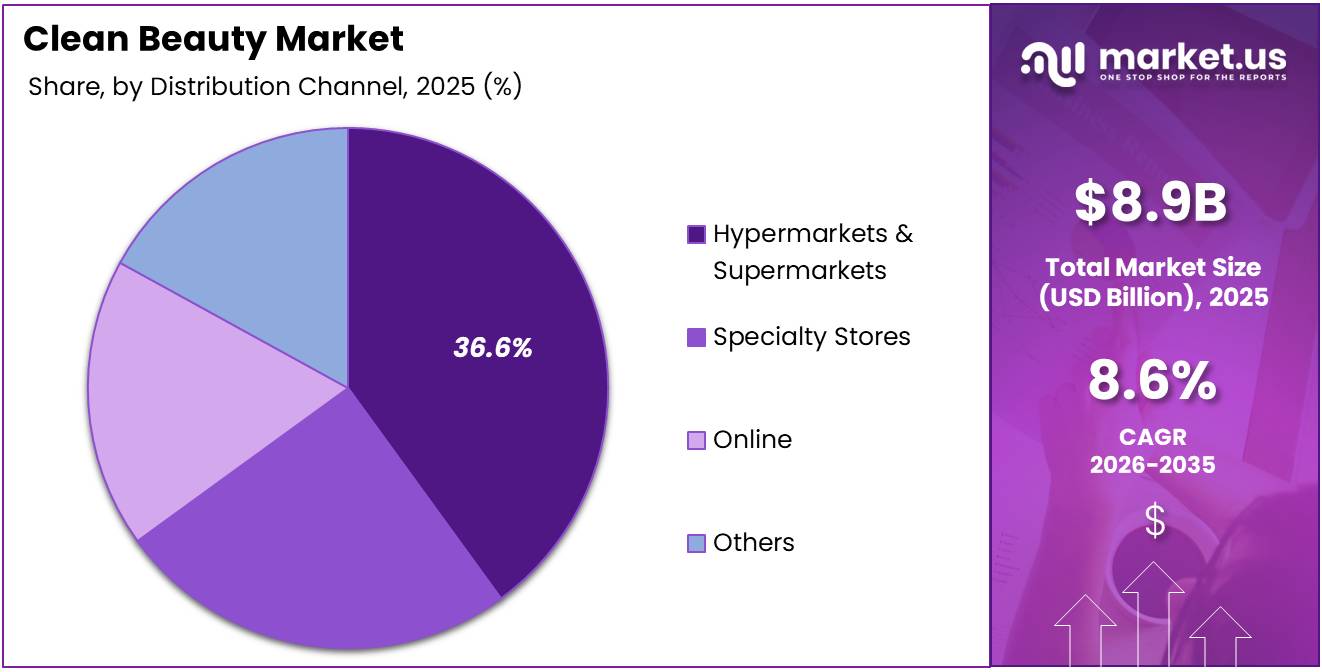
- By Distribution Channel, Hypermarkets and Supermarkets hold the largest share at 36.6% in 2025.
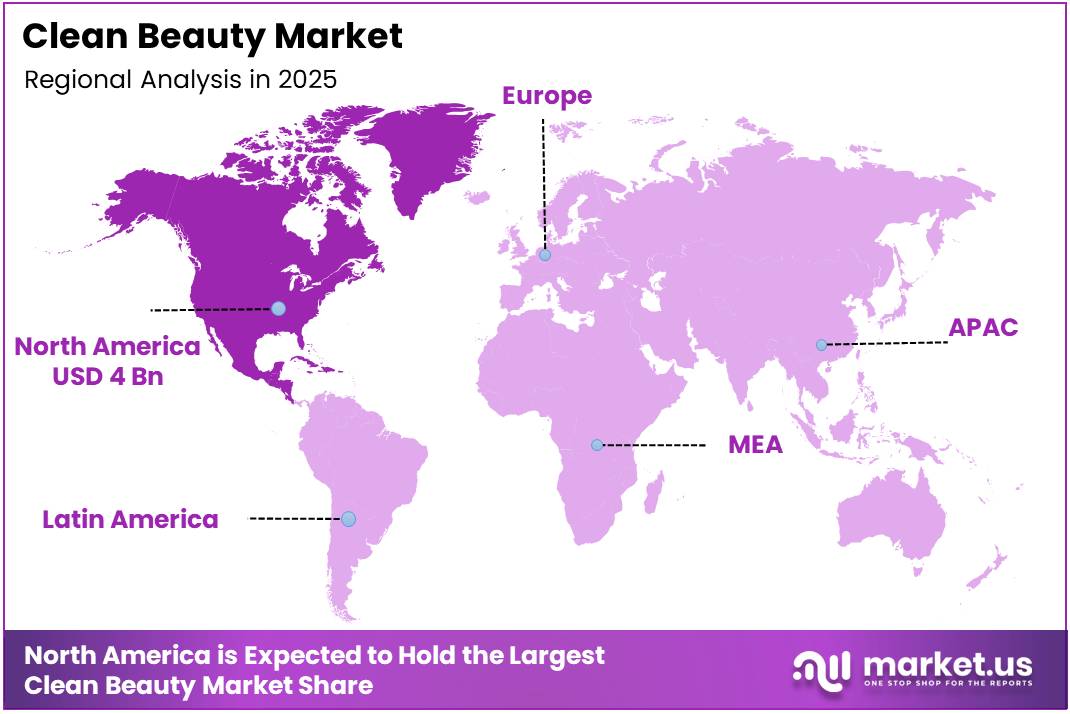
- North America dominates the regional landscape with a 45.80% market share, valued at USD 4 Billion in 2025.
By Product Analysis
Skincare dominates with 47.9% due to high consumer demand for safe, skin-nourishing facial formulations and treatments.
In 2025, Skincare held a dominant market position in the By Product segment of the Clean Beauty Market, with a 47.9% share. Skincare remains the largest category due to high consumer interest in facial serums, moisturizers, and treatments. Additionally, growing demand for non-toxic and skin-nourishing formulations continues to drive this segment forward consistently.
Face Care is a key sub-segment within the clean beauty product category, driven by consumer preference for gentle and chemical-free facial products. Products such as facial cleansers, toners, and face masks are gaining strong popularity. Moreover, clean formulations designed for sensitive skin have accelerated demand across this sub-segment globally.
Body Care products, including clean lotions, scrubs, and bath formulations, are witnessing steady growth. Consumers are becoming more mindful of what they apply to their skin on a daily basis. Therefore, demand for body care products free from parabens and artificial fragrances is rising consistently across major markets.
Haircare is an emerging yet fast-growing sub-segment within the clean beauty market. Consumers are shifting toward sulfate-free, silicone-free, and naturally derived hair products. Additionally, rising awareness of scalp health and clean formulation standards is driving adoption of clean haircare products among diverse consumer groups.
Color Cosmetics in the clean beauty space include foundations, lipsticks, and eyeshadows made without harmful dyes or synthetic chemicals. This sub-segment is growing as consumers demand high-performance makeup with clean formulations. Consequently, brands are innovating with plant-based pigments and skin-nourishing ingredients across this product category.
By End User Analysis
Women dominate with 72.4% due to their strong preference for safe skincare, haircare, and cosmetic formulations free from harmful chemicals.
In 2025, Women held a dominant market position in the By End User segment of the Clean Beauty Market, with a 72.4% share. Women represent the primary consumer group for clean beauty products, driven by strong interest in safe skincare, haircare, and cosmetics. Moreover, growing awareness of harmful chemical effects has further strengthened women’s preference for clean formulations.
Men represent a growing and increasingly important end user segment in the clean beauty market. Rising grooming consciousness and awareness of toxic ingredients are encouraging more men to choose clean beauty products. Additionally, targeted marketing and dedicated product development for men’s skincare and haircare are expanding this segment’s overall contribution.
By Distribution Channel Analysis
Hypermarkets and Supermarkets dominate with 36.6% due to wide product variety, competitive pricing, and high consumer footfall.
In 2025, Hypermarkets and Supermarkets held a dominant market position in the By Distribution Channel segment of the Clean Beauty Market, with a 36.6% share. These retail formats offer consumers wide product variety and easy access to clean beauty brands. Moreover, competitive pricing and the convenience of one-stop shopping continue to drive strong sales through this channel.
Specialty Stores play a significant role in the clean beauty distribution landscape, offering curated and premium product selections. These stores attract health-conscious consumers seeking expert guidance and exclusive clean beauty brands. Consequently, the specialty retail channel continues to maintain a loyal customer base within the broader clean beauty segment.
Online channels are experiencing rapid growth as a distribution platform for clean beauty products. E-commerce and direct-to-consumer platforms allow brands to reach global audiences efficiently and cost-effectively. Additionally, the growth of social commerce and influencer-led promotions is significantly boosting online sales of clean beauty products worldwide.
Others in this segment include pharmacies, drug stores, department stores, and direct sales channels. These formats cater to niche consumer groups seeking personalized clean beauty recommendations. Therefore, while smaller in share, these channels contribute to overall market accessibility and brand visibility across different consumer demographics.
Key Market Segments
By Product
- Skincare
- Face Care
- Body Care
- Haircare
- Color Cosmetics
By End User
- Women
- Men
By Distribution Channel
- Hypermarkets and Supermarkets
- Specialty Stores
- Online
- Others
Drivers
Rising Consumer Awareness and Sustainability Demand Drive Clean Beauty Market Growth
Rising consumer awareness of harmful chemicals in conventional beauty products is a primary driver for the clean beauty market. Shoppers are actively seeking ingredient transparency and choosing products free from parabens, sulfates, and synthetic additives. This shift in buying behavior is compelling brands to reformulate products and communicate ingredient safety more effectively.
Increasing demand for sustainable, eco-friendly, and cruelty-free beauty solutions is further accelerating market growth. Consumers are gravitating toward brands that demonstrate environmental responsibility through ethical sourcing and sustainable packaging. Consequently, the clean beauty market is benefiting from a broader shift toward conscious consumption and green lifestyle choices among global consumers.
Social media platforms and beauty influencers play a powerful role in shaping consumer perceptions of clean beauty standards. Influencer endorsements, educational content, and ingredient breakdowns have significantly increased consumer awareness and purchasing intent. Therefore, the digital marketing ecosystem has become one of the most effective channels for driving clean beauty adoption worldwide.
Restraints
Regulatory Gaps and Formulation Challenges Restrain Clean Beauty Market Growth
The absence of standardized regulations and globally recognized certifications for clean beauty claims remains a major restraint. Without a universal definition of clean beauty, brands use varying criteria, creating confusion among consumers and retailers. Consequently, the credibility of clean beauty labels is often questioned, reducing consumer trust and overall purchase confidence.
This regulatory gap also poses compliance challenges for brands operating across multiple markets with different ingredient restrictions. Inconsistent standards between regions such as North America, Europe, and Asia Pacific make it difficult for brands to align formulations globally. Therefore, regulatory fragmentation increases operational costs and slows down product development cycles significantly.
Limited shelf life and stability challenges of natural formulations also restrict market growth considerably. Unlike synthetic preservatives, natural alternatives often provide shorter product longevity, raising concerns for both manufacturers and consumers. Additionally, maintaining product efficacy and microbial safety without harsh chemicals remains a complex technical challenge for clean beauty formulators.
Growth Factors
Emerging Markets, Biotechnology Innovation, and Sustainable Packaging Fuel Clean Beauty Market Expansion
The expansion of clean beauty product lines in emerging markets and untapped regions represents a major growth opportunity. Countries across Asia Pacific, Latin America, and the Middle East are showing increasing consumer interest in safe and natural beauty products. Moreover, growing internet penetration and e-commerce are enabling clean beauty brands to reach new audiences effectively.
Innovation in biotechnology-derived and lab-grown natural ingredients is opening significant new avenues for product development. These advanced ingredients offer superior efficacy, improved stability, and a reduced environmental footprint compared to traditionally sourced botanicals. Consequently, biotechnology is enabling clean beauty brands to overcome formulation challenges while continuing to deliver high-performance products.
The increasing adoption of refillable and zero-waste packaging solutions is gaining strong traction within the clean beauty industry. Eco-conscious consumers are actively choosing brands that minimize single-use plastics and reduce overall packaging waste. Therefore, sustainable packaging innovation is becoming a key differentiator and a powerful growth driver across the clean beauty market.
Emerging Trends
Skinimalism, Waterless Formulations, and Hybrid Products Redefine Clean Beauty Market Trends
The surge in skinimalism and minimal ingredient formulations is one of the most prominent trends reshaping the clean beauty market. Consumers are shifting toward streamlined routines that use fewer, more effective products. Moreover, minimal ingredient lists are increasingly viewed as a sign of product safety, purity, and strong brand transparency.
The popularity of waterless and concentrated beauty products is growing rapidly within the clean beauty segment. These formulations are more sustainable, require less packaging, and often deliver higher ingredient concentration per use. Additionally, waterless products have a longer shelf life and a smaller carbon footprint, making them an attractive choice for environmentally conscious consumers.
The growing demand for hybrid beauty products that combine skincare and makeup benefits is a transformative trend in the clean beauty space. Products such as tinted moisturizers, skin-conditioning foundations, and SPF-infused cosmetics are gaining strong consumer interest. Consequently, this trend is blurring traditional category lines and creating new growth areas for clean beauty brands.
Regional Analysis
North America Dominates the Clean Beauty Market with a Market Share of 45.80%, Valued at USD 4 Billion
North America holds the leading position in the Clean Beauty Market with a 45.80% market share, valued at USD 4 Billion in 2025. The region benefits from high consumer awareness, strong purchasing power, and a well-established retail infrastructure for clean beauty products. Moreover, the presence of leading clean beauty brands and stringent regulatory standards has reinforced North America’s dominant market position.
Europe Clean Beauty Market Trends
Europe represents a significant market for clean beauty, driven by strict cosmetic regulations and high consumer demand for safe and sustainable products. The European Union’s cosmetics directive restricts thousands of potentially harmful ingredients, creating a favorable environment for clean beauty brands. Consequently, European consumers are among the most informed and discerning clean beauty buyers globally.
Asia Pacific Clean Beauty Market Trends
Asia Pacific is the fastest-growing region in the clean beauty market, supported by rising disposable incomes and increasing consumer awareness in China, Japan, South Korea, and India. The region’s growing middle class is driving demand for premium, natural, and clean beauty formulations. Additionally, the K-beauty trend has played a key role in promoting clean ingredient standards across the region.
Latin America Clean Beauty Market Trends
Latin America is emerging as a promising region for clean beauty products, with Brazil and Mexico leading market growth. Rising consumer interest in natural and organic ingredients is fueling demand across the region. Moreover, local brands are increasingly adopting clean beauty positioning to align with the preferences of health-conscious consumers throughout the region.
Middle East and Africa Clean Beauty Market Trends
The Middle East and Africa region is experiencing gradual yet consistent growth in the clean beauty market. Rising urbanization, a growing young population, and increasing awareness of safe beauty ingredients are driving demand. Therefore, international clean beauty brands are beginning to expand their presence in key markets within this region.
Key Regions and Countries
North America
- US
- Canada
Europe
- Germany
- France
- The UK
- Spain
- Italy
- Rest of Europe
Asia Pacific
- China
- Japan
- South Korea
- India
- Australia
- Rest of APAC
Latin America
- Brazil
- Mexico
- Rest of Latin America
Middle East & Africa
- GCC
- South Africa
- Rest of MEA
Key Company Insights
ILIA Beauty is a leading clean beauty brand recognized for its skin-forward makeup formulations that combine skincare benefits with high-performance color cosmetics. The company has built a strong reputation for ingredient transparency, offering products free from harmful chemicals and synthetic additives. ILIA’s commitment to sustainability and clean formulations has positioned it as a trusted name in the clean beauty segment.
The Estée Lauder Companies is a global powerhouse in the beauty industry with a growing portfolio of clean beauty products across multiple brand lines. The company has been actively investing in clean formulations and sustainable packaging practices. Moreover, its strategic acquisitions and research investments reflect a long-term commitment to meeting the clean beauty demands of modern consumers worldwide.
L’Oreal Paris is one of the world’s largest beauty companies and has made significant strides in advancing clean beauty solutions at scale. The company is progressing its sustainability commitments through eco-designed formulations and responsible sourcing of natural ingredients. Additionally, L’Oreal’s growing investment in green science and biotechnology is helping the brand lead product innovation across the global clean beauty market.
Olaplex, Inc. is a prominent player in the clean haircare segment, recognized for its bond-building and hair repair technology. The company’s formulations are designed to restore and protect hair structure without the use of harsh chemicals. Consequently, Olaplex has cultivated a strong global following among consumers and professional stylists who value clean, performance-driven haircare solutions.
Key Players
- ILIA Beauty
- The Estée Lauder Companies
- L’Oreal Paris
- Olaplex, Inc.
- Grown Alchemist
- John Paul Mitchell Systems
- Versed
- RMS Beauty
- e.l.f. Cosmetics, Inc.
- The Honest Company, Inc.
Recent Developments
- March 2026 – The Estée Lauder Companies announced it will acquire the remaining stakes in Forest Essentials, an Indian beauty brand specializing in Ayurvedic cosmetics, strengthening its presence in the fast-growing South Asian clean and natural beauty segment.
- January 2026 – Kiss Beauty Group acquired Chillhouse, a cool-girl nail and lifestyle brand, expanding its portfolio into the growing clean color cosmetics and nail care space.
- December 2025 – Perfumes y Diseño acquired a majority stake in Twelve Beauty, a premium clean skincare brand, reflecting continued consolidation and strategic investment activity within the global clean beauty industry.
- November 2025 – Actress Shay Mitchell launched Rini, a K-beauty-inspired clean skincare line specifically formulated for children aged 3 and up, co-developed alongside partners Esther Song and Matte Babel, marking a new niche within the clean beauty segment.
- August 2025 – Violet Grey acquired The Detox Market, a curated clean beauty retailer, with further growth ambitions targeting additional specialty retail acquisitions to accelerate its clean beauty distribution footprint.
- May 2025 – e.l.f. Beauty announced a definitive agreement to acquire rhode in a $1 Billion deal, marking one of the most significant clean beauty acquisitions of the year and signaling strong investor confidence in the sector’s growth trajectory.
Report Scope
Report Features Description Market Value (2025) USD 8.9 Billion Forecast Revenue (2035) USD 20.4 Billion CAGR (2026-2035) 8.6% Base Year for Estimation 2025 Historic Period 2020-2024 Forecast Period 2026-2035 Report Coverage Revenue Forecast, Market Dynamics, Competitive Landscape, Recent Developments Segments Covered By Product (Skincare, Face Care, Body Care, Haircare, Color Cosmetics), By End User (Women, Men), By Distribution Channel (Hypermarkets and Supermarkets, Specialty Stores, Online, Others) Regional Analysis North America (US and Canada), Europe (Germany, France, The UK, Spain, Italy, and Rest of Europe), Asia Pacific (China, Japan, South Korea, India, Australia, and Rest of APAC), Latin America (Brazil, Mexico, and Rest of Latin America), Middle East & Africa (GCC, South Africa, and Rest of MEA) Competitive Landscape ILIA Beauty, The Estée Lauder Companies, L’Oreal Paris, Olaplex, Inc., Grown Alchemist, John Paul Mitchell Systems, Versed, RMS Beauty, e.l.f. Cosmetics, Inc., The Honest Company, Inc. Customization Scope Customization for segments, region/country-level will be provided. Moreover, additional customization can be done based on the requirements. Purchase Options We have three licenses to opt for: Single User License, Multi-User License (Up to 5 Users), Corporate Use License (Unlimited User and Printable PDF) 
-
-
- ILIA Beauty
- The Estée Lauder Companies
- L'Oreal Paris
- Olaplex, Inc.
- Grown Alchemist
- John Paul Mitchell Systems
- Versed
- RMS Beauty
- e.l.f. Cosmetics, Inc.
- The Honest Company, Inc.
Our Clients

- 181544
- March 2026






