


Market Overview
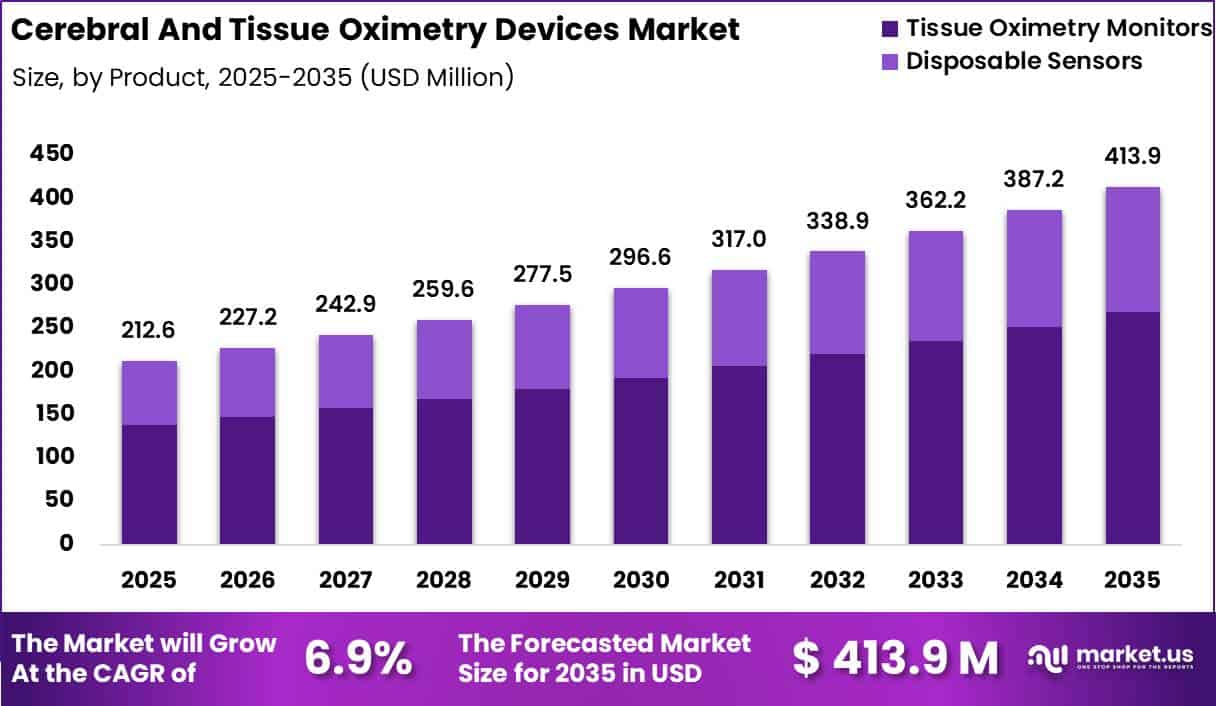
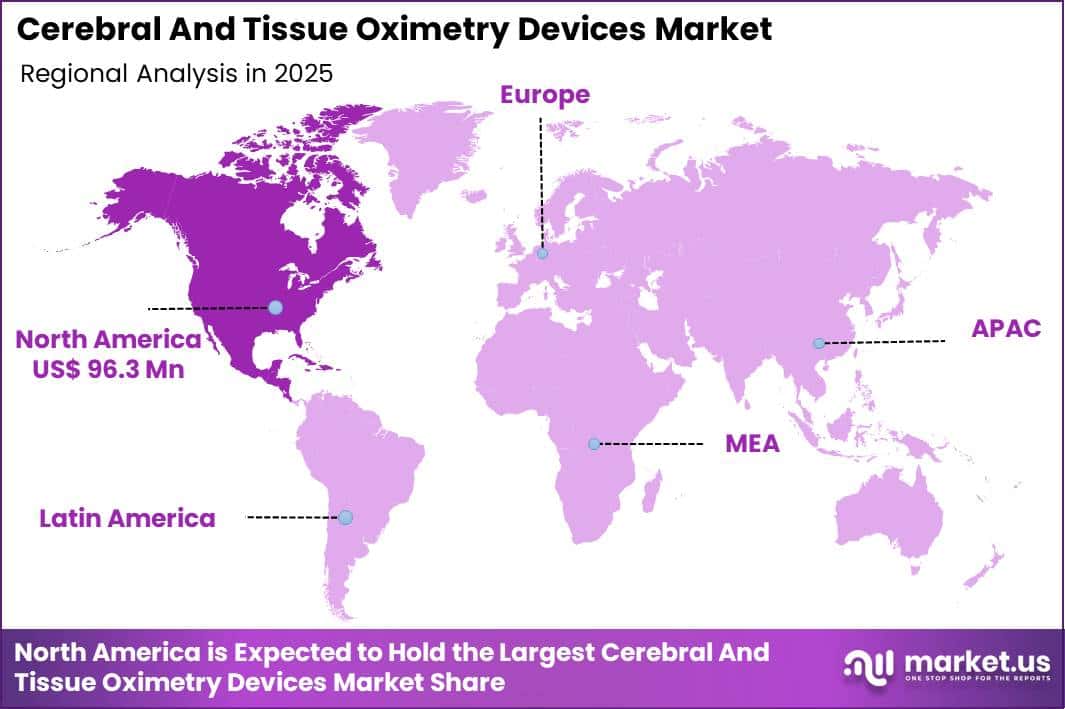
Global Cerebral And Tissue Oximetry Devices Market size is expected to be worth around US$ 413.9 Million by 2035 from US$ 212.6 Million in 2025, growing at a CAGR of 6.9% during the forecast period from 2026 to 2035. In 2025, North America led the market, achieving over 45.3% share with a revenue of US$ 96.3 Million.
The Cerebral and Tissue Oximetry Devices Market is witnessing steady growth due to increasing demand for non-invasive monitoring technologies that help clinicians assess oxygen levels in the brain and body tissues during critical care procedures. These devices primarily use Near-Infrared Spectroscopy (NIRS) technology to measure regional oxygen saturation (rSO₂/StO₂) by analyzing light absorption patterns from oxygenated and deoxygenated hemoglobin.
Cerebral and tissue oximetry devices are increasingly used in cardiac surgery, intensive care units (ICUs), emergency care, neonatal monitoring, anesthesia management, and neurological procedures where continuous oxygen monitoring is essential. The U.S. Food and Drug Administration (FDA) classifies cerebral oximeters as Class II medical devices under regulation 870.2700, with devices evaluated through the 510(k) clearance pathway.
Technological advancements are driving adoption through the development of portable, wireless, and real-time monitoring systems. Recent research has demonstrated that compact cerebral tissue oximeters can provide continuous oxygen saturation monitoring in settings such as ambulances, emergency carts, and ICUs.
The rising global burden of cardiovascular diseases and neurological complications is increasing the need for advanced monitoring solutions. According to the World Health Organization (WHO), cardiovascular diseases remain the leading cause of death globally, accounting for approximately 17.9 million deaths annually, strengthening demand for improved perioperative and critical-care monitoring technologies.
Future market expansion is expected to be supported by artificial intelligence integration, improved sensor accuracy, miniaturization, and wider adoption of continuous patient monitoring systems across hospitals and specialty care centers.
Key Takeaways
- Market Size: Global Cerebral And Tissue Oximetry Devices Market size is expected to be worth around US$ 413.9 Million by 2035 from US$ 212.6 Million in 2025.
- Market Share: The market is growing at a CAGR of 6.9% during the forecast period from 2026 to 2035.
- Product: Tissue Oximetry Monitors Segment Dominates Cerebral And Tissue Oximetry Devices Market with 65.0% Market Share in 2025.
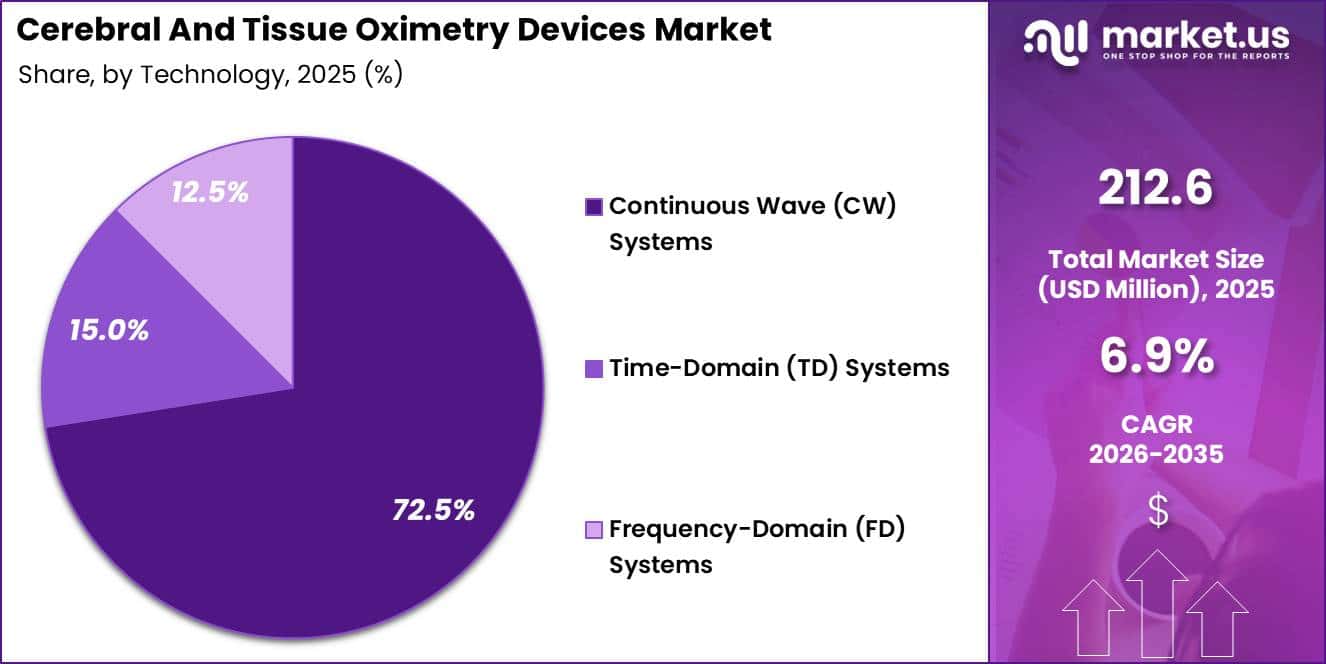
- Technology: Continuous Wave (CW) Systems Segment Dominates Cerebral And Tissue Oximetry Devices Market with 72.5% Market Share in 2025.
- Application: Cerebral Oximetry Segment Dominates Cerebral And Tissue Oximetry Devices Market with 75.3% Market Share in 2025.
- End User: Hospitals Segment Dominates Cerebral And Tissue Oximetry Devices Market with 58.0% Market Share in 2025.
- Regional Analysis: In 2025, North America led the market, achieving over 45.3% share with a revenue of US$ 96.3 Million.
Product Analysis
Tissue Oximetry Monitors Segment Dominates Cerebral And Tissue Oximetry Devices Market.
The product segment of the Cerebral And Tissue Oximetry Devices Market is categorized into Tissue Oximetry Monitors and Disposable Sensors. In 2025, Tissue Oximetry Monitors dominate the segment with a 65.0% market share, driven by their increasing adoption in critical care, cardiovascular procedures, neurosurgery, and intensive monitoring environments.
These monitors provide real-time oxygen saturation measurement of tissues, supporting clinicians in early detection of oxygen imbalance and improving patient management during complex surgeries. Growing demand for advanced patient monitoring technologies and minimally invasive diagnostic solutions is further supporting the adoption of tissue oximetry monitoring systems.
Disposable Sensors account for 35.0% of the market in 2025 and are witnessing steady growth due to their importance in infection control, patient safety, and workflow efficiency. Hospitals and surgical centers increasingly prefer single-use sensors to reduce cross-contamination risks and maintain hygiene standards.
Rising surgical volumes, expansion of intensive care units, and increasing focus on personalized patient monitoring are expected to strengthen demand for both monitors and disposable sensor products in the coming years.
Technology Analysis
Continuous Wave (CW) Systems Segment Dominates Cerebral And Tissue Oximetry Devices Market.
The technology segment of the Cerebral And Tissue Oximetry Devices Market includes Continuous Wave (CW) Systems, Time-Domain (TD) Systems, and Frequency-Domain (FD) Systems.
In 2025, Continuous Wave (CW) Systems lead the technology segment with a 72.5% market share, owing to their widespread clinical acceptance, cost efficiency, and ability to provide continuous oxygenation monitoring during surgical and critical care procedures. CW systems are extensively used in cardiac surgeries, neurological procedures, and intensive care settings due to their reliable performance and simpler operational requirements.
Time-Domain (TD) Systems hold a 15.0% market share in 2025 and are gaining attention because of their advanced measurement capabilities and improved accuracy in assessing tissue oxygenation. These systems offer enhanced depth sensitivity and detailed optical information, making them suitable for research and specialized clinical applications.
Frequency-Domain (FD) Systems represent 12.5% of the market in 2025 and are being adopted for applications requiring precise oxygenation analysis. Increasing innovation in optical sensing technologies and growing demand for advanced monitoring solutions are expected to support the future growth of TD and FD technologies.
Application Analysis
Cerebral Oximetry Segment Dominates Cerebral And Tissue Oximetry Devices Market.
The application segment of the Cerebral And Tissue Oximetry Devices Market is divided into Cerebral Oximetry and Tissue Oximetry.
In 2025, Cerebral Oximetry dominates the application segment with a 75.3% market share, supported by increasing utilization in neurosurgical procedures, cardiac surgeries, and intensive care monitoring. Cerebral oximetry devices help healthcare professionals continuously evaluate brain oxygen levels, enabling early identification of cerebral oxygen imbalance and supporting improved patient outcomes during high-risk procedures.
The growing prevalence of neurological disorders, increasing number of complex surgeries, and rising emphasis on intraoperative patient monitoring are contributing to the adoption of cerebral oximetry technologies across hospitals and specialty care centers. These devices are particularly valuable in procedures where maintaining adequate brain oxygenation is critical for reducing postoperative complications.
Tissue Oximetry applications account for the remaining market share and are expanding due to their use in assessing oxygen levels in muscles, organs, and peripheral tissues. These solutions are increasingly applied in vascular surgery, wound care monitoring, and rehabilitation settings. Advancements in non-invasive monitoring technologies and increasing demand for real-time physiological data are expected to drive growth across both application areas.
End User Analysis
Hospitals Segment Dominates Cerebral And Tissue Oximetry Devices Market.
The end user segment of the Cerebral And Tissue Oximetry Devices Market consists of Hospitals, Ambulatory Surgical Centers, and Others, including Clinics and Research Institutions.
In 2025, Hospitals represent the leading end-user segment with a 58.0% market share, driven by the extensive use of cerebral and tissue oximetry devices in operating rooms, intensive care units, and specialized surgical departments. Hospitals increasingly adopt these monitoring systems to improve perioperative care, enhance patient safety, and support real-time decision-making during complex procedures.
Ambulatory Surgical Centers are emerging as a growing segment due to the increasing shift toward minimally invasive surgeries and outpatient procedures. The demand for compact, efficient monitoring solutions is rising as surgical centers focus on improving operational efficiency while maintaining high-quality patient care.
Others, including Clinics and Research Institutions, contribute to market growth through expanding clinical studies and technological development activities. Research organizations are utilizing oximetry technologies for studying tissue oxygen metabolism and developing advanced healthcare applications.
Growing healthcare infrastructure, rising surgical procedures, and increased adoption of non-invasive monitoring solutions are expected to support expansion across all end-user categories.
Key Market Segments
By Product
- Tissue Oximetry Monitors
- Disposable Sensors
By Technology
- Continuous Wave (CW) Systems
- Time-Domain (TD) Systems
- Frequency-Domain (FD) Systems
By Application
- Cerebral Oximetry
- Tissue Oximetry
By End User
- Hospitals
- Ambulatory Surgical Centers
- Others (Clinics, Research)
Drivers
High Risk Cardiac and Vascular Surgery Driven Cerebral Oximetry Adoption.
Cerebral oximetry has transitioned from an adjunct tool to an increasingly standard component of care in complex cardiothoracic and major vascular surgeries. Clinical evidence shows that continuous monitoring of cerebral oxygenation helps detect intraoperative desaturation early, allowing interventions that reduce neurological complications such as stroke and cognitive decline.
By 2024, multiple FDA cleared non invasive cerebral oximetry systems were available in the U.S., supporting wider hospital adoption and encouraging standardization across operating rooms. This is especially relevant in high volume cardiac surgery systems, where even small reductions in postoperative complications can significantly lower ICU stay duration and readmission costs.
Adoption is strongest in North America and Western Europe, where reimbursement models and bundled payments place financial pressure on hospitals to reduce adverse outcomes in procedures like CABG, valve repair, and aortic surgery.
As a result, hospitals are increasingly willing to invest in monitoring systems despite upfront capital costs, typically offset by improved clinical outcomes and reduced complications.Overall, cerebral oximetry is evolving into part of integrated peri operative monitoring systems connected with anesthesia platforms and OR analytics, supporting broader adoption in mid tier hospitals and emerging markets.
| Driver | (~) % Impact on CAGR Forecast | Geographic Relevance | Impact Timeline |
|---|---|---|---|
| High-risk cardiac & vascular surgeries using cerebral oximetry | +2.0% | North America, Western Europe core; APAC tertiary centers | Medium term (2–4 years) |
| Expansion of neurocritical and trauma care pathways | +1.5% | North America, EU, selective APAC corridors, Middle East hubs | Long term (≥ 4 years) |
| Aging population and complex geriatric surgeries | +1.3% | OECD economies, China, South Korea | Long term (≥ 4 years) |
| Regulatory alignment and accelerated coverage (FDA–CMS RAPID, QMSR/ISO 13485) | +1.0% | U.S. primary, spill-over to EU and other regulated markets | Short–Medium term (≤ 4 years) |
| Technological shift to multi-parameter, wireless tissue oximetry platforms | +1.4% | Global, early in U.S., EU, Japan; fast-follower APAC | Medium term (2–4 years) |
| Peri-operative patient safety and quality-of-care metrics (JCI, Joint Commission) | +1.2% | Global large hospitals, integrated delivery networks | Short–Medium term (≤ 4 years) |
Challenges
High Capex Perioperative Deployment Constraints.
Cerebral and tissue oximetry systems remain relatively capital intensive, with OR grade consoles typically priced at USD 25,000–60,000 per room, plus additional disposable or limited reuse sensors costing USD 75–200 per major procedure.
At higher utilization levels (400–600 cases annually), this translates into meaningful recurring annual spend per operating room, which can reach tens of thousands of dollars.For cardiac and major vascular programs, these costs must be weighed against other competing investments such as echocardiography, neuromonitoring, and surgical infrastructure upgrades.
While clinical studies suggest benefits such as reduced hypoxic events and shorter ICU stays, many hospitals are still in the process of building long term outcomes evidence, which slows full scale adoption. Mid tier and resource constrained hospitals face the strongest barriers, as limited capital budgets force trade offs between multiple high priority technologies.
As a result, adoption is significantly higher in well funded tertiary centers compared to smaller or emerging market facilities.To address these constraints, vendors are introducing lower cost monitors, multi year financing models, and bundled platform offerings. However, broader adoption is expected to remain gradual until stronger cost benefit evidence and more flexible procurement models become widely established.
| Challenge | (~) % CAGR Friction Drag | Geographic Relevance | Mitigation Horizon |
|---|---|---|---|
| Complex multi-modal integration | -1.2% | North America core, EU teaching hospitals, APAC tertiary centers | Medium term (2–4 years) |
| High-capex perioperative deployment | -1.0% | North America, EU, Japan, Middle East cardiac hubs | Long term (≥ 4 years) |
| Data quality & calibration variance | -0.8% | Global installed base, community hospitals, ambulatory centers | Medium term (2–4 years) |
| Limited clinician workflow adoption | -0.9% | EU, North America, LatAm urban hospitals | Long term (≥ 4 years) |
| Reimbursement and coding complexity | -0.7% | U.S. CMS, EU public payers, select APAC systems | Medium term (2–4 years) |
| Fragmented regulatory digitization | -0.6% | U.S. FDA, EU MDR, emerging Asia regulators | Long term (≥ 4 years) |
Restraints
Regulatory Bias Driven Tightening in Oximetry Accuracy Standards.
Regulatory scrutiny around oximetry accuracy is increasing due to evidence that some pulse oximeters may overestimate oxygen saturation in patients with darker skin tones. This has prompted FDA safety communications and emerging draft guidance updates that are raising expectations for clinical validation and device performance across diverse patient populations. As a result, manufacturers are now required to conduct larger and more representative clinical studies, often expanding sample sizes to 200–300 patients across multiple skin tone categories.
This increases validation costs and extends development timelines by 12–18 months compared with earlier regulatory baselines.The added burden translates into higher R&D spending, more extensive bench and human factor testing, and greater algorithm refinement requirements.
For device manufacturers, this can increase development costs by several million dollars per product cycle and reduce the pace of new product launches between 2026 and 2030.Overall, these regulatory changes improve clinical safety and equity but also slow innovation cycles and raise barriers to entry, slightly dampening growth momentum in the oximetry market.
| Restraint | (~) % Impact on CAGR Forecast | Geographic Relevance | Impact Timeline |
|---|---|---|---|
| Bias-driven regulatory tightening on oximetry accuracy | -1.2% | North America core, EU | Medium term (2-4 years) |
| Hospital CapEx deferral and procurement consolidation | -0.9% | North America, EU, select APAC | Short–medium term (≤ 4 years) |
| Cybersecurity and connectivity compliance burden | -0.7% | North America, EU, advanced APAC | Medium–long term (≥ 3 years) |
| Reimbursement uncertainty for perioperative monitoring | -0.8% | North America core, EU | Medium term (2-4 years) |
| Interoperability and data integration friction | -0.6% | North America, EU, APAC corridors | Long term (≥ 4 years) |
| Supply chain constraints in optoelectronic components | -0.5% | Global, with APAC-centric sourcing | Short term (≤ 2 years) |
Opportunity
Expansion into Chronic Home Monitoring for High Risk Patients.
This opportunity centers on extending cerebral and tissue oximetry beyond hospitals into home based monitoring for high risk patients with conditions such as heart failure, COPD, diabetes, and peripheral vascular disease.
Today, most remote monitoring programs rely on basic vitals like SpO2, blood pressure, and heart rate, leaving more advanced tissue oxygenation insights largely unused outside clinical settings.By 2030, millions of patients in OECD markets are expected to qualify for chronic remote monitoring, yet only a small share currently participate in advanced programs.
This creates a meaningful unmet space for more sophisticated perfusion monitoring technologies that could detect early signs of deterioration before hospitalization is required.Vendors could develop wearable or simplified cerebral or tissue oximetry devices connected to cloud platforms, enabling subscription based monitoring models. Pricing in the range of USD 20–40 per patient per month could support attractive margins due to reusable hardware and software driven value creation.
However, adoption is currently limited because reimbursement frameworks and clinical guidelines still treat oximetry primarily as an acute care or perioperative tool. Broader expansion depends on payer recognition of remote tissue oxygenation monitoring as a reimbursable service.
If clinical evidence demonstrates reduced hospitalizations and improved early intervention outcomes, this could unlock risk sharing models and establish a new long duration revenue stream, supporting meaningful long term market expansion.
| Opportunity | (~) % Potential CAGR Upside | Geographic Relevance | Execution Window |
|---|---|---|---|
| Expansion into chronic home monitoring for high-risk patients | +2.2% | North America, EU, urban APAC | Medium term (2–4 years) |
| AI-driven multi-parameter perfusion analytics platform | +2.8% | North America core, EU, Japan, South Korea | Medium term (2–4 years) |
| Bundled oximetry in value-based perioperative pathways | +1.9% | US, Canada, UK, Germany | Short term (≤ 2 years) |
| Low-cost oximetry for emerging-market surgical safety | +2.4% | APAC emerging, Latin America, Africa | Long term (≥ 4 years) |
| Oximetry integration into neurocritical and pediatric tele-ICU | +1.7% | North America, EU, GCC, China | Medium term (2–4 years) |
| OEM/white-label modules for broader patient monitoring systems | +1.5% | Global, especially Asia manufacturing hubs | Short–Medium term (≤ 4 years) |
Regional Analysis
North America Leads the Cerebral And Tissue Oximetry Devices Market with Strong Healthcare Adoption.
North America dominated the Cerebral And Tissue Oximetry Devices Market in 2025, accounting for over 45.3% of the global market share and generating approximately US$ 96.3 Million in revenue. The region’s leadership is primarily supported by the presence of advanced healthcare infrastructure, high adoption of innovative patient monitoring technologies, and increasing demand for real-time tissue oxygenation assessment in critical care environments.
The United States represents the major contributor within the region due to the widespread use of cerebral and tissue oximetry devices in cardiac surgeries, neurosurgical procedures, intensive care units (ICUs), and emergency care settings.
Growing cases of cardiovascular disorders, neurological conditions, and surgical complications are encouraging hospitals to implement advanced monitoring solutions to improve patient outcomes. According to healthcare authorities, millions of cardiovascular and surgical procedures are performed annually in North America, creating significant demand for continuous monitoring technologies.
Additionally, favorable reimbursement frameworks, rising healthcare expenditure, and strong research activities in medical device innovation are accelerating market growth. Leading hospitals and academic medical centers are increasingly adopting near-infrared spectroscopy (NIRS)-based monitoring systems for detecting changes in cerebral and tissue oxygen levels during complex procedures.
The presence of established medical device manufacturers and continuous product advancements, including portable and wireless monitoring solutions, further strengthens North America’s position. Increasing focus on precision medicine, patient safety, and improved perioperative care is expected to sustain regional growth in the coming years.
Key Regions and Countries
North America
- The US
- Canada
Europe
- Germany
- France
- The U.K.
- Italy
- Spain
- Russia & CIS
- Rest of Europe
Asia Pacific
- China
- India
- Japan
- South Korea
- ASEAN
- Australia & New Zealand
- Rest of Asia Pacific
Middle East & Africa
- GCC
- South Africa
- Rest of Middle East & Africa
Latin America
- Brazil
- Mexico
- Rest of Latin America
Key Player Analysis
The Cerebral And Tissue Oximetry Devices Market is moderately consolidated, with a few established medical technology companies accounting for a significant portion of the competitive landscape. Market competition is influenced by technological advancements, clinical accuracy, device reliability, and integration with advanced patient monitoring systems.
Leading companies are focusing on improving near-infrared spectroscopy (NIRS) technologies, developing compact monitoring solutions, and enhancing real-time data interpretation for critical care and surgical applications.
Among the prominent players, Medtronic plc, Masimo Corporation, Edwards Lifesciences Corporation, Nonin Medical, Inc., and Philips Healthcare are strengthening their market presence through continuous innovation and healthcare technology advancements. These companies are investing heavily in R&D to improve sensor performance, monitoring accuracy, and device interoperability with hospital information systems.
Competitive strategies include strategic partnerships with healthcare providers, research institutions, and technology firms to expand clinical adoption. Product innovation remains a key focus, with companies developing advanced sensors, wireless monitoring capabilities, and software-enabled analytics platforms.
Workflow integration is also gaining importance as hospitals increasingly adopt connected monitoring ecosystems across intensive care units, operating rooms, and cardiac procedures. Leading manufacturers are competing through complete ecosystem solutions that combine hardware, software, and data management capabilities to support improved patient outcomes and personalized clinical decision-making.
Top Key Players
- Medtronic plc
- Masimo Corporation
- Edwards Lifesciences Corporation
- Nonin Medical, Inc.
- Hamamatsu Photonics K.K.
- Philips Healthcare
- GE Healthcare
- Covidien plc (Medtronic)
- ISS, Inc.
- Artinis Medical Systems B.V.
- MOCACARE, Inc.
- Shimadzu Corporation
- ViOptix, Inc.
- Cas Medical Systems, Inc.
- Somanetics Corporation
- Others
Recent Developments
- In August 2025, Masimo Corporation expanded O3® Regional Oximetry capabilities with FDA clearance for expanded indications of its O3® Regional Oximetry platform. The updated technology introduced advanced delta hemoglobin parameters, enabling clinicians to better understand changes in tissue oxygen saturation across cerebral and somatic monitoring applications. The development strengthens Masimo’s position in non-invasive oxygen monitoring by improving physiological insights for critical care, cardiac surgery, and neonatal applications.
- In July 2025, Medtronic plc and Philips Healthcare signed a multi-year patient monitoring partnership agreement focused on improving integrated patient monitoring solutions. The agreement supports the integration of Medtronic technologies, including Nellcor™ pulse oximetry and BIS™ brain monitoring, into Philips monitoring platforms. This move reflects the growing industry focus on connected hospital ecosystems and seamless clinical workflows., Hamamatsu Photonics K.K., Philips Healthcare, GE Healthcare, Covidien plc (Medtronic), ISS, Inc., Artinis Medical Systems B.V., MOCACARE, Inc., Shimadzu Corporation, ViOptix, Inc., Cas Medical Systems, Inc., Somanetics Corporation, Others
- In August 2025, Philips expanded its technical collaboration with Medtronic to combine multiple clinical parameters into streamlined monitoring platforms. The integration approach helps hospitals reduce dependence on multiple standalone devices while improving access to continuous patient information. This trend reflects the growing market shift toward connected ICU systems and centralized clinical monitoring.
Report Scope
| Report Features | Description |
|---|---|
| Market Value (2025) | US$ 212.6 Million |
| Forecast Revenue (2035) | US$ 413.9 Million |
| CAGR (2026-2035) | 6.9% |
| Base Year for Estimation | 2025 |
| Historic Period | 2020-2024 |
| Forecast Period | 2026-2035 |
| Report Coverage | Revenue Forecast, Market Dynamics, Competitive Landscape, Recent Developments |
| Segments Covered | By Product (Tissue Oximetry Monitors, Disposable Sensors), By Technology (Continuous Wave (CW) Systems, Time-Domain (TD) Systems, Frequency-Domain (FD) Systems), By Application (Cerebral Oximetry, Tissue Oximetry), By End User (Hospitals, Ambulatory Surgical Centers, Others (Clinics, Research)) |
| Regional Analysis | North America – The US, Canada; Europe – Germany, France, U.K., Italy, Spain, Russia & CIS, Rest of Europe; Asia Pacific – China, India, Japan, South Korea, ASEAN, Australia & New Zealand, Rest of Asia Pacific; Middle East & Africa – GCC, South Africa, Rest of Middle East & Africa; Latin America – Brazil, Mexico, Rest of Latin America |
| Competitive Landscape | Medtronic plc, Masimo Corporation, Edwards Lifesciences Corporation, Nonin Medical, Inc., Hamamatsu Photonics K.K., Philips Healthcare, GE Healthcare, Covidien plc (Medtronic), ISS, Inc., Artinis Medical Systems B.V., MOCACARE, Inc., Shimadzu Corporation, ViOptix, Inc., Cas Medical Systems, Inc., Somanetics Corporation, Others |
| Customization Scope | Customization for segments, region/country-level will be provided. Moreover, additional customization can be done based on the requirements. |
| Purchase Options | We have three licenses to opt for: Single User License, Multi-User License (Up to 5 Users), Corporate Use License (Unlimited User and Printable PDF) |





































