


Report Overview
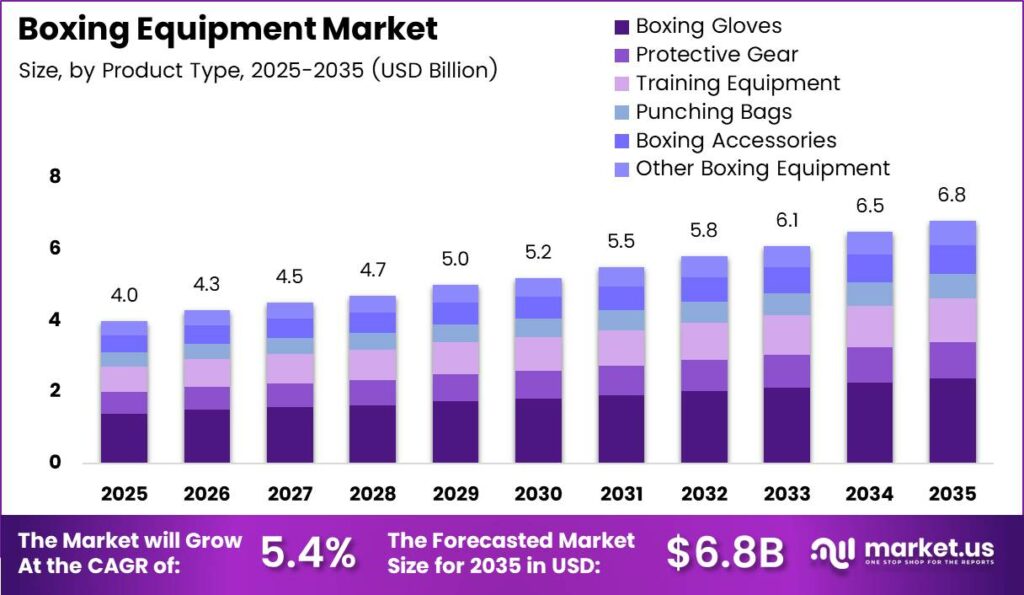
Global Boxing Equipment Market size is expected to be worth around USD 6.8 Billion by 2035 from USD 4.0 Billion in 2025, growing at a CAGR of 5.4% during the forecast period 2026 to 2035. The research forecast supports capacity planning across personal training, organized clubs, and competitive boxing. Manufacturers must align product investment with specific purchasing needs rather than treat all equipment categories as interchangeable revenue opportunities.
The boxing equipment market covers gloves, protective gear, training apparatus, punching bags, accessories, and other equipment used during practice and competition. The report separates protective and training products into dedicated groups, while material, end-user, and distribution classifications describe different purchasing dimensions. Therefore, suppliers must distinguish product function from buyer type when planning assortments, because an individual consumer and an institutional account can purchase similar equipment through different procurement processes.
Key Takeaways
- The research forecast places market revenue at USD 4.0 Billion in 2025 and USD 6.8 Billion by 2035, with a 5.4% CAGR.
- Boxing Gloves lead Product Type with 34.7%, making gloves a central category for portfolio planning.
- Headgear leads Protective Gear with 27.5%, highlighting the commercial importance of fit and equipment eligibility.
- Heavy Bags lead Training Equipment with 36.4%, connecting product purchasing with facility and installation requirements.
- Synthetic leather leads Material Type with 39.8%, making material documentation relevant to product differentiation.
- Individual Consumers lead End User with 39.3%, supporting consumer-focused purchasing guidance and product selection.
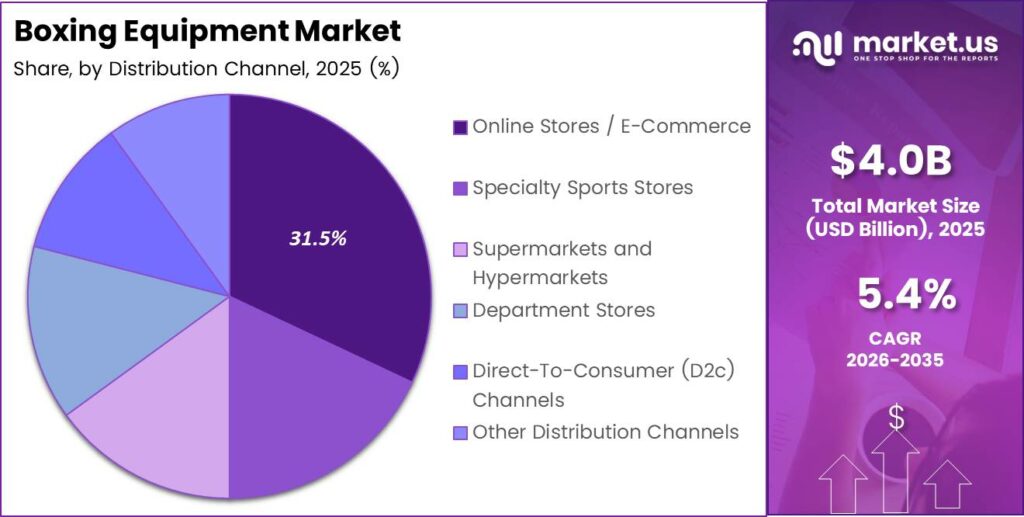
- Online Stores / E-Commerce lead Distribution Channel with 31.5%, making digital product information a key sales consideration.
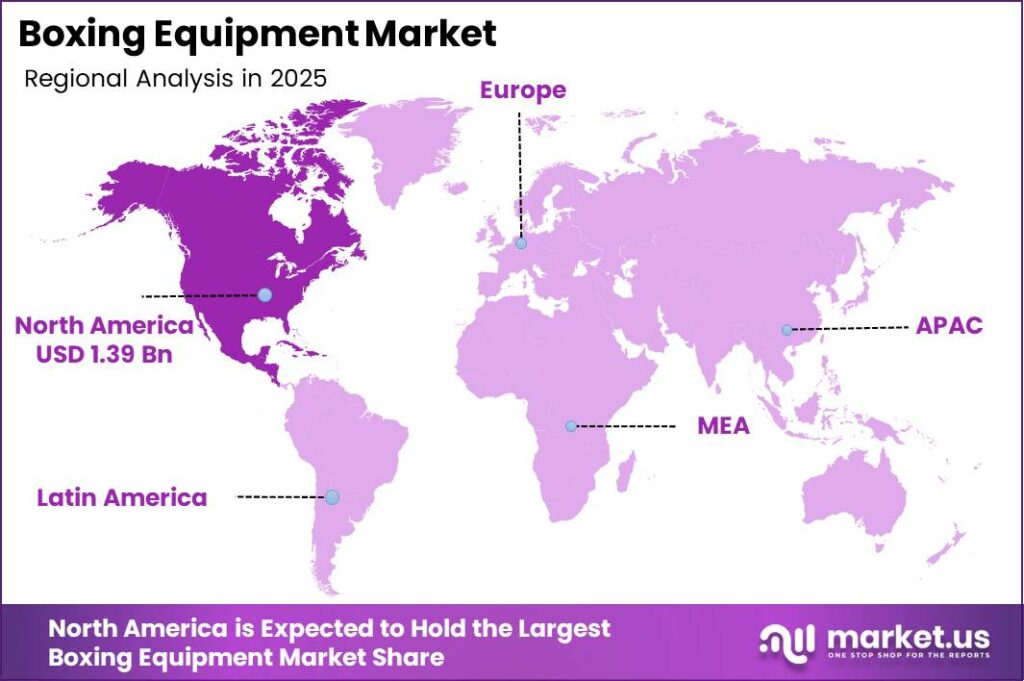
- North America leads the regional market with 34.9%, making regional coverage important to commercial execution.
According to the UK government’s February 2024 response, Sport England had invested over GBP 11.9 Million in projects facilitating boxing participation since 2020. The total included GBP 6.3 Million for England Boxing between 2022 and 2027, supporting organized participation rather than guaranteeing equipment sales. Suppliers can assess funded programs as institutional sales prospects, because expanded delivery can require additional or replacement equipment when existing club capacity cannot meet program needs.
World Boxing’s May 2026 announcement confirmed IOC approval of the Los Angeles 2028 qualification system, establishing a defined preparation pathway for national programs. The Olympic competition provides 248 athlete places across 7 weight classes for each gender, supporting athlete-specific equipment planning. Therefore, suppliers can align federation proposals with qualification preparation, because organized training creates equipment requirements, while athlete quotas alone do not establish purchasing volumes or guarantee supplier contracts.
Product Type Analysis
Boxing Gloves dominates with 34.7% due to direct use in training and competition.
In 2025, Boxing Gloves held a dominant market position in the By Product Type segment of Boxing Equipment Market, with a 34.7% share. According to World Boxing rules, competition gloves weigh 284 grams or 340 grams, making weight-specific assortments necessary for eligible competition use. Manufacturers must align construction and identification with approved specifications, because institutional buyers need equipment that meets the relevant rules rather than products carrying only familiar branding.
World Boxing announced in July 2025 that adidas Combat Sports equipment passed independent technical and chemical testing, qualifying the brand for competition-equipment tenders. The agreement runs until 2028 and includes random testing, making continued conformity part of the commercial requirement rather than a one-time approval. Its licensee distributes combat-sports equipment across more than 100 countries, providing distribution reach, while non-exclusive accreditation leaves contract awards dependent on subsequent procurement decisions.
Protective Gear Analysis
Headgear dominates with 27.5% due to category-specific protection requirements in eligible competitions.
In 2025, Headgear held a dominant market position in the By Protective Gear segment of Boxing Equipment Market, with a 27.5% share. As reported by World Boxing, headguards have a maximum weight of 450 grams and should come in 4 sizes, connecting product development with fit requirements. Suppliers must identify the intended competition category before presenting an assortment, because headguard eligibility differs across boxer groups and cannot follow from brand recognition alone.
TOP TEN became a World Boxing Official Equipment Manufacturer in August 2025, qualifying approved gloves, protective gear, and hand wraps for federation supply and competition tenders. The non-exclusive agreement gives protective-equipment suppliers another accredited competitor, making documented eligibility relevant to institutional purchasing. Manufacturers should distinguish approval from contract acquisition, because the announcement establishes access to procurement opportunities without confirming purchasing volumes, exclusive supply rights, or realized revenue from any particular federation or event.
Training Equipment Analysis
Heavy Bags dominates with 36.4% due to repeated use in punch training routines.
In 2025, Heavy Bags held a dominant market position in the By Training Equipment segment of Boxing Equipment Market, with a 36.4% share. England Boxing’s annual report recorded a peak of 1,086 affiliated clubs in 2024/25, identifying an organized account base for training-equipment suppliers. Manufacturers should assess bag condition, mounting capacity, and replacement schedules before quoting, because the club count identifies potential accounts rather than immediate purchasing commitments or uniform equipment needs.
Glasgow 2026 appointed Sting as its Official Boxing Equipment Provider in April 2026, connecting competition procurement with a broader training-infrastructure package. The announced supply included leather punch bags, double-end bags, and 16-foot training rings, showing that event contracts can extend beyond competition gloves. Suppliers pursuing institutional accounts should assess installation and training-station requirements alongside individual products, because a complete facility package requires coordinated equipment delivery rather than an isolated heavy-bag sale.
Material Type Analysis
Synthetic leather dominates with 39.8% due to use in equipment shells and coverings.
In 2025, Synthetic leather held a dominant market position in the By Material Type segment of Boxing Equipment Market, with a 39.8% share. adidas reported recycled or sustainably sourced renewable materials represented 60% of product and packaging materials in 2025, versus 56% in 2024, establishing broader sourcing context. These corporate figures do not measure boxing-equipment composition; suppliers should document product-level materials before making sourcing claims about gloves, bags, or protective gear.
KAZAKH INVEST reported June 2025 discussions on proposed RDX production localization, covering gloves, protective equipment, wraps, punching bags, and speed bags. The proposal identified 5 proprietary technologies and included protective products certified to CE and UKCA standards, connecting manufacturing plans with construction and compliance requirements. Material suppliers can assess specification and qualification needs within the proposed project, but negotiations do not establish operational production, synthetic-leather purchasing volumes, or confirmed orders for any particular input.
End User Analysis
Individual Consumers dominates with 39.3% due to personal equipment purchases for boxing practice.
In 2025, Individual Consumers held a dominant market position in the By End User segment of Boxing Equipment Market, with a 39.3% share. SFIA reported 250 million Americans participated in sport, fitness, or leisure activities in 2025, while CORE participation reached 158.8 million, distinguishing deeper engagement from general participation. These figures describe the broader activity market, so boxing retailers should assess actual training frequency before recommending starter purchases or recurring equipment replacements.
The Panamerican Boxing Confederation announced a July 2026 partnership with Sting Sports to provide equipment packages for 10 athletes, establishing a targeted institutional distribution route. Each package included training gloves, a competition or training headguard, and a groin protector, linking athlete support with multiple equipment categories. Suppliers should distinguish these federation-mediated purchases from individual retail transactions, because the beneficiary uses the equipment while a program determines allocation, assortment, and access rather than ordinary consumer purchasing behavior.
Distribution Channel Analysis
Online Stores / E-Commerce dominates with 31.5% due to digital purchasing access for equipment buyers.
In 2025, Online Stores / E-Commerce held a dominant market position in the By Distribution Channel segment of Boxing Equipment Market, with a 31.5% share. Based on US Census Bureau data, second-quarter 2026 retail e-commerce increased 12.4% year over year, compared with 6.6% growth in total retail sales, strengthening broader digital-channel context. These figures describe US retail rather than boxing equipment, so suppliers must evaluate product-specific conversion before applying economy-wide channel performance to sales forecasts.
Boxing Ireland announced a January 2026 partnership with Sting that combined athlete equipment support with the federation’s planned entry into equipment retailing. The arrangement covered Ireland and Northern Ireland, with a spring retail launch announced, creating a federation-linked route alongside conventional retailers and online stores. Suppliers should assess such partnerships by customer access and procurement responsibility, because a new retail announcement establishes a distribution initiative without proving completed transactions, digital-channel sales, or a measured shift in market share.
Key Market Segments
By Product Type
- Boxing Gloves
- Protective Gear
- Training Equipment
- Punching Bags
- Boxing Accessories
- Other Boxing Equipment
By Protective Gear
- Headgear
- Mouthguards
- Hand Wraps
- Groin Guards
- Other Protective Equipment
By Training Equipment
- Heavy Bags
- Speed Bags
- Double-End Bags
- Reflex Bags
- Other Training Equipment
By Material Type
- Synthetic leather
- Vinyl / PVC
- Foam
- Textile / fabric
- Other materials
By End User
- Individual Consumers
- Boxing Clubs and Gyms
- Sports Academies and Training Centers
- Professional Athletes
- Educational Institutions
- Promotional / Corporate Users
- Other Institutional Users
By Distribution Channel
- Online Stores / E-Commerce
- Specialty Sports Stores
- Supermarkets and Hypermarkets
- Department Stores
- Direct-To-Consumer (D2c) Channels
- Other Distribution Channels
Regional Analysis
North America Dominates the Boxing Equipment Market with a Market Share of 34.9%, Valued at USD 1.39 Billion
North America’s leading market position makes consumer distribution and institutional account coverage central to regional execution, but aggregate leadership does not identify the strongest buyer group. Suppliers should separate personal equipment orders from facility purchases when allocating inventory, because protective products and installed training apparatus serve different procurement needs. Regional sales planning should therefore connect product assortment with buyer type rather than assume every equipment category benefits equally from the region’s overall market position.
England Boxing reported Westway Boxing Club’s June 2026 redevelopment received GBP 700,000 in investment, linking facility expansion with identifiable equipment requirements. The planned center includes a full-sized ring, additional gym space, and dedicated storage, creating a practical account prospect for equipment suppliers. Europe also recorded a Spanish specialist-store opening in February 2025 and an Irish federation retail partnership in January 2026, showing separate routes through facility procurement, physical retail, and federation-linked distribution.
The Panamerican Boxing Confederation announced an athlete equipment support partnership in July 2026 covering 10 athletes, creating a defined route for targeted product placement. The packages included training gloves, headguards, and a groin protector, connecting athlete support with a practical protective and training assortment. Suppliers should distinguish this program from broad regional sales expansion, because the initiative establishes a specific support commitment rather than a measured purchasing trend across all markets in the Americas.
Key Regions and Countries
North America
- US
- Canada
Europe
- Germany
- France
- The UK
- Spain
- Italy
- Rest of Europe
Asia Pacific
- China
- Japan
- South Korea
- India
- Australia
- Rest of APAC
Latin America
- Brazil
- Mexico
- Rest of Latin America
Middle East and Africa
- GCC
- South Africa
- Rest of MEA
Market Dynamics
Market Opportunity Analysis - Buyer-specific procurement and product evidence offer focused entry strategies
Headgear offers a product-development route for entrants that can substantiate fit and equipment eligibility rather than compete through branding alone. The segmentation establishes headgear as the leading protective category, making a clear buyer proposition more useful than an unsupported claim of unmet demand. Manufacturers should identify the intended competition or training context before designing an assortment, because purchasing suitability depends on use requirements and cannot follow automatically from category leadership.
Heavy Bags offer a facility-account strategy that connects product selection with installation planning, replacement assessment, and purchasing responsibility. The training analysis identifies an organized club channel, giving entrants a practical starting point for account qualification rather than a broad claim about untapped demand. Suppliers should establish whether buyers need replacements, additional training stations, or installation-compatible products before building inventory, because a club’s existence does not reveal its current equipment purchasing needs.
Individual Consumers offer a differentiated retail strategy based on training frequency, product guidance, and intended use rather than general fitness participation alone. The end-user analysis separates the wider active population from deeper activity engagement, supporting a more selective approach to customer acquisition. Retailers should distinguish beginner purchases from repeat equipment needs, because a large fitness audience can generate marketing exposure without establishing boxing participation, purchasing conversion, or recurring equipment revenue.
European club redevelopment offers an account-specific entry route for suppliers that connect equipment proposals with published facility plans and purchasing schedules. The regional example establishes a funded project with identified training infrastructure, making project qualification more useful than describing the entire region as underserved. Entrants should confirm procurement responsibility, approved specifications, and delivery stages before forecasting revenue, because an investment announcement does not reveal the equipment budget or establish a supplier appointment.
Technology and Innovation Landscape - Condition-specific validation determines the value of connected boxing systems
According to the Motion Tape study, jab detection on a body opponent bag reached 97.6% accuracy, compared with 70.4% for lead hooks. The difference shows that equipment-use conditions affect detection performance, making a single overall accuracy figure an incomplete product claim. Manufacturers should test the punches and training apparatus their buyers actually use, because uneven detection can weaken automated workout records and comparisons between different training sessions and equipment configurations.
As reported in the XingXun validation study, single-punch acceleration reliability coefficients ranged from 0.926 to 0.950, supporting consistent measurement within the tested conditions. Combination-punch coefficients ranged from 0.871 to 0.905, indicating weaker consistency when the task became more complex. Buyers should evaluate the training sequence they intend to monitor, because reliability coefficients measure consistency rather than percentage accuracy and should not serve as interchangeable claims about overall sensor measurement performance.
Data from the Motion Tape study shows approximately 80 Hz sampling per channel and support for 8 simultaneous sensing channels, defining the tested acquisition capacity. The wireless node used 2.4 GHz Bluetooth Low Energy communications, establishing its transmission architecture rather than proving commercial installation readiness. Equipment developers should assess sensing coverage and data capture requirements before selecting an integration design, because sampling specifications and channel capacity describe different constraints on a connected training system.
The Apple Vision Pro study reported punch-type identification accuracy of 93.8% across 8,750 movements, providing a task-specific benchmark for mixed-reality boxing feedback. Average classification completion took 156 milliseconds, making response timing a separate consideration from correct identification. Developers should evaluate feedback behavior alongside recognition performance, because accurate classification does not establish improved training outcomes, commercial adoption, or the purchasing value of the system for individual consumers and institutional equipment buyers.
Drivers
According to England Boxing’s annual-report reference, the organization recorded more than 36,000 individual members in 2024/25, establishing an active club-linked customer base. Membership connects suppliers with buyers of gloves, wraps, protective equipment, and shared training apparatus, supporting club-account selling and replenishment planning. Manufacturers should distinguish participation from equipment-sales growth, because existing spare capacity and personal purchasing determine how membership translates into orders rather than guaranteeing an equivalent increase in equipment revenue.
The research procurement scenario assumes clubs add 10% more active members and equip half the additional participants, producing approximately 5% additional member-linked equipment demand. The model supports testing beginner bundles and shared-equipment replenishment against each club’s existing capacity rather than assuming automatic purchasing conversion. The table presents analyst scenario sensitivities, not measured causal effects, and participants should not add embedded driver adjustments mechanically to the baseline forecast or treat them as observed sales outcomes.
| Driver | (~) % Impact on CAGR Forecast | Geographic Relevance | Impact Timeline |
|---|---|---|---|
| Affiliated boxing-club participation | +0.40% | Global; strongest evidence in England | Short term (≤ 2 years) |
| Existing non-contact boxing classes | +0.30% | North America, Europe, urban Asia-Pacific | Short term (≤ 2 years) |
| Direct-to-consumer purchasing access | +0.20% | Global; digitally mature consumer markets | Short term (≤ 2 years) |
| Installed-equipment replacement demand | +0.15% | Established club and gym markets | Short term (≤ 2 years) |
| Premium glove product mix | +0.10% | North America, Western Europe, Japan | Medium term (2-4 years) |
Restraints
The EU General Product Safety Regulation applies from 13 December 2024 and creates a market-access barrier for covered products without required safety and traceability information. Covered consumer boxing products require an EU-based responsible economic operator, while online marketplaces must prevent publication without minimum product information. Sellers should prioritize documentation and listing remediation before assortment expansion, because non-compliant offers can lose purchasing access and fixed compliance spending can weigh more heavily on low-volume product lines.
The research seller scenario assumes EU consumer sales represent 20% of revenue and 15% of that stream becomes unavailable for 3 months. The resulting approximately 0.75% annual revenue exposure illustrates interrupted-listing risk before recovery through compliant substitutes, not a market-wide deduction. Exporters should assess exposure at product and seller level, because compliant incumbents and affected offers do not face equal commercial interruption, identical remediation costs, or the same dependence on European consumer purchasing channels.
| Restraint | (~) % Impact on CAGR Forecast | Geographic Relevance | Impact Timeline |
|---|---|---|---|
| Non-compliant consumer-product listings | -0.30% | European Union; exporters serving EU consumers | Short term (≤ 2 years) |
| Household discretionary-budget limits | -0.25% | Price-sensitive consumer markets globally | Short term (≤ 2 years) |
| Small-club financing constraints | -0.20% | Independent clubs; credit-constrained economies | Short term (≤ 2 years) |
| Heavy-bag installation restrictions | -0.10% | Dense urban and rental-housing markets | Medium term (2-4 years) |
| Import-dependent payment-access barriers | -0.10% | Foreign-exchange-constrained importing economies | Short term (≤ 2 years) |
Challenges
As reported in the research’s UNCTAD reference, Suez tonnage fell 70% by mid-2024, while Cape of Good Hope arrivals rose 89%, signaling longer replenishment routes. The Shanghai Containerized Freight Index more than doubled from late 2023, making freight exposure relevant to import-dependent equipment assortments. These shipping-system observations do not measure boxing-specific costs, but bulky bags and ring components can require additional working capital when importers hold stock against uncertain replenishment schedules.
The research importer model assigns freight 8% of landed cost and assumes a 50% freight increase, creating approximately 4% landed-cost inflation. Adding 2 weeks to an existing 8-week inventory cover ties up approximately 25% more stock, illustrating the capital cost of replenishment protection. Suppliers can assess regional stocking, route diversification, and packaging-density improvements as service propositions, while treating these model outputs as planning assumptions rather than observed boxing-equipment cost or inventory results.
| Challenge | (~) % CAGR Friction Drag | Geographic Relevance | Mitigation Horizon |
|---|---|---|---|
| Maritime routing and replenishment volatility | -0.35% | Asia-Europe trade; globally connected importers | Short term (≤ 2 years) |
| Padding consistency and durability control | -0.20% | Global manufacturing and sourcing networks | Medium term (2-4 years) |
| Skilled stitching workforce availability | -0.15% | Labor-intensive glove production clusters | Medium term (2-4 years) |
| Fit-related assortment and returns complexity | -0.10% | Online retail markets globally | Medium term (2-4 years) |
| Fragmented institutional demand forecasting | -0.10% | Independent clubs and specialist distributors | Medium term (2-4 years) |
Opportunities
WHO findings cited in the research show 31% of adults were insufficiently active in 2022, up 5 percentage points since 2010. Employer-funded beginner boxing programs could connect previously inactive adults with equipment purchasing, but inactivity does not establish boxing conversion or employer commitments. Suppliers should distinguish prospective equipment revenue from coaching services, because commercial execution requires employer contracts, beginner-safe kits, and delivery partnerships rather than relying on the general inactivity statistic alone.
The research program model assumes delivered costs fall 10-15% and acquisition expense falls 20-30%, supporting a target margin improvement of 2-4 percentage points. Full opportunity execution produces a conditional 1.05 percentage-point upside and a 6.45% scenario, making contracted purchasing central to the modeled outcome. Combined restraint and challenge sensitivities total 1.85 percentage points, leaving a 3.55% standalone downside scenario; these conditional outputs describe planning cases rather than measured industry performance or automatic forecast revisions.
| Opportunity | (~) % Potential CAGR Upside | Geographic Relevance | Execution Window |
|---|---|---|---|
| Employer-funded beginner boxing programs | +0.35% | Urban employer markets globally | Medium term (2-4 years) |
| Connected equipment analytics subscriptions | +0.25% | North America, Europe, developed Asia-Pacific | Medium term (2-4 years) |
| Adaptive boxing equipment ranges | +0.20% | Accessible-fitness and disability-sport markets | Medium term (2-4 years) |
| Equipment leasing and refurbishment | +0.15% | Institutional buyers in established fitness markets | Medium term (2-4 years) |
| Specialist distribution acquisition platforms | +0.10% | Fragmented regional distribution markets | Long term (≥ 4 years) |
Key Company Insights
Everlast Worldwide, Inc. appeared in a March 2026 collection announcement through a heavy bag and boxing gloves, extending equipment presentation into a fashion-led purchasing context. The placement gives functional products another route to consumer attention beyond conventional training retail. The announcement establishes planned availability rather than realized sales, so investors should separate collaboration visibility from evidence of sustained equipment revenue performance.
Adidas AG / Adidas Combat Sports gained competition procurement eligibility through its licensee’s July 2025 agreement with World Boxing. Independent technical and chemical testing supported equipment eligibility, making compliance a route into institutional tendering rather than merely product promotion. The non-exclusive agreement permits bids but does not guarantee contract awards, so commercial advantage depends on converting approved status into actual purchasing.
Key Players
- Everlast Worldwide, Inc.
- Adidas AG / Adidas Combat Sports
- Venum SAS
- Hayabusa Fightwear Inc.
- Century LLC / Century Martial Arts
- TITLE Boxing LLC
- Ringside, Inc.
- Combat Sports International (CSI) / Combat Brands
- Cleto Reyes S.A. de C.V.
- Winning Co., Ltd.
- Rival Boxing Gear Inc.
- Fairtex Equipment Co., Ltd.
- Twins Special Co., Ltd.
- RDX Sports
- Top King Boxing Co., Ltd.
Recent Developments
- January 2025: Hayabusa’s collaboration with Floyd Mayweather Jr. was reported as available, including branded boxing gloves, boxing shoes, hand wraps, and equipment bags in black, white, and gold color schemes.
- June 2025: RDX channel partner Rizwan Hussain and Emarat Developers CEO Syed Farhan Gilani discussed proposed production localization with KAZAKH INVEST. The proposed Kazakhstan project covered boxing gloves, protective equipment, hand wraps, punching bags, and speed bags, alongside plans for a joint brand and regional office. Production had not been confirmed as operational.
- July 2025: Everlast announced a strategic partnership with Pro Mountings covering heavy bag ceiling and wall mounts, modular bag racks, freestanding bag stands, and training accessories. Pro Mountings would lead design, engineering, and manufacturing, with initial products expected in winter 2025.
- August 2025: TOP TEN became a World Boxing Official Equipment Manufacturer under a nonexclusive agreement. Approved gloves, protective gear, and hand wraps qualified the company to supply national federations and tender for international competition equipment contracts.
- April 2026: Sting became an Official Boxing Equipment Provider for the Glasgow 2026 Commonwealth Games. Its contracted supply included the competition ring, gloves, pro hand wraps, protective equipment, leather punch bags, double end bags, and training rings measuring 16 feet.
- September 2026: England Boxing launched its 2026-2028 Diversity and Inclusion Action Plan, setting priorities to improve representation, remove participation barriers, and embed inclusion throughout the sport. The announcement established program priorities rather than equipment purchasing commitments.
Geopolitical Impact Analysis
According to UNCTAD, maritime trade volumes grew 2.2% in 2024 while ton-miles increased 5.9%, showing that rerouting expanded transport work faster than cargo volumes. Red Sea disruption and longer voyages connect geopolitical tensions with replenishment risk for internationally sourced gloves, protective equipment, and bulky training bags. Importers should assess delivery schedules and working-capital exposure separately from sales forecasts, because shipping-system pressure does not establish an identical cost increase for every equipment shipment.
Report Scope
| Report Features | Description |
|---|---|
| Market Value (2025) | USD 4.0 Billion |
| Forecast Revenue (2035) | USD 6.8 Billion |
| CAGR (2026-2035) | 5.4% |
| Base Year for Estimation | 2025 |
| Historic Period | 2020-2024 |
| Forecast Period | 2026-2035 |
| Report Coverage | Revenue Forecast, Market Dynamics, Market Opportunity Analysis, Technology and Innovation Landscape, Competitive Landscape, Recent Developments |
| Segments Covered | Product Type: Boxing Gloves, Protective Gear, Training Equipment, Punching Bags, Boxing Accessories, Other Boxing Equipment. Protective Gear: Headgear, Mouthguards, Hand Wraps, Groin Guards, Other Protective Equipment. Training Equipment: Heavy Bags, Speed Bags, Double-End Bags, Reflex Bags, Other Training Equipment. Material Type: Synthetic leather, Vinyl / PVC, Foam, Textile / fabric, Other materials. End User: Individual Consumers, Boxing Clubs and Gyms, Sports Academies and Training Centers, Professional Athletes, Educational Institutions, Promotional / Corporate Users, Other Institutional Users. Distribution Channel: Online Stores / E-Commerce, Specialty Sports Stores, Supermarkets and Hypermarkets, Department Stores, Direct-To-Consumer (D2c) Channels, Other Distribution Channels. |
| Regional Analysis | North America (US and Canada), Europe (Germany, France, The UK, Spain, Italy, and Rest of Europe), Asia Pacific (China, Japan, South Korea, India, Australia, and Rest of APAC), Latin America (Brazil, Mexico, and Rest of Latin America), Middle East and Africa (GCC, South Africa, and Rest of MEA) |
| Competitive Landscape | Everlast Worldwide, Inc.; Adidas AG / Adidas Combat Sports; Venum SAS; Hayabusa Fightwear Inc.; Century LLC / Century Martial Arts; TITLE Boxing LLC; Ringside, Inc.; Combat Sports International (CSI) / Combat Brands; Cleto Reyes S.A. de C.V.; Winning Co., Ltd.; Rival Boxing Gear Inc.; Fairtex Equipment Co., Ltd.; Twins Special Co., Ltd.; RDX Sports; Top King Boxing Co., Ltd. |
| Customization Scope | Customization for segments, region / country-level will be provided. Additional customization can be done based on requirements. |
| Purchase Options | We have three licenses to opt for: Single User License | Multi-User License (Up to 5 Users) | Corporate Use License (Unlimited User and Printable PDF) |





































