


Report Overview
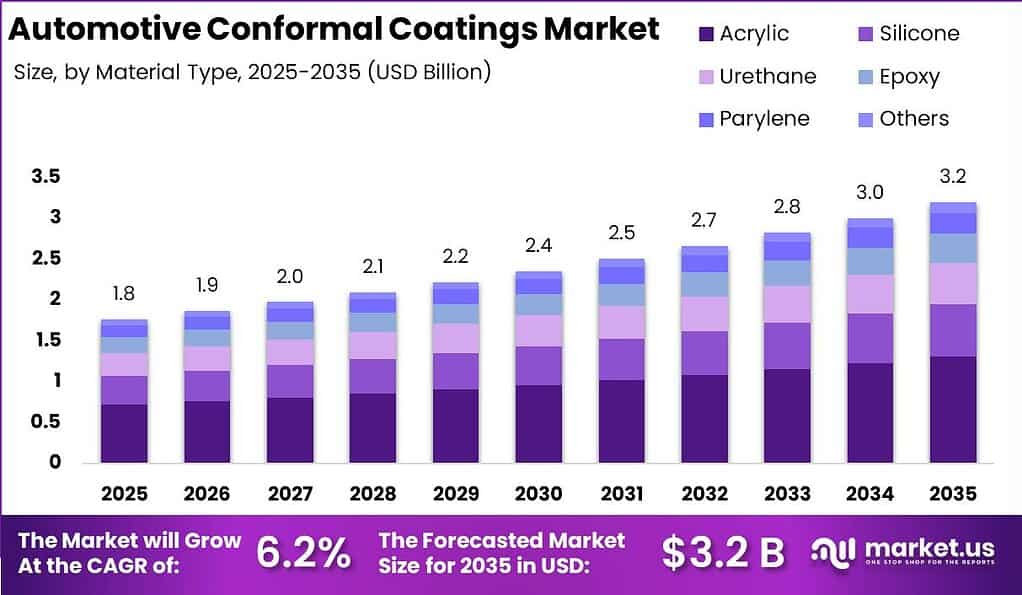
Global Automotive Conformal Coatings Market size is expected to be worth around USD 3.20 Billion by 2035 from USD 1.80 Billion in 2025, growing at a CAGR of 6.20% during the forecast period 2026 to 2035.
Electronic chemicals such as automotive conformal coatings protect printed circuit boards and control modules from moisture, dust, chemical exposure and thermal stress. Manufacturers apply thin acrylic, silicone, urethane, epoxy or parylene films through dipping, spraying, brushing or vapor deposition. This structure spans electronic control units, sensors, battery management systems and infotainment boards across passenger and commercial vehicles.
Key Takeaways
- Global Automotive Conformal Coatings Market size is estimated at USD 1.80 Billion in 2025 and is projected to reach USD 3.20 Billion by 2035, at a CAGR of 6.20%.
- Acrylic led the By Material Type segment with a 41.00% share.
- Spraying held 42.00% share in the By Application Technique segment, while Dipping was recorded as the largest and fastest growing technique.
- Electronic Control Units led the By Vehicle Component segment with a 34.00% share.
- Passenger Cars dominated the By Vehicle Type segment with a 68.00% share.
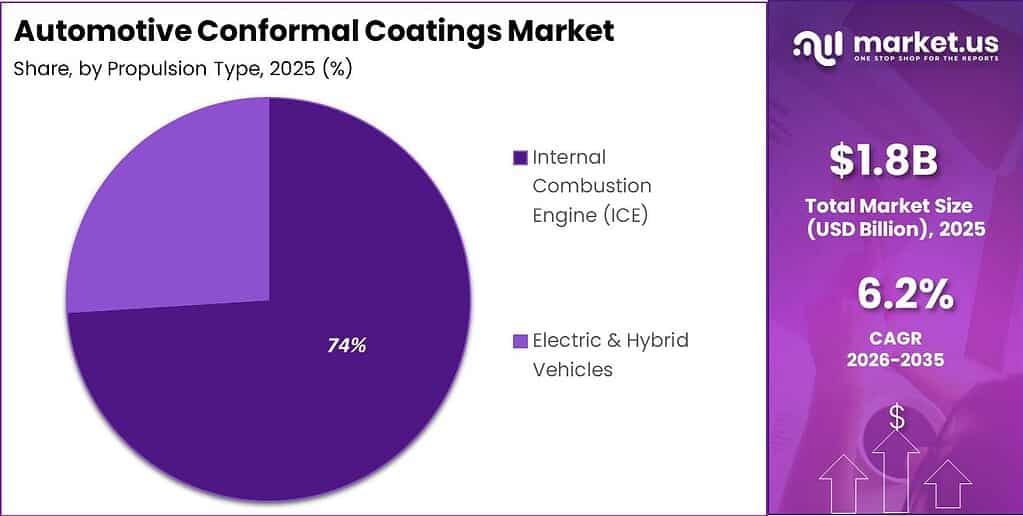
- Internal Combustion Engine vehicles held 74.00% share in the By Propulsion Type segment.
- OEMs accounted for 83.00% share in the By End User segment.
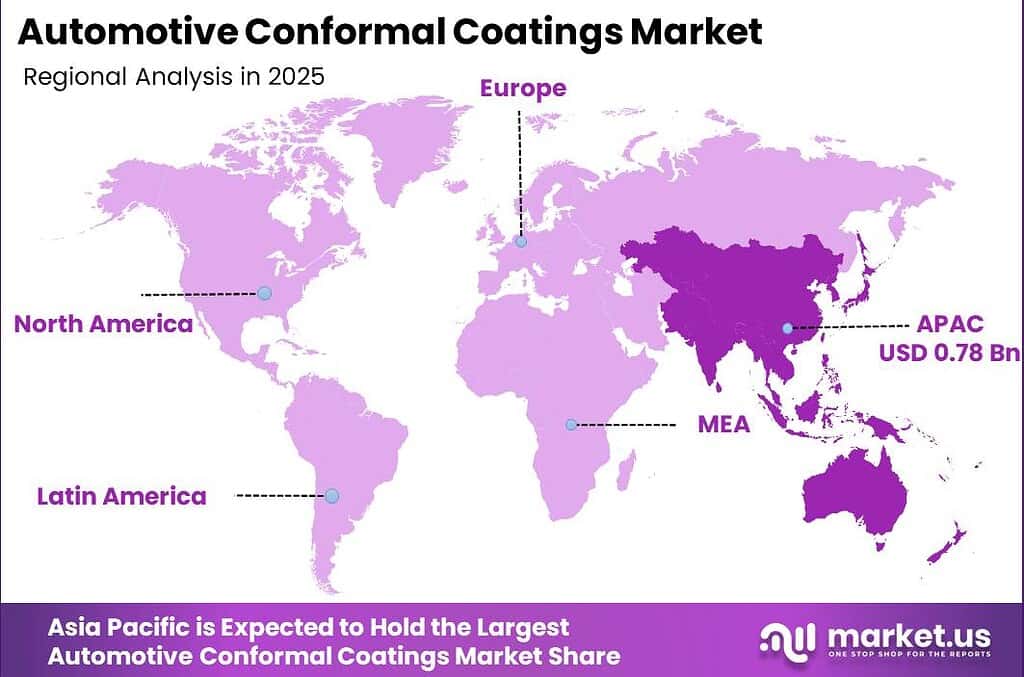
- Asia Pacific dominated the regional market with a 44.10% share, valued at USD 0.78 Billion.
Therefore, the coating chosen depends on the operating environment a given board faces inside the vehicle. Under hood electronics need higher thermal and chemical resistance than cabin mounted infotainment units. This distinction shapes material selection, application method and qualification cost across every vehicle program built today.
As per our research, automated selective spray systems can coat a 100 x 100 mm automotive circuit board in 30 seconds with 95% coverage accuracy. Faster coating cycles let Tier 1 suppliers raise daily board throughput without adding line space. This directly supports the volume growth automakers need as electronic content per vehicle keeps rising.
As per our research, automated optical inspection systems can detect coating pinholes as small as 0.05 mm with 99% accuracy after the coating step. This level of defect detection reduces field failures tied to moisture ingress on safety critical boards. Consequently, coating suppliers that pair chemistry with inspection data win longer qualification cycles with automotive Tier 1 buyers.
Material Type Analysis
Acrylic dominates with 41.0% due to low cost and easy rework access.
In 2025, Acrylic held a dominant market position in the By Material Type segment of Automotive Conformal Coatings Market, with a 41.0% share. Panacol rates its Vitralit UD 8050 LV acrylic coating for continuous operation from negative 40 degrees Celsius to 120 degrees Celsius. This wide operating window suits general purpose control modules. As a result, acrylic remains the default starting chemistry for new automotive board designs before upgrade evaluation.
Silicone coatings serve high voltage electronic modules that need flexibility across wide temperature swings. Novagard’s 500-210 moisture cured sprayable silicone coating reaches tack free performance in as little as 10 minutes, supporting continuous line processing. This speed cuts work in progress inventory on high mix assembly lines. Buyers of electric vehicle power modules increasingly specify silicone for its elastomeric recovery under thermal cycling.
Urethane coatings deliver strong chemical and abrasion resistance for boards exposed to fuel vapor or road spray. MG Chemicals reports its 4223F urethane coating can be handled after 15 minutes and completes heat curing in 2 hours at 100 degrees Celsius. Faster handling shortens the interval before downstream assembly steps. This makes urethane attractive for high volume under hood board programs.
Epoxy, Parylene and other niche chemistries collectively hold the remaining share in this segment. Parylene is applied through vapor deposition and reaches dry film thickness of 5 to 25 microns, the thinnest range among common automotive coatings. This thinness suits densely populated boards with fine pitch components. Epoxy remains a lower volume choice reserved for rigid, one time sealed modules.
Application Technique Analysis
Dipping dominates due to full immersion coverage on dense boards.
In 2025, Dipping held the leading position in the By Application Technique segment of Automotive Conformal Coatings Market, recorded in the data as the largest and fastest growing technique. Batch dip lines fully immerse populated boards, ensuring coverage on components with complex geometry. Consequently, dip processing remains the default for high density automotive boards where masking every connector individually would slow throughput.
Spraying held a 42.0% share in this segment through automated selective spray cells. As per our research, a selective sprayer can coat a 100 x 100 mm automotive board in 30 seconds with 95% coverage accuracy. This throughput supports high mix production without full immersion tanks. Tier 1 suppliers favor spraying where selective masking of connectors and test points is required.
Brushing serves rework, touch up and low volume prototype coating where full line automation is not justified. Vapor deposition applies parylene at 5 to 25 micron thickness inside vacuum chambers, a batch process suited to high reliability, low volume modules. This method has slower cycle times than spraying or dipping. As a result, vapor deposition remains concentrated in safety critical, low volume board families such as sensor clusters.
Vehicle Component Analysis
Electronic Control Units dominates with 34.0% due to dense high voltage board content.
In 2025, Electronic Control Units held a dominant market position in the By Vehicle Component segment of Automotive Conformal Coatings Market, with a 34.0% share. Bourns testing of a silicone coated common mode choke passed 1,000 thermal shock cycles across negative 55 to 150 degrees Celsius, while the acrylic coated comparison suffered wire breakage. This durability gap directly affects which chemistry Tier 1 suppliers specify for control unit programs. Consequently, control unit boards increasingly favor silicone or urethane grades over legacy acrylic.
Sensors mounted in engine bays and wheel wells face repeated vibration and chemical exposure. InCure documentation lists a typical coating viscosity range of 50 to 1,000 cP and dielectric strength above 1,500 V per mil for dense board assemblies. These properties allow thin, uniform films across fine pitch sensor connectors. This reduces short circuit risk on boards installed close to moving mechanical parts.
Printed Circuit Boards, Battery Management Systems and Infotainment Systems make up the remaining tracked component categories in this segment. Bourns measured acrylic coating modulus at up to 2,000 MPa against less than 100 MPa for silicone, with acrylic coefficient of thermal expansion doubling from 170 to 340 ppm per degree Celsius near its 14 degree Celsius transition point. Battery management boards therefore favor softer, more flexible chemistries. Infotainment boards, facing milder conditions, still commonly use lower cost acrylic films.
Vehicle Type Analysis
Passenger Cars dominates with 68.0% due to highest global production volume base.
In 2025, Passenger Cars held a dominant market position in the By Vehicle Type segment of Automotive Conformal Coatings Market, with a 68.0% share. Global passenger car production reached about 71.3 million units in 2025, up 5% from 2024, according to OICA data. This scale gives passenger vehicle programs the largest addressable board volume for coating suppliers. As a result, passenger car qualification wins carry the most weight in a coating supplier’s revenue base.
Light Commercial Vehicles and Heavy Commercial Vehicles make up the balance of this segment. According to OICA, global production of light commercial vehicles held near 20.9 million units in 2025, close to flat against the prior year. Fleet operators run these vehicles for longer duty cycles than passenger cars. This pushes commercial vehicle board programs toward coatings rated for extended thermal cycling rather than lowest initial cost.
Propulsion Type Analysis
Internal Combustion Engine dominates with 74.0% due to largest installed vehicle base.
In 2025, Internal Combustion Engine vehicles held a dominant market position in the By Propulsion Type segment of Automotive Conformal Coatings Market, with a 74.0% share. Asia Pacific vehicle production rose 7.6% to around 59.2 million units in 2025, per OICA regional data, and this base still runs predominantly combustion platforms. This scale keeps combustion board coating demand ahead of electrified programs in absolute unit terms. Therefore, coating suppliers cannot yet size capacity around electrified platforms alone.
Electric and Hybrid Vehicles make up the remaining share in this segment. China’s new energy vehicle production reached 16.626 million units in 2025, up 29% year on year, according to OICA. Electrified platforms carry higher voltage boards that need tighter dielectric control than combustion equivalents. This is shifting new qualification work toward silicone and urethane grades even while combustion volume still leads.
End User Analysis
OEMs dominates with 83.0% due to direct control over board qualification.
In 2025, OEMs held a dominant market position in the By End User segment of Automotive Conformal Coatings Market, with a 83.0% share. Global vehicle sales climbed to about 99.8 million units in 2025, up 4.7% from 2024, according to OICA figures. Every one of these vehicles ships with coated boards specified during the original design and qualification process. This keeps first fit programs as the primary revenue channel for coating suppliers.
Aftermarket work covers repair, rework and field replacement of damaged boards after the vehicle has left the factory. This channel depends on independent repair shops and parts distributors rather than Tier 1 qualification cycles. Coating choice in this channel favors brushable or single part products that cure without dedicated line equipment. As a result, aftermarket demand grows in step with vehicle parc age rather than new production volume.
Key Market Segments
By Material Type
- Acrylic
- Silicone
- Urethane
- Epoxy
- Parylene
- Others
By Application Technique
- Dipping
- Spraying
- Brushing
- Vapor Deposition
- Others
By Vehicle Component
- Electronic Control Units (ECUs)
- Sensors
- Printed Circuit Boards (PCBs)
- Battery Management Systems
- Infotainment Systems
- Others
By Vehicle Type
- Passenger Cars
- Light Commercial Vehicles
- Heavy Commercial Vehicles
By Propulsion Type
- Internal Combustion Engine (ICE)
- Electric and Hybrid Vehicles
By End User
- OEMs
- Aftermarket
Regional Analysis
Asia Pacific Dominates the Automotive Conformal Coatings Market with a Market Share of 44.10%, Valued at USD 0.78 Billion
Asia Pacific led the global market with a 44.10% share, valued at USD 0.78 Billion in 2025. Regional vehicle output rose 7.6% to around 59.2 million units in 2025, according to OICA data, giving the region more than 61% of global vehicle production. This concentration of assembly plants keeps board coating demand centered in the region. Consequently, coating suppliers continue to add selective spray capacity closest to this production base.
North America and Europe follow as established but slower growing regions for this market. In November 2025, HumiSeal expanded its authorized European distribution network through ConRo Electronics, Biesterfeld, Caplinq or Krayden, and Ellsworth Adhesives. This expansion improves technical support access for automotive electronics manufacturers across the region. As a result, European Tier 1 suppliers gain faster local access to qualified coating grades without added import lead time.
Key Regions and Countries
North America
- US
- Canada
Europe
- Germany
- France
- The UK
- Spain
- Italy
- Rest of Europe
Asia Pacific
- China
- Japan
- South Korea
- India
- Australia
- Rest of APAC
Latin America
- Brazil
- Mexico
- Rest of Latin America
Middle East and Africa
- GCC
- South Africa
- Rest of MEA
Drivers
| Driver | (~) % Impact on CAGR Forecast | Geographic Relevance | Impact Timeline |
|---|---|---|---|
| Electrified powertrain and high-voltage electronics penetration | +1.6% | China, Europe, North America | Short term (2 years or less) |
| ADAS sensor and domain controller proliferation | +1.3% | North America, Europe, Japan, Korea | Short term (2 years or less) |
| Zonal E/E architecture and compute density migration | +0.9% | Global | Medium term (2 to 4 years) |
| Extended OEM warranty and functional safety validation regimes | +0.7% | Europe, North America | Medium term (2 to 4 years) |
| Selective robotic coating line automation at Tier-1 plants | +0.6% | Asia Pacific | Short term (2 years or less) |
| ECU relocation into harsher under-hood and under-body zones | +0.4% | Global | Medium term (2 to 4 years) |
Vehicle electrification is the strongest force behind demand for higher grade automotive board coatings. Global electric car sales rose from about 17 million units in 2024 to roughly 21 million in 2025, per IEA transport tracking, while China’s electric share of new car sales passed 50% for the first time. Electrified platforms carry far more semiconductor content than combustion equivalents, forcing coating suppliers toward thinner, higher dielectric strength films. This shift is turning coating sales into qualified formulation contracts rather than simple volume orders, lifting the segment by an estimated 1.6 points against the 6.20% baseline.
Restraints
| Restraint | (~) % Impact on CAGR Forecast | Geographic Relevance | Impact Timeline |
|---|---|---|---|
| Fluorinated chemistry restriction under REACH freezing coating SKUs | -1.4% | European Union, global spillover | Short term (2 years or less) |
| Elevated lending rates deferring Tier-1 coating line CapEx | -0.9% | Global | Short term (2 years or less) |
| Section 232 duties on imported electrical vehicle parts | -0.7% | North America | Short term (2 years or less) |
| Costly removal and rework driving de-specification | -0.6% | Global | Medium term (2 to 4 years) |
| Statutory VOC content caps on solvent-borne grades | -0.5% | European Union, California | Short term (2 years or less) |
| Component miniaturization and potting substitution | -0.4% | Asia Pacific | Medium term (2 to 4 years) |
European regulation is closing off entire coating chemistries rather than simply raising costs. The European Chemicals Agency confirmed on 3 March 2026 that PFAS substances warrant a group wide restriction under REACH, with a final opinion targeted for end 2026. A new automotive coating grade must clear 1,000 thermal cycles between negative 40 and 125 degrees Celsius before requalification, pushing approval timelines out by 18 to 30 months. Suppliers therefore face reformulation costs of roughly USD 150,000 to USD 400,000 per SKU, holding back an estimated 1.4 points from the 6.20% baseline in European supply.
Challenges
| Challenge | (~) % CAGR Friction Drag | Geographic Relevance | Mitigation Horizon |
|---|---|---|---|
| Silicone precursor supply concentration | -0.6% | Asia Pacific, Europe | Medium term (2 to 4 years) |
| Coating process technician deficit | -0.5% | North America, Europe | Long term (4 years or more) |
| Inline inspection qualification bottlenecks | -0.45% | Global | Medium term (2 to 4 years) |
| Conformality defects at fine pitch | -0.4% | Asia Pacific, North America | Medium term (2 to 4 years) |
| Right-to-repair serviceability friction | -0.3% | European Union, North America | Long term (4 years or more) |
| Curing energy cost volatility | -0.25% | Europe | Short term (2 years or less) |
Silicone supply for automotive coatings depends heavily on a small group of upstream producers. China supplies roughly 70% to 80% of global metallurgical silicon, so smelting curbs or new duties raise input costs quickly. Lead times can stretch from 6 to 8 weeks toward 12 to 20 weeks during allocation episodes, with siloxane prices swinging 15% to 40% in a single year. This forces buyers to dual source and hold larger safety stock, capping the achievable ceiling by an estimated 0.6 points against the 6.20% baseline.
Opportunities
| Opportunity | (~) % Potential CAGR Upside | Geographic Relevance | Execution Window |
|---|---|---|---|
| Battery pack, busbar and BMS thin-film dielectric protection | +1.2% | Global | Medium term (2 to 4 years) |
| Fleet and aftermarket electronics re-coating service model | +0.8% | North America, Europe | Long term (4 years or more) |
| Fluorine-free UV-cure premium formulation tier | +0.7% | Europe, Japan | Medium term (2 to 4 years) |
| Coating-as-a-service line-side chemical management | +0.6% | North America, Europe | Long term (4 years or more) |
| Localized electronics clusters in India and ASEAN | +0.55% | India, ASEAN | Medium term (2 to 4 years) |
| Roll-up of regional specialty applicators and toll coaters | +0.4% | Global | Long term (4 years or more) |
Battery pack level isolation today runs mostly through potting compounds rather than thin film coatings, leaving demand unmet inside an adjacent vertical. New EU battery rules and UNECE electrical safety requirements above 60 volts push validated dielectric performance down to cell interconnect level. Swapping 200 to 600 grams of potting mass for a 50 to 100 micron film can cut protection cost per pack from USD 15 to USD 30 toward USD 3 to USD 8. Suppliers who co-develop with pack integrators can capture an estimated 1.2 points above the 6.20% baseline.
Key Company Insights
Henkel AG & Co. KGaA holds a strategic position through continuous portfolio renewal aimed at automotive electronics protection. In February 2026, the company launched LOCTITE STYCAST UV 7998, a solvent free, UV and moisture dual cure coating that Henkel states can cut CO2 emissions by up to 40% and needs up to 4 times less sprayed material for the same thickness. This lowers customer material cost per board while supporting sustainability targets, giving Henkel an edge with OEMs tightening environmental procurement criteria.
Dow Inc. competes through its Dow Corning silicone heritage, a chemistry favored for high voltage and electrified vehicle boards. Silicone grades offer wide elastomeric recovery across the thermal cycling that battery management and inverter boards face daily. This positions Dow to capture share as electrified platform qualification volume increases. However, reliance on silicone leaves exposure to the upstream supply concentration affecting global precursor pricing.
Key Players
- Henkel AG & Co. KGaA
- Dow Inc. (Dow Corning)
- H.B. Fuller Company
- Shin-Etsu Chemical Co., Ltd.
- Chase Corporation
- Dymax Corporation
- Electrolube (MacDermid Alpha)
- Chemtronics
- Illinois Tool Works Inc. (ITW)
- Altana AG (ELANTAS)
- MG Chemicals
- CHT Group
- KISCO Ltd.
- CSL Silicones Inc.
- Comelec SA
Recent Developments
- September 2025: Panacol-Elosol began operating as HOENLE ADHESIVES, combining the group’s industrial adhesives, including PCB coating, encapsulation and automotive electronics materials, with matched UV and UV-LED curing equipment under one brand.
Geopolitical Impact Analysis
Trade friction is reshaping where automotive coating chemistry gets sourced and applied. According to the World Trade Organization, global merchandise trade growth has slowed as tariff actions between major economies raise landed costs on electronic components and specialty chemicals. This means Tier 1 suppliers building coated boards for North American assembly plants face added duty exposure on imported precursor chemicals. As a result, some coating formulators are shifting blending and packaging steps closer to final assembly regions to reduce tariff exposure.
Shipping and logistics volatility compounds this pressure on coating supply chains. As reported by the World Shipping Council, container freight rates and transit reliability have swung sharply amid Red Sea rerouting and port congestion episodes in recent shipping cycles. This means silicone precursor and specialty resin shipments from Asia Pacific face longer, less predictable transit windows into European and North American board assembly hubs. Consequently, buyers are holding larger safety stock of qualified coating chemistry to protect production schedules against these disruptions.
Report Scope
| Report Features | Description |
|---|---|
| Market Value (2025) | USD 1.80 Billion |
| Forecast Revenue (2035) | USD 3.20 Billion |
| CAGR (2026-2035) | 6.20% |
| Base Year for Estimation | 2025 |
| Historic Period | 2020-2024 |
| Forecast Period | 2026-2035 |
| Report Coverage | Revenue Forecast, Market Dynamics, Market Opportunity Analysis, Technology and Innovation Landscape, Competitive Landscape, Recent Developments |
| Segments Covered | By Material Type (Acrylic, Silicone, Urethane, Epoxy, Parylene, Others), By Application Technique (Dipping, Spraying, Brushing, Vapor Deposition, Others), By Vehicle Component (Electronic Control Units, Sensors, Printed Circuit Boards, Battery Management Systems, Infotainment Systems, Others), By Vehicle Type (Passenger Cars, Light Commercial Vehicles, Heavy Commercial Vehicles), By Propulsion Type (Internal Combustion Engine, Electric and Hybrid Vehicles), By End User (OEMs, Aftermarket) |
| Regional Analysis | North America (US and Canada), Europe (Germany, France, The UK, Spain, Italy, and Rest of Europe), Asia Pacific (China, Japan, South Korea, India, Australia, and Rest of APAC), Latin America (Brazil, Mexico, and Rest of Latin America), Middle East and Africa (GCC, South Africa, and Rest of MEA) |
| Competitive Landscape | Henkel AG & Co. KGaA, Dow Inc. (Dow Corning), H.B. Fuller Company, Shin-Etsu Chemical Co., Ltd., Chase Corporation, Dymax Corporation, Electrolube (MacDermid Alpha), Chemtronics, Illinois Tool Works Inc. (ITW), Altana AG (ELANTAS), MG Chemicals, CHT Group, KISCO Ltd., CSL Silicones Inc., Comelec SA |
| Customization Scope | Customization for segments, region / country-level will be provided. Additional customization can be done based on requirements. |
| Purchase Options | We have three licenses to opt for: Single User License | Multi-User License (Up to 5 Users) | Corporate Use License (Unlimited User and Printable PDF) |





































