Report Overview
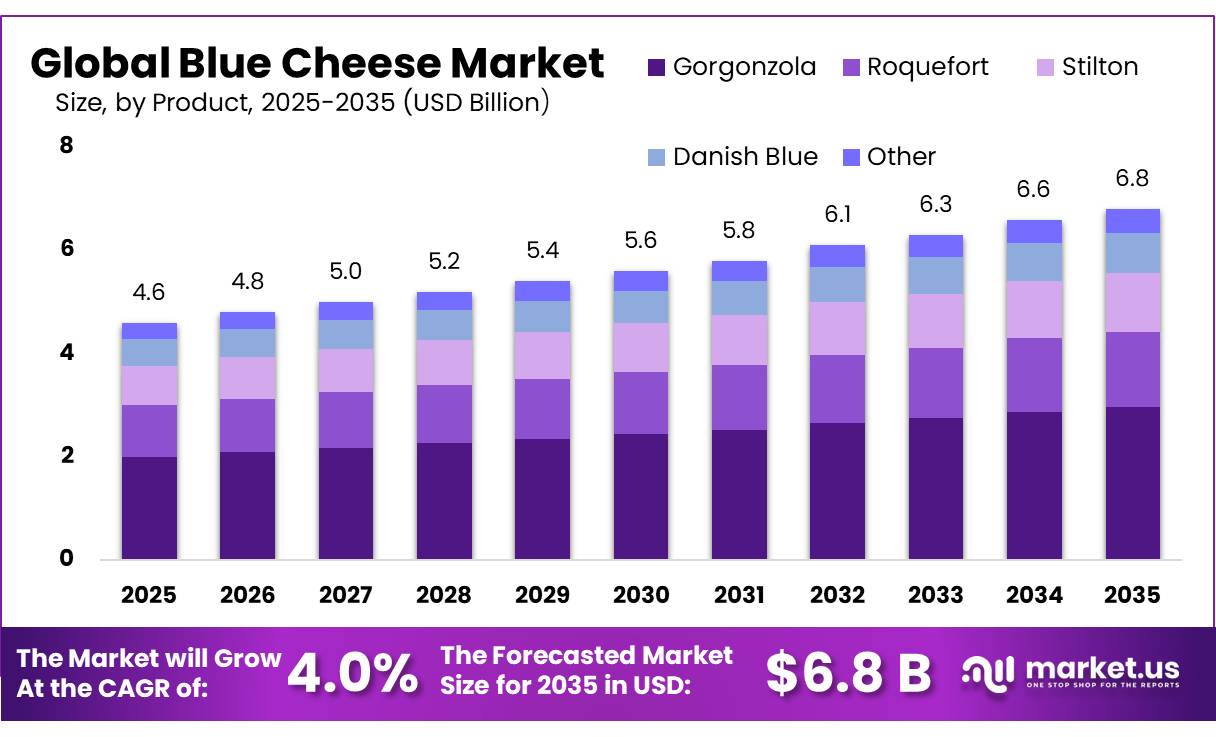
The Global Blue Cheese Market size is expected to be worth around USD 6.8 Billion by 2035, from USD 4.6 Billion in 2025, growing at a CAGR of 4.0% during the forecast period from 2026 to 2035. In 2025, Europe held a dominant market position, capturing more than a 46.78% share, holding USD 2.1 Billion revenue.
Blue cheese is a specialized segment of the global cheese and dairy processing industry, recognized for its distinctive blue-green veins, strong aroma, creamy texture, and sharp flavor. It is manufactured using milk from cows, sheep, or goats, with selected strains of Penicillium roqueforti introduced during production to develop its characteristic appearance and taste.
The industrial scenario for blue cheese is supported by the established growth of the wider cheese manufacturing industry. According to the United States Department of Agriculture (USDA), total cheese production in the United States reached 14.2 billion pounds in 2024, registering a 0.7% increase compared with 2023.
- Wisconsin accounted for 25.2% of total domestic cheese production, demonstrating the importance of established dairy-processing infrastructure. The USDA also reported separate production of blue and Gorgonzola cheese, with output reaching approximately 8.77 million pounds in May 2024, 7.92 million pounds in June, and 7.39 million pounds in July.
Government food standards and geographical protection initiatives also influence industrial development. In the United States, the Food and Drug Administration (FDA), under 21 CFR Section 133.106, specifies that standardized blue cheese must contain at least 50% milkfat by weight of solids, a maximum moisture content of 46%, and must be aged for at least 60 days. These requirements establish manufacturing and product-composition standards that support consistency and food quality.
In Europe, traditional blue cheese production benefits from protected geographical designation frameworks. The European Commission recognizes Roquefort as a Protected Designation of Origin (PDO) product, requiring production from raw whole sheep’s milk and maturation for at least 90 days. Such protection supports product authenticity, traditional manufacturing practices, and premium positioning in international markets.
Key Takeaways
- Blue Cheese Market size is expected to be worth around USD 6.8 Billion by 2035, from USD 4.6 Billion in 2025, growing at a CAGR of 4.0%.
- Gorgonzola held a dominant market position, capturing more than a 43.56% share.
- Cow held a dominant market position, capturing more than a 73.45% share of the Blue Cheese Market.
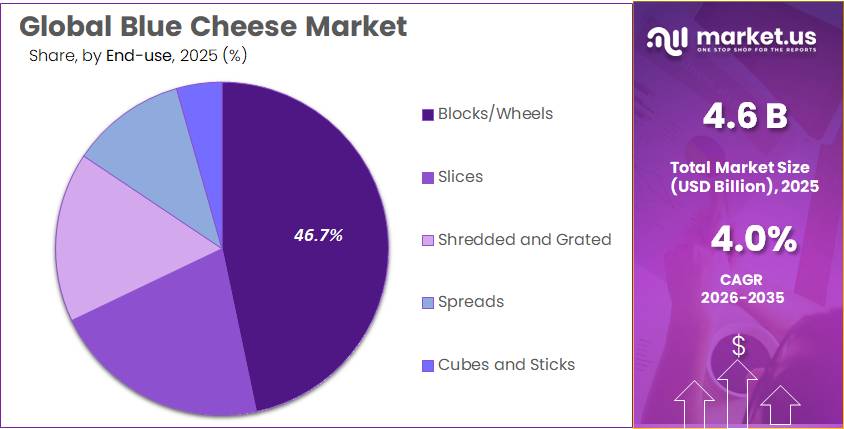
- Blocks/Wheels held a dominant market position, capturing more than a 46.78% share of the Blue Cheese Market.
- Commercial held a dominant market position, capturing more than a 56.67% share of the Blue Cheese Market.
- Offline held a dominant market position, capturing more than a 78.56% share of the Blue Cheese Market.
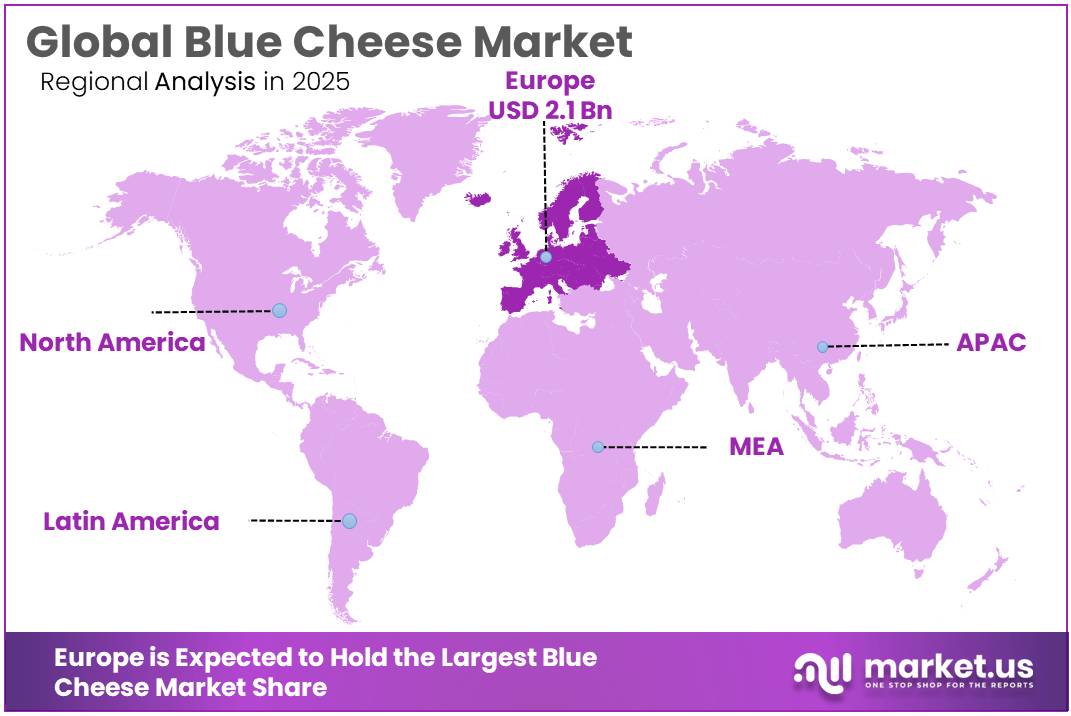
- Europe held a dominant position in the Blue Cheese Market in 2025, accounting for 46.78% of the global market, valued at approximately USD 2.1 billion.
By Product Analysis
Gorgonzola – Dominant Segment with a 43.56% Market Share in 2025
In 2025, “Gorgonzola” held a dominant market position, capturing more than a 43.56% share of the Blue Cheese Market by product. Its strong position is supported by its distinctive creamy texture, blue-green veining, and balanced sharp flavor, which make it suitable for several food applications. Gorgonzola is widely used in pasta, pizza, salads, sauces, risotto, and gourmet food preparations. Its established reputation in premium cheese categories and availability through specialty retailers and foodservice channels support its commercial demand.
Roquefort represents an important traditional product segment in the Blue Cheese Market, supported by its distinctive sheep’s milk composition, strong flavor, and traditional maturation process. Its PDO recognition in Europe protects its geographical identity and traditional production methods. The European Commission’s product specifications require Roquefort to be produced using raw whole sheep’s milk and matured for a minimum of 90 days.
This regulated maturation process contributes to its characteristic flavor, texture, and blue-veined appearance. In 2025, the segment continued to benefit from premium positioning in specialty cheese retail, gourmet foodservice, and traditional European cuisine. Its geographical recognition and established reputation provide manufacturers and distributors with opportunities to serve consumers seeking authentic, high-quality blue cheese products.
By Source Analysis
Cow – Dominant Segment Supported by Established Dairy Production
In 2025, “Cow” held a dominant market position, capturing more than a 73.45% share of the Blue Cheese Market by source. Its leading position is supported by the widespread availability of cow’s milk, established dairy-processing infrastructure, and its suitability for large-scale cheese manufacturing. Cow’s milk provides a consistent fat and protein composition, which helps manufacturers achieve the desired texture, flavor, and quality during cheese production.
The United States Department of Agriculture (USDA) reported that total cheese production in the United States reached 14.2 billion pounds in 2024, highlighting the strength of the cow’s milk-based cheese manufacturing industry. In 2025, established milk collection networks, processing capabilities, and consumer familiarity continued to support the dominant position of this segment.
Goat represents a specialized source segment in the Blue Cheese Market, supported by demand for distinctive cheese flavors and traditional dairy products. Goat’s milk offers a different fat and protein composition compared with cow’s milk, allowing manufacturers to develop blue cheese varieties with characteristic flavor, texture, and aroma. Goat milk-based cheese also provides opportunities for specialty producers targeting premium retail outlets, gourmet restaurants, and artisanal cheese consumers.
By Format Analysis
Blocks/Wheels – Dominant Format Supported by Traditional Cheese Production and Bulk Usage
In 2025, “Blocks/Wheels” held a dominant market position, capturing more than a 46.78% share of the Blue Cheese Market by format. Its leading position is supported by its suitability for traditional cheese production, longer maturation processes, and flexible use across retail and commercial foodservice applications. Blocks and wheels allow manufacturers to maintain the original texture, moisture, and flavor characteristics of blue cheese while providing flexibility in cutting, crumbling, and portioning.
This format is widely preferred by specialty cheese retailers, restaurants, hotels, and food processors because it can be used in salads, sauces, pasta, pizzas, and gourmet food preparations. In 2025, demand for premium cheese varieties and established distribution through specialty food outlets continued to support the segment’s position. The US Food and Drug Administration’s blue cheese standard specifies a maximum moisture content of 46%, highlighting the importance of controlled processing and product consistency in conventional blue cheese manufacturing.
Slices represent a convenient format in the Blue Cheese Market, particularly for consumers and foodservice operators seeking easy portioning and consistent product presentation. This format is suitable for sandwiches, burgers, wraps, and ready-to-prepare meals, where convenience and reduced preparation time are important purchasing considerations.
By End User Analysis
Commercial – Dominant End-User Segment Driven by Foodservice and Hospitality Demand
In 2025, “Commercial” held a dominant market position, capturing more than a 56.67% share of the Blue Cheese Market by end user. Its leading position is supported by the widespread use of blue cheese across restaurants, hotels, cafés, catering businesses, and institutional foodservice operations. Commercial establishments use blue cheese in salads, burgers, pizzas, pasta, sauces, dressings, and premium food preparations because of its distinctive flavor and versatility.
In 2025, demand from gourmet restaurants, quick-service restaurants, and premium dining establishments continued to support commercial consumption. The United States Department of Agriculture (USDA) reported that total cheese production in the United States reached 14.2 billion pounds in 2024, reflecting the scale of the country’s cheese manufacturing and supply infrastructure. This established production base supports the availability of cheese products for commercial foodservice applications.
Residential represents an important end-user segment in the Blue Cheese Market, driven by household demand for specialty cheese products and convenient food ingredients. Consumers use blue cheese in homemade salads, sandwiches, pasta, pizzas, dips, and dressings, making it a versatile ingredient for everyday and premium meal preparation. Retail availability through supermarkets, specialty cheese stores, and online grocery platforms improves product accessibility for household buyers. In 2025, interest in gourmet home cooking and premium food experiences supported opportunities for residential consumption.
By Distribution Channel Analysis
Offline – Dominant Distribution Channel Supported by Retail Accessibility and Product Inspection
In 2025, “Offline” held a dominant market position, capturing more than a 78.56% share of the Blue Cheese Market by distribution channel. Its leading position is supported by the strong presence of supermarkets, hypermarkets, specialty cheese stores, grocery retailers, and foodservice suppliers. Offline outlets allow consumers to examine product quality, compare different blue cheese varieties, and receive recommendations from retail staff before purchasing. These channels also provide access to fresh-cut cheese, packaged blocks, wheels, and crumbled formats.
According to the United States Census Bureau, total U.S. retail e-commerce sales reached USD 1,233.7 billion in 2025, representing 16.4% of total retail sales. This indicates that physical retail continued to account for the larger share of overall retail transactions, supporting the importance of offline distribution for food and dairy products.
Online represents an emerging distribution channel in the Blue Cheese Market, supported by the increasing availability of specialty dairy products through e-commerce platforms, online supermarkets, and direct-to-consumer websites. Digital channels allow consumers to explore different blue cheese varieties, compare product specifications, and purchase specialty products without visiting physical stores.
Key Market Segments
By Product
- Roquefort
- Gorgonzola
- Stilton
- Danish Blue
- Other Blue Cheese Varieties
By Source
- Cow
- Goat
- Sheep
- Other Milk Sources
By Format
- Blocks/Wheels
- Slices
- Shredded and Grated
- Spreads
- Cubes and Sticks
By End User
- Commercial
- Residential
By Distribution Channel
- Online
- Offline
Driver Analysis
PDO provenance and premium mix
Protected designation of origin, or PDO, creates a commercially defensible basis for differentiation through verified origin and product identity, allowing producers to compete on more than price per kilogram. The Gorgonzola Consortium reported 5,421,517 wheels produced in 2025, up 2.72%, and total production value exceeding €460 million; its earlier disclosure placed 2023 production value at €430 million, demonstrating the economic scale of the certified segment without establishing a like-for-like price increase.
Across French PDO and PGI dairy products—not blue cheese alone—INAO reported 272,236 tonnes marketed in 2024 and manufacturing–maturing revenue above €3 billion. However, provenance does not automatically generate volume growth: Roquefort sales fell from 14,436 tonnes in 2023 to 13,990 tonnes in 2024, approximately 3%, and were 17% below 2014. The strategic opportunity is therefore premium mix management rather than indiscriminate capacity expansion: traceable branded wedges, differentiated maturation profiles and retailer assortments that retain origin identity can support realized selling prices while protecting scarce production and maturation capacity.
The +0.7 pp contribution assumes, illustratively, that premium-mix initiatives reach 35% of global market revenue and produce 2.0% annual incremental price/mix improvement within that exposed segment; both inputs are analyst assumptions, not observed market shares. Roquefort’s contraction argues for measuring repeat purchase and sell-through alongside price realization, because higher unit values cannot indefinitely offset falling consumption.
Drivers Impact Analysis
| Driver | (~) % Impact on CAGR Forecast | Geographic Relevance | Impact Timeline |
|---|---|---|---|
| PDO provenance and premium mix | +0.7 pp | Italy, France, UK; EU premium retail | Medium term (2–4 years) |
| Culinary usage and portion formats | +0.5 pp | Italy, France, Spain; North American foodservice | Short term (≤ 2 years) |
| Selective export diversification | +0.4 pp | France, Spain, Canada, Japan; Vietnam niche | Medium term (2–4 years) |
| Lactose-free product positioning | +0.3 pp | Italy, Germany, France; Japan specialty retail | Medium term (2–4 years) |
| Shelf-life assurance and distribution | +0.3 pp | EU-27; exporters supplying EU markets | Long term (≥ 4 years) |
Restraint Analysis
Weak export demand and trade friction
The root cause is a weaker consumer and trade environment that has begun to hit exports of the category’s flagship cheese. Gorgonzola PDO exports fell 2.14% in 2025 to 25,445 tonnes, about 39% of production. The Consortium’s president cited international uncertainty, contracting consumption in several markets, and higher raw material and energy costs. The country detail shows how uneven the damage is. Germany, the second-largest foreign market, fell 6.9% to 432,793 wheels, and the Netherlands fell 16% to 90,737 wheels. The UK fell 6.58% to 38,314 wheels, and the US fell 2.62% to 31,440 wheels after the US imposed tariffs on EU imports in the second half of 2025.
France (+2.38%, 511,494 wheels) and Spain (+3.17%, 175,580 wheels) grew, but they do not offset German weakness in value terms. Canada’s +113% has no disclosed base, so it cannot be treated as a replacement market. Europe took about 5,508 of 6,350 tonnes (about 86.7%) in Q1 2026, so any slowdown in nearby markets hits volumes directly. The commercial effect is lower plant utilisation and more cheese pushed into domestic channels at lower prices.
Exporters also take on higher working-capital needs and discount pressure from importers. Production is still high (5,421,517 wheels in 2025, then -0.28% through May 2026), so the supply-demand gap is building. I model a 0.6 pp drag on the assumption that about 39% of Gorgonzola-type output is export-exposed, with export value growth roughly 1.5 pp below the underlying rate across the weakest corridors. That is a modelling assumption.
Restraint Impact Analysis
| Restraint | (~) % Impact on CAGR Forecast | Geographic Relevance | Impact Timeline |
|---|---|---|---|
| Weak export demand and trade friction | -0.6 pp | US, Germany, Netherlands, UK, Eastern Europe | Short term (≤ 2 years) |
| Energy and input cost inflation | -0.5 pp | EU, Italy core, France | Short term (≤ 2 years) |
| Mature volumes in heritage varieties | -0.4 pp | France, Italy, Western Europe | Long term (≥ 4 years) |
| Listeria compliance and cost burden | -0.3 pp | EU-27, exporters to EU | Medium term (2-4 years) |
| Perishability and cold-chain losses | -0.1 pp | Export corridors, emerging markets | Medium term (2-4 years) |
Opportunity Analysis
Ingredient contracts
The white space is to move beyond selling cheese as a standalone ingredient into multi-year, specification-led supply contracts with manufacturers of frozen meals, filled pasta, savory bakery products and sauces; the opportunity is not ordinary restaurant usage, which is already part of baseline demand. The Gorgonzola Consortium’s 2024 campaign demonstrated applications across five dishes, including soup, linguine and stuffed mushrooms, but that evidence establishes culinary versatility rather than penetration of industrial manufacturing contracts.
An illustrative account producing 10 million meals annually with a 12 g blue-cheese inclusion would require 120 tonnes of cheese; 20 independently won accounts of that scale would represent 2,400 tonnes, provided they create new consumption rather than replace existing purchases. At an explicitly assumed €8/kg producer realization, that program would generate €19.2 million annually in cheese revenue—not the much larger retail value of the finished meals. Suppliers would compete on flavor consistency, dosing performance, validated shelf life and dependable deliveries, potentially shifting from spot orders toward forecast-linked annual volumes and customer-specific product specifications.
Commercial gates should include a 6–12-month qualification allowance, minimum committed volumes and contribution margins measured after customization, freight and quality assurance; these are proposed investment criteria, not observed industry averages. The modeled +0.45 pp requires incremental 2031 producer revenue equal to 2.2% of the baseline global market, while excluding royalties or downstream processing revenue unless the market definition is deliberately expanded.
Opportunity Impact Analysis
| Opportunity | (~) % Potential CAGR Upside | Geographic Relevance | Execution Window |
|---|---|---|---|
| Industrial ingredient contracts | +0.45 pp | EU, US, Japan | Medium term (2-4 years) |
| Organic supply programs | +0.20 pp | Germany, France, Nordics | Medium term (2-4 years) |
| Japan chain-menu partnerships | +0.30 pp | Japan | Medium term (2-4 years) |
| Visitor-to-subscription sales | +0.15 pp | Italy, France, UK | Short term (≤ 2 years) |
| Shared export platforms | +0.40 pp | EU producers; Canada, Japan | Long term (≥ 4 years) |
Challenges Analysis
Ripening consistency at scale
Blue cheese requires a repeatable biological outcome from a process whose flavor, texture and veining develop over weeks rather than immediately after manufacture, making consistency a continuing technical challenge rather than a prohibition on sales. The Gorgonzola Consortium describes selected Penicillium roqueforti cultures, repeated piercing to provide oxygen, and characteristic flavor development beginning approximately 40–45 days into maturation; another production account describes piercing after about three weeks, with ripening conditions of 2–7°C and 85–99% relative humidity. These are product-specific descriptions, not universal operating specifications for all blue cheeses.
At an illustrative facility producing 1,000 tonnes annually, moving 2% of output from a standard realization of €8/kg into a discounted €5/kg channel reduces revenue by €60,000 without preventing the cheese from being sold; this demonstrates why the relevant friction is quality-mix leakage, not necessarily discarded volume. A five-day delay in reaching the desired sensory profile also holds approximately 13.7 tonnes in process at that production rate, assuming even daily throughput.
Corporate mitigation requires batch-level links between milk composition, starter performance, piercing, room conditions and final grading, followed by corrective trials rather than reliance on room-average measurements alone. The -0.30 pp scenario represents a 1.5% terminal-revenue shortfall attributable specifically to quality downgrading and inconsistent customer specifications; it excludes food-safety withdrawals and capacity delays allocated elsewhere in this analysis.
Challenges Impact Analysis
| Challenge | (~) % CAGR Friction Drag | Geographic Relevance | Mitigation Horizon |
|---|---|---|---|
| Ripening consistency at scale | -0.30 pp | Italy, France, UK, US | Medium term (2-4 years) |
| Climate-sensitive milk scheduling | -0.25 pp | Northern Italy, southern France | Long term (≥ 4 years) |
| Maturation capacity and forecasting | -0.20 pp | EU, UK, North America | Medium term (2-4 years) |
| Artisan knowledge transfer gaps | -0.15 pp | Italy, France, UK | Long term (≥ 4 years) |
| Export inventory allocation complexity | -0.10 pp | EU–Japan, EU–Canada, intra-EU | Short term (≤ 2 years) |
Geopolitical Impact Analysis
Impact of Ongoing Wars and Geopolitical Conflicts on the Blue Cheese Market
The ongoing Russia-Ukraine war and the 2026 Middle East conflict are creating additional pressure on the global Blue Cheese Market through higher energy costs, shipping disruptions, and rising dairy production expenses. Blue cheese manufacturers depend on stable supplies of milk, microbial cultures, packaging materials, refrigeration, and transportation. Disruptions in international trade routes are increasing freight charges, insurance costs, and delivery uncertainty, particularly for exporters supplying premium cheese to international markets.
According to UN Trade and Development (UNCTAD), shipping transits through the Strait of Hormuz declined by more than 95% following the escalation of the Middle East conflict in 2026. The World Bank reported on October 28, 2026, that global energy prices were projected to increase by 32% in 2026, increasing operating costs for dairy processors that rely on electricity, refrigeration, and fuel.
These developments are increasing pressure on cheese manufacturers, particularly those dependent on imported ingredients and long-distance distribution. Higher cold-storage and transportation expenses can reduce profit margins and increase retail prices. However, manufacturers can limit these risks through diversified sourcing, regional production facilities, alternative shipping routes, and improved energy efficiency. The ability to maintain reliable cold-chain operations and stable milk procurement will remain important for the industry’s performance amid geopolitical uncertainty.
Regional Insights
Europe – Dominating Region with a 46.78% Market Share
Europe held a dominant position in the Blue Cheese Market in 2025, accounting for 46.78% of the global market, valued at approximately USD 2.1 billion. The region’s leadership is supported by its long-established cheese-making traditions, strong specialty dairy industry, and widespread consumption of premium cheese varieties such as Gorgonzola and Roquefort. Countries including France, Italy, Germany, and the Netherlands have well-developed dairy processing industries and established distribution networks.
According to Eurostat, the European Union produced 10.8 million tonnes of cheese in 2024, demonstrating the strength of its manufacturing infrastructure. Germany accounted for approximately 2.4 million tonnes, France produced 1.9 million tonnes, and Italy contributed 1.4 million tonnes. Protected Designation of Origin recognition also supports traditional blue cheese varieties and their premium positioning.
North America represents an important growth region for the Blue Cheese Market, supported by established dairy manufacturing facilities, premium food consumption, and demand from restaurants and foodservice operators. The United States provides a strong production base, with blue cheese used in salads, burgers, sauces, dressings, and specialty food preparations.
According to the USDA, total cheese production in the United States reached 14.8 billion pounds in 2025, increasing by 4.0% compared with 2024. This expansion highlights the strength of the regional cheese manufacturing industry and its ability to support specialty cheese production. Growing interest in gourmet food, convenient cheese formats, and premium retail products creates further opportunities for blue cheese manufacturers.
Key Regions and Countries Insights
- North America
- US
- Canada
- Europe
- Germany
- France
- The UK
- Spain
- Italy
- Rest of Europe
- Asia Pacific
- China
- Japan
- South Korea
- India
- Australia
- Rest of APAC
- Latin America
- Brazil
- Mexico
- Rest of Latin America
- Middle East & Africa
- GCC
- South Africa
- Rest of MEA
Key Players Analysis
Arla Foods amba maintains a strong position in the global dairy industry through its cheese brands, extensive milk procurement network, and international distribution capabilities. In 2025, the company generated revenue of EUR 15.1 billion and recorded a total milk intake of 14.3 billion kg. Its portfolio includes Castello, which offers specialty cheese varieties, including blue cheese. The company’s established production capabilities and presence across international retail and foodservice channels support its participation in the specialty cheese market.
Groupe Lactalis is a major global dairy manufacturer with a broad portfolio of cheese, milk, butter, and cream products. In 2025, the company reported revenue of EUR 31.2 billion, collected 23.1 billion litres of milk, and operated 266 production sites across 49 countries. Its international brands, including Président and Galbani, strengthen its presence in retail and foodservice distribution. Its large-scale cheese manufacturing capabilities and international supply network support its competitive position in the global blue cheese industry.
Savencia Fromage & Dairy strengthens its position in the specialty cheese industry through its international cheese brands and diversified dairy portfolio. In 2025, the company recorded net sales of EUR 6,956.6 million, representing a 2.6% decline compared with the previous year. Cheese Products contributed EUR 4,017 million, accounting for 57.7% of consolidated revenue. The company focuses on specialty cheese development, product innovation, and international distribution, supporting its participation in premium cheese categories, including blue cheese.
Top Key Players Outlook
- Arla Foods amba
- Groupe Lactalis
- Savencia Fromage and Dairy
- Emmi Group
- Saputo Inc.
- Ornua Co-operative Limited
- Colston Bassett Dairy
- Cropwell Bishop Creamery
- Long Clawson Dairy
- Hartington Creamery
- Roquefort Société
- Fromageries Papillon
- Other Key Players
Recent Developments
- In January 2026, Emmi reported 4.3% organic growth for 2025, with specialty cheeses contributing to its positive performance. The company also invested CHF 168.2 million in fixed assets during 2025, supporting its wider production and operational development.
- In August 2026, Saputo entered into a definitive agreement to sell its UK Dairy Division to Lactalis for an enterprise value of approximately GBP 988 million. The transaction includes 5 manufacturing facilities and brands such as Cathedral City and Wensleydale, although it is not directly related to its blue cheese operations.
Report Scope
| Report Features | Description |
|---|---|
| Market Value (2025) | USD 4.6 Bn |
| Forecast Revenue (2035) | USD 6.8 Bn |
| CAGR (2026-2035) | 4.0% |
| Base Year for Estimation | 2025 |
| Historic Period | 2020-2024 |
| Forecast Period | 2026-2035 |
| Report Coverage | Revenue Forecast, Market Dynamics, Competitive Landscape, Recent Developments |
| Segments Covered | By Product (Roquefort, Gorgonzola, Stilton, Danish Blue, Other Blue Cheese Varieties), By Source (Cow, Goat, Sheep, Other Milk Sources), By Format (Blocks/Wheels, Slices, Shredded and Grated, Spreads, Cubes and Sticks), By End User (Commercial, Residential, By Distribution Channel, Online, Offline) |
| Regional Analysis | North America – US, Canada; Europe – Germany, France, The UK, Spain, Italy, Rest of Europe; Asia Pacific – China, Japan, South Korea, India, Australia, Singapore, Rest of APAC; Latin America – Brazil, Mexico, Rest of Latin America; Middle East & Africa – GCC, South Africa, Rest of MEA |
| Competitive Landscape | Arla Foods amba, Groupe Lactalis, Savencia Fromage and Dairy, Emmi Group, Saputo Inc., Ornua Co-operative Limited, Colston Bassett Dairy, Cropwell Bishop Creamery, Long Clawson Dairy, Hartington Creamery, Roquefort Société, Fromageries Papillon, Other Key Players |
| Customization Scope | Customization for segments, region/country-level will be provided. Moreover, additional customization can be done based on the requirements. |
| Purchase Options | We have three licenses to opt for: Single User License, Multi-User License (Up to 5 Users), Corporate Use License (Unlimited User and Printable PDF) |