Global B2B Telecommunication Market Size, Share and Analysis Report By Solution (Unified Communication and Collaboration, VoIP, WAN, cloud services, M2M Communication, Others), By Enterprise Size (Small & Medium Enterprises (SME's), Large Enterprises), By Vertical (BFSI, Healthcare, Media and Entertainment, Government, Energy and Utility, Retail, Transportation and Logistics, Others), By Regional Analysis, Global Trends and Opportunity, Future Outlook By 2025-2035
- Published date: Feb. 2026
- Report ID: 179441
- Number of Pages: 387
- Format:
-
keyboard_arrow_up
Quick Navigation
Report Overview
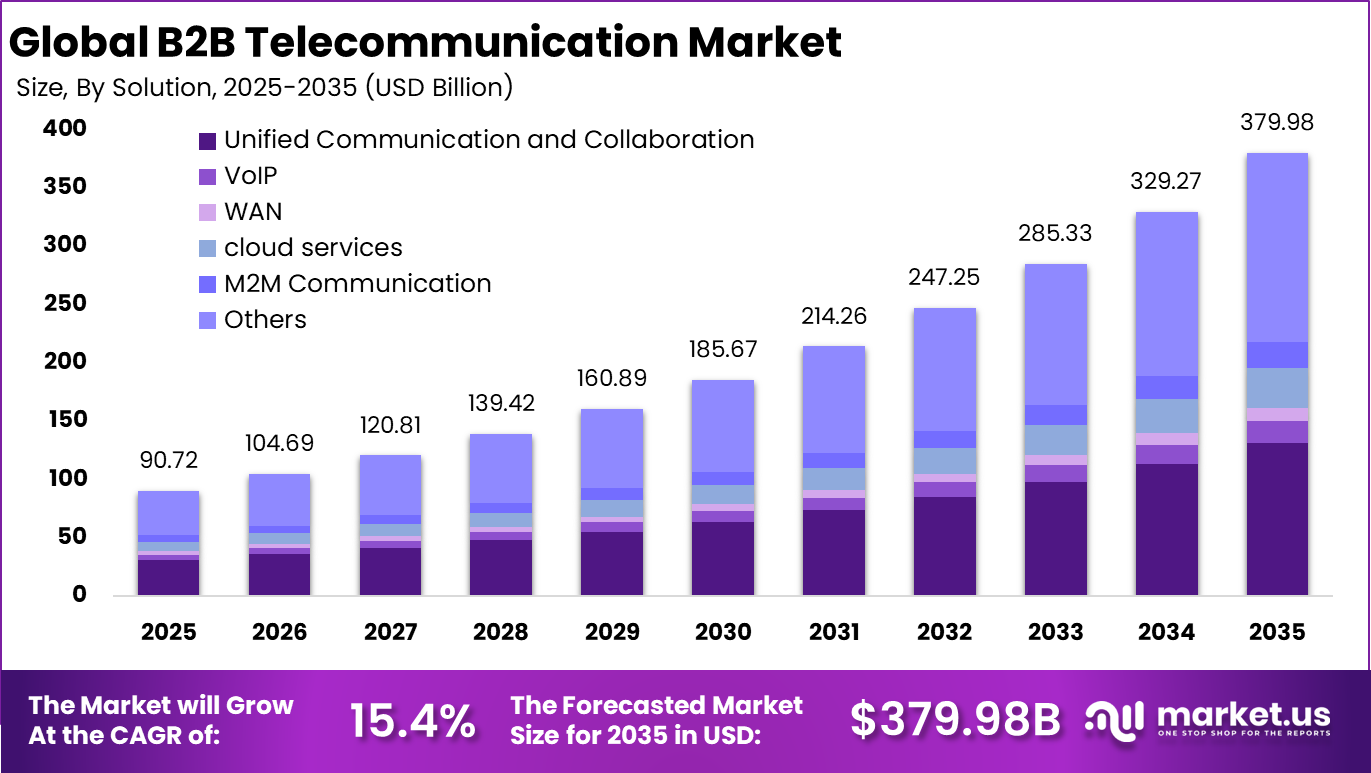
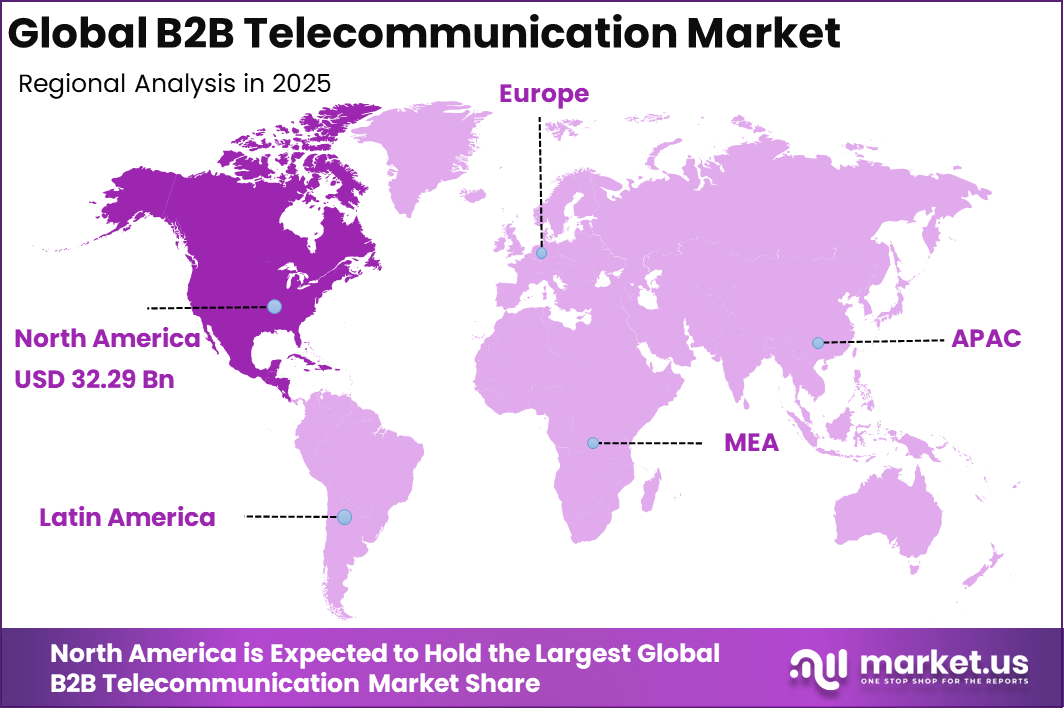
The Global B2B Telecommunication Market size is expected to be worth around USD 379.98 billion by 2035, from USD 90.72 billion in 2025, growing at a CAGR of 15.4% during the forecast period from 2025 to 2035. North America held a dominant market position, capturing more than a 35.6% share, holding USD 32.29 billion in revenue.
B2B telecommunication services provide businesses with communication solutions such as voice, data, cloud-based services, and secure network connections. Over 68% of companies now rely on unified communication tools to connect teams and manage operations. These services are essential for remote work, real-time collaboration, and digital workflows, forming the backbone of modern business operations.
The market for B2B telecommunication is driven by the growing need for seamless and reliable business communication. Companies increasingly adopt cloud-based platforms, unified messaging, and real-time collaboration tools to connect remote and in-office teams. The demand for secure networks, faster data transfer, and efficient workflow management encourages enterprises to invest in advanced telecom solutions that support productivity and operational efficiency.
Across sectors such as finance, healthcare, manufacturing, and logistics, demand for B2B telecom services continues to rise. Hybrid and remote work models make secure connectivity essential, with video calls, cloud access, and data sharing becoming daily requirements. The rapid adoption of IoT devices in businesses, from connected sensors to automated systems, further amplifies the need for robust telecom services.
For instance, in January 2026, Verizon is set to close its acquisition of Frontier Communications’ fiber assets on January 20, expanding high-speed B2B connectivity. This combines Verizon’s 5G with fiber for bundled services, creating significant value for enterprise customers nationwide.
Key Takeaway
- In 2025, Unified Communication and Collaboration led the Global B2B Telecommunication Market, accounting for 34.5% of total revenue share.
- In 2025, Large Enterprises represented the dominant customer group, holding a significant 70.2% share of the market.
- In 2025, the BFSI sector emerged as the leading industry vertical, capturing 36.8% of overall demand.
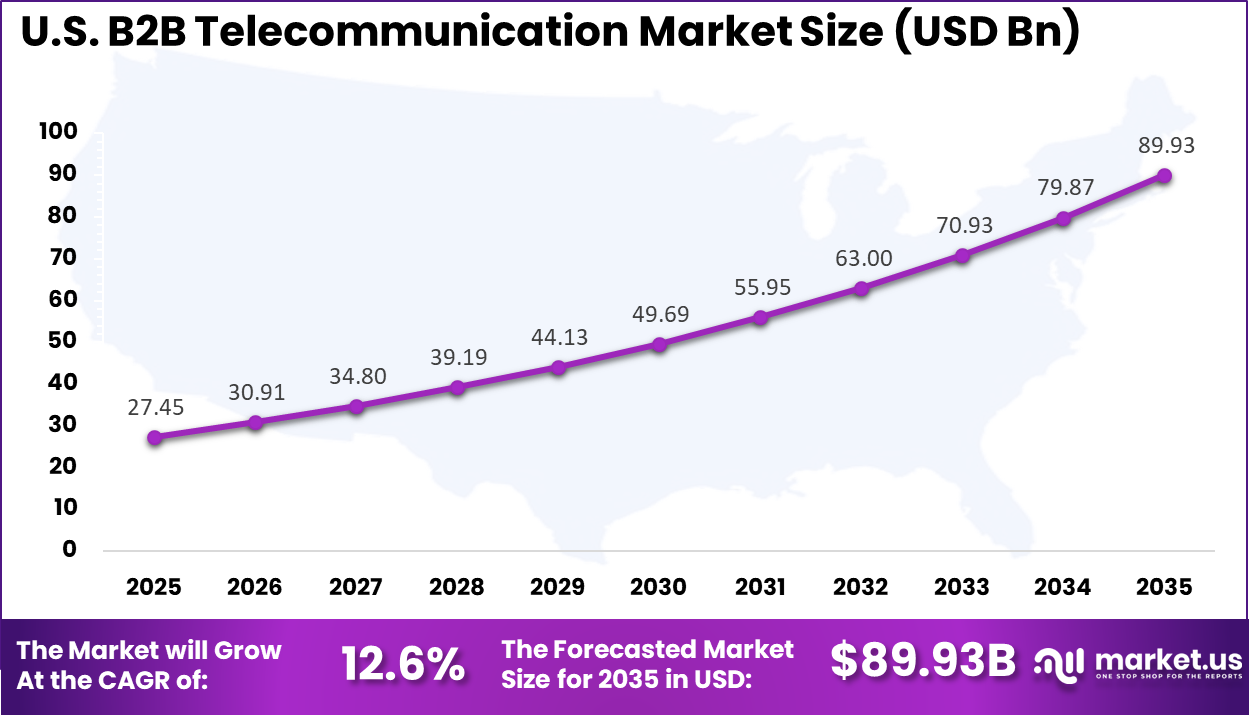
- In 2025, the U.S. B2B Telecommunication Market reached USD 27.45 billion and recorded a strong growth rate of 12.6%.
- In 2025, North America maintained regional leadership, securing more than 35.6% of the Global B2B Telecommunication Market.
Key Insights Summary
- Private 5G and LTE deployments have been associated with up to 80% reduction in workplace accidents by improving real time monitoring and connectivity.
- Organizations adopting private cellular networks have reported productivity improvements ranging from 20% to 90%, depending on operational complexity.
- SD WAN implementation has reduced wide area network costs by 30% to 50% by redirecting high volume traffic to lower cost broadband links.
- In India, average monthly mobile data consumption per user is projected to increase from around 18 GB to more than 55 GB by 2026, reflecting strong digital usage growth.
- Global cellular IoT connections are expected to reach approximately 4.5 billion by the end of 2025, indicating rapid expansion in connected device ecosystems.
By Solution
Unified Communication and Collaboration accounts for 34.5% of total adoption in the B2B Telecommunication Market. This dominance reflects strong enterprise demand for integrated communication platforms that combine voice, messaging, video conferencing, and file sharing within a single environment. Businesses prioritize seamless interaction across departments and geographies.
The preference for unified communication solutions is also driven by remote and hybrid work models. Organizations require centralized systems that maintain productivity across distributed teams. Integration with enterprise applications further strengthens adoption.
Security and compliance features are additional influencing factors. Businesses need encrypted communication and controlled access management. These requirements sustain strong demand for unified communication and collaboration solutions.
For Instance, in February 2026, Cisco Systems Inc. launched updates to its Unified CM platform, addressing key security flaws for better reliability. This move strengthens unified communication tools by fixing hardcoded credential issues, allowing businesses to deploy secure video, voice, and collaboration features without risks. It supports seamless hybrid work, boosting adoption in B2B telecom as teams demand robust, integrated platforms.
By Enterprise Size
Large enterprises represent 70.2% of total market demand by enterprise size. These organizations operate across multiple locations and require scalable telecommunication infrastructure. Advanced communication systems are critical to support complex operational structures. The scale of large enterprises increases reliance on secure and high capacity networks.
Real time communication supports decision making and operational coordination. Modern telecommunication platforms enhance efficiency across large workforces. Investment capacity also influences adoption. Large enterprises allocate significant budgets to digital transformation initiatives. This reinforces their dominant share within the market.
For instance, in September 2025, Verizon advanced its 5G strategy with AI Connect and the Frontier fiber acquisition, targeting large enterprises. This bundles fiber, wireless, and edge computing for AI workloads, helping big firms manage complex networks and scale operations reliably in the B2B telecom space.
By Vertical
The banking, financial services, and insurance sector accounts for 36.8% of vertical based demand. This segment relies heavily on secure and reliable communication networks to manage customer interactions and regulatory reporting. Telecommunication infrastructure supports transaction processing and service delivery. BFSI institutions require high levels of data protection and compliance. Secure communication channels reduce operational and reputational risk.
This drives sustained investment in telecommunication solutions. The increasing digitization of financial services further strengthens demand. Remote customer engagement and digital transactions require stable communication networks. These factors maintain BFSI’s leading position within the vertical segment.
For Instance, in November 2025, Telefónica Germany extended its Amdocs billing platform while adding GenAI for personalized upsells across services. In BFSI, this supports secure transaction handling and client engagement, vital for financial firms relying on robust telecom for compliant, real-time communications.
Regional Perspective
North America holds a leading position in the B2B Telecommunication Market, accounting for 35.6% of total activity. The region benefits from advanced digital infrastructure and high enterprise technology adoption.
Businesses actively invest in modern communication systems. Strong regulatory frameworks and cybersecurity awareness also influence market growth. Enterprises prioritize secure and scalable solutions. These conditions support North America’s strong regional role.
For instance, in January 2026, Verizon boosted North American B2B telecom leadership with its $20 billion acquisition of Frontier Communications, finalized after regulatory approvals. It expands fiber access to nearly 30 million homes and businesses, enabling converged 5G mobile and fiber offerings. This strategy drives cross-sell opportunities and market growth for enterprise clients.
The United States represents the largest contributor within North America, with a market value of USD 27.45 Bn and a growth rate of 12.6% CAGR. Expansion is supported by rising enterprise digitalization and increased demand for integrated communication platforms. Unified communication adoption continues to expand.
U.S. enterprises focus on operational efficiency and customer engagement. Advanced telecommunication systems enable faster collaboration and improved service delivery. These dynamics collectively support steady growth in the U.S. market segment.
For instance, in February 2026, AT&T Inc. completed its $5.75 billion acquisition of Lumen’s Mass Markets fiber business, adding over 4 million fiber locations across 32 states. This strategic move bolsters AT&T’s fiber network for B2B telecom services, enabling bundled 5G and high-speed internet offerings to enterprises, enhancing U.S. dominance in North American connectivity.
Emerging trends
One emerging trend in B2B telecommunication is the rapid adoption of private 5G networks. Enterprises are increasingly using 5G to support low-latency applications, real-time data processing, and secure connectivity for IoT devices. This shift allows businesses to enhance operational efficiency and maintain reliable communication across multiple locations.
Another key trend is the integration of AI and automation in telecom operations. AI helps predict network issues, optimize traffic, and improve security, while automation streamlines routine tasks. Together, these technologies reduce downtime, improve performance, and enable businesses to respond quickly to changing communication needs.
Growth Factors
The growth of B2B telecommunication is driven by the increasing reliance of businesses on digital tools and remote work solutions. Organisations are investing in high-speed networks, cloud-based communication, and unified collaboration platforms to ensure seamless connectivity across teams, which enhances efficiency and productivity.
Another major factor is the rising demand for secure and reliable communication systems. Businesses need robust networks to protect sensitive data, support real-time transactions, and manage IoT and automated systems. These requirements push enterprises to adopt advanced telecom solutions, sustaining growth in the market.
Key Market Segments
By Solution
- Unified Communication and Collaboration
- VoIP
- WAN
- cloud services
- M2M Communication
- Others
By Enterprise Size
- Small & Medium Enterprises (SME’s)
- Large Enterprises
By Vertical
- BFSI
- Healthcare
- Media and Entertainment
- Government
- Energy and Utility
- Retail
- Transportation and Logistics
- Others
Key Regions and Countries
North America
- US
- Canada
Europe
- Germany
- France
- The UK
- Spain
- Italy
- Russia
- Netherlands
- Rest of Europe
Asia Pacific
- China
- Japan
- South Korea
- India
- Australia
- Singapore
- Thailand
- Vietnam
- Rest of APAC
Latin America
- Brazil
- Mexico
- Rest of Latin America
Middle East & Africa
- South Africa
- Saudi Arabia
- UAE
- Rest of MEA
Drivers
Demand for Integrated Business Connectivity
The growth of B2B telecommunication is driven by businesses’ increasing need for reliable and integrated communication systems. Organisations are relying on cloud communication, unified messaging, and video collaboration to keep teams connected across offices and remote locations. Strong network services that support voice, data, and video help companies maintain smooth operations and improve efficiency.
Enterprises also value flexibility in their communication platforms. By replacing older fragmented systems with modern integrated networks, businesses can streamline workflows, reduce delays, and enhance coordination between departments. Reliable connectivity supports faster decision-making and helps organisations stay competitive in a digital-first environment.
For instance, in February 2026, AT&T teamed up with Cisco to launch a 5G Standalone-native IoT platform, blending AT&T’s nationwide 5G core with Cisco’s mobility tools for secure, low-latency connections. This move boosts integrated business connectivity, aiding enterprises in sectors like smart cities and healthcare with reliable network slicing and edge performance.
Restraint
Legacy Systems and Regulatory Constraints
One major restraint is the difficulty companies face when moving from legacy communication systems to modern networks. Older infrastructure often cannot support new technologies, making upgrades complex and costly. This slows the adoption of advanced telecom solutions that are essential for digital transformation.
Additionally, varying regulations for data protection and network compliance create challenges. Businesses and providers must navigate these rules carefully to avoid penalties, which can increase costs and extend deployment timelines. Concerns about compliance sometimes make organisations hesitant to fully adopt new telecommunication systems.
For instance, in February 2026, Comarch highlighted in an IDC analysis the push from fragmented legacy systems to unified cloud-native inventory platforms amid rising telco complexity. Their OSS tools aid operators in modernizing old setups, tackling regulatory hurdles, and IT bloat that slow B2B service rollouts.
Opportunities
Growth of Connected Systems and IoT Use
The rise of connected systems and IoT presents a significant opportunity in B2B telecommunication. Businesses are integrating devices and sensors in manufacturing, logistics, and smart operations, which increases demand for telecom services that can manage large volumes of data reliably. Providers supporting IoT integration enable companies to gain real-time insights and improve automation.
This trend encourages telecom companies to develop specialised solutions tailored for connected business environments. Offering services that handle multiple devices efficiently helps enterprises unlock new use cases and adds value beyond traditional voice and data communication, strengthening provider-client relationships.
For instance, in November 2025, AT&T. Transforma Insights ranked AT&T Connected Solutions high for IoT connectivity gains, crediting tools like Global SIM Advanced and IoT Console. This strengthens connected systems, enabling businesses to scale IoT with simple management and real-time insights.
Challenges
Competition from Digital-First Providers
A key challenge for traditional B2B telecommunication providers is competition from digital‑first technology companies. Many modern enterprises prefer cloud‑native communication platforms that are designed for agile deployment and easier scalability. These digital players often update their services quickly, making it harder for traditional telecom firms to keep pace with innovation and meet changing customer expectations.
Smaller and medium enterprises also show a tendency to explore alternative providers that offer flexible pricing and feature‑rich platforms that do not require heavy upfront investment. This shift places pressure on established telecom companies to rethink their offerings, invest in new capabilities, and find ways to remain relevant as business communication preferences evolve rapidly.
For instance, in June 2025, Deutsche Telekom advanced industrial IoT with AI, 5G, and eSIM via partnerships like MECC with Nordic Semiconductor for easier global cellular integration. Facing digital rivals, it targets sector-specific solutions to hold ground in connected products.
Key Players Analysis
The B2B Telecommunication Market is driven by global network operators and telecom technology providers with strong enterprise portfolios. AT&T Inc., Verizon, Deutsche Telekom AG, Vodafone Group PLC, Orange S.A., Telefonica S.A., and NTT Communication offer dedicated business connectivity, managed services, cloud networking, and cybersecurity solutions. These companies focus on high capacity fiber networks, 5G enterprise use cases, and software defined networking.
Technology and platform providers also play a strategic role in enabling enterprise telecom services. Cisco Systems Inc. delivers advanced networking hardware, software defined infrastructure, and security platforms that support enterprise communication frameworks. Amdocs provides billing, customer experience, and digital transformation solutions tailored for telecom operators serving business clients.
Competitive intensity remains high due to rising demand for integrated communication and connectivity solutions. Market participants are expanding managed services, IoT connectivity, private 5G networks, and edge computing offerings to address enterprise digital transformation needs. Strategic partnerships, network modernization, and cloud integration initiatives are being widely adopted.
Top Key Players in the Market
- Amdocs
- AT&T Inc.
- Cisco Systems Inc.
- Comarch S.A.
- Deutsche Telekom AG
- NTT Communication
- Orange S.A.
- Telefonica S.A.
- Vodafone Group PLC
- Verizon
- Others
Recent Developments
- In June 2025, Cisco Systems was involved in the telecom M&A wave, with broader industry deals like CCI Systems acquiring Total Site Services for wireless infrastructure. Cisco continues to power B2B networks through its secure networking solutions amid rising demand for AI and cloud integration.
- In October 2025, Deutsche Telekom launched One Portal, a unified B2B telecom platform across Europe. This cloud-based solution simplifies operations with digital self-care and cross-selling features, addressing legacy system challenges while driving digital transformation for enterprise clients.
Report Scope
Report Features Description Market Value (2025) USD 90.7 Bn Forecast Revenue (2035) USD 379.9 Bn CAGR (2026-2035) 15.4% Base Year for Estimation 2025 Historic Period 2020-2024 Forecast Period 2026-2035 Report Coverage Revenue forecast, AI impact on Market trends, Share Insights, Company ranking, competitive landscape, Recent Developments, Market Dynamics and Emerging Trends Segments Covered By Solution (Unified Communication and Collaboration, VoIP, WAN, cloud services, M2M Communication, Others), By Enterprise Size (Small & Medium Enterprises (SME’s), Large Enterprises), By Vertical (BFSI, Healthcare, Media and Entertainment, Government, Energy and Utility, Retail, Transportation and Logistics, Others) Regional Analysis North America – US, Canada; Europe – Germany, France, The UK, Spain, Italy, Russia, Netherlands, Rest of Europe; Asia Pacific – China, Japan, South Korea, India, New Zealand, Singapore, Thailand, Vietnam, Rest of Latin America; Latin America – Brazil, Mexico, Rest of Latin America; Middle East & Africa – South Africa, Saudi Arabia, UAE, Rest of MEA Competitive Landscape Amdocs, AT&T Inc., Cisco Systems Inc., Comarch S.A., Deutsche Telekom AG, NTT Communication, Orange S.A., Telefonica S.A., Vodafone Group PLC, Verizon, Others Customization Scope Customization for segments, region/country-level will be provided. Moreover, additional customization can be done based on the requirements. Purchase Options We have three license to opt for: Single User License, Multi-User License (Up to 5 Users), Corporate Use License (Unlimited User and Printable PDF)  B2B Telecommunication MarketPublished date: Feb. 2026add_shopping_cartBuy Now get_appDownload Sample
 -
-
- Amdocs
- AT&T Inc.
- Cisco Systems Inc.
- Comarch S.A.
- Deutsche Telekom AG
- NTT Communication
- Orange S.A.
- Telefonica S.A.
- Vodafone Group PLC
- Verizon
- Others
Our Clients

- 179441
- Feb. 2026