


Report Overview
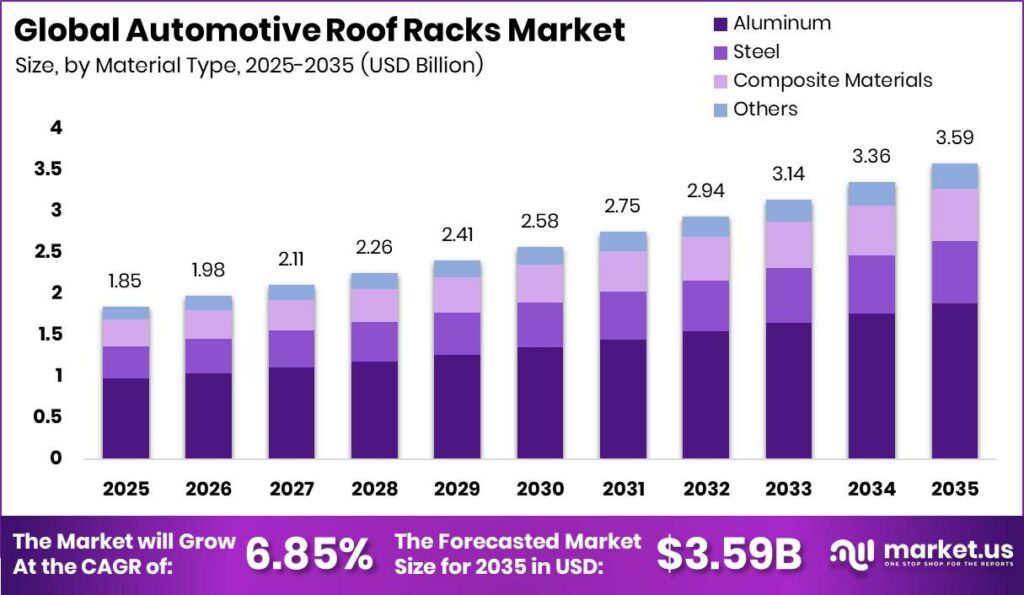
Global Automotive Roof Racks Market size is expected to be worth around USD 3.59 Billion by 2035 from USD 1.85 Billion in 2025, growing at a CAGR of 6.85% during the forecast period 2026 to 2035. This steady climb reflects rising demand for external vehicle cargo capacity. Buyers now treat roof racks as core mobility gear, not optional add-ons.
The Automotive Roof Racks Market covers mounting systems fitted to vehicle rooftops for carrying cargo, sports gear, and utility loads. Manufacturers structure the market across product type, material, application, vehicle type, and sales channel. This layered structure lets suppliers target distinct buyer groups. Therefore vendors can build tailored product lines for both premium and value shoppers.
Key Takeaways
- Global market size will reach USD 3.59 Billion by 2035, up from USD 1.85 Billion in 2025.
- The market grows at a CAGR of 6.85% across the 2026 to 2035 forecast window.
- Raised Rail Roof Racks lead product type with a 34.80% share.
- Aluminum dominates material type with a 52.60% share.
- Cargo Carriers lead application demand with a 41.30% share.
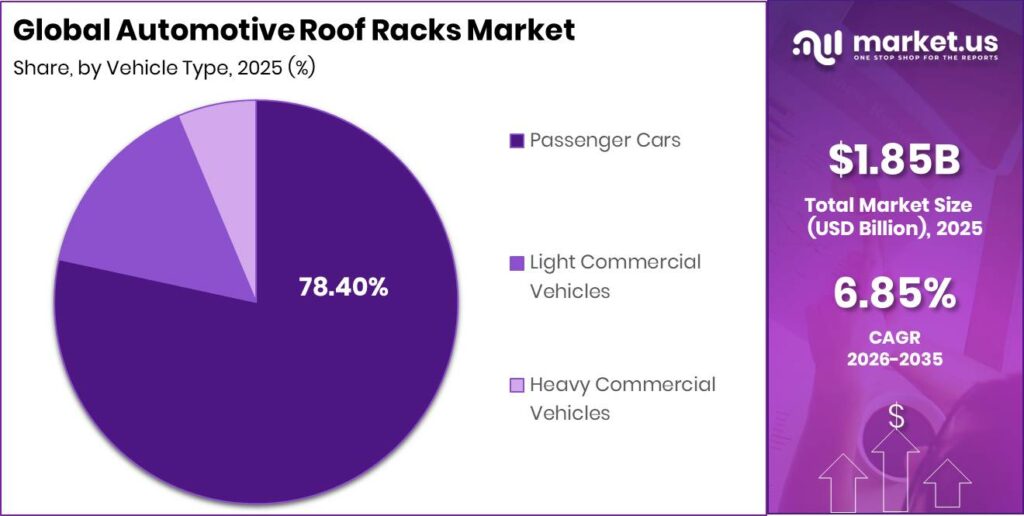
- Passenger Cars hold the top vehicle type position with a 78.40% share.
- The Aftermarket channel commands a 58.70% share of sales.
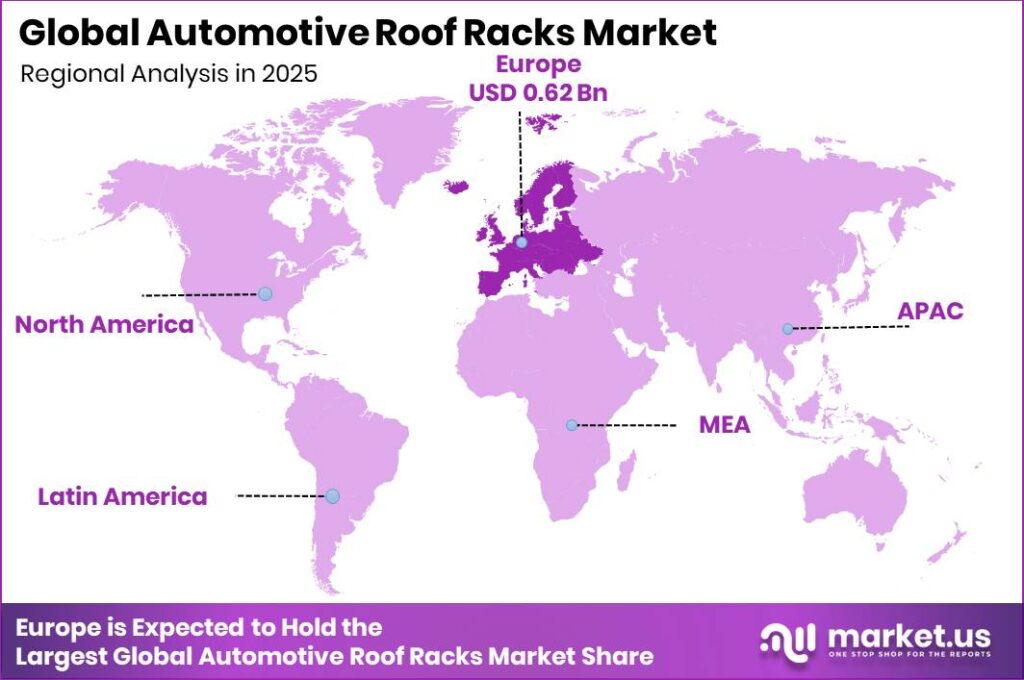
- Europe leads all regions with a 33.80% share, valued at USD 0.6253 Billion.
Government fuel economy rules shape product design across major markets. Regulators in Europe and North America push automakers toward lighter vehicle components. This pressure steers rack makers toward aluminum systems that cut weight. As a result, compliance-driven engineering now guides material sourcing and product roadmaps for suppliers.
Thule Group employed approximately 3,000 workers worldwide in 2025, spread across production and sales operations. This large base gives Thule deep engineering and distribution capacity that smaller rivals cannot match. Therefore new entrants must compete on niche design rather than scale, since matching this workforce depth demands years of sustained capital investment.
Yakima launched its Spring 2025 roof-rack lineup, marking the company’s 45th year of roof transport products. This milestone signals durable brand equity built over four decades of continuous product development. Consequently loyal customers trust legacy names when upgrading systems, giving established brands a defensible edge over low-cost newcomers in premium aftermarket segments.
Product Type Analysis
Raised Rail Roof Racks dominate with 34.80% due to easy factory-fitted rail mounting.
In 2025, Raised Rail Roof Racks held a dominant market position in the By Product Type segment of Automotive Roof Racks Market, with a 34.80% share. Ford OEM documentation confirms roof structures support up to 300 kg when stationary and evenly loaded. This high static capacity reassures buyers about safety. Therefore suppliers can market raised rail systems as robust, load-ready platforms for family and adventure use.
Material Type Analysis
Aluminum dominates with 52.60% due to lightweight fuel economy compliance benefits.
In 2025, Aluminum held a dominant market position in the By Material Type segment of Automotive Roof Racks Market, with a 52.60% share. Kia OEM documentation states roof structures carry up to 400 kg when parked with an evenly distributed load. This strength paired with low weight makes aluminum the preferred choice. Consequently manufacturers can charge premium prices while meeting strict weight targets.
Application Analysis
Cargo Carriers dominate with 41.30% due to versatile everyday hauling capability.
In 2025, Cargo Carriers held a dominant market position in the By Application segment of Automotive Roof Racks Market, with a 41.30% share. Ford OEM manuals specify a maximum dynamic roof load of 75 kg while driving. This driving-load limit shapes how carriers get designed and rated. Therefore vendors must clearly display capacity ratings to guide safe buyer choices and reduce returns.
Vehicle Type Analysis
Passenger Cars dominate with 78.40% due to broad global ownership base.
In 2025, Passenger Cars held a dominant market position in the By Vehicle Type segment of Automotive Roof Racks Market, with a 78.40% share. Kia OEM documentation specifies a 100 kg maximum dynamic roof load during driving. This standard driving limit helps passenger car owners choose safe rack loads. As a result, suppliers gain a huge addressable base and can standardize fitment kits across popular car models.
Sales Channel Analysis
Aftermarket dominates with 58.70% due to flexible post-purchase upgrade demand.
In 2025, Aftermarket held a dominant market position in the By Sales Channel segment of Automotive Roof Racks Market, with a 58.70% share. As per our research, aftermarket buyers replace or upgrade racks multiple times across a vehicle’s life. This repeat behavior lifts channel value well beyond a single sale. Therefore distributors that build strong retail and online reach capture recurring revenue streams over many years.
Key Market Segments
By Product Type
- Raised Rail Roof Racks
- Flush Rail Roof Racks
- Gutter-Mounted Roof Racks
- Fixed Point Roof Racks
- Bare Roof Roof Racks
By Material Type
- Aluminum
- Steel
- Composite Materials
- Others
By Application
- Cargo Carriers
- Bicycle Carriers
- Water Sports Carriers
- Winter Sports Carriers
- Utility & Commercial Transport
By Vehicle Type
- Passenger Cars
- Light Commercial Vehicles
- Heavy Commercial Vehicles
By Sales Channel
- Aftermarket
- OEM
Regional Analysis
Europe Dominates the Automotive Roof Racks Market with a Market Share of 33.80%, Valued at USD 0.6253 Billion
Europe leads the Automotive Roof Racks Market with a 33.80% share worth USD 0.6253 Billion. Strong outdoor culture and dense OEM presence drive this lead across Germany, France, and the UK. This means European buyers demand high-quality, compliance-ready racks. Therefore suppliers targeting the region must prioritize aluminum systems and precise vehicle-specific fitment to win share.
Asia Pacific stands out as the fastest-growing region across the forecast period. Rising vehicle ownership in China and India expands the addressable base each year. In March 2026, Yakima launched its StepUp and StepUp Swing production models with modular truck bed compatibility. This signals fresh product entry that helps brands capture emerging demand across growing regional markets.
Key Regions and Countries
North America
- US
- Canada
Europe
- Germany
- France
- The UK
- Spain
- Italy
- Rest of Europe
Asia Pacific
- China
- Japan
- South Korea
- India
- Australia
- Rest of APAC
Latin America
- Brazil
- Mexico
- Rest of Latin America
Middle East and Africa
- GCC
- South Africa
- Rest of MEA
Market Dynamics
Market Opportunity Analysis - Underexploited channels, regions, and vehicle segments open entry points for new players
The OEM sales channel remains underexploited against the Aftermarket’s 58.70% lead. Automakers still fit fewer factory racks than aftermarket buyers install later. This gap leaves room for suppliers to win dealer-installed contracts. Therefore firms that build OEM partnerships early can capture a channel where competition stays thin today.
Light Commercial Vehicles sit far behind the Passenger Cars 78.40% share. Fleet operators increasingly need rooftop utility carrying for urban delivery work. This creates open demand for durable commercial rack systems. As a result, vendors targeting van and work fleets can grow a segment that most premium brands currently overlook.
Steel and Composite Materials trail the Aluminum 52.60% lead by a wide margin. Value buyers in emerging markets still favor lower-cost steel systems. This means a clear entry point exists for affordable, durable steel racks. Therefore new entrants can serve price-sensitive shoppers before scaling toward premium aluminum lines later.
Technology and Innovation Landscape - Load engineering and modular design shape competitive advantage
OEM load engineering now anchors roof rack design across the industry. Ford documentation confirms roof structures support up to 300 kg static and 75 kg dynamic load. These precise ratings force suppliers to engineer to strict tolerances. Therefore firms that master certified load design gain buyer trust and reduce liability risk across markets.
Modular platform systems mark the leading edge of rack innovation. Yakima’s redesigned StepUp and HoldUp systems carry up to 60 lbs per tray with RV-rated compatibility. This modular approach lets buyers expand systems over time. As a result, manufacturers that invest in flexible mounting platforms lock in accessory sales and deepen customer loyalty.
Material innovation drives compliance and performance gains for makers. Kia OEM documentation confirms roof structures carry up to 400 kg when parked with even load distribution. This validates strong, lightweight aluminum construction. Consequently suppliers advancing alloy engineering can meet fuel economy rules while delivering the strength that adventure buyers demand.
Drivers
Outdoor recreation demand pushes roof rack sales forward across major markets. The Outdoor Industry Association reported outdoor participation reached roughly 170 million people by 2024, a 7 to 9% rise over pre-pandemic levels. This surge lifts demand for cargo transport gear. Therefore rack makers can shift from commodity crossbars toward premium modular systems that raise margins.
Modular buyers also fuel repeat sales that reshape the business model. A customer buying a platform rack typically adds 2 to 4 accessory purchases within 18 to 36 months. This pattern lifts customer lifetime value by an estimated USD 600 to 1,800. As a result, brands invest in proprietary ecosystems that earn gross margins of 35 to 50%.
| Driver | (~) % Impact on CAGR Forecast | Geographic Relevance | Impact Timeline |
|---|---|---|---|
| Outdoor Recreation & Adventure Tourism Boom Accelerating Roof Rack Accessory Demand | +2.10% | North America, Europe, Australia, GCC | Short term (≤ 2 years) |
| SUV, Crossover & Pickup Truck Segment Dominance Expanding Addressable Fitment Base | +1.65% | Global — North America, China, Middle East, Australia | Short term (≤ 2 years) |
| Rising OEM Factory-Fit & Dealer-Installed Roof Rack Option Penetration | +1.10% | Europe, North America, Japan, South Korea | Medium term (2–4 years) |
| Last-Mile Delivery & Urban Van Fleet Expansion Driving Commercial Rack Demand | +0.75% | Europe, North America, India, Southeast Asia | Short term (≤ 2 years) |
| Lightweight Aluminium Alloy Rack Adoption Improving Fuel Economy Compliance | +0.65% | Europe, North America, Japan | Medium term (2–4 years) |
| E-Commerce & DTC Channel Growth Reducing Retail Distribution Friction | +0.43% | North America, Europe, China, Australia | Short term (≤ 2 years) |
Restraints
Import tariffs raise roof rack prices across North America and Europe. U.S. Section 232 aluminium tariffs held at 10% in 2025, while a 25% tariff hit Canada and Mexico goods from March 4, 2025. This raises landed costs sharply. Therefore manufacturers face pressure on both price and margin.
Tariff stacking drives aggregate duty burdens of 35 to 48% on fully assembled systems. Firms passing costs through report unit sales declines of 12 to 18% in price-sensitive channels. This means suppliers must rework sourcing to stay competitive. As a result, some delay U.S. assembly investment that needs 18 to 30 months to deliver relief.
| Restraint | (~) % Impact on CAGR Forecast | Geographic Relevance | Impact Timeline |
|---|---|---|---|
| US & EU Import Tariffs on Aluminium & Steel Rack Components Inflating Consumer Prices | -1.30% | United States, European Union, Canada | Short term (≤ 2 years) |
| EV Roofline & Panoramic Glass Roof Designs Restricting Rack Fitment Compatibility | -0.85% | China, Europe, North America | Medium term (2–4 years) |
| Fuel Economy & Range Penalty Deterring Roof Rack Use on BEV & PHEV Platforms | -0.55% | Europe, North America, China | Medium term (2–4 years) |
| Low-Cost Chinese Manufacturer Imports Suppressing ASPs in Aftermarket Channels | -0.42% | Southeast Asia, Middle East, Africa, Latin America | Short term (≤ 2 years) |
| Consumer Discretionary Spending Compression Under Elevated Interest Rate Environments | -0.32% | United States, Europe, Australia | Short term (≤ 2 years) |
Challenges
Fitment kit proliferation strains roof rack supply chains worldwide. A full-line supplier in Europe and North America must stock 800 to 1,500 vehicle-specific kits to cover 85 to 90% of the parc. This ties up working capital in slow-moving parts. Therefore distributors carry heavy inventory cost disproportionate to revenue.
Fitment errors also drag on aftermarket profits. E-commerce fitment error rates run at 6 to 11% of orders for complex categories. This generates returns costs of USD 18 to 35 per incident. As a result, leading players invest USD 2 to 6 million in AI fitment tools to cut error rates below 2%.
| Challenge | (~) % CAGR Friction Drag | Geographic Relevance | Mitigation Horizon |
|---|---|---|---|
| Vehicle-Specific Fitment SKU Proliferation | -0.80% | Global — concentrated at aftermarket distributors & OEM accessory programs | Long term (≥ 4 years) |
| Load Certification & Liability Standard Fragmentation | -0.65% | European Union, Australia, United States | Medium term (2–4 years) |
| Aerodynamic Drag & NVH Complaint Management | -0.50% | Global — most acute in premium & EV OEM programs | Medium term (2–4 years) |
| Counterfeit & Sub-Standard Rack Proliferation | -0.40% | South Asia, Southeast Asia, Sub-Saharan Africa, Latin America | Long term (≥ 4 years) |
| Seasonal Demand Volatility & Inventory Management | -0.33% | North America, Northern Europe, Australia | Medium term (2–4 years) |
Opportunities
EV-optimized aero racks open clear white space for suppliers. On BEV platforms, roof rack drag cuts real-world range by 8 to 15% at 110 km/h. This range loss keeps BEV rack fitment rates 40 to 55% below ICE-equivalent platforms. Therefore purpose-built low-drag racks can unlock an underserved and fast-growing buyer group.
The unit economics reward early movers strongly. A premium EV aero rack retails at USD 800 to 1,500 versus USD 250 to 500 for a conventional crossbar. This delivers gross margins of 38 to 52%. As a result, firms investing 18 to 30 months in aero engineering now can lock in platform advantage before rivals scale.
| Opportunity | (~) % Potential CAGR Upside | Geographic Relevance | Execution Window |
|---|---|---|---|
| EV-Optimised Low-Drag Aero Rack Platform for Range-Sensitive Vehicles | +1.60% | Europe, North America, China, South Korea | Medium term (2–4 years) |
| Modular Accessory Ecosystem Lock-In & Recurring Revenue Platform | +1.10% | North America, Europe, Australia | Medium term (2–4 years) |
| Commercial Fleet & Work Van Integrated Rack-as-a-Service Subscription | +0.75% | Europe, North America, GCC | Long term (≥ 4 years) |
| India & Southeast Asia Organised Aftermarket Penetration | +0.60% | India, Indonesia, Vietnam, Thailand | Short term (≤ 2 years) |
| Solar Panel & Rooftop Energy Integration for Off-Grid Overlanding | +0.45% | Australia, North America, GCC, Sub-Saharan Africa | Long term (≥ 4 years) |
Key Company Insights
Thule Group AB sold its products across 138 markets worldwide in 2025 and reported SEK 10.4 billion in net sales. This vast reach and revenue base give the firm strong pricing power and dense distribution. Therefore Thule can fund continuous innovation and defend premium share, while smaller rivals struggle to match its global footprint and marketing depth.
Rhino-Rack strengthened its portfolio when its parent acquired RockyMounts in January 2025. This deal expanded bicycle transport and hitch rack coverage across the North American aftermarket. As a result, Rhino-Rack now competes across more product lines and buyer segments. However integrating two brands demands careful channel management to avoid overlap and protect existing dealer relationships during the transition.
Key Players
- Thule Group AB
- Yakima Products Inc.
- Rhino-Rack
- SportRack
- Malone Auto Racks
- JAC Products Inc.
- Magna International Inc.
- ROLA
- Inno Racks
- VDL Hapro B.V.
- Mont Blanc Group AB
- G3 S.r.l.
Recent Developments
- September 2025: Yakima unveiled its 2026 rack platform preview, featuring redesigned HoldUp and StepUp systems with higher load capacity up to 60 lbs per tray and RV-rated hitch compatibility.
- April 2026: Thule launched new pickup truck rack systems called Thule Xscape and an updated Thule Pulse roof box, emphasizing easier installation and improved cargo integration design.
- May 2026: Rhino-Rack introduced a low-profile rooftop tent system with integrated accessory channels and quick-release mounting designed for modular roof rack platforms and overlanding use.
- May 2026: Thule acquired Swiss company curli AG, expanding its vehicle transport ecosystem into dog harnesses and pet travel systems within its Active with Dogs category.
Report Scope
| Report Features | Description |
|---|---|
| Market Value (2025) | USD 1.85 Billion |
| Forecast Revenue (2035) | USD 3.59 Billion |
| CAGR (2026-2035) | 6.85% |
| Base Year for Estimation | 2025 |
| Historic Period | 2020-2024 |
| Forecast Period | 2026-2035 |
| Report Coverage | Revenue Forecast, Market Dynamics, Market Opportunity Analysis, Technology and Innovation Landscape, Competitive Landscape, Recent Developments |
| Segments Covered | By Product Type (Raised Rail Roof Racks, Flush Rail Roof Racks, Gutter-Mounted Roof Racks, Fixed Point Roof Racks, Bare Roof Roof Racks), By Material Type (Aluminum, Steel, Composite Materials, Others), By Application (Cargo Carriers, Bicycle Carriers, Water Sports Carriers, Winter Sports Carriers, Utility & Commercial Transport), By Vehicle Type (Passenger Cars, Light Commercial Vehicles, Heavy Commercial Vehicles), By Sales Channel (Aftermarket, OEM) |
| Regional Analysis | North America (US and Canada), Europe (Germany, France, The UK, Spain, Italy, and Rest of Europe), Asia Pacific (China, Japan, South Korea, India, Australia, and Rest of APAC), Latin America (Brazil, Mexico, and Rest of Latin America), Middle East and Africa (GCC, South Africa, and Rest of MEA) |
| Competitive Landscape | Thule Group AB, Yakima Products Inc., Rhino-Rack, SportRack, Malone Auto Racks, JAC Products Inc., Magna International Inc., ROLA, Inno Racks, VDL Hapro B.V., Mont Blanc Group AB, G3 S.r.l. |
| Customization Scope | Customization for segments, region / country-level will be provided. Additional customization can be done based on requirements. |
| Purchase Options | We have three licenses to opt for: Single User License | Multi-User License (Up to 5 Users) | Corporate Use License (Unlimited User and Printable PDF) |





































