


Report Overview
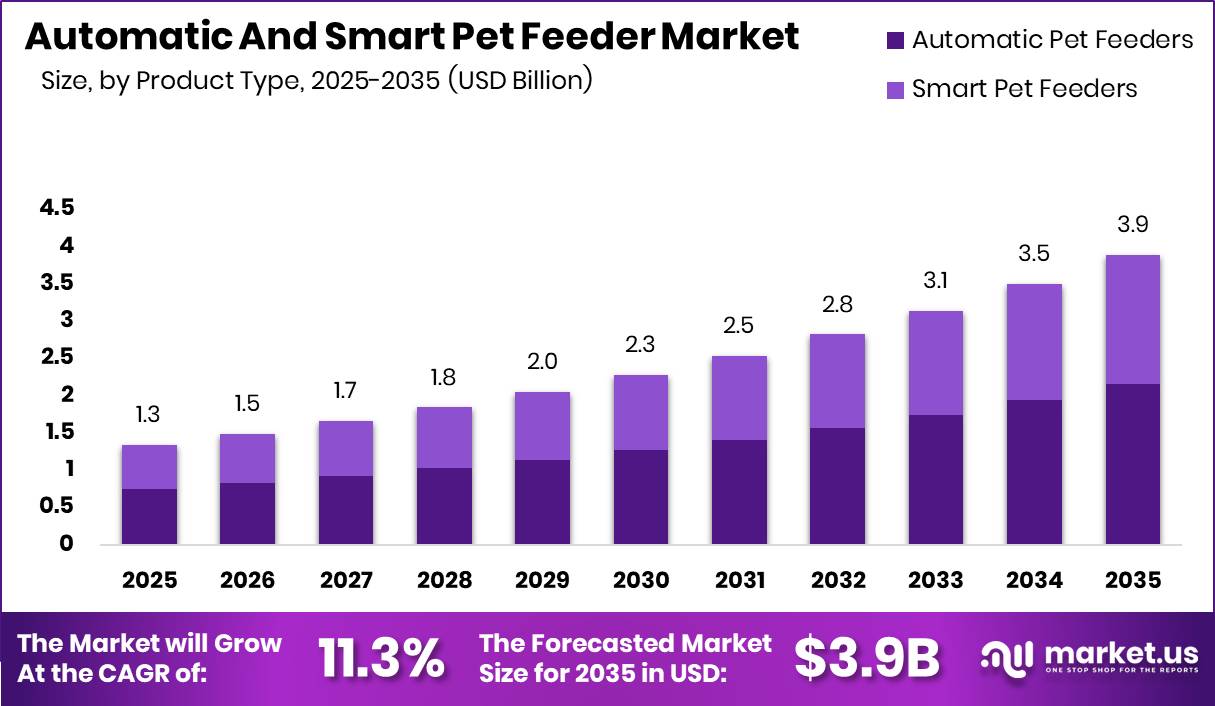
Global Automatic and Smart Pet Feeder Market size is expected to be worth around USD 3.9 Billion by 2035 from USD 1.3 Billion in 2025, growing at a CAGR of 11.3% during the forecast period 2026 to 2035. This growth reflects rising household spending on connected pet care devices.
Therefore, the automatic and smart pet feeder market includes hardware devices that dispense food on programmed schedules through mechanical or app-controlled systems. These devices range from basic timer feeders to Wi-Fi connected units with cameras and portion tracking. The market serves households seeking consistent feeding routines without manual intervention.
As per our research, 95 million U.S. households owned at least one pet in 2025. This wide ownership base creates a large addressable market for automated feeding devices. Manufacturers can target both new and existing pet owners through tiered product offerings.
According to Petfood Processing, 53% of pet parents purchased pet products online in 2025, compared with 45% buying in-store. This signals a shift toward digital-first purchasing for connected feeding devices. Consequently, manufacturers increasingly integrated AI-powered pet recognition and camera-based monitoring into new product launches throughout 2026.
This reflects greater use of omnichannel access to pet care products. Retailers combining online and offline experiences capture more conversions. As a result, brands investing in cross-channel visibility gain stronger positioning across the forecast period.
Key Takeaways
- Global market size is valued at USD 1.3 Billion in 2025 and is projected to reach USD 3.9 Billion by 2035.
- The market is expected to grow at a CAGR of 11.3% between 2026 and 2035.
- Automatic Pet Feeders lead the By Product Type segment with a 55.60% share.
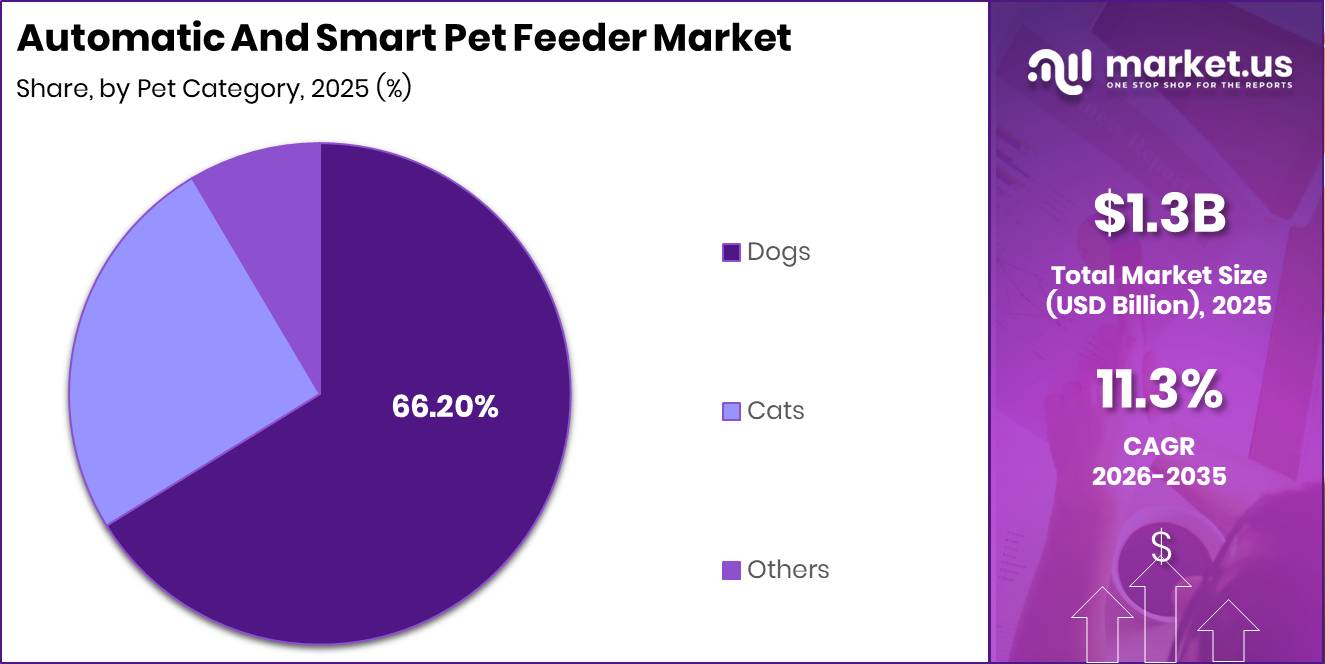
- Dogs dominate the By Pet Category segment, accounting for 66.20% of usage.
- Dry Food holds the largest share in the By Food Form segment at 65.00%.
- The 3 to 5 Liters hopper capacity segment leads with a 58.25% share.
- Wi-Fi Enabled devices dominate the By Connectivity and Technology segment with 65.88% share.
- Mid-Range products hold the largest share in the By Price Range segment at 46.58%.
- Offline Retailers lead the By Distribution Channel segment with a 72.98% share.
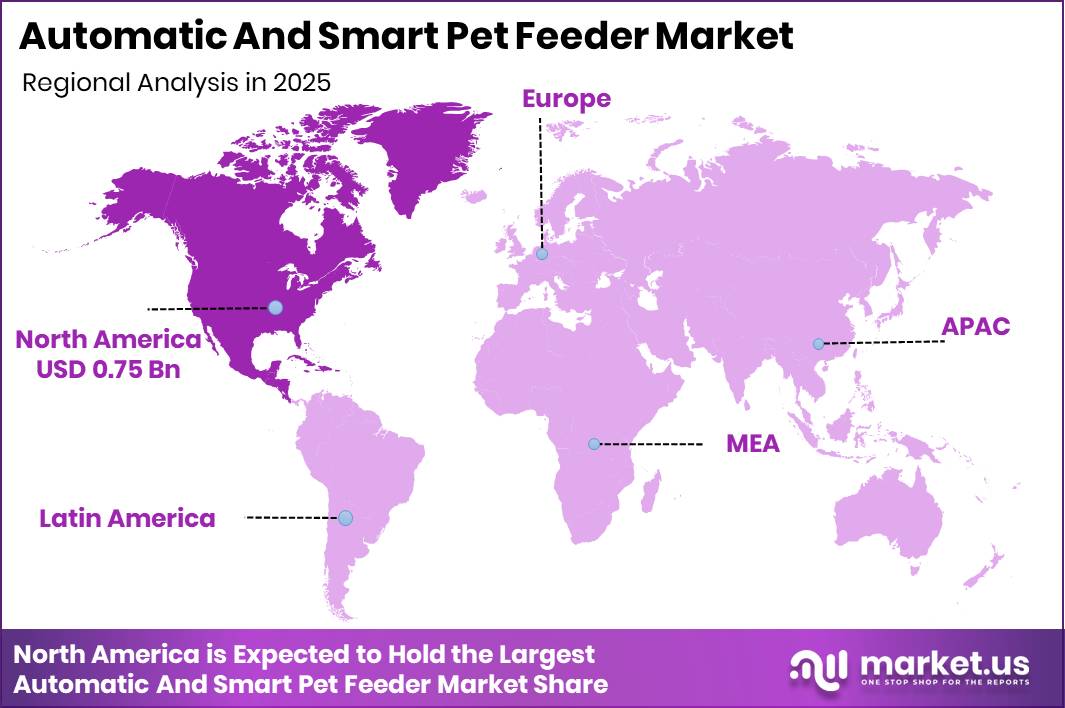
- North America dominates the regional market with a 55.76% share, valued at USD 0.75 Billion.
Product Type Analysis
Automatic Pet Feeders dominates with 55.60% due to lower cost and simpler operation.
In 2025, Automatic Pet Feeders held a dominant market position in the By Product Type segment of Automatic and Smart Pet Feeder Market, with a 55.60% share. Data from The consumers. Guide shows most automatic feeders display a 5 to 10% dispensing accuracy variance by kibble count. This price advantage keeps demand strong among first-time buyers entering the category.
Pet Category Analysis
Dogs dominates with 66.20% due to higher feeding frequency needs.
In 2025, Dogs held a dominant market position in the By Pet Category segment of Automatic and Smart Pet Feeder Market, with a 66.20% share. Dog owners often need structured feeding schedules to manage weight and activity levels. This pattern pushes vendors to prioritize larger hopper designs and dog-specific portion controls.
Food Form Analysis
Dry Food dominates with 65.00% due to easier storage and dispensing.
In 2025, Dry Food held a dominant market position in the By Food Form segment of Automatic and Smart Pet Feeder Market, with a 65.00% share. Dry kibble resists spoilage and moves easily through mechanical dispensing systems. Therefore, manufacturers continue to design hoppers and augers around dry food compatibility first.
Hopper Capacity Analysis
3 to 5 Liters dominates with 58.25% due to balanced capacity for households.
In 2025, 3 to 5 Liters held a dominant market position in the By Hopper Capacity segment of Automatic and Smart Pet Feeder Market, with a 58.25% share. This range supports multi-day feeding without oversized hardware footprints. Households with single or dual pets find this capacity practical for daily and weekend use.
Connectivity and Technology Analysis
Wi-Fi Enabled dominates with 65.88% due to remote app-based feeding control.
In 2025, Wi-Fi Enabled held a dominant market position in the By Connectivity and Technology segment of Automatic and Smart Pet Feeder Market, with a 65.88% share. As reported by arXiv, a LoRaWAN-enabled smart feeding station achieved 97.99% data-transmission reliability. Tractive also completed its acquisition of Whistle from Mars Petcare in 2025, consolidating the connected device space.
Price Range Analysis
Mid-Range dominates with 46.58% due to balanced features and affordability.
In 2025, Mid-Range held a dominant market position in the By Price Range segment of Automatic and Smart Pet Feeder Market, with a 46.58% share. This tier offers app connectivity without premium camera or AI features. Buyers seeking functional automation without high upfront cost gravitate toward this pricing bracket.
Distribution Channel Analysis
Offline Retailers dominates with 72.98% due to in-store product trial preference.
In 2025, Offline Retailers held a dominant market position in the By Distribution Channel segment of Automatic and Smart Pet Feeder Market, with a 72.98% share. Based on Pet food Processing data, 65.2% of pet owners used omnichannel purchasing across online and in-store channels in 2025. This behavior pushes retailers to align in-store and digital experiences closely.
Key Market Segments
By Product Type
- Automatic Pet Feeders
- Smart Pet Feeders
By Pet Category
- Dogs
- Cats
- Others
By Food Form
- Dry Food
- Wet Food
- Mixed / Freeze-Dried
By Hopper Capacity
- Up to 3 Liters
- 3 to 5 Liters
- Above 5 Liters
By Connectivity and Technology
- Wi-Fi Enabled
- Bluetooth / Offline
By Price Range
- Low-Cost (Economy)
- Mid-Range
- High-End (Premium)
By Distribution Channel
- Online E-Commerce
- Offline Retailers
Regional Analysis
North America Dominates the Automatic and Smart Pet Feeder Market with a Market Share of 55.76%, Valued at USD 0.75 Billion
North America leads the automatic and smart pet feeder market with a 55.76% share, valued at USD 0.75 Billion. High pet ownership and strong e-commerce infrastructure support steady adoption. Agrolimen acquired Ollie in a transaction valued at more than $600 million, strengthening competitive consolidation across the regional pet-care market.
Europe represents a developed pet-care market where structured retail networks support smart feeder distribution. Consumers across the region show consistent interest in connected pet-care technology. Established veterinary infrastructure across Western Europe supports integration between feeding devices and pet health management programs.
Asia-Pacific is identified in current data as a growing region for automatic and smart pet feeders. This signals rising urban pet adoption and expanding e-commerce access across countries including China and Japan. Growing middle-class spending power encourages experimentation with connected pet-care technology.
The Middle East and Africa region remains an emerging market for automatic and smart pet feeders. Pet ownership trends in Gulf nations continue to support gradual retail expansion. Limited domestic manufacturing means most products enter through imports, shaping pricing and availability across the region.
Latin America shows early-stage adoption of automatic and smart pet feeders. Brazil and Mexico anchor regional demand through expanding pet ownership and retail modernization. As a result, distributors are extending product availability through both physical retail and online marketplaces.
Key Regions and Countries
North America
- US
- Canada
Europe
- Germany
- France
- The UK
- Spain
- Italy
- Rest of Europe
Asia Pacific
- China
- Japan
- South Korea
- India
- Australia
- Rest of APAC
Latin America
- Brazil
- Mexico
- Rest of Latin America
Middle East and Africa
- GCC
- South Africa
- Rest of MEA
Market Dynamics
Market Opportunity Analysis - Smart connectivity and underpenetrated regions create entry points for new players
Swine operations remain underexploited within the livestock segment despite established ruminant and poultry automation. This signals room for vendors building feeders sized for swine housing density. Investors targeting this gap can enter before larger competitors shift focus from dairy and poultry lines.
Rail-Guided Feeding Systems hold a smaller position within the product segment compared with conveyor and self-propelled formats. This creates room for vendors specializing in fixed-path precision delivery. Therefore, manufacturers focusing on repeatable dosing accuracy can capture niche barn retrofit demand.
Middle East and Africa show measured regional uptake compared with Asia Pacific and North America. This reflects limited farm financing access rather than weak underlying demand. Consequently, vendors offering flexible payment structures can capture share ahead of broader regional financing reform.
Latin America shows growing but still developing adoption tied to export livestock and aquaculture production. This means equipment vendors entering early can build distribution relationships before competition intensifies. By contrast, mature regions like North America already carry established competitive density.
Technology and Innovation Landscape - Computer vision and AI-driven measurement models sharpen feeding precision across aquaculture operations
Artificial intelligence powered fish growth measurement is advancing feeding precision in aquaculture. As per our research, a 2024 automated fish feeding study reported its growth measurement model identified fish body length with less than 0.1% deviation. This level of accuracy lets operators fine-tune feed quantity to actual fish size rather than estimates.
Computer vision and artificial intelligence adoption is rising across advanced fish farming programs. According to a 2024 peer-reviewed study, fish farming programs using advanced technologies applied computer vision in 51% of cases and artificial intelligence in 70% of cases. This signals a shift toward data-driven feeding decisions over manual observation.
IoT enabled feeding platforms now combine feed sensors with water quality and level monitoring in aquaculture settings. This creates centralized visibility across multiple remote sites from one control interface. Operators managing offshore cages benefit most, since manual monitoring across dispersed locations is difficult.
Drivers
Expanding pet ownership continues to drive the automatic and smart pet feeder market by enlarging the potential customer base. In 2025, approximately 77.5 million U.S. households owned at least one pet, including 59.8 million dog-owning and 42.2 million cat-owning households. This broad base supports both hardware sales and connected feeding services.
Smart feeders appeal to households seeking feeding consistency, workday convenience, and travel flexibility. Connected devices typically have shorter replacement cycles than traditional feeding accessories, supporting repeat demand. This reflects continued strength in long-term growth potential for automated feeding technologies across diverse household types.
| Driver | (~) % Impact on CAGR Forecast | Geographic Relevance | Impact Timeline |
|---|---|---|---|
| Rising pet-care wallet allocation | +2.4% | North America core, Western Europe, affluent APAC | Short term (≤ 2 years) |
| Expanding pet-owning household base | +2.1% | North America, EU, urban APAC, ANZ | Medium term (2-4 years) |
| Portion-control and feeding compliance demand | +2.0% | North America, Japan, South Korea, EU | Medium term (2-4 years) |
| Recall-driven food management behavior | +1.7% | North America, EU, Australia | Short term (≤ 2 years) |
| Multi-pet home feeding complexity | +1.8% | North America, EU, Latin America urban households | Short term (≤ 2 years) |
| Premium connected-pet ecosystem adoption | +1.6% | North America, affluent APAC, GCC, Western Europe | Long term (≥ 4 years) |
Restraints
Situational-use limitations restrain the automatic and smart pet feeder market because many owners do not see automation as a daily necessity. Although 77.5 million U.S. households owned a pet in 2025, only a subset value feeding automation enough to purchase. Demand concentrates among travelers and long-workday households.
Many owners continue manual feeding and see little benefit from automation in normal routines. Feeder hardware often lasts 3 to 5 years, which lowers repeat-purchase opportunities. As a result, brands rely on added features and promotions to expand demand beyond core users.
| Restraint | (~) % Impact on CAGR Forecast | Geographic Relevance | Impact Timeline |
|---|---|---|---|
| Premium pricing versus basic feeders | -2.0% | North America, EU, LATAM, Southeast Asia | Short term (≤ 2 years) |
| Low necessity outside travel use | -1.6% | Global mass market | Medium term (2-4 years) |
| Trust barrier for unattended feeding | -1.5% | North America, Europe, Japan | Medium term (2-4 years) |
| Category fragmentation and weak standards | -1.3% | Global e-commerce channels | Long term (≥ 4 years) |
| Limited retail education depth | -1.1% | Offline retail markets, emerging urban channels | Short term (≤ 2 years) |
| Food-safety liability sensitivity | -1.2% | North America, EU, Australia | Medium term (2-4 years) |
Challenges
Returns and support burden challenges the automatic and smart pet feeder market due to electronics, dispensing mechanics, and high owner expectations. E-commerce returns often stem from setup difficulty, Wi-Fi issues, noise, or pet rejection of the device. For lower-priced models, reverse logistics and support costs can consume 12% to 20% of gross profit.
This pressure grows as adoption spreads to less technology-comfortable buyers. Feeding routines directly affect pet well-being, making customers highly sensitive to performance issues. Therefore, companies must invest in better onboarding and clearer product-matching guidance to protect margins despite demand growth.
| Challenge | (~) % CAGR Friction Drag | Geographic Relevance | Mitigation Horizon |
|---|---|---|---|
| Food compatibility variance | -1.2% | North America, EU, Japan, South Korea | Medium term (2-4 years) |
| App reliability expectations | -1.0% | North America, Western Europe, affluent APAC | Short term (≤ 2 years) |
| Multi-pet identification accuracy | -0.9% | North America, EU, urban APAC | Medium term (2-4 years) |
| Returns and support burden | -1.1% | North America, EU, e-commerce-heavy markets | Short term (≤ 2 years) |
| Hygiene and contamination management | -0.8% | Global | Medium term (2-4 years) |
| Battery and connectivity tradeoffs | -0.9% | Global, especially emerging markets | Long term (≥ 4 years) |
Opportunities
Vet-linked therapeutic feeding offers a major opportunity by expanding smart feeders from convenience devices into health-management tools. The market includes 59.8 million dog-owning and 42.2 million cat-owning U.S. households, creating a large base for health-focused solutions. Average annual veterinary spending reaches $580 per dog and $433 per cat.
Smart feeders can support obesity management, diabetes care, and post-operative recovery through precise portion tracking. Service attachment rates could rise from below 10% to 20% to 30% among higher-income owners. This shift can deliver 400 to 700 basis points of gross-margin improvement over hardware-only sales.
| Opportunity | (~) % Potential CAGR Upside | Geographic Relevance | Execution Window |
|---|---|---|---|
| Vet-linked therapeutic feeding | +2.6% | North America core, Western Europe, Japan | Medium term (2-4 years) |
| Consumables and refill ecosystems | +2.2% | North America, EU, affluent APAC | Short term (≤ 2 years) |
| Recall-aware traceability platforms | +1.9% | North America, EU, Australia | Medium term (2-4 years) |
| Multi-pet recognition intelligence | +2.1% | North America, EU, urban APAC | Short term (≤ 2 years) |
| Senior-pet care monitoring pivot | +2.4% | North America, Japan, South Korea, EU | Long term (≥ 4 years) |
| Shelter and breeder fleet systems | +1.7% | North America, EU, LATAM urban clusters | Medium term (2-4 years) |
Key Company Insights
Radio Systems Corporation (PetSafe Brands) holds a strong position through proven hardware reliability. As reported by AutoPetFeed, the PetSafe Smart Feed completed 90 consecutive days of testing with zero feeding jams. PawTech Review also notes a 24-cup food storage capacity, supporting extended unattended operation for multi-day travel use.
PETKIT Network Technology Co., Ltd. strengthens its position through frequent product innovation in camera-enabled feeding. In December 2025, PETKIT launched the YUMSHARE Dual-Hopper 2 With Camera Smart Pet Feeder, adding cat facial-recognition technology. This pace of innovation pressures slower-moving competitors to accelerate feature development.
Key Players
- Radio Systems Corporation (PetSafe Brands)
- PETKIT Network Technology Co., Ltd.
- Shenzhen Libro Technology Co., Ltd. (Petlibro)
- Sure Petcare (Merck Animal Health / SureFlap)
- WOPET Smart Pet Products Co., Ltd.
- Dogness (International) Corporation
- Whisker (Litter-Robot)
- Cat Mate (Ani Mate Ltd.)
- Xiaomi Corporation
- Pawbo Inc. (Acer Group)
- HoneyGuaridan
- Furbo (Tomofun Co., Ltd.)
- Petcube Inc.
- Arf Pets
- Skymee
Recent Developments
- October 2025 – Whisker launched its next-generation smart pet care lineup, including Litter-Robot 5 Pro, Litter-Robot 5, and Litter-Robot EVO, along with AI-powered technologies such as PetTag and the Whisker+ subscription platform.
- October 2025 – Whisker introduced an AI-enabled automatic litter system featuring facial recognition, behavior monitoring, and health-tracking capabilities, following approximately $50 million in R&D investment during 2024 to 2025.
- January 2026 – PETKIT unveiled the YumShare Daily Feast, one of the industry’s first automatic wet-food feeders capable of storing and dispensing meals for up to seven days using AI-powered monitoring.
- June 2026 – Vetic raised $40 million in a funding round led by Bessemer Venture Partners to accelerate expansion across its pet-care platform.
Report Scope
| Report Features | Description |
|---|---|
| Market Value (2025) | USD 1.3 Billion |
| Forecast Revenue (2035) | USD 3.9 Billion |
| CAGR (2026-2035) | 11.3% |
| Base Year for Estimation | 2025 |
| Historic Period | 2020-2024 |
| Forecast Period | 2026-2035 |
| Report Coverage | Revenue Forecast, Market Dynamics, Market Opportunity Analysis, Technology and Innovation Landscape, Competitive Landscape, Recent Developments |
| Segments Covered | By Product Type (Automatic Pet Feeders, Smart Pet Feeders), By Pet Category (Dogs, Cats, Others), By Food Form (Dry Food, Wet Food, Mixed / Freeze-Dried), By Hopper Capacity (Up to 3 Liters, 3 to 5 Liters, Above 5 Liters), By Connectivity and Technology (Wi-Fi Enabled, Bluetooth / Offline), By Price Range (Low-Cost, Mid-Range, High-End), By Distribution Channel (Online E-Commerce, Offline Retailers) |
| Regional Analysis | North America (US and Canada), Europe (Germany, France, The UK, Spain, Italy, and Rest of Europe), Asia Pacific (China, Japan, South Korea, India, Australia, and Rest of APAC), Latin America (Brazil, Mexico, and Rest of Latin America), Middle East and Africa (GCC, South Africa, and Rest of MEA) |
| Competitive Landscape | Radio Systems Corporation (PetSafe Brands), PETKIT Network Technology Co., Ltd., Shenzhen Libro Technology Co., Ltd. (Petlibro), Sure Petcare, WOPET Smart Pet Products Co., Ltd., Dogness (International) Corporation, Whisker (Litter-Robot), Cat Mate (Ani Mate Ltd.), Xiaomi Corporation, Pawbo Inc. (Acer Group), HoneyGuaridan, Furbo (Tomofun Co., Ltd.), Petcube Inc., Arf Pets, Skymee |
| Customization Scope | Customization for segments, region/country-level will be provided. Additional customization can be done based on requirements. |
| Purchase Options | We have three licenses to opt for: Single User License, Multi-User License (Up to 5 Users), Corporate Use License (Unlimited User and Printable PDF) |





































