


Global Application Rollback Tools Market By Component (Software, Services), By Application (Version Control Rollback, Database Rollback, Configuration Management Rollback, Scripted Rollback, Others), By Deployment (On-Premises, Cloud-based), By Enterprise Size (Large Enterprises, Small & Mid-Sized Enterprises (SMEs)), By End-User Industry (IT & Telecom, BFSI, Healthcare, Manufacturing, Retail, Government, Others), By Regional Analysis, Global Trends and Opportunity, Future Outlook By 2025-2035
- Published date: Mar. 2026
- Report ID: 180635
- Number of Pages: 278
- Format:
-
keyboard_arrow_up
Quick Navigation
- Report Overview
- Top Market Takeaways
- Drivers Impact Analysis
- Restraints Impact Analysis
- By Component
- By Application
- By Deployment
- By End User Industry
- Investor Type Impact Matrix
- Technology Enablement Analysis
- Key Challenges
- Emerging Trends
- Growth Factors
- Key Market Segments
- Regional Analysis
- Competitive Analysis
- Future Outlook
- Recent Developments
- Report Scope
Report Overview
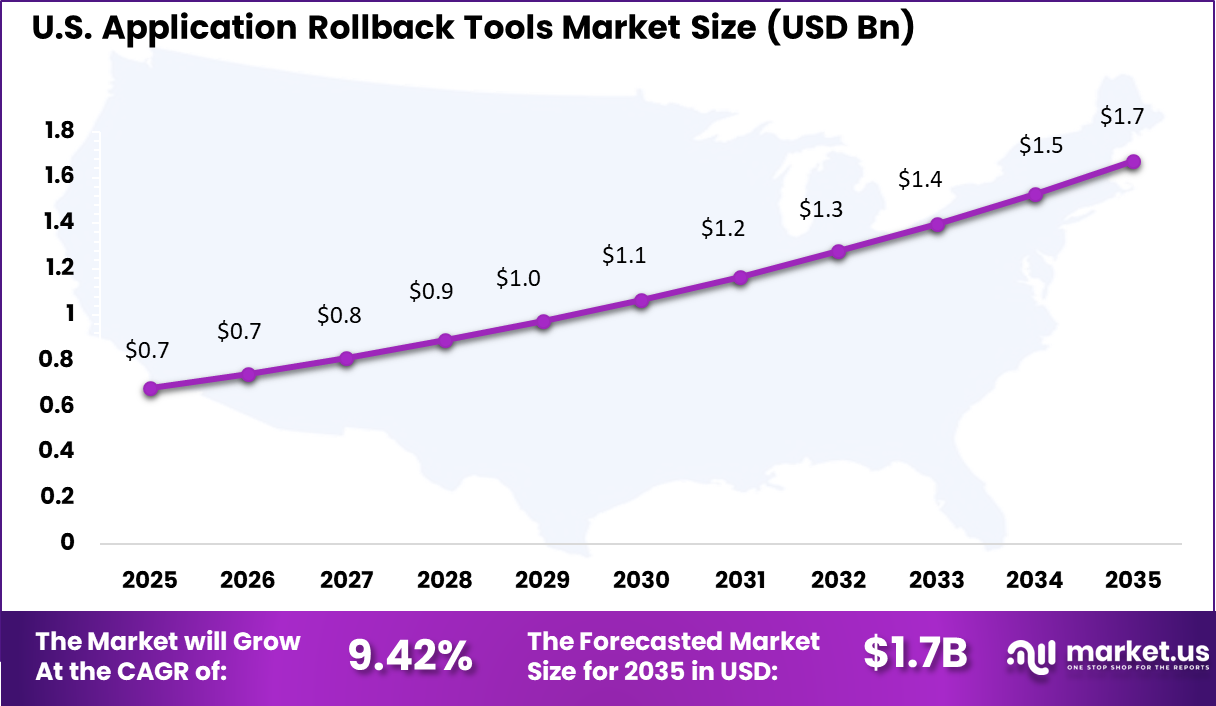
The Global Application Rollback Tools Market generated USD 1.7 billion in 2025 and is predicted to register growth from USD 1.9 billion in 2026 to about USD 5.2 billion by 2035, recording a CAGR of 11.70% throughout the forecast span. In 2025, North America held a dominan market position, capturing more than a 40.73% share, holding USD 0.69 Billion revenue.
The Application Rollback Tools Market represents an important segment within software development and IT operations that focuses on restoring applications to a previous stable state after deployment failures, system errors, or security incidents. Application rollback tools allow organizations to quickly revert software updates, configuration changes, or system modifications without disrupting business operations. These solutions are widely used in modern DevOps environments, cloud infrastructure, and continuous integration and continuous delivery pipelines.
The demand for rollback tools has increased significantly as enterprises adopt rapid software deployment practices. Modern applications are frequently updated to introduce new features, security patches, and performance improvements. However, these updates may occasionally introduce bugs or compatibility issues. Rollback tools enable organizations to restore previous application versions quickly, minimizing downtime and maintaining service availability.
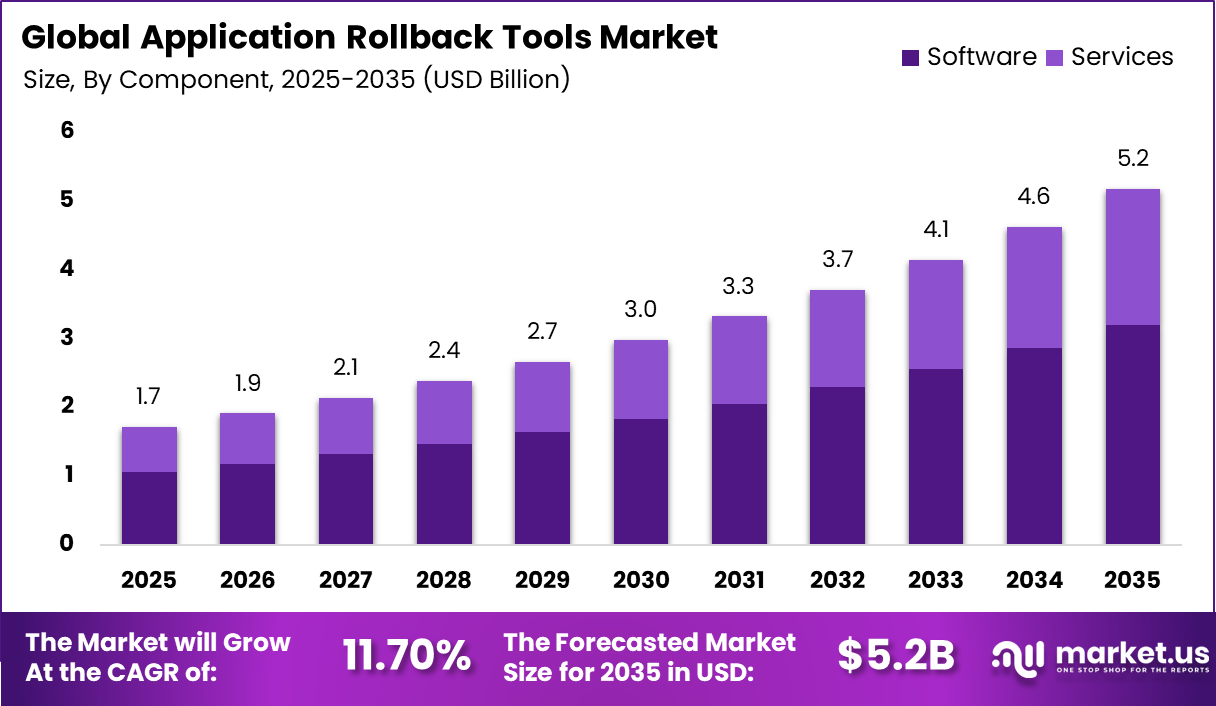
The scope of the application rollback tools market includes deployment management platforms, version control systems, container orchestration tools, configuration management platforms, and automated recovery systems used in DevOps pipelines. These technologies support automated rollback capabilities for applications deployed across cloud platforms, virtual machines, and containerized environments.
Research methodology used in industry analysis generally combines insights from DevOps engineers, IT operations specialists, and enterprise software architects alongside secondary data from software development reports and cloud infrastructure adoption studies. Market analysis also evaluates trends in continuous deployment, software reliability engineering, and enterprise DevOps investments.
One of the strongest forces driving the adoption of application rollback tools is the increasing use of continuous integration and continuous deployment practices. These development methodologies allow organizations to release software updates more frequently, but they also increase the risk of deployment errors. Rollback tools provide a safety mechanism that ensures rapid recovery from failed updates.
Top Market Takeaways
- By Component, software dominates with 61.7% share, automating snapshot capture, delta reversal, and health-check validated rollbacks across containerized and VM workloads.
- By Application, version control rollback claims 42.3%, enabling Git-triggered reversions, blue-green failover, and canary analysis integration.
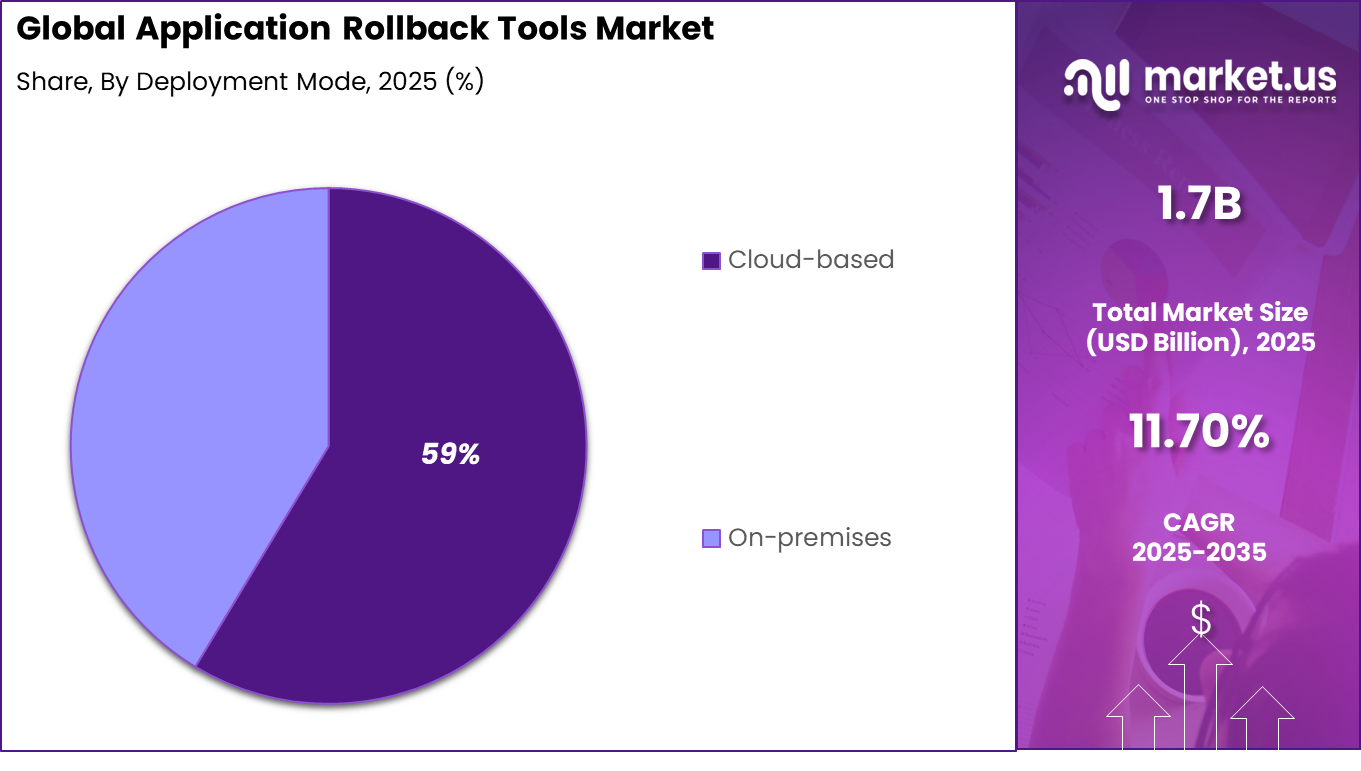
- By Deployment, cloud-based captures 58.65%, providing elastic recovery orchestration, cross-region replication, and serverless rollback execution.
- By Enterprise Size, large enterprises hold 67.24%, managing mission-critical application fleets with compliance audit trails and SLA-backed recovery.
- By End-User Industry, IT & telecom commands 35.6%, securing 5G core upgrades, NFV orchestration, and carrier-grade availability during live network migrations.
- Regionally, North America accounts for 40.73% global share, with the U.S. market valued at USD 0.68 billion and a CAGR of 9.42%, driven by zero-downtime deployment mandates and regulatory resilience requirements.
- The rollback rate is measured as the ratio of rollbacks to total deployments, where a 5% rate indicates that 5 out of 100 deployments were reverted.
- Automated rollback systems are designed to achieve a 100% success rate, ensuring failed updates are reversed without long term service disruption.
- More than 30% of IT projects are canceled before completion, reinforcing the importance of reliable testing and rollback mechanisms.
- The average safe rollback window is approximately 2 days, after which reverting changes may become more complex due to system dependencies.
Drivers Impact Analysis
Key Drivers Impact on CAGR Forecast (~%) Geographic Relevance Impact Timeline Strategic Importance Increasing Adoption of DevOps and Continuous Deployment +2.9% North America, Europe Short to Medium Term Requires automated rollback capabilities Rising Frequency of Software Updates and Releases +2.5% Global Medium Term Increases need for deployment recovery mechanisms Growing Complexity of Cloud-native Applications +2.1% North America, APAC Medium to Long Term Encourages automated rollback frameworks Demand for Improved System Reliability and Uptime +1.8% Global Medium Term Drives adoption of recovery and fail-safe tools Integration with CI/CD and Infrastructure Automation Platforms +1.5% Global Medium Term Enhances deployment lifecycle management Restraints Impact Analysis
Key Restraints Impact on CAGR Forecast (~%) Geographic Relevance Impact Timeline Market Constraint Level Complexity in Managing Multi-environment Rollbacks -1.9% Global Medium Term Increases operational challenges Integration Challenges with Legacy Application Infrastructure -1.6% Europe, APAC Medium Term Slows enterprise adoption High Implementation and Customization Costs -1.3% Emerging Markets Short to Medium Term Limits adoption among smaller organizations Limited Awareness of Advanced Deployment Recovery Tools -1.0% Emerging Markets Short to Medium Term Slows early adoption By Component
Software accounts for 61.7% of adoption in the application rollback tools market, as organizations require automated systems to restore previous versions of applications when deployment failures occur. These software platforms monitor updates, track version histories, and enable rapid recovery from system disruptions. This capability helps reduce downtime and maintain service continuity.
Rollback software also integrates with DevOps pipelines and deployment automation tools. By maintaining version checkpoints, organizations can quickly revert changes without affecting core operations. This functional advantage continues to position software as the leading component.
By Application
Version control rollback represents 42.3% of application demand, as development teams rely on controlled release management to maintain software stability. Rollback capabilities allow engineers to restore earlier code versions when new updates introduce errors or compatibility issues. This approach improves reliability during continuous integration and deployment cycles.
Version rollback tools also enhance collaboration across development teams. Structured version tracking reduces configuration conflicts and deployment risks. This keeps version control rollback as a key application area.
By Deployment
Cloud based deployment holds 59%, reflecting the growing shift toward cloud hosted development and testing environments. Cloud platforms enable centralized management of rollback tools across distributed teams and applications. This flexibility supports modern DevOps workflows.
Cloud deployment also simplifies scaling and integration with cloud native development tools. Automated updates and remote accessibility improve operational efficiency. These advantages continue to drive cloud adoption.
 By Enterprise Size
Large enterprises represent 67.24% of adoption due to their complex application ecosystems and frequent software releases. These organizations manage multiple development teams and large code repositories. Rollback tools help maintain operational stability during continuous deployment.
Large firms also require strong governance and change management practices. Automated rollback systems improve risk mitigation and compliance. This continues to drive uptake among enterprise scale organizations.
By End User Industry
The IT and telecommunications sector holds 35.6% of end user adoption, as these industries operate extensive digital infrastructure and software platforms. Service providers require stable applications to support communication networks and digital services. Rollback tools help maintain service reliability during updates.
Frequent system upgrades in telecom environments increase the need for rapid recovery mechanisms. Automated rollback capabilities reduce downtime and operational disruption. This continues to position IT and telecom as a key end user industry.
Investor Type Impact Matrix
Investor Type Growth Sensitivity Risk Exposure Geographic Focus Investment Outlook Venture Capital Medium to High Medium North America Focus on DevOps infrastructure startups Private Equity Medium Medium North America, Europe Attractive enterprise software revenue models Strategic Cloud Platform Providers High Low to Medium Global Integration with cloud deployment ecosystems Institutional Investors Medium Medium Developed Markets Long-term enterprise IT infrastructure allocation Corporate Technology Investors Medium Low to Medium Global Expansion of software lifecycle management platforms Technology Enablement Analysis
Technology Enabler Impact on CAGR Forecast (~%) Geographic Relevance Impact Timeline Adoption Momentum Automated Rollback Mechanisms in CI/CD Pipelines +3.3% North America, Europe Short to Medium Term Enables rapid deployment recovery Cloud-native Deployment Management Platforms +2.7% Global Medium Term Supports scalable rollback processes AI-driven Release Monitoring and Failure Detection +2.2% North America Medium to Long Term Improves predictive rollback triggers Container Orchestration Integration +1.9% APAC, North America Medium Term Supports Kubernetes and microservices environments Infrastructure as Code Deployment Recovery Tools +1.5% Global Long Term Enhances automated system restoration Key Challenges
- Difficulty in restoring applications quickly without affecting system performance
- Integration challenges with existing deployment and DevOps pipelines
- Risk of data loss if rollback processes are not properly configured
- Complexity in managing rollback across multiple cloud and on premises environments
- Limited visibility into application changes that trigger rollback requirements
Emerging Trends
In the Application Rollback Tools market, a key trend is the growing emphasis on automated rollback mechanisms that allow development teams to quickly restore previous versions of applications when deployment issues occur. Modern software delivery environments often involve frequent updates, and organisations are implementing rollback capabilities that work seamlessly within continuous integration and deployment pipelines.
This approach helps teams maintain system stability while still releasing updates at a faster pace. Another visible trend is the use of real time monitoring and rollback triggers, where systems automatically detect abnormal behaviour such as performance drops or failed processes and initiate restoration of the last stable version.
Growth Factors
A major growth factor in this market is the increasing pace of software development and deployment across organisations. Businesses release updates more frequently to improve functionality, security, and user experience, which increases the possibility of unexpected errors during deployment. Rollback tools help reduce downtime by allowing teams to quickly return systems to a stable state when problems arise.
Another important factor is the growing reliance on complex cloud and distributed application environments. Applications today operate across multiple services and platforms, making troubleshooting more challenging when issues occur. Rollback tools provide a structured way to manage application changes and maintain service continuity, helping organisations protect operational reliability and maintain confidence in their software delivery processes.
Key Market Segments
By Component
- Software
- Services
By Application
- Version Control Rollback
- Database Rollback
- Configuration Management Rollback
- Scripted Rollback
- Others
By Deployment
- On-Premises
- Cloud-based
By Enterprise Size
- Large Enterprises
- Small & Mid-Sized Enterprises (SMEs)
By End-User Industry
- IT & Telecom
- BFSI
- Healthcare
- Manufacturing
- Retail
- Government
- Others
Regional Analysis
North America accounts for 40.73% of the application rollback tools market, supported by strong adoption of DevOps and continuous deployment practices across enterprise IT environments. Organizations in the region are increasingly using rollback tools to restore previous application versions quickly when software updates cause performance issues or system instability. Demand is driven by the need to maintain service continuity, reduce downtime, and improve reliability across complex application deployment pipelines.
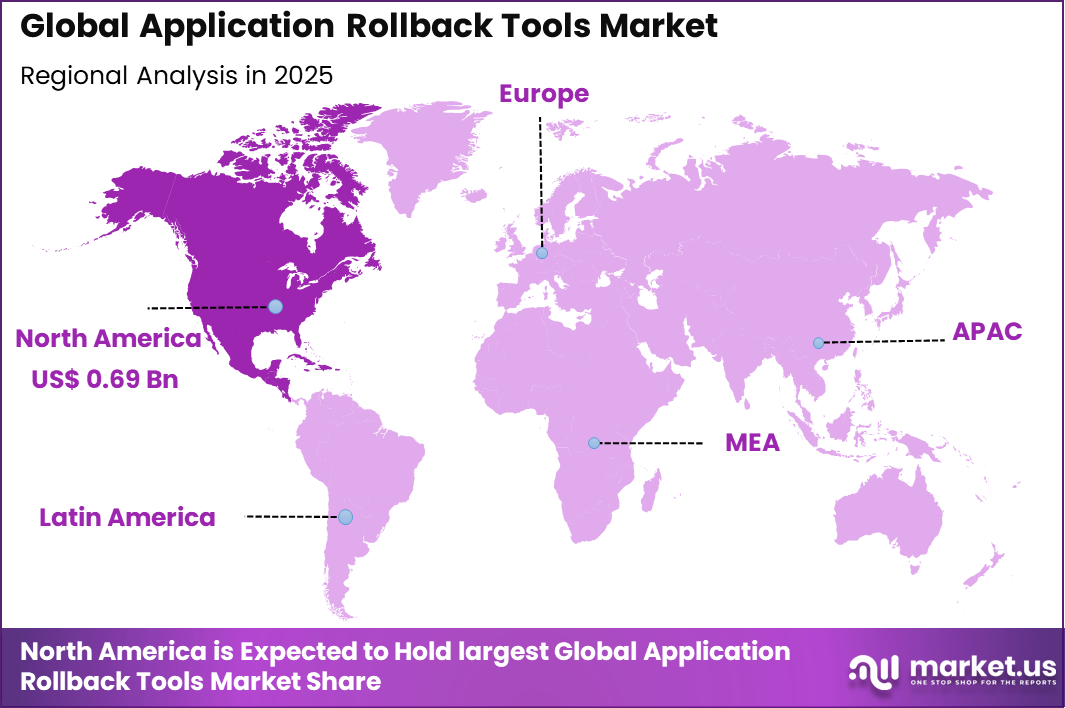
The United States market is valued at USD 0.68 Billion and is expanding at a CAGR of 9.42%, reflecting growing emphasis on application stability and release management. Adoption is influenced by rising use of microservices architectures, frequent software updates, and the need for automated recovery mechanisms in production systems. Growth is further supported by integration of rollback tools within CI/CD pipelines, enabling faster incident response and improved operational resilience in enterprise software environments.
Key Regions and Countries
- North America
- US
- Canada
- Europe
- Germany
- France
- The UK
- Spain
- Italy
- Russia
- Netherlands
- Rest of Europe
- Asia Pacific
- China
- Japan
- South Korea
- India
- Australia
- Singapore
- Thailand
- Vietnam
- Rest of APAC
- Latin America
- Brazil
- Mexico
- Rest of Latin America
- Middle East & Africa
- South Africa
- Saudi Arabia
- UAE
- Rest of MEA
Competitive Analysis
The Application Rollback Tools market is led by enterprise software and infrastructure providers such as VMware, IBM, Microsoft, Oracle, Red Hat under IBM, CA Technologies under Broadcom, and Atlassian.
These companies compete on strong integration with enterprise infrastructure, automated deployment management, and reliable rollback capabilities during system updates. Their platforms are widely adopted by large organizations that require controlled software releases, minimal downtime, and stable recovery processes across complex IT environments.
DevOps and automation focused vendors including Chef Software, Puppet, GitLab, Ansible by Red Hat, Turbonomic, JFrog, Harness, Perforce Software, Digital.ai, and others compete through continuous integration and deployment features with built in rollback controls.
Competition in this segment is driven by automation efficiency, release visibility, and quick restoration of previous application versions during failed deployments. These providers are often selected by development teams seeking faster release cycles with strong deployment safety and operational stability.
Top Key Players in the Market
- VMware
- IBM Corporation
- Microsoft Corporation
- Oracle Corporation
- Red Hat (IBM)
- Chef Software Inc.
- Puppet
- Atlassian Corporation Plc
- GitLab Inc.
- CA Technologies (Broadcom)
- Ansible by Red Hat
- Turbonomic Inc.
- JFrog Ltd.
- Harness Inc.
- Perforce Software
- Digital.ai
- Others
Future Outlook
The future outlook for the Application Rollback Tools Market is positive as organizations increasingly rely on continuous software updates and rapid deployment cycles. Application rollback tools help restore previous versions of software when updates cause errors or system issues, ensuring system stability and reducing downtime.
As businesses adopt DevOps practices, cloud platforms, and automated deployment pipelines, the need for reliable rollback capabilities is expected to grow. Overall, the market is likely to expand as organizations focus on maintaining application reliability, minimizing operational disruptions, and improving software deployment management.
Recent Developments
- October, 2025 – Harness Inc. launched Continuous Rollback with AI failure prediction. Teams revert deployments in under 60 seconds across Kubernetes clusters. Enterprises cut downtime by 45%. The platform analyzes traffic shifts pre-rollback. GitOps integration pulls last-good manifests automatically. Harness serves 2,000+ customers with zero-downtime guarantees.
- December, 2025 – Puppet added Blue-Green Rollback to its orchestration suite. IT ops teams test canary releases against production loads. Rollback success rate hit 98% in field trials. Multi-cloud support covers AWS, Azure and VMware. Anomaly detection triggers auto-revert on error spikes. Puppet processes 10 million rollbacks yearly now.
Report Scope
Report Features Description Market Value (2025) USD 1.7 Billion Forecast Revenue (2035) USD 5.2 Billion CAGR(2025-2035) 11.70% Base Year for Estimation 2024 Historic Period 2020-2024 Forecast Period 2025-2035 Report Coverage Revenue forecast, AI impact on Market trends, Share Insights, Company ranking, competitive landscape, Recent Developments, Market Dynamics and Emerging Trends Segments Covered By Component (Software, Services), By Application (Version Control Rollback, Database Rollback, Configuration Management Rollback, Scripted Rollback, Others), By Deployment (On-Premises, Cloud-based), By Enterprise Size (Large Enterprises, Small & Mid-Sized Enterprises (SMEs)), By End-User Industry (IT & Telecom, BFSI, Healthcare, Manufacturing, Retail, Government, Others) Regional Analysis North America – US, Canada; Europe – Germany, France, The UK, Spain, Italy, Russia, Netherlands, Rest of Europe; Asia Pacific – China, Japan, South Korea, India, New Zealand, Singapore, Thailand, Vietnam, Rest of Latin America; Latin America – Brazil, Mexico, Rest of Latin America; Middle East & Africa – South Africa, Saudi Arabia, UAE, Rest of MEA Competitive Landscape VMware, IBM Corporation, Microsoft Corporation, Oracle Corporation, Red Hat (IBM), Chef Software Inc., Puppet, Atlassian Corporation Plc, GitLab Inc., CA Technologies (Broadcom), Ansible by Red Hat, Turbonomic Inc., JFrog Ltd., Harness Inc., Perforce Software, Digital.ai, Others Customization Scope Customization for segments, region/country-level will be provided. Moreover, additional customization can be done based on the requirements. Purchase Options We have three license to opt for: Single User License, Multi-User License (Up to 5 Users), Corporate Use License (Unlimited User and Printable PDF)  Application Rollback Tools MarketPublished date: Mar. 2026add_shopping_cartBuy Now get_appDownload Sample
 -
-
- VMware
- IBM Corporation
- Microsoft Corporation
- Oracle Corporation
- Red Hat (IBM)
- Chef Software Inc.
- Puppet
- Atlassian Corporation Plc
- GitLab Inc.
- CA Technologies (Broadcom)
- Ansible by Red Hat
- Turbonomic Inc.
- JFrog Ltd.
- Harness Inc.
- Perforce Software
- Digital.ai
- Others
Our Clients

- 180635
- Mar. 2026






