


Market Overview
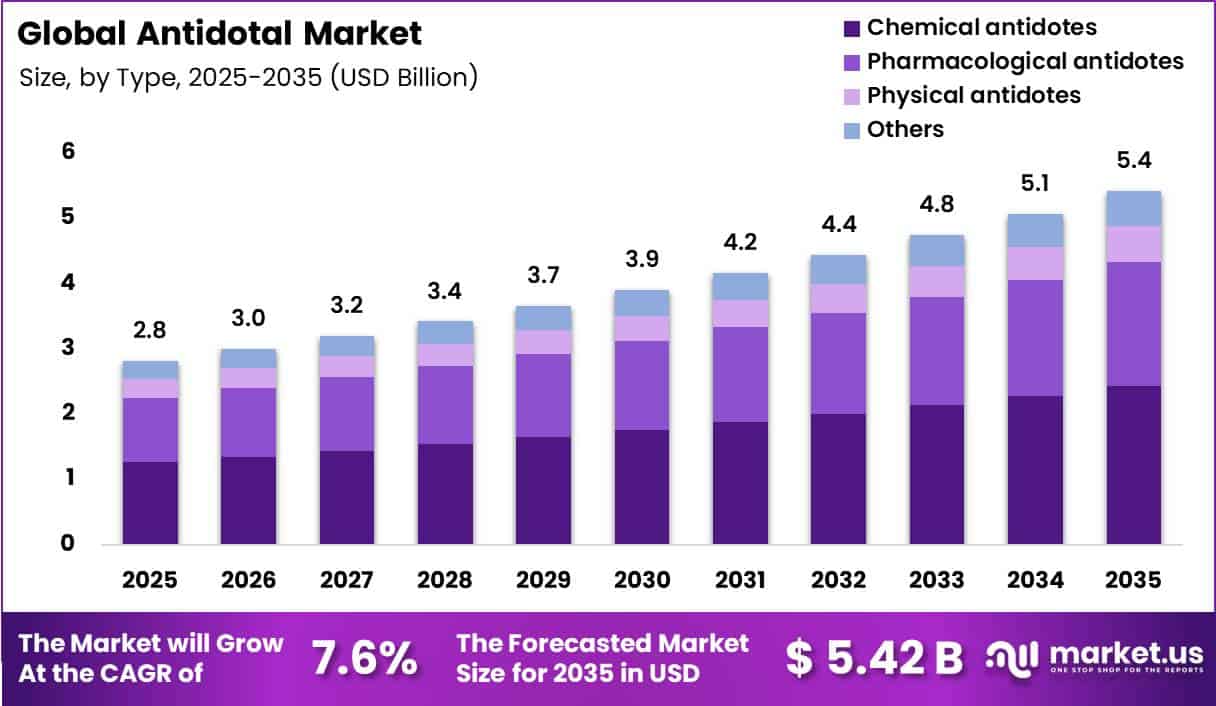
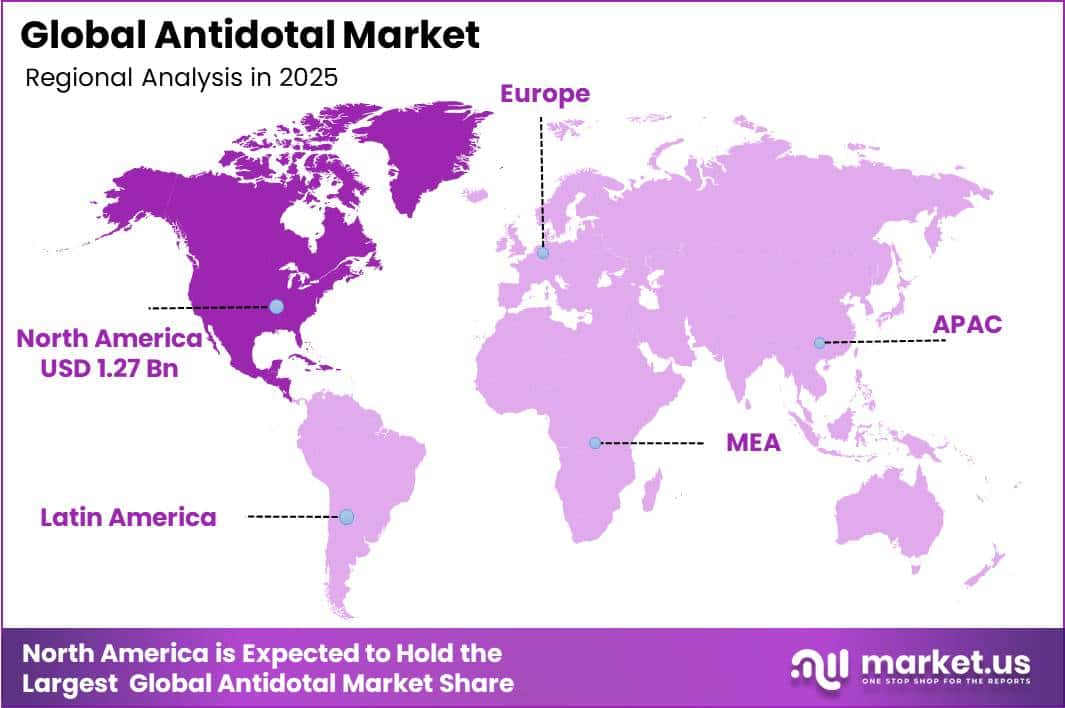
The Global Antidotal Market size is expected to be worth around US$ 5.42 Billion by 2035 from US$ 2.81 Billion in 2025, growing at a CAGR of 7.6% during the forecast period from 2026 to 2035. In 2025, North America led the market, achieving over 45% share with a revenue of US$ 1.27 Billion.
The global antidotal market represents an essential segment of emergency medicine focused on the development and availability of antidotes used to counteract the effects of toxic substances, including drug overdoses, chemical exposures, venomous bites, and poisoning incidents.
Antidotes play a critical role in reducing mortality by rapidly neutralising toxins, reversing toxic effects, and supporting emergency treatment protocols across hospitals, poison control centres, and critical care facilities.
The demand for antidotal therapies is strongly associated with the increasing burden of poisoning emergencies worldwide. According to the World Health Organisation, unintentional poisoning caused approximately 84,000 deaths globally in 2019, with exposures involving household chemicals, pesticides, medicines, and occupational chemicals.
Additionally, venom-related emergencies continue to create significant demand for antivenoms; WHO estimates that snake bites affect around 5.4 million people annually, resulting in 1.8–2.7 million cases of envenoming and up to 137,880 deaths each year.
Drug overdose management is another major application area for antidotal products, particularly opioid reversal agents. The Centres for Disease Control and Prevention reported an estimated 80,391 drug overdose deaths in the United States during 2024, highlighting the continued need for rapid emergency interventions.
The antidotal market is evolving with advances in biotechnology, improved toxin identification methods, expanded poison management networks, and the development of targeted therapies. Increasing emphasis on emergency preparedness, occupational safety, and access to life-saving antidotes is expected to support the continued clinical importance of this market.
Key Takeaways
- Market Size: The Global Antidotal Market size was US$ 2.81 billion in 2025. The market is estimated to grow to US$ 5.42 billion by 2035.
- Market Share: The Compound Annual Growth Rate (CAGR) of the market from 2026 to 2035 will be 7.6%.
- Type: Chemical Antidotes has the largest market share, accounting for 45% of the total type segment revenue.
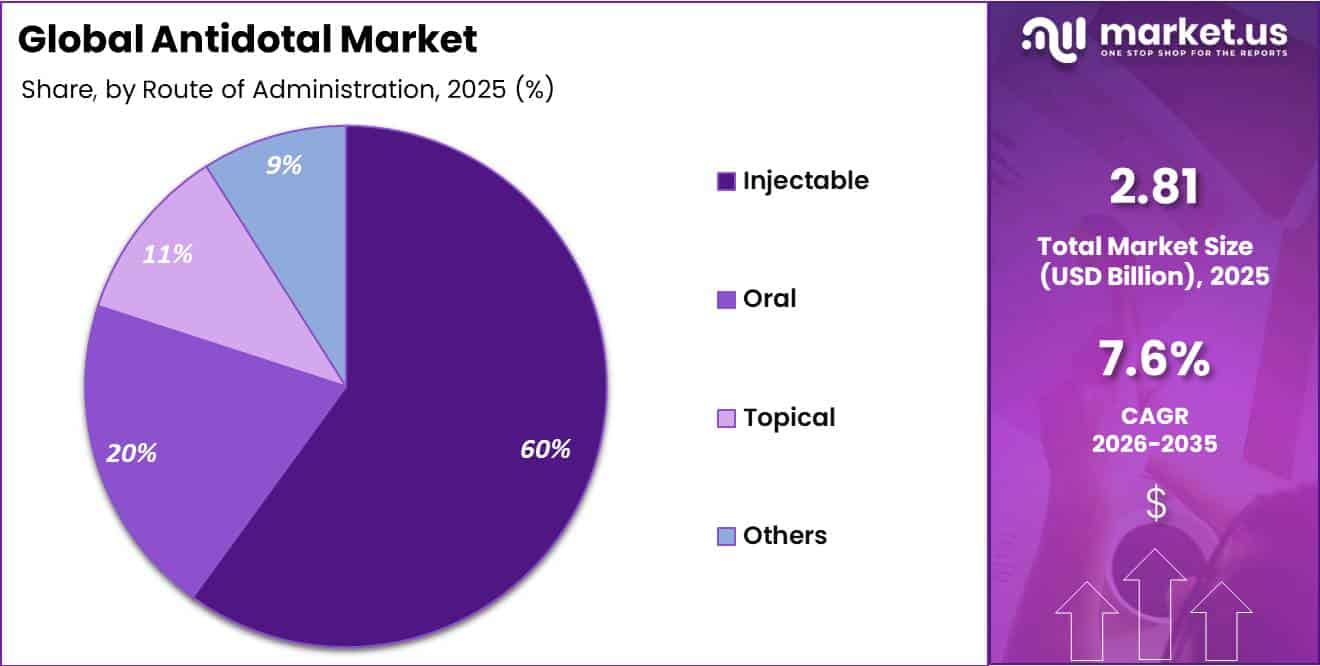
- Route of Administration: Injectable leads the segment, accounting for 60% of total route of administration revenue.
- End User: Emergency Departments and Trauma Centres leads the segment, accounting for 50% of total end-user revenue.
- Regional: North America is the dominant regional market, accounting for 45% of global revenue.
Type Analysis
The antidotal market by type is characterised by the widespread utilisation of chemical, pharmacological, and physical approaches designed to neutralise toxins, prevent further absorption, or reverse toxic effects.
Chemical antidotes dominate the market, accounting for approximately 45.0% share in 2025, supported by their established clinical role in managing diverse poisoning cases, including heavy metal toxicity, chemical exposures, and industrial toxicants. These antidotes are widely adopted due to their proven efficacy, availability in emergency care protocols, and inclusion in poison management guidelines.
Pharmacological antidotes represent around 35.0% of the market and are projected to be the fastest-growing segment, driven by increasing demand for targeted therapies that counteract specific drug overdoses, metabolic toxins, and life-threatening toxic reactions. Advancements in drug development and improved understanding of toxin mechanisms are encouraging innovation in pharmacological antidotal therapies.
Physical antidotes contribute approximately 10.0% of market share and are primarily used to limit toxin absorption through mechanisms such as adsorption or removal. Other anecdotal solutions account for the remaining segment, including specialised therapies and supportive interventions used in complex poisoning scenarios.
Overall, growth across antidotal categories is influenced by rising poisoning emergencies, expanding emergency healthcare infrastructure, and increasing emphasis on rapid toxin-specific treatment approaches.
Route of Administration Analysis
The antidote market is categorised by route of administration into four main types: injectable, oral, topical, and other delivery methods. Injectable administration is the dominant segment, accounting for approximately 60% of the market share in 2025.
This preference is due to its critical role in emergency toxicology management, rapid drug action, and the need for immediate therapeutic responses in time-sensitive cases. Intravenous and intramuscular delivery methods are particularly effective for severe poisoning events, drug overdoses, venom-related emergencies, and chemical exposures that require quick reversal of toxic effects.
Oral administration constitutes around 20% of the market and remains an important route for antidotes appropriate for stable patients, particularly in managing gastrointestinal toxin exposure and situations where immediate injectable intervention is not necessary.
Topical administration accounts for approximately 11% of the market and is primarily used for localised toxin exposure, chemical contact injuries, and skin-related toxic reactions that require direct application of treatment.
The other category includes specialised delivery methods designed for specific clinical conditions, making up nearly 9% of the market. The growth of this market is supported by increased emergency care capacity, improved availability of antidotal products, and ongoing development of targeted formulations. Nonetheless, injectable therapies will continue to be the preferred choice in acute poisoning scenarios.
End User Analysis
The antidotal market by end user is primarily driven by emergency healthcare facilities, hospitals, speciality clinics, and homecare settings, reflecting the diverse environments where poisoning and toxic exposure management occurs.
Emergency departments and trauma centres account for approximately 50.0% market share in 2025 and represent the fastest-growing end-user segment due to the critical requirement for immediate antidote administration during acute poisoning incidents, drug overdoses, venomous bites, and chemical emergencies. These facilities maintain essential antidote inventories and provide rapid diagnostic and treatment capabilities for life-threatening toxic conditions.
Hospitals represent another major segment, supported by their role in intensive care, toxicology management, and post-emergency patient monitoring. Speciality clinics contribute to market demand through focused treatment of specific toxic exposures and chronic complications associated with poisoning events.
Homecare settings are gaining attention for selected anecdotal therapies that can be administered outside healthcare facilities, particularly in cases requiring rapid first-response intervention. Other end users include poison control centres, occupational health facilities, and public health organisations involved in emergency preparedness programs.
Growing awareness of poisoning prevention, expansion of emergency medical services, and improved access to critical antidotal therapies continue to strengthen adoption across end-user segments.
Key Market Segments
By Type
- Chemical Antidotes
- Pharmacological Antidotes
- Physical Antidotes
- Others
By Route of Administration
- Injectable
- Oral
- Topical
- Others
By End User
- Emergency Departments and Trauma Centres
- Hospitals
- Homecare
- Specialty Clinics
- Others
Driver
CGM linked care model expansion and reimbursement normalisation
Continuous glucose monitoring (CGM) has evolved from a specialist diagnostic tool into a core data infrastructure layer for software-driven diabetes management. Reimbursement expansion, particularly through CMS eligibility updates effective from April 16, 2023, has broadened coverage to include insulin users and select non-insulin patients with documented hypoglycemia risk, reinforcing CGM adoption through 2025 to 2026.
This policy shift has helped move CGM from discretionary spending to a reimbursed, recurring-use medical benefit under the durable medical equipment framework. As a result, utilisation is becoming more stable and less sensitive to out-of-pocket constraints, supporting higher continuity of use and broader population penetration.
For digital diabetes platforms, reimbursed CGM data streams enable more reliable, high-frequency monitoring of metrics such as time in range, alert burden, adherence patterns, and escalation events. This improves clinical fidelity and makes outcome-based contracting more feasible compared with traditional glucose monitoring methods.
Commercially, normalisation of CGM reimbursement allows ecosystem players to shift from hardware-centric revenue models toward higher-margin software, analytics, coaching, and care coordination services. This transition strengthens retention, stabilises demand, and supports more scalable, data-driven diabetes care delivery models.
| Driver | (~) % Impact on CAGR Forecast | Geographic Relevance | Impact Timeline |
|---|---|---|---|
| Diabetes burden expansion and undiagnosed-patient conversion | +2.4% | North America core, EU5, APAC urban corridors, LATAM spill-over | Medium term (2-4 years) |
| CGM-linked care model expansion and reimbursement normalisation | +2.1% | U.S. core, Canada, Western Europe, developed APAC | Short term (≤ 2 years) |
| FDA digital-health pathway clarity and TEMPO pilot acceleration | +1.7% | U.S. core, EU regulatory followers, APAC innovation hubs | Short term (≤ 2 years) |
| Shift from episodic diabetes care to continuous software-led engagement | +1.5% | U.S., EU, GCC private care systems, East Asia metros | Medium term (2-4 years) |
| AI-enabled risk stratification, decision support, and workflow automation | +1.3% | North America, EU, Japan, South Korea, Singapore | Medium term (2-4 years) |
| Cybersecurity and interoperable-device compliance as enterprise unlock | +0.9% | U.S. core, EU, advanced APAC provider networks | Long-term (≥ 4 years) |
Challenges
Critical Mineral Volatility in Battery Supply Chains
Dependence on concentrated global supply chains for lithium, nickel, cobalt, and graphite creates a structural volatility risk for battery and energy storage markets. A small number of producer countries dominate both extraction and processing, making the system highly sensitive to geopolitical disruptions, export restrictions, and supply shocks.
Demand for lithium alone is expected to rise approximately five times by 2030 and up to around 14 times by 2040 compared to 2020 levels, while key cathode and anode materials remain over 90 % concentrated in a few regions.
This imbalance has led to sharp price cycles, with lithium spot prices historically fluctuating three to five times within 18 to 24 months, significantly affecting downstream cost structures. These swings translate into 10 to 20 % variability in battery cost per kilowatt hour and increase uncertainty in project economics, adding risk premiums of 150 to 250 basis points to the cost of capital.
As a result, investment delays, contract repricing, and staged capital deployment can reduce potential CAGR by an estimated 1.3 % points. Mitigation strategies include diversifying supplier bases, securing index-linked long-term offtake agreements, partial vertical integration into refining, and developing hedging frameworks. Flexibility in battery chemistry and demand allocation can further reduce exposure during periods of extreme price volatility.
| Challenge | (~) % CAGR Friction Drag | Geographic Relevance | Mitigation Horizon |
|---|---|---|---|
| Critical mineral volatility | -1.3% | APAC mining hubs, EU, US | Long-term (≥ 4 years) |
| Scale-up manufacturing inefficiency | -1.1% | Asia gigafactory belts, NA, EU | Medium term (2-4 years) |
| Regulatory traceability overhead | -0.9% | EU regulatory hubs, US exporters | Medium term (2-4 years) |
| Advanced battery talent shortfall | -1.2% | North America core, EU, India | Long-term (≥ 4 years) |
| Supply-chain geopolitics & tariffs | -0.8% | US–China–EU trade lanes | Long-term (≥ 4 years) |
| Recycling & circularity undercapacity | -0.7% | EU, US, India urban centres | Long-term (≥ 4 years) |
Restraints
Fragmented regulatory and clinical standards in the antidotal market
Fragmented regulatory and clinical standards act as a persistent structural drag because the antidotal market spans therapeutics, devices, and data-driven interventions, each governed by different frameworks across the FDA, EMA, and national regulators. This leads to asynchronous approval timelines ranging from approximately 12 months for low-risk digital tools to 48 to 60 months for complex combination products.
Sponsors must comply with varying requirements for safety reporting, cybersecurity, evidence generation, and real-world data capture across jurisdictions. This increases regulatory staffing needs by 30 to 40 % and adds approximately USD 3 to 7 million in pre-launch compliance costs per program. Differences in clinical endpoints and trial designs also raise patient recruitment costs by 20 to 35 % and extend trial durations by 8 to 12 months.
As a result, only about 50 to 60 % of early-stage concepts reach pivotal trials, and fewer than 25 to 30 % achieve multi-region approval within a decade. This fragmentation slows global rollout, forces staggered launches, and reduces revenue ramp efficiency by 15 to 20 % compared with harmonised scenarios, ultimately contributing an estimated 1.6 % point drag on CAGR.
| Restraint | (~) % Impact on CAGR Forecast | Geographic Relevance | Impact Timeline |
|---|---|---|---|
| High unit economics and CapEx drag | -2.3% | North America core, EU, China hubs | Medium term (2-4 years) |
| Fragmented regulatory and clinical standards | -1.6% | US federal, EU-27, China national | Medium term (2-4 years) |
| Supply-chain concentration in critical inputs | -1.5% | APAC corridors, US import-reliant, EU | Long-term (≥ 4 years) |
| Scale-up and manufacturing yield risk | -1.9% | US/EU pilot plants, China gigafactories | Short–Medium term (≤ 4 years) |
| IP, data, and reimbursement uncertainty | -1.2% | US payers, EU health systems, Asian private | Long-term (≥ 4 years) |
Opportunity
Value-based antidote bundles and risk-sharing models
Value-based antidote bundles represent an emerging shift away from traditional fee-for-service reimbursement, where payments are tied to individual doses, toward episode-based care models that integrate treatment, monitoring, and follow-up into a single payment structure.
As payer frameworks evolve, especially in Medicare-like systems and commercial insurance markets, there is growing interest in bundling acute poisoning treatment episodes. These bundles could include antidote administration, intensive care unit support, and post-event care, with payments linked to outcomes such as reduced ICU stay or improved survival metrics.
Early models suggest bundled pricing could be set 10 to 15 % above current per-dose levels, while tying a portion of reimbursement, typically 5 to 7 %, to performance outcomes through rebates or adjustments. This structure could increase realised revenue per case by 20 to 25 % while improving cost predictability for payers. If adopted for even approximately 20 % of high-cost poisoning cases in North America and Europe by 2030, this approach could add an estimated 1.0 to 1.5 billion dollars in incremental market opportunity.
Improved contract visibility and reduced discounting could also expand operating margins by 3 to 5 % points. Overall, this remains an emerging opportunity rather than a current market driver, dependent on the development of standardised bundle definitions, outcomes analytics infrastructure, and payer alignment around episode-based reimbursement models.
| Opportunity | (~) % Potential CAGR Upside | Geographic Relevance | Execution Window |
|---|---|---|---|
| AI-enabled antidote decision platforms | +2.5% | North America, EU, advanced APAC | Medium term (2-4 years) |
| Community and pre-hospital antidote networks | +1.8% | North America core, LATAM, emerging APAC | Medium term (2-4 years) |
| Value-based antidote bundles & risk-sharing | +2.0% | North America, EU | Short term (≤ 2 years) |
| Personalised toxicology & rare-poison antidotes | +1.5% | EU, North America, selected APAC | Long-term (≥ 4 years) |
| Integrated data services with payers & regulators | +1.2% | North America, EU, global multilateral markets | Medium term (2-4 years) |
| Low-cost antidote access in low-resource settings | +1.0% | Africa, South Asia, lower-income LATAM | Long-term (≥ 4 years) |
Regional Analysis
In 2025, North America led the market, achieving over 45% share with a revenue of US$ 1.27 billion. The antidotal market demonstrates regional variation based on the prevalence of poisoning incidents, availability of emergency medical infrastructure, government preparedness programs, and access to specialised toxicology services.
North America represents a significant market due to advanced healthcare systems, well-established poison control networks, and strong adoption of emergency treatment protocols. The region benefits from increasing demand for opioid overdose reversal agents, chemical exposure management solutions, and rapid-response antidotal therapies supported by extensive emergency care capabilities.
In the United States, poison control centres and public health initiatives play an important role in improving access to critical antidotes and enhancing awareness regarding poisoning prevention and treatment.
Europe holds a prominent position in the antidotal market, supported by strong regulatory frameworks, organised emergency healthcare systems, and widespread availability of specialised toxicology centres. Countries across the region emphasise effective management of pharmaceutical overdoses, industrial chemical exposures, and environmental poisoning risks through coordinated healthcare programs.
Asia Pacific is expected to witness significant growth due to increasing healthcare investments, rising awareness of poisoning management, expanding emergency medical services, and a high burden of venomous bites and pesticide-related poisoning cases in several countries. Improvements in healthcare accessibility and government-led safety initiatives are supporting market development.
Latin America and the Middle East & Africa regions are gradually expanding, driven by increasing focus on emergency healthcare infrastructure, occupational safety measures, and improved availability of essential antidotal treatments for toxic exposures and envenoming cases.
Key Regions and Countries
North America
- The US
- Canada
Europe
- Germany
- France
- The U.K.
- Italy
- Spain
- Russia & CIS
- Rest of Europe
Asia Pacific
- China
- India
- Japan
- South Korea
- ASEAN
- Australia & New Zealand
- Rest of Asia Pacific
Middle East & Africa
- GCC
- South Africa
- Rest of the Middle East & Africa
Latin America
- Brazil
- Mexico
- Rest of Latin America
Key Player Analysis
Suppliers in the global antidotal market seek competitive advantage through emergency-ready formulation development, including auto-injector and prefilled syringe delivery formats, enabling rapid administration in time-critical poisoning and overdose emergency scenarios without requiring complex preparation steps by first responder or emergency department clinical staff.
Key strategic focus areas include naloxone opioid overdose antidote distribution network expansion, responding to escalating opioid crisis demand across North American and European public health emergency response systems, nerve agent and chemical warfare antidote stockpiling program participation through government defence and public health agency procurement partnerships, and novel antidote mechanism development targeting emerging poisoning risks, including fentanyl analogue overdose and increasingly prevalent novel psychoactive substance intoxication presentations.
Companies continue investing in FDA approval programs for new antidote indications, emergency use authorisation pathway engagement with regulatory agencies, and hospital emergency department and government stockpile procurement relationship development to secure long-term institutional supply agreements with hospital emergency departments, national strategic medical stockpile programs, and military and defence medical procurement agencies globally.
The escalating opioid overdose crisis across North America and progressive expansion of naloxone access programs enabling over-the-counter and community distribution without prescription requirements are creating structurally sustained non-discretionary antidote procurement demand through the forecast period to 2035.
Top Key Players
- Pfizer Inc.
- Hikma Pharmaceuticals PLC
- Dr. Reddy’s Laboratories Ltd.
- Aurobindo Pharma Ltd.
- Endo International plc
- Mylan N.V./Viatris Inc.
- Akorn Operating Company LLC
- Alvogen
- Fresenius Kabi AG
- Zydus Cadila (Cadila Healthcare Ltd.)
- Daiichi Sankyo Co., Ltd.
- Nichi-Iko Pharmaceutical Co., Ltd.
- ADAPT Pharma Inc.
- Baxter International Inc.
- Meridian Medical Technologies Inc.
Recent Developments
- In January 2026, Pfizer Inc. expanded its injectable antidote portfolio distribution across North American hospital emergency department institutional buyers, targeting growing opioid overdose reversal and poisoning management procurement demand through group purchasing organisation supply agreements.
- In February 2026, Hikma Pharmaceuticals secured a multi-year naloxone injectable supply agreement with a leading US state public health agency, covering community naloxone distribution program procurement targeting opioid overdose emergency response across regional first responder and pharmacy access networks.
- In March 2026, Fresenius Kabi AG launched an expanded prefilled syringe antidote product range targeting European hospital emergency department and intensive care unit institutional buyers seeking ready-to-administer antidote formats reducing preparation time in critical poisoning management scenarios.
- In May 2026, Meridian Medical Technologies secured a government strategic medical stockpile supply contract covering nerve agent antidote auto-injector procurement for national emergency preparedness programs across North American defence and public health institutional procurement frameworks.
Report Scope
| Report Features | Description |
|---|---|
| Market Value (2025) | US$ 2.81 Billion |
| Forecast Revenue (2035) | US$ 5.42 Billion |
| CAGR (2026-2035) | 7.6% |
| Base Year for Estimation | 2025 |
| Historic Period | 2020-2024 |
| Forecast Period | 2026-2035 |
| Report Coverage | Revenue Forecast, Market Dynamics, Competitive Landscape, Recent Developments |
| Segments Covered | By Type (Chemical Antidotes, Pharmacological Antidotes, Physical Antidotes, Others), By Route of Administration (Injectable, Oral, Topical, Others), By End User (Emergency Departments and Trauma Centers, Hospitals, Homecare, Specialty Clinics, Others) |
| Regional Analysis | North America – The US, Canada; Europe – Germany, France, U.K., Italy, Spain, Russia & CIS, Rest of Europe; Asia Pacific – China, India, Japan, South Korea, ASEAN, Australia & New Zealand, Rest of Asia Pacific; Middle East & Africa – GCC, South Africa, Rest of Middle East & Africa; Latin America – Brazil, Mexico, Rest of Latin America |
| Competitive Landscape | Pfizer Inc., Hikma Pharmaceuticals PLC, Dr. Reddy’s Laboratories Ltd., Aurobindo Pharma Ltd., Endo International plc, Mylan N.V./Viatris Inc., Akorn Operating Company LLC, Alvogen, Fresenius Kabi AG, Zydus Cadila (Cadila Healthcare Ltd.), Daiichi Sankyo Co., Ltd., Nichi-Iko Pharmaceutical Co., Ltd., ADAPT Pharma Inc., Baxter International Inc., Meridian Medical Technologies Inc. |
| Customization Scope | Customization for segments, region/country-level will be provided. Moreover, additional customization can be done based on the requirements. |
| Purchase Options | We have three licenses to opt for: Single User License, Multi-User License (Up to 5 Users), Corporate Use License (Unlimited User and Printable PDF) |





































