


Report Overview
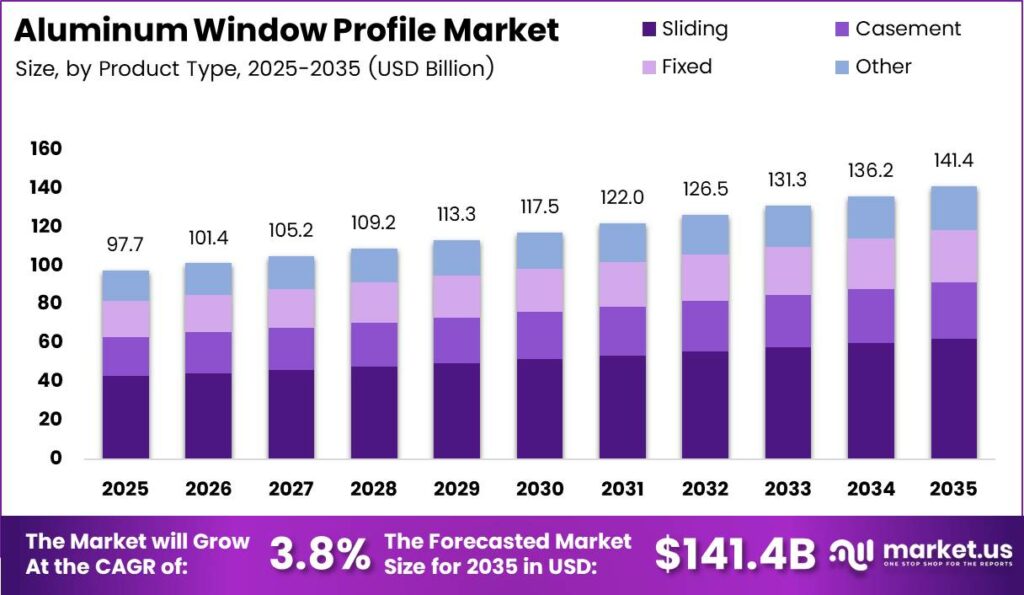
Global Aluminum Window Profile Market size is expected to be worth around USD 141.4 Billion by 2035 from USD 97.7 Billion in 2025, growing at a CAGR of 3.8% during the forecast period 2026 to 2035. This steady pace signals a mature replacement and construction market rather than a speculative one. Investors should expect value creation from product upgrades and specification wins, not raw volume alone. Suppliers with tested thermal systems will capture the larger share of that added value.
However, the market covers more than raw aluminum extrusion. Profile makers design system families that fabricators cut, assemble, and glaze into finished windows. The market splits by product type into sliding, casement, fixed, and other designs, and by glazing into single, double, and triple units. End users span residential, commercial, and industrial buildings. This structure rewards suppliers who control both system design and the fabricator relationships that turn profiles into installed windows.
Key Takeaways
- The Global Aluminum Window Profile Market was valued at USD 97.7 Billion in 2025 and is forecast to reach USD 141.4 Billion by 2035 at a CAGR of 3.8%.
- Sliding held 42.45% of the By Product Type segment in 2025 and is also the fastest growing product type.
- Double Glazed Aluminum Window Profiles held 34.23% of the By Application segment, while Triple Glazed profiles are the fastest growing.
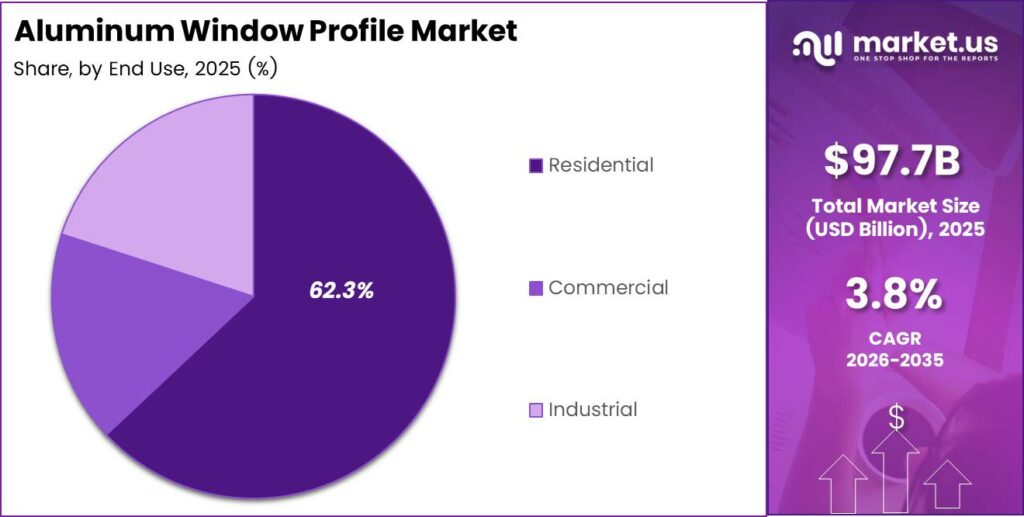
- Residential held 62.34% of the By End Use segment and is also the fastest growing end use.
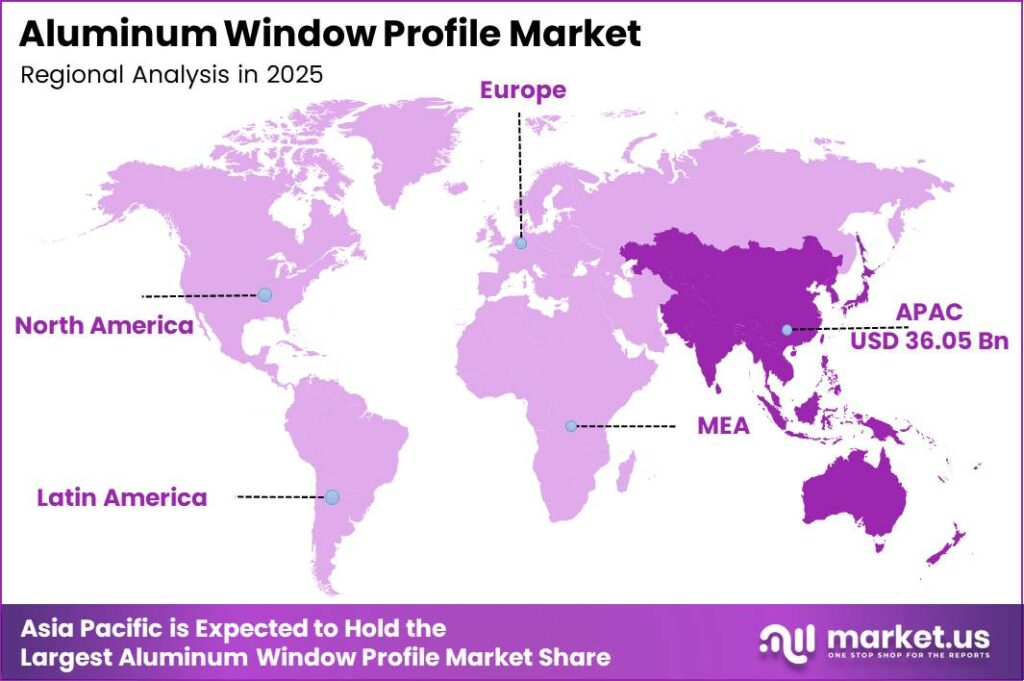
- Asia-Pacific led the market with a 36.90% share, valued at USD 36.05 Billion.
- Middle East and Africa is the fastest growing region.
Government regulation now shapes how buyers specify window frames. European energy rules push owners to renovate inefficient homes, and recycled metal is becoming a policy linked asset. A Spanish profile producer opened a €38 million recycling centre in Coirós in December 2025, sized for up to 100,000 tonnes of recycled billet a year. Rising renovation activity lifts demand for low carbon profiles, so suppliers with secure recycled feedstock gain a pricing edge.
According to the International Energy Agency, buildings accounted for about 30% of global energy demand in 2024. As construction activity expands, every new building adds window area that must meet tighter energy targets. Data from UNEP and GlobalABC shows buildings and construction produced about 34% of global energy related CO2 emissions in 2023. This means profile makers that cut embodied and operating carbon will win public and private tenders first.
Product Type Analysis
Sliding dominates with 42.45% due to space saving wide opening glass panels.
In 2025, Sliding held a dominant market position in the By Product Type segment of Aluminum Window Profile Market, with a 42.45% share. Alumil’s SMARTIA S350 insulated sliding system supports double glazing up to 28 mm thick, proving sliders can meet thermal targets. Cortizo launched COR Vision Evolution in November 2025 with a 25 mm central sightline and sash weights up to 500 kg. This means suppliers can sell larger, slimmer panes at premium prices.
Fixed profiles serve facades, display windows, and partitions where no sash needs to open. Aluprof’s MB-45 system accepts glass from 2 to 26 mm thick in fixed windows and doorframes, with opening sash weights of 120 to 130 kg. The system also passed hurricane tests under Florida Building Code protocols. This means fixed glazing suppliers can target storm exposed commercial projects. Casement and Other designs hold the remaining share collectively.
Application Analysis
Double Glazed Aluminum Window Profiles dominates with 34.23% due to balanced cost and insulation performance.
In 2025, Double Glazed Aluminum Window Profiles held a dominant market position in the By Application segment of Aluminum Window Profile Market, with a 34.23% share. Alumil’s SMARTIA M15000 hinged system accepts single and double glazing from 4 to 47 mm thick. Schüco’s AWS 70.HI system uses a basic profile depth of 70 mm to house insulated units. As a result, fabricators can serve mixed glazing orders from one profile family, cutting stock costs.
Triple glazed profiles serve buyers chasing the deepest thermal savings, making them the fastest growing application. The IEA reports building emissions grew an average 0.7% per year since 2015, as floor area growth outpaced efficiency gains. IEA data also shows building energy codes cover only about half of new floor area in emerging economies. Therefore, wider code adoption will push specifications past double glazing toward triple units. Single glazed profiles hold the remaining share.
End Use Analysis
Residential dominates with 62.34% due to home renovation and housing construction.
In 2025, Residential held a dominant market position in the By End Use segment of Aluminum Window Profile Market, with a 62.34% share. The U.S. Department of Energy reports that window heat gain and loss drive 25% to 30% of residential heating and cooling energy use. Reynaers Aluminium UK launched SlimLine 38 HI+ in March 2026 with profiles 8 mm deeper than the standard system. Therefore, homeowners chasing lower bills will favor insulated profiles over basic frames.
Commercial buyers specify windows through architects and facade consultants, so tested system data matters more than price. Figures from the IEA show commercial and public buildings use about 30% of building sector energy, while homes use about 70%. This split explains why residential leads, yet commercial projects carry larger glazed areas per contract. As a result, suppliers can win high value tenders with certified facade ready profiles. Industrial holds the remaining share.
Key Market Segments
By Product Type
- Sliding
- Casement
- Fixed
- Other
By Application
- Single Glazed Aluminum Window Profiles
- Double Glazed Aluminum Window Profiles
- Triple Glazed Aluminum Window Profiles
By End Use
- Residential
- Commercial
- Industrial
Regional Analysis
Asia-Pacific Dominates the Aluminum Window Profile Market with a Market Share of 36.90%, Valued at USD 36.05 Billion
Asia-Pacific holds the largest regional position as urban housing and infill construction keep fabricators busy. A Greek profile maker’s Indian unit launched a thermally insulated sliding system in June 2025, and its SlideAir version moves sashes up to 1,000 kg without electricity. This reflects how premium sliding demand now extends into Indian housing. Suppliers that localize system launches in the region will capture value beyond commodity extrusion.
Middle East and Africa is the fastest growing region, supported by local extrusion investment. The EBRD agreed in March 2026 to lend up to €13.7 million to an Egyptian subsidiary of a Greek profile maker for a new extrusion line in Cairo’s Polaris Industrial Zone. This signals lender confidence in regional supply. Local presses cut import lead times and help suppliers win regional projects faster.
Europe and North America form the replacement core of the market. Energy performance led window replacement concentrates in Europe, while institutional building refurbishment spans North America, Europe, and the Gulf states. By contrast, coastal corrosion resistance requirements shape specifications across coastal Asia-Pacific, the Middle East, and the Americas. This means suppliers in mature regions win through tested retrofit systems, while coastal markets reward durable finishes and proven corrosion performance.
Key Regions and Countries
North America
- US
- Canada
Europe
- Germany
- France
- The UK
- Spain
- Italy
- Rest of Europe
Asia Pacific
- China
- Japan
- South Korea
- India
- Australia
- Rest of APAC
Latin America
- Brazil
- Mexico
- Rest of Latin America
Middle East and Africa
- GCC
- South Africa
- Rest of MEA
Market Dynamics
Market Opportunity Analysis - Advanced glazing, emerging regions and niche frame types offer entry points for new players
Triple Glazed Aluminum Window Profiles remain underexploited despite being the fastest growing application. Double glazed units still hold the larger installed base, so fabricators have built tooling around them. This leaves room for entrants offering deeper profiles and tested thermal breaks for triple units. Investors should back suppliers that pair these systems with fabricator training, since installation skill limits how fast triple glazing spreads.
Middle East and Africa offers the clearest regional gap as the fastest growing region. By contrast, Asia-Pacific already hosts dense supplier networks and fierce price competition. Local extrusion in Middle East and Africa is still building scale, which leaves openings for system brands and fabricator partnerships. New entrants that set up distribution hubs early can lock in project relationships before larger rivals expand capacity.
Casement and Fixed profiles sit behind Sliding in the By Product Type segment, yet they serve distinct building needs. Fixed windows suit large glazed facades, while casement units fit ventilation focused homes and offices. Therefore, specialists can win share by building focused system ranges rather than broad catalogues. This approach lowers entry costs and lets smaller players compete on engineering depth instead of extrusion volume.
Technology and Innovation Landscape - Thermal engineering, scrap sorting and digital tools redefine competitive edges
Thermal break assembly technology now decides which profile makers win energy led specifications. Suppliers insert insulating strips between aluminium sections to slow heat flow through the frame. However, process variability in this assembly can create quality gaps between batches. Manufacturers that automate and test thermal break production will secure approvals faster, while buyers gain more reliable energy performance from every installed window.
Advanced scrap sorting and spectrometric checks are reshaping how profile makers secure recycled feedstock. These tools separate alloys before remelting and verify chemistry before extrusion. This reflects a shift from buying scrap on weight to buying it on usable yield. Producers that invest in sorting lines can raise recycled content while protecting finish and strength, which supports premium low carbon pricing.
Design configuration licensing platforms digitize how fabricators select and order profile systems. These platforms let fabricators configure windows, check performance, and send cutting lists straight to production. As a result, system brands can earn licensing income and lock fabricators into their ecosystems. Investors should watch suppliers that connect these digital design tools with factory ready modular window interfaces and repeat orders.
Drivers
Stricter building energy rules are moving window profile competition away from commodity extrusion toward tested thermal break systems. The revised European Energy Performance of Buildings Directive requires average residential primary energy cuts of 16% by 2030 and 20 to 22% by 2035. At least 55% of that reduction must come from renovating the worst performing buildings. This creates a steady replacement pipeline for inefficient windows across Europe.
The modeled contribution of this driver is +0.35 percentage points, assuming aluminum holds its share against other framing materials. Therefore, suppliers need thermal testing capability, fabricator support, and documented system performance rather than extra extrusion capacity alone. All table figures are analyst scenario sensitivities against the baseline CAGR. Combined, the positive and negative sensitivities produce illustrative outer bounds of 5.40% and 2.90%, not a revised central forecast.
| Driver | (~) % Impact on CAGR Forecast | Geographic Relevance | Impact Timeline |
|---|---|---|---|
| Energy-performance-led window replacement | +0.35% | Europe; selected developed markets | Medium term (2–4 years) |
| Urban housing and infill construction | +0.23% | India; Southeast Asia; Africa | Medium term (2–4 years) |
| Large-opening architectural specifications | +0.16% | Global premium residential markets | Short term (≤ 2 years) |
| Coastal corrosion-resistance requirements | +0.12% | Coastal Asia-Pacific; Middle East; Americas | Short term (≤ 2 years) |
| Institutional building refurbishment | +0.09% | North America; Europe; Gulf states | Medium term (2–4 years) |
Restraints
Import duties can wipe out the landed cost advantage behind cross border profile orders. The United States raised additional tariffs on covered aluminum articles and derivatives from 25% to 50%, effective June 2025. As a result, buyers may cancel orders or switch to domestic supply rather than wait. Product classification, origin, and entry date rules now matter more than any blanket duty assumption.
For an illustrative shipment fully exposed to the tariff, a duty inclusive cost index rising from 125 to 150 lifts indexed cost by 20% before freight. The estimated global CAGR deduction stands at 0.20 percentage points, because domestic suppliers recapture part of the lost trade. Exporters face lost orders, discount pressure, and idle presses. Consequently, qualifying local production becomes the main commercial response.
| Restraint | (~) % Impact on CAGR Forecast | Geographic Relevance | Impact Timeline |
|---|---|---|---|
| Import-tariff barriers to profile sales | -0.20% | United States; exposed exporting countries | Short term (≤ 2 years) |
| Unavailable developer construction finance | -0.14% | Credit-constrained construction markets | Short term (≤ 2 years) |
| Lower-cost framing substitution | -0.11% | Price-sensitive residential markets | Short term (≤ 2 years) |
| Exclusionary heritage-preservation specifications | -0.05% | Protected districts; Europe; North America | Long term (≥ 4 years) |
| Unpaid receivables blocking shipments | -0.04% | Fragmented contractor-led markets | Short term (≤ 2 years) |
Challenges
Mixed post consumer scrap creates a structural quality problem because remelting cannot remove unwanted alloying elements. European Aluminium flags alloy mixing and contamination as constraints and recommends separate recycling routes and advanced sorting. Hydro recycled 451,000 tonnes of post consumer aluminum in 2024 and sold 57,000 tonnes of product with at least 75% post consumer scrap. This signals high recycled content is achievable, though not yet universal.
Recycling uses about 95% less energy than primary aluminum, but that saving does not cut finished profile costs by the same amount. In a plant scenario, a usable metal yield drop from 95% to 92% raises scrap input by about 3.3%. This supports a modest 0.12 percentage point friction allowance. However, suppliers offering spectrometric checks and alloy specific scrap routing can sell verified quality as a paid service.
| Challenge | (~) % CAGR Friction Drag | Geographic Relevance | Mitigation Horizon |
|---|---|---|---|
| Scrap alloy purity control | -0.12% | Global recycled-billet supply chains | Medium term (2–4 years) |
| Thermal-break assembly process variability | -0.09% | Global high-performance profile production | Medium term (2–4 years) |
| Skilled extrusion technician shortages | -0.07% | Established and expanding manufacturing hubs | Medium term (2–4 years) |
| Custom die scheduling complexity | -0.05% | Global customized architectural supply | Short term (≤ 2 years) |
| Coating finish consistency management | -0.03% | Global decorative-profile production | Short term (≤ 2 years) |
Opportunities
Standardized window to module interfaces form commercial white space, but suppliers must develop them jointly with off site builders and repeatable connection details. United Nations findings published in 2025 place 45% of the global population in cities and count 33 megacities. This creates concentrated construction demand, though neither figure measures modular window adoption. The opportunity lies in selling factory ready profile packages rather than competing on extrusion weight alone.
An illustrative execution case targets a 10 to 15% cut in fabrication and installation labor and a 1 to 2 percentage point gain in first pass assembly yield. Supplier gross margin could rise 2 to 4 percentage points through machining, kitting, and engineering services. The estimated upside is 0.22 percentage points above baseline. Early movers that secure repeat programs will keep this integration value.
| Opportunity | (~) % Potential CAGR Upside | Geographic Relevance | Execution Window |
|---|---|---|---|
| Factory-ready modular window interfaces | +0.22% | Asia-Pacific; Europe; North America | Medium term (2–4 years) |
| Profile-to-system fabrication integration | +0.16% | Fragmented regional fabrication markets | Medium term (2–4 years) |
| Design-configuration licensing platforms | +0.12% | Digitally enabled fabricator networks | Medium term (2–4 years) |
| Certified security-window profile systems | +0.09% | Institutional; security-sensitive building markets | Long term (≥ 4 years) |
| Contracted spare-profile service networks | +0.06% | Large managed-property portfolios | Long term (≥ 4 years) |
Key Company Insights
Schüco International KG competes from scale in specification led premium aluminium systems and design. The Schüco Group reported consolidated revenue of €2.06 billion in 2025, up from €2.05 billion in 2024. This flat growth signals a mature core business. The company’s scale funds testing and fabricator support, but it must find new segments to lift revenue faster.
Aluprof S.A. builds its position through engineered casement systems for demanding projects. The company introduced MB-79N CSF in August 2025, with fixed frame sightlines as narrow as 35.2 mm and glazing up to 63 mm thick. Its patented hybrid hinge supports sash weights up to 80 kg. This gives Aluprof an edge in large, slim windows, though rivals can copy sightline trends quickly.
Key Players
- Schuco International KG
- Aluprof S.A.
- Alumil S.A.
- YKK AP Inc.
- Hydro Building Systems (Norsk Hydro ASA)
- Kawneer Company, Inc. (Arconic Corporation)
- China Zhongwang Holdings Limited
- Guangdong Xingfa Aluminium Co., Ltd.
- Guangdong Weiye Aluminium Factory Co., Ltd.
- Shandong Nanshan Aluminium Co., Ltd.
- LIXIL Corporation
- Other Key Players
Recent Developments
- February 2026: Cortizo was reported to be constructing a €100 million aluminium factory in Chaves, Portugal, with earthworks underway. The project initially envisaged 100 direct jobs, with phased growth to approximately 450 employees, and was designated a Project of National Interest.
- March 17, 2025: Hydro held the groundbreaking ceremony for its €180 million aluminium recycling plant in Torija, Spain. The planned facility has annual production capacity of 120,000 tonnes of extrusion ingots and annual recycling capacity of up to 70,000 tonnes of post consumer scrap.
- January 2025: Corialis announced an agreement to acquire the European Gutmann Group, a manufacturer of aluminium profile systems for windows, doors and façades. The transaction included the Weißenburg premises in Germany and remained subject to competition authority approval at announcement.
- January 2025: Reynaers Aluminium introduced the SlimLine 38 High Insulation + series at BAU Munich. The system retained the narrow sightlines of the standard SlimLine 38 while increasing system depth to achieve passive level thermal insulation.
- September 25, 2024: Hydro and PADNOS announced the start of commercial operations at their Alusort joint venture in Grandville, Michigan. The project involved a $4 million investment in advanced sorting technology with annual aluminium scrap sorting capacity of 20,000 tonnes.
- June 5, 2024: Hydro announced a €14.8 million investment to upgrade recycling facilities at its Atessa extrusion plant in Italy, raising annual recycling capacity from 30,000 to 40,000 tonnes and enabling production of Hydro CIRCAL recycled aluminium.
- April 24, 2024: Hydro announced a NOK 180 million investment in a scrap sorting facility at its Wrexham recycling plant in the United Kingdom, with planned capacity to source and sort more than 30,000 tonnes of aluminium scrap annually and create 16 local jobs.
Geopolitical Impact Analysis
According to UNCTAD, ship tonnage through the Suez Canal stayed about 70% below its 2023 average by early May 2025. Longer routes around Africa raise freight costs and delay billet and profile shipments between Asia and Europe. UNCTAD indicates that the Strait of Hormuz carries about 11% of global maritime trade and over one-third of seaborne oil exports. This means any disruption there lifts energy costs for energy intensive aluminium smelting and extrusion.
However, trade kept moving despite these chokepoints. Figures from UNCTAD show global seaborne trade volumes rose 2.2% in 2024. As reported by UNCTAD, ton miles grew 5.9% over the same period because cargo traveled longer distances. This gap signals higher shipping effort per tonne, which adds cost to imported aluminium profiles. Profile makers that source billet regionally can shield margins from freight volatility.
Report Scope
| Report Features | Description |
|---|---|
| Market Value (2025) | USD 97.7 Billion |
| Forecast Revenue (2035) | USD 141.4 Billion |
| CAGR (2026-2035) | 3.8% |
| Base Year for Estimation | 2025 |
| Historic Period | 2020-2024 |
| Forecast Period | 2026-2035 |
| Report Coverage | Revenue Forecast, Market Dynamics, Market Opportunity Analysis, Technology and Innovation Landscape, Competitive Landscape, Recent Developments |
| Segments Covered | By Product Type (Sliding, Casement, Fixed, Other), By Application (Single Glazed Aluminum Window Profiles, Double Glazed Aluminum Window Profiles, Triple Glazed Aluminum Window Profiles), By End Use (Residential, Commercial, Industrial) |
| Regional Analysis | North America (US and Canada), Europe (Germany, France, The UK, Spain, Italy, and Rest of Europe), Asia Pacific (China, Japan, South Korea, India, Australia, and Rest of APAC), Latin America (Brazil, Mexico, and Rest of Latin America), Middle East and Africa (GCC, South Africa, and Rest of MEA) |
| Competitive Landscape | Schuco International KG, Aluprof S.A., Alumil S.A., YKK AP Inc., Hydro Building Systems (Norsk Hydro ASA), Kawneer Company, Inc. (Arconic Corporation), China Zhongwang Holdings Limited, Guangdong Xingfa Aluminium Co., Ltd., Guangdong Weiye Aluminium Factory Co., Ltd., Shandong Nanshan Aluminium Co., Ltd., LIXIL Corporation, Other Key Players |
| Customization Scope | Customization for segments, region / country-level will be provided. Additional customization can be done based on requirements. |
| Purchase Options | We have three licenses to opt for: Single User License | Multi-User License (Up to 5 Users) | Corporate Use License (Unlimited User and Printable PDF) |





































