


Report Overview
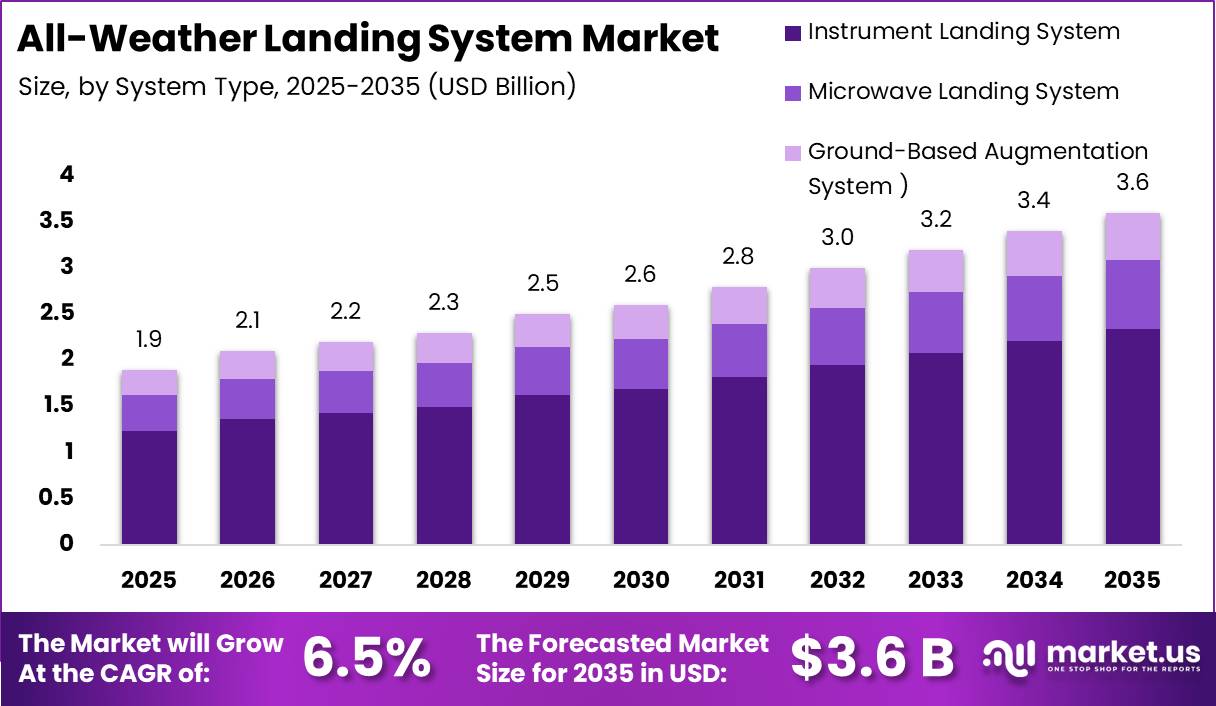
In 2025, the Global All-Weather Landing System Market was valued at USD 1.9 billion. The market is projected to grow at a CAGR of 6.5% during 2026–2035, reaching approximately USD 3.6 billion by 2035. North America dominated the global market in 2025, accounting for more than 37.5% of the total market share and generating approximately USD 0.71 billion in revenue.
Airports need reliable precision-approach capability as they add runway capacity, upgrade airfield safety systems, and handle more passenger movements. In the United States, the Federal Aviation Administration’s Airport Infrastructure Grant program provides $14.5 billion across five years for runway, taxiway, safety, terminal, and related airport projects. The FAA released its final $2.89 billion annual allocation for fiscal year 2026.
The agency also issued $481 million for 191 airport infrastructure grants across 36 states and two territories. Large hubs and regional airports use this funding to improve runway safety areas, reconstruct taxiways, and modernize operations. Canada adds demand through its geographically dispersed airport network, where adverse weather and long-distance connectivity increase the value of dependable approach and landing capability.
Key Takeaway
- The Global All-Weather Landing System Market will grow from USD 1.9 billion in 2025 to USD 3.6 billion by 2035. The market will expand at a 6.5% CAGR from 2026 to 2035.
- Instrument Landing System (ILS) leads the system type segment with a 64.9% share.
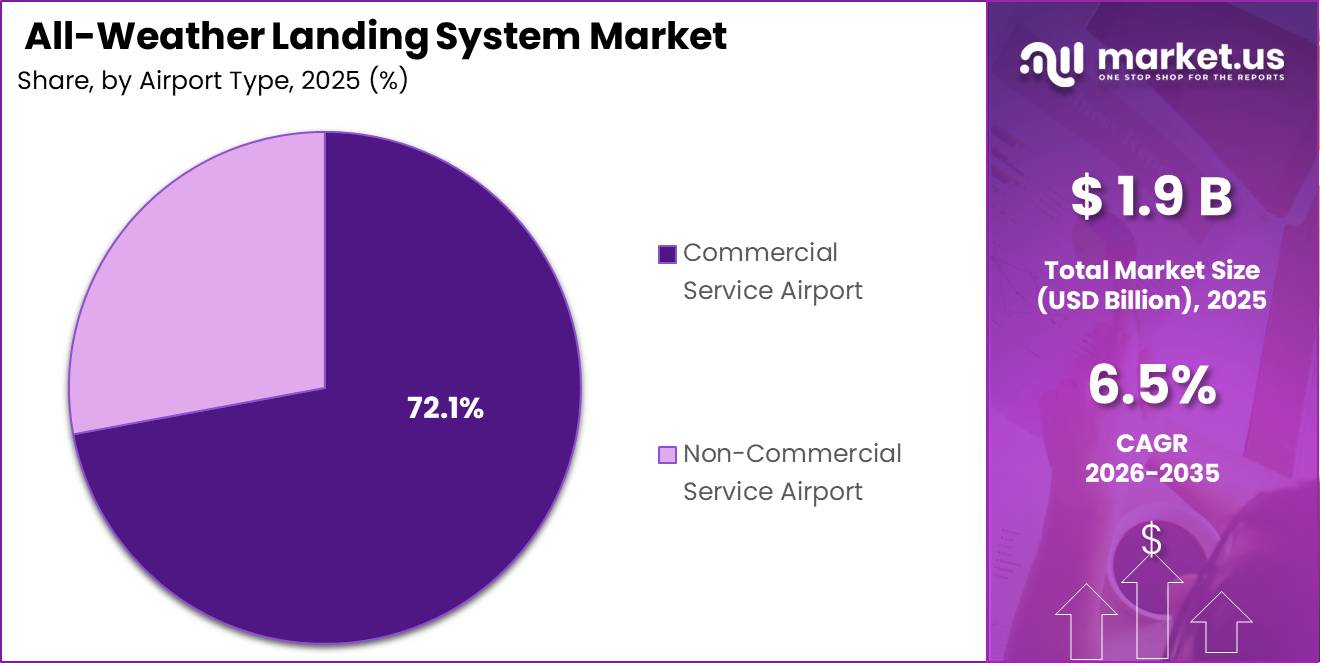
- Commercial Service Airport leads the airport type segment with a 72.1% share.
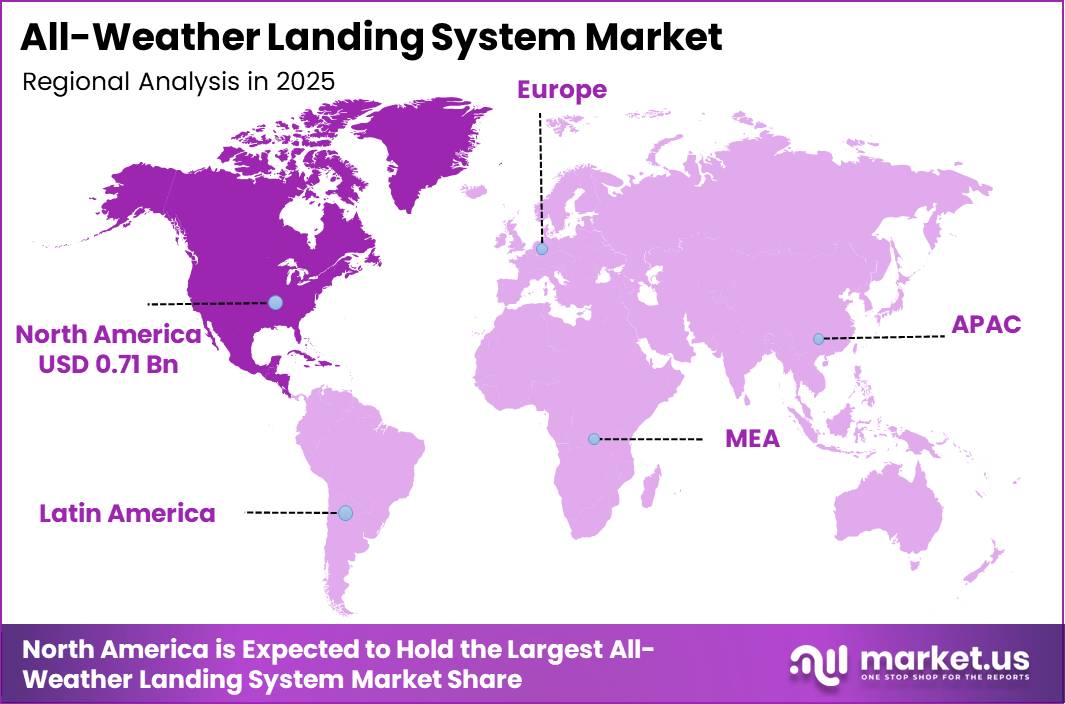
- North America leads with a 37.5% share and USD 0.71 billion in revenue.
By System Type
Instrument Landing System (ILS) dominates with 64.9% due to proven low-visibility precision approach capability.
Instrument Landing System, or ILS, leads the system type segment with 64.9% because airports, airlines, pilots, and regulators use it as a proven precision-approach standard. It gives pilots both lateral and vertical guidance during an approach, which supports safe landings in fog, rain, snow, and low cloud.
The Federal Aviation Administration states that an ILS uses a localizer operating from 108.1 MHz to 111.95 MHz for runway alignment and a glide slope operating from 329.15 MHz to 335.0 MHz for descent guidance. The FAA also confirms that ILS remains the only system approved for Category II and Category III operations in the United States.
By Airport Type
Commercial Service Airport dominates with 72.1% due to scheduled traffic and reliability needs.
Commercial Service Airport leads the airport type segment with 72.1% because scheduled passenger operations need dependable arrival access and tight control of weather disruption. Airlines depend on predictable landing capacity to protect connections, aircraft rotations, crew schedules, gate use, and passenger service.
The FAA defines a commercial service airport as a publicly owned airport with at least 2,500 annual enplanements and scheduled air carrier service. Its 2025 to 2029 National Plan of Integrated Airport Systems identifies 390 primary airports, which serve the largest share of scheduled airline activity and therefore need robust precision-approach coverage.
Non-Commercial Service Airport is the fastest-growing airport type because regional connectivity, business aviation, emergency operations, and local air access create demand for safer all-weather approaches outside large hubs. The FAA’s National Plan includes 3,364 airports, down from a broader public-use network of 5,314 airports.
Key Market Segments
By System Type
- Instrument Landing System (ILS)
- Microwave Landing System (MLS)
- Ground-Based Augmentation System (GBAS)
By Airport Type
- Non-Commercial Service Airport
- Commercial Service Airport
Geopolitical Impact Analysis
Geopolitical conflict, tariff uncertainty, and rerouted shipping lanes raise the delivered cost and lead time of all-weather landing systems. These systems depend on imported radio-frequency electronics, antennas, semiconductor-based controllers, precision monitoring units, cabinets, copper wiring, steel structures, and specialist test equipment.
UNCTAD expects total maritime trade volume to grow only 0.5% in 2025, while containerized trade will increase 1.4%. Slower and less predictable container flows can delay imported cabinets, signal processors, spare transmitters, and replacement parts that airport contractors need during runway closure windows.
Trade-policy shifts also create pricing risk for equipment suppliers that source components across North America, Europe, and Asia. Airports often buy landing systems through long procurement cycles, but suppliers must price contracts before they know the full effect of tariffs, foreign-exchange changes, and freight surcharges.
The Strait of Hormuz carries 34% of global seaborne oil exports, according to UNCTAD reporting, so disruption risks can lift fuel and shipping costs for oversized antenna arrays, steel towers, calibration equipment, and field-service travel. Suppliers can reduce risk by qualifying regional electronics sources, holding critical spares near airport customers, and structuring contracts to manage duty and freight volatility.
Regional Analysis
North America dominates the All-Weather Landing System Market, holding a 37.5% share and generating USD 0.71 billion in revenue. The United States drives regional demand through runway reconstruction, airport safety spending, air traffic modernization, and the replacement of legacy navigation equipment.
The Federal Aviation Administration supports airport infrastructure through annual Airport Improvement Program grants for runways, taxiways, lighting, markings, and signs. These airfield upgrades often require coordinated work on precision-approach systems because airports must maintain reliable landing operations while they change runway geometry, safety areas, lighting circuits, or pavement.
Asia Pacific is the fastest-growing region for the All-Weather Landing System Market. China, India, Japan, South Korea, and Australia continue to add airport capacity, upgrade regional airports, and strengthen air navigation resilience. New runway projects and airport expansion support demand for navigation aids, approach lighting interfaces, runway monitoring, and GBAS-ready infrastructure.
Key Regions and Countries
North America
- US
- Canada
Europe
- Germany
- France
- The UK
- Spain
- Italy
- Rest of Europe
Asia Pacific
- China
- Japan
- South Korea
- India
- Australia
- Rest of APAC
Latin America
- Brazil
- Mexico
- Rest of Latin America
Middle East and Africa
- GCC
- South Africa
- Rest of MEA
Market Dynamics
Drivers
| Driver | (~) % Impact on CAGR Forecast | Geographic Relevance | Impact Timeline |
|---|---|---|---|
| Rising Commercial Flight Activity | +0.7% | Global | Short term (2 years or less) |
| Low-Visibility Safety Mandates | +0.5% | North America and Europe | Short term (2 years or less) |
| Severe Weather Disruption | +0.4% | Global weather-exposed airports | Medium term (2 to 4 years) |
| Commercial Airport Capacity Expansion | +0.3% | Asia Pacific and Middle East | Long term (4 years or more) |
| Airline Schedule Reliability Pressure | +0.2% | Major global hubs | Short term (2 years or less) |
Rising Commercial Flight Activity
Rising flight activity is increasing the need for reliable landing systems that keep runways operational during fog, heavy rain, snow, and low cloud. ICAO reported 4.7 billion scheduled airline passengers in 2024, up 7.9%, while departures reached 37.4 million, increasing 5.1%. In 2025, passenger traffic reached about 4.95 billion, while departures rose to 38.08 million, up 9.3% and 2.7%, respectively.
EUROCONTROL recorded 11.12 million European flights in 2025, around 4% higher than in 2024. Airports Council International also reported more than 9.4 billion airport passengers in 2024, an increase of 8.4%. Higher aircraft movements support investment in ILS upgrades, backup power, monitoring, calibration, maintenance, software updates, spare parts, flight inspection, and performance-based service contracts.
Restraints
| Restraint | (~) % Impact on CAGR Forecast | Geographic Relevance | Impact Timeline |
|---|---|---|---|
| High Project Capital Intensity | -0.8% | Global | Short term (2 years or less) |
| Long Sovereign Tender Cycles | -0.5% | Asia Pacific, Latin America, and Africa | Medium term (2 to 4 years) |
| Weak Direct Revenue Payback | -0.4% | Regional and secondary airports | Medium term (2 to 4 years) |
| Restricted Runway Access Windows | -0.3% | Congested commercial hubs | Short term (2 years or less) |
| Small-Airport Traffic Thresholds | -0.2% | Rural and remote markets | Long term (4 years or more) |
High Project Capital Intensity
All-weather landing projects require navigation equipment, protected sites, power systems, communications, civil works, flight inspection, certification, and long-term maintenance. Airports Council International reported operating expenses of USD 10.31 and capital costs of USD 5.33 per passenger in 2024, while non-aeronautical revenue covered only 48% of total airport costs.
The FAA allocated USD 15 billion for airport infrastructure over 5 years, while the U.S. Department of Transportation awarded more than USD 332 million through 171 airport grants in January 2025. World Bank data also showed IDA aviation financing rising 9% to USD 542 million and private-sector investment increasing 17.8% to USD 726 million. Limited funding can delay projects, encourage phased installations, and pressure supplier margins.
Challenges
| Challenge | (~) % CAGR Friction Drag | Geographic Relevance | Mitigation Horizon |
|---|---|---|---|
| Avionics Component Supply Volatility | -0.6% | Global manufacturing networks | Short term (2 years or less) |
| Certified Technician Capacity Gap | -0.5% | North America and Europe | Medium term (2 to 4 years) |
| GNSS Interference Resilience | -0.4% | Europe, Middle East, and Asia Pacific | Long term (4 years or more) |
| Multi-Vendor Integration Complexity | -0.3% | Global modernized airports | Medium term (2 to 4 years) |
| Calibration Uptime Burden | -0.2% | Remote and high-traffic airports | Medium term (2 to 4 years) |
Avionics Component Supply Volatility
Landing-system production depends on globally sourced radio-frequency modules, processors, antennas, power electronics, cables, and testing equipment. UN Trade and Development reported that Suez Canal tonnage in May 2025 remained 70% below its 2023 level, while vessel rerouting increased global ton-miles by 6% in 2024.
Shanghai container spot rates also climbed 122%, including a 256% increase on European routes. The WTO reported 20% year-on-year growth in semiconductor, server, and telecommunications-equipment trade during the first half of 2025, indicating strong competition for electronic components.
Merchandise trade growth is expected to slow to 0.5% in 2026. These conditions encourage suppliers to diversify component sources, increase safety stocks, establish regional repair capacity, and include freight and tariff adjustments in long-term contracts.
Opportunities
| Opportunity | (~) % Potential CAGR Upside | Geographic Relevance | Execution Window |
|---|---|---|---|
| Multi-Runway GBAS Platforms | +0.6% | Global hub airports | Medium term (2 to 4 years) |
| Remote Monitoring Subscriptions | +0.3% | Global and remote airports | Short term (2 years or less) |
| Regional Airport Retrofit Packages | +0.2% | Asia Pacific, Latin America, and Africa | Medium term (2 to 4 years) |
| CAT III GBAS Commercialization | +0.1% | North America, Europe, and advanced Asian hubs | Long term (4 years or more) |
| Predictive Weather Integration | +0.1% | Weather-exposed airport networks | Long term (4 years or more) |
Multi-Runway GBAS Platforms
Multi-runway GBAS offers future growth potential because many airports still depend on separate ILS installations for individual runway directions. The FAA states that 1 GBAS can support up to 48 approaches, while ICAO notes that a single station can serve several runway ends and support Category I through Category III operations.
Australia currently operates only 2 GBAS systems, supporting 6 runway ends in Sydney and 4 in Melbourne. The FAA further expanded the regulatory pathway on May 20, 2026, covering GBAS use in Category II and Category III conditions.
In a scenario where up to 10 separate runway-end systems are replaced by 1 shared platform, the main ground-system count could decline by 90%. After redundancy and civil works, cost per enabled approach could fall by about 30% to 45%, while lifecycle services may improve supplier gross margins by roughly 3 to 5 percentage points.
Key Players Analysis
Tier 1 market leaders include Thales Group, Honeywell International, L3Harris Technologies, Collins Aerospace, Leonardo S.p.A., Raytheon Technologies Corporation, and Saab AB. These companies combine avionics, communications, surveillance, navigation, airport systems, defense electronics, and lifecycle support capabilities. Thales reported €22.1 billion in 2025 revenue, €25.3 billion in order intake, and €2.7 billion in adjusted EBIT.
Its scale gives it a strong position in air traffic management, avionics, secure communications, and airport-system projects that need long service commitments. Large suppliers can package navigation equipment with integration, monitoring, cybersecurity, remote support, and maintenance contracts, which helps airports manage complex upgrade programs.
Tier 2 challengers include Indra Sistemas S.A., Sierra Nevada Corporation, Systems Interface Ltd., Astronics Corporation, Cobham plc, Mopiens Inc., Multi Electric-OCEM Airfield, NEC Corporation (AT&T Inc.), and other specialized providers. These firms compete through airport-system integration, niche communications products, lighting interfaces, specialized hardware, software, and regional service coverage.
Public financial disclosure does not consistently separate revenue, R&D expense, capital expenditure, or acquisition values specifically for all-weather landing systems. Therefore, a product-specific ranking based on disclosed segment revenue would require company-level validation before publication. The available Thales disclosure confirms group-level scale, but it does not isolate landing-system revenue.
Top Key Players in the Market
- Thales Group
- Indra Sistemas S.A.
- L3Harris Technologies, Inc.
- Sierra Nevada Corporation
- Honeywell International Inc.
- Systems Interface Ltd.
- Astronics Corporation
- Cobham plc
- Collins Aerospace
- Leonardo S.p.A.
- Mopiens Inc.
- Multi Electric- OCEM Airfield
- NEC Corporation (AT&T Inc.)
- Raytheon Technologies Corporation
- Saab AB
- Other Key Players
Recent Developments
- In September 2026, Thales and COCESNA signed an agreement to install 1 integrated DVOR/DME radio-navigation system at El Salvador’s new Pacific International Airport. The project includes Thales’ fifth-generation DME and marks the first deployment under COCESNA’s regional navigation-renewal program in El Salvador.
- In April 2026, Airservices Australia conducted certification testing for 2 Instrument Landing Systems at Western Sydney International Airport. Each airborne validation session required 4 to 6 hours, and Airservices extended testing by 2 days to support operational readiness.
- In May 2025, Indra and ASECNA completed a EUR 15 million navigation-modernization program across 17 airports in 12 African countries. Indra installed 18 localizers, 14 glide-path systems, and 12 distance-measuring systems in under 24 months, while training nearly 100 technical personnel.
- In January 2025, NEC’s GBAS-16 system entered official service at Tokyo Haneda Airport, making Haneda the first Asian airport to operate GBAS officially. NEC supplied 1 complete equipment set to Japan’s Civil Aviation Bureau for precision approach and landing operations across multiple runway ends.
Report Scope
| Report Features | Description |
|---|---|
| Market Value (2025) | USD 1.9 Billion |
| Forecast Revenue (2035) | USD 3.6 Billion |
| CAGR (2026-2035) | 6.5% |
| Base Year for Estimation | 2025 |
| Historic Period | 2020-2024 |
| Forecast Period | 2026-2035 |
| Report Coverage | Revenue Forecast, Market Dynamics, Competitive Landscape, Recent Developments |
| Segments Covered | By System Type (Instrument Landing System (ILS), Microwave Landing System (MLS), Ground-Based Augmentation System (GBAS)); By Airport Type (Non-Commercial Service Airport, Commercial Service Airport) |
| Regional Analysis | North America – US, Canada; Europe – Germany, France, The UK, Spain, Italy, Rest of Europe; Asia Pacific – China, Japan, South Korea, India, Australia, Singapore, Rest of APAC; Latin America – Brazil, Mexico, Rest of Latin America; Middle East & Africa – GCC, South Africa, Rest of MEA |
| Competitive Landscape | Thales Group, Indra Sistemas S.A., L3Harris Technologies, Inc., Sierra Nevada Corporation, Honeywell International Inc., Systems Interface Ltd., Astronics Corporation, Cobham plc, Collins Aerospace, Leonardo S.p.A., Mopiens Inc., Multi Electric- OCEM Airfield, NEC Corporation (AT&T Inc.), Raytheon Technologies Corporation, Saab AB, Other Key Players |
| Customization Scope | Customization for segments and region/country-level will be provided. Additional customization can be done based on requirements. |
| Purchase Options | We have three licenses to opt for: Single User License, Multi-User License (Up to 5 Users), Corporate Use License (Unlimited Users and Printable PDF) |





























