


Global Algae Fats Market Size, Share, And Enhanced Productivity By Type (Food Grade, Feed Grade, Industrial Grade), By Product Formn (Oil, Powder, Capsules, Tablets, Encapsulated Emulsion), By Fat Type (Omega-3 Fatty Acids, Omega-6 Fatty Acids, Omega-9 Fatty Acids), By Source (Microalgae, Macroalgae), By Application (Biofuel, Dietary Supplement, Animal Feed (Poultry, Swine, Cattle, Aquaculture, Pet Food)), By Region and Companies - Industry Segment Outlook, Market Assessment, Competition Scenario, Trends, and Forecast 2026-2035
- Published date: March 2026
- Report ID: 181073
- Number of Pages: 223
- Format:
-
keyboard_arrow_up
Quick Navigation
Report Overview
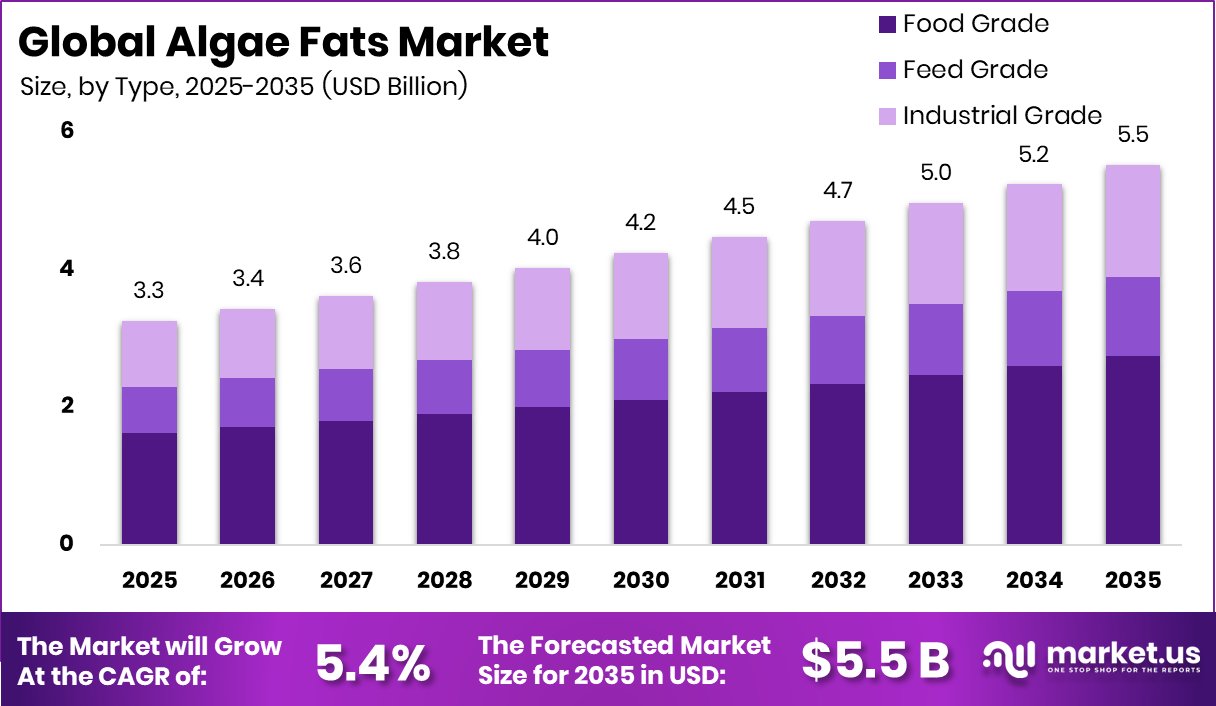
The Global Algae Fats Market is expected to be worth around USD 5.5 billion by 2035, up from USD 3.3 billion in 2025, and is projected to grow at a CAGR of 5.4% from 2026 to 2035. Algae Fats Market in Asia Pacific held 37.80% share, totaling approximately USD 1.2 Bn.
Algae fats are lipids extracted from algae species such as microalgae and macroalgae. These fats are naturally rich in essential fatty acids and are valued for their nutritional and functional properties. Algae fats can be processed into different forms including oil, powder, capsules, tablets, and encapsulated emulsions, making them suitable for diverse applications. They are commonly used for producing omega-3, omega-6, and omega-9 fatty acids, which are widely utilized in nutrition, food formulations, and industrial uses. Because algae can grow rapidly in controlled environments, they provide a sustainable alternative to conventional fat sources derived from plants or marine organisms.
The Algae Fats Market refers to the commercial production, processing, and distribution of fats obtained from algae for various industries. These fats are used across food grade, feed grade, and industrial grade segments. Their applications include dietary supplements, animal feed, and biofuel production. Market demand is shaped by the growing interest in alternative lipid sources that support nutritional health and sustainable manufacturing practices. Advances in algae cultivation and extraction technologies have also improved product quality and scalability, allowing manufacturers to integrate algae fats into multiple product categories.
Growth in the market is strongly influenced by increasing focus on sustainable bio-based resources and energy alternatives. Governments and organizations are supporting biofuel and algae-based innovations through funding and research programs. For example, the U.S. Department of Energy awarded $118 million to accelerate domestic biofuel production, while the USDA released $537 million in biofuel infrastructure funding. In addition, a $9 million grant was provided to study cactus pear as a water-saving biofuel resource in the Mountain West. These initiatives encourage the exploration of algae and other renewable sources for fuel and industrial fat production.
Demand for algae fats is expanding due to rising interest in nutrition-focused products and plant-based ingredients. Algae-derived omega fatty acids are increasingly used in dietary supplements and functional formulations because they offer a marine-free alternative for obtaining essential nutrients. Investment activity also highlights the growing confidence in algae-based technologies. MiAlgae secured $18.5 million to scale production of omega-3s from microalgae, while Tagaddod raised $26.3 million in a Series A round led by The Arab Energy Fund to advance sustainable bio-based solutions. Such developments indicate strong industry momentum.
Opportunities in the algae fats sector continue to expand as industries explore new applications and scalable production methods. Improvements in cultivation systems, fermentation technologies, and lipid extraction processes are enabling higher yields and more consistent product quality. These advancements create possibilities for algae fats to be used in a broader range of applications including nutrition, energy, and feed. As sustainability and resource efficiency become more important across industries, algae fats present a promising pathway for developing renewable lipid solutions that meet both environmental and commercial needs.
Key Takeaways
- The Global Algae Fats Market is expected to be worth around USD 5.5 billion by 2035, up from USD 3.3 billion in 2025, and is projected to grow at a CAGR of 5.4% from 2026 to 2035.
- The Algae Fats Market is largely driven by food grade products, accounting for a dominant 49.7% share globally.
- In the Algae Fats Market, oil-based product forms lead demand, contributing approximately 48.6% of total market usage.
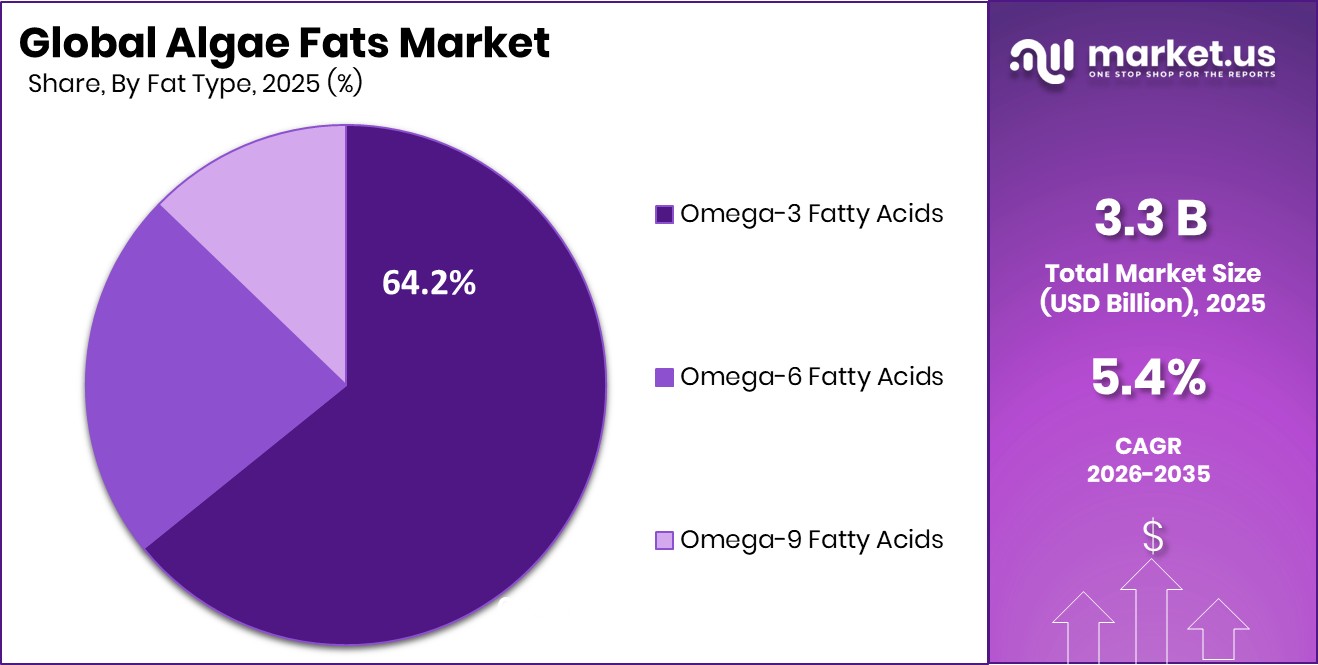
- Omega-3 fatty acids dominate the Algae Fats Market, representing about 64.2% due to strong nutritional demand.
- Microalgae remain the primary source in the Algae Fats Market, holding around 76.1% share in production.
- Dietary supplements significantly drive the Algae Fats Market, accounting for nearly 49.3% of overall application demand.
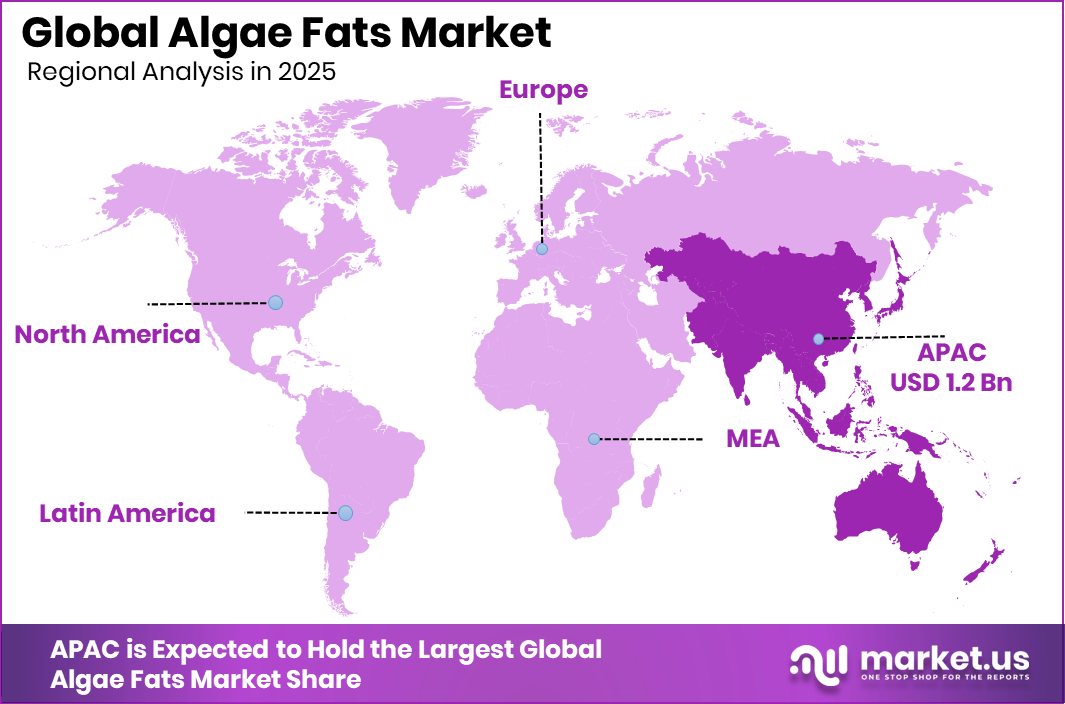
- Asia Pacific accounted for 37.80% of global Algae Fats Market, reaching USD 1.2 Bn value.
By Type Analysis
Food-grade products dominate the Algae Fats Market, accounting for 49.7% overall share globally.
In 2025, the food-grade segment held a significant share of the Algae Fats Market, accounting for 49.7% of the overall market demand. The growth of this segment is largely driven by increasing consumer preference for natural, plant-based, and sustainable ingredients in everyday food products. Food manufacturers are increasingly incorporating algae-derived fats into bakery products, dairy alternatives, snacks, and functional foods due to their nutritional profile and clean-label appeal. These fats are rich in essential fatty acids and are considered a healthier alternative to conventional oils.
Additionally, regulatory approvals in several regions for algae-based ingredients in food formulations have strengthened market adoption. The rise of vegan and flexitarian diets has further encouraged food producers to explore algae fats as a sustainable and nutrient-rich ingredient in innovative food applications.
By Product Form Analysis
Oil form leads the Algae Fats Market, representing about 48.6% product usage worldwide.
In 2025, algae fat oils dominated the product form segment of the Algae Fats Market with a share of 48.6%. Oil-based forms are widely preferred because they are easier to process, blend, and incorporate into a variety of commercial applications. Manufacturers favor algae oil due to its stability, neutral taste, and high concentration of beneficial fatty acids. It is increasingly used in cooking oils, nutritional supplements, infant formula, and fortified beverages.
The oil form also offers longer shelf life and better compatibility with existing food and nutraceutical production processes. With rising demand for healthier lipid sources, companies are investing in advanced extraction technologies to enhance yield and quality. As consumers continue to seek plant-based nutrition solutions, algae oil is becoming an attractive alternative to traditional fish and vegetable oils.
By Fat Type Analysis
Omega-3 fatty acids hold 64.2% share within the algae fats market segments.
In 2025, omega-3 fatty acids represented the largest fat type segment in the Algae Fats Market, capturing 64.2% of the market share. Omega-3 fats derived from algae are gaining widespread recognition due to their health benefits, particularly for heart, brain, and eye health. Unlike traditional fish oil sources, algae-based omega-3 provides a sustainable and vegetarian-friendly option, which is increasingly appealing to health-conscious consumers.
The demand for omega-3 enriched foods, beverages, and supplements has surged as people become more aware of preventive healthcare and nutritional wellness. Algae serves as the original source of marine omega-3, making it an environmentally responsible option that reduces dependence on marine fish stocks. This growing awareness is encouraging manufacturers to expand their algae-based omega-3 product portfolios across multiple industries.
By Source Analysis
Microalgae sources dominate the Algae Fats Market, contributing 76.1% of production supply.
In 2025, microalgae emerged as the leading source in the Algae Fats Market, accounting for 76.1% of the total market share. Microalgae are widely cultivated because they offer high lipid productivity and can be grown in controlled environments with relatively low resource requirements. Their ability to produce essential fatty acids, including omega-3, makes them a highly valuable raw material for food, nutraceutical, and pharmaceutical applications.
Microalgae cultivation also aligns with sustainability goals, as it requires less land compared to traditional oil crops and can utilize carbon dioxide during growth. Advances in biotechnology and fermentation processes have further improved the efficiency of microalgae production. As industries continue to seek environmentally friendly lipid sources, microalgae-based fats are becoming an increasingly reliable and scalable solution.
By Application Analysis
Dietary supplements represent 49.3% of applications within the growing Algae Fats Market.
In 2025, dietary supplements represented a major application segment in the Algae Fats Market, accounting for 49.3% of total usage. The rising demand for nutritional supplements focused on heart health, cognitive function, and overall wellness has significantly contributed to this segment’s growth. Algae-derived fats, particularly omega-3 fatty acids, are widely used in capsules, soft gels, and liquid supplement formulations. Consumers are increasingly turning to algae-based supplements as a plant-based alternative to fish oil, especially among vegetarian and vegan populations.
Additionally, the growing trend of preventive healthcare and daily nutritional supplementation is encouraging supplement manufacturers to adopt algae-derived ingredients. With ongoing research supporting the health benefits of algae fats, the dietary supplement sector is expected to remain a key driver of market expansion.
Key Market Segments
By Type
- Food Grade
- Feed Grade
- Industrial Grade
By Product Form
- Oil
- Powder
- Capsules
- Tablets
- Encapsulated Emulsion
By Fat Type
- Omega-3 Fatty Acids
- Omega-6 Fatty Acids
- Omega-9 Fatty Acids
By Source
- Microalgae
- Macroalgae
By Application
- Biofuel
- Dietary Supplement
- Animal Feed
- Poultry
- Swine
- Cattle
- Aquaculture
- Pet Food
Driving Factors
Rising demand for plant-based omega nutrition
The growing demand for plant-based omega nutrition is becoming a key driver for the Algae Fats Market. Consumers are increasingly seeking alternatives to traditional marine sources of omega fatty acids, particularly options that align with vegetarian and vegan dietary preferences. Algae-based fats provide a direct and sustainable source of omega-3 and other essential fatty acids, supporting their use in food products and dietary supplements.
As health awareness continues to grow, manufacturers are exploring algae-derived lipids to develop nutrition-focused formulations that appeal to modern consumers. Investment activity is also supporting innovation in this space. For instance, a Long Island City-based nutrition startup recently raised $20 million in Series A funding, highlighting strong investor interest in plant-based nutrition solutions and technologies that can expand the availability of algae-based omega ingredients.
Restraining Factors
High production and processing costs
High production and processing costs remain a notable challenge for the Algae Fats Market. Cultivating algae at commercial scale requires controlled environments, specialized cultivation systems, and advanced extraction technologies, all of which can increase operational expenses. These costs can influence the final price of algae-derived fats compared with more established lipid sources. Infrastructure requirements, energy consumption, and technological complexity also contribute to the overall production cost.
Despite these challenges, industry innovation and financial support continue to drive improvements in production efficiency. Funding activity within the broader biotechnology and microbial solutions sector demonstrates growing confidence in new technologies. For example, Bactolife secured over €30 million in Series B funding to support commercialization efforts, reflecting ongoing investment interest in microbial and bio-based innovations that may contribute to improved production approaches.
Growth Opportunity
Expanding applications in biofuel production
The expanding use of algae fats in biofuel production presents significant growth opportunities for the Algae Fats Market. Algae can produce high lipid yields and can be cultivated in controlled environments without competing for traditional agricultural land, making them attractive for renewable fuel development. As energy industries look for alternative feedstocks to support sustainable fuel production, algae-based lipids are increasingly explored as a promising resource.
Policy initiatives and public sector investments are also encouraging research and infrastructure development related to energy and bio-based products. For instance, the FDA has sought $7.2 billion to enhance food safety and nutrition, advance medical product safety, and strengthen public health, which indirectly supports innovation across biotechnology, nutrition, and related sectors where algae-derived ingredients may play a role in future product development.
Latest Trends
Advancements in microalgae cultivation technologies
Advancements in microalgae cultivation technologies are shaping recent trends in the Algae Fats Market. Improvements in cultivation systems, including controlled bioreactors and optimized growth conditions, are helping increase lipid productivity and consistency in algae-based fat production. These technological developments support more reliable and scalable manufacturing processes, enabling producers to supply algae-derived fats for nutritional, industrial, and energy applications.
Research and innovation efforts are also being supported by broader initiatives focused on improving food access and resource management. For example, while discussions around SNAP funding continue, a South Carolina fund distributed $233,000 to help food banks stock up on essential supplies, highlighting ongoing attention toward nutrition accessibility. Such initiatives reflect the broader ecosystem where innovation in sustainable nutrition sources, including algae fats, continues to evolve.
Regional Analysis
In 2025, Asia Pacific dominated the Algae Fats Market with 37.80% share, valued at USD 1.2 Bn.
The Algae Fats Market demonstrates varied regional performance across North America, Europe, Asia Pacific, the Middle East & Africa, and Latin America, driven by differences in consumer awareness, industrial adoption, and nutritional product demand.
Asia Pacific emerged as the dominating region, accounting for 37.80% of the global market with a value of USD 1.2 Bn, supported by expanding dietary supplement consumption, rising demand for plant-based nutrition, and increasing integration of algae-derived ingredients in functional foods. Countries across the region are witnessing stronger adoption of algae fats in nutraceutical formulations and food applications, contributing to the region’s leading market share.
North America represents a mature market characterized by strong demand for omega-3 alternatives and established dietary supplement industries. Europe also shows consistent growth due to increasing consumer focus on sustainable ingredients and plant-derived fatty acids used in health products.
Meanwhile, the Middle East & Africa and Latin America are gradually expanding markets, supported by improving awareness of nutritional supplements and growing interest in alternative lipid sources for food and wellness products. Overall, regional demand patterns highlight Asia Pacific as the leading market contributor.
Key Regions and Countries
- North America
- US
- Canada
- Europe
- Germany
- France
- The UK
- Spain
- Italy
- Rest of Europe
- Asia Pacific
- China
- Japan
- South Korea
- India
- Australia
- Rest of APAC
- Latin America
- Brazil
- Mexico
- Rest of Latin America
- Middle East & Africa
- GCC
- South Africa
- Rest of MEA
Key Players Analysis
In 2025, ADM continues to demonstrate a strategic position within the global Algae Fats Market through its strong capabilities in ingredient development, large-scale processing, and supply chain integration. The company’s broad expertise in food and nutrition ingredients allows it to explore algae-derived lipid solutions that align with growing demand for plant-based and sustainable fat sources. ADM’s operational scale and technical knowledge in lipid processing provide advantages in refining and incorporating algae fats into food, nutrition, and specialty ingredient applications. Its focus on innovation and ingredient functionality supports the development of algae-based formulations that meet evolving consumer expectations around nutrition, sustainability, and product performance.
PLT Health Solutions is recognized for its specialization in nutraceutical and functional ingredient solutions, which positions the company to address growing interest in algae-derived lipids for health-focused applications. The company emphasizes science-supported ingredient development and formulation expertise, allowing it to introduce algae fat ingredients tailored for dietary supplements and wellness products. PLT Health Solutions’ approach centers on delivering differentiated nutritional ingredients that align with consumer demand for plant-based alternatives. Its focus on formulation support and product innovation enables supplement manufacturers to incorporate algae fats effectively into capsules, functional blends, and health formulations.
AGT Food and Ingredients contributes to the evolving algae fats landscape through its experience in plant-based food ingredients and global ingredient supply. The company’s strengths in sourcing, processing, and distributing plant-derived nutritional components create opportunities to expand into algae-based lipid solutions. AGT Food and Ingredients focuses on delivering high-quality ingredients for food and nutrition markets, which aligns with the broader shift toward sustainable and plant-derived fats. Its established distribution channels and ingredient expertise support potential integration of algae fats into various food and nutritional product applications.
Top Key Players in the Market
- ADM
- PLT Health Solutions
- AGT Food and Ingredients
- Cyanotech Corporation
- Cargill, Inc.
- Earthrise Nutritional
- Cambridge Commodities Ltd
- Algenol Biofuels Inc.
- Ingredion Inc.
Recent Developments
- In January 2025, ADM, a global food and nutrition ingredient company, expanded its plant-based nutrition portfolio in January 2025 by strengthening development of algae-derived omega-3 ingredients used in dietary supplements and fortified foods. The initiative focuses on sustainable DHA and EPA sources from algae to support vegan nutrition products.
- In July 2024, PLT Health Solutions, a company that develops science-based nutraceutical ingredients, introduced élantria® Algal DHA, an omega-3 ingredient derived from microalgae. The product delivers around 40% DHA by weight and is designed for dietary supplements and functional foods requiring stable algae-based omega-3 sources.
Report Scope
Report Features Description Market Value (2025) USD 3.3 Billion Forecast Revenue (2035) USD 5.5 Billion CAGR (2026-2035) 5.4% Base Year for Estimation 2025 Historic Period 2020-2024 Forecast Period 2026-2035 Report Coverage Revenue Forecast, Market Dynamics, Competitive Landscape, Recent Developments Segments Covered By Type (Food Grade, Feed Grade, Industrial Grade), By Product Formn (Oil, Powder, Capsules, Tablets, Encapsulated Emulsion), By Fat Type (Omega-3 Fatty Acids, Omega-6 Fatty Acids, Omega-9 Fatty Acids), By Source (Microalgae, Macroalgae), By Application (Biofuel, Dietary Supplement, Animal Feed (Poultry, Swine, Cattle, Aquaculture, Pet Food)) Regional Analysis North America – US, Canada; Europe – Germany, France, The UK, Spain, Italy, Rest of Europe; Asia Pacific – China, Japan, South Korea, India, Australia, Singapore, Rest of APAC; Latin America – Brazil, Mexico, Rest of Latin America; Middle East & Africa – GCC, South Africa, Rest of MEA Competitive Landscape ADM, PLT Health Solutions, AGT Food and Ingredients, Cyanotech Corporation, Cargill, Inc., Earthrise Nutritional, Cambridge Commodities Ltd, Algenol Biofuels Inc., Ingredion Inc. Customization Scope Customization for segments, region/country-level will be provided. Moreover, additional customization can be done based on the requirements. Purchase Options We have three licenses to opt for: Single User License, Multi-User License (Up to 5 Users), Corporate Use License (Unlimited User and Printable PDF) 
-
-
- ADM
- PLT Health Solutions
- AGT Food and Ingredients
- Cyanotech Corporation
- Cargill, Inc.
- Earthrise Nutritional
- Cambridge Commodities Ltd
- Algenol Biofuels Inc.
- Ingredion Inc.
Our Clients

- 181073
- March 2026






