


Report Overview
Global Knife Market size is expected to be worth around USD 6.80 Billion by 2035 from USD 3.80 Billion in 2025, growing at a CAGR of 6.0% during the forecast period 2026 to 2035. This expansion signals steady capital rotation into branded cutlery, outdoor blades, and industrial cutting tools. Investors who lock in capacity now gain pricing power before mid-decade volume peaks.
Therefore, the Knife Market covers fixed, folding, utility, and multi-tool blades sold for kitchen, outdoor, tactical, and industrial use. Product design, steel grade, price tier, and retail channel form the core structure. Buyers treat knives as durable goods, so brand trust and edge retention decide reorder rates across home and professional kitchens.
Key Takeaways
- The Knife Market reaches USD 3.80 Billion in 2025 and USD 6.80 Billion by 2035 at a 6.0% CAGR.
- Fixed Blade leads Product Type with a 54.00% share.
- Kitchen and Culinary leads Application with a 44.50% share.
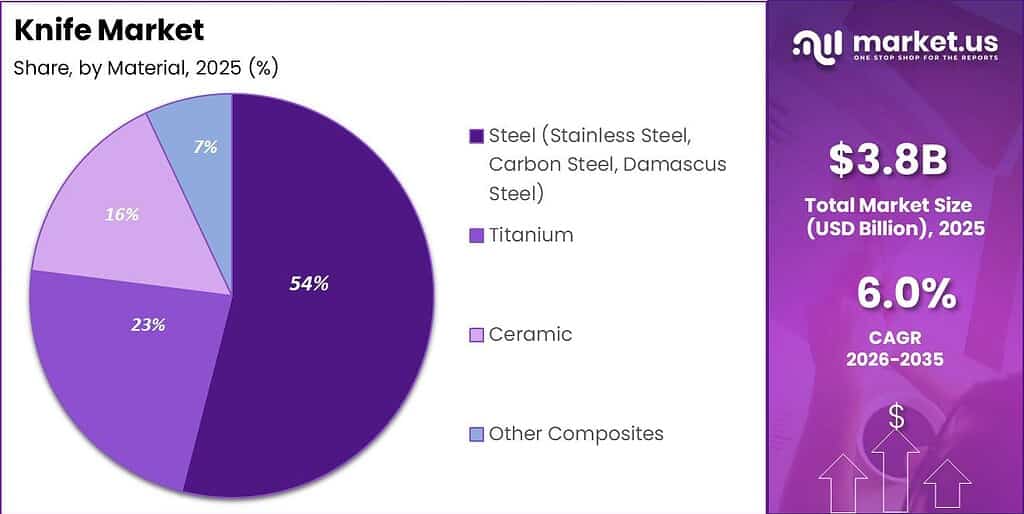
- Steel leads Material with a 54.00% share.
- Premium and Luxury leads Price Point with a 42.00% share.
- Offline Retail leads Distribution Channel with a 45.00% share.
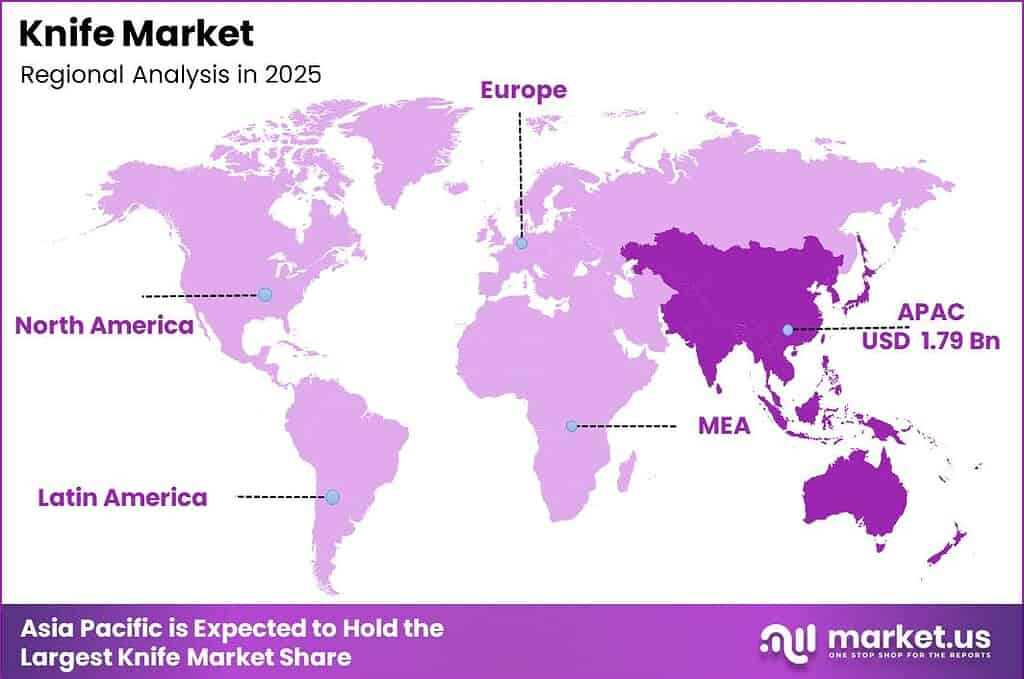
- Asia Pacific leads regionally with a 47.50% share valued at USD 1.79 Billion.
As per our research, England and Wales recorded 50,430 knife or sharp instrument offences in the year ending September 2025, a 9% drop from the prior year. This decline supports tighter carry rules that push demand toward kitchen and industrial blades rather than street carry SKUs. Brands that stress culinary and workplace safety messaging protect share under stricter retail scrutiny.
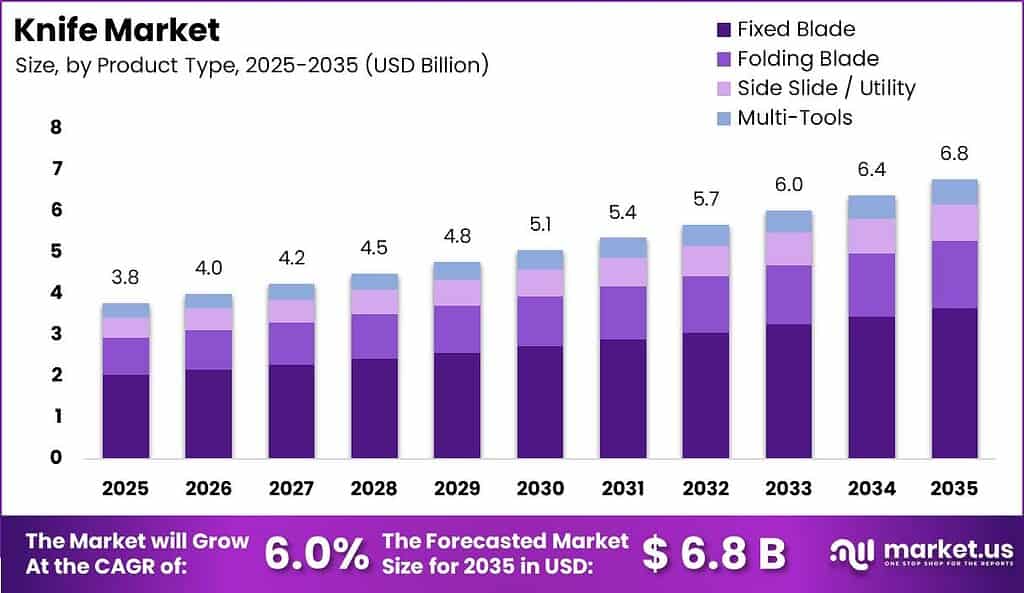
Consequently, Victorinox released a 2025 Special Companion Damast Limited Edition with a Damasteel blade rated at 60 HRC. This hardness rating proves premium metallurgy still commands collector and gift spend. In July 2025, Victorinox also relaunched Swiss Classic cutlery in Sunny Side, Mango Tango, and Smashed Avocado colorways, linking home cooking growth directly to higher-margin color SKUs.
Product Type Analysis
Fixed Blade dominates with 54.00% due to kitchen and outdoor durability needs.
In 2025, Fixed Blade held a dominant market position in the By Product Type segment of Knife Market, with a 54.00% share. World crude steel output reached 1,849.4 million tonnes in 2025 across 70 reporting countries, securing billet supply for full-tang kitchen and hunting blanks. This volume stability lets fixed-blade makers scale forging without billet shocks. Factories that secure long-term steel contracts lock margin before rivals bid up scrap.
Folding Blade products serve everyday carry and pocket utility buyers who need compact closure and one-hand deployment. HS heading 8211 classifies knives with cutting blades for customs tracking across major trade lanes. This coding clarity speeds import clearance for folding SKUs into specialty retail. Brands that certify lock strength and pocket-clip ergonomics win repeat urban buyers.
Side Slide and Utility knives serve packaging, warehouse, and craft users who need replaceable blades and safe retraction. Global crude steel production fell 3.7% in December 2025 versus December 2024, at 139.6 million tonnes monthly. This short-cycle dip raises blank costs for high-volume utility lines. Suppliers who dual-source carbon strip protect shelf price against monthly steel swings.
Multi-Tools combine pliers, drivers, and blades for field and workshop kits. Buyers treat them as toolkits rather than single knives, lifting average selling price. August 2025 Buck Knives launches of the 791 Range Elite and 790 Mini Range Elite with MagnaCut steel and crossbar locks show folding and multi-function innovation still draws enthusiast spend. Remaining lower-volume formats hold the balance of product mix collectively.
Application / End-Use Analysis
Kitchen and Culinary dominates with 44.50% due to daily home and foodservice use.
In 2025, Kitchen and Culinary held a dominant market position in the By Application / End-Use segment of Knife Market, with a 44.50% share. Residential home cooks and commercial HoReCa kitchens drive this lead through daily prep cycles. OECD-linked household kitchenware spend outpaced broader retail through 2025 in major markets. Vendors who bundle sharpening service raise lifetime value per kitchen account.
Outdoor and Survival covers hunting, fishing, and camping or bushcraft blades built for field dressing and camp prep. World crude steel production totaled 1,885 million tonnes in 2024, feeding specialty stainless and carbon stock for outdoor makers. This feedstock depth supports corrosion-resistant coatings for wet environments. Brands that rate blades for saltwater and abrasion win fishing and bushcraft shelf space.
Tactical and Military demand centers on combat, defense, and rescue or emergency service knives with secure grips and sheath systems. UK police recorded 49,151 knife-enabled offences in the year ending December 2025, down 10% year over year. This drop reinforces professional-only positioning for tactical lines. Suppliers who sell through authorized defense and EMS channels avoid consumer carry backlash.
Industrial and Manufacturing uses span packaging, food processing, and electronics or textiles cutting. High-cycle replacement blades create recurring revenue independent of consumer fashion. Plants that standardize blade SKUs cut downtime and inventory cost. Packaging, food processing, and electronics or textiles lines together hold the remaining industrial share.
Material Analysis
Steel dominates with 54.00% due to hardness balance and proven edge life.
In 2025, Steel held a dominant market position in the By Material segment of Knife Market, with a 54.00% share spanning stainless, carbon, and Damascus grades. World crude steel output of 1,849.4 million tonnes in 2025 keeps alloy strip available for stamped and forged blanks. This scale advantage keeps steel unit costs below exotic metals. Mills that certify food-grade stainless capture kitchen OEM contracts first.
Titanium serves buyers who need low weight and corrosion resistance for marine and ultralight kits. Density near 4.5 g/cm³ undercuts steel mass in multi-day packs. This weight cut justifies premium pricing in outdoor catalogs. Makers who pair titanium handles with steel edges balance cost and performance.
Ceramic blades deliver extreme hardness and chemical inertness for clean kitchen slicing. They resist acidic foods better than many carbon steels. This property attracts health-focused home cooks. Brands must educate buyers on impact fragility to limit return rates.
Other Composites cover hybrid laminates and coated cores that blend toughness with edge retention. U.S. Section 232 rules apply a flat 50% tariff on articles made almost entirely of steel or aluminum. This duty structure raises landed cost for full-metal imports and favors composite handles that lower dutiable metal share. Composite and hybrid lines hold the remaining material mix.
Price Point Analysis
Premium and Luxury dominates with 42.00% due to chef-grade home upgrade spend.
In 2025, Premium / Luxury held a dominant market position in the By Price Point segment of Knife Market, with a 42.00% share above USD 200. German and Japanese export unit volumes for cutlery rose roughly 5 to 7 percent year over year on trade-body shipment data. This lift confirms buyers still pay up for forged, full-tang sets. Brands that prove Rockwell hardness and warranty length defend the over-USD 200 tier.
Mid-Range knives between USD 100 and USD 200 target serious home cooks who want pro features without luxury markups. Gross margins on premium-tiered lines expanded 150 to 200 basis points as mix shifted upward. This margin gap pulls mid-range SKUs toward better steel and ergonomics. Vendors who close the feature gap capture step-up buyers leaving mass market.
Low and Mass-Market knives under USD 100 fill supermarket and big-box starter kits. High unit velocity offsets thin margins when distribution is dense. This tier absorbs first-time buyers and replacement demand. Producers who automate stamping keep landed cost competitive under tariff pressure. Mid-Range and Low / Mass-Market together hold the remaining price-point share.
Distribution Channel Analysis
Offline Retail dominates with 45.00% due to touch-and-feel purchase behavior.
In 2025, Offline Retail held a dominant market position in the By Distribution Channel segment of Knife Market, with a 45.00% share across specialty, department, supermarket, and hardware stores. Buyers still test balance and handle grip before high-ticket cutlery purchases. This tactile need keeps specialty stores central for premium sets. Retailers who staff trained cutlery desks lift conversion on sets above USD 200.
Online and E-commerce channels cover direct-to-consumer brand sites and third-party marketplaces. E-commerce direct-to-consumer expansion contributes roughly +0.9% to forecast CAGR on a global basis. This channel cut removes wholesale layers and funds richer product video. Brands that control DTC pricing protect map policy against marketplace discounting.
Specialty stores win on expertise and after-sales sharpening, while department stores and supermarkets move volume starter sets. Hardware shops anchor utility and multi-tool demand near job sites. Offline formats that add click-and-collect close the gap with pure online speed. Online / E-commerce holds the remaining channel share as logistics improve in emerging cities.
Key Market Segments
By Product Type
- Fixed Blade
- Folding Blade
- Side Slide / Utility
- Multi-Tools
By Application / End-Use
- Kitchen & Culinary
- Residential (Home Cooks)
- Commercial (Hotels, Restaurants, Catering / HoReCa)
- Outdoor & Survival
- Hunting
- Fishing
- Camping / Bushcraft
- Tactical & Military
- Combat / Defense
- Rescue / Emergency Services
- Industrial & Manufacturing
- Packaging
- Food Processing
- Electronics / Textiles
By Material
- Steel (Stainless Steel, Carbon Steel, Damascus Steel)
- Titanium
- Ceramic
- Other Composites
By Price Point
- Premium / Luxury (> $200)
- Mid-Range ($100 – $200)
- Low / Mass-Market (< $100)
By Distribution Channel
- Offline Retail (Specialty Stores, Department Stores, Supermarkets, Hardware Shops)
- Online / E-commerce (Direct-to-Consumer / DTC, Third-Party Marketplaces)
Regional Analysis
Asia Pacific Dominates the Knife Market with a Market Share of 47.50%, Valued at USD 1.79 Billion
Asia Pacific leads on dense manufacturing clusters in Japan, China, South Korea, and India plus rising home and foodservice demand. Regional foodservice recovery adds roughly +0.7% to medium-term CAGR impact. This industrial base feeds both export blanks and local finished goods. Producers who locate heat treatment near Asian steel mills cut freight and duty exposure.
North America and Western Europe drive premium home-cooking upgrades that add about +1.4% short-term CAGR impact. Outdoor and tactical gear adoption adds roughly +1.1% in North America and Southeast Asia. This dual pull supports high ASP SKUs in specialty retail. Brands that certify steel origin for U.S. buyers reduce tariff uncertainty at the shelf.
Consequently, Middle East foodservice build-out and Latin American mass retail expand unit volume at lower ASPs. Europe remains critical for German forged brands and UK regulatory watchpoints. Multi-region portfolios that balance Asia volume with Western premium mix stabilize earnings through tariff cycles.
Key Regions and Countries
North America
- US
- Canada
Europe
- Germany
- France
- The UK
- Spain
- Italy
- Rest of Europe
Asia Pacific
- China
- Japan
- South Korea
- India
- Australia
- Rest of APAC
Latin America
- Brazil
- Mexico
- Rest of Latin America
Middle East and Africa
- GCC
- South Africa
- Rest of MEA
Market Dynamics
Market Opportunity Analysis - U.S. finishing roll-ups, mid-tier gaps, and Asia foodservice open clear entry lanes.
Domestic U.S. finishing capacity remains underused relative to full import models under Section 232 pressure. Asia Pacific already holds 47.50% share, yet North American final assembly still lags. This gap favors acquirers of regional heat-treatment shops. Investors who close deals inside a 2 to 4 year window gain duty-advantaged unit economics.
Folding Blade, Side Slide / Utility, and Multi-Tools sit below Fixed Blade’s 54.00% lead and still lack equal specialty shelf depth in many cities. Urban everyday-carry and warehouse buyers need certified locks and replaceable blades. This underserved shelf space rewards brands that train retail staff on lock safety. Early category captains own the planogram before mass private label arrives.
By contrast, Mid-Range and Low / Mass-Market price tiers trail Premium / Luxury’s 42.00% share even as first-time cooks enter the category. Step-up kits between USD 100 and USD 200 can convert supermarket buyers without full luxury ASPs. Vendors who match steel grade messaging to that band capture lifetime upgrades. Ignoring mid-tier cedes volume to unbranded imports.
Online / E-commerce still trails Offline Retail’s 45.00% share despite global DTC CAGR support near +0.9%. Emerging-market click-and-collect and marketplace trust tools remain thin. This leaves room for brand.com experiences with sharpening subscriptions. Players who integrate offline try-on with online replenishment win hybrid shoppers.
Technology and Innovation Landscape - Hardness ratings, coatings, and compact multi-function design reset product edges.
Damasteel and high-Rockwell recipes such as the Victorinox 2025 Damast blade at 60 HRC set measurable hardness benchmarks buyers can compare. This transparency shifts marketing from heritage stories to lab numbers. Manufacturers who publish HRC and corrosion test data win specification-led chefs. Investors should track patent filings on powder metallurgy as a moat signal.
Diamond-Like Carbon coatings on WÜSTHOF Performer formats cut food release friction and stain risk on 16 cm and 17 cm blades. This surface tech supports premium ASPs without full blade material changes. Coaters who scale DLC capacity serve multiple OEMs. Buyers gain easier cleanup and longer cosmetic life in commercial kitchens.
Compact multi-function engineering packs 9 tools into a 93 mm, 94 g frame on the Pioneer X Alox platform. Weight near 10.4 g per function raises the bar for pocket tools. Rivals must match density or lose enthusiast forums. Crossbar-lock and MagnaCut pairings on 2025 Buck Range Elite models show lock and steel co-innovation remains active.
Rounded-tip Junior designs and colorway refreshes on Swiss Classic lines extend safe learning and gift occasions. These moves grow household penetration without new core blade patents. Brands that own first kitchen moments lock multi-decade replacement cycles. Automation of grinding and polishing will decide who scales these SKUs without artisan bottlenecks.
Drivers
Post-pandemic home cooking permanently raised demand for chef-grade cutlery, shifting makers from wholesale single SKUs toward subscription and sharpening bundles. These bundles lift average order value by an estimated 18 to 22 percent per transaction. Discretionary kitchenware spend rose faster than overall retail through 2025. German and Japanese cutlery export units climbed roughly 5 to 7 percent year over year.
As a result, gross margins on premium lines expanded 150 to 200 basis points as brands moved mix toward professional-grade SKUs. This pivot compresses low-margin commodity volume but improves blended profit. CapEx toward precision forging over the next 24 months becomes easier to justify. Outdoor gear, e-commerce DTC, foodservice recovery, and advanced steel metallurgy add further short and medium-term support.
| Driver | (~) % Impact on CAGR Forecast | Geographic Relevance | Impact Timeline |
|---|---|---|---|
| Premium Home-Cooking Culinary Trend | +1.4% | North America, Western Europe | Short term (2 years or less) |
| Outdoor and Tactical Gear Adoption | +1.1% | North America, Southeast Asia | Short term (2 years or less) |
| E-Commerce Direct-to-Consumer Expansion | +0.9% | Global | Short term (2 years or less) |
| Foodservice Sector Recovery and Expansion | +0.7% | Asia Pacific, Middle East | Medium term (2 to 4 years) |
| Advanced Steel Metallurgy Adoption | +0.6% | Japan, Germany, South Korea | Medium term (2 to 4 years) |
Restraints
United States Section 232 duties as of August 18, 2025 apply a 50 percent tariff on steel and aluminum derivative articles including fixed-blade and folding knives. A further country-specific tariff of 39 percent on Swiss-origin goods can cost one flagship producer about 13 million dollars yearly. Landed unit costs rise an estimated 15 to 20 percent. Importers front-load containers to hold prices into 2026.
This means U.S.-bound export growth freezes while brands delay retail price pass-through and test low-value domestic finishing. Gross margins compress an estimated 300 to 400 basis points for import-heavy labels. Reciprocal tariffs, UK and EU carry laws, and high retail interest rates add further short-term drag. New distribution CapEx stalls until tariff rules stabilize.
| Restraint | (~) % Impact on CAGR Forecast | Geographic Relevance | Impact Timeline |
|---|---|---|---|
| Section 232 Steel and Aluminum Tariffs | -1.8% | United States, European Union exporters | Short term (2 years or less) |
| Country-Specific Reciprocal Tariff Rates | -1.2% | Switzerland, Germany, Japan | Short term (2 years or less) |
| Restrictive Knife-Carry Legislation | -0.6% | United Kingdom, parts of European Union | Short term (2 years or less) |
| High Interest Rate Environment on Retail CapEx | -0.5% | North America, Europe | Short term (2 years or less) |
Challenges
Aging artisan workforces in Japan, Germany, and the United States cut new forging and heat-treatment entrants by roughly 30 to 35 percent over the past decade. Hand-forged premium lines now face lead times of 4 to 6 weeks. Skilled metalworking wages rise 8 to 12 percent yearly. Capacity stays tight even as premium demand grows.
This creates pressure to automate mid-tier grinding, fund vocational cross-training, and nearshore semi-finished blanks. Those fixes need multi-year capital beyond typical 4-year plans before throughput improves. Raw steel volatility, counterfeits on e-commerce, and fragmented emerging-market retail add medium-term friction. Firms that invest early in talent pipelines protect premium delivery dates.
| Challenge | (~) % CAGR Friction Drag | Geographic Relevance | Mitigation Horizon |
|---|---|---|---|
| Skilled Bladesmith Talent Shortage | -0.7% | Japan, Germany, United States | Long term (4 years or more) |
| Raw Steel Supply Volatility | -0.6% | Global, concentrated in China exports | Medium term (2 to 4 years) |
| Counterfeit and Grey-Market Products | -0.5% | Southeast Asia, e-commerce platforms globally | Medium term (2 to 4 years) |
| Fragmented Retail Distribution Channels | -0.4% | Emerging markets, rural regions | Medium term (2 to 4 years) |
Opportunities
Domestic U.S. finishing and assembly roll-ups remain open white space because no major producer has scaled that model under Section 232 rules. Localizing final assembly can cut effective tariff exposure by an estimated 10 to 15 percent per unit. Gross margin can improve 200 to 250 basis points versus fully imported finished goods. A 2 to 4 year execution window exists before rivals copy the playbook.
This signals genuine upside above baseline CAGR for buyers who deploy M&A capital into underused heat-treatment and assembly shops. Smart sensor-embedded knives, middle-class foodservice in India and Southeast Asia, and recycled-steel lines add further long-horizon upside. Early movers who secure regional shops lock duty-advantaged capacity. Passive importers risk permanent cost disadvantage.
| Opportunity | (~) % Potential CAGR Upside | Geographic Relevance | Execution Window |
|---|---|---|---|
| Domestic U.S. Finishing and Assembly Roll-Up | +1.5% | United States | Medium term (2 to 4 years) |
| Smart and Sensor-Embedded Knife Technology | +1.0% | North America, East Asia | Long term (4 years or more) |
| Emerging Middle-Class Foodservice Penetration | +0.9% | India, Southeast Asia, Africa | Medium term (2 to 4 years) |
| Sustainable and Recycled-Steel Product Lines | +0.6% | Western Europe, North America | Long term (4 years or more) |
Key Company Insights
Zwilling J.A. Henckels AG anchors the premium kitchen tier through German forged heritage and global specialty retail depth. This positioning defends ASPs above mass private label when home cooks upgrade sets. However, tariff exposure on steel-heavy imports can squeeze U.S. landed margins. Capacity closer to North American finishing would reduce that risk.
Victorinox AG pairs Swiss multi-tool equity with kitchen color refreshes and limited metallurgy drops. The 2025 Pioneer X Alox Limited Edition packs 9 functions into a 93 mm body weighing 94 g, or about 10.4 g per function. This density proves engineering lead in compact tools. April 2025 WÜSTHOF Junior rounded-tip launches show peer focus on safe family kitchen entry.
Key Players
- Zwilling J.A. Henckels AG
- Victorinox AG
- WÜSTHOF GmbH
- Groupe SEB
- KAI Corporation
- Yoshida Metal Industry Co., Ltd. — GLOBAL
- Fiskars Group
- Stanley Black & Decker, Inc.
- Spyderco, Inc.
- Buck Knives, Inc.
- Gerber Gear
- Benchmade Knife Company, Inc.
- Dexter-Russell, Inc.
- Opinel SAS
- Kyocera Corporation
Recent Developments
- January 2025: Benchmade Knife Company unveiled its 2025 knife portfolio, including the updated 535-09 Bugout, Mini Bedlam, Dacian and marine-focused Adira variants.
- January 2025: Buck Knives introduced its 2025 lineup, including the Range series with the company’s first crossbar-lock mechanism, new Stinger and Ruckus folding knives and redesigned 100-series fixed blades.
- January 2025: Spyderco launched Reveal 17, introducing the Edgerati, PITS 2, Slym and Essenza folding knives alongside new Salt and Sprint Run variants.
- February 2025: WÜSTHOF expanded its Performer kitchen-knife series with new 16 cm chef’s knife and 17 cm Rotoku blade formats featuring Diamond-Like Carbon coatings.
Geopolitical Impact Analysis
According to U.S. trade guidance, Section 232 applies a flat 50% tariff on articles made entirely or almost entirely of steel or aluminum, covering many finished knives. Data from World Steel Association shows global crude steel output at 1,849.4 million tonnes in 2025, so feedstock exists but duty math dominates U.S. landed cost. This duty stack raises import prices and pushes finishing nearer U.S. plants. Exporters from Switzerland, Germany, and Japan face layered country rates on top of metal duties.
Consequently, Figures from the Office for National Statistics show knife-enabled crime in England and Wales fell 10% to 49,151 offences in the year ending December 2025. This regulatory climate tightens consumer carry SKUs while kitchen and industrial channels stay open. Brands reroute marketing and SKUs toward culinary and workplace use. Supply chains that dual-source steel outside single-country risk windows protect delivery schedules.
Report Scope
| Report Features | Description |
|---|---|
| Market Value (2025) | USD 3.80 Billion |
| Forecast Revenue (2035) | USD 6.80 Billion |
| CAGR (2026-2035) | 6.0% |
| Base Year for Estimation | 2025 |
| Historic Period | 2020-2024 |
| Forecast Period | 2026-2035 |
| Report Coverage | Revenue Forecast, Market Dynamics, Market Opportunity Analysis, Technology and Innovation Landscape, Competitive Landscape, Recent Developments |
| Segments Covered | By Product Type (Fixed Blade, Folding Blade, Side Slide / Utility, Multi-Tools), By Application / End-Use (Kitchen & Culinary [Residential (Home Cooks), Commercial (Hotels, Restaurants, Catering / HoReCa)], Outdoor & Survival [Hunting, Fishing, Camping / Bushcraft], Tactical & Military [Combat / Defense, Rescue / Emergency Services], Industrial & Manufacturing [Packaging, Food Processing, Electronics / Textiles]), By Material (Steel (Stainless Steel, Carbon Steel, Damascus Steel), Titanium, Ceramic, Other Composites), By Price Point (Premium / Luxury (> $200), Mid-Range ($100 – $200), Low / Mass-Market (< $100)), By Distribution Channel (Offline Retail (Specialty Stores, Department Stores, Supermarkets, Hardware Shops), Online / E-commerce (Direct-to-Consumer / DTC, Third-Party Marketplaces)) |
| Regional Analysis | North America (US and Canada), Europe (Germany, France, The UK, Spain, Italy, and Rest of Europe), Asia Pacific (China, Japan, South Korea, India, Australia, and Rest of APAC), Latin America (Brazil, Mexico, and Rest of Latin America), Middle East and Africa (GCC, South Africa, and Rest of MEA) |
| Competitive Landscape | Zwilling J.A. Henckels AG, Victorinox AG, WÜSTHOF GmbH, Groupe SEB, KAI Corporation, Yoshida Metal Industry Co., Ltd. — GLOBAL, Fiskars Group, Stanley Black & Decker, Inc., Spyderco, Inc., Buck Knives, Inc., Gerber Gear, Benchmade Knife Company, Inc., Dexter-Russell, Inc., Opinel SAS, Kyocera Corporation |
| Customization Scope | Customization for segments, region / country-level will be provided. Additional customization can be done based on requirements. |
| Purchase Options | We have three licenses to opt for: Single User License | Multi-User License (Up to 5 Users) | Corporate Use License (Unlimited User and Printable PDF) |





































