Global AI Stadium Experience Enhancement Market Size, Share and Analysis By Component (AI Software & Platforms, Hardware, Services), By Application (Fan Engagement, Operational Efficiency, Security & Safety, In-Stadium Commerce, Others), By Technology (Computer Vision, Natural Language Processing, Predictive Analytics, Others), By Stadium Type (New Smart Stadiums, Legacy Stadium Retrofits), By End-User (Stadium Operators, Sports Teams & Leagues, Broadcasters), By Regional Analysis, Global Trends and Opportunity, Future Outlook By 2025-2035
- Published date: March 2026
- Report ID: 180370
- Number of Pages: 209
- Format:
-
keyboard_arrow_up
Quick Navigation
- Report Overview
- Key Takeaway
- Key Insights Summary
- Role of Generative AI
- Investment and Business Benefits
- By Component
- By Application
- By Technology
- By Stadium Type
- By End User
- By Region
- Growth Factors
- Emerging Trends
- Key Market Segments
- By End-User
- Driver Analysis
- Restraint Analysis
- Opportunity Analysis
- Challenge Analysis
- Key Players Analysis
- Recent Developments
- Report Scope
Report Overview
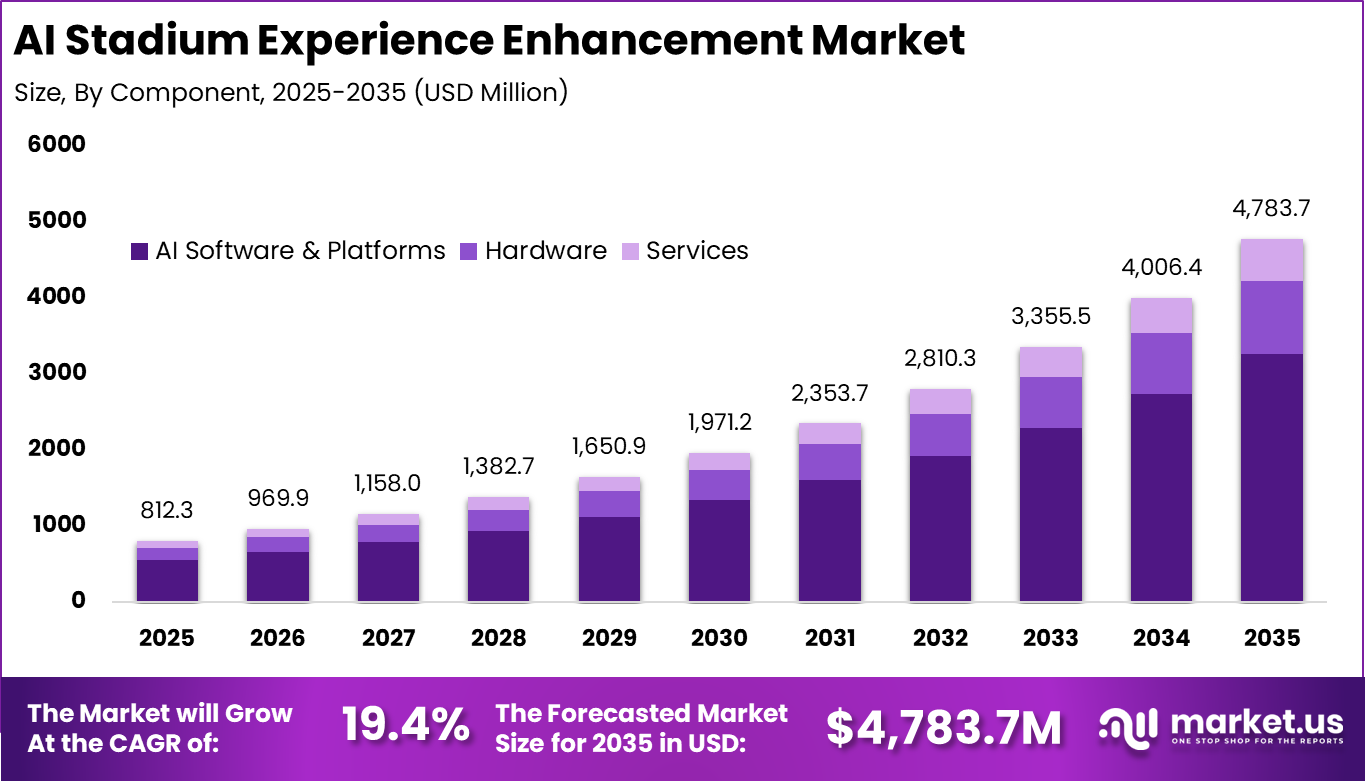
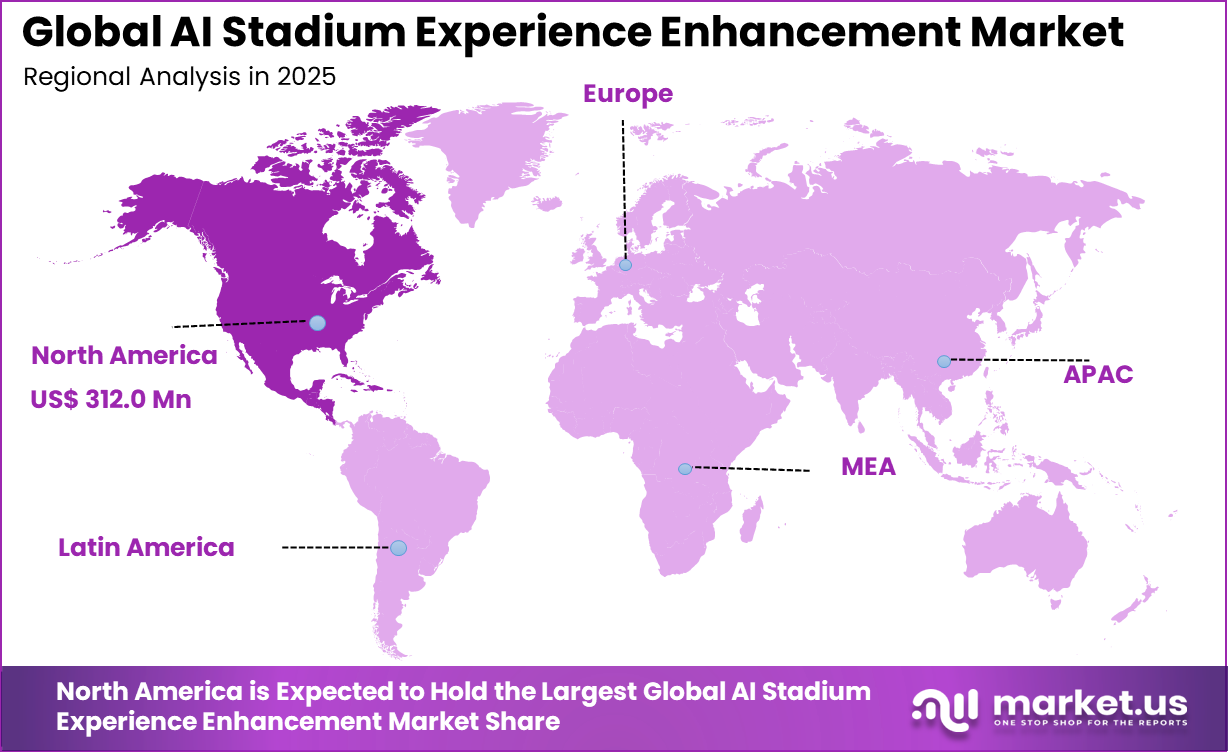
The Global AI Stadium Experience Enhancement Market size is expected to be worth around USD 4,783.7 million by 2035, from USD 812.3 million in 2025, growing at a CAGR of 19.4% during the forecast period from 2025 to 2035. North America held a dominant market position, capturing more than a 38.41% share, holding USD 312.0 million in revenue.
The AI Stadium Experience Enhancement market refers to the use of artificial intelligence technologies to improve fan engagement, operational efficiency, and overall visitor experience within sports and entertainment venues. These solutions integrate AI with stadium infrastructure such as cameras, sensors, mobile applications, and digital screens to analyze crowd behavior, personalize services, and optimize event management.
AI systems enable stadium operators to deliver real-time insights that improve fan comfort, safety, and entertainment value during live events. The adoption of AI in stadium environments has increased as sports organizations aim to create immersive and digitally connected experiences for spectators. Modern stadiums are evolving into smart venues where data analytics, facial recognition, predictive crowd management, and automated services help enhance fan satisfaction while improving operational performance.
Demand for AI in fan engagement continues to grow as younger audiences look for technology driven experiences inside stadiums. Mobile tools that provide directions, instant highlights, and tailored content make events more interactive. Around 45% more fans engage with stadium apps when AI recommends content related to their favorite players. Smart crowd sensors also improve entry and exit movement, supporting about 25% faster fan flow.
For instance, in October 2025, Deltatre expanded its AI‑driven fan‑engagement platform to North America, adding real‑time video‑clip generation, automated highlight packages, and AI‑guided content triggers for stadium apps. The move positions Deltatre as a key European‑based provider of AI‑content tools for U.S. sports leagues and venues.
Key Takeaway
- AI Software and platforms accounted for 68.4% of the market by component, indicating strong reliance on intelligent analytics and automation systems in stadium operations.
- Fan engagement represented 41.7% of the market by application, highlighting the growing use of AI to enhance real time audience interaction and personalized experiences.
- Computer vision held 52.8% share by technology, reflecting its wide use in crowd monitoring, security management, and automated event analytics.
- New smart stadiums captured 58.3% of the market by stadium type, supported by increased investment in digitally connected sports infrastructure.
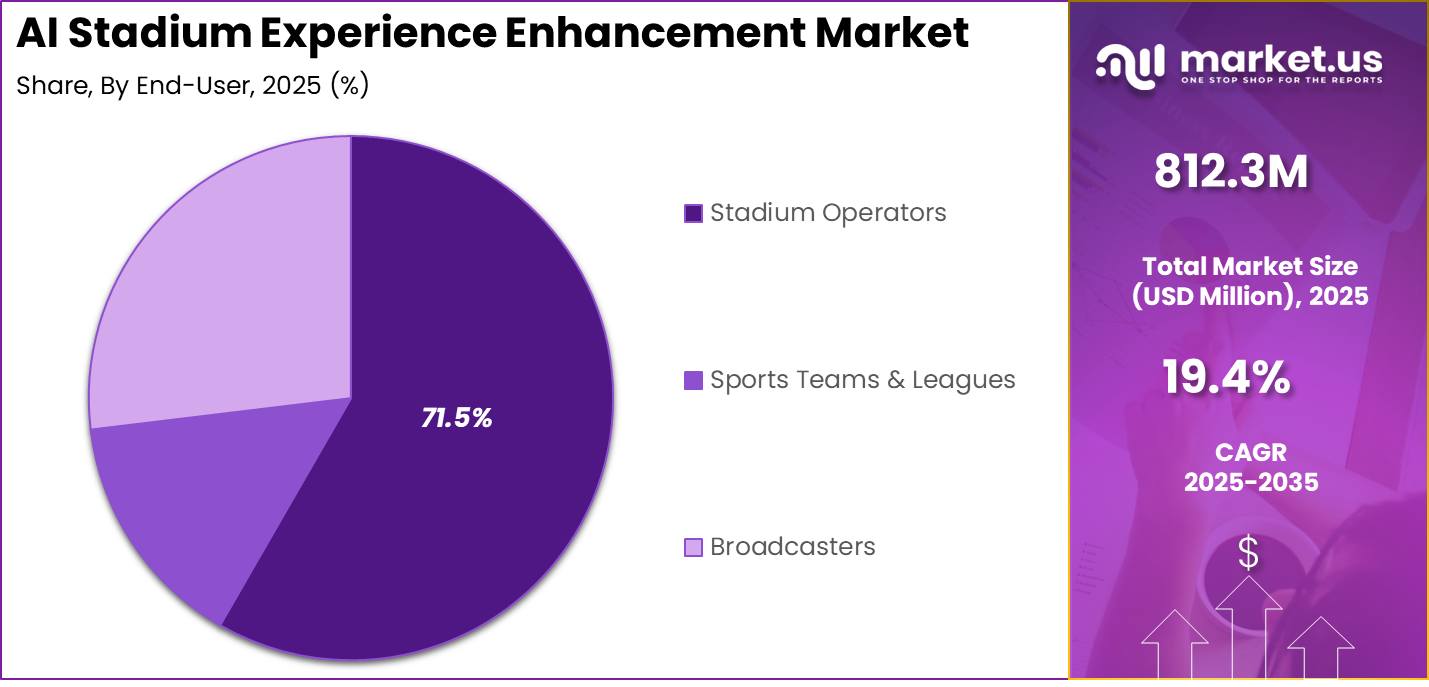
- Stadium operators dominated the end user segment with 71.5% share, as these organizations continue adopting AI solutions to improve operational efficiency and fan satisfaction.
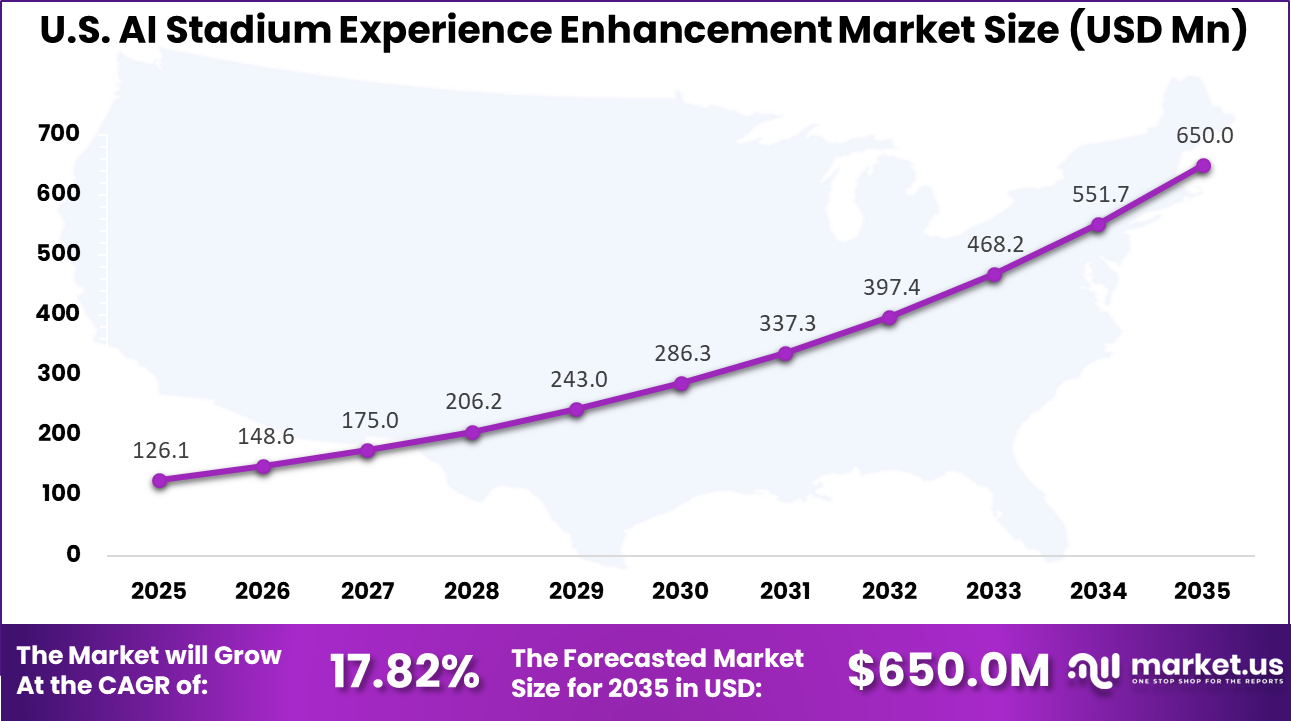
- North America accounted for 38.41% of the global market, with the United States generating USD 126.1 Mn and expected to expand at a CAGR of 17.82%.
Key Insights Summary
- Fan Adoption and Trust 85% of fans recognize value in AI integration within stadium experiences, while 59% express trust in AI generated content.
- Operational Efficiency AI enabled facial recognition has improved stadium entry and transaction processes, with one Intuit Dome case reducing entry time from 30 minutes to under 2 minutes.
- Engagement Tools 73% of fans use mobile applications for match updates and services, while 51% rely on AI curated video highlights for personalized viewing.
- Value and Monetization 27% of fans indicate willingness to pay more for AI enhanced viewing and interactive stadium experiences.
- Top Priorities for AI Features Real time game updates are prioritized by 35% of fans, followed by personalized content experiences selected by 30%.
Role of Generative AI
Role of Generative AI in Stadium Experience Enhancement: Generative AI plays an important role in transforming how fans experience live sporting events. It allows stadium platforms to produce personalized content such as custom highlight clips, tailored match updates, and real time commentary based on individual fan interests. Surveys show that nearly 65% of fans now expect such personalized digital experiences during live games.
Generative AI also supports creative engagement features inside stadium environments. Fans can explore AI generated crowd chants, interactive displays, and virtual merchandise try-ons that enhance participation during matches. Early stadium deployments indicate around a 40% rise in fan satisfaction scores where these tools operate, helping venues strengthen emotional connections with spectators.
Investment and Business Benefits
Investment interest is rising in AI based security and fan engagement technologies within sports venues. Intelligent camera systems identify potential risks early and help reduce incidents by nearly 30%, strengthening stadium safety standards. Investors also focus on predictive fan applications that help sponsors achieve about 25% to 40% higher returns from targeted engagement, while scalable sensor networks create opportunities for smaller arenas.
AI supported stadium systems deliver operational and commercial benefits for sports venues. Personalized digital services encourage fans to remain inside the stadium longer, increasing spending on merchandise and refreshments. Operational improvements also appear through around 30% shorter waiting times at service areas. Stronger engagement helps maintain loyalty, with nearly 40% more fans returning for future matches and events.
By Component
AI software and platforms account for 68.4% of the market, reflecting the growing reliance on digital systems that manage fan interaction, security monitoring, and operational analytics. These platforms integrate multiple data streams from ticketing systems, mobile applications, cameras, and sensors to deliver real time insights. Stadium operators use AI platforms to improve decision making related to crowd flow, concession demand, and facility operations.
The dominance of software solutions is also supported by their ability to scale across multiple stadium facilities and event types. AI platforms enable predictive analytics that help optimize staffing, parking management, and service delivery. As sports venues continue to adopt connected technologies, AI software platforms remain central to enhancing stadium operations and fan experiences.
For Instance, in January 2026, IBM launched a new AI software toolkit for stadium data processing at a sports tech conference. This update lets venues handle real-time crowd info and personalize vendor displays smoothly. Operators find it easier to cut wait times by 20%, drawing more fans back regularly. The tool integrates with existing systems without major overhauls, which keeps costs in check.
By Application
Fan engagement represents 41.7% of market applications, highlighting the importance of interactive experiences in modern sports venues. AI driven engagement tools allow fans to access personalized content, real time statistics, and interactive features through mobile applications and digital displays. These platforms improve the overall entertainment experience by connecting fans more closely with live events.
Stadium operators also use AI to analyze fan behavior and preferences to design targeted promotional campaigns. Personalized recommendations for merchandise, food services, and event activities help increase revenue opportunities. As sports organizations focus on delivering immersive experiences, AI powered fan engagement tools continue to gain widespread adoption.
For instance, in November 2025, Stats Perform debuted an AI-driven app feature for live game highlights tailored to user preferences. Fans get instant clips based on their favorite players right on their phones. This keeps remote viewers hooked longer, with usage jumping in beta trials. It builds loyalty through simple, timely content.
By Technology
Computer vision accounts for 52.8% of the technology segment due to its ability to analyze visual data from stadium cameras and monitoring systems. AI powered vision systems help detect crowd density, monitor security conditions, and track movement patterns within stadium facilities. These capabilities support improved safety management and operational planning.
Computer vision technology also enables features such as automated entry systems, facial recognition based ticket validation, and queue management. Real time visual analytics help stadium operators respond quickly to changing crowd conditions. As stadium security and operational efficiency become critical priorities, computer vision technologies remain widely adopted.
For Instance, in December 2025, Hawk-Eye Innovations expanded its computer vision system for crowd monitoring in European stadiums. Cameras now spot unsafe densities early and alert staff quietly. Safety improved without disrupting the vibe, and fans felt more secure. It’s a quiet game-changer for busy venues.
By Stadium Type
New smart stadiums represent 58.3% of the market, reflecting the growing number of venues designed with integrated digital infrastructure. These facilities incorporate high speed connectivity, sensor networks, and AI enabled monitoring systems from the initial design stage. Smart stadium architecture allows seamless integration of digital services that enhance both operations and fan engagement.
New stadium developments increasingly prioritize data driven management systems that support automated lighting, climate control, and security monitoring. AI platforms coordinate these systems to improve efficiency and sustainability. As cities and sports organizations invest in modern stadium infrastructure, smart stadiums continue to drive market expansion.
For Instance, in October 2025, Siemens broke ground on a smart stadium project with built-in AI sensors from day one. The design routes fans efficiently and adjusts the climate per section. Builders aim for full operation by next season, promising hassle-free visits. Excitement builds around its seamless flow.
By End User
Stadium operators account for 71.5% of market adoption due to their responsibility for managing venue operations and fan services. These organizations deploy AI technologies to improve security management, operational coordination, and customer experience. Intelligent systems allow operators to monitor stadium conditions and respond quickly during live events.
Operators also use AI platforms to analyze attendance patterns and optimize service delivery across large venues. Insights derived from AI analytics help improve crowd movement, reduce waiting times, and enhance safety measures. As stadium management becomes more technology driven, operators remain the primary adopters of AI based stadium enhancement solutions.
For Instance, in January 2026, Honeywell unveiled an AI suite for energy management in operator dashboards. It tweaks HVAC and lights based on occupancy, saving power without comfort loss. Operators cut bills noticeably in pilots. Daily use feels straightforward, like flipping a smart switch.
By Region
North America holds 38.41% of the market share, supported by advanced sports infrastructure and high adoption of digital entertainment technologies. Major sports leagues and stadium operators in the region have implemented AI driven systems to enhance fan experiences and operational performance. Investments in smart venue technology and high speed connectivity have accelerated regional adoption.
For instance, in October 2025, Cisco deployed AI-powered networking at SoFi Stadium, enabling real-time crowd analytics and seamless 5G connectivity for 70,000 fans. Their solutions cut latency by 40%, reinforcing North America’s dominance in smart stadium infrastructure and immersive fan experiences.
Within North America, the United States contributes USD 126.1 million with a growth rate of 17.82%. The presence of large professional sports leagues and technologically advanced stadium facilities has strengthened national market development. Continued innovation in AI driven fan engagement and stadium management technologies is expected to sustain market growth across the region.
For instance, in January 2026, IBM renewed its long-term partnership with Wimbledon, leveraging WatsonX AI to create personalized fan experiences like Match Chat and Live Likelihood to Win. This boosted app engagement by 19% during the 2025 Championships, showcasing U.S. leadership in AI-driven stadium digital enhancements.
Growth Factors
One of the primary growth factors in the AI Stadium Experience Enhancement market is the increasing demand for interactive and personalized fan experiences. Sports fans expect more than traditional viewing experiences and seek digital engagement such as real-time statistics, personalized recommendations, and interactive content delivered through mobile applications and smart displays.
Surveys show that about 62% of regular stadium attendees want mobile apps capable of adjusting recommendations and updates instantly based on their preferences. AI systems analyze fan preferences and behavior patterns to deliver tailored services that enhance engagement during events.
Another growth factor is the modernization of stadium infrastructure. Sports venues worldwide are investing in smart technologies such as IoT sensors, high-speed connectivity, and advanced analytics platforms. These technologies create a data-rich environment that allows AI solutions to monitor crowd movement, optimize service delivery, and improve operational planning.
Emerging Trends
One emerging trend in this market is the use of computer vision for crowd analytics and security management. AI-powered cameras can monitor crowd density, identify unusual activity, and assist security teams in maintaining a safe environment during large-scale events. These systems improve safety while enabling stadium operators to manage crowd flow more efficiently.
Another trend is the integration of augmented reality and immersive digital experiences. Fans can access interactive content through mobile devices or smart glasses, allowing them to view player statistics, instant replays, and enhanced visual elements during live events. This integration transforms stadium visits into more engaging and technologically advanced entertainment experiences.
Key Market Segments
By Component
- AI Software & Platforms
- Hardware
- Services
By Application
- Fan Engagement
- Operational Efficiency
- Security & Safety
- In-Stadium Commerce
- Others
By Technology
- Computer Vision
- Natural Language Processing
- Predictive Analytics
- Others
By Stadium Type
- New Smart Stadiums
- Legacy Stadium Retrofits
By End-User
- Stadium Operators
- Sports Teams & Leagues
- Broadcasters
Key Regions and Countries
North America
- US
- Canada
Europe
- Germany
- France
- The UK
- Spain
- Italy
- Russia
- Netherlands
- Rest of Europe
Asia Pacific
- China
- Japan
- South Korea
- India
- Australia
- Singapore
- Thailand
- Vietnam
- Rest of APAC
Latin America
- Brazil
- Mexico
- Rest of Latin America
Middle East & Africa
- South Africa
- Saudi Arabia
- UAE
- Rest of MEA
Driver Analysis
Digital Transformation of Sports Venues
A major driver of the AI Stadium Experience Enhancement market is the digital transformation of sports venues into connected entertainment hubs. Stadium operators are investing in digital platforms that integrate ticketing systems, concession services, navigation assistance, and fan engagement tools. AI technologies analyze this operational data to optimize resource allocation and improve service efficiency during events.
Another driver is the increasing use of mobile applications for fan engagement. Stadium apps provide navigation guidance, real-time event updates, and personalized recommendations. AI algorithms analyze user activity within these platforms to deliver targeted content and promotions, improving fan interaction and satisfaction.
For instance, in August 2025, IBM teamed up with the USTA to launch AI chat features at the US Open, giving fans instant match updates and player insights right on their phones. This move taps into fans’ love for seamless digital ties during live events, keeping them hooked with tailored content that feels personal and timely. It shows how tech firms are fueling the push for stadiums to blend physical and virtual worlds effortlessly.
Restraint Analysis
High Infrastructure Investment
One restraint affecting the AI Stadium Experience Enhancement market is the high cost associated with implementing advanced technology infrastructure. Deploying AI-powered analytics systems, sensors, and high-speed connectivity networks requires significant investment. Smaller venues may face financial constraints that slow adoption of these technologies.
Another restraint involves concerns related to privacy and data protection. AI systems that analyze facial recognition, crowd behavior, and user data must comply with strict privacy regulations. Ensuring responsible data usage while maintaining system effectiveness remains a critical challenge for stadium operators.
For instance, in January 2026, Cisco rolled out a major network upgrade for a European soccer stadium, tackling old cabling that slowed AI sensor rollouts. The project highlighted the tough work of syncing new systems with legacy setups, often delaying fan-facing apps like real-time seating alerts. Teams note these overhauls demand careful planning to avoid game-day hiccups.
Opportunity Analysis
Smart Venue Ecosystems
A significant opportunity lies in the development of fully integrated smart stadium ecosystems. AI platforms can combine data from ticketing systems, crowd analytics, concession services, and security monitoring to create a unified operational framework. This integration enables stadium operators to improve event management, reduce waiting times, and deliver seamless experiences for fans.
Another opportunity involves the expansion of AI-driven monetization strategies. Personalized promotions, targeted merchandise offers, and dynamic pricing for services can increase revenue opportunities for stadium operators. By analyzing fan behavior and purchasing patterns, AI systems enable more effective marketing and sales strategies.
For instance, in March 2025, Siemens installed sensor networks in a new US baseball venue, paving the way for AI to manage crowd flow and energy use more smartly. This build lets operators layer on fan perks like dynamic pricing for food based on wait times. It opens paths for venues to evolve into fully connected spaces that adapt on the fly.
Challenge Analysis
Data Integration and System Interoperability
A key challenge in this market is integrating AI technologies with existing stadium infrastructure. Many venues operate with legacy systems that were not originally designed for advanced analytics or real-time data processing. Integrating new AI platforms with these systems requires technical expertise and coordinated infrastructure upgrades.
Another challenge involves managing large volumes of real-time data generated during live events. AI systems must process information from cameras, sensors, and mobile applications simultaneously. Ensuring reliable performance and accurate insights under high data loads remains a technical challenge for stadium operators.
For instance, in November 2025, Intel shared a framework at a tech conference for secure AI processing in stadium cameras, addressing fears over facial recognition data from crowds. The tool aims to let fans enjoy personalized replays without sharing location details widely. It underscores the need for hardware that builds trust amid rising scrutiny on fan tracking ethics.
Key Players Analysis
The AI Stadium Experience Enhancement Market is driven by global technology companies that provide advanced computing infrastructure, connectivity, and analytics platforms for modern sports venues. IBM, Cisco, Intel, Nvidia, and Hewlett Packard Enterprise provide high performance computing, edge processing, and AI analytics platforms used in stadium environments. These technologies support real time data processing, smart security monitoring, and immersive fan engagement applications.
Industrial technology and smart building solution providers play a major role in stadium automation and operational efficiency. Siemens, Honeywell, and Johnson Controls deliver integrated building management systems and IoT enabled facility controls. These platforms improve energy efficiency, crowd flow management, and safety monitoring within large sports venues.
Sports analytics and media technology firms further strengthen the competitive landscape. Atos, Deltatre, Hawk-Eye Innovations, Pixellot, Stats Perform, Sportradar, and WSC Sports specialize in AI driven video analytics, real time statistics, and automated content generation. These capabilities enhance fan engagement through interactive broadcasts and digital media platforms.
Top Key Players in the Market
- IBM
- Cisco
- Intel
- HPE
- Nvidia
- Siemens
- Honeywell
- Johnson Controls
- Atos
- Deltatre
- Hawk-Eye Innovations
- Pixellot
- Stats Perform
- Sportradar
- WSC Sports
- Others
Recent Developments
- In February 2026, Intel launched edge AI processors optimized for stadium 360° video analytics at MLB venues. Processing 10,000 camera feeds simultaneously, their solution delivers instant player stats overlays and personalized AR content directly to fan mobile devices.
- In March 2026, Nvidia powered the world’s first 8K AI livestream from a European soccer stadium, using GPU clusters for real-time highlight generation. Their Omniverse platform enables broadcasters to create immersive multi-angle replays 5x faster than traditional methods.
Report Scope
Report Features Description Market Value (2025) USD 812.3 Mn Forecast Revenue (2035) USD 4,783.7 Mn CAGR (2026-2035) 19.4% Base Year for Estimation 2025 Historic Period 2020-2024 Forecast Period 2026-2035 Report Coverage Revenue forecast, AI impact on Market trends, Share Insights, Company ranking, competitive landscape, Recent Developments, Market Dynamics and Emerging Trends Segments Covered By Component (AI Software & Platforms, Hardware, Services), By Application (Fan Engagement, Operational Efficiency, Security & Safety, In-Stadium Commerce, Others), By Technology (Computer Vision, Natural Language Processing, Predictive Analytics, Others), By Stadium Type (New Smart Stadiums, Legacy Stadium Retrofits), By End-User (Stadium Operators, Sports Teams & Leagues, Broadcasters) Regional Analysis North America – US, Canada; Europe – Germany, France, The UK, Spain, Italy, Russia, Netherlands, Rest of Europe; Asia Pacific – China, Japan, South Korea, India, New Zealand, Singapore, Thailand, Vietnam, Rest of Latin America; Latin America – Brazil, Mexico, Rest of Latin America; Middle East & Africa – South Africa, Saudi Arabia, UAE, Rest of MEA Competitive Landscape IBM, Cisco, Intel, HPE, Nvidia, Siemens, Honeywell, Johnson Controls, Atos
Deltatre, Hawk-Eye Innovations, Pixellot, Stats Perform, Sportradar, WSC Sports, OthersCustomization Scope Customization for segments, region/country-level will be provided. Moreover, additional customization can be done based on the requirements. Purchase Options We have three license to opt for: Single User License, Multi-User License (Up to 5 Users), Corporate Use License (Unlimited User and Printable PDF)  AI Stadium Experience Enhancement MarketPublished date: March 2026add_shopping_cartBuy Now get_appDownload Sample
 -
-
- IBM
- Cisco
- Intel
- HPE
- Nvidia
- Siemens
- Honeywell
- Johnson Controls
- Atos
- Deltatre
- Hawk-Eye Innovations
- Pixellot
- Stats Perform
- Sportradar
- WSC Sports
- Others
Our Clients

- 180370
- March 2026