Global AI Quiz Generator Market Size, Share and Analysis Report By Deployment Mode (Cloud-based, On-Premises), By End-User (Education, Training & Development, Recruitment & Hiring, Entertainment, Others), By Pricing Model (Freemium, Subscription, Others), By Regional Analysis, Global Trends and Opportunity, Future Outlook By 2025-2035
- Published date: Feb. 2026
- Report ID: 179680
- Number of Pages: 255
- Format:
-
keyboard_arrow_up
Quick Navigation
Report Overview
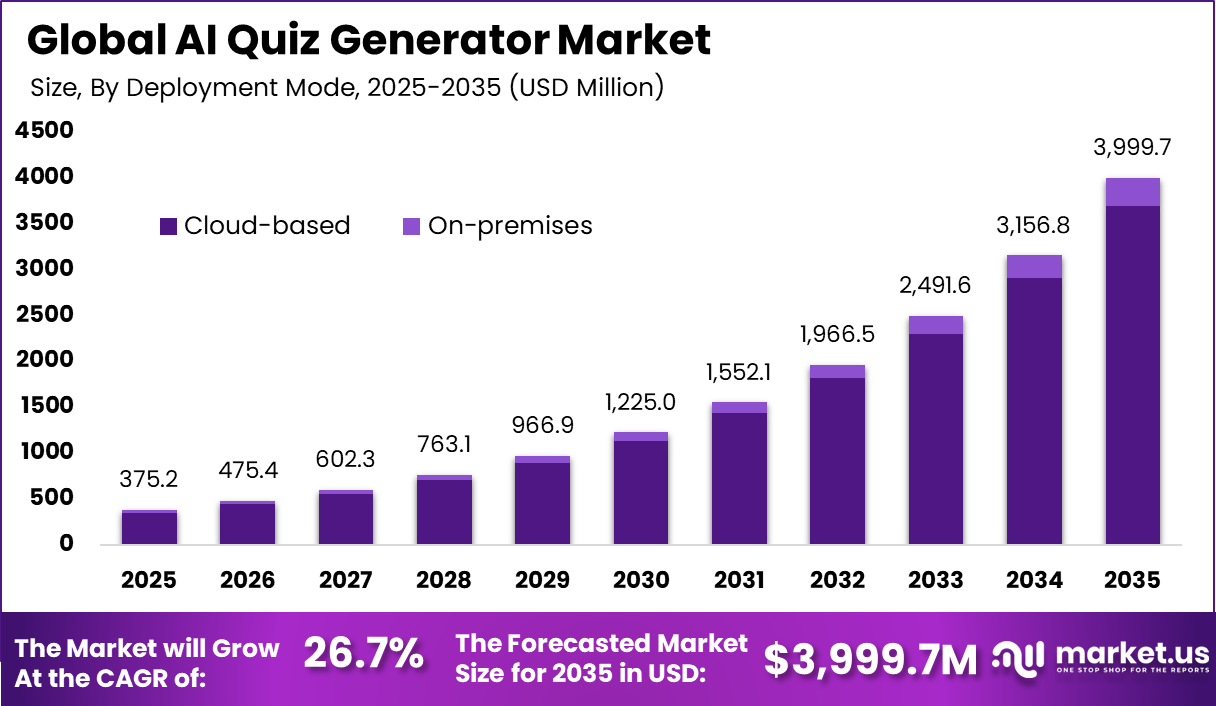
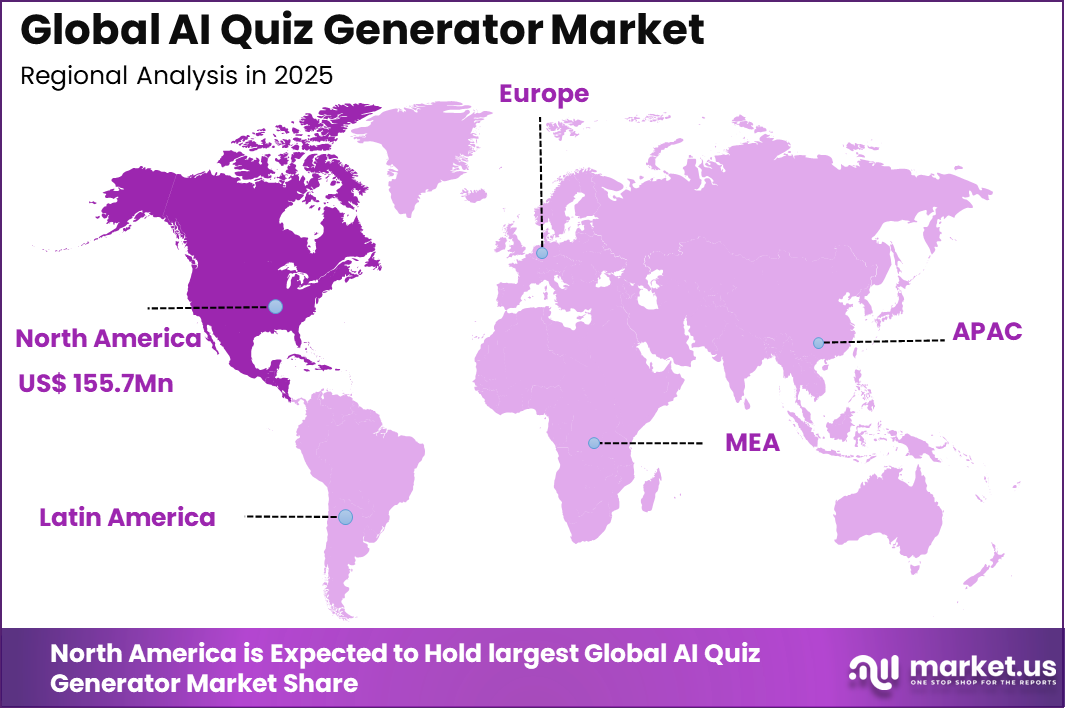
The Global AI Quiz Generator Market size is expected to be worth around USD 3,999.7 Million By 2035, from USD 375.2 Million in 2025, growing at a CAGR of 26.7% during the forecast period from 2026 to 2035. North America held a dominant Market position, capturing more than a 41.5% share, holding USD 155.7 Million revenue.
The AI Quiz Generator Market has emerged as a critical segment within digital education and assessment technology. The market is driven by the rapid shift toward digital learning environments and automated content creation tools. Educational institutions, corporate training departments, and online learning platforms are increasingly relying on artificial intelligence to create instant, customized quizzes. This shift is supported by rising internet penetration and widespread use of smart devices across global regions.
The demand for AI-powered quiz generation is being strengthened by the need for scalable and cost-efficient assessment methods. Manual quiz preparation is time consuming and resource intensive, especially for large academic institutions and enterprises. AI systems enable automatic question creation from text, videos, and structured data, reducing preparation time significantly. As digital education continues to expand, the adoption of AI-based content tools is expected to remain strong.
One of the primary driving factors is the acceleration of e-learning adoption worldwide. Global education systems have integrated digital classrooms, learning management systems, and remote assessment tools. AI quiz generators are being deployed to support continuous evaluation and adaptive learning models. The need for real-time performance analytics further enhances the value of these solutions.
Demand for AI quiz generator platforms is particularly strong within academic institutions and corporate learning environments. Schools and universities are integrating automated assessments into blended learning models. These tools allow instructors to quickly generate subject-specific quizzes aligned with curriculum standards. The result is improved teaching productivity and consistent evaluation frameworks.
The integration of natural language processing and machine learning technologies is transforming the AI quiz generator landscape. These technologies enable systems to analyze long documents, lecture transcripts, and web content to produce relevant questions automatically. Large language models enhance contextual understanding, ensuring higher question quality and relevance. Continuous improvements in AI accuracy are strengthening market confidence.
Top Market Takeaways
- Cloud-based deployment accounts for 92.3%, reflecting strong preference for scalable and remotely accessible platforms.
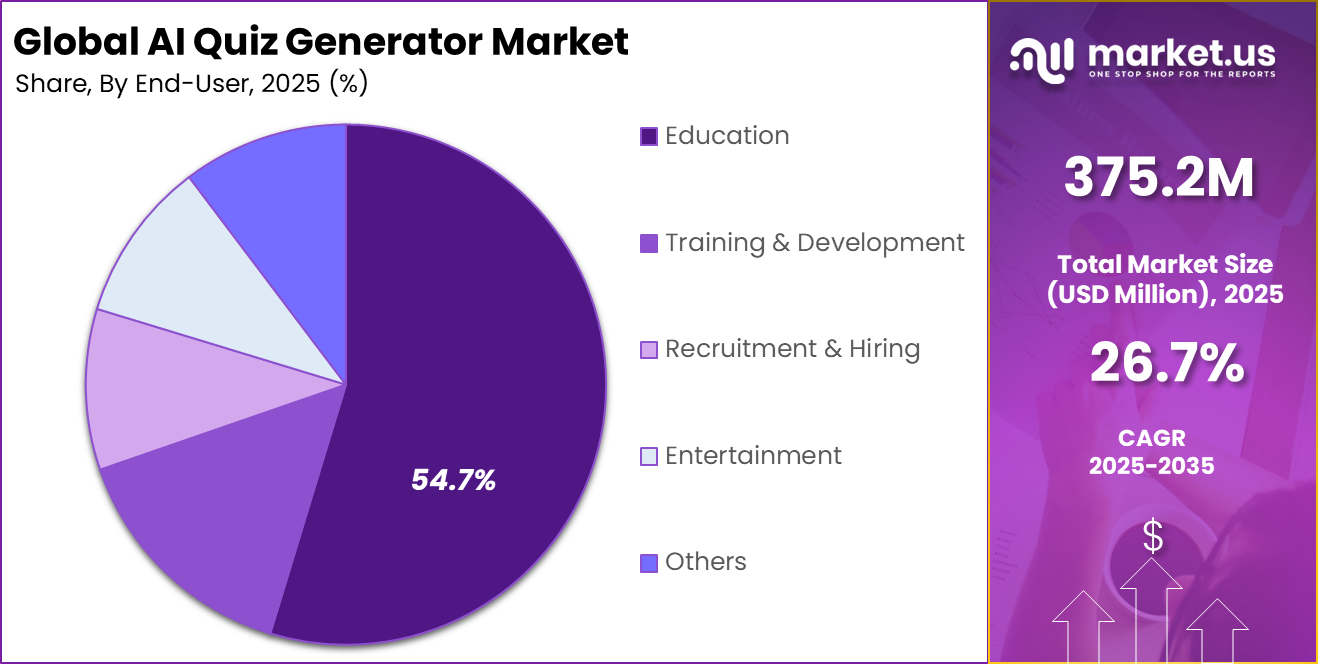
- Education represents 54.7% of total end-user adoption, highlighting the sector’s central role in digital assessment growth.
- Subscription pricing dominates with 65.8%, indicating steady recurring revenue models across providers.
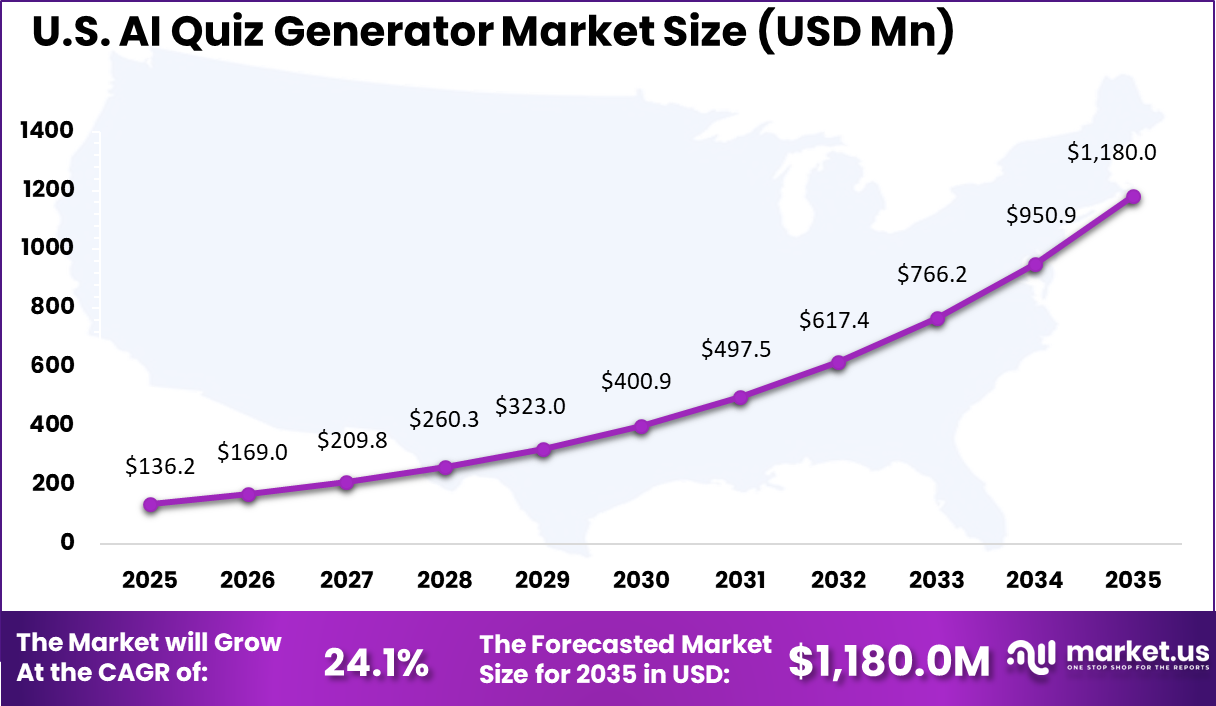
- North America holds 41.5% of the market, while the United States accounts for 136.2 million users, supported by a CAGR of 24.1% driven by rapid EdTech integration.
By Deployment Mode
Cloud based deployment accounts for 92.3% of total adoption in the AI Quiz Generator Market. This dominance reflects strong demand for scalable platforms that allow educators and organizations to generate quizzes instantly without local infrastructure. Cloud environments support real time content creation and multi user access.
The preference for cloud deployment is also driven by accessibility. Teachers and administrators can create, edit, and distribute quizzes from any location. This flexibility supports remote learning and hybrid education models.
Cloud platforms further enable continuous feature updates and AI model improvements. Automated updates enhance question accuracy and personalization capabilities. These advantages sustain cloud based deployment as the dominant model.
By End User
The education sector represents 54.7% of total end user demand. Schools, universities, and training institutes increasingly rely on AI tools to automate assessment creation. AI quiz generators reduce the time required to prepare structured evaluation materials. Adoption within education is driven by rising digital learning integration.
Institutions seek tools that adapt to different learning levels and subject areas. AI powered systems generate varied question types aligned with curriculum standards. Educational institutions also value analytics features. Performance tracking and automated grading improve learning outcomes. These benefits maintain strong demand from the education segment.
By Pricing Model
Subscription based pricing accounts for 65.8% of total market adoption. This dominance reflects the preference for recurring access models that provide continuous updates and support. Institutions benefit from predictable budgeting and scalable usage. The subscription model also enables tiered service structures. Users can select plans based on feature requirements and quiz generation volume.
This flexibility aligns with diverse educational needs. Continuous AI improvements and feature enhancements are included within subscription packages. Regular updates maintain system relevance and performance. These factors reinforce subscription based pricing as the leading model.
Regional Analysis
North America holds a leading position in the AI Quiz Generator Market, accounting for 41.5% of total activity. The region benefits from strong digital education adoption and advanced cloud infrastructure. Educational institutions actively integrate AI tools into teaching processes. High awareness of adaptive learning technologies further supports adoption. Institutions prioritize efficiency and data driven assessment strategies. These factors sustain North America’s dominant regional role.
The United States represents the largest contributor within North America, with a market value of USD 136.2 Million and a growth rate of 24.1% CAGR. Expansion is supported by widespread use of digital learning platforms and demand for automated assessment tools. AI quiz generators are increasingly embedded into classroom workflows.
U.S. institutions focus on personalized learning and performance analytics. AI driven tools help improve engagement and evaluation efficiency. These dynamics collectively support strong growth in the U.S. market segment.
Key Market Segments
By Deployment Mode
- Cloud-based
- On-Premises
By End-User
- Education
- Training & Development
- Recruitment & Hiring
- Entertainment
- Others
By Pricing Model
- Freemium
- Subscription
- Others
Regional Analysis and Coverage
- North America
- US
- Canada
- Europe
- Germany
- France
- The UK
- Spain
- Italy
- Russia
- Netherlands
- Rest of Europe
- Asia Pacific
- China
- Japan
- South Korea
- India
- Australia
- Singapore
- Thailand
- Vietnam
- Rest of Latin America
- Latin America
- Brazil
- Mexico
- Rest of Latin America
- Middle East & Africa
- South Africa
- Saudi Arabia
- UAE
- Rest of MEA
Emerging Trend Analysis
The AI Quiz Generator market is currently experiencing an emerging trend towards automated content creation using generative artificial intelligence models. These models analyze text, documents, or presentations and produce tailored quiz questions in formats such as multiple choice, true or false, short answer and more within seconds.
This automated generation reduces the workload for educators and trainers by transforming existing materials directly into assessments without manual effort. Such capabilities increase efficiency in the creation of learning content and allow organizations to scale their assessment processes rapidly while maintaining consistency in question quality and relevance. The integration of these AI tools into existing learning management systems and productivity platforms is also gaining traction.
Providers are embedding quiz generator features into platforms for document handling, presentation tools, and form builders, which supports seamless workflow integration for educators and corporate trainers. This trend reflects broader adoption of generative AI technologies that support automated content creation across business and educational domains, enhancing user engagement and learner outcomes through interactive assessment experiences.
Driver Analysis
A key driver for the AI Quiz Generator market is the increasing demand for personalized and interactive learning experiences. Educational institutions and e learning providers are shifting towards adaptive assessments that respond to individual learner needs and performance levels.
AI quiz generators automate this process, enabling rapid creation of customized quizzes that are aligned with specific learning objectives and topics. This capability reduces the administrative burden on educators and improves the quality of learner engagement by providing assessments that are relevant and tailored.
In addition to education, businesses adopt these tools to support training, employee assessment and recruitment processes. Human resources and talent development teams require effective methods to evaluate skills and knowledge across large groups, and AI driven quiz tools provide efficient and scalable solutions for objective assessment creation.
Restraint Analysis
One restraint in this market is concerns around content accuracy and educational effectiveness. While AI models can generate quiz questions quickly, ensuring these questions are valid, unbiased, and aligned with curriculum standards remains a challenge. Educators and trainers often need to review and edit AI generated content to maintain quality, which introduces additional time and effort investments.
Data privacy issues also constrain adoption in contexts where sensitive information may be uploaded or processed by AI systems. Organizations must implement robust governance practices to ensure that learner data and proprietary content are protected during the quiz generation process. Regulatory compliance and internal policies around data handling can therefore limit the speed at which these tools are adopted, especially in regulated industries.
Opportunity Analysis
A significant opportunity exists in expanding the use of AI quiz generators beyond traditional education into corporate training and professional certification. Companies are increasingly investing in continuous learning and skills development, and automated quiz tools can support frequent knowledge checks and certification preparation.
Integration with analytics platforms enables deeper insights into learner performance trends, identifying skill gaps and informing targeted training interventions. There is also opportunity in enhancing language support and contextual adaptation for diverse global markets.
Tools that can generate quizzes in multiple languages and adapt content to regional educational standards can unlock new user segments in international education and corporate training. This expansion supports broader accessibility and increases the overall utility of AI driven quiz creation technologies.
Challenge Analysis
A major challenge for the AI quiz generator market is maintaining academic integrity and fairness. Automated question generation can occasionally produce ambiguous or incorrect items, which may mislead learners or skew assessment results. Educators and test designers must implement quality control measures to ensure fairness and reliability, which can counteract some of the time savings offered by automation.
Another challenge is competition from general content creation tools that include basic quiz features as part of broader productivity suites. These general tools may not offer the depth of customization or analytical insights required by advanced assessment needs, making it difficult for specialized quiz providers to differentiate their offerings. Organizations therefore face decisions about tool selection based on integration, cost, and analytical capabilities.
Competitive Analysis
The competitive landscape of the AI Quiz Generator Market is moderately fragmented, with numerous specialized providers offering SaaS-based solutions. Companies such as OpExams, Quizbot, Questgen, and QuestionWell focus on automated question creation powered by natural language processing. These platforms emphasize ease of use and integration with learning management systems. Continuous product upgrades are common strategies to retain subscribers.
Interactive learning providers including Vevox, Wooclap, Quizizz, and ClassPoint combine quiz generation with live classroom engagement tools. Their platforms support real-time polling, gamified assessments, and analytics dashboards. This integrated approach enhances student participation and classroom interaction. Competitive differentiation is often based on user interface quality and analytics depth.
Other emerging players such as Quizcube, Fillout, Quizgecko, Revisely, Testportal, Quiz Ai, Yippity, Conker, Interact AI, and Taskade are expanding feature sets to address niche segments. Some focus on enterprise training, while others target academic exam preparation. Innovation cycles are rapid, with frequent updates to AI algorithms and customization features. Market competition is expected to intensify as adoption rates continue to grow across global regions.
Top Key Players in the Market
- OpExams
- Quizbot
- Questgen
- QuestionWell
- Vevox
- Quizcube
- Fillout
- Quizgecko
- Revisely
- Testportal
- Wooclap
- Quizizz
- Quiz Ai
- ClassPoint
- Yippity
- Conker
- Interact AI
- Taskade
- Others
Recent Developments
- In March 2025, OpExams rolled out enhanced multilingual support, allowing quizzes in over 20 languages to better serve global users. This update came alongside a partnership with a major edtech platform, boosting its integration option.
- In April 2025, QuestionWell launched a mobile app version, making on-the-go quiz creation a reality for busy educators. They also partnered with textbook publishers that month for pre-loaded content libraries. By February 2026, feedback-driven updates improved question randomization for fairer testing.
Report Scope
Report Features Description Market Value (2025) USD 375.2 Mn Forecast Revenue (2035) USD 3,999.7 Mn CAGR (2026-2035) 26.7% Base Year for Estimation 2025 Historic Period 2020-2024 Forecast Period 2026-2035 Report Coverage Revenue forecast, AI impact on Market trends, Share Insights, Company ranking, competitive landscape, Recent Developments, Market Dynamics and Emerging Trends Segments Covered By Deployment Mode (Cloud-based, On-Premises), By End-User (Education, Training & Development, Recruitment & Hiring, Entertainment, Others), By Pricing Model (Freemium, Subscription, Others) Regional Analysis North America – US, Canada; Europe – Germany, France, The UK, Spain, Italy, Russia, Netherlands, Rest of Europe; Asia Pacific – China, Japan, South Korea, India, New Zealand, Singapore, Thailand, Vietnam, Rest of Latin America; Latin America – Brazil, Mexico, Rest of Latin America; Middle East & Africa – South Africa, Saudi Arabia, UAE, Rest of MEA Competitive Landscape OpExams, Quizbot, Questgen, QuestionWell, Vevox, Quizcube, Fillout, Quizgecko, Revisely, Testportal, Wooclap, Quizizz, Quiz Ai, ClassPoint, Yippity, Conker, Interact AI, Taskade, Others Customization Scope Customization for segments, region/country-level will be provided. Moreover, additional customization can be done based on the requirements. Purchase Options We have three license to opt for: Single User License, Multi-User License (Up to 5 Users), Corporate Use License (Unlimited User and Printable PDF) 
-
-
- OpExams
- Quizbot
- Questgen
- QuestionWell
- Vevox
- Quizcube
- Fillout
- Quizgecko
- Revisely
- Testportal
- Wooclap
- Quizizz
- Quiz Ai
- ClassPoint
- Yippity
- Conker
- Interact AI
- Taskade
- Others
Our Clients

- 179680
- Feb. 2026