


Global AI-powered Knowledge Base Software Market Size, Share and Analysis By Solutions (Natural Language Search & Q&A, Content Generation & Summarization, Automated Content Tagging & Structuring, Analytics & Usage Insights, Integration & API Management, Others), By Deployment Mode (Cloud-based/SaaS, On-premises), By Organization Size (Large Enterprises, Small and Medium-sized Enterprises), By End-User Industry (IT & Technology, Banking, Financial Services, and Insurance, Retail & E-commerce, Healthcare, Telecommunications, Others), By Application (Customer Service & Support, Internal Employee Support, Product Documentation & Manuals, Sales & Marketing Enablement, Others), By Regional Analysis, Global Trends and Opportunity, Future Outlook By 2025-2035
- Published date: March 2026
- Report ID: 180216
- Number of Pages: 317
- Format:
-
keyboard_arrow_up
Quick Navigation
- Report Overview
- Key Takeaway
- By Solutions
- By Deployment Mode
- By Organization Size
- By End User Industry
- By Application
- By Region
- Role of Generative AI
- Investment and Business Benefits
- Top Emerging Trends
- Growth Factors
- Key Market Segments
- Drivers
- Restraint
- Opportunities
- Challenges
- Key Players Analysis
- Recent Developments
- Report Scope
Report Overview
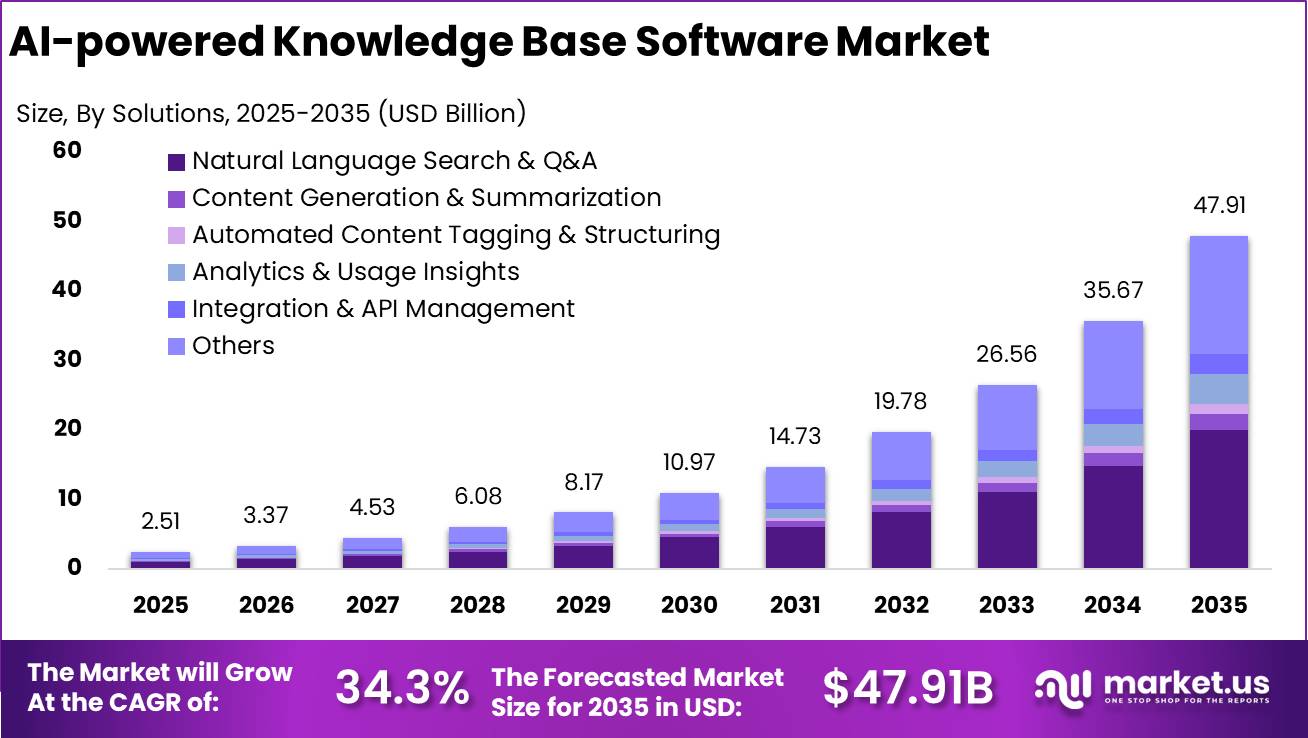
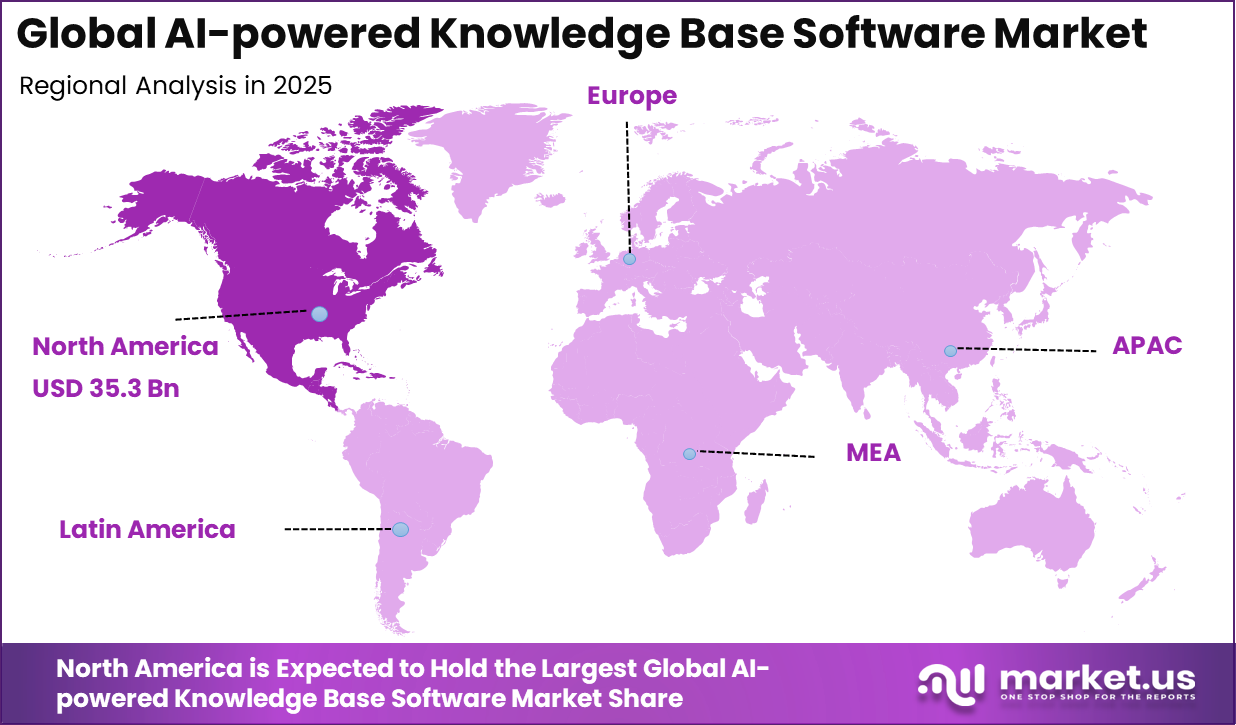
The Global AI-powered Knowledge Base Software Market size is expected to be worth around USD 47.91 billion by 2035, from USD 2.51 billion in 2025, growing at a CAGR of 34.3% during the forecast period from 2025 to 2035. North America held a dominant market position, capturing more than a 35.3% share, holding USD 0.88 billion in revenue.
AI-powered Knowledge Base Software refers to intelligent platforms that use artificial intelligence to organize, understand, and deliver information in a meaningful way. Instead of storing documents in static folders, these systems interpret user queries, learn from interactions, and provide accurate answers within seconds. They support employees and customers by simplifying access to knowledge, improving efficiency, and reducing repetitive manual searches.
Businesses adopt AI-powered knowledge base software as data volumes expand rapidly, with teams managing nearly twice as much information as a decade ago. Employees lose around 20% of their workday searching for files, which directly affects productivity. In remote environments, instant access to verified information supports faster decisions and improves coordination across departments without operational delays.
The market for AI-powered Knowledge Base Software is driven by the growing need for faster and more accurate access to information across organizations. As data volumes expand and customer expectations rise, businesses seek intelligent systems that reduce manual search time and improve service efficiency. Companies adopt these solutions to streamline internal workflows, strengthen self-service support, and ensure consistent knowledge delivery.
AI-powered knowledge base software can enhance organizational productivity by up to 80% and improve customer satisfaction by nearly 30%. Nearly 47% of employees report difficulty in locating the information needed for their tasks. By replacing static or disconnected knowledge systems with automated and intelligent search tools, these platforms enable continuous 24/7 access to accurate information and improve operational efficiency.
Demand remains strong in customer support and healthcare, where response speed shapes outcomes. Support teams report 30% fewer tickets when AI systems resolve routine queries automatically. Healthcare professionals access clinical information 40% faster, reducing reliance on outdated records. Organizations also record higher satisfaction rates as users receive accurate answers quickly, improving both service quality and internal efficiency.
For instance, in October 2025, Helpjuice, Inc. added conversational AI search trained on customer feedback loops, improving answer relevance by 45%. Small businesses praised the intuitive interface. Helpjuice grows steadily in accessible AI knowledge management.
Key Takeaway
- In 2025, the Natural Language Search and Q&A segment led the AI-powered Knowledge Base Software Market with a 41.7% share.
- In 2025, the Cloud-based/SaaS deployment model dominated the market, accounting for 93.5% share.
- In 2025, Large Enterprises held the largest share, capturing 67.4% of the market.
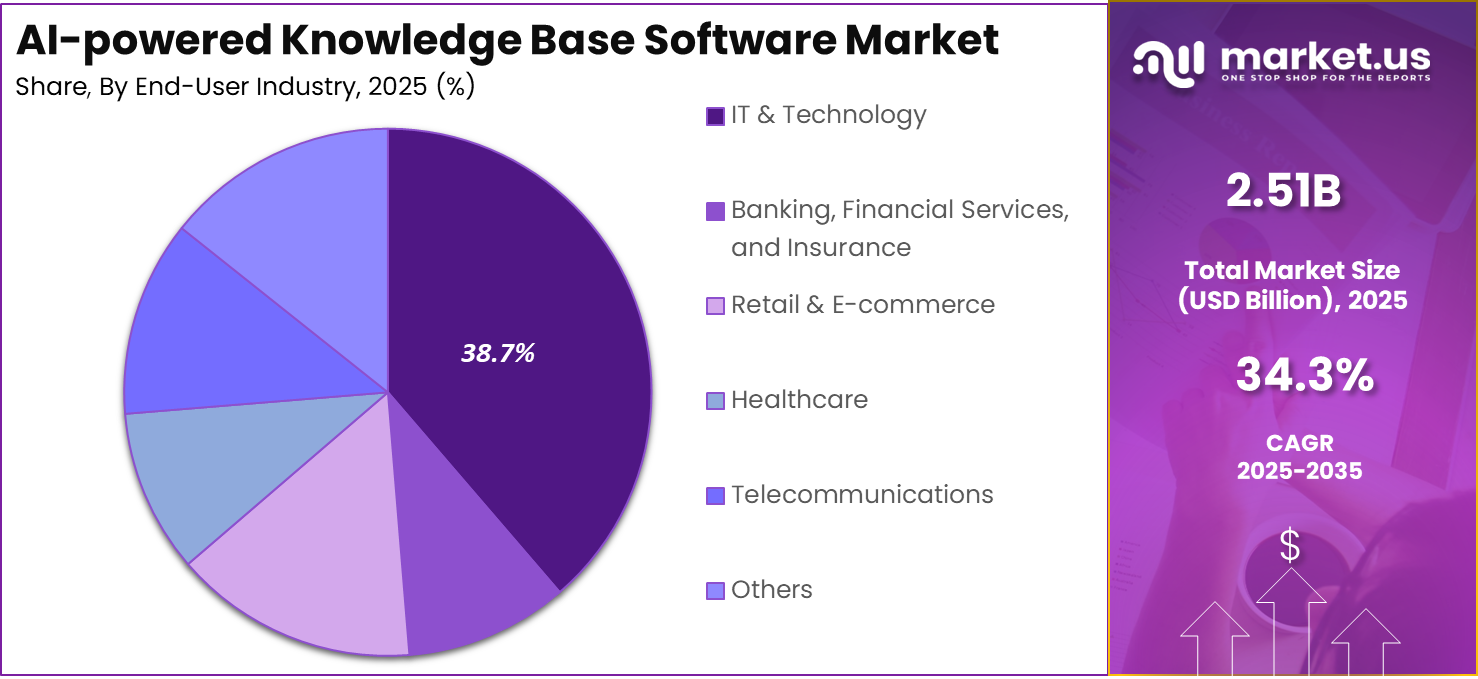
- In 2025, the IT and Technology industry accounted for 38.7% of the AI-powered Knowledge Base Software Market.
- In 2025, Customer Service and Support applications led the market with a 58.3% share.
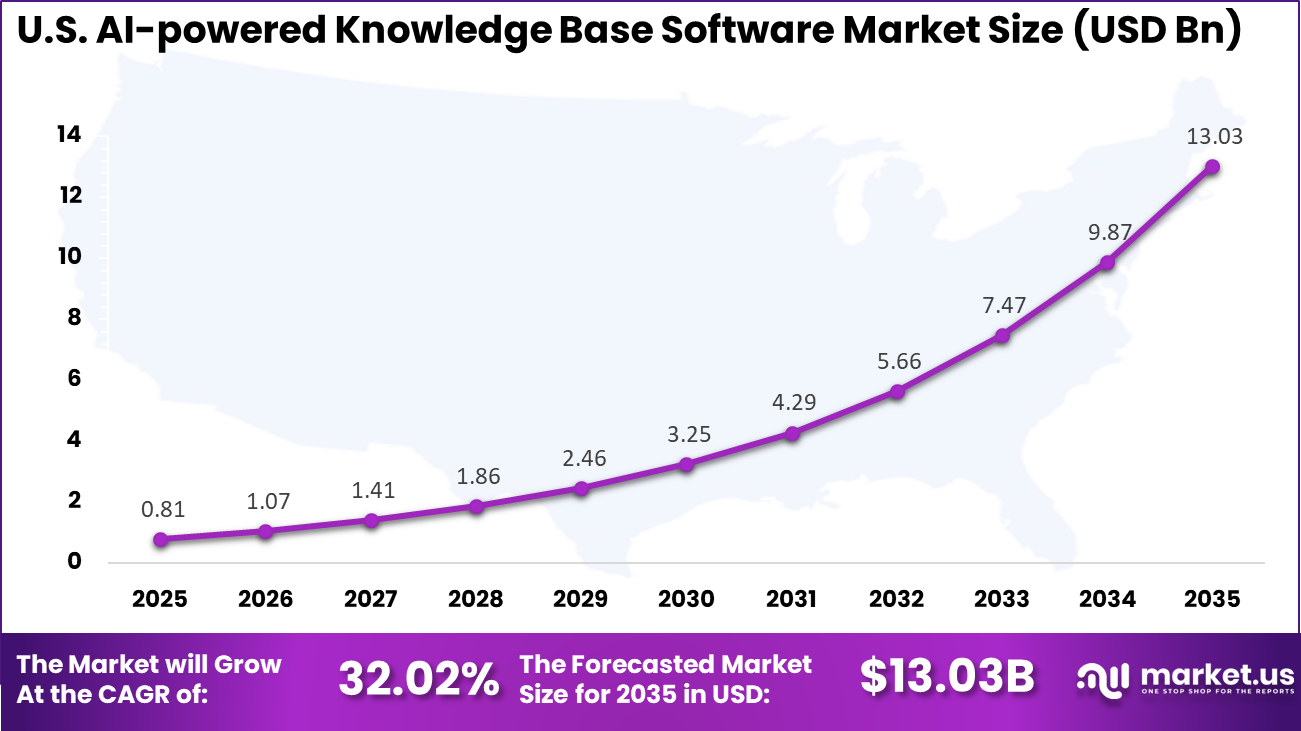
- In 2025, North America held a 35.3% market share, while the U.S. market reached USD 0.81 billion, growing at a 32.02% CAGR.
By Solutions
Natural language search and question and answer solutions account for 41.7% of the market, reflecting the growing demand for conversational knowledge access. These platforms allow users to retrieve information by asking questions in everyday language rather than using complex keyword queries. AI models analyze context, intent, and language patterns to deliver precise responses from enterprise knowledge repositories.
The adoption of natural language search improves employee productivity and reduces time spent locating internal documentation. Knowledge base systems can also recommend relevant articles, guides, and troubleshooting instructions based on user queries. As organizations expand digital documentation, natural language search tools play a key role in simplifying information retrieval.
For Instance, in February 2026, Zendesk launched an AI-driven Q&A upgrade to its knowledge base, letting agents ask plain-language questions for instant article suggestions. It cuts search time by matching context over exact terms, helping support staff resolve issues faster. Early feedback shows higher first-contact resolution rates.
By Deployment Mode
Cloud based and SaaS deployment represents 93.5% of the market, indicating strong enterprise preference for scalable and easily accessible knowledge platforms. Cloud infrastructure enables organizations to centralize knowledge repositories while allowing employees to access information from any location. This capability is particularly important for distributed teams and remote work environments.
SaaS platforms provide continuous updates and advanced AI capabilities without requiring significant internal infrastructure management. Integration with collaboration tools, customer relationship management systems, and service management platforms further strengthens the value of cloud based knowledge solutions. As organizations adopt digital workflows, cloud deployment remains the dominant model.
For instance, in November 2025, Atlassian pushed Confluence Cloud updates with seamless SaaS scaling for AI knowledge tools. Teams deploy without servers, accessing real-time edits from anywhere, which fits remote workflows perfectly. Adoption spiked as companies ditched on-prem setups for this flexibility.
By Organization Size
Large enterprises account for 67.4% of market adoption due to the scale and complexity of their information environments. These organizations manage extensive documentation related to products, services, policies, and operational procedures. AI driven knowledge management platforms help organize this information and ensure employees can quickly locate reliable guidance.
Enterprise wide knowledge bases also support internal training and decision making processes. By providing structured access to verified information, organizations reduce dependency on manual support channels. As enterprises continue to digitize internal processes, large organizations remain the primary adopters of intelligent knowledge base systems.
For Instance, in December 2025, ServiceNow tailored its Vancouver release for enterprise-scale knowledge management, integrating AI across vast IT datasets. Large firms unify siloed info into one searchable hub, streamlining compliance and training. It handles millions of docs without lag, suiting Fortune 500 needs.
By End User Industry
The IT and technology sector represents 38.7% of market adoption because of its heavy reliance on technical documentation and support knowledge. Technology companies manage large libraries of product manuals, troubleshooting guides, and software documentation. AI powered knowledge systems help organize these resources and deliver accurate responses to user queries.
Rapid product development cycles in the technology industry create continuous updates to documentation. Automated knowledge management platforms help ensure that information remains current and accessible. As software ecosystems grow more complex, AI driven knowledge platforms are becoming essential tools for managing technical information.
For Instance, in January 2026, Atlassian bolstered Jira Service Management for IT knowledge bases, with AI surfacing fixes from past tickets. Tech sectors leverage it for codebases and network docs, keeping engineers productive. Usage grew as hybrid IT ops demanded quick, accurate info access.
By Application
Customer service and support applications account for 58.3% of market usage. Organizations deploy knowledge base software to assist support teams in resolving customer inquiries more efficiently. AI systems analyze customer questions and recommend relevant articles or solutions, enabling faster response times.
Self service portals also allow customers to access answers directly without contacting support teams. This improves service efficiency and reduces operational costs for organizations. As businesses prioritize customer experience and digital service channels, AI powered knowledge bases continue to play a central role in support operations.
For Instance, in March 2026, Zendesk added bots to its Sunshine platform, drawing from knowledge articles for self-service support. It routes complex issues to humans seamlessly, easing agent workloads. Companies saw ticket drops by guiding users to answers upfront.
By Region
North America holds 35.3% of the market share due to widespread adoption of enterprise software and digital service platforms. Organizations across technology, finance, and healthcare sectors have implemented AI driven knowledge management systems to improve operational efficiency. Strong investment in artificial intelligence research and cloud infrastructure supports continued regional growth.
For instance, in January 2026, ServiceNow expanded its AI-powered knowledge management in Customer Service Management, enabling autonomous triage across enterprise systems. This Vancouver Summit showcase highlights U.S. innovation, streamlining workflows, and solidifying North American leadership in integrated service intelligence.
Within North America, the United States contributes USD 0.81 billion with a growth rate of 32.02%. High demand for advanced customer service solutions and enterprise automation has strengthened the country’s market position. As organizations expand digital knowledge ecosystems, adoption of AI powered knowledge base software is expected to remain strong across the region.
For instance, in March 2026, Freshworks strengthened its market position with Freddy AI enhancements to Freshdesk’s knowledge base, featuring generative AI for instant article creation and multilingual support. This U.S.-led innovation cuts resolution times, powering efficient customer service for growing North American businesses.
Role of Generative AI
Generative AI reshapes knowledge base platforms by creating clear, context-aware answers from vast information pools. Around 65% of enterprises now deploy generative AI tools to strengthen internal knowledge systems, reducing manual drafting and improving consistency.
Generative AI also tailors responses based on user behavior and query history, which improves customer experience. Organizations report a 40% drop in response times when generative AI manages knowledge queries. This shift allows teams to deliver faster, more accurate information while continuously updating content as new data becomes available.
Investment and Business Benefits
Investment Opportunities Investment potential centers on seamless integration, as 87% of buyers prioritize tools that connect easily with email and chat platforms. Mobile-friendly systems attract attention because 60% of professionals now rely on smartphones for work-related information. Industry-specific AI training models further create opportunities for tailored deployments that address specialized operational requirements.
Business Benefits in AI-powered knowledge platforms enhance operational efficiency by automating routine information requests, improving team productivity by 28%. Customers benefit from rapid self-service experiences, with search times reduced to seconds and satisfaction levels increasing by 45%. Over time, these systems establish a centralized source of truth, minimizing data inconsistencies and strengthening organizational reliability.
Top Emerging Trends
One emerging trend is the use of generative AI to automatically generate knowledge articles and summaries from support tickets, documents, and conversation histories. This capability reduces manual documentation work and ensures that knowledge repositories remain updated as new information becomes available.
Another trend is conversational knowledge access through AI chat interfaces. Instead of browsing articles manually, users can ask questions in natural language and receive contextual responses instantly. These conversational systems improve usability and encourage wider adoption of knowledge platforms across organizations.
Growth Factors
Growth Factors Demand for self-service solutions accelerates adoption as customers and employees prefer instant answers over waiting for live agents. Around 75% of businesses report efficiency gains after implementing AI-driven knowledge tools for routine inquiries. This shift reduces operational pressure while maintaining consistent information delivery.
Cloud scalability also strengthens market growth by enabling systems to handle expanding data volumes smoothly. Teams experience 50% faster onboarding when AI-powered knowledge bases provide contextual guidance and structured learning paths. These capabilities position the software as a critical asset for organizations managing rapid information growth.
Key Market Segments
By Solutions
- Natural Language Search & Q&A
- Content Generation & Summarization
- Automated Content Tagging & Structuring
- Analytics & Usage Insights
- Integration & API Management
- Others
By Deployment Mode
- Cloud-based/SaaS
- On-premises
By Organization Size
- Large Enterprises
- Small and Medium-sized Enterprises
By End-User Industry
- IT & Technology
- Banking, Financial Services, and Insurance
- Retail & E-commerce
- Healthcare
- Telecommunications
- Others
By Application
- Customer Service & Support
- Internal Employee Support
- Product Documentation & Manuals
- Sales & Marketing Enablement
- Others
Key Regions and Countries
North America
- US
- Canada
Europe
- Germany
- France
- The UK
- Spain
- Italy
- Russia
- Netherlands
- Rest of Europe
Asia Pacific
- China
- Japan
- South Korea
- India
- Australia
- Singapore
- Thailand
- Vietnam
- Rest of APAC
Latin America
- Brazil
- Mexico
- Rest of Latin America
Middle East & Africa
- South Africa
- Saudi Arabia
- UAE
- Rest of MEA
Drivers
Growing Adoption of Automated Knowledge Solutions
Organizations increasingly adopt automated knowledge solutions to manage rising volumes of internal data and customer queries. Manual documentation and keyword search no longer meet the speed and accuracy required in modern operations. AI-powered systems organize information intelligently, helping teams retrieve relevant answers quickly and reduce repetitive work across departments.
Companies also view these tools as a way to improve service consistency and employee productivity. Automated knowledge platforms support self-service models, allowing customers and staff to access verified information without delays. As businesses focus on efficiency and digital maturity, the shift toward intelligent knowledge automation continues to strengthen across industries.
For instance, in February 2026, Salesforce rolled out its Winter ’26 update, pushing automated knowledge tools that learn from service chats. The system spots gaps in articles and suggests fixes on its own. Teams now handle queries faster as AI pulls answers without manual digs. This move fits right into daily support work, making routines smoother for everyone involved.
Restraint
Data Privacy and Security Concerns
Data privacy and security concerns limit adoption, especially in sectors handling sensitive customer and corporate information. AI-powered knowledge systems require access to large datasets to function effectively, which raises questions about data exposure and regulatory compliance. Organizations remain cautious about how information is stored, processed, and shared within these platforms.
Regulatory frameworks and internal governance standards add further complexity. Companies must invest in strong access controls, encryption, and monitoring systems before deploying AI-driven tools at scale. This additional layer of compliance and security planning often slows implementation timelines and increases operational responsibility for IT teams.
For instance, in December 2025, ServiceNow faced questions over how its knowledge AI handles user data in shared setups. Reports highlighted risks when sensitive notes feed into cloud systems without extra locks. Companies paused rollouts to check access rules and encryption layers. The issue slowed trust in broader use across departments.
Opportunities
Real-time Knowledge Updates
Real-time knowledge updates create a strong growth opportunity as businesses demand up-to-date and accurate information. Static repositories often become outdated quickly, leading to inconsistent responses and operational inefficiencies. AI-powered systems can continuously sync with internal databases, ensuring that new insights and policy changes are reflected instantly across the platform.
This capability enhances decision-making and customer interactions by providing current information at every touchpoint. Teams benefit from reduced errors caused by outdated documents, while management gains confidence in data reliability. As organizations prioritize agility and accuracy, real-time updating functions position AI knowledge systems as strategic assets.
For instance, in February 2026, Freshworks launched live update feeds in its support platform, syncing knowledge as events happen. Agents get fresh details during active chats without page refreshes. This keeps responses spot on in fast-paced help desks. Businesses in retail jumped on it for handling peak-time rushes better.
Challenges
Integration and Change Management
Integration with existing enterprise systems presents a practical challenge for many organizations. Legacy infrastructure, fragmented databases, and incompatible software environments complicate deployment. Aligning AI-powered knowledge platforms with collaboration tools, helpdesk systems, and internal portals requires careful technical planning and coordination.
Change management also influences success. Employees may hesitate to shift from familiar processes to AI-driven workflows. Without proper training and communication, adoption levels may remain low despite technological capability. Businesses must focus on user engagement and clear value demonstration to ensure a smooth transition and long-term utilization.
For instance, in October 2025, Notion struggled to blend its AI knowledge with older file systems during a big workspace shift. Data mismatches caused delays in pulling unified views. Staff training sessions stretched longer than planned to build comfort. The rollout taught lessons on pacing tech merges with team habits.
Key Players Analysis
The AI powered Knowledge Base Software Market is influenced by major enterprise platform providers that integrate knowledge management within customer service and collaboration ecosystems. Salesforce, Inc., Zendesk, Inc., Atlassian Corporation, Freshworks Inc., HubSpot, Inc., and ServiceNow, Inc. provide integrated knowledge base tools combined with AI powered search and automated support features. These platforms are widely adopted by enterprises to improve customer self service and internal information management.
Dedicated knowledge management providers focus on collaborative content creation and real time knowledge sharing. Bloomfire, Guru, Inc., Document360, and Helpjuice, Inc. emphasize centralized documentation and AI based content recommendations. Their solutions are designed to reduce support workload and improve access to verified information across organizations.
Collaboration and documentation platforms also contribute to the competitive landscape. Notion Labs, Inc., Slite, KnowledgeOwl, and HelpDocs provide flexible documentation tools with AI assisted search and content organization features. The widely used Confluence platform from Atlassian remains a strong solution for enterprise documentation and knowledge sharing.
Top Key Players in the Market
- Salesforce Inc.
- Zendesk Inc.
- Atlassian Corporation
- Freshworks Inc.
- HubSpot Inc.
- ServiceNow Inc.
- Bloomfire
- Guru Inc.
- Document360
- Helpjuice Inc.
- Slite
- Notion Labs Inc.
- Confluence (Atlassian)
- KnowledgeOwl
- HelpDocs
- Others
Recent Developments
- In October 2025, Freshworks Inc. introduced Freddy AI Insights for its Freshdesk knowledge base, auto-tagging support trends, and suggesting article updates. The feature helped SMBs reduce ticket volumes by 35%. Freshworks keeps gaining ground with affordable, intuitive AI tools.
- In February 2026, Zendesk, Inc. rolled out AI-powered Knowledge Copilot, enabling agents to query internal docs conversationally during support calls. Early adopters saw 40% faster first-response times as the system surfaces precise answers from scattered sources. Zendesk continues dominating customer-facing AI knowledge bases.
Report Scope
Report Features Description Market Value (2025) USD 2.5 Bn Forecast Revenue (2035) USD 47.9 Bn CAGR (2026-2035) 34.3% Base Year for Estimation 2025 Historic Period 2020-2024 Forecast Period 2026-2035 Report Coverage Revenue forecast, AI impact on Market trends, Share Insights, Company ranking, competitive landscape, Recent Developments, Market Dynamics and Emerging Trends Segments Covered By Solutions (Natural Language Search & Q&A, Content Generation & Summarization, Automated Content Tagging & Structuring, Analytics & Usage Insights, Integration & API Management, Others), By Deployment Mode (Cloud-based/SaaS, On-premises), By Organization Size (Large Enterprises, Small and Medium-sized Enterprises), By End-User Industry (IT & Technology, Banking, Financial Services, and Insurance, Retail & E-commerce, Healthcare, Telecommunications, Others), By Application (Customer Service & Support, Internal Employee Support, Product Documentation & Manuals, Sales & Marketing Enablement, Others) Regional Analysis North America – US, Canada; Europe – Germany, France, The UK, Spain, Italy, Russia, Netherlands, Rest of Europe; Asia Pacific – China, Japan, South Korea, India, New Zealand, Singapore, Thailand, Vietnam, Rest of Latin America; Latin America – Brazil, Mexico, Rest of Latin America; Middle East & Africa – South Africa, Saudi Arabia, UAE, Rest of MEA Competitive Landscape Salesforce Inc., Zendesk Inc., Atlassian Corporation, Freshworks Inc., HubSpot Inc., ServiceNow Inc., Bloomfire, Guru Inc., Document360, Helpjuice Inc., Slite, Notion Labs Inc., Confluence (Atlassian), KnowledgeOwl, HelpDocs, Others Customization Scope Customization for segments, region/country-level will be provided. Moreover, additional customization can be done based on the requirements. Purchase Options We have three license to opt for: Single User License, Multi-User License (Up to 5 Users), Corporate Use License (Unlimited User and Printable PDF)  AI-powered Knowledge Base Software MarketPublished date: March 2026add_shopping_cartBuy Now get_appDownload Sample
 -
-
- Salesforce Inc.
- Zendesk Inc.
- Atlassian Corporation
- Freshworks Inc.
- HubSpot Inc.
- ServiceNow Inc.
- Bloomfire
- Guru Inc.
- Document360
- Helpjuice Inc.
- Slite
- Notion Labs Inc.
- Confluence (Atlassian)
- KnowledgeOwl
- HelpDocs
- Others
Our Clients

- 180216
- March 2026









