Global AI in Virtual Reality Training Sports Market Size, Share and Analysis Report By Component (Hardware, Software, Services), By Type (Immersive VR Training Systems, Non-Immersive VR Training Systems, Semi-Immersive VR Training Systems), By Deployment Mode (On-Premise, Cloud-Based), By Technology (Machine Learning, Deep Learning, Computer Vision, Natural Language Processing, Others), By Sport Type (Football, Basketball, Cricket, Tennis, Golf, Baseball, Others (Hockey, Boxing, Athletics), By Application (Skill Acquisition and Performance Enhancement, Injury Prevention and Rehabilitation, Game Strategy Analysis, Player Behavior and Biomechanics Monitoring, Others), By End-User (Professional Sports Teams and Clubs, Sports Academies and Training Centers, Individual Athletes, Research Institutions), By Regional Analysis, Global Trends and Opportunity, Future Outlook By 2025-2035
- Published date: Jan. 2026
- Report ID: 174801
- Number of Pages: 380
- Format:
-
keyboard_arrow_up
Quick Navigation
- Report Overview
- Key Takeaway
- Key Insights Summary
- Drivers Impact Analysis
- Risk Impact Analysis
- Restraint Impact Analysis
- Component Analysis
- Type Analysis
- Deployment Mode Analysis
- Technology Analysis
- Sport Type Analysis
- Application Analysis
- End-User Analysis
- Regional Analysis
- Investor Type Impact Matrix
- Technology Enablement Analysis
- Key Market Segments
- Key Players Analysis
- Recent Developments
- Report Scope
Report Overview
The Global AI in Virtual Reality Training Sports Market size is expected to be worth around USD 14,495.3 million by 2035, from USD 1,171.7 million in 2025, growing at a CAGR of 28.6% during the forecast period from 2025 to 2035. North America held a dominant market position, capturing more than a 42.3% share, holding USD 495.6 million in revenue.
The AI in virtual reality training sports market refers to the use of artificial intelligence combined with virtual reality to enhance sports training and performance development. These solutions simulate real-game environments and analyze athlete movements, reactions, and decision-making in immersive settings. AI-driven VR training is used by professional teams, sports academies, coaches, and athletes. The technology supports skill development, tactical training, and performance assessment.
Adoption improves training realism and data-driven coaching. Market development has been influenced by the growing need for advanced and safe training methods. Traditional sports training often requires physical repetition and live opponents. VR environments allow athletes to train without injury risk or logistical constraints. AI enhances these simulations by adapting scenarios to individual performance levels. As sports become more data-focused, intelligent VR training gains importance.
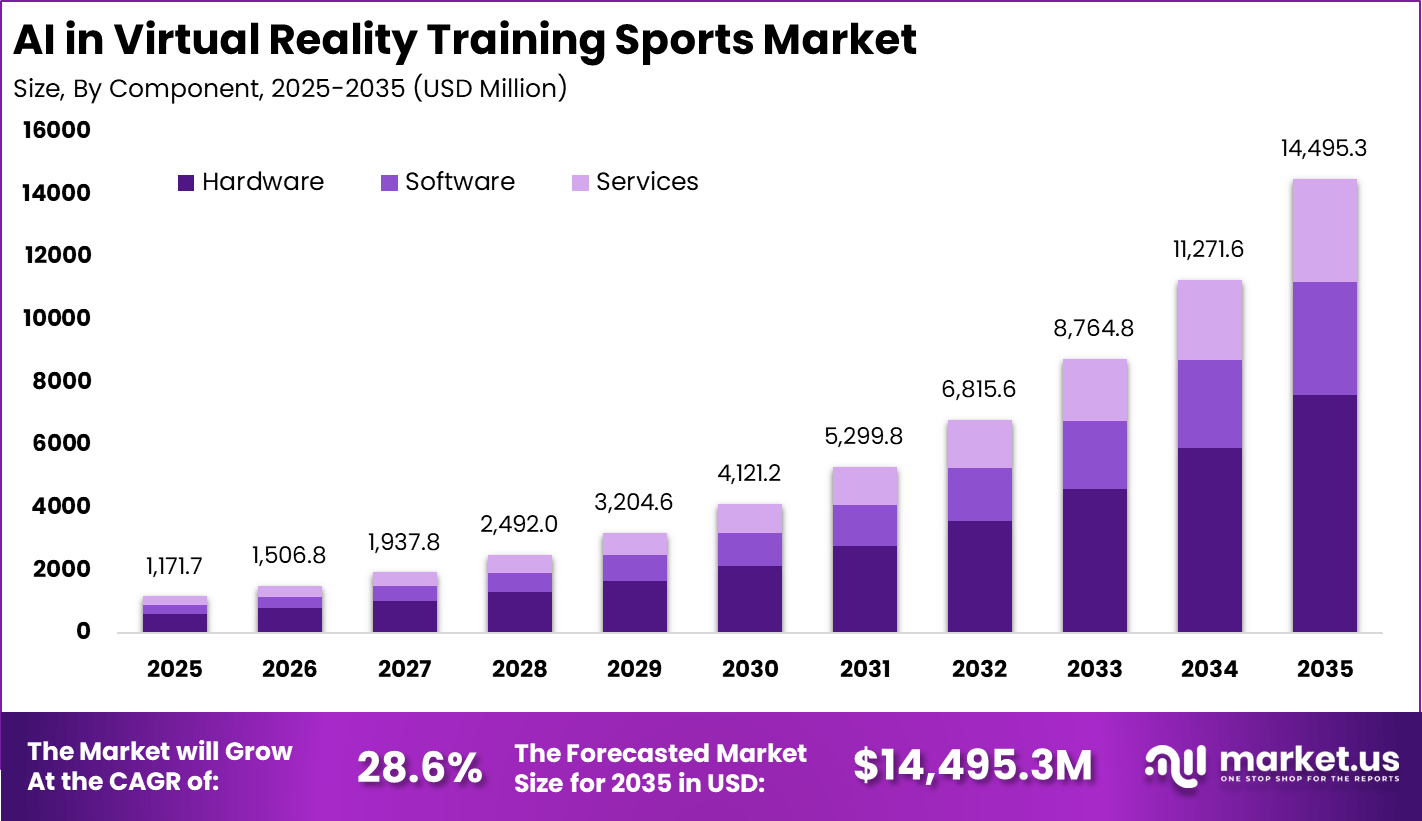
One major driving factor of the AI in virtual reality training sports market is the demand for performance optimization. Competitive sports require continuous improvement and precise skill refinement. AI-powered VR systems provide detailed feedback on technique and timing. Personalized training scenarios improve effectiveness. Performance pressure drives adoption.
For instance, in March 2025, Strivr launched custom VR modules for sports teams and athletes, achieving 75% retention rates vs traditional methods. NFL squads use it for immersive scenario practice, underscoring California’s role in scaling AI-VR for peak performance worldwide.
Demand for AI-driven VR sports training solutions is influenced by professionalization across sports disciplines. Teams invest in advanced tools to gain competitive advantage. Data-driven training improves preparation and consistency. VR systems allow repeatable and controlled practice. Professional demand continues to increase.
Key Takeaway
- Hardware led the market with a 52.4% share in 2025, driven by demand for advanced VR headsets, sensors, and edge processing devices.
- Immersive VR training systems dominated with 70.3%, reflecting preference for fully interactive and realistic training environments.
- On-premises deployment accounted for 62.8%, as sports organizations prioritized data control, latency reduction, and customized training setups.
- Computer vision captured 41.7%, supporting motion tracking, performance analysis, and real-time feedback within VR training modules.
- Football emerged as the leading sport with a 30.5% share, supported by high investment in player development and tactical training.
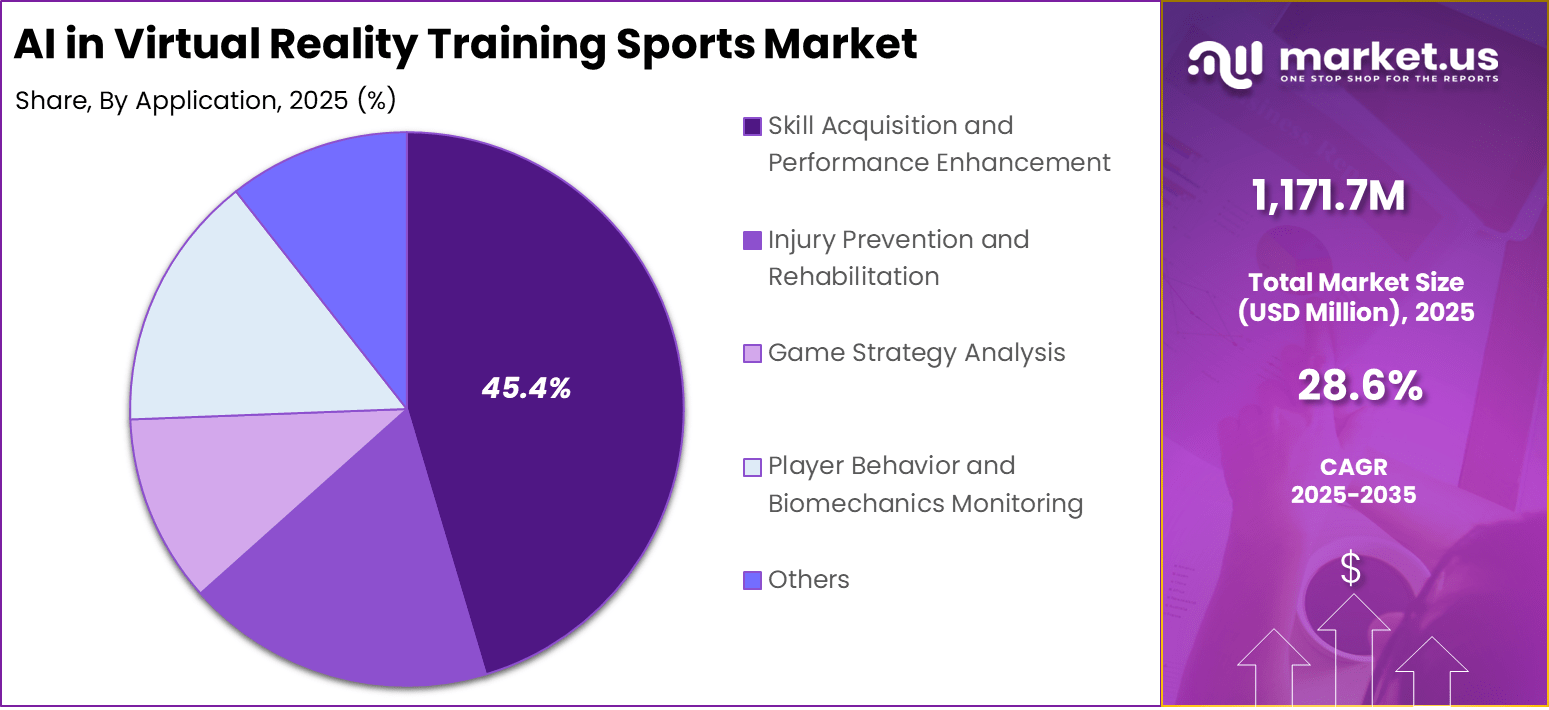
- Skill acquisition and performance enhancement represented 45.4%, highlighting focus on improving technique, decision-making, and reaction time.
- Professional sports teams and clubs held 52.9%, reflecting strong adoption among elite training programs.
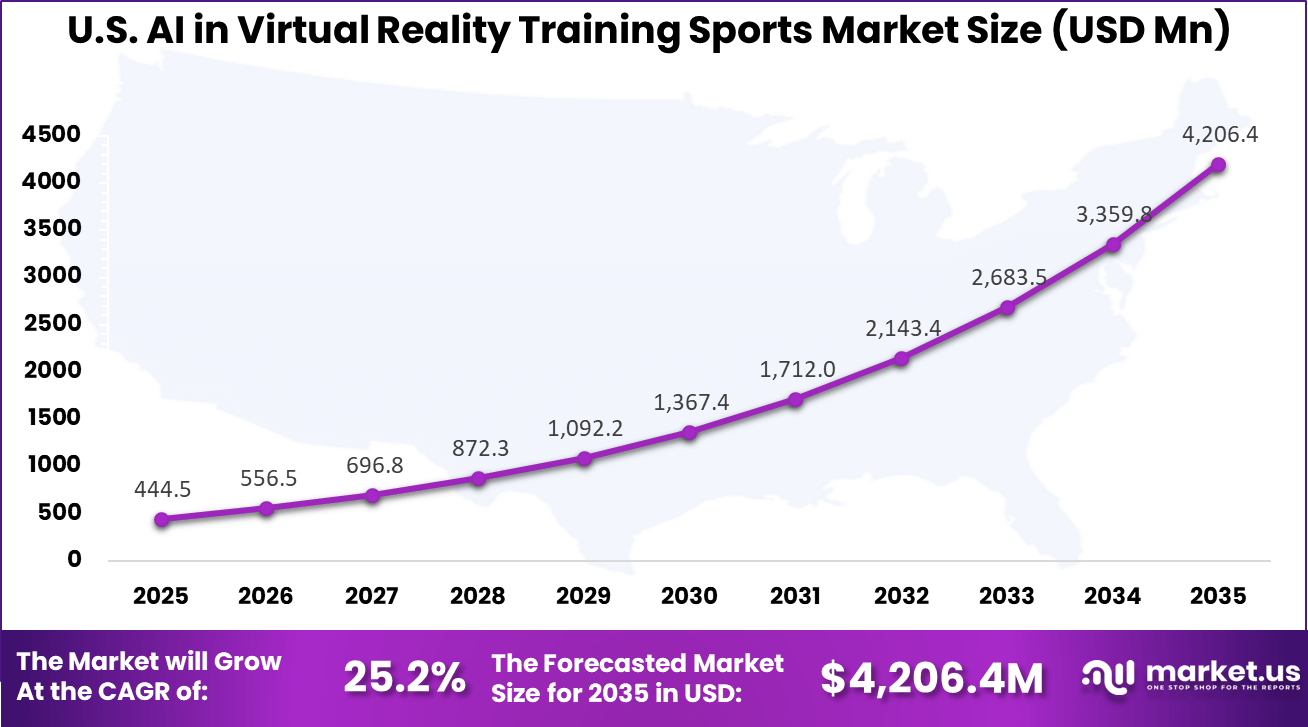
- The U.S. market reached USD 444.5 Million in 2025, growing at a 25.2% CAGR, driven by advanced sports tech adoption.
- North America led globally with over 42.3% share, supported by strong sports infrastructure and early adoption of AI-driven training solutions.
Key Insights Summary
Performance Statistics by Sport
- Soccer players achieved 15% improvement in passing accuracy.
- Tactical understanding in soccer increased by 20% through VR-based drills.
- Basketball players recorded an 8% point rise in shooting accuracy due to posture optimization.
- VR drills improved dribbling and slalom skills beyond traditional court-only training.
- Combat sports athletes improved reaction speed by 12%.
- Tactical execution accuracy in combat sports increased by 18%.
- Motorsports training reduced average lap times by 2.5 seconds.
- Overtaking success rates in motorsports improved by 15%.
- Gymnastics athletes improved execution quality of difficult moves by 15%.
- Error rates in gymnastics routines declined by 20%.
Core AI and VR Training Metrics
- Athlete reaction times dropped by an average of 85 milliseconds.
- Decision-making accuracy improved by 22% with AI-enhanced VR training.
- Injury incidence declined by 30% through biomechanical risk detection.
- Cognitive focus levels were 35% higher during VR training sessions.
- Knowledge retention reached 75%, significantly above traditional learning methods.
Technological Benchmarks
- VR training platforms achieved 99.99% system availability.
- Network latency was maintained below 30 ms, ensuring realistic motion experience.
- AI performance prediction models reached 65%-78% accuracy.
- Deep learning-based movement tracking achieved 90% accuracy in complex action detection.
Drivers Impact Analysis
Driver Category Key Driver Description Estimated Impact on CAGR (%) Geographic Relevance Impact Timeline Professional sports digitization Adoption of data driven training methods ~7.3% North America, Europe Short Term Demand for injury risk reduction Safe simulation based training ~6.1% Global Short Term Advances in VR hardware performance Higher realism and motion accuracy ~5.4% Global Mid Term Integration of AI and computer vision Precision motion and skill analysis ~5.0% Global Mid Term Growth of elite athlete development programs Continuous performance optimization ~4.1% Global Long Term Risk Impact Analysis
Risk Category Risk Description Estimated Negative Impact on CAGR (%) Geographic Exposure Risk Timeline High system cost Capital intensive VR and AI hardware ~5.8% Emerging Markets Short Term Motion sickness and usability issues Athlete adaptation challenges ~4.6% Global Short Term Integration complexity Alignment with coaching workflows ~3.9% Global Mid Term Data accuracy limitations Variability in motion capture quality ~3.2% Global Mid Term Limited scalability Facility and space constraints ~2.5% Global Long Term Restraint Impact Analysis
Restraint Factor Restraint Description Impact on Market Expansion (%) Most Affected Regions Duration of Impact High upfront investment VR labs and AI system costs ~6.1% Emerging Markets Short to Mid Term Technical skill requirements Need for VR and AI specialists ~4.8% Global Mid Term Limited standardization Inconsistent training protocols ~3.7% Global Mid Term Hardware maintenance needs Ongoing calibration and upgrades ~2.9% Global Long Term Unclear ROI measurement Performance gains hard to quantify ~2.3% Global Long Term Component Analysis
Hardware – 52.4%
Hardware represents 52.4% of the AI in virtual reality training sports market, reflecting its foundational role in delivering immersive experiences. VR headsets, motion sensors, cameras, and processing units are essential for realistic simulation and accurate performance tracking. Sports organizations prioritize reliable hardware to ensure consistency during training sessions.
The quality of hardware directly impacts visual realism, motion accuracy, and system responsiveness. Advanced sensors and high-resolution displays enable athletes to experience real-game scenarios in controlled environments. This supports more effective skill development and decision-making practice.
As VR training becomes more specialized, demand for sport-specific hardware configurations increases. Continuous improvements in device comfort and durability also support adoption. Hardware remains a critical investment area within AI-driven VR training systems.
For Instance, in July 2025, Rezzil partnered with Premier League clubs for VR hardware setups using Meta Quest headsets and sensors. Teams equip players with trackers on their legs to mimic real kicks in immersive drills. This hardware boost helps repeat high-pressure football moments safely, cutting injury risks while sharpening decisions. Adoption grows as pros see faster skill gains from precise motion capture gear.
Type Analysis
Immersive VR Training Systems – 70.3%
Immersive VR training systems account for 70.3% of the market, highlighting strong demand for fully simulated training environments. These systems allow athletes to engage in realistic scenarios that closely replicate match conditions. Immersion improves focus, reaction speed, and situational awareness.
Sports teams use immersive systems to simulate tactical situations and pressure scenarios. AI enhances these systems by adapting difficulty levels and scenarios based on athlete performance. This creates personalized training experiences.
The dominance of immersive systems reflects their effectiveness in improving learning outcomes. As realism improves, adoption continues to expand. Immersive VR remains the preferred training approach across professional sports.
For instance, in July 2025, Burnley FC tested Rezzil’s immersive VR for live game recreations at Turf Moor. Fans and players dive into panoramic stadium views with crowd noise via Meta Quest. It recreates full matches for decision training. Clubs expand this type for a cognitive edge in tight spots. Growth ties to real performance lifts.
Deployment Mode Analysis
On-Premises – 62.8%
On-premises deployment holds a 62.8% share, driven by the need for data control and system reliability. Professional teams prefer localized installations to ensure uninterrupted training and data privacy. On-site systems also allow customization based on facility layouts.
On-premises setups support high-performance processing with minimal latency. This is critical for real-time motion tracking and instant feedback. Teams benefit from full control over software updates and hardware integration.
Despite growing interest in cloud solutions, on-premises deployment remains dominant. Performance consistency and security concerns support continued preference. This model aligns well with professional training environments.
For Instance, in June 2025, Strivr set up on-premises VR labs for NFL and NBA teams. Custom rooms with dedicated servers run private training sessions without cloud delays. Teams deploy hardware onsite for daily drills on decision-making. This mode thrives for secure, instant access during camps.
Technology Analysis
Computer Vision – 41.7%
Computer vision accounts for 41.7% of technology adoption within the market. This technology enables precise tracking of athlete movements, posture, and interactions within virtual environments. It forms the basis for performance analysis and feedback.
AI-driven computer vision systems analyze movement patterns and detect errors in technique. Coaches use these insights to refine training plans and reduce injury risks. The technology supports objective and repeatable assessments.
As accuracy and processing speed improve, computer vision remains central to VR sports training. Its ability to convert visual data into actionable insights strengthens its value. This technology continues to shape training innovation.
For Instance, in September 2025, Sportsbox AI added computer vision to its 3D golf swing app with Google Gemini. Single-camera tech scans poses for AI chat feedback on thousands of swings. Golfers get instant form fixes. It grows in sports for markerless analysis anywhere.
Sport Type Analysis
Football – 30.5%
Football represents 30.5% of market adoption, making it the leading sport type in VR-based training. The sport’s tactical complexity and high physical demands benefit strongly from simulated training environments. VR allows players to practice positioning, decision-making, and game awareness.
Football teams use VR training to review plays and simulate match situations without physical strain. AI-driven scenarios adapt to player roles and skill levels. This supports both individual and team-based training. The global popularity of football supports widespread adoption of advanced training tools. Clubs invest in VR to gain competitive advantages. Football remains a key driver of market growth.
For Instance, in July 2025, Rezzil powered Burnley FC’s VR football friendlies against Lazio. Live stadium recreations train reactions with real match data. Players kick in virtual crowds. Football leads as tactics demand endless scenario reps. Clubs scale it league-wide.
Application Analysis
Skill Acquisition and Performance Enhancement – 45.4%
Skill acquisition and performance enhancement account for 45.4% of application demand. VR training enables athletes to repeatedly practice specific skills in controlled environments. AI personalization accelerates learning by focusing on individual weaknesses.
These applications improve reaction times, coordination, and tactical understanding. Athletes receive immediate feedback, which supports faster improvement. Training efficiency increases without overexertion. As performance optimization becomes a priority, this application continues to expand. Sports organizations value measurable improvement outcomes. This keeps skill-focused VR applications in strong demand.
For Instance, in June 2025, Rezzil advanced football skills for Premier League recoveries and youth. VR drills build confidence in injury rehab and basics. Cognitive gains show in matches. Apps focus here for targeted gains.
End-User Analysis
Professional Sports Teams and Clubs – 52.9%
Professional sports teams and clubs account for 52.9% of end-user adoption. These organizations invest in advanced technologies to enhance training effectiveness and reduce injury risks. AI-powered VR systems support structured and data-driven training programs.
Teams use VR to supplement physical training and tactical preparation. The ability to simulate complex scenarios improves readiness. This is especially valuable during recovery periods or congested match schedules.
As competition intensifies, professional teams continue to adopt innovative training tools. Long-term performance development drives sustained investment. This positions teams and clubs as the primary end users.
Regional Analysis
Market Share 42.3% | United States USD 444.5 Million | CAGR 25.2%
North America accounts for 42.3% of the AI in virtual reality training sports market, supported by early technology adoption and strong investment in sports innovation. Professional teams across the region actively integrate AI and VR to enhance training efficiency and player performance. Advanced infrastructure and access to skilled technology providers further support market development.
For instance, in Sportsbox AI, at the 2025 U.S. Open, Sportsbox AI analyzed fans’ golf swings in 15 seconds using AI-powered 3D motion capture, providing instant pelvis and chest rotation metrics. This fan engagement initiative highlights North American dominance in VR/AI sports analytics, bridging professional training tech with consumer experiences.
Region Primary Growth Driver Regional Share (%) Regional Value (USD Mn) Adoption Maturity North America Advanced sports technology adoption 34.8% USD 407.7 Mn Advanced Europe Professional football training innovation 29.6% USD 346.8 Mn Advanced Asia Pacific Expansion of elite sports academies 23.7% USD 277.7 Mn Developing to Advanced Latin America Football focused training investments 6.8% USD 79.7 Mn Developing Middle East and Africa Early adoption by professional clubs 5.1% USD 59.8 Mn Early 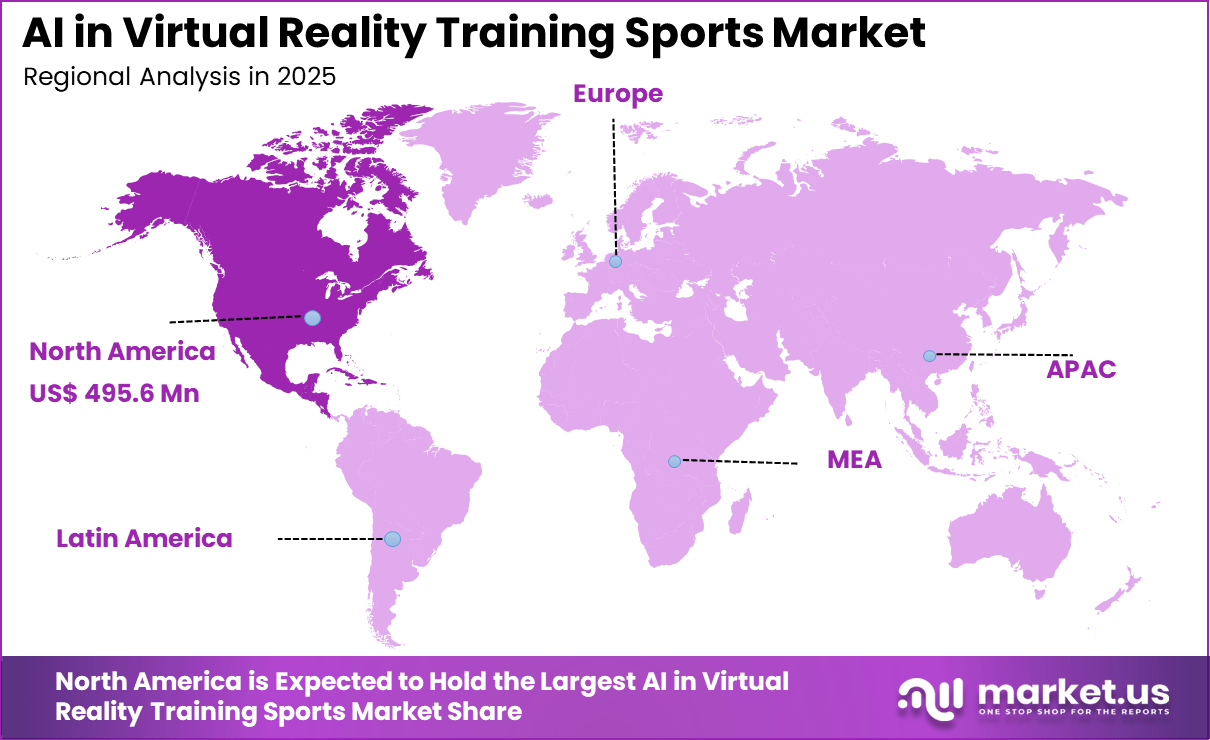
The United States contributes USD 444.5 million in market value, driven by widespread adoption among professional leagues and training facilities. Sports organizations in the country focus on performance analytics, injury prevention, and skill optimization. AI-powered VR systems align well with these objectives by delivering data-driven training environments.
A CAGR of 25.2% indicates strong growth momentum across the region. Increasing competition, higher performance expectations, and continued digital transformation support expansion. North America remains a leading region for innovation and adoption in AI-driven VR sports training.
For instance, in June 2025, Strivr Advanced enterprise VR adoption with custom training modules for sports and the workforce, achieving high retention rates. NFL teams and retailers use Strivr for immersive scenarios, solidifying U.S. leadership in AI-VR sports performance training.
Investor Type Impact Matrix
Investor Type Adoption Level Contribution to Market Growth (%) Key Motivation Investment Behavior Professional sports teams and clubs Very High ~52.9% Competitive performance improvement Facility wide deployment Sports academies High ~21% Skill development and safety Phased adoption National sports federations Moderate ~13% Athlete preparation programs Program based investment Training technology providers Moderate ~9% Platform differentiation Strategic partnerships Amateur sports organizations Low ~5% Cost sensitive training Limited usage Technology Enablement Analysis
Technology Layer Enablement Role Impact on Market Growth (%) Adoption Status Computer vision Motion tracking and posture analysis ~6.7% Growing AI driven performance analytics Skill evaluation and feedback ~6.0% Growing Immersive VR hardware Realistic training environments ~5.3% Mature Sensor fusion systems Accurate movement capture ~4.1% Developing Simulation engines Scenario based training ~3.2% Developing Key Market Segments
By Component
- Hardware
- Software
- Services
By Type
- Immersive VR Training Systems
- Non-Immersive VR Training Systems
- Semi-Immersive VR Training Systems
By Deployment Mode
- On-Premise
- Cloud-Based
By Technology
- Machine Learning
- Deep Learning
- Computer Vision
- Natural Language Processing
- Others
By Sport Type
- Football
- Basketball
- Cricket
- Tennis
- Golf
- Baseball
- Others (Hockey, Boxing, Athletics)
By Application
- Skill Acquisition and Performance Enhancement
- Injury Prevention and Rehabilitation
- Game Strategy Analysis
- Player Behavior and Biomechanics Monitoring
- Others
By End-User
- Professional Sports Teams and Clubs
- Sports Academies and Training Centers
- Individual Athletes
- Research Institutions
Key Regions and Countries
- North America
- US
- Canada
- Europe
- Germany
- France
- The UK
- Spain
- Italy
- Russia
- Netherlands
- Rest of Europe
- Asia Pacific
- China
- Japan
- South Korea
- India
- Australia
- Singapore
- Thailand
- Vietnam
- Rest of APAC
- Latin America
- Brazil
- Mexico
- Rest of Latin America
- Middle East & Africa
- South Africa
- Saudi Arabia
- UAE
- Rest of MEA
Key Players Analysis
Leading players such as Strivr, StatusPro, and Rezzil focus on immersive athlete training using AI and VR simulations. Their platforms replicate real game scenarios to improve decision making and reaction speed. AI is used to analyze movement, vision tracking, and performance patterns. Adoption is strong among professional teams and academies. Demand is driven by the need for safe, repeatable, and data-driven training environments.
Specialized sports and skill training providers such as Sense Arena, Beyond Sports, and Sportsbox AI emphasize biomechanics and technique improvement. WIN Reality and Golf+ address sport-specific needs. These solutions help athletes train remotely with consistent feedback. Growth is supported by rising investment in athlete performance analytics and personalized coaching tools.
Platform and ecosystem driven players such as META support hardware and developer infrastructure for sports VR training. HOLOFIT and Mobalytics extend AI driven insights into hybrid training models. Emerging vendors add innovation in motion learning and analytics. Other players strengthen regional adoption. This competitive landscape supports steady innovation and expanding use of AI powered VR training across professional and amateur sports.
Top Key Players in the Market
- Strivr
- StatusPro
- Rezzil
- Sense Arena
- Beyond Sports
- Sportsbox AI
- GamePlan
- HOLOFIT
- Mighty Sports
- VR Motion Learning
- MIRACL
- META (Reality Labs)
- WIN Reality
- Golf+
- deeptrack
- Mobalytics
- Mune
- MVM
- Swish Analytics
- Others
Recent Developments
- In March 2025, Strivr enhanced its XR platform with AI-backed immersive learning experiences, solidifying its leadership in VR training for elite sports teams. The Santa Clara-based company continues to dominate decision-making and situational training, with professional football programs reporting superior pattern recognition gains through realistic 3D environments.
- In July 2025, Rezzil Partnered with Burnley FC and Premier League Player app to deliver the first immersive VR broadcast of a live pre-season friendly against Lazio on Meta Quest headsets. Fans experience panoramic stadium views with real-time commentary, extending Rezzil’s AI-VR tech from player training to global fan engagement.
Report Scope
Report Features Description Market Value (2025) USD 1,171.7 Mn Forecast Revenue (2035) USD 14,495.3 Mn CAGR(2026-2035) 28.6% Base Year for Estimation 2025 Historic Period 2020-2024 Forecast Period 2026-2035 Report Coverage Revenue forecast, AI impact on Market trends, Share Insights, Company ranking, competitive landscape, Recent Developments, Market Dynamics and Emerging Trends Segments Covered By Component (Hardware, Software, Services), By Type (Immersive VR Training Systems, Non-Immersive VR Training Systems, Semi-Immersive VR Training Systems), By Deployment Mode (On-Premise, Cloud-Based), By Technology (Machine Learning, Deep Learning, Computer Vision, Natural Language Processing, Others), By Sport Type (Football, Basketball, Cricket, Tennis, Golf, Baseball, Others (Hockey, Boxing, Athletics), By Application (Skill Acquisition and Performance Enhancement, Injury Prevention and Rehabilitation, Game Strategy Analysis, Player Behavior and Biomechanics Monitoring, Others), By End-User (Professional Sports Teams and Clubs, Sports Academies and Training Centers, Individual Athletes, Research Institutions) Regional Analysis North America – US, Canada; Europe – Germany, France, The UK, Spain, Italy, Russia, Netherlands, Rest of Europe; Asia Pacific – China, Japan, South Korea, India, New Zealand, Singapore, Thailand, Vietnam, Rest of Latin America; Latin America – Brazil, Mexico, Rest of Latin America; Middle East & Africa – South Africa, Saudi Arabia, UAE, Rest of MEA Competitive Landscape Strivr, StatusPro, Rezzil, Sense Arena, Beyond Sports, Sportsbox AI, GamePlan, HOLOFIT, Mighty Sports, VR Motion Learning, MIRACL, META (Reality Labs), WIN Reality, Golf+, deeptrack, Mobalytics, Mune, MVM, Swish Analytics, Others Customization Scope Customization for segments, region/country-level will be provided. Moreover, additional customization can be done based on the requirements. Purchase Options We have three license to opt for: Single User License, Multi-User License (Up to 5 Users), Corporate Use License (Unlimited User and Printable PDF)  AI in Virtual Reality Training Sports MarketPublished date: Jan. 2026add_shopping_cartBuy Now get_appDownload Sample
 -
-
- Strivr
- StatusPro
- Rezzil
- Sense Arena
- Beyond Sports
- Sportsbox AI
- GamePlan
- HOLOFIT
- Mighty Sports
- VR Motion Learning
- MIRACL
- META (Reality Labs)
- WIN Reality
- Golf+
- deeptrack
- Mobalytics
- Mune
- MVM
- Swish Analytics
- Others
Our Clients

- 174801
- Jan. 2026